Category Archives: Readers Writers Workshop

Baby Steps into Writing Workshop

For several years now, I’ve been hovering around Readers/Writers Workshop, certain that this is the path that is exactly what my students need. I started with Readers Workshop two years ago, and I’ve watched my students grow in their love of reading and stretch themselves. I’ve seen kids go from being professed (and almost proud) non-readers to stalking my bookshelves for new books or asking me to get my hands on specific books that they’ve heard about. (If you’re new to the idea of Readers Workshop, check out this post to learn more about why it’s so awesome!) We still have work to do in Readers Workshop in my classroom, but I feel comfortable about the direction in which we’re heading, and I’m confident that my kids are on the right track. I even use Readers Workshop strategies with my AP kids, thanks to encouragement from posts like this one from Amy. She’s the one who started me down this path.

pexels-photo-264635.jpeg

Writers Workshop is a different animal (for me) entirely. Perhaps it’s the fact that I feel like I should be reading everything that they write; maybe it’s that I’m still struggling with giving up some control–I’ve been at this teaching game for a while (since 1997) and sometimes it’s hard to teach old dogs new tricks. Writing has always been important to me, and it’s something that I’ve put emphasis on in my classroom. My kids have always known that they’ll be doing plenty of writing in my classroom; until this year, though, most of that writing has been in traditional academic essays: ACT-style essay prompts, persuasive essays, literary analysis, etc.

For several years now, I’ve abandoned traditional objective tests, opting instead to give my students essay exams. It means that my grading load is heavier, but I feel more confident that I’m getting a more clear idea of what my kids know and can do as opposed to the answers that they have memorized from the students from earlier class periods. I tell them that I’m not necessarily concerned that they remember the specific character names of the characters in Farewell to Arms or that Huck Finn met Buck in the middle of a Hatfield/McCoy style shoot-out. What I’m more interested in are the ideas and connections that they can make from what we’re reading in class to other pieces of literature and to what’s going on in their lives and in the world around them. I want them to see that the themes in Langston Hughes’ “Mother to Son” still resonates today, even though it was written 96 years ago, and that Carl Sandburg’s “I Am the People, I Am the Mob” could have been written by Emma Gonzalez last month after the Parkland shooting instead of in 1916, 102 years ago. That’s the beauty of literature–the themes are timeless and the human experience tends to be the same from generation to generation. So we’re doing real work, and I’m working to help them make connections so that they can see models for navigating these times that we find ourselves in. (Read more about connections like these here.) I’ve seen improvements throughout the years, and I’ve seen kids grow, but I haven’t seen the same kind of buy-in that I’ve seen in the growth in the reading culture in my classroom.

All of the literature is clear–just as readers thrive in a culture of choice, writers need choice as well. Kelly Gallagher says that, in order to improve, writers should write at least four times what teachers could possibly read–FOUR TIMES! Knowing that but also knowing that I’m barely keeping my head above water with my grading load is probably also part of the hesitation that I’ve had with Writers Workshop.

This year I’ve been determined to move past that hesitation that I have in order to better help my students. I’m so enamored by posts like Shana’s that show just how powerful Writers Workshop can be, so I am pushing past my awkwardness. I’ve modified how I grade essays, trying to cut down on some of the workload there. Rather than marking up student essays, I try to do more holistic grading and then encourage my students to come to me for writing conferences where I can give them more focused feedback. This pushes my students to look at their writing themselves rather than simply search for my comments and make changes based on those. I’ve also tried to build in some choice in writing topics, giving them 4 different options for argumentative prompts, for example, rather than one topic that they’ll all write in lock-step.

The biggest change with writing in my classroom lately, though, has been with the introduction of writing journals and writing prompts. I was lucky to go to a professional development session with Penny Kittle and Kelly Gallagher in February, and they talked about different ideas and strategies to get students writing. One of the things that they modeled was writing beside students and encouraging students to take a small period of time to “make it better.” Now we have a writing prompt at the beginning of class just about every day. I usually give them about 4 minutes to write, and then they’ll have 1 minute to make it better. Sometimes I specify how they should do that–sometimes I ask them to strengthen their verbs, other times I ask them to add details, while still other times I ask them to work with sentence structure, adding complexity and interest. After their “make it better” minute, we spend some time talking about what they’ve done and sometimes I ask for students to share their work.

pexels-photo-545053.jpeg

These are little moments in the scope of my classroom–we have 53 minute periods, so we spend 10 minutes reading (choice reading, of course), 4 minutes writing, and then 1 minute making it better, before we move on to the other 38 minutes of whatever we’re doing that day–but these have become some of the most powerful moments in my classroom. I’ve had students who are so excited to share or who have been proud of a particular turn of phrase or image. These moments of Writers Workshop in my classroom have begun to create a community of collaborators with students working together to encourage each other or to come up with the right tweak of a sentence. They’re excited about these short segments of class and they buzz with ideas for their writing. There have been requests (pleas, really) for more time to keep writing because students are pulling on a thread and they want to stay with it while the ideas are fresh.

One of the best parts of this, from a time management perspective, is that I’ve been able to do these things and achieve this growth without adding anything to my grading load. The feedback comes from our discussions and from their peers’ response to what they have written. I will have them go to their notebooks soon and pull something from what they’ve written to expand it into a longer, more developed piece, but this little foray into Writers Workshop has taken away some of the stigma of writing in the classroom. When they’re done in 4 minute segments with 1 minute to “make it better,” it seems more accessible for students and less intimidating. I’m not asking them to plan out a whole paper or to reflect what they should have read–these prompts have (so far) been either reaction/response prompts to current events or creative outlets. The creative prompts are the ones that they have enjoyed the most. I teach Juniors in high school, so there are very few moments in the day when they actually get to do things “just for fun”–these Writers Workshop moments and the independent reading for our Readers Workshop are the “fun moments” in my kids’ days. Maybe that’s the biggest takeaway for me–through Readers and Writers Workshop, my kids are beginning to reawaken that part of themselves that enjoyed learning just for learning’s sake. That alone makes any struggle or growing pains immensely worthwhile. We may be making baby steps in our progress towards Writers Workshop, but it feels as if we’re starting along the right path.

Do you use Readers and Writers Workshop strategies in your classroom? What were the hardest parts for you when you were getting started? What have you seen as the biggest rewards? Share your story with us in the comments section below!

March Madness – A Book Bracket that Breaks a Few Rules

As I write this post, I can’t help imagining what it will feel like at this time Thursday night when I am up to my eyeballs (finally) in all things Spring Break. I’m envisioning an episode of This is Us, an adult beverage, and perhaps some Easter candy the bunny just won’t get a chance to deliver. Maybe I’ll throw caution to the wind and rent a movie, stay awake for the entire thing, and put extra butter on my popcorn. Don’t try and hold me back, friends – I’m going to let ‘er rip. This girl is going to calorically navigate every day of this vacation.

Because let’s face it, sometimes we need to break the rules and revel in what feels good. Sometimes we need to abandon the stress, irritation, and seemingly endless march of…March.

Sometimes we need to break the rules.

Now I know, if I were you, I would be reading on in great anticipation of a reflective post that smacks at the very heart of pushing aside what’s prescribed and going instead with the deeply personal, life-altering, philosophy-bending, workshop work that fuels lives rich in reading, writing, and empathetic connections across our school communities.

Well…did I mention I am only four class periods away from vacation? 344 total class minutes. 18 total hours on the clock. 27 miles there and back to my nice warm bed. Dozens of warm smiles and well wishes for a well-deserved break to all my lovely students and colleagues.

Some will voyage to lands far and wide. Some will go on great adventures.

I will gladly go to my couch. My brain is fried.


As such, I wanted to share with you my experience with a March Madness Book Bracket, in the hopes that if you haven’t tried this yet, you’ll consider it for next year, or even better, you will ditch the March Madness component and just create your own Book Battle for April or May of this year to stir up passions around the current favorite titles in your classroom.

Personally, this idea came from two places:

  1. A random picture I saw on Twitter at some point that highlighted the excitement around a classroom book battle.
  2. March Madness Hoopla (punny is as punny does) here at Franklin High School.

Our school is blessed with a great number of hugely passionate, committed, and just all around awesome teachers and administrators across the building. This past month, Franklin saw the advent of our annual March Madness school-wide event. The incomparable Pat Gain, AP Environmental Science teacher to the stars, organizes an extravaganza the brings the whole school together in excitement, friendly competition, and support of Franklin’s Relay for Life and Best Buddies. Students earn raffle tickets for possible school spirit, teams organize to battle it out on the court, and the entire school gathers for a pep rally to watch the championship games and other fun at week’s end. This year, it inspired me to jump on the bandwagon and create a book bracket in my room.

IMG_9931.jpg

After the fact, I found this awesome March Madness Book Bracket that includes book trailers, printable brackets, a bracket reveal video, and the wherewithal to organize it all way ahead of time and share it so classes across the world can vote. You can vote in their championship matchup between The Hate You Give and Scythe right now! These people have t-shirts. It’s legit.

Meanwhile, I’ll be over here with my humble pie and share with you what I did and what I want to try to do for next year.

First, a disclaimer. I said I broke rules. I did. But it still worked.

  • There was no actual bracket to fill out.
  • I don’t know a lot (enough, much, anything) about basketball.
  • My bracket had no actual lines.

But it all worked out. Check it out below.

Mrs. Dennis March Madness Book Bracket 2018…

  1. Each of my classes did a quick write on their favorite read so far this year. We chatted after writing, reminisced about great books, added to our “I Want to Read” lists, and then put some titles up on the board. Over the course of a few days, the suggestions for awesome books grew, and I picked 16 that represented the most consistently raved about and most passionately advocated for in each class.
  2. I matched up the books somewhat appropriately in logical pairings. Two classics up against one another. Two historical fiction texts. Two books in verse. Etc.
  3. I printed images of the book covers for each title and set up a rudimentary book bracket on the back wall.
  4. A Google Form shared on Google Classroom gave my students the opportunity to vote in any/all of the matchups they felt compelled to vote for. I also shared this Google Form with other members of the English Department and encouraged them to share the link with their students and to vote for their own favorites.
  5. After the initial matchups, I was left with eight books in illogical pairings, so I had students vote for their top four choices one week, their top two the next, and now we’ve arrived at Championship Week.
  6. Before voting each round, students lobbied for the books they felt should move on to the next round. Which were the most worthy of advancing? Which changed student thinking? Which were the page-turners? It was awesome to hear kids going to the mat for their choices, and even when their favorites lost, they continued to try and sway people to still give the book a try. It did make it to the Big Dance after all.

Franklin March Madness Book Bracket Every Year From Now On…

  1. Start the whole process earlier. Give students a chance to pick up a book or two from the bracket and add fuel to the fire of how many kids have a book in the race.
  2. Complete actual brackets for some random and cheap prizes from my Kelly Gallagher-inspired Bag of Fun Crap.
  3. Random pairings. I love the idea from the link above to let the chips fall where they may and let books battle au natural. This eliminates my perceived issue of illogical matchups. Brackets are made to be busted!
  4. Measure twice, cut once. My book covers were almost too big. I had to move furniture! The hallway may be a more appropriate space and would promote the matchups to a wider audience as well.
  5. My pithy neighbor Brandon suggested that tape between the matchups would make it look a lot more like an actual bracket. Touché.
  6. Expand the empire and work to involve more students, more grade levels, more opinions, more passionate pleas for books to advance. More. Madness.

IMG_0107.jpg

My March needed a bit of madness and I look forward to doing it again next year. Though we didn’t have any actual brackets to fill out ahead of time, or league sanctioned seeding, or even actual matchups past the first round, the results involved a whole lot of passionate talk and writing around books.

When students hustle in the room to see which books are winners, as opposed to hurridly taking one last glance at their phones before the bell rings, I consider it a slam dunk.

(He he…told you I needed a vacation).

Our bracket is down to The Nightingale by Kristin Hannah and When Breath Becomes Air by Paul Kalanithi. Which one would be your winner? Which books could go the distance with your classes this year? Please leave your comments below!


Lisa Dennis teaches English and leads a department of incredible English educators at Franklin High School near Milwaukee. Her knowledge of basketball is limited, but her support of underdogs is fierce. Let’s Go, Loyola! Follow Lisa on Twitter @LDennibaum. 

Creating Magic in the Classroom

Disney

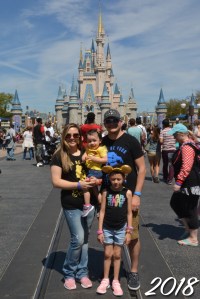
My family and I on our last day at Disney World a few weeks ago.

I recently took my family on vacation to the most magical place on earth-Disney World! The days leading up to our travels took a toll on my anxiety, patience, and stress levels. I planned this trip several months in advance and felt prepared to ensure that my family and I were going to have the most amazing time ever, and we did. All of our reservations went off without a hitch, my children behaved beautifully (surprisingly, no meltdowns!), my husband and I worked together as a team, and we had an itinerary that helped us stay on track without feeling pressured to see and do everything. At the risk of sounding cliché, it was truly a magical experience.

After pouring through hundreds of photos and reminiscing on everything we did, I came to a realization. We had a exceptional time not because I made incredible plans (although, it definitely helped!), but because of our environment, trust in each other, ability to let go of things we couldn’t control, and simply enjoying each moment and the time spent together.

That had me thinking. Isn’t that the ultimate goal of a successful workshop classroom? Isn’t that the beauty and magic of why it works?

Trust me, teaching high school English is no walk in a Disney park (pun TOTALLY intended), but it IS an extraordinary experience. Who would have thought that what makes a successful family vacation ALSO translates into the workshop classroom? (You can find amazing resources about why it works here and here, and by exploring the Three Teachers Talk archives.)

Creating and maintaining the spark may seem overwhelming. However, based on the insight I have gained through this recent epiphany after returning from Disney, I want to share with you my top 5 ways to help you create (and continue to foster) magic in your classroom.

5 Ways to Make Your Workshop Classroom Magical:


1. Be prepared. It is true, in life we cannot prepare for everything. However, the confidence that is instilled when one feels as prepared as they can should not be overstated. In my classroom, I ease my personal anxiety and that of my students when we have a plan. We have clear expectations and a set plan/goal that helps us stay focused. It seems like a simple solution, but it is quite the task. Ultimately, in order to feel in control (and to provide that for my students, too) I am consistent about the following; 

Class Collage

(L to R) My objectives are written daily. I share a daily agenda on the projector and write the homework for the week on the board. (The colored calendars are the proposed plans for the grading period and are posted to my website as well) 

  • Have an agenda
  • Communicate the goal of each day
  • Inform students of major deadlines in advance
  • Plan for multiple scenarios and/or have a back up plan.

 I also provide calendars, teacher and student samples of work when possible, and an array of mediums in which students can access helpful information. Over the years, I have found this cuts down on having to explain the same items repeatedly and helps students learn accountability.


2. Be mindful of the impact of your environment. Ambiance is a huge part of my personal philosophy when creating the climate of my classroom. As a germ-a-phobe, I have bottles of hand sanitizer, tissue, and Lysol wipes readily available. Rarely, if ever, are the fluorescent lights on.  1.) The lights give me headaches and remind me of a doctor’s office, so I chose to use a few floor lamps in my room. 2.) I adore natural lighting, especially with 3 large windows in my room. 3.) The dim lighting helps students feel comfortable, less intimidated, and reduces the noise levels (Trust me, it does!). In addition, I am particular about the quotes and student work on display. I even have carpets and pillows to increase comfort and provide flexible seating. You don’t have to pull out all the stops, especially with teenagers, but it helps to pay attention to the vibe of your tribe.

This slideshow requires JavaScript.

3. Trust in your support systems… and your kids. Lean on your admin or campus leadership, colleagues and PLC’s when you can. You never know when YOUR leadership can also serve as the support system for others as well. In my experience, I have learned something from every team and grade level I have been a part of, regardless of personalities or personal opinions. As educators, we are in the business of learning and seizing all teachable moments. This should also apply to our interactions with our colleagues.

One of the prime examples of why the workshop model works is because the focus is on the kids. As with any vacation or event for kids, we MUST keep them first at all times. Kids are kids. Yes, they will have times where it is a struggle to get through each moment, but it is worth it when the light bulbs finally turn on. All of the effort is completely worth it to see the growth and progress they make each day. My students never cease to amaze me with their stories, experiences, and development every year.

4. Prioritize. Part of planning and preparing is also understanding that you might not get to everything. Don’t stress about it, just figure out what your non-negotiables are and start there. Some reflection questions I have to help me in this process are;

  • What do I want my students to learn in this unit?
  • How will I know if they understand it?
  • What do I do if they don’t?
  • What do I do for my students who require extended learning or have special circumstances?

By keeping these in mind, I can quickly determine where we need to go, how we get there, and plan for various ways for my students to master their learning.

5. Enjoy the time together. At the end of the day, we became teachers for a reason. It is imperative that we also strive to keep that passion and excitement alive. Our love for our content and profession is contagious. When you surround yourself with opportunities to appreciate the time you spend cultivating young minds, trusting in the process, and uncovering the joy and value of each moment, that is the true magic of teaching.

I would love to hear about what has worked for you in your classrooms! What are some ways you and your students have been successful throughout your journey?

Gena Mendoza is still reeling from her recent visit to Disney World with her family over Spring Break. She is currently trying to convince her husband to agree to go back as soon as possible. In addition, she teaches High School English in Texas and is grateful for her students who kindly (and patiently) tolerate her latest obsession with all things Disney. She invites you to connect with her on Twitter and Instagram at @mrs_mendoza3.


An Intervention Change Up and a Plug for Summer Learning

brady-cook-314868-unsplash

Photo by Brady Cook on Unsplash

I bet I am more ready for summer than you. No, really. I am SO ready.

It’s not that I don’t like my job. It’s not that I am not having tons of great learning experiences with my students — they are doing beautiful things. It’s not that all things testing come crushing in this time of year (TELPAS, STAAR, AP) and make me daydream of working at a spa folding towels. It’s really none of that. It’s not even that I need a vacation — although I do. Did we already have Spring Break? (Oh, yeah, we did.)

It’s this:  Last summer I had one of the most amazing, awe-inspiring experiences of my teaching life. And I get a do over this summer.

Last summer I got to work with a powerhouse group of ELAR teachers in Clear Creek ISD with my friend and collaborator, Billy Eastman. I met Coach Moore who now writes on this blog and many other true blue educators dedicated to doing the work of workshop instruction and determined to do right by their readers and writers.

I could go on and on and on. But I won’t because Billy and I already did.

We wrote about our planning and implementation of that summer learning in this article “An Intervention Change Up: Investing in Teacher Expertise to Transform Student Learning,” recently published in English Journal.

I hope you’ll read it. Think about the intervention routines on your campus. Are they good for all students? Will they increase confidence in the hearts and minds of your readers and writers? Will they help students gain skills — or reinforce their lack of them?

And what about teachers? What’s in that work for you?

I’d love to know your thoughts. And if we can help, please let us know that, too.

Amy Rasmussen teaches English IV and AP English Language and Composition at a large senior high school in North TX. She is grateful to the North Star of TX Writing Project and Penny Kittle for showing her the benefits of choice and challenge; otherwise, she would probably still be dragging students through Dickens’ novels and pulling her hair our over plagiarized essays. Thank God she learned a better way. Follow Amy @amyrass and @3TeachersTalk. And please join the Three Teachers Talk Facebook page if you haven’t already. Join the conversation and share the good news of your workshop classroom.

Standing, spellbound, among Giants…

So that’s that. I’m almost exactly two years in.

I jumped head first into workshop practice at the start of the fourth grading quarter of the 2016-2017 school year. This was about the same time I asked to try my hand at sponsoring our Student Council on top of coaching football in the fall and soccer in the spring.

I learned I’m a glutton for punishment.

Two years of workshop practice elapsed and I still quake at my lack of knowledge and experience.

I’m still a novice; yet I’m motivated now more than ever before.

Thinking about starting the journey? Look here.  Also, check out this amazing post! This blog contains a wealth of knowledge and when it was introduced to me two years ago, I was smitten.

I think we can all agree that Workshop is both exhilarating and terrifying. It’s kind of like standing in front of one of the largest living organisms on the planet.

Recently, I traveled across California on a site seeing adventure that shared some symbolism with my workshop journey.

As my family and I wound upward in elevation through a mountain forest ten days ago, we started noticing giants. They stood out from the other bits of foliage not just in their massive size, but also in their presence. The sensations reminded me of the amazing teachers I’ve met. Have you ever noticed how some teachers have almost an aura about them? I feel it every day before school, between classes, at meetings or even just walking down the hall.

tree3

Standing among those behemoths was exhilarating. I’m a big guy and these ancient giants made me feel like a tiny speck, a flea at their feet. I’ve never felt so insignificant, small, or helpless. If you haven’t stood next to one, you can’t possibly understand the deep sense of awe, unless you know truly transcendent teachers, as I do.

The same feelings that massive trees evoke pour out of my mind as I reflect on my journey with workshop; which I do often.

Maybe you are like me and sometimes feel overwhelmed by the complicated and time consuming process of delivering workshop style instruction day in and day out.

Many of my peers tell me how much they love this pedagogy, but also remark how much preparation is necessary to be true to what the students need most. They are so right!!!

Despite the struggle.  Despite the time and stress…in me:

bane

So the following ideas are what work best for me:

  1. Engage the professionals around you – I learn more from the professionals around me than I do from anywhere else. Our impromptu hallway discussions are invigorating and refreshing.  Teachers learn best from teachers.

  2. Engage the professionals in your professional library – There exists an avalanche of information for us to access.  Of course Kittle, Gallagher, Romano, Newkirk, Anderson, Atwell and so many others should be studied and reviewed yearly.  There are many new and notable books that I’ve experienced just this year:

  3. Engage the professionals on social media- For so long I was afraid of social media and its potential impact on my professional life.  I felt it was for the kids and better left alone.  Boy was I wrong.  Social media leverages collaboration in a way that nothing else has ever done.  Twitter chats are so much fun to follow, much less participate in.  Check this out.

  4. Engage in reflecting on your own work- Take time to write about your experience.  I’ve found writing about this journey to be cathartic and energizing.  Its more than writing though, its recording my place in this movement.  We are changing the world by advocating for literacy to emerge in the forefront of education.

Charles Moore is currently neck deep in Fates and Furies and is engrossed finding more books for his library. 

Five Ways Your Classroom Library will Sell Itself (Without taking up valuable class time!)

Classroom libraries are essential in the workshop model, as kids who have access to books will naturally read more books. I’m beyond thrilled that my school has invested so much into our classroom libraries. Now that the books are here, it’s time to get the students to read them!

classroom library fall 17

This is what my classroom library looked like in the fall of 2017.


Book talks are an essential way for teachers and students to discover new treasures hidden in classroom libraries, but they aren’t the only way.

Speed dating, student led book talks, and book tastings are all excellent methods for students to learn about books and develop healthy next reads lists, but they all take time.

Below are five ways to “book talk” without using valuable class time:

  1. These are quick, easy to photocopy book recommendations written by students. I keep a stack of them on a shelf with the books, and as students return books they read and loved, they can choose to fill in the recommendation form. I’m sure there are more beautiful recommendation forms out there, but this is what we have, and it works.

2. Mini-whiteboards are easily changed-out, and both students and teachers can quickly feature new and different titles. It takes moments, and the written “grab” can be copied from the inside flap or the back of the book.

  1. themed book display

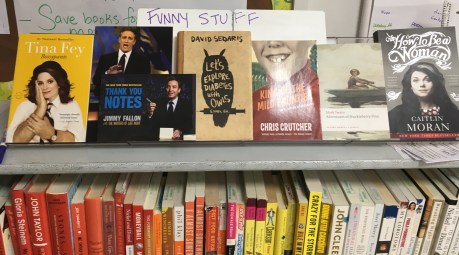
3. Themed book displays are easy to curate.  All that’s necessary are a few display stands and either some mini-white boards or some heavy paper that can be switched out. I rotate my display about once a week, and sometimes my students ask me to “do a theme” with the display. I try to oblige. This one focused on humor, but anything is possible. I’ve currently got a music theme going, and it’s fun to find themed collections based on other random ideas – animals, travel, even the color of the covers. Imagination is the only limitation with this one.


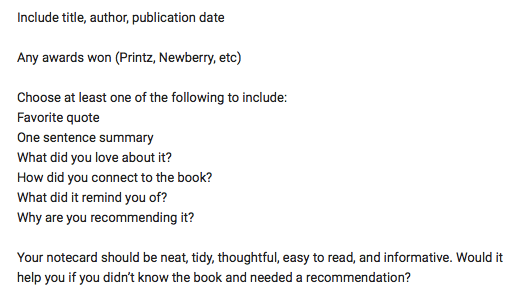
4. We reinvented the old-school card catalogue by filling an organizing bin with book recommendations. The categories in the bin match the ones on the library shelves, and students add their recommendations as they are motivated to do so, but only after reading the books, and if they liked the title. I gave them some basic guidelines for making the cards:Screen Shot 2018-03-20 at 5.29.43 PM

It takes students about five minutes to make a card, and they can even browse the “card catalog” at their desks.


5. The last method utilizes these frames from IKEA. They are double-sided, so on one side is a copy of the book cover, and on the other is the student recommendation.

I provided minimal guidelines for making the inserts to the frames:

Screen Shot 2018-03-20 at 5.29.23 PM

We are displaying them on our classroom conferring tables, on our book shelves, and in our school’s learning commons.

The common denominator with all of these ideas is that they are easily displayed, often student-created, and require minimal class time for students to create and use. They also get kids talking about books that they love, about their next reads lists, and about their reading lives. It’s win-win-win!

The gradual removal of scaffolding (like book talks) and the journey to independent reading lives are a couple of the major goals of workshop. Helping students build a community of readers means that they will depend on each other’s recommendations rather than those of their teachers’, and that helps us all reach the common goal of student independence. When students are encouraged to talk to each other about the books they read without the interference of the teacher, then true independence is closer than ever.

How do you encourage your students to build a reading community? I’d love to hear your ideas in the comments below.


Julie has been teaching secondary language arts for nineteen years, spending the first fifteen in rural Central Oregon, and the last four in Amman, Jordan. She’s thrilled to report that she and her family will be moving across the agua to Managua, Nicaragua next year, where a new adventure will begin.

Follow her on twitter @SwinehartJulie

Getting Around the Gradebook: How (and Why) to Go Gradeless

I spent a good portion of my spring break last week catching up on reading all of my students’ writing, and their thinking was a real treat. It is a blessing to work with preservice teachers, whose idealism and energy remind me of the optimistic fervor with which I tackled any challenge that came my way as a new educator.

As I read their work last week, I left comments, asked questions, and gave feedback. Often, I wrote thank-you notes to kids at the end of their papers–thank you for sharing your thoughts. Thank you for sharing them with me. Thank you for being you.

I did not leave grades.

I have believed for a long time that grades are part of the systematic destruction of our students’ love of learning. We’re killing their creativity, as Ken Robinson discusses in his TED talk that my students and I watched on the first day of class this semester:

We began our year with Ken Robinson’s powerful suggestion that we educate students out of their creativity–and yet, that we must teach students to survive in a future that we can neither predict nor imagine.

We next read Paulo Freire, who suggests in A Pedagogy of Freedom that the purpose of teaching is to create the possibilities for the production and construction of knowledge, that “what is essential is to maintain alive the flame of resistance that sharpens their curiosity and stimulates their capacity for risk.”

Just take a moment and let that sink in. THE FLAME OF RESISTANCE! THE CAPACITY FOR RISK! It’s beautiful, people!!!!!

So, where do grades have a place in this utopian vision for great teaching and learning?

My students’ thinking, which aligns with my own, suggests that they don’t. In fact, they create a dystopia: Jamie writes that students have shifted from being “programmed for learning” to just experiencing “programmed learning.” Kat lamented that “students are taught to anticipate rather than participate.”

It is essential that things change.

23398899.jpg

See? He’s totally Colin Firth

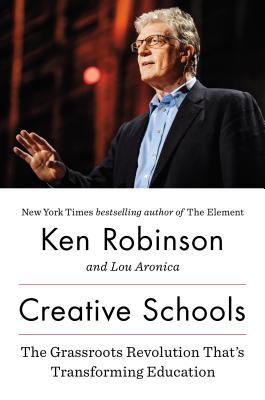
After becoming enamored with Ken Robinson’s Colin Firth-esque looks (to my mind, at least), I picked up his book Creative Schools: The Grassroots Revolution That’s Transforming Education. He narrates the audio version, and as he speaks to me in his adorable British accent, he advocates for a vision of change to the systems through which children learn.

Ken argues that schools and learning have long been erroneously thought of as mechanized processes, and that as such, efforts to reform them have been framed as simple tweaks, such as one would make to an industrial process in order to streamline it. But Ken presents a clear argument that learning is not an industrialized process, but rather an organic one: a complicated, complex system that cannot be standardized.

When I finish the book, I am sure I will be able to go and fix everything that is wrong with education today, but in the meantime, I’m content to a) recommend it to you, and b) stand firm in my commitment to make changes where I can.

I reflected, and found a place to make a change.

The change I made this semester was in removing grades from my classes. I had to cheat a little to do this, but I like the way it’s worked out. While I’ve always longed to do away with grades, I struggled with how to do so within the confines of a system that makes me put grades into a gradebook.

I found the answer in one of Tom Romano‘s syllabi from my Teaching Writing class with him:

screen-shot-2018-03-21-at-6-16-36-am.png

(Yes, I save syllabi for years. Electronically. I’m a teacher, okay?! That means I hoard.)

That was it, I decided. Eureka! Do the work. Do it well and do it on time. You’ll get an A. No ifs, ands, or buts.


Now, as I read student work via Google Docs, I focus on leaving organic comments, questions, reactions. I push and prod, pull and praise. I focus on what’s important, as Amy writes here.

My students receive feedback from their critical friends and me, and engage in a conversation with all of us in the comments. We talk about their work in class, read it together, and pull out highlights and paste them into shared Google Docs, like these from our midterm self-assessments:

Screen Shot 2018-03-21 at 6.50.46 AM.png

(At the end of the semester, I’ll compile those highlights, some variation of which we do weekly, into a printed anthology I’ll give to each student.)

In my grading spreadsheet, I give full credit to match the point values of each assignment–10 points for one-pagers, 50 points for major papers, 25 points each for self-assessments and notebook turn-ins. No thinking about percentages or worrying about fractions. Just an A for work done well and on time, because it removes the pressure from students to worry about their grades.

Because I teach teachers, I get to be very meta about my processes, and I’ve practiced giving strong and thoughtful feedback alongside my students. We study our students’ (and our own) products, discuss what learning we see being made visible, and work to improve our feedback methods and messages each week:

IMG_7286

If I can’t remove grades, and the stress that comes with them, I’ll give all students a grade that makes them stop worrying about whether they’ll attain that A or not. That is what I have been longing to give them: learning unfettered by the pressure to boil down their thinking to a number or letter.

All thinking, reading, writing is worth so much more than a grade. It’s worth a reader, a respondent, a friendly ear, a coaching eye, a nurturing nudge.

This is my cheat code for how I’ve managed to get away from being a grade-doling disciplinarian, and come to enjoy being a truly engaged teacher of my students’ growth.

How do you get around the gradebook? Please share your strategies in the comments.

Shana Karnes teaches preservice teachers at West Virginia University, works with practicing ELA teachers through the National Writing Project @WVU, and reads approximately 562 books a day with her two daughters, ages 4 months and 23 months. Find Shana on Twitter at @litreader.


Change My View: Being a Good Citizen Now

The Background

“I don’t want to prepare my students to be good, contributing citizens when they graduate. I want them to be good citizens now.

quote-chalk-think-words.jpg

All I could do was stare. This sentiment, uttered almost in passing by my PLC partner, was paradigm shifting for me.

She’s a smart lady, quick to advocate for her students, quick to find a solution, quick to speak up. Her insights often stick with me for days; this particular one for months. Of course, I want my students to be good citizens when they graduate, but to just box them into being good in the future denies them the opportunity to be good citizens now.

And, my goodness, haven’t we seen plenty of students acting as concerned citizens nationally and even locally over the past few weeks? Haven’t we been encouraged, even inspired, by their bravery, their maturity, their passion?

Motivated by the current student activism sparked by the Stoneman Douglas survivors, the subsequent walkouts on the 17th (both topics dealt with beautifully by Lisa Dennis here and Shana Karnes here) and wanting to give our own students a place to both discuss current events and practice their argument skills for a real audience, my partner and I looked to the AP Language group on Facebook and, well, Reddit.

I’m not even kidding.

The Writing

Now, Harry Wong tells us that good teaching is good stealing, and this brain child is the product of some Swiper-level theft: we combined the Columnist Project (a common AP Language assignment where students complete a mentor text survey of a columnist before analyzing her style in a formal essay) with the structure and goals of the  /r/changemyview subreddit.

This subreddit encourages participants to make an original post (OP) about anything big or small and invite the community to change their mind about their position. Deltas are awarded for posts that change the OP’s mind. Participants are encouraged to use any tool in their toolbox to change the OP’s mind.

Given our current political climate, we wanted students to practice articulating their views clearly and respectfully when they disagreed with someone, to be exposed to new ideas, to identify when they are closed-minded versus open-minded, and to practice their argument skills with a real audience. We called it the CMV – Change My View. Original, I know.

So, we sent students to their notebooks using a brainstorming process pulled from our writing project days:

Step 1:

     1-2 – List 2 issues that are important to you personally

     3-4 – List 2 issues that are important to your school or community

     5-6 – List two conversations you have had lately

     7-8 – List two ways you spend your time

     9-10 – List two things we should start or stop doing in the world

     11-12 – Other – List other topics that you are interested in that 1-10 didn’t cover

Step 2:

     Develop two of those ideas in two five minute quick writes. Just write.

Step 3:

     Pick the one that you like best and quick list:

  1. reasons why you think this way (understand their own thinking)
  2. ways in which you are open to having your mind changed (recognize if they are willing to change their minds)
  3. Universal nouns that could apply to your topic (help us organize the topics)

The Results

After some brainstorming, we found a digital platform, and let slip the dogs of war! I mean we let the students loose to play. And my goodness!

The research, the rhetoric, the respect, the results!

I teach at a great school with very few discipline problems, and yet, for the past week, I find myself asking students to put their CMV away and focus, to just do this for now and look at the CMV later. Friday, I threw in the towel and made CMV part of our work day stations. I know when I’m beat. But I also know my PLC partner and I have hit upon a great writing adventure, one students can’t stay away from.

Students have willingly engaged in writing with more creativity, fire, and passion than they ever would have for a formal essay. They are researching their positions with a ferocity never engendered by any research assignment. They are trying new tactics – that logos isn’t working? Well, here’s some pathos. They are taking risks with their writing to earn that delta.

For example, here are three students (each contribution denoted by a different color) discussing the walkout last week. Notice the back and forths, the concessions and the respect, the arguments made and the way they’re taking what they know about argumentation and applying it to a real conversation about a real world topic.

Like we already know, meaningful writing is powerful, and sharing that writing is even more powerful. I can admit that an in class discussion of some of the topics they are tackling with such gusto would make me uncomfortable. But, our students have so much to say; we owe it to them to find ways and spaces to let them speak. Let them be good, thinking, critical citizens now.

Sarah Morris teaches AP Language & Composition and Film as Literature in Murfreesboro, Tn. Born with a reading list of books she’ll never finish, she tries to read new texts but often finds herself revisiting old favorites: Name of the Wind, The Stand, Harry Potter and the Methods of Rationality. She tweets at @marahsorris_cms.

$%^@* Gradebook!

Sorry for the semiotic profanity, but the more research I read, the more conversations I have with students, the more reflecting I do about my practice, $%^@* is what comes to mind. The inherent contradictions between meaningful learning and the system in which it takes place become most apparent about a week before grades are due, which for many of us is right about now–the end of a quarter. And the accompanying frustration and anxiety seem especially pronounced in writing courses, where our emphasis is on process over product.

I teach Advanced Writing, one of several English courses for seniors. The whole of third quarter has been devoted to an author or genre study: students must read 3 full-length texts and a number of critical articles by and about their author/genre, and express their findings through a variety of genre, ie a multigenre paper. Students made their own schedules, although I assigned drafts throughout the process to be workshopped and revised prior to the due date, which is today.

Many students held firm to their own and my deadlines all along, becoming heavily invested in their work — and the work of their classmates. Claire, a self-professed “math & science person,” immersed herself in the work and the philosophy of Camus. RJ, a devoted journal-keeper, examined the work and the critical reception of confessional poetry. Grace, a reader of all things spooky, explored the connection between horror writers and themes of lost innocence and coming-of-age. (I could go on, but I want to save their work for another post). These students and many others made careful, purposeful decisions about how to express their discoveries in a variety of genre, even — gasp! — taking that bold writerly step of abandoning a draft that wasn’t working and trying something new. Workshop and multigenre at its finest, right?

Sort of. Last week, drafts started to trickle in from students who had arrived late to the process party. I gave feedback as effectively as I could and kept my teacherly admonishments about deadlines under control. By Saturday morning, I had returned at least one draft to every student who had submitted work, and so I carried on with my weekend. Sunday afternoon, my inbox was full again with drafts of genre pieces. I still don’t know why I was so surprised, given that the quarter-long project was due in less than 24 hours. As I skimmed the list of submitted drafts, I faltered between pride in the work that finally came in and frustration over how late it was.

grade cartoon Glasbergen_1824This course is about nothing if it’s not about writing as a process. For three quarters, our work has been based on no other principle more than this one. Students who handed in drafts so late clearly did not engage in the work at this fundamental level. Surely I couldn’t award them the same grade as those who had. Right?! Right. So I started drafting a not-so-nice email to those stragglers pointing out that they all have known the due date for quite some time and surely they must have had no intention to revise in the first place so why did they even bother handing in a draft and was it just to get a number in a gradebook but of course I will not award the same credit so you will receive that fat ZERO because you’re seniors and by gosh I’m going to use that fat zero to show you how the world works because it’s time you start …
OK, no, I didn’t go that far, but that’s where it felt I was headed, and it felt wrong. How could I disregard their work yet still claim to value the process? How could I do the talk (and walk) against grades as an artificial, arbitrary, inaccurate measure of ability and achievement and then use them as a punishment? The only lesson they are likely to learn is that yet another adult they wanted to trust is revealed as a hypocrite.

In the end, I made my best attempt at a compromise, the details of which I’m sure resemble what anyone reading this blog would have done. But in that initial moment of composing that email — and that it was my first instinct — reminded me how ingrained the system can be even in those of us who do all we can in our practice to skirt around its limitations. I’m sorry this post doesn’t provide any grand answers to this pervasive conflict between meaningful learning and hierarchical measurements of such, but gosh I feel so much better for having shared with an audience that can commiserate. I hope you do, too.

Revision Strategies that Make the Cut: Helping Students Be Incisive

I learned to be more incisive as a writer as an AP Language and Composition student (somewhere in between rocking flannel and rocking out to Pearl Jam). My perspicacity heightened with my argument research paper, which I had written by hand. Yes, by hand. We owned a computer, but I still expressed myself better pen to page (I’d make the case that writing by hand is still important for our students. Um–notebook time, anyone?). As I read what I had written, preparing to make revisions, I knew I wanted to rearrange the sections. So, I reached for scissors and tape. And–gasp–I cut up my essay, by paragraph, by sentence even. Sprawled on my bedroom floor, I spent the rest of that evening moving parts around until satisfied the parts built toward my whole.

My students’ body language says it all when I offer this story as the lead in to cutting up their own writing. They lean back, raising eyebrows, looking at me quizzically. I imagine their thoughts: “We have cut and paste for that, Mrs. J. You know, on our smartphones.” “Oh rats (emphasis added), I didn’t print my paper. Ha! Now I don’t have to do that.” “I like the way it is. Why would I want to cut it up?” This last query I think is most important. Writing is an act of making, of creation. As humans, we typically get attached to the things we make; we grow to love our words and the way we’ve orchestrated them on the page. Some students need to wrestle with this implicit bias more in order to discover the gaps in their writing. By making my students cut up their drafts, giving them a different kind of constraint, I’m helping them to engage in cognitive conflict, the kind of disequilibrium they need to continue their work revising and to move forward as writers.

These are 5.5 of the strategies so far (I’m always culling) that have made the cut in my classroom.

1. For Invention and Structure

Process: During the planning phase for their argument research papers, I offer old books and magazines to my students, directing them Disney Imagineer Style to cut words and images related to their issues and then arrange them on the page, keeping their audiences in mind.

Benefits: This kind of gathering, cutting, and moving allows for intuitive structuring of their papers AND sometimes engenders creative analogies within their justification (warrants).

2. For Structure

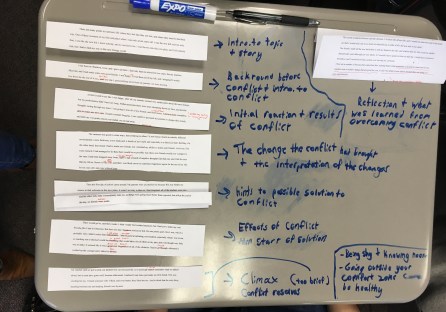
Process: To further gather ideas for structuring, I direct students to cut apart mentor texts to see how they are structured. Typically, I advise them to start with paragraphing but then encourage them to make further cuts and move text as needed in order to discover the ordering of the text and to label and note for themselves what moves the writers made.

Benefits: This exploration compels students–because they must analyze the implications of how the writer arranged the text–to more purposefully arrange and connect their own ideas.

3. For Development

Process: Students begin by cutting up their papers by paragraphs. They then label the purpose of each section or determine what question each paragraph answers, keeping a post-it with the thesis/theme/point near to see if each paragraph aligns. They can then begin moving paragraphs or parts around to see how to manipulate time, to see if there can be greater logical interrelatedness, or to see if parts require more information.

img_1565-1.jpg

This student sample shows a narrative cut up and labeled.

Benefits: Cutting apart their own texts challenges students to determine the efficacy of development in their writing, especially because this compels them to examine one section–in isolation–at a time (something more difficult to do digitally). Here is one of my students talking through how he used the process and what he discovered.

4. For Purpose

Process: Here the cutting gets more minute: I ask students to cut out the center of gravity sentence (their thesis, claim, so what, point, etc.) to see if everything really does rest on it. After cutting it out (and sometimes just transferring it to a post it), students can move it next to different parts of their paper to see if the parts not only relate but if they build toward this.

Benefits: Sometimes the benefit here comes in the realization that they need a so what or that the parts don’t align or that the sentence itself lacks strength.

5. For Style

Process: Cutting out where they used a mentor text move and seeing if they applied that move to their own writing gets students looking at sentence construction.

Benefits: If we ask our students to “lift” a move from a mentor text, can’t we also ask them to lift their text and compare it back to the original, moving them side by side to determine how effective the application of the mentor text move is after all?

 5.5 For . . .?

Possible Processes: Cut away what tells instead of shows. Cut out all of the comparisons in the text to look for patterns, connectivity, etc. Cut out the best sentence from each paragraph to look for ways to build meaningful repetition.

Benefits: I don’t know yet. These are half-formed ideas right now. But I know they could help my students become more discerning as writers.

Amy Estersohn wrote in her recent post about the tools she relies on for workshop. I’d like to add one more tool: scissors. This tool inspires strategy, and thus, our writers. I frequently tell my students that writing is made of moveable parts. So, let’s get our students moving it!

Kristin Jeschke frequently finds scraps of paper and post it notes around her house–writing that may or may not have made the cut of her budding cartoonist nine-year-old and her emerging storyteller six-year-old. Of course, on days when her students are armed with scissors, her classroom looks similar. Follow her on Twitter @kajeschke.