Category Archives: Readers Writers Workshop

Groundhog Day and Writing Conferences

ask blackboard chalk board chalkboard

3TT writers have shed a lot of (digital) ink about the benefits of conferencing with students about their writing – you can read about here and here. We love the conference.  And, I imagine that if you’re reading this, you love the conference too – or at least, you’re starting to love conferencing… or at the very least, you’re starting to love the idea of loving conferencing.

This is my first year really making the conference a centerpiece of my instruction, and I’m really starting to see the benefit in letting those conferences drive instruction. In the past, I would teach an essay and already know what follow-up instruction I would offer after the essay was over. I had November planned in June and felt so proud of myself for being so prepared. And I was, in a limited kind of way. I was prepared to talk about what I wanted to talk about, not prepared to meet my students where they were.

With conferencing, though, I find that I need to be prepared in a completely different way. I need to be able  to deliver all kinds of writing and craft instruction at the drop of a hat; I need a series of quick mini-lessons and questions that I can go to again and again . Some days, I find myself giving the same kind of feedback like I’m stuck in some Groundhog Day style purgatory. Others, I have to go deep into the well and pull out information I haven’t had occasion to use in years. Other-other days, I just have to admit that I need a night or two to think of a response to a question and agree to meet again later that week.

I take that Groundhog Day style feedback to heart – sure, it’s maddening in the moment to explain an idea again and again to a new student with a new piece of writing, but I VERY easily recognize what I need to reteach. This last week has been one of those weeks. I’m realizing that a majority of my students could all use more time and practice with adding warrant to their body paragraphs. Here are four methods I use to teach warrant:

  1. Slip or Trip – This clever little cartoon and accompanying activity created by George Hillocks is great for understanding the assumption/values part of warrant. I’ve seen it work in 8th grade classrooms and with juniors. I’ve seen it work with juniors who remembered working with it from their 8th grade years. It’s powerful in its simplicity. The premise is just to determine whether Queenie’s husband Arthur fell down the stairs or was pushed down the stairs. The instruction comes in helping students explain why their evidence supports their claims, in explaining the assumptions they are making.
  2. Toddlers and Teenagers – This is more of an analogy to help students understand the two parts of warrant
    1. The toddler – warrant addresses the question WHY – Why does this evidence prove this claim? Why did I chose this evidence? – Students ask WHY until they run out of answers – like little toddlers who just learned the magic of asking why.
    2. The teenager – warrant also address the question SO WHAT or what’s the IMPACT of this argument – So like an eighth grader decked out in blue eyeshadow and posted up by the Claire’s in a local mall, students ask the SO WHAT question for each of their WHY answers until they can’t think of any more responses. For some students, the SO WHAT question is enough. Others need the guidance of two more questions to really land the SO WHAT: Who is harmed and who is benefitted? Why should we care? What are the effects of this harm? You can further specify this harm/benefit question set to emotional/physical/economic/social/moral harm/benefit to help the students who still need a nudge in the right direction.
  3. The IF/THEN strategy – Full confession: I stole this idea from a blog post or a class website somewhere on the internet. So, unfortunately,  I can’t give appropriate attribution, but this teacher is an English goddess. She encourages her students to create IF/THEN statements working backwards from the warrant to the claim using a fill in the blank sentence. Here’s that sentence: If we assume (general rule, idea, belief, stance, assumption – WARRANT) and this matters because (IMPACT/SO WHAT), then [EVIDENCE] proves that [CLAIM]. Simple, quick, to the point. A clear way to look at a complex idea.
  4. 5 whys – Another full confession, I’m not sure why I call this the 5 whys, and the name is a little misleading for students – they don’t actually have to create 5 whys; 2-3 works just fine. (I think the name was actually a really bad joke: something about 5 Whys for 5 Guys, Cheeseburgers and Fries. Sometimes weird things just happen in the classroom.) This is an argument structure that helps students evaluate claims and allow their body paragraphs to be reason/warrant focused NOT evidence focused. So students start with a claim – their thesis- and ask why. The answer for that first why question becomes the topic sentence for the first body paragraph. From that first answer, students again ask why creating a second answer which becomes the topic sentence for their next body paragraph. This movement of asking why and answering creates an outline of reasons that often moves from a pretty specific start to a philosophical ending, allowing students to move away from the five paragraph essay which just repeats the same idea ad nauseum. Another benefit to the structure is that the questioning of their claims allows them to see when/where their claims are weak and they can revise accordingly.
    1. Here’s an example for a prompt about the value of civil disobedience
  • Thesis: Disobedience is necessary to advance society
    • Why? Because →  society tends to resist change,
      • it’s a large machine that is slow to stop and slow to start *so* we have to start it, nudge it, guide it
      • “Civil disobedience”
      • Objects in motion tend to stay in motion
    • Why? Because →  change is hard work – it can be violent or long or messy or complicated – *but* we have to keep working at it anyways
      • Length of struggles – I might trace the history of several different movements using disobedience as a motivating factor
        • American Revolution
        • Women’s Suffrage Movement
        • Civil Rights Movement
        • Black Lives Matter
    • Why? Because → humans as a species are discontent with being content – we crave betterment
      • Where do we see ourselves craving betterment?
      • WHY do we crave betterment?
      • Can I trace this historically or chronologically?
    • Therefore….conclusion stuff

Conferencing has made my students better writers individually through one conference at a time. However, it’s also improved my whole class instruction as well – allowing me to provide better guidance for my students as they need it. What insights are you gaining in your classroom through your conferencing practice?

Sarah Morris teaches AP Language & Composition and Film as Literature in Murfreesboro, Tn. She is rewatching Brooklyn Nine-Nine for about the third time. Nine! Nine! She tweets at @marahsorris_cms.


Salvaging the Threads

3TT writers have employed a variety of useful analogies to our experience in reading-writing workshop — from little league baseball to a trip to the dentist! To me, these analogies collectively speak to our constant, evolving understanding of our own work (let alone refining our attempts to explain it to others). Allow me to “weave” mine into the mix.

Venom-Marvel-Comics-Spider-Man-Eddie-BrockI bet I’m not alone (at least I desperately hope not) in that I still haven’t even had a chance to process everything I took away from NCTE, what with reconciling my sub plans with what actually occurred, catching up on all the grading time I missed, and coping with the energy sap of the holidays. The chapter covering Saturday evening in my world is the one that features A Lengthy Car Ride through Rural Iowa (read: Without Internet Service) in Which a Teacher Becomes Increasingly Anxious About Aforementioned Concerns and Impending Week of Classes and in Which Teacher’s Husband’s Attempts at Assuagement are Rebuffed with Increasing Venom. So, because in these moments of anxiety and dread it can be so helpful to resurrect and dwell upon our failures, upon returning home I took out my knitting.
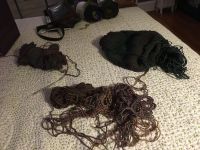
As I get older, any amateur attempts at fox-like knowledge are totally overwhelmed by my fully-developed hedgehog sensibility (note: Quick-Write prompt?). I’m really good at a narrow few utterly arcane knitting disastersskills, like paring down 1000+-word college essays to below 650 and breaking down a mentor text like nobody’s business. I’m a decent cook and a better seamstress (nonsexist “seamster”?), but I’m notorious for my “SnickerPuck” cinnamon cookies and knitted hats with signature random and inexplicable holes. I’ve given up the baking, but for some reason I can’t let go the knitting. These three piles of SnickerPuck were supposed to be a hat each. That night my husband hesitated but was brave: Why I was taking a photo of this trifecta of failure? “I think it might figure into my blog post,” I obliged. “I’m just not sure yet how.” He obliged by offering vague encouragement and vacating the premises. (Note: guest-blog about living with a RWW teacher?)
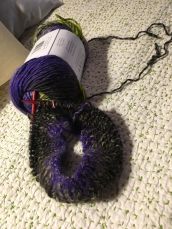
The physical presence of these knit squid-carapace non-hats helped me begin to see: I have to tether these loose pedagogical tentacles to some greater purpose for the rest of the quarter. I decided to make use of this textile and cephalapodian imagery to look forward in concrete ways.

1. Infusing revision strategies across writing “laps”: My sophomores have two working drafts right now, not by design but rather by my inability to return either assignment in a timely way with any meaningful feedback. So, the “loose threads” of the skills they need to move these pieces forward — engaging leads, arguable claims, effective discourse markers to signal arrangement — will the the focus of mini-lessons next week, which they will then apply to both pieces of writing (a multi-paragraph media review based on a mentor text a la Allison Marchetti and Rebekah O’Dell and a focused one-page mini-essay supporting an arguable claim). The hope is to reinforce the value of these writing attributes across the singular tentacles of “assignments.”

2. Revitalizing independent reading: Last year I tried Amy’s personal reading challenges, which she writes about here. In true late-to-the-party form, last year I finally got around to it in the middle of quarter 3. But with love to my student Nasade and gratitude for providing confirmation of its value beyond my poor planning in the 11th-reading-hour of sophomore English, she so politely suggested, “Ms. Maguire, maybe we should have done this earlier in the year.”

3. Thus, weaving the threads of our RWW community: I’ve come to live with the reality that RWW workshop courses tend not to coalesce or liven up until second quarter (even though I totally forgot about that and beat myself up about it for all of first quarter). Nevertheless, it’s happening now with my sophomores. With of course a few exceptions, they are sharing book recommendations and writing challenges at their tables as a matter of course. Rather than follow my tendency to focus on the outliers — knit 2who (at the risk of abusing the metaphor) may need a new color/texture of yarn or needles of a different size — students will be invited to channel their writing conversations into more focused workshop experiences (for quarter 2, based on skills outlined above), to make their impromptu book talks more public (in place of my [ir]regular book talks), and to continually share titles via their reading experiences and their personal reading challenge cards.

The knitting analogy only goes so far — after all, those tangled shrouds need to be torn out and started over, which isn’t the most productive option in RWW if students are producing any writing at all. And thicker, fuzzier yarn may only serve to better conceal those gaping holes. But as it turns out, the fresh eyes that come with a brand new project out of class can renew the perspective from within.


The Role of Play: Discovering a Structure for Writing

Having grown up in the home of a preschool teacher who has always taught in a play-centered classroom, I’ve witnessed the importance of play in the physical, social, emotional, and cognitive development of a young person. Mom and I speak frequently about our concern for the lack of play at all levels of education. Kenneth Ginsburg, in an article for Pediatrics, reinforces that highly-scheduled children (which so many of our students are!) have had less time for free, creative play and therefore have built fewer coping mechanisms for managing the effects of pressure and stress. Of course, I can not wholly mitigate this; but I can help students harness (thanks Amber!) their creative potential to not only foster cognitive growth but also social-emotional well-being. I can help them use play as a means for creation.

Compelled to prioritize play as a creative force, inspired by Angela Stockman’s Make Writing, driven to help students find intuitive ways to structure their argument research writing, I use this lesson to help students move beyond the perceived rigidity of the research paper.

Objectives:

  1. Understand the roles of tools and of play in the act of creating;
  2. Discover a possible structure for the argument research paper that serves both purpose and audience;
  3. Inspire confidence in students’ own decision-making skills as writers.

Lesson:

Step 1: For my AP Language and Composition students, many of whom are used to the highly analytical, “academic” environment (indeed, the one I–along with others–foster), I begin by positioning the learning opportunity. I show them pictures of my own children: in one, they play with cardboard boxes, making their own spaceships, dressed in costume for the occasion; in the other, swirling words and designs into shaving cream, using fingers and forks and Duplos. This is critical! These pictures evoke memories of their own childhood, priming my students’ imaginations. Then I share words from Kenneth Ginsburg: “play helps children develop new competencies that lead to enhanced confidence and the resiliency they will need to face future challenges. …When play is allowed to be child driven, children practice decision-making skills, move at their own pace, discover their own areas of interest, and ultimately engage fully in the passions they wish to pursue.”

Step 2: Purpose articulated, I give the a tour of the “Play Stations”:

    1. Imagineering: Disney Imagineers cut out a collection of images they find interesting and then they start to arrange them to see if they can blend ideas. At this station, students find old books and magazines, paper, scissors, and glue so they can imagine away.
    2. LEGOS and Duplos: At this station, students find these toys for building; considering the size, shape, and color of the LEGOS/Duplos, students experiment with the structure of their piece.
    3. Pipe Cleaners and Beads: At this station, students are encouraged to consider the size, shape, and color of the beads and to talk through their ideas as they string the beads. When they finish, they look for patterns.
    4. Comic Book Templates, Receipt Roll Paper, and Craft Paper: At this station, students use the comic book templates provided to craft the “story” of their argument. They may also choose some receipt roll paper to work with the “story” in more linear ways or craft roll paper to make “cave drawings” or other illustrations of their ideas.
    5. Painting:  At this station, students use watercolor paints or paint pens along with paper plates (this offers a different constraint) or paper to paint their arguments.
    6. Play dough: At this station, students use play dough (homemade is the best) to mold and shape their argument. Sometimes I encourage multiple buildings since the joy of play dough is how easy it is to build, destroy, re-build.

Step 3: Before freeing my students to play, I ask them to consider this question: “What can you build that will meet the needs of your audience and purpose?”. I also direct them to review their work plan, their issue, claim, and a list of topics they’ll address in their papers.

Step 4: Play. “Confer” (I ask students to tell me about what they are making. I offer observations about their creations. I exclaim over the cool things they invent.).

This slideshow requires JavaScript.

Step 5: Reflect. On post-its, students describe what they made, what they discovered, and what they may do as a result.

Follow-Up:

Following this lesson, I share other ways to arrange or format an argument paper, including Persuasive, Rogerian, Pro Con, Problem Solution, Problem-Cause-Solution, Top 5, Monroe’s Motivated Sequence, and others. When my students ask if it’s okay if they use the structure they invented or if it’s okay to combine what they invented with one of these structures or even if they can combine these new structures, I see the value of play. I see my students combining, adapting, modifying, synthesizing, and harnessing their own potential to discover–for themselves!–how to shape their writing.  

Kristin Jeschke helps her students–in AP Language and Composition and College Prep English at Waukee High School–harness their intuition through play. She doesn’t even mind the chaos and inevitable mess that follows (as long as it leads to creation). She thanks her parents for free time to play in the dirt and the sand. Follow her on Twitter @kajeschke. 

What are we going to do?

Attending any professional conference always leaves my brain buzzing with new ideas and a Christmas-morning-esqe excitement about delivering my learning to students.  NCTE was no different–it is a convention of crusaders that feels like the best (only?) staff meeting you never want to end.

And I needed it this year.

This year has been different, difficult at times, as I navigate a new school and new expectations, balancing between very traditional American Literature and AP Literature curriculums with the workshop work I know is impactful for students. Truth be told, I have been more of a good employee than an inspiring educator.  I have made choices that didn’t rock the boat and those choices often cut student voices. When I wrote about not being there, in retrospect, it is because I haven’t been fully committed to workshop this year.  Thus, students haven’t been fully committed to it either.

Chris Emdin, spoken word-educator-scientist,  asked, “Are you a good employee or an educator?

Penny Kittle, workshop Goddess, asked, “What are we going to do?

“Balance” won’t work any more. There is urgency to the work we are doing.  I have to make choices between what builds authentic literacy and what makes me a good employee.

My juniors are leaving for their post-secondary endeavors, majority of them to four years institutions, soon.  The end of their adolescent education is upon them and they face down daunting tasks. During her presentation, Penny shared a graphic featured in 180 Days: Two Teachers and the Quest to Engage and Empower Adolescents (Heinemann 2018) which showcases the urgency of student literacy.

From a survey of college syllabi for freshmen English done by reDesign (2014) shows first year students will encounter:

  • 5,000 pages of reading
  • 75 text-based discussions
  • 20 argumentative or research essays
  • And 90-100 polished essay pages

A semi-stunned “Wow” is what I thought to myself as the sweet sophomore teacher from Texas audibly gasped as the data was shown, then unpacked through Kittle’s high school to college transition.

What am I going to do in relation to how much students read and write in my classroom versus how much they need to read and write to be prepared for the rigors of post-secondary school?  Am I going to be a good employee and assign The Adventures of Huckleberry Finn before The Great Gatsby because that is what the curriculum guide says? Am I going to educate or follow?    

As Ms. Kittle discussed, we have to shift our thinking from one of victimization to one of urgent empowerment, from “Welp, what are we going to do?” to “What are we going to do?  What CAN we do?”

So much.

It is not too late to save the year.

I will say no (politely).  I will return to what works, listen to what students want, and make time for what kids need.  I will read with students and write alongside them.  I will use my voice and research to justify what many perceive as an “alternative path” to personalized literacy.  My duty is to get students on the road to being successful after K-12 by giving them the tools, stamina, and skills to navigate 5,000 pages of reading, text-based discussions, and various writing demands.

Chris Emdin defined teaching as being “the art of the remix.”  So come Monday, I am going to remix my approach and re-define literacy in my classroom, and be, first and foremost, an educator.

Maggie Lopez is currently hiking through the arches and right to the edge of cliffs in beautiful Moab, Utah while re-reading 180 Days. She is always grateful for the educators in her life, including the Three Teachers Talk community. You can find her @meg_lopez0.

NCTE: Sparking Hope, Equity, and Voice

Like so many educators who attended the 2018 NCTE conference, I am still reeling from the wealth of information and inspiration provided by some of the brightest and most compassionate people in the world. I listened with awe and determination as strong speakers like Chimamanda Ngozi Adichie and Elizabeth Acevedo stressed the importance of what we do as ELA teachers, and I carry with me a renewed sense of urgency about literacy instruction that empowers all students. No – not “empowers” – even that word has been transformed, as I now understand that it’s not my place to give them power; rather, it is my job to help students recognize and harness the power they already possess.1

The universal message of the conference did not so much present new ideas as it did combine them and clarify that we cannot wait any longer to act. We must reach each of our students where they are, provide them with the representation they need and deserve, and encourage them to add their own voices to the world. We have embraced diversity, equity, and representation in a variety of ways, but the time for the best practices to coalesce into purposeful change across schools is at hand.

Screen Shot 2018-11-19 at 10.38.29 PM

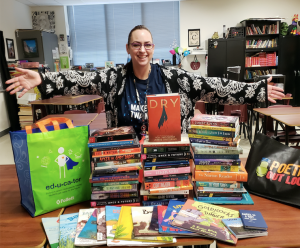
My book haul from NCTE 2018 – I can’t wait for my students to read these!

As I walked through the exhibit hall, admittedly searching for free books to take back to my students, I heard two main ideas – to quote Kylene Beers and Bob Probst – “again and again.” By absorbing the voices around me over the four days of the conference, I was able to discern what teachers, who attended a wide variety of sessions, thought. One of the most common ideas expressed was that NCTE presenters were “preaching to the choir.” Of course, this is true to a great extent. Teachers who love learning, who support choice, who engage their students in meaningful instruction, who believe in the power of writing workshop: these are the teachers most likely to attend the conference, and, more specifically, the sessions that explore these ideas. Teachers who believe in the humanities love the young humans we teach, and we will always seek to improve for their benefit and the benefits to society. This is no way diminishes the power of these workshops or their presenters, for they offer the keenest insight and carefully collected research to support best practices in teaching, and though I admittedly enter sessions predisposed to agree with much of what I hear, I always leave with new ideas scrawled in the margins of my notes. Like many others, I always leave feeling renewed, reinvigorated, and inspired, and I wish every ELA teacher could feel this way.

This brings us to the second most common idea expressed throughout the exhibit hall lines: how do we take these ideas back to our schools and inspire those who weren’t at the conference? I heard several teachers – both in sessions and while milling about – who said things like “I wish [so-and-so] from our department could hear this.” The truth is: we all know teachers who need to hear the messages from the conference, and the difficulty lies in how to offer the essence of what we have gleaned in a palatable manner. Some ideas are not well-received by teachers entrenched in established practices, and we must balance the urgency with which shifts need to occur with the tact and professionalism that our well-meaning colleagues deserve. I had the opportunity to speak with Amy Rasmussen about The College Board’s stance on shifting away from a focus on the canon to include more contemporary and diverse texts, and she offered an analogy that I wish all could hear: we don’t expect doctors to ignore research in favor of the practices they personally prefer, and when one of their primary research-based organizations like the American Medical Association or the New England Journal of Medicine offers guidelines, those are adopted as best practices. Can you imagine if they didn’t? We’d still have doctors bleeding us for pneumonia.

So, as I continue to synthesize all I learned at the conference and develop my own lines of inquiry, I leave you with these questions: why don’t we expect all ELA teachers to follow the research and vision of NCTE? Why can’t we confidently return to our campuses as ambassadors of ELA and NCTE and share what we’ve learned with our peers? Will we let the established system and soft bigotry continue to deny true equity to our students, or will we carry the spark of progress back to our campuses? I, for one, plan to stoke the fire.

1 I would love to offer due credit to the speaker who discussed the problematic idea of “empowerment,” but I cannot find the connection in my notes. If you can offer proper attribution, please add it in the comments.

Amber Counts teaches AP English Literature & Composition and Academic Decathlon at Lewisville High School. She believes in the power of choice and promotes thinking at every opportunity. She is married to her high school sweetheart and knows love is what makes the world go around. Someday she will write her story. Follow Amber @mrscounts.

NCTE 2018 Recap

I woke up this morning in Key West after yesterday’s Miami sunrise.  I promise I’ll stop thinking about the conference at some point and enjoy this get-away.  First, I want to share just a little of my experience from NCTE.

Thank goodness NCTE brought their annual convention to Houston this year.  I cannot overstate the importance of the shared experience that comes with conference attendance. Sitting next to colleagues as you soak in the collective wisdom of our field’s leaders, turning and talking with a complete stranger, meeting people you’ve only known through social media, we need these experiences.

We may not come away from events like these with a new-found awakening of what teaching means to us. It’s not, to me, the profundity of the experience that excites.  Instead, it’s the almost guaranteed replenishment of confidence and strength that I need, every so often, to redouble my efforts in the fight for literacy.

Conferences give me courage.

I’ll take time to reflect on the teachers who stood in long lines to meet Chimamanda Ngozi Adichie or Elizabeth Acevedo and shared their adoration. The reading and writing call-to-arms delivered by Pernille Ripp, Donalynn Miller, and Penny Kittle will, for a long time, echo, in my mind. Dr. Christopher Emdin’s charge to change my world-view knocked me down in the moment, and then picked me up again.

In the mean time, I’m going to rev up my step count as I recharge in sunny Key West.  I hope you find a way to recharge too.

Charles Moore can’t wait to write a professional learning proposal titled: Your Worksheet is Ruining Our Workshop. Maybe the warm temperatures down here at the southernmost point in the U.S. will heat up his teacher angst. Maybe not. 


NCTE 2019 Pregame- Gearing up our Action Plan!!!

Why am I so nervous?

The lights and the stage don’t scare me.  The topic of our presentation is something I’ve lived, day in and day out, for a few years now.  The faces in the crowd, the silence begging to be filled, the words I’ve rehearsed over and over…none of that scares me.

Is it because I want so badly for ears to hear our message? Is it because I’ve been afforded this massively important opportunity to share this message?

Late this afternoon, at the NCTE Conference, I will share the stage with some very important teachers.  These women, like me, believe that inclusivity is something that we must address intentionally.

I’ll spend every second of my allotted time sharing how I’m moving my classroom library from something that reflects traditional, mainstream texts to one that is more inclusive.  One that invites students to read books that give them a better opportunity to see themselves on the pages and a better opportunity to see themselves in this world.

Please join us this afternoon at 4:15 in 361 C.

NCTE 2018- shared slides

#NCTE18: Taking Action To Establish Cultural Competence In The ELA Classroom

“Cultural competence is having an awareness of one’s own cultural identity and views about difference, and the ability to learn and build on the varying cultural and community norms of students and their families. It is the ability to understand the within-group differences that make each student unique, while celebrating the between-group variations that make our country a tapestry. This understanding informs and expands teaching practices in the culturally competent educator’s classroom.”

-National Education Association

Part of being a culturally responsive and competent teacher includes learning how to cultivate critical conversations. However, competence also includes taking a long, hard look in the mirror to figure out how our OWN individual identities impact our pedagogy.

Working together with students means modeling how to explore the ways in which our identities impact how we view the world. Creating classroom environments and cultures that encourage self-discovery through critical perspectives are vital to culturally responsive teaching. It is not enough to be AWARE that issues exist, we have to foster COMPETENCE among ourselves and our students enough to be critical voices in these conversations.

This Saturday, please join me at NCTE as I engage with my colleagues across the nation to discuss the importance of taking action to develop cultural competence among teachers and students in today’s ELA Classrooms.

Can’t make it? Start a conversation in the comments! What are ways you actively engage in cultural competence with your students? What are ways that YOU are looking to become culturally competence in your classrooms? I would love to hear your feedback as to how we can start a plan of action for ALL educators!
NCTE 2018- shared slides

Gena Mendoza teaches High School English in San Antonio, Texas. Her most salient identities include female, Chicana, feminist, mother, wife, educator, dog mom, and self-proclaimed advocate for social justice and equality. In between managing her career and grad school, she enjoys making paper flowers and spending quality time with her family. She invites you to connect with her on Twitter at @Mrs_Mendoza3 and looks forward to collaborating with you at #NCTE18!


#NCTE18 –Ready, Set, Talk: An Action Plan for More Critical Conversations

“There can be no settlement of a great cause without discussion, and people will not discuss a cause until their attention is drawn to it.”  William Jennings Bryan

We’ve written quite a lot about the importance of talk on this blog. Too often, classrooms remain quiet as teachers impart their wisdom instead of helping students discover their own. Listening and speaking often get short shrift in our classrooms; however, with concerted team effort, we can change this.

At NCTE this Saturday, Lisa Dennis, ELAR teacher, and Alejandra Ovalle-Krolick, World Languages teacher, will share how they had a meeting of the minds and began shaping opportunities for learners to read and discuss culturally relevant texts across disciplines.

Opening windows and inviting critical conversations that explore our shared humanity is one way we become allies and advocates who instigate positive change.

NCTE 2018- shared slides

From Victim to Validated

lit is good for youIn RWW, we aren’t teachers of literature per se.  Still, the spectre of the literary ideal can show itself in our workshop classrooms for reasons from the pedagogical (as mentor texts) to the administrative (curricular requirements).

In Advanced Writing, an elective class for seniors, Mariana and I are taking students through a fiction-writing unit. As we blithely assembled a set of short stories as mentor texts, it dawned on us — more slowly than I am proud of — that with minimal exception, our short-story mentors were all writing about women in peril.

In an effort to ground what has in the past been a scurrilous unit, both teaching-wise for us and writing-wise for students, we required students to ground their stories in some real-world element. We read an excerpt from Black Water, Joyce Carol Oates’s retelling of the Chappaquiddick incident from Mary Jo Kopechne’s viewpoint. Then, because they are exquisite examples of the form — and because Mariana and I love them so much — we read “Where Are You Going, Where Have You Been?” by JCO and “Victory Lap” by George Saunders, for plot/characterization and character/p-o-v, respectively.

Lo and behold, a young woman is preyed upon in each of these three unconnected stories. Ha ha, we laughed. How art imitates life, we laughed. We then went about the business of selecting short-story material for students to “read like writers” while we are at NCTE later this week, intending to offer an oeuvre of stories representative of sex- and region- and race-diverse viewpoints.

Here’s what we came up with in our initial brainstorm:

  • “Hairball” by Margaret Atwood
  • “Brownies” by ZZ Packer
  • “Welcome to the Monkey House” by Kurt Vonnegut
  • “A Good Man Is Hard to Find” by Flannery O’Connor

In “Hairball,” a woman undergoes surgery to remove an ovarian cyst and then has her Peril job stolen from her by her married lover. The little girls in ZZ Packer’s Brownie troop suffer both racial and disability slurs. Kurt Vonnegut’s 6-foot asexual heroine is abducted and raped inside a futuristic museum of the Kennedy Compound. And in “A Good Man is Hard to Find,” the grandmother “would of been a good woman if it had been somebody there to shoot her every minute of her life.”
How much of what we teach — in English and other curriculum — reminds students of the perils of patriarchy but without the empowerment? How do we balance our content to provide windows, mirrors, sliding glass doors, AND those heavy doors that take effort, will, discomfort to open, as Amy writes about so eloquently here.

I face a similar struggle in my class of sophomores. Our curriculum calls for a literary analysis, yet the suggested texts typically depict the great suffering endured by a variety of marginalized groups. (It just occurred to me in writing this why so many high school students still prefer to read about superheroes.)

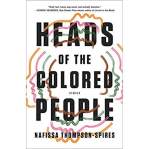
In oHeads of the Colored Peopleur persistent efforts to give voice to the voiceless without beating the same very-much-alive patriarchal horse, we turned to some more recent fiction by writers of color. Heads of the Colored People by Nafissa Thompson-Spires includes a story called “Fatima, the Biloquist: a Transformation Story,” in which a young Black woman who attends a mostly-white private school seeks to embrace her Blackness. The title story in Nana Kwame Adjei-Brenyah’s debut collection Friday Black exposes the grave danger inherent in American consumerism from the perspective of a retail clerk who, literally, is above it all. I also love to use Lucille Clifton’s “won’t you celebrate with me” as a quick write prompt.

Alas, if art needs must imitate life, we can find ways for students to see triumph and celebration without oversimplifying their experience. Or putting them in even more peril.