Category Archives: Readers Writers Workshop

Managing Feedback: A Tool for Teachers

Whenever I talk to a group of teachers about writing instruction, we talk about the core elements of writing workshop: choice, time, and teaching. We hone in on this idea of how much practice writers need. As Kelly Gallagher writes in his blog post “Moving Beyond the 4 x 4 Classroom,” volume is essential:

Screen Shot 2019-04-16 at 9.21.40 PMWithin 30 minutes assessment comes up. “How do we grade all this?” teachers ask.

I think what we mean when we say this is “How do we manage all this feedback?” We know that feedback is key to supporting our writers. If we want students to grow as writers, we must figure out ways to offer them feedback that is both actionable and timely (Wiggins, 2012). 

Enter ProWritingAid  (with thanks to Jennifer Gonzalez’s post). This online platform has been a game changer for me as a writer, and I think could be for our students too. There’s a free version, along with a paid subscription. I’ve only used the free version, but even with the limitations, it has impressed me.

How it works

Writers paste a piece of writing into the text box, then run a summary. Through the magic of algorithms, the site creates a report on the writing. And I have to say, it’s a good report. You get information about the general readability of your writing, along with more detailed feedback.
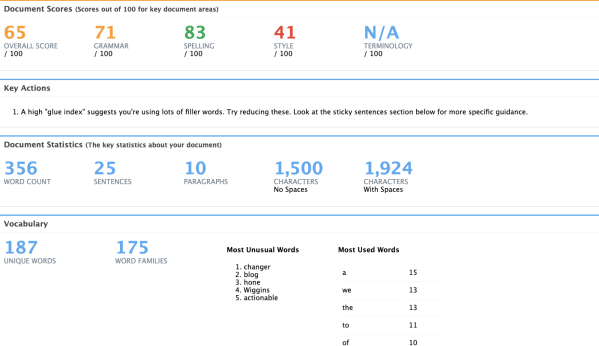
Screen Shot 2019-04-16 at 9.33.20 PM

The above report is from the first draft of this essay (yikes!).  As a writer, though, I find this report helpful. It gives me a goal to work towards — I want to get those yellow scores to green, and the red one to at least yellow. I’m not recommending that these numbers correlate to a grading scale. Rather, they tell me about areas that I can strengthen as a writer.

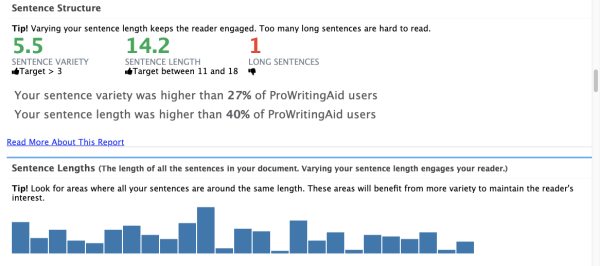
One of my favorite areas of the report is the section on Sentence Structure. I love how this section graphs out my sentence length. I can see if I’m using a variety of lengths, as well as where I need to focus my attention if I notice an overabundance of long (or short) sentences.
Screen Shot 2019-04-16 at 9.36.44 PM

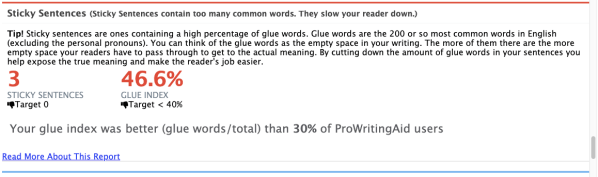
Another part of the report addresses what they call Sticky Sentences. I love the way this tool talks about the elusive fluff. We all know writers who tend to be verbose, or who fill their writing with words that just kind of take up space (apparently, First Draft Angela is one of those people).
Screen Shot 2019-04-16 at 9.38.45 PM

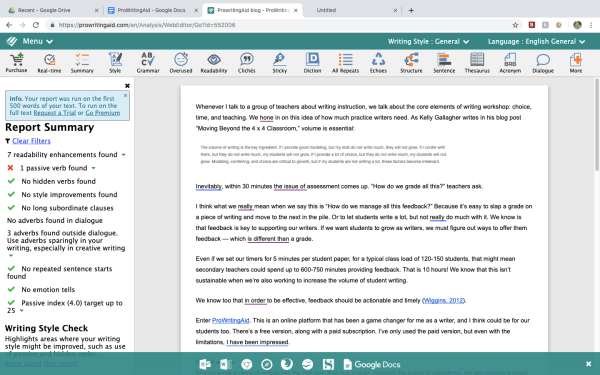
This overall report is only part of what ProWritingAid analyzes. Using the toolbar at the top of the page, writers can drill down into specifics.

Screen Shot 2019-04-16 at 9.34.51 PM

Based on my initial report, my Style score was pretty low, so I start there. I click on the Style button and the screen below shows up. When I hover over the underlined areas, I’m given specific recommendations. Eliminate adverbs. Change “which is different from” to “differs from”. The recommendations don’t change the message of my writing; rather, they strengthen it.
Screen Shot 2019-04-16 at 9.42.25 PM

I love this tool. I’ve noticed that the feedback it gives me as a writer is similar (if not a little better) than what I would give students. And the best part is that it puts the ownership back on students. I love that I know what to do after looking at this report. I have specific, actionable steps. And honestly, it’s fun. I like revising and then running the scan again to see if it’s better.

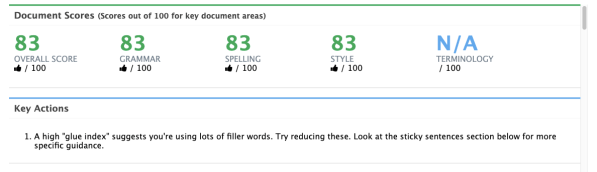
After I’ve looked at the suggestions from the site, I choose which suggestions to accept and which to ignore. I own my writing. I notice that most of the feedback focuses on my use of adverbs. I need to, as Tom Romano says, weed the garden. After revision, my scores increase considerably.
Screen Shot 2019-04-16 at 9.55.13 PM
How I might use with students

Conferring: I can imagine asking students to run a report on their draft and to bring it to a conference. What a great place to start talking to students about their writing. The report summary would help us focus on areas students might want to ask me about, or it might help me know what a good teaching point would be for that writer.

Reflection: I have been thinking about asking students to print their full report and attach it to the final draft of a piece of writing (or to screenshot it and insert with their doc). I would love for students to highlight places where they’ve made revisions and then reflect on how their writing changed and what impact those changes had on the writing.

Peer feedback: I think this would be a great talking point for students to talk to each other in partnerships. I struggle with peer conferencing because students don’t always know what to say to each other. With this, though, they begin to internalize a vocabulary around writing that will elevate their conversation.

Independence & Transfer: My biggest hope for our student writers is that they leave our classrooms with tools they can use their whole life. This tool gives them a place to go when they need help with their writing. Because that’s what real writers do. They’re not always going to have us and our red (or purple) pen to tell them what to do next as writers. Instead, I want them to know they have some places to go.

Try it. Before you introduce to students, take a piece of your writing and run it through the algorithm. Better yet, do it in front of students. Show them how easy yet powerful it is to utilize this tool. And then, enjoy the gift of time you have. Use that time to confer with students, to talk about mentor texts, to increase the volume of writing that’s happening in your classroom. 

Angela Faulhaber is a literacy coach in the Cincinnati, OH area, where spring is showing off every day. Currently she and her three kids are fascinated by the robin’s nest in the tree out front. It’s up to four eggs today! You can find Angela on Twitter @WordNerd.


A little bit of reflection goes a long way


person holding yellow and white flowers

Photo by Lisa Fotios on Pexels.com

Good morning!

I want to say that Spring had finally sprung here in gorgeous Middle Tennessee, but that’s a hard call to make. Tennessee weather is notoriously fickle – a beautiful breezy 70 degree day could easily give way to a bitterly cold 38 degree day. It’s confusing – no one knows how to dress, spring cleaners are stumped.

But for me, I know the signs of Spring. Like Lorelai smelling snow, I know when my Spring Spidey-sense is tingling: I’m chock full of ideas for next year! Now, I know for many of us we still have whole weeks of instruction left, which, TBH, yay! My students are busy little bees using modern pieces of pop culture to answer our essential question: In what ways does pop culture both create and reflect social values. (The conversations have been extremely interesting from a deep dive into the social criticism of Jordan Peele’s Get Out or how the two men of Black Panther might represent the ideologies of Malcolm X and MLK.) We’re still working -and writing – thoughtfully and intentionally in the kinds of ways that we can only really do at the end of the year.

Yet, I’m ready to start assessing what I did this year and how I can make next year even better. This week, I’d like to focus on what went well, before focusing on what still has room for improvement in my next post. Acknowledging strengths first before finding room for improvement is a pretty key part to a workshop mentality, so I’ll stick with that format here.

What have I tried this year #1: Conferences!

And they were a huge hit leading to building strong student-teacher relationships and better writing more quickly. In November, students were writing in ways that they typically don’t until March. Short, ten minute student focused conferences work! I’ll never go back. I teach AP Lang,  so a lot of our conferencing focused around the kinds of writing students do on the AP test (not all, but a fair amount). We alternated between conferencing about a piece – ten minutes of focused feedback – and then receiving just a score on a piece with no feedback from me. Well, really a symbol that represented a score. Delayed feedback is a powerful tool. These scored pieces were then used in station rotations where we looked at mentor texts, worked in small groups for writing conferences and revised. The growth and buy-in were tremendous.

How will I improve this for next year: Writing partners!

I have a pretty heavy course load – 105ish AP students – and that’s a lot of time outside of my teaching day for conferences. Next year, I want to create writing partners and build in writing partner/in class individual/small group conferencing time. I could easily give up some of our bell work to devote to building solid partnerships and shifting some of that conference scheduling burden into the school day.

What have I tried this year #2: Choice reading for units!

Last year after scoring about a million essays at the AP Reading, one of my thinking partners and I realized how often students try to shoehorn in the literature they read in class into an argument essay. Ultimately, a lot of these essays were unsuccessful. So we began brainstorming how to fix this problem. You can read about that here and here. We have seen a dramatic increase in students’ synthesis and critical thinking skills as well as engagement with the course material. After all, right now they’re ‘reading’ a piece of pop culture and pairing it with a non-fiction title in order to discuss social values, norms, traditions. For example, my student who is viewing Get Out is pairing it with The New Jim Crow. Who wouldn’t want to watch a Marvel movie and call it homework over Spring Break?? We’re engaging in such deep, student driven reading and thinking, reaching the kinds of depths I only dreamt of when studying Gatsby. I won’t be going back to whole class novels for a while. This is an experiment that has definitely borne fruit.

How will I improve this for next year: Reading conferences/more time reading!

That sentence gave me such a rush of joy! Most of our reading is done outside of class, but next year, I’m making a concentrated effort to bring some of that reading into our class time as well. Again, I could move some of the bell work around and find time to read in class. I could also find more time to create buy-in after choosing texts for our units. This year, we followed the same format every time we chose new books: we broke down the essential question, brainstormed possible universal noun/extending questions, went to the library and chose our books, then began to read them outside of class. Next year, I plan on stealing some organizational ideas from a local elementary ed teacher. She has her students glue green, yellow, and red pieces of paper into their notebooks and as they work individually, they just flip their notebook paper to the appropriate color: green – I’ve got it; yellow – I might need some help; red – HELP! This process lets her know how to spend her time. I think when we go to the library next year we might try something similar – either grouping by preparedness level for choosing books or using pages in their notebooks to signal how comfortable they are in choosing a book. I found myself just running around after kids, asking about their selections, and I know some just slipped through the cracks. This approach would allow the librarians (who are amazing!) and myself to prioritize those students who need more guidance and get out of the way of the students who don’t. Additionally, we also spent about 30 minutes in the library choosing books. I think I will extend that time next year to include reading time after we’ve chosen our new books – time to make sure this is the book for me and time to ‘fall into’ a new text.

Finally, I want to make class time available to talk to students about what they are reading. I know reading conferences can be as valuable as writing conferences, but I’m much less sure about how to proceed on that front. Good thing I have a summer and excellent colleagues to get my ducks in a row.

What have I tried this year #3: Authentic writing!

For our final piece of writing in our education unit (answer the question: to what extent do schools serve the purpose of a true education?), we noticed that a lot of our conversations centered around problems within systems of educations. This observation led us to ask students to create a problem solution piece in a genre of their choosing to an audience of their choosing – ideally someone who could take actionable steps to fixing the solutions. The results were astonishing. Students were INVESTED, researching, conferencing with each other, agonizing over word choice. I vividly remember one student exclaiming: “If I’m sending this to my history teacher then it has to be just right – I can’t just complain. I have to make HIM care about it too.” From a kid who’s struggled to see how audience can affect a piece of writing all year, the concept crystallized when the audience became a real person.

How will I improve this for next year: More authentic writing!

This one is a little tough – the problem solution piece just worked naturally with our essential question and highlighted several skills students would need on the AP test. Finding more ways to write authentically for a real audience is an idea very much in its early stages, but there’s no doubting that a real world audience coupled with passionate student writing led to some of the best work of the year.

What about you?

I don’t know where you are in your year – are you just trying to make it through until the end of May? Are you already knee-deep in ideas for next year? Regardless, I would encourage you to list and celebrate your accomplishments from this year. It’s good and healthy to remind ourselves of where we have succeeded and how far we’ve come in just a year’s time. Happy Teaching!

Sarah Morris teaches AP English Language and Film as Lit in Middle Tennessee. Currently, she’s still reeling from that final scene in the the new episode of Game of Thrones: BRAN! And! JAIME! The last time they were together was the end of the first episode of the whole season, and here they are, together again, with so much between them. I can’t WAIT until next week!


Managing the Paperload with Essay Edit Rotations

IMPORTANT NOTE:  I went to a session about managing the paper load in AP courses at the convention in Las Vegas in 2013, and a presenter shared different strategies for having students write more, but grade less.  This session was packed, and rightfully so. We all left with a wealth of ideas, and I  wish I could find the handouts to provide proper credit–I believe they were safely stored in my AP school box that went missing between our Houston to Chicago move.  If this was your session, you are a goddess! (Also, please message me!).

Right about now, the stretch after spring break into AP exams, I find myself wanting to provide students with as much practice writing as they feel they need to be confident in transferring their skills to the exam in May, but not bog myself down with essays upon essays to review as the weather becomes warmer and the days are longer.

Enter “Essay Edit Rotations,” a way to include timed practice but not grade every piece.  There are two simple components to this instructional pacing. Part 1: Students write. Part 2:  Students learn more about how they write.  

Here is how the rotations work:  Set aside one day a week for a timed writing session.  Students come in and write, then those timed drafts are collected and reviewed for trends/misunderstandings, but not scored.  Repeat this over the course of four weeks, so students have four essays in total to edit. That is Part 1: students are practice writing without grades.

Part 2 involves editing those drafts from Part 1.  I provide students with the same number of options for how to study their writing as they have timed writings and typically set aside 3-4 class days to dig in.  Students select which edit to apply to each one of their essays, “rotating” through their pieces, with one of the timed writings is always revised and typed to be scored by me for a stand-alone AP grade.

You can tailor the prompts/essays to what your students need practice on, just as you can create as many different edits as you need and scaffold over the course of the year.

I have utilized a variety of editing strategies over the years, including:

  • Scored Second Draft:  Students edit, revise, and rewrite one essay to be submitted as a stand-alone AP  score, graded by me. I typically always ask students to complete this edit.
  • Peer Editing/Conferencing:  This unfolds so organically as students grow in their writing–they’re able to help their peers assess and improve their writing based on experience and mentor texts/exemplars
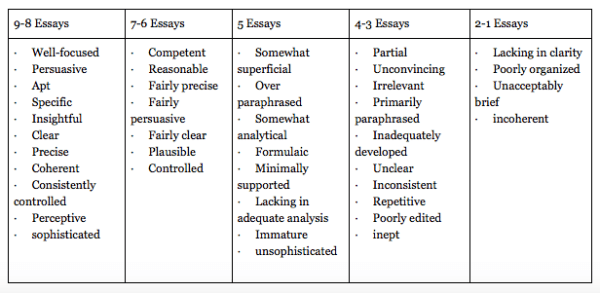
  • Reflective Annotating or Writing:  Students can utilize a rubric or create a +/delta chart based on their noticings. Often, I ask students to assign themselves a score based only off the adjectives used on the AP scoring (see below).

Screen Shot 2019-04-04 at 7.31.59 AM

  • Analyze the Components:  Students color code and highlight each element of their essay (i.e.: Claim, Evidence, Analysis, Transition) to understand how they are layering their ideas by reflecting on the visual structure, as well as the ratio of evidence to analysis.
  • Oral Editing with a Peer:  Have students pair up and read their essay, verbatim, to one another.  Students can hear what sounds inconsistent or where a thought trails off.  Students then revise these murky areas with
  • Grammarly:  Students can upload their essay (requires typing) and receive feedback.  I typically have students reflect over the commentary and identify trends and next steps for implementations.
  • Focused Revisions: I am pinpoint a specific area we have been playing with, such as varying our syntax for emphasis or upgrading our diction, and ask students to only revise those elements.


Screen Shot 2019-04-04 at 7.26.09 AM

Bella used one of her Book Club prompt responses to complete an edit focused on diction and syntax. Students are asked to highlight every other sentence, list the first word of each sentence to note repetition, count the number of words in each sentence, determine their evidence to commentary ratio, find transitions, and a myriad of other tasks to understand how they craft their responses.  While tedious, this edit creates discussion points for amazing conversations!


You can browse a wealth of recent Three Teachers Talk ideas around editing herehere, and here! Oh, and earlier this week, too!

Rounds of Essay Edit Rotations support the foundational ideas, practices, and benefits of a workshop-based classroom:

  • Low stakes writing practice:  Students practice in a timed environment, but know they will have a chance to review and edit their essays.  This workshop approach to the timed writings becomes about the edits and what students learn from their writing versus what is produced within 40 minutes.
  • Students are writing more than we are grading:  As only one of the essays will be graded by the teacher, after revision, students are benefitting from writing practice yet we are not grading each one (I do complete a quick review the essays after each writing period and provide feedback, usually in a +/delta format, before they write again).
  • Students understand themselves as writers:  Test writing is different from regular writing.  There is a rubric, yes, and a goal, but there is also pressure.  With the opportunity to edit, students can gain insight into their habits when they write for this purpose and make improvements accordingly.  Students also have the autonomy to select what edit to apply to their writing, curating their learning.
  • Builds skills for test transference:  Timing is often the most anxiety-inducing component of any standardized test.  Students can practice writing coherent, intriguing ideas within 40 minutes safely so they can find their rhythm before exam day.
  • Creates space for writing conversations and conferences:  I typically have students do their editing in class over 3-4 days so students can ask questions, work with their peers, and meet with me.  It feels like a true writer’s workshop with students tinkering away, shuffling through multiple colored pens, highlighting, adding post-it notes, and conversing with peers.

In the past, I have had students practice Part 1 with the same style of open response question, mixed up the questions, given students choice over what question they practice with each week, and have done a full exam using the three prompts over the weeks.  After that round, students assigned themselves a formative score to use as a conference conversation to set goals for moving forward. I have also implemented this during the fall when AP writing seems scary to students, in the middle of the year for review, and in the spring for low-stakes practices.

Every time, these Essay Edit Rotations work like a charm.

So thank you to the amazing writing teacher who presented in 2013.  You have saved me hours upon hours and fostered conversations around writing in my classrooms around the country.  Thank you.


Maggie Lopez is saying goodbye to ski season and hello to spring in Salt Lake City while keeping her juniors focused with choice reading, low stakes writing, and student-driven conversations as we build to the end of the year.  She just finished Everybody’s Son by Thirty Umrigar, an NCTE conference find, and began Tayari Jones’ Silver Sparrow yesterday.  You can find her on Twitter @meg_lopez0.


Planning Time for Thinking

One thing I know for sure:  Writing is hard. Lately, I’ve been reminded how hard as I’ve tried to keep up with Sarah Donovan’s challenge #verselove2019 to write a poem a day during the month of April.

It’s only day 9, and Oh, my!

It’s not even the poetry part I’m finding difficult, which is surprising. Deciding on an idea and then sticking to it has wrecked me for eight straight days. And now I’m wondering:

How often do I expect students to dive into drafting without giving them time to talk and question and change their minds about their ideas? Do they have enough time to play and mull and sit with their thoughts before they make a commitment–or before a draft is due?

I know what so many great writers say:  Just start writing; you’ll discover what you want to say. But what if that doesn’t work for everyone? Lately, it hasn’t worked for me.

So now I’m wondering:  How can I plan for enough time to give everyone the time they need to settle in to their ideas before I plan enough time for them to write?

Now, I’m not talking about timed writing — or state-mandated test writing. Those are different (and in my humble opinion) horrible inauthentic beasts. I’m talking about the process of thought. The thinking it takes to draft with intention.

I’m pretty sure I’ve rushed it.

And I want to slow it down.

#verselove2019

Amy Rasmussen lives and writes from her home in North Texas where the bluebonnets are blooming beautifully. She thinks about writing all the time and needs to get better at getting her thoughts on the page. Writing poetry, which is far out of her comfort zone, may help. You can follow her on Twitter @amyrass

Revising and Editing with Jeff Anderson Part III

Grouped around a big table in the library, seven students looked at me as if they knew the next hour of their life would set the record for engaged boredom.  These were students who volunteered their time to get one last push towards success on our state assessment. Like dental surgery, they assumed going in, that it would be painful.

None of these students were on my rosters, thus, they had no idea who I was or of the learning vortex we were about to descend into.

We picked up an excerpt from Unwind by Neil Shusterman and jumped in with both feet, after reviewing the guidelines for sentence building. Our stated goal was to review the piece with an eye towards sentence structure, alas, what we found was much more meaningful.

I wrote about Jeff Anderson’s book Everyday Editing here and hereCheck out those posts for Anderson’s first six tenets in editing instruction.

The last three parts of this book are:

  • Invitation to Edit
  • Extending the Invitation
  • Open Invitations

Invitation to Edit:

Anderson, in this section, writes about seeking authenticity and meaning in their editing practices: developing an editor’s eye.  He shares with us an activity he calls, “How’d they do that?”  This is an exact move we practiced in my STAAR prep group Thursday afternoon. We stumbled upon a sentence that blew us away and we dissected it with a thoroughness that I’m not sure I’ve ever explored with high school students.  We looked at the way the Schusterman wove words and punctuation together to create magical meaning.

Cast your gaze on this beauty:

unwind

Consider this Anderson gem:

“It hit me as the exact way education gets editing instruction wrong. We make it about identifying what’s missing or there, and students haven’t ever met the concept or become familiar with it.  If they don’t know of it’s existence, they can’t notice its absence” (p. 43).

Extending the Invitation:

What are we supposed to do when we see an amazing sentence sitting there, minding its own business, nestled quietly in a mentor text? The answer is, we stop what we are doing and ogle it. We poke and prod it , using our editing scalpels to peel back its layers and reveal the secrets where-in.  Don’t ever be afraid to pause a reading or writing lesson that has nothing to do with sentence structure to talk about a particularly well structured sentence.  I mean, really, all reading and writing lessons connect a text’s internal and external structures.  Amirite?

Open Invitation:

This section is about removing the idea that editing lessons are their own separate learning task.  Anderson argues that they should be the basis of all writing instruction and that these lessons should creep over into all the others that we use to help our students grow in their literacy.

One more time:

“I want those boundaries muddied so that the rest of the writing and editing lessons I do, besides those start-of-class, blastoff point invitations, are mixed with mini-lessons, writing, and sharing time in writer’s workshop” (p. 46).

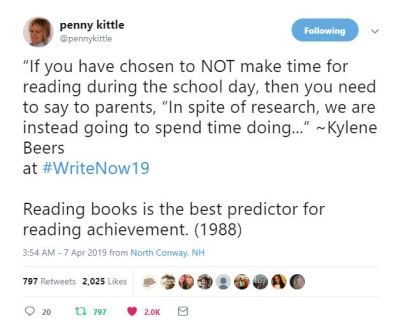
All this reminds me how important one-on-one instruction is to literacy instruction and I think back to the absolute necessity that is self-selected independent reading. Consider the wisdom of Penny Kittle quoting Kylene Beers:

PK2

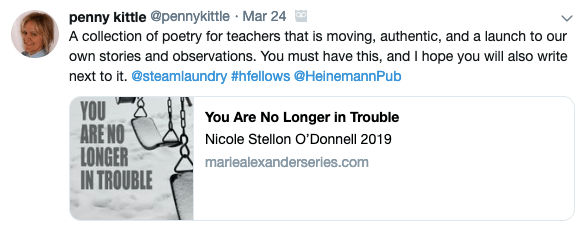
And then what she tweeted next:

pK1

I think this “nudge” can be about craft and not just content.  This is a place into which we can extend invitations.

With you-know-what looming, a lot of what we’ve studied with our reading and writing should, hopefully, help the kids out, but more importantly, set them up for success in their literacy lives.


Charles Moore is so excited to share the last six weeks, or so, of the year with his freshman. He’s looking forward to experimenting with collaborative groups, exploring new ways for students to publish, and, of course, talking to kids about books.  If you want to reach out to him about teaching reading and writing, shoot him an email. Check out his twitter if you want to see the latest episode in dad themed humor.

In Favor of Fun

How many English classes have you been in during which students do not read or write?

Think back. Truly. How many of your own educational experiences, your own lesson plans, or classes you’ve observed contain a rich amount of student reading and writing? And…how many are filled with round robin reading, audiobooks, review games, vocab quizzes, grammatical dog-and-pony tricks?

Equally frustrating is when reading and writing is being taught in an English class, but it’s still the dog-and-pony variety: classics only. Whole-class texts only. Five-paragraph you-know-whats only. The teacher makes all the choices, and often, those choices were not made by the teacher, or he or she made them many years ago.

Day in and day out, I see these complacent practices in place–a classroom in which students see words but rarely read or write them independently; an autocratic, teacher-centered class in which students do some reading and writing but exercise no choice.

I have seen all of this in a wide variety of classrooms in just the last few weeks, as I’ve been doing some classroom-hopping in the form of substitute teaching. As I watch preservice teachers get their feet wet, as I read lesson plans left for a lowly, inept sub, as I talk to students who are unaccustomed to having the chance to speak during class, I keep returning to one question:

Where is the fun?!

Where is the talk, the chatter, the laughter, the rapport, the pure enjoyment of learning? It’s almost as though the culture of fear so common in traditional schools has permeated the student-teacher line, and made school and classroom leaders as afraid of fun as the learners are.

This, for me, is unconscionable. A deadened classroom brings no pleasure to the teacher or student, which makes for a learning environment that’s almost oxymoronic: little learning is occurring in an environment with no life.

At the end of a period in which I, the sub, have simply given students instructions to “listen to the audio” (and don’t fall asleep), “work on your online program for 20 minutes” (assuming the WiFi is working), or “complete the grammar warm-up” (that took half the class)…there is always free time. For a substitute, this is often a period of terror: untasked children, out of control. YIKES.

img_1994For me, though, this is an opportunity for some fun to finally happen. I ask questions. What do they want? What do they wish for? What would engage them?

In every instance, in every classroom–from elementary through high school seniors–students have surprised and delighted me with their creative replies to these questions. One class wrote a reading response to To Kill a Mockingbird entirely in hashtags. Another class chose to make a literary bucket list of things they wanted to do in English class before they went to high school. One group of 12th graders elected to craft a visual response to their writing prompt about what they wanted from the future.

Over and over, students proved to me that creativity, self-expression, and the desire to share their thoughts and feelings with the world was universally present. Despite their lack of recent practice, those skills were innate, and readily available. Their willingness to try was instant.

In their reflections on learning, students asked for the same things:

  • choice and challenge:  they requested to be able to choose some reading and writing topics independently, but also asked for things like “read a long book together as a class;” “do one really long writing where you help us the whole time.”
  • authenticity:  many, many requests to “be real with us,” “teach us stuff we will actually use in the future,” “teach us like you know what we’ve been through.”
  • respect:  students broke my hearts with their tales of ‘dumb-shaming,’ in which a teacher has mocked a student for not having an answer, a skill, a scholarly habit. They asked me, in so many words, to respect what students have been through and are going through, and to teach for what they will go through.

These words of wisdom–many of them from students in middle school, where I’ve spent most of my time subbing–are prescient and pressing. Engagement is universally appealing, to all students, of all ages, in all content areas. When given the chance to create, they seize it.

This indicates, to me, that if we teach in a way that prizes choice and creativity, there is little risk on the teacher’s part–we need not be afraid of students misbehaving or disengaging. It’s time to shove off the fear so many teachers have of taking a chance on a more creative curriculum.

There’s no need to be afraid of a little fun in learning.

img_1821.jpg

Shana Karnes is a “real teacher” in West Virginia, who has worked with secondary English students, preservice teachers, and practicing educators for 10 years. When she’s not in the classroom, she spends time reading, writing, and learning with her daughters, husband, and friends. Connect with Shana on Twitter at @litreader.

Can a poem be wrong? And other inspiration for #NationalPoetryMonth

I never call myself a poet, but I am in love with words.

I wrote this beside a poem in my notebook one day (I wish I could remember the poem):

Poetry is spiritual. Shouldn’t it be? It’s language laced in love and longing; purpose — and yes, peace. Sometimes. It’s also anger, anguish, sorrow, and despair. Poetry is people trying to find a place. It’s help in healing. It’s the tangle and torment of humanity shouting up and calling out. “Speak your truth.” the voices say. I’ll just play with speaking mine in verse.

Is that a poem? If I called myself a poet, I’d probably say yes. But I don’t, so I won’t.

I am like the kid too afraid to write. Too afraid to be wrong.

Can a poem be wrong?

I remember a several years ago when I first began teaching. I questioned myself a lot back then, and I had a knee-knocking fear of teaching poetry. Thinking to give myself an edge, I picked up the poetry binder the teacher before me had used. It screamed Keats and the Romantics. (Please don’t jump all over me if you revel in this era.) I’m sure the binder had other poets and other poems. I just remember how wrong it felt — how wrong I felt — trying to teach poems I didn’t love in a way my students and I didn’t love. We analyzed and analyzed. Never wrote beside a single one. I fear I passed the baton, my fear and even dislike of poetry, to my students.

That was wrong.

Thankfully, I learned to run toward the pain. I got better at teaching young people instead of teaching poetry. I learned to do more than have my students bring in their favorite song lyrics. I bought novels in verse and poetry anthologies. I read for pleasure. I wrote to discover, to wonder, to enjoy. I learned to love poets who made me think and feel and to experience language like I never had before. I shared all of this with my students.

It took me years to overcome my fear of poetry. How silly and how sad.

So maybe you are like the old me — stuck in a rut or an old binder. Maybe you dread all the talk of poetry in April because you’re stressed about test prep or whatever. Maybe you just want a little spring in your step. That’s what I now think poetry is — a pretty powerful spring.

Whether you love poetry, or not, here’s a little inspiration to get your bounce on:


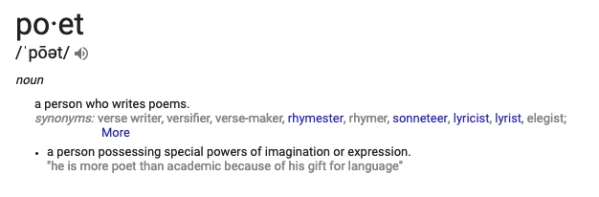
Sometimes it’s fun to look up words we already know. Today I looked up poet.

poet

Don’t you just love the second definition? I’m thinking superhero with a pen.


Amy Rasmussen began writing love poems in 6th grade about her boyfriend Frankie, but somewhere along the way of life, she lost her love of poetry. She’s since read Good Poems and all the poetry of Billy Collins. Aimless Love is her favorite. She’s always on the lookout for new poems to write beside. This is a new favorite. She’s not sure why. Follow Amy on Twitter @amyrass 

Fine, Let’s talk Anchor Charts!

As she dropped her backpack onto her desk during a recent passing period, a student asked, “Mr. Moore, where are the walls?”

“I don’t know. I haven’t seen them in ages,” I replied, as I tidied up my library shelves, shoving books back into their alphabetical order.

“But they used to be right there, and there, and two more, there and there,” she pressed, a hint of confusion sneaking into her voice.

I paused for a moment, thinking, before saying, “When was the last time you saw them?”

“I can’t remember.” she replied, slumping down in her desk, reaching for her book.

Finishing up my book shelving task, I took a second to consider what she was trying to tell me. Surveying the panorama of my classroom all I saw were giant white sticky notes.  I thought I heard a faint intake, a gasp for air, as if the old walls were struggling to breath, suffocated by their new decoration. Hardly any of the burgundy paint showed through. Instead, the walls were decorated with the tapestries of learning, covered by curtains of craft and content; literacy lessons.

img_5305

This is just the front of my room.

These new walls are better than the old walls. They aren’t frozen in place; a testament to tax dollars. These new walls are mobile – the kids carry them, accessing their information wherever they read and write. Earthquakes can’t wrench these walls from the foundation, nor can they be melted by flame.

I catch a lot of flack for the appearance of my anchor charts. I mix up the colors, try to use shapes, and squiggle my lines. My chart-writing improves daily, yet still my “man handwriting” is criticized by my colleagues and the kids make me re-write words until they are perfectly legible from the moon.

img_5298.jpg

Please consider my feelings. I tried to use fun letters at the top.

Not all charts are created equally.

First of all, the chart paper can’t be some namby-pamby (made up words) semi-stick, off brand, weak-sauce chart paper.  I want the super adhesive, never fall off the wall paper that I can move around, frantically pointing from one chart to another, connecting ideas, pulling their thinking from a previous lesson to connect to a new one.

Some charts find themselves arrayed with other, like-minded charts, like a file folder.  Others are stacked together to save space. Oftentimes, the students ask amazing questions that I answer, not by re-teaching something we’ve already covered, but by pointing to the appropriate anchor chart and then analyzing the looks on their faces to determine if I need to drill deeper or leave them be.

I’m not the only one doing the pointing.  Anchor charts multiply the number of teachers in the room.  Maybe one kid elbows another, confused.  The elbowed victim points to the board, or the wall, before refocusing on their work.

The universal usefulness of anchor charts helps all of our learners. Inclusion teachers are masters at using our anchor charts. My English learners lean on them frequently.  Don’t, however, think that the GT/Pre-AP kids don’t use them.  They do, almost as much as anyone.

img_5297

Somehow, I’ve assumed the mantle of “Anchor Chart Guy.” This means that whenever I bop (stroll? strut?) into the classrooms of other teachers, they demand I cast my gaze upon their anchor chart collections, beaming with teacher pride.  For me, anchor charts have become a shibboleth.  You either know how important they are or you don’t, and I pity those who fall in the “don’t” category.

We share anchor charts on our team.  Often times, we will do each other the favor of snapping a picture of a chart and uploading it to our team planning pages in OneNote. I’ve walked into my teammates classrooms and noticed specific, amazing anchor charts, only to have he or she tell me it was stolen…from me!!! Conversely, I might see one of hers (or his) that appears particularly useful, and I’ll snap a picture of it with my phone, storing that idea for later.

img_5299.jpg

We even started an Anchor Chart Hall of Fame in our OneNote planning notebook. Mostly as a joke…mostly.

I counted my anchor charts on Friday.  There were forty.  I wasn’t surprised. Those who know me won’t be either.


Charles Moore wants to learn more anchor charts. If you know of a book that is particularly insightful to this idea, please let him know.  He’s also looking forward to the weather, and therefore his pool, heating up. And crawfish. Always crawfish.  One last note, if you run into him, ask him about the Saga of the Lost Charm Bracelet.  You won’t be disappointed.  Check out his twitter feed at @ctcoach.

Why I’ve Started Getting Feedback on Writing Conferences

Of course, one of the best indicators of success with conferring (or applying mini lessons or using mentor text moves or utilizing feedback or adapting a quick write…) appears in student writing. Did the student try time cues in her This, I Believe piece after examining the mentor? Yes, I can see that application. Did the student use the strategy of highlighting important lines in the essay and then rearrange them to build a poem? Yes, the drafting shows the highlighted essay, and the poem synthesizes those powerful lines. This is feedback, information I can use to continue to tweak, modify, adjust, and adapt how I confer with writers.

One day recently, though, I thought: I should ask my students to assess the conference. Maybe what compelled me that day originated from working with Making Thinking Visible and a desire for my students to make more concrete a thoughtful conference–one involving curiosity, creativity, and connection from student and teacher. Maybe it originated from Cornelius Minor’s We Got This and an increased urgency to seek more direct feedback from students (in the most unobtrusive ways). Maybe it originated from observations that some of my students seem reluctant participants, participants who lack experience with this kind of conferring. Maybe it originated from my deep desire to anticipate and insure that I meet everyone’s needs.

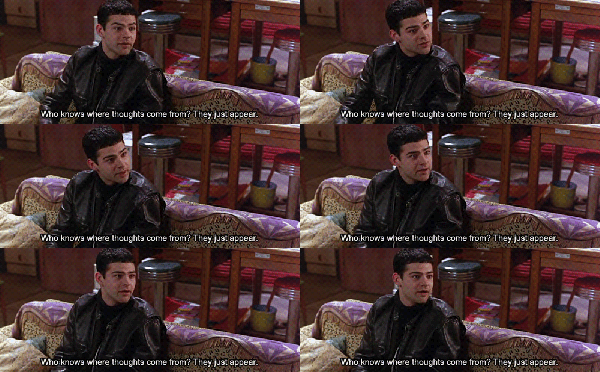
7-Empire-Records-quotes

*From Empire Records

Whatever the genesis that day, I knew a simple strategy, one my instructional coach used with me. When experimenting with a collaborative multi genre research project this fall, I realized I had little experience with group conferring. So, I invited my instructional coach to observe. He scripted each of the three conferences; he asked me to assess the conferences based on a scale of 1-10 (this is a Jim Knight instructional coaching strategy); he and I then described what we noticed. Looking back, we kept the “source of truth” (in the words of Marcus Buckingham and Ashley Goodall in “The Feedback Fallacy” featured in the Harvard Business Review) of the words with me, allowing me to examine my conferring practice without a sense of external judgment.

IMG_3340

**Notes my instructional coach took

In these 10 minute conferences, I learned that . . . I asked a lot of questions, between 10-15; I paraphrased regularly; I directed them to mentor texts; I offered micro lessons. Though I assessed no conference higher than an 8/10, and though I wondered if I questioned my groups to death, I noticed ultimately that I exercised flexibility, stretching in the direction of my groups’ needs. Yet at the time, I wasn’t sure what would constitute a 10/10 in my assessment. But now I’m sure what I’ll need to try to reach this (well, almost sure). Student assessment. Because what I see manifested in their writing makes visible only some of the effects of conferring (if any at all!).

So, on that recent day, I tried it. To my students, I had not indicated I would do so nor had I trained them for what the numbers could mean, nor given them any other parameters. With the handful I tried this with, here’s what I noticed:


  • It affirmed my writers’ needs were met. A few were quick to offer a 10/10 rating (surprising me with their smiles and affirming nods) because they “got what they needed”–had their questions answered, discovered next steps, or received resources they could further collaborate with.  
  • It prompted reflection. One offered an 8/10 rating. Upon seeking explanation, the student explained that the conference may have been more valuable had he been more prepared with his writing; there was a limit to the benefits of the conference when his writing was not as “ready.”  
  • It cued them to symphonize. When directed to explain their rating, the students then engaged in integrating their thinking with my noticings, reactions, or inquiries into their writing, an orchestration of thought that helped them internalize next steps.
  • It compelled me to remember that my perception of success in these conferences was just that: my perception.

Possible Next Steps

  1. More routinely ask students to assess our conferences and offer explanations, and then keep a record of these so I can see patterns across a student or through a room over time;
  2. More routinely self-assess conferences and record my self-assessment and why so as to study my practices;
  3. Assess the conferences for different skills or effects–academic or affective (modeling of a strategy, level of safety, etc.);   
  4. Video select conferences to assess and study OR invite my instructional coach to script.  

True to when my brain puzzles over any novelty (book, song, teaching strategy), I’ve been testing this outside the classroom. The other night, working with my son as he practiced cello, I asked him to rate, on a scale of 1-5 (which seems a more manageable range for a ten-year-old), his performance of “Lightly Row.” He assessed it at a 3; I asked why and he explained. Then I asked what he thought he should work on, and since he wanted to get it up to a 5, he took charge of figuring out what he needed to do to perform at that level. Music to my ears.

group of people

Photo by Mark Angelo on Pexels.com

When I confer with my students, I can orchestrate even more opportunities for growth, especially when I discover ways like this to share the baton.

Kristin Jeschke teaches College Prep English and AP Language and Composition at Waukee High School in Waukee, Iowa. She’s been trying to work on feeding her writers and herself in 2019, and she appreciates how this sounds in her classroom.


Popular Titles for Middle School Students

Lately I’ve seen several twitter and facebook posts asking for “must-purchase” titles for classroom libraries and book clubs. It’s that time of year – the time when we order for next year and cross our fingers that it all arrives by the first day of school.

Ordering titles for our classroom libraries is no joke, so I love seeing how thoughtful people are about it.

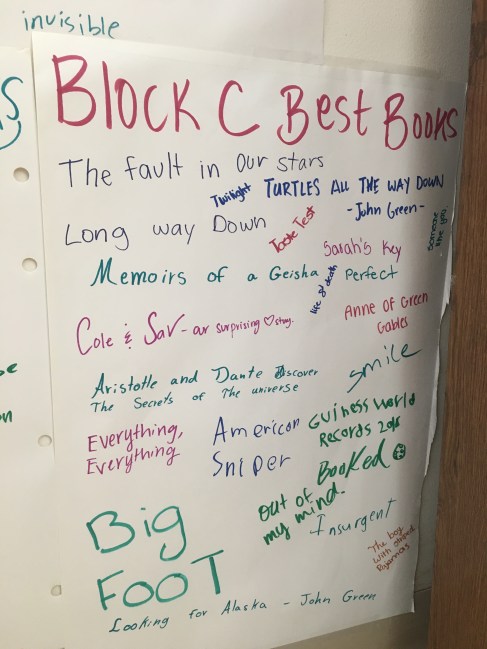
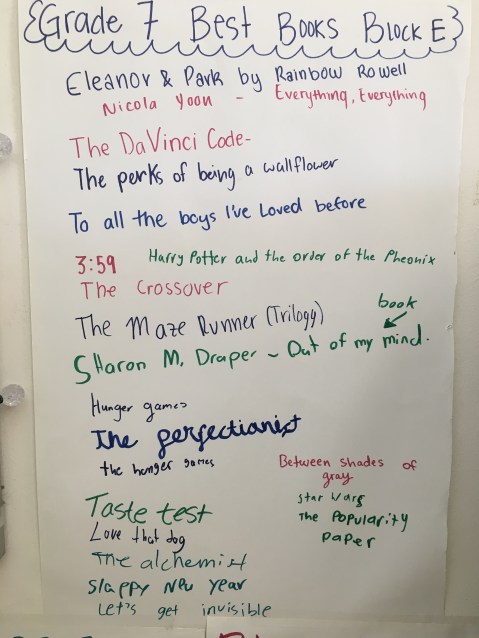
I thought I’d check in with my students to find out how they might answer that question, so I asked them what their best books of the year have been so far. They wrote about it and talked about it, and then I had them publicly post their titles so that other students could get inspired to read new titles, add to their next reads lists, or think about new titles for summer reading.

Here’s what we came up with:

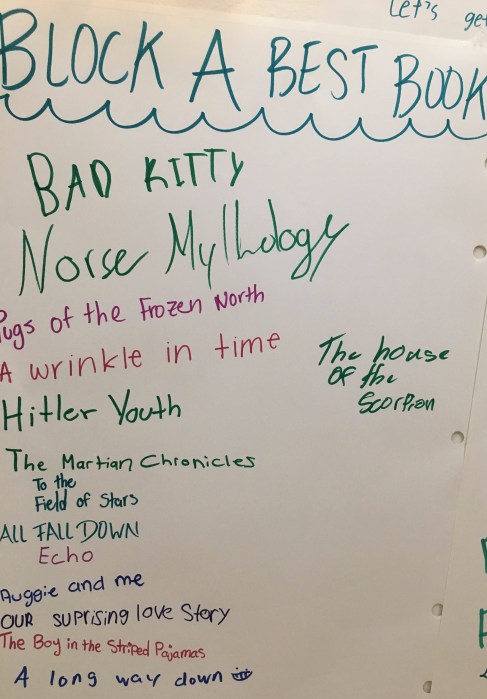
Block A Best Books

Bad Kitty, Norse Mythology, Pugs of the Frozen North, A Wrinkle in Time, Hitler Youth, The Martian Chronicles, To the Field of Stars, All Fall Down, Echo, Auggie and Me, Our Surprising Love Story, The Boy in the Striped Pajamas, Long Way Down, The House of the Scorpion

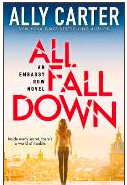
All Fall Down by Ally Carter has been a big hit with several of my seventh grade girls. All Fall Down Cover

It’s the first in a mystery series, and three of my seventh-grade girls have read all three of the books in the series since I added it to my classroom library in January. It’s led one of them to read some of Ally Carter’s other books, and they have had some fun and authentic discussions about these books, which is always fun to witness.

Block C Best Books

The Fault in our Stars, Twilight, Long Way Down, Memoirs of a Geisha, Turtles All the Way Down, Sarah’s Key, Everything Everything, Big Foot, Looking for Alaska, American Sniper, Smile, Booked, Guinness Book of World Records, Anne of Green Gables, Perfect, Out of My Mind, Insurgent, Aristotle and Dante Discover the Secrets of the Universe, The Boy in the Striped Pajamas

Aristotle and Dante Discover the Secrets of the Universe moved one of my readers to tears.

Aristotle and Dante cover

This student literally hugged her copy when she was done with it, and while she is a prolific reader, this one made it to her “top book” award. If this student recommends it, then I’m sold.

Block E Best Books

Eleanor and Park, Everything Everything, The DaVinci Code, The Perks of Being a Wallflower, To all the Boys I’ve Loved Before, 3:59, Harry Potter and the Order of the Phoenix, The Crossover, The Maze Runner, Out of My Mind, The Hunger Games, The Perfectionist, Taste Test, Love that Dog, The Alchemist, Slappy New Year, Between Shades of Gray, Star Wars, The Popularity Papers

Out of My Mind seems to be a game changer for a few of my seventh grade readers.

Out of my Mind cover

Somehow, this sweet story of an eleven-year-old girl who is drastically underestimated has reached some students who I never would have pegged as liking “this kind of book.” One boy in particular has said it’s the best book he’s ever read, and if I could translate the look on his face into words, you wouldn’t doubt it.

Hopefully these titles my students shared will help with some of your purchasing choices this spring.

One thing to notice is that these titles aren’t the latest or newest publications, but they are fairly recently published, for the most part.

I think the important piece is not that we have the newest and hottest titles (not that it doesn’t help!), but that we realize that variety and availability are what matter. To illustrate this point, I’ll share an example: I purchased about 150 “new” books for my classroom library over the winter break, brought them back to Nicaragua in my suitcases, book talked them daily, and made them available to all of my students.

Variety and availability have made a significant difference in the reading habits and attitudes of many of my students. I didn’t spend a lot of money – some of the books I purchased second or third hand for fifty-cents apiece. I’ve reinforced the paperback covers with packing tape, and it helps. The point is that the books are readily available, and I know what I have in my library, I know my readers, and I can do my best to play matchmaker between book and reader.

How do you choose books for your classroom library? What are some of your must-haves?

Julie has been teaching secondary language arts for twenty years, spending the first fifteen in rural Central Oregon, and the last four in Amman, Jordan. She’s thrilled to report that she and her family have moved across the world to Managua, Nicaragua this year, where a new adventure has begun.

Follow her on twitter @SwinehartJulie