Category Archives: Community

How do you read enough to match students with books? #3TTWorkshop

Questions Answered (1)The verb is the key. How do we read enough in order to help students find books they want to read? We read. We have to read — a lot. And we have to know our students.

The reading part is fairly simple. Well, as simple as carving out the time for it, which I know can be a challenge. Maybe it’s a matter of belief. I have to believe my time reading books I may not normally choose for myself will be worth it. I have to believe that YA literature has substance. I have to believe that my students will read, and most likely read more, when I can recommend books because I have read them.

We find time for the things we value. Simple as that. If we value our readers, we must do the things that help them want to read, and reading books that appeal to adolescent readers is a major part of it.

Book Stack

My Current To Read Next Stack

Personally, I like books in print because I like to save favorite sentences and passages that I might be able to use for craft lessons as I read. But audiobooks are a time saver I trust. I usually have at least two books I’m reading at any one time, hardcopy and in Audible. (I started The 57 Bus by Dashka Slater yesterday; I’m halfway through listening to There There by Tommy Orange.)  And honestly, there are some books I just can’t finish, but that doesn’t mean I haven’t read enough to know if I might have a student who wants to give it a try. I can read enough to know if a book might engage one of my readers.

I have to know my readers. The best way I know to get to know them is by talking to students one on one.

Again, the time issue.

Short personal writing can be a real time saver, especially at the beginning of the year or a new semester. Lisa’s Author Bio idea is one of my favorites, ever. I also like to use Meg Kearney’s Creed poem and have students compose their own. Writing like this gives students permission to show themselves, and it gives me an invitation to see into their lives. This is what I need to help match students with books.

A follow up question to the How do you read enough . . .? is often:  How can I find books my students will want to read? or What are some great books for seniors? for 7th graders? for sports enthusiasts? for dog lovers? for a student born in Pakistan? for a group of kids into becoming Insta famous?

I don’t know.

Your school librarian will, most likely.

(Really, I may have some ideas for a few of those questions….but that’s not the point.)

Create a partnership with your school librarian. Hopefully, you still have one. This person loves books and advocates for books and readers. This book expert is a friend to self-selected independent reading, and this professional has access to book lists with descriptors and synopses. (And sometimes funds to add books to the school library.)

Of course, you can find all kinds of book lists online:  Pernille Ripp posts great lists on her blog. The Assembly on Literature for Adolescents of the NCTE (ALAN) shares picks. Young Adult Library Services Association (YALSA) has Best of the Best lists. Edith Campbell recently posted a list of 2019 middle grade and YA books, featuring and written or illustrated by Indigenous people and people of color. And, of course, this list I crafted before Christmas — all recommendations from the contributors on this blog.

To make self-selected independent reading work, which is a vital part of an authentic literacy focused pedagogy, we have to do the work. We have to read, and I wish I could remember where I heard it first:  Reading YA literature is a powerful form of professional development. Isn’t it?

Amy Rasmussen reads a ton of books on the porch, in the yard, by a pool, on her bed in North Texas. She will be spending a lot of her summer with teachers facilitating PD around readers-writers workshop in secondary English classes. Her favorite. She’s also going to be doing a lot of writing. And a little poetry study at the Poetry Foundation Summer Teachers Institute in Chicago. Follow her @amyrass


Rethinking Summer Assignments

black and blue plastic pen non top of black covered notebook

Photo by rawpixel.com on Pexels.com

Ahh…Summer reading…

For some of us, summer reading means lounging by the pool reading something that isn’t school related. Maybe we’re soaking in the rays and the books that, if you’re like me, have been piling up on our dressers all year long while we reread Gatsby for the 100th time. (If you’re looking for a great summer pleasure read, I have to suggest Daisy Jones and the Six. It was fantastic. Definitely listen to some Fleetwood in the background while you read the novel.)

For others of us, summer reading means sitting down with our arsenal of sticky notes and highlighters and InkJoy Gel Pens to catch up on some professional reading because, you know, we spent the year rereading Gatsby for the 100th time. Gotta love that green light and the bae across the bay plotline! (If you’re looking for a solid professional summer read, I highly suggest Why They Can’t Write. It’s prompted some interesting conversations and some thoughtful reflections for me.)

I plan on partaking in both kinds of summer reading – the more traditional for pleasure books and the I can’t stop thinking about teaching for pleasure books.

For our students, however, I wonder how many of them look forward to their summer reading. I wonder how many of them find value in their summer assignments besides the assignment just being a hoop to jump through.

I do think there’s value in summer reading assignments. Summer slide is real, and I like my classes to come in to the first day with something more to discuss than the syllabus. I also teach at a highly competitive magnet school, and summer work is one of those unstated expectations for AP classes.

So all of these ideas were running through my mind when thinking about my summer assignment for AP Seminar – a new course we’re offering for the first time next year. I knew that the students were expected to complete something over the summer. I knew that I wanted their assignment to have some choice involved. I knew that I didn’t want the assignment to take all summer, but that it should be meaty enough that we could start discussions at the beginning of the year. A lot of boxes to check. The brilliant Hattie McGuire came to the rescue. She posted her ideas of offering a summer writing invitation instead of a summer reading assignment. After talking with her, I tweaked some of her ideas to fit my environment.

Here’s the assignment:

I wanted my students to continue to think critically and inquisitive about the world around them, to take stock of their surroundings and experiences and to try to push their thinking further by asking themselves, “I wonder…” until they couldn’t wonder (or in some cases, wander) anymore.

So in an attempt to spend part of the summer writing and to cultivate a researcher’s mindset, each student will create 42 entries in a “Curiosity Journal.” Each entry will catalogue an observation/problem/question about their day and an attempt to take that observation/problem/question as far into “I wonder territory” as possible. We’re calling this part “further implications.”

A sample entry might look like this:

I observed that the extremism of Marie Kondo’s method of cleaning was very cathartic for me personally, and the house does feel less cluttered, but I wonder what good I’m truly doing by donating all of my unwanted junk to Goodwill.

My further implications for this observation might be: In participating in this behavior and in giving my stuff to Goodwill, I’m making the assumption that other people want my junk. I wonder if I’m doing good with my leftovers. This makes me think of disaster relief efforts and how often we send out crappy sloppy seconds to people who are truly in need. We do offer our stuff because doing so makes us  feel better, makes us feel useful, but I wonder if it’s actually useful for those people in need. I also wonder if it’s better to just throw all of this stuff away in a landfill. I wonder if there are other, better options for donation besides Goodwill. I find that the trend of minimalism goes against the consumerism of American society – it’s counterculture but it’s also pop culture, which is interesting. We’re overwhelmed by our stuff, which should make us question why we have all of this stuff to begin with in the first place. I also wonder how long I can keep up this minimalism streak until I’m back in Target buying another throw pillow. I also notice that there’s a lot of privilege present in even being able to KonMari my home. I wonder what the implications and effects of this privilege are?

So after a run of seven observations, students will choose one problem or question to pursue a little bit further by finding one external source that deepens their understanding of the issue, offers another perspective, or adds to their further implications. They’ll write about this new piece as well.

We’ll begin our first day of class discussing our favorite observations and, hopefully, the rabbit holes our observations led us down, maybe sparking a conversation about research and questioning. I’m hoping to find trends in the kinds of problems/questions/observations my students noticed that could begin to facilitate a conversation about what all of this says about who we are as people or how society works. I plan on using their Curiosity Notebook as a jumping off place for our individual introduction conferences that will happen during the first two weeks of school.

Mostly, I’m hoping that this assignment will keep students writing and reading and thinking over the summer about ideas that they’re interested in.  I’ve linked the assignment here if you’re interested.

Happy reading – whatever you’re reading, I hope it’s good!

Sarah Morris teaches AP English Language, AP Seminar and Film as Lit in Middle Tennessee. She’s currently enjoying her first summer as a married woman, spending her time travelling with her husband. You can follow her @marahsorris_cms.


Q & A: How does workshop work to prepare students for college? (Or I love teaching these books) #3TTWorkshop


Questions Answered (1)I’ve been asked this question in several different ways:  How do we do this for college prep courses? How does workshop work in an AP English class? If I’m not teaching books from the canon, how am I preparing students for college? And we’ve written about it a lot on this blog. (See here and here and here and here and here and here for starters.)

Sometimes I think we have misplaced ideas about what is expected of students in college — especially if we were English majors, and our students may not be —  and perhaps some skewed ideas of what rigor looks like when it comes to high school English classes.

I first clued in when I read Readicide by Kelly Gallagher. No doubt, I killed the love of reading — and the love of the literature I loved — the way I “taught” the books I expected my students to read. (Most didn’t.) Since then, I’ve studied, practiced, implemented, revised, and stayed up late thinking about how I need to revise my instruction in order to best meet the needs of my students. All of my students — not just those in a college prep or AP English or those going to college — but every student in every English class in preparation for the rest of their lives. I want them to be fully confident in their literacy and all the gifts that will give them in whatever future they choose.

My students, not just those in advanced classes, or on a college-bound track, need to know how–

  • to think critically about their ideas and the ideas of others
  • to articulate their thoughts in writing (in multiple modes) and orally (with clarity and confidence)
  • to support their thinking with valid sources
  • to revisit their ideas and revise them when they encounter viewpoints that require them to extend, modify, or change their thinking
  • to verify sources, and identify and analyze bias

There’s power in these skills, opportunity and freedom — for our students and for ourselves. We do not need a list of “AP suggested novels” to teach them.

What we need is to build communities in our classrooms where students feel safe to engage in inquiry, share their thoughts, receive feedback, and give themselves to the learning process. Study guides, worksheets, TpT lesson plans, and the same ol’ same ol’ approach to teaching the same ol’ books will not cut it. Just because a book is considered of literary merit does not make the learning around it rigorous. Rigor is not in the text but in what students do with the text. (For more on this, see Jeff Wilhelm’s article “Teaching Texts to Somebody! A Case for Interpretive Complexity“)

What we need is to to know our state ELA standards or the AP English Course and Exam Description as provided by College Board. (I think the AP English Course descriptions scream “workshop.”) Then, begin thinking about and hunting for mentor texts, written in a variety of modes, that 1) prompt students to think in different ways about a different topics, 2) engage students in inquiry and class discussion, 3) spark ideas for research, and all along the way, invite students to write beside these mentors:  What do you think? What do you notice? What do you wonder?

At least this is the genesis of answering the question:  How does workshop work to prepare students for college? There’s so much more to it.

Resources that have helped me:  Write Beside Them and Book Love by Penny Kittle, Dr. Paul Thomas’ blog. Currently reading: Why They Can’t Write by John Warner, and the #1 on my summer reading list Handbook of Research on Teaching The English Language Arts 4th edition, edited by Diane Lapp and Douglas Fisher.

I once did a two day workshop, helping a district coordinator move her teachers into the readers-writers workshop model. In a reflection after our training, one teacher-participant wrote:  “I’ve been teaching for 24 years, and feel like I’ve been told I’ve been doing it wrong all along.” Nope.

But. . .

What if we could do instruction better?


Amy Rasmussen lives in North Texas where she thinks, ponders, and writes about how to motivate, engage, and teach today’s adolescent readers and writers. She will be spending a lot of her summer facilitating PD focused on readers-writers workshop in secondary English classes. Follow her @amyrass — and she’d love it if you follow this blog!


5 Things Students Say That Give Me Life

It seems like each year of teaching is more intense than the last–the highs are higher, the lows are lower, and the chaos is more…chaotic. This year was no exception, and as my 7th and 8th graders leave the classroom this week, I am an exhausted mix of relieved and saddened to see them go.

Each year, while the bureaucracy of school politics, students’ disengaged behavior, and the heartbreak of kids who slip through the cracks drags me into despair, my students are the ones who pick me back up again. They, in their own words, give me life. Here are five standout things students say that lift me up when I’m down.

img_3545

JC creates a blackout poem from a dictionary page.

“This is fun!” The surprise and delight in a young teen’s exclamation about learning being fun never fails to bring a small, secret smile to my face. Learning is fun, engaging, and challenging in equal measures when students have choice, agency, and confidence in their work. My students created blackout poems as part of their final multigenre projects, and many students wrote in their final reflections that this was one of the most memorable activities during our time together.

“Can you conference with me about this?” After leaping right into reading and writing conferences with students when I met them in April, the verb “confer” became a standard in our classroom. Conferences about choosing which books to read, about how to improve a piece of writing, or even about those pesky grade questions take on more gravity than a simple comment here and there. Students learned that conferring was a time for one-on-one conversation, during which the participants were not to be interrupted. With the simple introduction of the term “conference,” the culture of the classroom shifted to one where talk was still vivacious, but was also more focused and productive.

img_3662

Logan shows off his final multigenre paper.

“I’m proud of this.” My middle school students are boisterous at their most basic level, but each time they submitted a best draft of a piece of writing or turned in part of a project they’d worked hard on, they became suddenly shy. They’d look at me, almost confidentially, and tell me quietly, “I’m proud of this,” as they slid their work into a turn-in folder. Their multigenre projects this year were some of the longest and most complex pieces of work they’d created in their middle school academic careers, and Logan’s shy smile sums up their feelings of pride and accomplishment about their pieces.

“You should be proud of your daughter.” During my plan period one afternoon, I was chatting with my mom on speakerphone. A few students walked in with a question, and I told them I was on the phone with my mom and asked if they wanted to say hi. They greeted her and said, “you should be proud of your daughter. She’s an awesome teacher.” This mark of respect made me tear up and embarrass the two boys, but nonetheless it restored my faith in the sensitivity and manners all teens are capable of possessing.

img_3908.jpg

“Now look at me.” My students’ final self-evaluations are some of my favorite things to read each year. Page after page of student writing is filled with students assessing their accomplishments and detailing their own growth. I ask them always to tell me how they’ve changed–something they don’t always know until they begin writing about it–and this year I was floored by one student’s response. Her struggles with addiction began at a young age, and as she found a more stable home and her life improved, she transformed herself into an avid reader and writer. This powerful self-assessment–“Now look at me! I’m a writer, a poet.”–floored me. It was a forceful reminder that literacy saves lives.

As difficult as a school year can be, I just keep coming back for more–and the students are really what keep me in the classroom. Each May, as my will wilts from the stresses of testing and schedule interruptions, my students’ energy and vitality give me life at the end of each year…just when I need it.

What do your students do to give you life? Please share in the comments.

Shana Karnes teaches in West Virginia, but only for three more weeks. She’ll be moving to Wisconsin with her family, her books, and her love of teaching. Connect with Shana on Twitter at @litreader.

Q & A: How do I keep my students reading throughout the summer?

Questions Answered

Let us know if you have questions about readers-writers workshop. Throughout the summer, we’ll be posting answers.

Don’t you just love this question so much more than “What do you do for summer reading?”

Of course, we know to get to the “keep my students reading” part, we have to do a lot of work — sometimes a whole lot of work — to get some student reading throughout the school year. And those of us who give so much of our time to this heart work of reading, can feel sad, anxious, and exasperated when our students leave us and get “assigned” a book, or more than one, for summer reading.

For several years, my AP Lang students, many who were second language learners who took a courageous leap to tackle an advanced English class, would read stacks of self-selected books, and grow exponentially as readers, only to get handed at the end of their junior year a summer reading assignment and a list of study questions for AP Lit. Beowulf. This is problematic on so many different levels — but entirely out of my control. What could I do?

The only thing that made sense at the time was to encourage my students to form their own summer book clubs. I suggested they might set some goals to read their assigned text first, and then meet together to talk about it — similar to what they’d done in class in the three rounds of books clubs we’d done throughout the year. Then, they could choose another book and meet up again. Students took it upon themselves to circulate an interest form, and most students wrote that they were interested.

It didn’t really work. I was too busy in the summers to commit to keeping the idea alive. And we all know soon-to-be-seniors, or many teens for that matter:  Procrastination is their BFF.

I still love the idea of summer book clubs, and I know some schools are having great success with them. Hebron High School is one of them. The English department at Hebron is doing amazing things to cultivate a culture of reading, not just during the school year, but throughout the summer as well. They open the school library every Wednesday afternoon, so students can select books — and get coaching for college essays. They’ve got book clubs scheduled with teachers and coaches. They’ve got a wish list for books circulating within their community. Really fantastic ideas to keep the focus on the power of reading.

Scholastic recently released a report about summer reading trends. The report states that 32% of young people ages 15-17 read zero books over the summer — up 10% in two years. The report also states that “53 percent of kids get most of the books they read for fun through schools—so what happens for that majority when school isn’t in session?”

It doesn’t take much to know the answer. So what can we do? Besides following Hebron’s lead, here’s a few ideas:

  • Talk up your public library! Invite a librarian to come visit your classes, and get students to sign up for library cards. One of my biggest regrets at my last school is that I didn’t take my 11th and 12th grade students on a field trip to the public library. We could have walked — the library was that close. I know the majority of my students had never been inside, and every year I thought what a great activity this would be. Every year I didn’t do it. #ifIcouldgoback
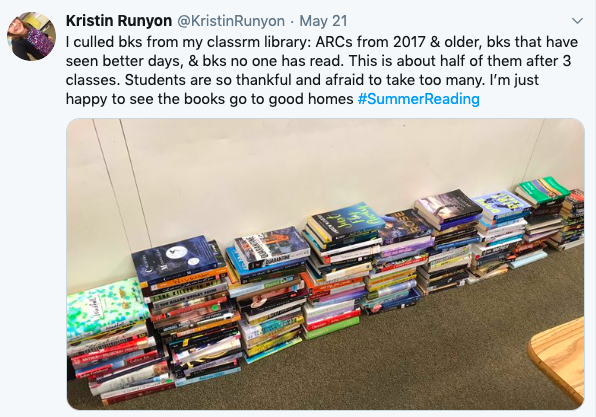
  • Cull your classroom library, and let students take home books. I know. I know. Many of us invest so much time, energy, and money building fantastic classroom libraries, and we lose enough books throughout the year without giving them out freely at the end of it. But, really, what can it hurt? Every year I’d pull books that I felt I could give up and put them on the whiteboard rails for students to take home for the summer. (Sometimes they even brought them back.) It didn’t matter. I’d rather have books in kids’ hands than hidden under butcher paper in my closed up classroom. Kristin does, too:tweet about giving books
  • Give students access to lists of high interest and award winning books —  and free resources. Pernille Ripp shares her students’ favorite books each year. YALSA has great lists. And a cool new Teen Book Finder. BookRiot published “11 Websites to Find Free Audiobooks Online.Audiobook Sync gifts two free audiobooks all summer. Great titles, too!
  • Invite students to talk to you about their reading. Yes, even during the summer! Lisa does this in a slowchat on Twitter with students who will be in her classes in the fall. Students tweet her updates about their reading lives. She tweets back. It’s a great way to build relationships and share book ideas.

Every year I feel like I could have done more to keep my students reading throughout the summer. The truth is — we can only do what we can do. Sometimes it touches the right student at the right time. Sometimes we just keep trying.

I’m sure you have more ideas. Please share them in the comments.

Amy Rasmussen lives, gardens, and rides her bike in North Texas. She will be spending a lot of her summer with teachers facilitating PD around readers-writers workshop in secondary English classes. Her favorite thing. She’s also going to be doing a lot of writing. And a little poetry study at the Poetry Foundation Summer Teachers Institute in Chicago. Follow her @amyrass


On Slow Stylists and Teaching Writers

My hair and North Texas humidity are not friends. I can fix my hair in the morning, take one tiny step outside, and floop — it’s like the photo next to the word frizz in a picture dictionary.

I need help with my hair.

Not long ago, I had to find a new stylist. I’d seen my hair pro for going on 20 years — through short and kinda long and short again and kids’ friends and schools and graduations. I didn’t even know I had attachment issues until I called to make an appointment and learned Vivian had moved to another salon. They would not tell me where.

You may know how hard it is to find a new stylist. Overwhelming and risky come to mind. I just couldn’t deal with it — so I went cheap. I saw a random ad on line for “models” and took a chance on a “stylist-in-training”.

Photo by Markus Spiske on Unsplash

And it was good.

Well, it got good. First, I waited 35 minutes just to get in the chair. I learned why as Emily tentatively combed and cut in tiny snips. She was S.L.O.W. but cheerful, eager, and excited to put the skills she learned through lecture and video into hands-on real-hair practice. Emily’s “expert mentor” stood to the side, giving tips and clarifying process the whole time. Then, when Emily thought she was done with my cut, the mentor picked up the comb and scissors, checked each section for wayward hairs, and reviewed the moves Emily had just made to create my style.

Of course, this all reminded me of teaching writers.

Awhile back I wrote about slowing down and planning time for students to think and talk and question before we demand they get to drafting. I think planning time applies to other aspects of teaching writers as well.

Here’s three things I’m wondering–

  1. How can we plan time for more talk? Writers write well when they have a solid base of information from which to build their ideas. Purposeful talk can help our writers grow in knowledge, recognize bias, and engage in conversation that pushes thinking. Listening and speaking often receive short shrift in ELA classes. We can change that. We can help students get their hands and heads into real-life practice as they talk about issues, news, and attitudes that fuel their writing.
  2. How can we plan time for more questions? When writing, questions often lead to answers. I teach asking questions as a revision strategy:  Students read their peers’ writing and can only respond with questions that prompt the writer to add more detail, include examples, develop thoughts more fully, etc. This takes practice, but it’s the best approach I’ve found so far in helping students question their own writing. (See Start with a Question for more on how questions aid writers.) We can give tips and clarify process — and help students work together to improve their writing — when we spend a little time helping them ask good questions.
  3. How can we plan time for more conferring? A few years ago, I asked my students how best they wanted me to help them improve as writers. These high school juniors overwhelmingly asked for more one-on-one. I was kind of surprised: Teens wanted to talk to me moreSeriously, they did. These writers understood they were all at different places with their language skills and writing abilities, and they knew the value of our conferences. Undivided attention, sometimes just noticing, even for a brief few moments, can make a world of difference to a writer. Sometimes we instruct. Sometimes review. Most often we just listen.

I left the salon that day 2.5 hours later — the longest I’ve ever spent in a salon. Time didn’t matter to Emily. She wanted to do well, truly practice her new skills, and create a cut she’d be proud of. I know we feel rushed and crushed in our English classes, but there’s a lesson here:  How can we slow down in order to maximize the time our students need to grow as writers?

In case you’re wondering, I like my cut, but I’m still battling Texas weather.


Amy Rasmussen loves working with student writers and their teachers. She thanks her family and friends for their time: generating ideas, reading drafts, proofing, editing, encouraging. And she thanks you for all you do for readers and writers everywhere. Follow Amy on Twitter @amyrass

What I’ve read in 2019, So Far!!!

I’m not finding a lot of reading time this year. Maybe it’s graduate school. Or maybe it’s that I’m just really lazy. I’m up to 14 books in 2019. I’d say that’s a pretty respectable number, but what strikes me is the quality of books I’ve been able to enjoy as winter has moved into spring, then into summer, then back into spring, then summer, and on and on, ad nauseum…

Amazing Books that Everyone Should Read Right Now!!!

40519254Shout by Laurie Halse Anderson

Speak was one of the books that sent me, several years ago, on this YA journey.  Shout is Anderson’s memoir-in-verse that inspired her to write Speak. Every girl needs to read this book, and so does every boy.

img_5084For Every One by Jason Reynolds

A book everyone needs to read to themselves and to each other. We need more books just like this.  Some might breeze through this book book in a hour or less. Others might savor every page, basking in the wisdom of Reynolds.  This book is a mentor text gold mine.


On the Come Up by Angie Thomas

GREATEST YOUNG ADULT NOVEL I HAVE EVER READ!!!! Must I say more? I will. This book’s protagonist, Bri, let’s the reader see an authentic young adult attempting to find herself in a world she doesn’t totally understand.  I’m an adult that doesn’t understand this world and yet…wisdom abounds. I can’t even…

Sequel Successes and Follow Up Fun!!!

The Vanishing Stair (Truly Devious, #2) by Maureen Johnson

img_5411I loved Truly Devious for so many reasons.  Massive and mysterious Gothic mansion setting? Check! Plucky and intelligent teenage sleuth? Check! Fast paced narrative that weaves in authentic “teenager sounding” dialogue? Check! This sequel is a win for everyone involved and I can’t wait for the final book in the series!!
img_5412

Odd One Out by Nic Stone

I have a nasty habit of moving about 80(ish) pages into a book and then losing interest. I let myself stray to far from this book for too long. When I book talked this book for my students, I noted how it wasn’t so much about a love triangle, it was more of a love circle. The confusion about how we are supposed to feel about ourselves feels authentic, even to this old man.

img_5419Two Can Keep a Secret by Karen McManus

I enjoyed her first book, One of Us is Lying, but this one missed me, somehow.  The plot twist was interesting, but predictable, and I struggled to keep up with the constantly switching points of view.  Me not liking this book may reflect more upon the reader than the writer and I HATE that I didn’t like this book, but reading it wasn’t particularly enjoyable. Others will love it and I will not be a person that denounces it based solely on my own discomfort.

Fun Books that May not be for Everyone

Bull by David Elliot

A book in verse that retells the story of the Minotaur. I didn’t realize how much a book could make me feel uncomfortable, both linguistically and contextually.

We Were Liars by E. Lockhart

If you love twist endings, or are far more intuitive than I am, you will love this book. An examination of total mental meltdown through the eyes of our current generation of teenagers, this book has many layers.

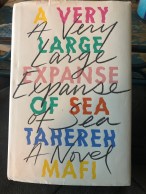
c79cbe95-7c09-4d7e-b25e-f4d26b880aa0-7652-0000007733788706_file-1A Very Large Expanse of Sea by Tahereh Mafi

Another book I let gather dust on my nightstand. The story of Shirin and Ocean.  A girl who clings to her faith in the face of bigotry, while at the same time exploring forbidden love.  Excellent lesson for us all.

The Assassination of Brangwain Spurge by M.T. Anderson

This was a weird, wild book. Don’t believe the words or the pictures, both can lead you astray in this fantasy story about clashing cultures and an unpredictable friendship.

Guilty Pleasures

img_5345Wolf Pack (Joe Pickett, #19) by C. J. Box 

A guilty pleasure, a wheelhouse book.  When I can’t get wait to get to another Jack Reacher story, Joe Pickett is the next best choice. I could see our junior and senior boys loving the easy escapism this book provides.  Like a romance novel for readers with beards.

Verses for the Dead (Pendergast, #18) by Douglas Preston and Lincoln Child

Aloysious X. L. Pendergast is a lone wolf FBI investigator with a mortician’s wardrobe and the gaunt, pale skin to match.  He solves the bureaus most bizarre cases using a combination of inductive reasoning and the focus of a Tibetan monk.  I will never pass on an offering from Preston and Child because they, so deftly, mix intrigue with well crafted prose.

Adrift (Corps Justice – Daniel Briggs #1) by C. G. Cooper

My wife has been trying for at least a year to convince me to read free e-books from Amazon Prime.  This book had an interesting concept, not unlike the books I love from Lee Child. A former soldier finds himself caught up in the middle of a small town turf war and, while he didn’t light the fire, he is more than willing to put it out.  Not that I’m a master of the written word, but having crafted a sentence or two, I can sympathize with an author when I see he or she needs a good editor.


Charles Moore can’t wait to see what the Battle of Winterfell does to his beloved Westeros. He’s trying to be a diligent reader, but he’s not trying as hard as he could be.  He enjoyed seeing the whole family together for the first time in a long time over the Easter Weekend and he’s ready for grad school to be over for the semester.  

Fine, Let’s talk Anchor Charts!

As she dropped her backpack onto her desk during a recent passing period, a student asked, “Mr. Moore, where are the walls?”

“I don’t know. I haven’t seen them in ages,” I replied, as I tidied up my library shelves, shoving books back into their alphabetical order.

“But they used to be right there, and there, and two more, there and there,” she pressed, a hint of confusion sneaking into her voice.

I paused for a moment, thinking, before saying, “When was the last time you saw them?”

“I can’t remember.” she replied, slumping down in her desk, reaching for her book.

Finishing up my book shelving task, I took a second to consider what she was trying to tell me. Surveying the panorama of my classroom all I saw were giant white sticky notes.  I thought I heard a faint intake, a gasp for air, as if the old walls were struggling to breath, suffocated by their new decoration. Hardly any of the burgundy paint showed through. Instead, the walls were decorated with the tapestries of learning, covered by curtains of craft and content; literacy lessons.

img_5305

This is just the front of my room.

These new walls are better than the old walls. They aren’t frozen in place; a testament to tax dollars. These new walls are mobile – the kids carry them, accessing their information wherever they read and write. Earthquakes can’t wrench these walls from the foundation, nor can they be melted by flame.

I catch a lot of flack for the appearance of my anchor charts. I mix up the colors, try to use shapes, and squiggle my lines. My chart-writing improves daily, yet still my “man handwriting” is criticized by my colleagues and the kids make me re-write words until they are perfectly legible from the moon.

img_5298.jpg

Please consider my feelings. I tried to use fun letters at the top.

Not all charts are created equally.

First of all, the chart paper can’t be some namby-pamby (made up words) semi-stick, off brand, weak-sauce chart paper.  I want the super adhesive, never fall off the wall paper that I can move around, frantically pointing from one chart to another, connecting ideas, pulling their thinking from a previous lesson to connect to a new one.

Some charts find themselves arrayed with other, like-minded charts, like a file folder.  Others are stacked together to save space. Oftentimes, the students ask amazing questions that I answer, not by re-teaching something we’ve already covered, but by pointing to the appropriate anchor chart and then analyzing the looks on their faces to determine if I need to drill deeper or leave them be.

I’m not the only one doing the pointing.  Anchor charts multiply the number of teachers in the room.  Maybe one kid elbows another, confused.  The elbowed victim points to the board, or the wall, before refocusing on their work.

The universal usefulness of anchor charts helps all of our learners. Inclusion teachers are masters at using our anchor charts. My English learners lean on them frequently.  Don’t, however, think that the GT/Pre-AP kids don’t use them.  They do, almost as much as anyone.

img_5297

Somehow, I’ve assumed the mantle of “Anchor Chart Guy.” This means that whenever I bop (stroll? strut?) into the classrooms of other teachers, they demand I cast my gaze upon their anchor chart collections, beaming with teacher pride.  For me, anchor charts have become a shibboleth.  You either know how important they are or you don’t, and I pity those who fall in the “don’t” category.

We share anchor charts on our team.  Often times, we will do each other the favor of snapping a picture of a chart and uploading it to our team planning pages in OneNote. I’ve walked into my teammates classrooms and noticed specific, amazing anchor charts, only to have he or she tell me it was stolen…from me!!! Conversely, I might see one of hers (or his) that appears particularly useful, and I’ll snap a picture of it with my phone, storing that idea for later.

img_5299.jpg

We even started an Anchor Chart Hall of Fame in our OneNote planning notebook. Mostly as a joke…mostly.

I counted my anchor charts on Friday.  There were forty.  I wasn’t surprised. Those who know me won’t be either.


Charles Moore wants to learn more anchor charts. If you know of a book that is particularly insightful to this idea, please let him know.  He’s also looking forward to the weather, and therefore his pool, heating up. And crawfish. Always crawfish.  One last note, if you run into him, ask him about the Saga of the Lost Charm Bracelet.  You won’t be disappointed.  Check out his twitter feed at @ctcoach.

Popular Titles for Middle School Students

Lately I’ve seen several twitter and facebook posts asking for “must-purchase” titles for classroom libraries and book clubs. It’s that time of year – the time when we order for next year and cross our fingers that it all arrives by the first day of school.

Ordering titles for our classroom libraries is no joke, so I love seeing how thoughtful people are about it.

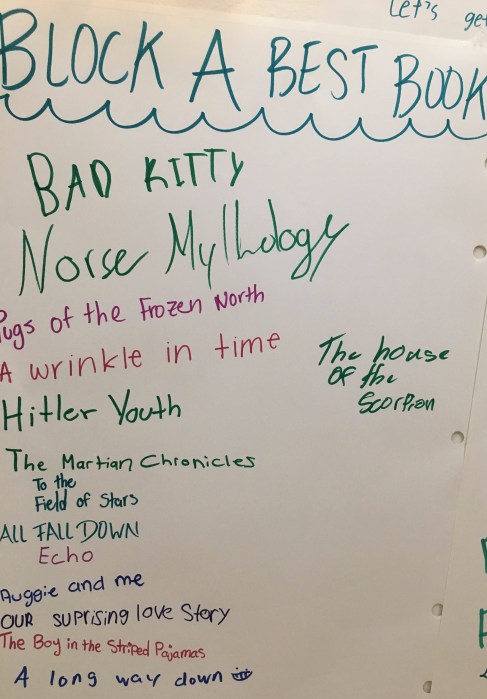
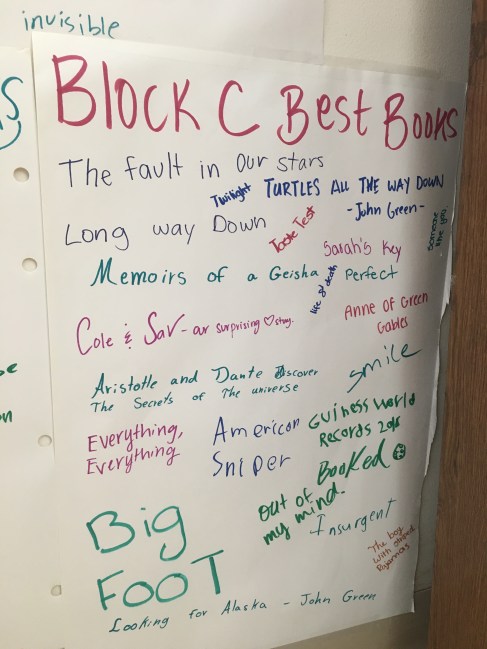
I thought I’d check in with my students to find out how they might answer that question, so I asked them what their best books of the year have been so far. They wrote about it and talked about it, and then I had them publicly post their titles so that other students could get inspired to read new titles, add to their next reads lists, or think about new titles for summer reading.

Here’s what we came up with:

Block A Best Books

Bad Kitty, Norse Mythology, Pugs of the Frozen North, A Wrinkle in Time, Hitler Youth, The Martian Chronicles, To the Field of Stars, All Fall Down, Echo, Auggie and Me, Our Surprising Love Story, The Boy in the Striped Pajamas, Long Way Down, The House of the Scorpion

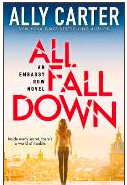
All Fall Down by Ally Carter has been a big hit with several of my seventh grade girls. All Fall Down Cover

It’s the first in a mystery series, and three of my seventh-grade girls have read all three of the books in the series since I added it to my classroom library in January. It’s led one of them to read some of Ally Carter’s other books, and they have had some fun and authentic discussions about these books, which is always fun to witness.

Block C Best Books

The Fault in our Stars, Twilight, Long Way Down, Memoirs of a Geisha, Turtles All the Way Down, Sarah’s Key, Everything Everything, Big Foot, Looking for Alaska, American Sniper, Smile, Booked, Guinness Book of World Records, Anne of Green Gables, Perfect, Out of My Mind, Insurgent, Aristotle and Dante Discover the Secrets of the Universe, The Boy in the Striped Pajamas

Aristotle and Dante Discover the Secrets of the Universe moved one of my readers to tears.

Aristotle and Dante cover

This student literally hugged her copy when she was done with it, and while she is a prolific reader, this one made it to her “top book” award. If this student recommends it, then I’m sold.

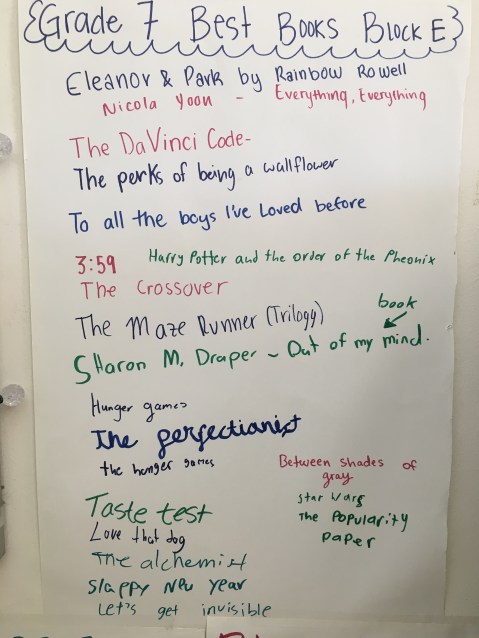
Block E Best Books

Eleanor and Park, Everything Everything, The DaVinci Code, The Perks of Being a Wallflower, To all the Boys I’ve Loved Before, 3:59, Harry Potter and the Order of the Phoenix, The Crossover, The Maze Runner, Out of My Mind, The Hunger Games, The Perfectionist, Taste Test, Love that Dog, The Alchemist, Slappy New Year, Between Shades of Gray, Star Wars, The Popularity Papers

Out of My Mind seems to be a game changer for a few of my seventh grade readers.

Out of my Mind cover

Somehow, this sweet story of an eleven-year-old girl who is drastically underestimated has reached some students who I never would have pegged as liking “this kind of book.” One boy in particular has said it’s the best book he’s ever read, and if I could translate the look on his face into words, you wouldn’t doubt it.

Hopefully these titles my students shared will help with some of your purchasing choices this spring.

One thing to notice is that these titles aren’t the latest or newest publications, but they are fairly recently published, for the most part.

I think the important piece is not that we have the newest and hottest titles (not that it doesn’t help!), but that we realize that variety and availability are what matter. To illustrate this point, I’ll share an example: I purchased about 150 “new” books for my classroom library over the winter break, brought them back to Nicaragua in my suitcases, book talked them daily, and made them available to all of my students.

Variety and availability have made a significant difference in the reading habits and attitudes of many of my students. I didn’t spend a lot of money – some of the books I purchased second or third hand for fifty-cents apiece. I’ve reinforced the paperback covers with packing tape, and it helps. The point is that the books are readily available, and I know what I have in my library, I know my readers, and I can do my best to play matchmaker between book and reader.

How do you choose books for your classroom library? What are some of your must-haves?

Julie has been teaching secondary language arts for twenty years, spending the first fifteen in rural Central Oregon, and the last four in Amman, Jordan. She’s thrilled to report that she and her family have moved across the world to Managua, Nicaragua this year, where a new adventure has begun.

Follow her on twitter @SwinehartJulie

No Accountability Book Clubs

Prior to starting a round of Book Clubs with my AP Lit students, I questioned what would be a “just right” accountability fit for my very different first and fourth periods.  Third quarter always hits juniors hard.  It is a reality check that changes are ahead.  It seems to be the time students are in full swing with clubs, theater, sports, and other projects.  My students are invested in their independent reading, with many switching between texts they can use on the exam and fun YA selections, and developing reading identities.  My students are also chatty and friendly–Book Clubs seemed like a perfect fit at this point in the year.

But how to keep students accountable in a non-punitive way when they’re already overbooked.  I thought about my goals for the Book Clubs, which extended far beyond adding another text of literary merit to their tool belts for question three.  I wanted them to read, to engage, to think.  For students to have fun meeting together to discuss books like adult readers do.

For some, a bit of accountability helps spur their reading and processing.  I have many students who like to document their thinking with annotations or dialectical journals and be rewarded for their visual thinking.  I understand that. For others, a bit of accountability becomes a chore that interferes with their engagement. Students have reflected that tasks associated with reading pull their focus away from the text and onto the assignment.  I get that, too.

I have been ruminating over my grading practices this year, taking notes on what is helpful and what can change next year as we progress, seeking practices which keep students accountable in non-intrusive, authentic ways.  Letter grades in the English classroom can be tricky. Our content lends to subjectivity when grading. Add in the pressure for college-acceptable GPAs and authentic learning can be lost in the quest for an “A.” It can be difficult to accurately measure understanding, as well as the more essential habits for success beyond our classrooms–effort, improvement, depth of thought and questioning–with five letters.  I am trying to shift from grades and points to accountability, effort, revision, second-laps, and reflection as tools for building skills and taking risks. I want anything I evaluate to have meaning and to be balanced by a lot of low stakes participation, effort, and reflection.

Book Clubs are like independent reading, just a bit more social.  Why grade it with check-listy parameters?  I wanted students to read, engage, and think with one another.  To come to the table with questions, thoughts, and connections, like a college student would.  To process challenging books together, like an adult book club would.

So I decided I would assign no accountability checks.  Nothing. I only asked students to be accountable to one another, as adults would be in a “real” book club each week, with the schedule they set.

Knowing they wouldn’t be receiving a tangible grade or reward, I was concerned students would see this as an invitation not to read deeply, or that some wouldn’t feel invested in the payoff. However, my hope that our months of community building and sharing in reading experiences as readers outweighed my tinges of fear.  Why not step aside and set them free?

I gave Thursday’s class period over to the Book Clubs and student-driven conversations with the ask that students use the class period to process together.

Students owned it.  

There wasn’t a lull in conversation on Thursdays.  Student groups chatted with each other while I circulated and enjoyed their voices and insights.  I wasn’t roaming the classroom with a clipboard or checking an assignment in while half listening. I was a floating member of each club (hence why there are no pictures accompanying this post!).

I noticed there were discussions about the gray areas of the books, like what is the Combine Chief Bromden references and what the heck happened to Nurse Ratched to make her the adult she is in One Flew Over the Cuckoo’s Nest.  I noticed the crew reading Ceremony worked to make sense of the non-linear structure and researched the myths of the Laguna Pueblo people. Readers of Brave New World connected the text to Oryx and Crake, a summer read, as well as our world.  Readers of The Road hypothesized on the events before the book begins.  Many students annotated their books, kept a notecard of questions to ask one another, took notes during the meetings, and referenced the text throughout their discussions.

There was no need to dangle a carrot in front of their noses or keep track of data to issue a grade.  Students did the work because the elements were there:  choice, time, conversation.  They made meaning together, employing the habits developed throughout the year while practicing being adult readers–readers who read, engage, and think in a realm where there isn’t official accountability to turn in.

I’m not sure what my digital gradebook categories will look like next year, what practices and procedures I will put into place to promote authentic accountability, but I know I will challenge myself to step aside more often, to trust students will do the work if the environment is right.


Maggie Lopez is entering the fourth quarter in Salt Lake City upon returning from spring break.  She is currently reading Hitler’s Furies by Wendy Lower. You can find her at @meg_lopez0.