Category Archives: Community

Can We Talk? The Silence is Killing Me.

Let me start by acknowledging the following : We all work hard.

Day in, day out, passionately, for hours outside the classroom, over breaks, through the night, in the summer, at the expense of our own health, sanity, and in some cases children, tirelessly, endlessly, hard.

We wrestle with accountability, making the right choices, bankrupting our personal finances, moving in new directions, providing substantive feedback, reinventing our curriculum, and capturing that often elusive “I’m making a difference” feeling.

And all of these opportunities, obstacles, maneuvers, struggles, negotiations, blessings…are well worth the effort. We know this to be true.

We grow. Students grow. The world brightens.

This week, however, a week of extra meetings, assigned readings, professional development planning, ACT Interim test data analysis, sophomore research papers and practice AP tests in all of my classes, has me feeling cranky, irritable, and disenchanted with the whole thing (and apparently listy, because I’ve got a lot of lists rolling here).

But it’s not all of these “bonuses” to my week that really have me in a funk. silence2
It’s the quiet.
The file in and file out of my classroom.
The silence of compliance.

My students have not been talking the past few class periods, and the absence of their ideas has me crankdified.

While it might seem nice to have a “break” to work while kids complete practice tests and independent study, it didn’t feel nice. It felt…empty.

It hit me last week during a discussion of Scott Brown’s “Facebook Friendonomics.”

We’re in a unit on community in AP Language and wrestling with the following:

What is the individual’s responsibility to the community? 

I had just read the piece aloud, asked students to respond to it in a quick write, and was now listening to a discussion on the author’s use of allusion. Brown suggests that the natural evolution of friendships is corrupted by social media.

The discussion was not initially brilliant. Students wrestled with some examples of allusion that meant nothing to them (the author details contacts in a Rolodex, quips about watching 90210, and references Garbage Pail Kids), so I suggested we try to update references, eliciting an enthusiastic walk (dance) down memory lane for my seventeen year olds, back to Pokemon cards and “Soulja Boy” (Ahhhh…2007).

As I listened to them reminisce about cultural touchstones in their lives, I had to smile.

“So, what is this author trying to tell us about community?” I asked.

Our discussion continued for another few minutes, encompassing author craft, the existence of Finsta (I am suddenly SO old), the unnatural qualities of social media “friends,” and the duality of both fake and fulfilling relationships through online communities. I sent my students back to their notebooks and they reflected a bit further on how discussion had expanded their understanding of the ways this piece answered our essential question.

And I…was happy. tree
I had listened, mostly. Invited a few students into the discussion who hadn’t shared. Pulled us back to the task at hand.

But I had let them talk. No agenda. No time limit. No right answers.

Now, I’m not here to suggest that having a discussion with your class is revolutionary. Obviously it’s not, but it occurred to me:

My individual responsibility to this community is to keep my students talking.

And while I’m on this soapbox (it’s not my preferred method of communication, thankfully, but I sort of like it up here), I’ll say it another way:

We need to listen. More.

Educators the world over, both seasoned and virginal, know, but all too often forget (so guilty myself), that the talk in our classrooms that is most vital to engagement, progression, retention, and overall enthusiasm for learning, is not our own.

Facilitated and guided by the teacher – yes.
Framed by objectives, teaching points, and standards – of course.
Aimed at gradual release – ideally.
Supplemented with our insights, passions, and ideas – I certainly hope so.

Talk to their small groups, talk to the class, talk to me, talk to their notebooks, talk about talk. It’s all talk that can promote discovery.

We need students talking, not just to check comprehension (flashback to the initiate, respond, evaluate cycle of classrooms I grew up in), but far more importantly, to develop their thinking.

My modeling and guided instruction is far more beneficial in the long run, as the goal of each is to get students involved in a way that has them taking the torch and forging ahead on their own.

That’s where the emptiness of this past week had come from. We weren’t involved in anything together, and I felt the absence of the interaction keenly.

With the testing behind us and the research papers waiting patiently for another hour (or seven hours, if my calculation for that stack is correct), I conferred with several students during reading time, to selfishly feel better myself. During our quick write, I sat down at a table with my kids and wrote, as opposed to staying at my desk. I started several writing conferences during workshop time with, “Tell me about…”

I’m not in any sort of denial that what I’ve written here is new or different in any way,  but I am certain that the reminder did me good. I hope it does for you too.

Let’s talk about talk in the comments below. I’m a good listener. 

Lisa Dennis teaches English and leads a department of English educating gods and goddesses at Franklin High School near Milwaukee. She loves to listen to the Decemberists, the call of redwing blackbirds, and audiobooks read with British accents. Follow Lisa on Twitter @LDennibaum 


Will You Share Your AP Scores? Here We Go Again

I am not mean very often, but last week I was mean. Okay, not mean exactly, but certainly snarky.

I friend asked me about my AP scores. Innocent question. Struck a nerve.

I’ve written about AP English and AP test scores in the past, and I imagine as long as I teach AP English Language and Composition, I will continue to do so. I really do not mean to be snarky, but the more I talk with kids about their reading lives, the more I keep hoping more and more teachers Aim Higher — not just in AP classes, but in all English classes.

In the signature line of my school email, I include this quote by Emerson:  “We aim above the mark to hit the mark.”

I like that it helps me focus on what matters in my practice:  Teaching beyond a test. Always teaching beyond a test.

So what does this look like in my practice? Mostly, it looks like helping readers find their way back to a love of reading. After all, the best readers are usually the best writers, and the best readers and writers are usually the best test takers.

When Jessica asked me about my test scores last week, I know she was just working on building a case for choice books on her campus, a case for a workshop pedagogy. And while my scores did improve 50% the first year I moved to readers-writers workshop, no testing data captures the learning that happens in my classroom. No data shows an accurate picture of my students’ growth as readers and writers.

See for yourself:

For our midterm last week, my students wrote self-evaluations of their reading lives. Their words are much more valuable than mine when it comes to adding weight to the debate for time to read and choice of books in all English classes.

Leslie is a talker. She speaks with a beautiful Spanish accent and loves to use the new

LeslieandGiselle

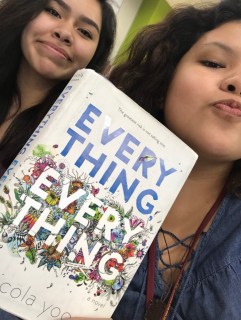
Giselle and Leslie, Nicola Yoon fans, dying for the movie!

vocabulary words she’s studying. I often have to hush her table because these girls like to talk about what they are reading during reading time. The fuss over Everything Everything by Nicola Yoon is on-going. They LOVE that book! Leslie writes:

“My reading goal for next nine weeks is seven books, I want to reach my reading goal and I will make it happen by reading more and do it because I enjoy it not just because I have to do it. I can gladly say that I love reading now, back then I used to be allergic to books and never touch them to read the beautiful stories that they have inside their covers.  After I become the perfect reader I intend to become the perfect writer.”

Giselle’s list of books she’s read so far this year reads like a spine poem. When she writes about whole class novels, she means our book club titles. I use book clubs to push many students into reading more complex books.

Lissbeth has been in the U.S. for three years. She titled her post “No Excuses for Not Reading.” My favorite line: “One of the things that I have learn thanks to my English teachers, is that reading is not just something you do for entertainment, it can also become a lifestyle.” Of course!

image2

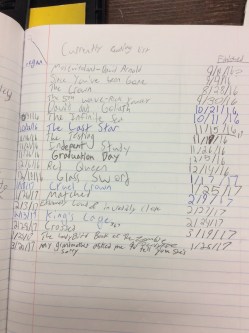
Audrey’s Currently Reading list

Already a reader when she entered my class, Audrey explains her reading experience since last August:

I have learned some about myself as a reader. I’ve learned that I like to stay in my reading comfort zone, but with a little nudge I’m able to read other genres and enjoy it. I’ve learned that I’m always growing as a reader. My reading rate can always improve. My vocabulary can always improve. As a reader I know that with due time, and with a lot of reading and determination, I can read ANYTHING!” [Note: If you read Audrey’s full post, when she mentions me giving the class a list, she’s referring to our book club choices. I do not have a list of all the books in my classroom library.]


Some students are in my block class, so I’ve only had them since mid January.

Cheyenne, who has read 14 books since the beginning of the semester, feels pretty strongly

blogger2bpt2b5

Cheyenne’s book stack

about the whole class novel. She writes: “I definitely have a deep dislike for class novels. This has more to do with the fact that I hate being forced to read certain books by certain deadlines, for me, it defeats the thrill, if you will, of reading the book in the first place.”

This year was the first time since middle school that I have been excited to read in class, and that was because we weren’t assigned a class book to read and we got to choose a book we wanted to read,” Rachel writes.

If you don’t believe some students lose a love of reading because of school, ask them. Ask them questions about what happened. Every kid I know was once an excited reader. Few are when they get to me in 11th grade.

Reghan confirms this in her post. She writes:

From elementary school through middle school, I read every kind of book, big or small. From nonfiction books about the unsinkable, sunken ship: the Titanic, to fantasy books about alternate universes and dystopian societies, I was a reader.

“Until my freshman year of high school.

“Ninth grade wasn’t easy for me. A lot went on that year with my family and personal life, causing me to be unfocused on school, my grades, and reading…and my transcript made that very obvious. I don’t think I read even one book in that entire year, summer included. This carried into my sophomore year, as well as part of my Junior year too. Zero books read, many to go.

“Being in AP English this semester and having to work hard to stay afloat has helped me tremendously and it wouldn’t be possible without my teachers . . . I’ve read four books this nine weeks including: Paper Towns by John Green, Will Grayson, Will Grayson by John Green and David Levithan, Extremely Loud and Incredibly Close by Jonathan Safran Foerand Sharp Objects by Gillian Flynn and I’m on my fifth: Columbine by Dave Cullen. That’s more than I’ve read in the last three years, combined. I’ve been introduced to books that I’ve never heard of and books that I never would’ve picked on my own. In fact, thanks to our assigned book clubs, I now have a new favorite book which is the aforementioned, Extremely Loud and Incredibly Close.

” I credit Mrs. Rasmussen with my progress because of her belief that we as students are more likely to read if we’re choosing books that we want, not that our chosen for us. In my experience, any book that has been chosen for me by a teacher, has been uninteresting and/or hard to finish. Being able to choose has only helped me and there’s proof in the numbers. Not only has this freedom improved my desire to read, but it has showed me who I am and what I like as a reader.”

And then there’s Ciara, who wrote “The Oprah Winfrey (with a little twist) Show.” Here’s a reader I am still working on, but oh, her writing voice. And her taste in TV shows! (We’ve bonded lately over quite a few.)


So in a post with AP test scores in the title, I give you a post about what students have to say about their reading lives.

That’s gonna be my answer every single time.

I happen to be assigned to teach AP English Language and Comp, but what I teach is how to love reading to students who miss it. Most of them miss it.

What are you doing about it?


Amy Rasmussen lives in north Texas and teaches AP English Language and English 3 to the Fighting Farmers at Lewisville High School. She also facilitates professional development for other teachers making the move into a workshop pedagogy. She adheres to the words of Emerson: “We aim above the mark to hit the mark,” and Jesus Christ: “Love one another.” Imagine a world if we all love more than we think we can. Follow Amy on Twitter @amyrass.

Getting Feedback From Your Toughest Critics

Remember what it’s like to be a student, constantly wondering if your teacher likes you, worrying about your next assignment and your next grade?


Me too.


I give out periodic “teacher progress reports” to my students to coincide with the progress reports I have to fill out for them.


These “progress reports” are an opportunity to hear raw student voices enter the way I think about our work together and the way I plan future lessons and future units.   Unlike your principal, students spend dozens of hours with you and aren’t trained to hand you a compliment sandwich.

recite-1hilvei

Here’s some of what I learned by going through student responses:


Students really, really, really like independent reading time.   It’s clear from student feedback that independent reading is an important routine to their days.  Some wrote about how they look forward to coming in from lunch to a silent classroom for some reading.  Others wrote about how they enjoyed the time to do something they enjoyed.  Many students asked me for more independent reading time.  Aside from giving out candy (most popular suggestion #1) and going outside to play for class sometimes (most popular suggestion #2), more reading topped the list.  Some students even ask me if we’ll ever spend a whole period reading.


They love to write when they know what I am — and am not — grading for. One of the beauties of setting up strong workshop routines is that there’s always a good sub plan in the wings.  If I am going to be out of class for a period or two, I assign a “free choice” writing assignment.  Students are responsible for handing in a writing piece on a topic or genre of their choosing, and they are graded only on their attention to the grammar and mechanics concepts that we’ve reviewed in class.  By making the assessment so literal, students play with form, content, and message: I collect memoirs, mob stories, text message conversations (with graphics!), screenplays, journal entries,  epic fantasies, and more.


Students love “ghost grades” on major assessments.  I give students the option of a “ghost grade” on a draft for a major project.  That grade serves as a) a minimum final grade, and b) a benchmark for future improvement with concrete feedback on what needs fixing.  Students enjoy making changes and watching that lower “ghost grade” improve in the final draft.  This ghost grade helps make some of their writing progress visible as far as the literal gradebook is concerned.


Do you do elicit feedback from your students?  If so, what have you learned from that feedback?


Amy Estersohn is a middle school English teacher in New York.  She will probably never give out candy, but she will, on occasion, give out emoji stickers, which students pretend not to care about.  (But they do.)  Find her on twitter at @HMX_MSE

Reframing Independent Reading: We Can Start By Not Grading It

imgres-1.jpgAll week, I’ve been thinking about Pernille Ripp’s exasperated plea, “Can we please stop grading independent reading?”  (I imagine that she initially had an exclamation point at the end of that post, like, COME ON, people, but then deleted it to be nice.)
Still, I am one of those people she is exasperated with.  Or I was while in the high school classroom, dedicatedly printing log sheets and grading reading every week for three years, using a complicated system of reading rates and conferences to give a number grade that reflected reading growth and sustained progress.

One year, I abandoned this system in the third quarter, just to see what would happen–would kids stop reading if I removed the accountability of a weekly reading grade?

Yes, yes they would–and they did.  So I re-instituted weekly grades, which, combined with a quarterly assessment, combined to 20% of my students’ total grade.  I was happy that this much of my course grade was dedicated to independent reading, but I didn’t realize that the grades I was mandating weren’t really creating independent readers at all.  (In hindsight, I should have begun the year without reading grades and created an authentic community of readers who weren’t motivated by reading logs.)

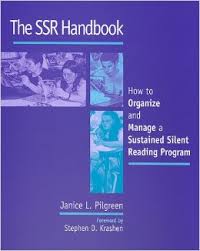
imgres.jpgAfter I read Pernille’s post, while thinking about this idea (read: beating myself up for slaughtering kids’ love of reading), I pulled out one of the most memorable texts I read while in college–Janice Pilgreen’s The SSR Handbook.  In the foreword, Stephen Krashen writes:

Free voluntary reading means reading what you want to read, with no book reports, no questions at the end of the chapter, and not having to finish the book if you don’t want to.  Sustained silent reading provides children with an opportunity to do free voluntary reading in school.  Is this a good idea?  Yes.

Pilgreen lists eight components of a successful SSR practice:

  1. Access – to many reading materials (books, newspaper, magazines, comics)
  2. Appeal – the materials are interesting and appropriate for the students
  3. Conducive Environment – the space in which students may read is comfortable and welcoming
  4. Encouragement – teachers and peers encourage students to read through discussions, modeling, and more
  5. Staff Training – teachers should have practical approaches in place for helping kids become readers
  6. Non-Accountability – no records, no monitoring, no “task-oriented” attitudes toward reading
  7. Follow-Up Activities – thoughtful, creative, interactive ways in which students discuss their reading lives authentically
  8. Distributed Time to Read – a volume of time that consistently occurs during which students read freely in school

When I think now about these eight simple factors, I see them clearly through the lens of workshop teaching.  To me, the components translated to my real-world readers workshop classroom look like this:

  • a classroom library brimming with high-interest books;
  • a reader-friendly community built not only into a welcoming physical space, but one in which daily reading, talk, conferring, and encouragement happen;
  • a teacher-leader who is the best reader in the room, who can model fluent reading and recommend a wide volume of books to students;
  • a lack of graded formative assessment and an emphasis on summative assessments for learning, not of learning.

This means no reading levels, no required number of books per year, no structured programs in place, no minimum number of minutes of reading done per week.  This means relinquishing control.  This means a lot of modeling, conferring, and progress monitoring to encourage student growth and lifelong learning.

This means thinking about independent reading as truly independent–independent of grades and of accountability.  This means reframing independent reading in school as an authentic, student-centered activity in which the readers take the lead and teachers merely help provide coaching and guidance.

If these ideologies are in place, teachers will know if kids aren’t reading (by simple observation and conferring).  We can adjust our instructional practices from there, without the damaging effects of punitive grades.  We can still give a grade for summative student self-assessments of independent reading growth (student-led is the key, here) to satisfy those mandatory gradebook updates, but if students are to become real readers we, as teachers, cannot be the ones holding them accountable for their progress.

There are many other kinds of reading that happen in language arts classrooms in addition to independent reading:  whole-class study of texts; small-group book clubs; close reading studies of poetry, articles, essays; explorations of mentor texts; analyses and syntheses of plays and novels and writing of all sorts.  This is where the work of learning to become a better reader can come in (which can be very enjoyable!), which lends itself to skills-based reading assessments.

In contrast, independent reading and all its many joys and struggles and spaces for success and failure are not, as Pernille says, “gradeable skills but instead a child practicing habits to figure out how to get better at reading.”  If we want to nurture this practice, we cannot keep grading it–and that’s the first step to reframing our thinking about independent reading.

Shana Karnes lives in West Virginia and teaches sophomore, junior, and senior preservice teachers at West Virginia University.  She finds joy in all things learning, love, and literature as she teaches, mothers, and sings her way through life.  Follow Shana on Twitter at @litreader or join her for the Slice of Life Writing Challenge here.


Letting Go in the Name of Book Love

letting go

I am a super fan of Pro/Con lists, although the true reflection of these lists never seem to govern my life as much as the making of them does.  Let me explain.

I can always think of a million reasons not to do something, but if I’ve already decided I want to do it, the Pros generally outweigh the Cons because of just that–weight.  Sometimes the reasons TO do something are fewer, but are so weighty that they can’t be ignored.

Workshop was that for me.

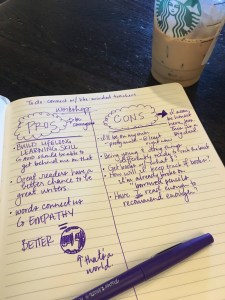
pro con

This is a real picture of my real notebook.  Please don’t judge the fact that I give myself pep talks within my P/C Lists.


Here are a few Cons of workshop from my list at the beginning of this year:

  • I’ll be on my own, pretty much.
  • I’m young, and everyone will think I’m just trying to rock the boat.
  • WHERE WILL I GET THE BOOKS?!!
  • Once I get those books, likely via my own dwindling bank account, how will I keep track of the books?  I already go broke on borrowed pencils–and those cost…well… can anyone break a penny?
  • What if I haven’t read enough to recommend enough?

Sure, all of these were true then, and are still true now.  However, I think the weight of the Pros on this list were hard to ignore:

  • I could truly build something that would become a lifelong skill that carries students through the rest of their lives as learners.
  • Great readers have the potential to be great writers.  You can’t do what you’ve never seen (at least not well).
  • Reading in builds empathy.  Reading far and wide builds empathy far and wide.

To be honest, the biggest fear on that list of Cons was the idea of losing books.  We teachers, just as Lisa pointed out yesterday, are notorious for going broke for the cause.

I started workshop anyway.  As soon as I met 3rd Period this year, Terri-Rose quickly became the actualization of my worst nightmare.  On the first day when we checked out books, she insisted on taking three home to peruse because she couldn’t make a decision.  My first endeavor into workshop, I wasn’t quite sure if that was a thing.  I gritted my teeth and slowly expelled a perfectionistic breath, attempting to inhale a free spirit (something which usually doesn’t hover near me much less inhabit my own body).  She held three of my shiny new bestsellers bought with my own money after the small grant I obtained already ran out.  I told her she could do that as long as she signed them out and brought two of them back to me the next time.  I glanced over my shoulder to my then-meager amount of books after the first checkout.  Who knew 300 books could go so quickly?  I might never see them again.  

But, you know what, I did.  Most of them.  Terri-Rose still hasn’t learned to make a decision.  Whenever she finishes one book, she takes two more.  She’ll get halfway through one, and then give it back to me.

I’ll ask, “You didn’t like this one?”

She’ll say, “I do, but I want someone else to be able to read it while I finish this other one.” We developed a system with her book marks.  She likes to use candy wrappers (always pristine) to mark her place, so she’ll hand me the candy wrapper, and I’ll put a sticky note on it with the book title and page number to hand back to her when she’s ready for that book again.  It’s a nice system.

The other day, she came into class raving about a book.  It’s a normal occurrence.  She’s never quiet about something she loves–a quality I’m hoping to channel more in the future.  She wanted to barrel her way through Everything, Everything because the movie is slated to release in May.

Then came the request.

“Mrs. Paxson, I have this pen pal in Weatherford and we’ve started talking about books.  I told her about Everything, Everything, and the movie coming out and now she really wants to read it.  Would it be okay if I mailed it to her to read and then she mails it back before school is over?  I can even ask her to write a review for it before she sends it back!”

The exhale and inhale was quicker this time, mostly because I was leaping for joy inside at the desire to share the Book Love.  I agreed to the terms of her proposal, and I can’t wait to get the book back with a long distance review.

All of those Cons, like I said before, still stand true.  I’ve lost some books this year–probably five or six.  But the weight of the Pros have grown heavier with success and small triumphs–more than I ever thought they might.

As I think of Terri-Rose, unable to make a decision, reading books halfway through and two at a time, always sharing with friends before she’s even close to done, I’m reminded of my own reading life.  It’s a real one, not one for a grade or to check a box.

Then I think: Holy crap–it works.

What moments have surprised you with sharing #BookLove and watching it grow?

Jessica Paxson is an English IV and Creative Writing teacher in Arlington, TX.  She frequently feels as though someone made a mistake in allowing her to hold the futures of over 100 teenagers in her jittery, over-caffeinated hands for the past two years.  If you enjoy watching her make a fool of herself by being unbearably vulnerable, you can catch more of that over at www.jessicajordana.com. Follow her on Twitter or Instagram @jessjordana.


Going Broke Buying Books

Disclaimer: There are countless ways to save money when securing books for your classroom library. I, however, often lack the patience for such measured and responsible procurement of texts. This is my story (and possibly my defense should my husband discover just how much I spend on books).


My husband Nick is a dear man. He has to be, to put up with the amount of time, energy, and hard earned cash I devote to this passion called teaching.

In the 14 years I’ve been at this, or rather the 2 years I’ve been building a genuine classroom library, I have probably spent $4, 398,291 (hyperbolic numbers are my favorite, because I’ve never been good at math).

It often happens before I know what I’m doing. Like those poor souls who sleepwalk and end up in the middle of a busy road in their pajamas, I find myself “just putting a book in my Amazon cart so I remember the title,” or “checking Thriftbooks for a minute (or 27), to see what’s new.”

Hi. My name is Lisa, and I buy a lot of books for other people’s children. 

doryThis “problem” sort of took me by surprise. With my head hanging low, I must admit there was a time, not too long ago, when there were very few books in my classroom. There were very few books in my life period, besides the ones I “taught” year after

year. My classroom was rich in many valuable thoughts, inquiries, and experiences before workshop, but it was not full of books.

How, as a teacher of literacy, had I allowed my classroom to become devoid of the very tools of reading I kept suggesting to my students would be their salvation in the face of collegiate ambitions, thematic exploration, and aspirations of world domination?

Apparently, it wasn’t important to me.

Ugh. That reflection looks ugly in print.

I didn’t purposefully create a text desert in my classroom, of course. If someone had said, “Hey, Dennis. You teach English. Where are all the books?” I would have smiled and pointed to the textbooks and countless copies of Uncle Tom’s Cabin. Students bought any books they needed for independent reading, and I happily progressed with assigning reading, providing study guides, giving content quizzes, lather, rinse, repeat. This is what I knew. This is what I had experienced myself. This is how I was taught to teach.

But then, one day, a big rock fell on my head. I dreamt of rows upon rows of bookshelvesryan gosling lining the walls of my classroom and students clutching copies of countless titles to their bosoms. Ryan Gosling walked into the room and said, “Hey girl. I really love the work you’re doing for public education. Let’s get those kids reading more. Cool?” When I came to, I was blushing, but more importantly, I knew that my students needed more choice. More challenge. More access to books.

Ok. Not really. But the conclusions I came to after some workshop research, training by the lovely workshop team of Three Teachers Talk, and logical reflection about how I wanted my students to view reading, that part is true.

There is still a very important place for whole class novel work in my classroom. There is still a place for short lists of books with a central theme to get kids working in book clubs. There is still a place for the classic and contemporary. But there is also now a place for a lot more choice right in my classroom, always located just a few steps away.

And though we might not want to believe that we have to hold our kids’ hands and walk them to our bookshelves, instead of trusting them to take their own time to go to the library or while away the hours at the local bookshop, at least in the beginning, we do. We need to make the books so wildly available, that kids can’t help but wade through them in the course of our time together.

Think of elementary classrooms. Books upon books, upon teachers reading aloud books. If books aren’t at home, they are certainly at school, and when kids are learning to read, they are showered with books. Why not shower them with texts when we are trying to reignite that love of reading?

Given time to read, talk about books, formative and summative work around independent novel study, goal setting, book challenges, quick writes on choice reading, daily book talks, a teacher who pours passion about books all over their every class period AND shelves of books three feet away, progress in building and rebuilding readers is very possible, and even, probable.

We can teach children to read, but for reading to become a habit, they need ready access to books. We also know, they need choice, choice, and more choice (thank you a million times for your brilliance, Donalyn Miller).

When it comes down to it, we might not want to believe our students evade the reading we ask them to do, but they often do. Many fake read very, very well. Others simply smile, or avert their gaze, or defiantly say, “I didn’t do it” or “I’m just super busy.”

I’ll put it this way, my dentist hands me floss, but I don’t use it as often as I should. There. I said it. I am a college educated, do-gooder, who knows she should floss…every day. I do not floss every day. I know my teeth will suffer for it. I know when I go to the dentist I feel bad for having to say that I could probably floss more. I know it’s with the best intentions for my own self-interest that the professional tells me to do it, but…I don’t do it. I’m just super busy.

Perhaps a bad analogy, but our students don’t always make the right choices when it comes to reading. They prioritize other things. If my dentist were handing me floss every day, chances are good, I’d get in the habit. Should he have to? No. Should I just do it on my own because I know it’s good for me, of course. But, I’m flawed. We all are.

So, at least for awhile, I’m going to care enough about my students’ teeth, er, reading habits to make it highly visible, readily accessible, and as entertaining as I can.

The payoff just this week is real:

  • Josh is a super smart kid who hadn’t been devoting time to reading. He, like so many others, used to love to read, but had fallen out of the habit. With our 10-15 minutes of reading a day, and my suggestion that he add just 10 minutes before falling asleep each night, Josh is back into books. Major texts, in fact, and just book talked The Name of the Wind by Patrick Rothfuss to our a class. A little bit here and a little bit there made the reading a habit again. I bought the book and handed it to one of his peers who flew through it too.
  • I saw Brianna standing at the bookshelf yesterday morning. Sort of swaying back and forth. I skipped over (ok, I was skipping in my head, but I was excited to help her find something magical).
    “What are you in the market for, my dear?”
    “Uh…I’m not sure. I just read Think Like a Freak: The Authors of Freakonomics Offer to Retrain Your Brain. It was really good, but I might be over nonfiction for a while.”
    “Makes sense. How about a really good story? Try this. Oooo! And this…and I had someone read this one last month. And…this (The Help). Have you read this one yet? Take a look at the reviews in the front from past readers. This is a great book.”
    Brianna was 20 pages into The Help and picked up the book between activities in class that day.
  • The somewhat shocked and surprised smile on JJ’s face when, after book talking Jodi Picoult’s Small Great Things: A Novel last week, I put in his hands a copy of her incredible new release. He had asked for my copy a few days later when he finished his latest read, but it had already been checked out. He looked crestfallen. When I saw it yesterday on the new release cart in the library, I checked it out, and hunted JJ down during our resource period. “Wow. Thank you!
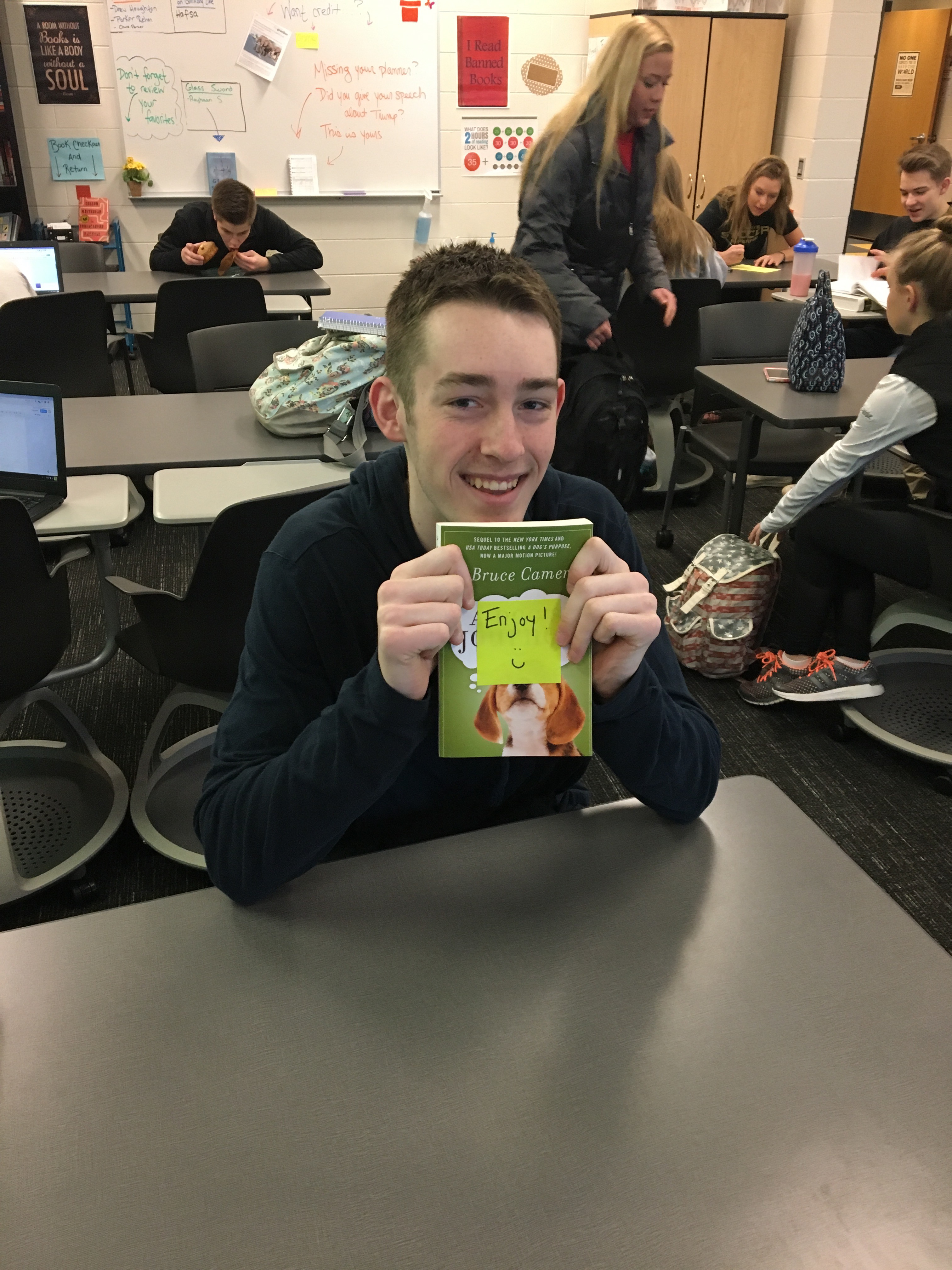
  • And this…You might remember Nathan from a few weeks back after he finished A Dog’s Purpose:
    img_0266
    I was at Barnes and Noble and used one of my gift cards to buy the sequel A Dog’s JourneyI think this smile is worth the expense:

Truth be told, I’m very lucky to work in a district that has put a huge amount of money into funding the classroom libraries of our English department as we’ve moved to workshop. And there are countless ways to put on your thrifty teacher cap and get the texts rolling into your room if your district isn’t yet on board with choice reading:

  • Write letters to your local bookstores and appeal to their sense of community pride, favorable Yelp reviews, and goodwill to all.
  • Loiter in bookstores and flash your teacher credentials. Sometimes a pleading jessicasmile and/or a small purchase will secure some free or discounted books.
  •  Apply for grants (Nothing says #booklove like free books…next year).
  • Rummage, thrift, estate sale your way through the summer.
  • Gather some research on classroom libraries and get it in the hands of your administrators. You might be surprised.
  • Ask Shana for books. She loves to give away books to fellow workshop teachers.
  • Befriend authors via social media! Jessica is trying her hand at scoring some Matthew Quick books through Shana’s connection. No shame, Jessica! Twirt (twitter flirt, I believe) away!

You don’t necessarily have to spend your own money on books, but I do. Something inside of me saying that I need more. I need more variety. I need more to recommend. I need more books.

I keep telling my husband that I’m helping to inform, inspire, and impassion the electorate. I’m also in charge of the money, so my little addiction should be able to continue a little while longer.

I consider you all my support group in this matter. Thank you for your support.

How do you surround your students with books? What titles have you added recently that keep flying off your shelves? We’d love to hear from you in the comments below. 

FTC guideline affiliate links

Lisa Dennis teaches English and leads a department of friends at Franklin High School near Milwaukee. Her latest classroom library purchases were The Hate U Giveby Angie Thomas, American Street by Ibi Zoboi,  and Violent Endsthe story of a school shooting told from various perspectives and written by 17 YA Lit. authors.  Follow Lisa on Twitter @LDennibaum. 

Beyond Hillbilly Elegy: Books for Country Boys

IMG_1959

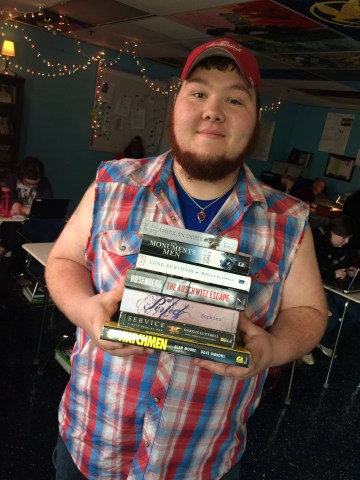
Bull with a few of his favorite books

I’ve been thinking about one of my former students recently, wondering how he’s doing.  His name was Logan, but everyone–his family included–called him Bull.

I’ve been thinking about him because I had him in class for two years, and it took me a long time to realize I’d been recommending all the wrong books for him.

With the recent popularity of a book like Hillbilly Elegy (which has caused quite a stir here in Appalachia) I’m reflecting on how it’s a book I probably would’ve recommended to Bull.  Like the many other “country” books I’d offered him, figuring the text had a character he could actually relate to, I think Bull would’ve hated it, as many of my friends here in West Virginia have.  I haven’t had a chance to read it, but my peers and students alike who have say it’s too much of a stereotype of Appalachian culture, that it paints Appalachia much too negatively, and that it in no way captures the beauty of our mountains, music, or lifestyle.

I had a hard time getting Bull interested in reading, but boy, he’d write.  He wrote beautifully about the country he lived in, the simplicity of his family life (he showed me videos of teaching his barefooted three-year-old brother how to operate a push plow on their farm), and his love of hunting.

I think no book can capture the kind of love that a kid like Bull has for his own heritage, and I didn’t realize that when I offered him book after book that I thought had a “similar” kind of character for a protagonist.

But, in his reading life, Bull was a different kid last year.  He was a senior, about to enter the real world and acutely aware of his need to be prepared for it.

When I talked to him at the end of last school year, he described his junior year reading life as “shitty.”  I asked him why, and he said, “cuz I was lazy.”  He read two books all year, and when I talked to him about this, he laughed sheepishly.

Last year, he’d read 13 books and was in the midst of his 14th–Monuments Men by Robert Edsel–when I went on maternity leave.  I think he read 17 books by the end of the school year.  Before I left, I talked with Bull about his reading life.  We’d discovered his love of war books with American Sniper.  “My great grand-pap was in Vietnam, and I want to read about what he went through,” Bull explained, gesturing to his stack of books.

I also asked him how he felt about reading.  “It calms me,” he told me.  “It gives me something to do.”

It calms me.  I still remember him saying that to me, sitting in my classroom with the back door open, where a spring breeze wafted in and the sounds of kids eating lunch outside could’ve been a huge distraction.  But as Bull reflected on what reading did to him, the act of thinking about books took him away from our classroom and into a place of relaxation.

I loved watching reading transform Bull.

From war biographies, Bull moved to war fiction, then to books in verse, then to graphic novels, then to a variety of nonfiction titles.  He eschewed books about country life, popular fiction, and YA novels all year.

I’m thinking about Bull now as I reflect on the mirrors, windows, and doors we ask students to walk through in their reading lives.  I’m thinking about him as I reflect on Pernille Ripp’s plea for us to stop grading independent reading.  I’m thinking about how I approached Bull first with books I thought of as mirrors, but he was craving windows and doorways all along.  I’m thinking about how his whole junior year, he got 2/10s on reading logs, and I’m thinking about what a colossal mistake that was on my part.

So, last spring, I asked Bull to compile a list of his favorite books, and the draft has been sitting in my WordPress sidebar ever since.  I share it with you now to remind you that this list, a list for “any country boy,” in Bull’s words, is a list of books set far beyond the mountains of Appalachia–and represents a story that can never be told with an independent reading grade.

  1. Lone Survivor by Marcus Luttrell – “This was an amazing book.  It was a true story of a Navy SEAL, and his whole team got attacked in an ambush and he was the only one that lived.  Just the things that he gives you is like standing in war–it’s just amazing how something can give you so much detail that it seems to be real.”
  2. Article 5 by Kristen Simmons – “It was the end of the world basically, and there are a few kids running away from the people who were going to kill them.  It was also a really detailed book so I could imagine what the new world looked like.  I liked that book a lot.”
  3. Perfect by Ellen Hopkins – “This book was all about everything people give up to be perfect.  The whole time I was reading it, I just thought, nobody’s perfect–what is wrong with these people?  But it made me understand everybody else better.”
  4. The Auschwitz Escape by Joel Rosenberg – “Hitler ruled this book.  It was about war from a prisoner’s point of view, and it gave lots of detail about what he went through and what Hitler forced him into.  I would never have wanted to be part of World War II as a soldier or a prisoner.  That was some crazy shit.”
  5. Symphony for the City of the Dead by M.T. Anderson – “This one was really hard to understand compared to the other WWII books I read.  I picked it for my challenge book, and it was about what happened in Russia during World War II.  It taught me more about writing than about war, honestly.”
  6. Watchmen by Alan Moore – “This was my first graphic novel and I liked that it was and was not about war, at the same time. It was kind of about the cold war, but through the fighters’ eyes and not the politicians or the history books.”
  7. The Blind Side by Michael Lewis – “Well this book was nothing like the movie, but I wanted to read the book after I saw the movie.  It’s about a football player that came right out of the Bronx, basically had no mom, and he just went from clear down to about nothing to making millions of dollars a year playing in the NFL.  I got inspired by him how you can come from nothing to the NFL and you can do anything you put your mind to.”

Bull now works for the water company here in West Virginia, still lives on a farm…and still reads.  And the song of his reading life is so much broader than a hillbilly elegy.

Shana Karnes lives in West Virginia and teaches sophomore, junior, and senior preservice teachers at West Virginia University.  She finds joy in all things learning, love, and literature as she teaches, mothers, and sings her way through life.  Follow Shana on Twitter at @litreader or join her for the Slice of Life Writing Challenge here.

Booktalk this now: THE PLOT TO KILL HITLER by Patricia McCormick

The story behind the story.  At this year’s ALAN workshop (you should go!!! free books!!!! lots of authors!!!!!!)  I heard Ryan Graudin, author of Wolf By Wolf, talk about her research of Dietrich Bonhoeffer.  


Dietrich who??!!!


Oh, you know, this guy who was part of a larger group planning to publicize Hitler’s misdeeds to the broader world and to kill him.


Ryan’s book is all about an underground resistance that planned to kill Hitler.  Her book is fantasy.  


The Plot to Kill Hitler, Patricia McCormick’s biography of Dietrich Bonhoeffer, is as real as it gets.

plot-to-kill-hitler

Whom this book is for.  Readers who have a basic, elementary school-level understanding of Hitler and concentration camps know enough to follow this story from beginning to end: McCormick takes care of readers from there.


The topic is heavy, but the short chapters and brisk pacing make this 150-page piece perfect for middle and high school readers as well as mature elementary school readers.  If your school already does a holocaust unit, this book will provide a new point of view.


More sophisticated readers will make connections between Bonhoeffer and Martin Luther King and can debate the relative merits of a pure nonviolent approach to more direct and retributive forms of protest.  One of the most fascinating parts of this book for me was seeing how Bonhoeffer, a deeply religious emotional young man, transformed from a social justice scholar and Gandhi acolyte to a subversive and aggressive warrior.


How to booktalk it. Not too much preamble.  Just read the 2-page prologue out loud to the class, where Bonhoeffer knows he is about to be captured by Nazis and races to hide his incriminating papers in a ceiling panel and leaves a deliberately fake diary to throw the Nazis off his path.


You should also know… I struggle to match quality middle grades nonfiction with readers.  Some of the most fantastic middle grades nonfiction titles require a lot of patience and background knowledge.  Some are so laden down with information that there isn’t enough of a story to keep readers going.  Other terrific nonfiction titles are awkwardly sized and aren’t easy to carry down the hallway.  This book avoids all of those possible pitfalls.


Amy Estersohn is a middle school English teacher in New York.  Despite her observations that nonfiction books tend to be harder to carry around than fiction books, she has seen students lug around the 10-pound “Hamilton” book — you know, the one with all the pictures of the original cast.    Since you were asking, she won lottery tickets to see “Hamilton” during its first week on Broadway.  Really.  Twitter handle: @HMX_MSE

Need a Friend? Yup, Me Too.

Our juniors spent last Tuesday morning taking the ACT test, along with every other junior in the state of Wisconsin. I spent the morning watching them take the test. Talk about mind numbing.

“You will now be taking the fourth part of the test in Science. You will have 35 minutes to complete this test. Please open your test booklets and try not to fall out of your chairs after three hours of testing, during which I have listened to you sniffle, shuffle, and sigh to the point of my own mental health crisis. I mean…you may begin.”

On days when I hand out Kleenex and monitor bubble fill in, I long for interactive class periods of inquiry, exchange, and exploration. However, that sometimes is a pipe dream as well.

Lately, it’s been a bit like pulling teeth to get kids to participate. Pushing them to meet their reading goals feels less like inspiring work, and more like drudgery (How much more inspirational do you need me to be with this whole reading gig? Just DO IT already.). Their quarter three blank stares and exhausted sighs have me resisting the urge to fix my vacant eyes right back at them and mouth breathe until they see their reflections in the mirror of my face.

worksheet

 At times like these, I am reminded by fellow trench mates that we teachers need love too. I don’t want to feel tired, occasionally demoralized, and ill tempered, but I’m there, and part of the reason is that I know my kids are there too.

Workshop can be legitimately magical. Students reading more than they ever have, writing for authentic audiences, and hearing each other speak deeply and passionately about real life issues through literacy. But, Shana didn’t post 9 Books to Hook Your Holdouts for nothing. Amy had the Tissue Issue and needed to Write When It Was Hard.  Jessica is finding her way in a brand new workshop classroom. And countless sources across the web detail teacher burnout and student engagement struggles.

So when our newest contributor Jessica to 3TT reached out over the weekend with: “You ladies are rockstar teachers. Do you ever have discipline or complacency struggles in your classroom?” I had to smile. And then laugh. And then cry a little. And then…

I was taken back to a conversation with a colleague a few years back, where an offhanded comment poked me right in the teacher feels. We had actually been talking about this very idea – the slump we can all feel when teaching gets somewhat less Stand and Deliver and more, students loitering around the complacency trough.

“Well,” he had said somewhat smugly, “As long as you have engaging lessons, students don’t check out.”

Oh. Really? That’s awesome for you…

Listen, I get his point, and to some extent I agree, of course engagement has to be at the heart of what we do, but from personal experience as a learner, it’s not always possible to engage all of the kids all of the time (collective gasp, coupled with Lisa polishing her resume). And that can be exhausting and frustrating to educators, and disruptive to the class.

But today, I am not here to provide advice for how to move forward with this issue in the classroom (I happen to know for a fact that my 3TT ladies have several posts up their sleeves all about engagement. Stay tuned!).

strong

I’m actually here to quickly remind everyone, because I needed the reminder too, that when you are feeling like you could arrange for Big Bird to walk in the door and hand out cookies to everyone in the class, but no one would crack a smile, you need…friends.

Teacher friends.

In your building, down the hall, gathered at PLC, across the country, on the phone, send a quick note, smile at your neighbors, friends.

trouble

I, for one, am a lucky duck in this department. I work with friends. Dear friends.

Stand up in her wedding, give a quick tearful hug, giggle over buffalo chicken dip, join a bowling league, talk about Ryan Adams, compare Lularoe leggings, grab a drink, bake some cookies, geek out over Out of Print literary shirts, talk about being daddy’s girls, Irish Oatmeal, send each other lip sync videos, eye roll at the same time, laugh first and ask questions later, friends ( I think I hit everyone in the department. Seriously. I love you people). 

So, whenever possible, and especially when you feel like you might voluntarily throw yourself down the stairs rather than walk into 3rd period, find people to spill your guts to. Find people to share your successes and colossal failures with. Friends who share mini lesson ideas and friends who share unbelievable content knowledge. Fresh out of college and boundlessly energetic friends, and experienced, measured, and wise friends. Those who have seen decades in the classroom and those who weren’t born yet when you started teaching.

Take the time to engage with the people you work with, both as educators and as humans. Engagement at work increases when we have friends. Harvard said so.

And if the people you work with don’t do this for you, branch out.

The ladies at 3TT have been WhatsApp-ing (verb I just created) lately. We use voice messages, pictures, texts, and links to talk about classroom questions, vent about burnout, explore possible post ideas, and discuss who’s drinking which variety of wine tonight.

There are always ways to connect with like-minded, similarly leaning, comparably focused educators. And there are ways to connect with challenging, make you reflect on your practice, I can’t believe I used to do that too educators who can help reassure you that you are making the right moves, even when those moves are difficult.

Hand someone a cup of coffee and take a seat.

Open up Twitter and join a #chat.

Send one of the Three Teachers (really five of us now, how cool is that?) an email and we’d be glad to listen. 

Don’t close your door and let handing out Kleenex to kids feel like a highlight of positive, professional interaction.

Friends can help you feel sane, productive, positive, and human again. A few kind words, commiseration, a hug, and a maybe a quick snack.

Little else is needed to take the deep breath necessary and get back to 3rd period.

Except maybe, Spring Break.

We’d love to hear your shout-outs to fellow educators who help you right your ship, stay afloat, and just keep swimming! Please share in the comments below. 

shout out.png


Lisa Dennis teaches English and leads a department of friends at Franklin High School near Milwaukee. She almost left the profession in year one, and would have, if not for fellow English teacher Erin Doucette who took Lisa under her wing and taught her the importance of being yourself in the classroom, challenging you students, and celebrating St. Patrick’s Day every year without fail. I love the teacher you are and the teacher you have helped me to become. Follow Lisa on Twitter @LDennibaum. 


Window, Mirrors, and Gigantic Doors: Inviting Sound into Uneasy Silences

For weeks I’ve worked on a list of books to use for book clubs in our junior English classes. I believe that students must have options that challenge, yet engage, and allow them to see themselves and/or others within the pages. It’s that whole windows and mirrors and doors analogy. Jillian Heise describes it well in this post. I’ll just quote a part that struck me:

Dr. Rudine Sims Bishop originated the idea that many now reference. She talks about windows as “offering views of worlds that may be real or imagined, familiar or strange.” And about mirrors, “…we can see our own lives and experiences as part of the larger human experience.” But she also talks about sliding glass doors which “readers have only to walk through in imagination to become part of whatever world has been created or recreated by the author.” The thing is, it’s the third part of it, the sliding glass door that seems to often be left out, but is perhaps the most important part – it’s the part that, in my interpretation, allows us to step into those other worlds and become part of them for the time we are in that book – and isn’t that the power of reading? Being able to develop empathy, understanding, new perspectives by living in someone else’s shoes for a short time. Especially for books as powerful as the ones being written about these real issues that are affecting kids in their lives today, this mirror, window, sliding door access becomes even more important for them to see they have a place in our society, no matter what perspective they may bring.”

I’d like to offer an addition, not just sliding glass doors that  “allow us to step into those 8124672460_6b6f1ef826_zother worlds and become part of them for the time we are in that book,” although that interpretation is certainly vital to developing readers who love books and to gaining empathy.

What about other doors — like the kinds we have to push or pull to get through — the doors that make us work: cathedral doors, fortress doors, iron doors, or doors with scary knockers? These doors require effort. These doors may make us uncomfortable. And sometimes they require courage.

Some books can change us if we view them this way. They can change our students. And I’m not just talking about lexile levels, or complexity of ideas. I am talking about content. The content that exposes our flaws and weaknesses, the content that pushes our thinking, moves us out of our comfort zones, and makes us face, as Dr. Kim Parker puts it, “the lived experience of so many folks of color in this country.”

I am a white woman who teaches students of color. I grew up in a middle class family with conservative ideals. I go to church regularly, and I practice my religion. I had parents who were married for 55 years and taught me the value of hard work, education, and persistence. I am different from most of the students in my classroom. I enjoy a privilege in this country most of them have never experienced.

So what does this have to do with doors?

I choose the big ones.

Awhile ago I conducted a PD session with a group of teachers, mostly white women who like me teach mostly students of color. I showed some of the spoken word videos I use with my students:  “Spelling Father” by Marshall Davis-Jones and “Knock Knock” by Daniel Beatty. I shared articles about undocumented immigrants and Syrian refugees. I read an except from Homegoing by Yaa Gyasi where a character’s wife is kidnapped and he desperately tries to find her, showing her picture around the streets, and finally being accosted by a policeman after he accidentally brushes into a white woman. The policeman rips up the man’s only picture of his 8-months-pregnant wife. The year:  pre-Civil War.

We viewed and read texts. We wrote quickwrites and analytical responses. We discussed author’s craft and studied the moves the writers make to create meaning. Everyone read. Everyone wrote. Everyone engaged in the learning.

Later, the conversation turned to engagement, and I asked the questions:  “What are you doing to make the learning matter to your students? How are you discussing the issues that echo in their lives?”

I gave them time to talk, and I wandered the room, listening in to table discussions. I heard some valuable exchanges, but I also heard: “Oh, I don’t even go there. I’d lose control.”

Hmm.

How will we ever change as a society if we don’t ever go there? How will our students, no matter their color, ever learn to talk about tender and sizzling issues, ever learn to deal or challenge or change them, if their teachers never go there?

We cannot make excuses. We have to invite the hard topics into our classrooms. We have to provide books that are windows, mirrors, sliding doors, and gigantic wooden ones. Not only for the sake of the students we teach but for our profession.

How will we ever have more teachers of color if our students of color do not have better experiences in their English classes?

At NCTE last November, I met Dr. Kim Parker in person for the first time. She read her credo and she sealed a place in my heart with her sincere desire to do right by the students in her care. I share her credo here because it so closely echoes my own. I don’t think she’ll mind:

Ze’Voun tells me that he never knew that reading books could matter so much, could be so enjoyable. He is a young man who is Black, brilliant, and bored. He is a writer and a reader for whom schools seem to be increasingly less designed. When he disappears from my class without any explanation, I learn, a few weeks later, that he has been assigned to an out of school placement program, joining other boys who are–likely–as Black, brilliant, and bored as he.

I believe in rage, and I believe in action. I believe in a world where staying woke matters.  

My most essential work is making classrooms spaces where kids like Ze’Voun can read and write in ways that matter to them–from diss tracks; to letters to the local police department reminding them that Black Lives Matter, too, and that wearing their hoodies is not a crime; to Tweets to favorite authors thanking them for books that are just for him; to books that affirm, reflect, and extend his existence as a brilliant Black boy. Opening up spaces inside classrooms where they can speak a variety of Englishes as they explore the origins of Ebonics, where they can engage and delight with canonical and multicultural texts and write about their understandings, and where they are creators of texts that validate and stretch their identities is some of “the work my soul must have.”

Though Ze’Voun never returned, I continue to hold space in my classroom for other young people who have similar needs and desires, who are hungry for the diverse texts that reach them. I continue to hold on to a belief, and a dream, that the work I do must be as diverse as the students I teach. As escapist, as validating, as powerful as the texts they read. As whole, as free, as happy as we all wish, hope, and need to be.

This what I’ve dubbed Right Now Literacy. We have to give every student the commitment, resources, and opportunities they need to learn the reading and writing skills they need right now, to live and thrive in the world we are in right now.

Dear reader, I ask you the same questions I asked those teachers at that PD:  What are you doing to make the learning matter to your students? How are you discussing the issues that echo in their lives? 

Please answer in the comments. Let’s share our best practices and best resources for pushing ourselves and our students through the doors that can change us at the core. (And next week I’ll try to remember to share my new book club lists.)

FTC guideline

Amy Rasmussen lives in north Texas and teaches AP English Language and English 3 to the Fighting Farmers at Lewisville High School. She adheres to the words of Emerson: “We aim above the mark to hit the mark,” and Jesus Christ: “Love one another.” Imagine a world if we all love more than we think we can. Follow Amy on Twitter @amyrass.