Category Archives: Community

Defining Readers-Writers Workshop

“I need a visual of a ‘workshop.’ That word confuses me still.”

This is not the first time I’ve been part way through facilitating professional development and a participant has made a similar request. There’s a lot for me to learn here.

Before we can begin really sharing the excitement and benefits of a readers-writers workshop model of instruction, we must get on the same page as to what we mean by Workshop. I’ll try to do that here.

Let’s start with the dictionary definition of workshop and zero in on #2.
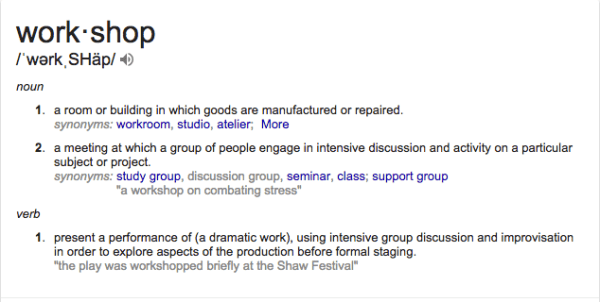
workshop definition

Based on this definition, let’s consider this essential question:

How do we create open spaces where the children we teach can grow as readers and writers?

To me “open spaces” equates to “workshop.” Open spaces means teachers let go of control, remove themselves from center stage as the holders of the knowledge, and invite students into a space of curiosity and discovery. It’s a space where students thrive in a community of trust and sharing, where they talk about their identities and experiences as readers and writers, where they play with language and take risks as they explore what it means to develop their comprehension and analysis skills — and their craft as writers.

Opening spaces requires planning. It is not willy-nilly choice in books or topics, or stations without specific guidelines and instructions, or seats moved from rows into small groups without modeling the thinking that makes it possible to “engage in intensive discussion and activity” around our content. Teachers must model what this looks like. And we must trust that our students will engage and learn in this model.

They will — if we let them.

Readers-writers workshop is a method of instruction that often requires a paradigm shift, a shift from the teacher making all the choices and telling students what to learn within a text, to students making choices, and through practice and application of skills-based lessons, learning as they read and write.

I’ll return to some definitions found online to help clarify:

“The Reading Workshop is a teaching method in which the goal is to teach students strategies for reading and comprehension. The workshop model allows teachers to differentiate and meet the needs of all their students.”

For our readers, we open the space for students to choose the books they read. By doing so, we meet students where they are in terms of their interests and abilities. The teacher becomes a coach, teaching skills specific to the needs of each learner. This requires time. We must reserve time for students to read when they are with us in class, and we must confer with students about what they are reading — and how they are reading it. This is reading instruction in a workshop model. We teach the reader, not the book. Readers must predict, visualize, infer, comprehend, analyze, and evaluate. These are all skills we model and teach in readers’ workshop.

What about writer’s workshop?

“As in a professional writer’s workshop, each student in the class is a working author. The teacher is a writing professional and peer coach, guiding authors as they explore their craft. … Teachers write with their students and share their own work as well.”

To teach our writers, we must be writers ourselves. We must model the moves writers make as they use language to craft meaning. We must validate our writers and help them recognize what professional writers do to think of ideas, organize those ideas, and convey those ideas in a way comprehensible to readers. In a workshop classroom, we use mentor texts:  sentences, paragraphs, passages, essays, poems, stories to teach writing skills that students apply to their own writing. We teach the writer, not the writing.

workshopquestion

So, what do I mean when I say “workshop”? I mean students doing the work of readers and writers, “engaged in intensive discussion and activity on a particular subject” — specifically related to growing as readers and writers. This work happens because teachers open the spaces in their classrooms which allow for it.

Questions about your move to a workshop model of instruction? Please ask in the comments.

Amy Rasmussen lives in north Texas and teaches AP English Language and English 4 (new prep in ’17. She loves talking books, daughters’ weddings (two this year), and grandbabies (five). She also loves facilitating PD for other teachers making the move into a workshop pedagogy. Amy adheres to the words of Emerson: “We aim above the mark to hit the mark,” and Jesus: “Love one another.” Imagine a world if we all aim higher. Follow Amy on Twitter @amyrass. And she really hopes you will follow this blog!


We are Magnificently Confused and other names for book shelves

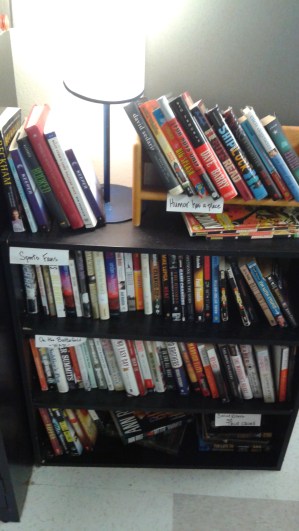
I have a lot of bookshelves and a lot of books. I have a relationship with my classroom

bookshelves

some of my current shelves

library like many drivers have with their cars. I shine it up and keep it running smoothly. I love the new book smell.

Quite often someone asks about how I organize my library. Very carefully. When I know which shelves hold which books, I can more easily match books to readers. Shelf labels matter.

The labels on my shelves do a couple of things:  They help me know what holds what, but more importantly, these labels serve to pique curiosity and press readers to explore.

When you get to know a lot of books, you realize that most books may sit comfortably on several shelves, especially if we sort them by topic or theme and not just genre.  Sometimes I group the same copies of specific books together, and sometimes I break the sets a part to put on separate shelves.

morebookshelves

sports and war books need a taller shelf

When school returns in August, I will be in a new classroom. A different classroom. That means that my hundreds of books had to move down the stairs and down the hall. Now those boxes wait for when I have time. I’m going to need a lot of time.

I am thinking about how I want to organize my shelves in this new learning space — maybe two reading nooks instead of one, fewer books on the lowest shelves? more intriguing labels on more shelves with the hope of inviting more readers?

I’m thinking for sure on that last one:  changing up the category labels on the shelves. I could use your help here. I think it would be fun to be clever, but clever is hard for me.

So far, I’ve read through a ton of quotes on books and reading, and pulled phrases for shelf labels I think will work for most of the books in my library.

Here’s what I have so far:

Born into Chaos

Clapping for the Wrong Reasons

Burning Bridges

Gracefully Insane (or Close to It)

Black Sheep Own the World

You Cant Just Get Over It

Holding Close My Secrets

Making Myself into a Hero

Stop Reminding Me I Need a Life

Do You Kiss with Eyes Open or Closed?

You Just Can’t Get Over It

The Present Hides the Past

History is Herstory, too

History:  Echoes Heard & Unheard

The Edge of Possibility

Foul Play (and other sports stories)

A Likely Story

Detecto Mysterioso

It’s Going to Break Your Heart

Using My Life as a Lesson

We are Magnificently Confused

What labels would you add?

And the question of the hour:  What high-interest books would you put on these shelves?


Amy Rasmussen lives in north Texas and teaches AP English Language and English 4 (new prep in the fall). She loves talking books, daughters’ weddings (two this year), and grandbabies. She also loves facilitating PD for other teachers making the move into a workshop pedagogy because it keeps her focused on her own improvement. Amy adheres to the words of Emerson: “We aim above the mark to hit the mark,” and Jesus: “Love one another.” Imagine a world if we all aim higher. Follow Amy on Twitter @amyrass. And she’d love it if you follow this blog!

Student Gratitude – A Guest Post by Margaret Lopez

I didn’t teach last year because I resigned.  I still feel guilty.

When I moved back to my hometown of Chicago, I accepted a position with a well-known, controversial charter school network in the city.  I quickly found it was not the right fit for me.  It wasn’t the students–they were full of hope and sweet in spite of the adverse circumstances they dealt with outside of school.  It was the system.  

If the ACT was king, a strict demerit system was the reigning queen.  Students were part of a system that didn’t see them as individuals, but cogs in a wheel that kept churning out “College and Career Ready” students, as measured only by a test, and using strictScreen Shot 2017-05-01 at 8.44.22 PM rules to keep the wheels turning.  There was no student choice, just multiple choice.  No discussions, just lectures.  No collaboration, just eyes tracking the teacher.

It was horrible.  So horrible that I made the choice to leave.   I felt like teaching to the school’s standards made me compromise non-negotiable parts of my teaching philosophy.  I tried to break the mold, but received teacher demerits (seriously..teacher demerits).   I couldn’t find my way in the system and struggled to officially make the choice to put myself before students.

I made a choice to leave.  But I didn’t realize how many repercussions that choice would have.  There was so much about teaching I missed and what I, admittedly, didn’t take the time to appreciate when I was in the classroom.   I missed students most of all.

I missed the little things, like greeting them at my door, ready to embark on a 50 minute odyssey into the literary world.  I missed wishing them a happy, safe weekend, then anxiously awaiting their return on Monday.  I missed seeing their homecoming pictures and watching them in the school play.  I missed having class jokes and saying hello in the hallways.  I missed reminding every class, every day about an upcoming assignment and the student who had the best excuse when it isn’t completed on time.  I missed waving to students as we each got into our cars to head home.  I missed reminding them to relax, just take it easy for a night.  I missed the chaotic moments in the classroom just as much as I missed the moments when all the fates in the world conspired and each child was rapt in their learning.

I missed transforming the protesting non-reader into a book worm. I missed adding recommendations to my book list from all types of readers.  I missed students asking me what I was reading and why, did I like the book or the movie better , or which John Green book is the best.  I missed the excitement I felt when a student genuinely loved a book or returned a book that I thought had been lost to a locker or car trunk forever.  I missed being moved by a student’s connection to a character.  I missed seeing my bookshelf fluctuate depending on what topic or genre was trending.

I missed reading their timed essays, the writing in their notebooks, the personal annotations in the margins of their books.  As an English teacher, taking home 180 essays over your weekend doesn’t always feel like one of the perks of the job.  Grading becomes tiresome halfway through the first stack of essays, and builds to a mundane, tedious task quickly thereafter.  Until that one essay…the one from a shy student.  The one from the athlete who no one takes seriously.  The one from the student who actually managed to turn something in on the deadline.  The one that yanks you from your near slumber and makes you re-read it because it is so insightful, poignant, and refreshing.  These essays can be few and far between, but when they are uncovered in my stack of loose-leaf paper, they stir up my teacher soul.  These golden essays remind us of the humanity and intelligence high schoolers have within them.

Can students be whiny?  Sure.  Can they be inconsistent?  Consistently, it seems, some weeks.  Can they be forgetful, even with a school-issued agenda and text-message reminders sent to their phones?  Yep.  But they can also be generous, helpful, and shockingly perceptive about the world.  They can be innovative and resilient.  In fact, they usually are every day.

thank

As teachers, I think we often see the best of our students, the qualities their parents miss and their peers don’t notice.  We notice their compassion when they offer to help a struggling student.  We enjoy their passion when they light up on the field.  We see their curiosity through the books they select and the choices they make in their own learning.  I missed learning about each student as a member of my classroom community, and uncovering their beliefs, habits, and ideas slowly throughout the school year.  I missed noticing their growth, as English students and young adults, from August to December to May.  What is more rewarding than taking a step back and admiring an individual’s progress?  We are so fortunate that nurturing and acknowledging individual progress is a routine component of our jobs.

I still think about those kids, the ones I chose to leave behind, and I still feel guilty.  I wonder how they’ve fared as seniors, how they performed on the ACT, if they’re itching to break out of the mold and be free in a few short weeks.  I wonder what they have been reading and writing.  I wonder how I could have stayed and made it work.

There is magic that happens in a classroom.  Sometimes we don’t notice it in the moment or it looks messy.  It isn’t graded on our appraisals or summatively assessed, but it happens, in little moments and big “ah ha” moments.  It happens because of our students.  

thank2

As these weeks get more stressful the closer we get to summer break, I want to challenge all of us to remember the good in our students and try to have gratitude for what they bring to us each day.  To be proud of the relationships you’ve worked to forge with your young readers and writers.  To remember student achievements and how you have supported that growth.  To recall, during arguably the most hectic, patience-testing time of the school year, the young adults that make this noble profession so demanding and rewarding.

Maggie Lopez has six years of teaching experience at large public high schools in Louisville, Houston, and now Chicago.  A graduate of Miami University, she had the pleasure of learning from the workshop masters and is on a continual quest to challenge, inspire, and learn from her hilariously compassionate juniors and seniors. 


Screen Shot 2017-05-01 at 8.44.22 PM

Care to join the conversation? We’d love to add your voice! Please email guest post ideas to Lisadennibaum@gmail.com.

Practicing What We Teach, One Letter at a Time – A Guest by Amy Menzel

I’m not always ready for Monday, but I was ready for this one. I had spent a lot of time reading Penny Kittle’s Book Love over the weekend and was anxious to get back into the classroom and spread my love of all things literary. Wouldn’t you know it…my seniors weren’t.

Now, it was “senior skip day,” and I knew that, so maybe I was less prepared than I thought. I thought, “Hey, I’ll be able to give more individual attention to students Screen Shot 2017-05-01 at 8.44.22 PMwho need it.” Meanwhile, they thought, “Hey.  I’m here.  What more do you want?”
It’s not so much that they thought this that bothered me, but that they said it. They actually said,  “You should just be happy we’re here.”  To my face. And they meant it.

A small part of me died right then and there. Likely from overheating because my blood was boiling. It took me a while (and eleventy-seven deep breaths) to calm down. Somehow I made it through the day without exploding, but barely.

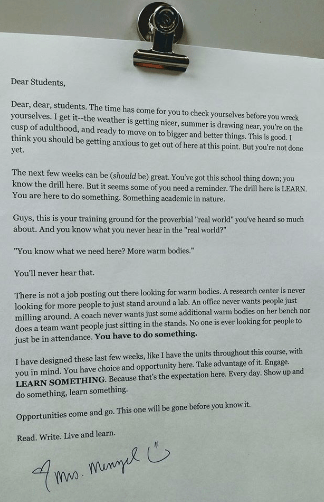
That afternoon, I sat at my desk as the building got quiet. When only the sounds of the custodian’s sweeping and my continued deep breathing remained, I opened a new Google doc. “Dear Students,” I began, and channeled my frustrations and feelings through my fingertips.

menzel

I made 140 copies, left them in a neat stack in the middle of my cluttered desk, closed my door, walked to my car, drove away, and hoped for a better day.

I felt better that I wrote about it (duh, say many researchers). And I felt better having calmly and clearly expressed my expectations. I also had a student voice echoing in my head from last semester: I’ve never had a teacher take the time to write to us before.”

Of course, we write to students all the time; we write our syllabi, our assignments, our writing prompts. But I do think there’s a difference when we address a note, a discussion to our students. It’s more personal. I forget about this.

It’s also a way to practice what we teach.

Back in April, Lisa talked about the importance of English teachers being readers. She closed her impassioned post, “We must be readers…otherwise, we are in the business of false advertising.” The same is true of our work as writing teachers.  We must write.

This is a lesson I learned (or finally appreciated) during my participation in the UWM Writing Project back in 2010. One of the core principles of the National Writing Project, the program of which the UWM Writing Project is an affiliate, is that, “Knowledge about the teaching of writing comes from many sources: theory and research, the analysis of practice, and the experience of writing. Effective professional development programs provide frequent and ongoing opportunities for teachers to write and to examine theory, research, and practice together systematically,” — emphasis mine.

I learned a lot that summer, but the most significant lesson I took away was the importance of practice. Each of us teacher consultants prepared and presented a teacher inquiry workshop and the number one rule for these presentations was to have your participants write early and often. It changed the way I teach. Still, I find that I need to remind myself to write more often.

Now, I know it’s the end of the year. So you may be thinking…

menzel2

But I’m all about embracing the constant reflect-and-revise nature of teaching. So allow me to publically commit to writing to my students more–early and often starting next school year.

Dear fellow teachers,

Are you with me?

Sincerely,
Amy Menzel

Amy Menzel teaches English at Waukesha West High School in Waukesha, Wisconsin. She hopes her unbridled enthusiasm for all things literary haunts her graduating seniors for decades to come. In the best possible way, of course.


icon

Care to join the conversation? We’d love to add your voice! Please email guest post ideas to Lisadennibaum@gmail.com.

A Call for Real Opportunities to Learn — Not More Test Prep

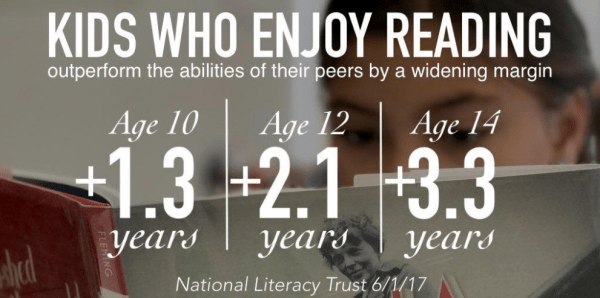
Natl Literacy Trust Survey 2016

Of course, this data caught my eye.

My friend Gary Anderson posted it on Facebook with this link to the National Literacy Trust Findings from their Annual Literacy Survey 2016: Celebrating Reading for Enjoyment.

I had just spent the day working with teachers in Clear Creek ISD as they launched their two week STAAR Academy, a series of summer school-like classes designed to immerse students in authentic reading and writing — not the typical mode of tutorials often offered in the hope of helping students pass their state mandated English exams.

Billy Eastman, Clear Creek ISD High School ELA and World Languages Coordinator, is a visionary who believes in his teachers and in the students they serve. He knows that when students choose books they want to read, experience learning in an environment that validates their personal lives and learning journeys, and are given space and instruction that allows them to write about the topics that matter to them, students grow. They grow in confidence, and they grow in ability.

Thirty-five teachers met with me in a two hour institute this morning. We read and talked and wrote and talked. We built a community of teacher-readers and writers. We engaged in learning — all with a central goal:  How can we create a space for all students to advance as readers and writers?

Then, teachers planned. In teams they designed lessons intent on engaging students as real readers and writers — not just students reading and writing for a test.

After lunch, teachers facilitated similar community building activities with the roughly 250 students attending the academy.

With generous funding by his district, Mr. Eastman was able to provide books, lots of new high-interest YA literature, in which students could choose a book they want to read. This is the first step in “celebrating reading for enjoyment” and all the benefits that come with it.

As I visited the 12 classrooms this afternoon, I witnessed students writing and talking about their reading lives.

“I like stories okay,” one boy said, “but I don’t like to read.”

“I’m not really into reading,” said another.

“Reading isn’t my thing,” another boy said.

I asked one young man if he liked to read, and he told me: “Yes, I read a lot.” He had just selected Scythe, the new book by Neil Shusterman, and I could tell he was eager to get started reading it. He’d already read Unwind and quickly told me how much he enjoyed that series. The other three students in this boy’s small group were less enthusiastic about reading anything, but they were willing to try. One chose Still Life with Tornado by A.S. King, another Boy 21 by Matthew Quick, and the other Out of Darkness by Ashley Hope Perez.

As I observed every classroom this afternoon, I noticed a few things:

  • The ratio of boys to girls in most every classroom was at least 4 to 1.
  • Boys want to read books that look “tough.” The cover has to captivate them.
  • Girls will choose books with male protagonists more often than boys will choose books with female protagonists.
  • Few students choose historical fiction — they seem drawn to realistic fiction and dystopian.
  • Many students chose books teachers might deem too difficult for them. (One of the most popular book choices offered today was All the Light We Cannot See, which won the Pulitzer Prize in 2015.)

For the next nine weekdays, students will read their chosen books and spend time engaged in their community of learners. They will practice the moves of real readers and writers as teachers practice the routines of readers-writers workshop and read and write beside their students. Besides the obvious benefit for students, teachers will engage in the kind of professional development that truly matters, the kind that gives hands-on experience with students as they practice the art and craft of teaching.

I am excited for the outcome. I am excited that teachers are excited. I am honored to be a part of Mr. Eastman’s vision for his district.

So what does this have to do with the National Literacy Trusts’ Annual Survey? A lot.

As I read through the report this evening, I found nothing startling or surprising. Of course, there are advantages to reading for enjoyment.

But then I shifted my thinking and began questioning the why and the what. Why does the data say what it does? Why are their gaps in enjoyment between boys and girls? Why are their gaps between age groups? What is happening in schools that might be causing these gaps? What is happening in students’ lives that might be causing these gaps? What can change if we approach reading and writing instruction differently? What should change?

I challenge you to read the report and ask yourself similar questions. Then, I challenge you to take the next step:  follow Billy Eastman’s lead. Whatever your sphere of influence, how can you allow a space for reading for enjoyment? And if you haven’t done so yet: How can you change the model of instruction in your classroom, in your school, or in your district so all students have the chance to become real readers and writers who enjoy what they read and write?

Don’t all students deserve similar opportunities to learn — not more test prep?

Amy Rasmussen lives in north Texas and teaches AP English Language and English 4 (new prep in the fall). She loves talking books, daughters’ weddings (two this year), and grandbabies. She also loves facilitating PD for other teachers making the move into a workshop pedagogy because it keeps her focused on her own improvement. Amy adheres to the words of Emerson: “We aim above the mark to hit the mark,” and Jesus: “Love one another.” Imagine a world if we all aim higher. Follow Amy on Twitter @amyrass. And she’d love it if you follow this blog!

Summer Reads to Stay Up Late With

Teachers, we are SO close.

giphy


The end of the school year is nigh.  Perhaps it’s this week, maybe it’s next, but either way, it’s nearly time to treat yo’self with what all teachers love to do in the summertime:

Take 84 naps, and then start binge reading.

This is what I did when my school year ended a few weeks ago, and after several days of excessive sleep, I started staying up late to finish books guilt-free.

Please forgive me for what I’m about to do to your Amazon carts while I gush over the titles that’ve kept me up until the wee hours, and their friends on my TBR list:

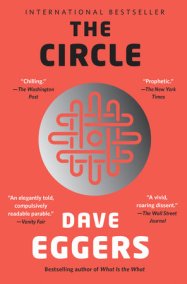
9780345807298

The Circle by Dave Eggers – This book was so plausible that it creeped me out.  It’s the tale of an ambitious college grad who lands a job at one of the tech industry’s premier companies, The Circle, who so slowly ingratiate their surveillance, social sharing, and health-tracking apps into her life (and others’) that it seems like no big deal at all–until it is a big deal.  This one kept me in suspense until 2 am, when I breathlessly finished it.  Similar titles on my TBR include The Handmaid’s Tale, Dark Matter, and The Dinner.  Creeptastic!

410ZVjytceL._SX329_BO1,204,203,200_

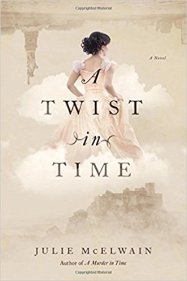
A Twist in Time by Julie McElwain – I’ve been anxiously awaiting this title since I read the first book in the series, A Murder in Time.  Now that it’s here, I’ve already devoured half of its 600-page bulk, most of that on my wedding anniversary, no less.  Kendra Donovan is a modern day FBI agent, a genetically-engineered genius who’s an outcast even amongst her fellow elite criminal profilers…or so she thinks, until she’s transported through time to the 1800s and really feels like an outcast.  Now, she’s stuck there solving murders without the help of forensic equipment and techniques readily available to her in the 21st century…or any hope of getting home.

I think McElwain’s writing is a great blend of period-accurate details and modern, funny asides, and the story only further serves to suck me in.  If you, too, find yourself craving a tale of time-traveling modern women, check out Outlander or the National Book Award finalist News of the World.

41kE9IRLqpL._SX329_BO1,204,203,200_

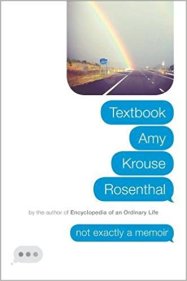
Textbook by Amy Krouse Rosenthal – I’ve been wanting to read this book since I read Encyclopedia of an Ordinary Life, but then got even more desperate to do so when I read Rosenthal’s heartbreaking essay in the New York Times, and then about her subsequent death.  It’s impossible not to read this book through those lenses, and while it’s amazing on its own, it’s even more powerful as a magnum opus.  I also want to check out similar memoirs like The Rules Do Not Apply, Hallelujah Anyway, and Strangers Tend to Tell Me Things


51zE2A3zS0L._SY344_BO1,204,203,200_

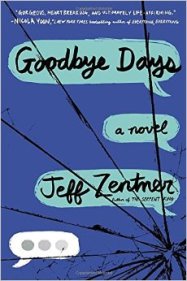
Goodbye Days by Jeff Zentzler – I read this one in two days over Memorial Day weekend, largely ignoring our company to finish it that Sunday.  I was sucked in on page one by the beautiful writing and the premise–a teen dealing with the fact that he sent a text message that led to the deaths of all three of his best friends–and I asked my friends if they’d read it.  “I did,” Amy volunteered.  “It ripped my guts.”  And boy, did it.  This was one of the first YA reads I’ve picked up lately that I really just couldn’t put down.  I’d love to see how The Inexplicable Logic of My Life, A List of Cages, and The First Time She Drowned can measure up to this book.

51VK2PHg7rL._SX258_BO1,204,203,200_

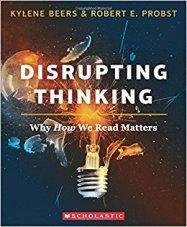
Disrupting Thinking by Kylene Beers & Bob Probst – Lisa has been so effusive about this book that I just had to go ahead and start reading it, even though I’ve been trying to wait until everyone else in the Book Love Summer Book Club dives in.  But it’s so darn readable, and such a great refresher of a lot of the research I’ve read and loved.  I always enjoy Beers and Probst for helping synthesize their wide reading into a crucible of new ideas.  Other fabulous pedagogical reads on my TBR list this summer are Joy Write, No More Telling as Teaching, and Write What Matters.

download

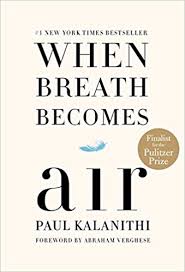
When Breath Becomes Air by Paul Kalanithi – This book hit home for me, and at quite a short length, I read it in one day–about half of it while on a treadmill!  It’s the memoir of a neurosurgical resident who, near the end of his grueling training, finds out he has advanced stage cancer.  My husband is entering his fourth year of orthopedic residency, so I read this book with a blend of horror at its possibilities and admiration for its author’s poise and eloquence.  My gushing over it led to lots of our resident friends reading it with similar amounts of waterfall-like tears.  After reading it in an afternoon, my hubby asked for some more books like it, so I ordered him Being Mortal, The House of God, and The Buddha and the Borderline.

410eExjPXCL._SX327_BO1,204,203,200_

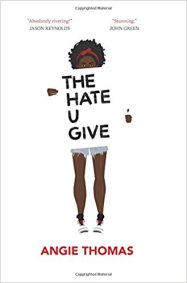
The Hate U Give by Angie Thomas – I listened to this now-famous (in teacher circles, anyway) book on audio, and found myself driving or walking in circles so I could hear more faster.  What impressed me most about this book wasn’t its nuanced treatment of the topic of police shootings, or its awesome one-liners, or its many layers of issues faced by its narrator, Starr.  No, what impressed me most was how authentic to Angie’s life and personal history it seemed.  After reading Between the World and Me, I learned a great deal about the roots of African-American empowerment and efforts for equality.  Malcolm X, the Black Panthers, James Baldwin, and more had been strangers to me before that book, but I saw them come up again and again in The Hate U Give.  

This terrific book definitely broadened my worldview, and to help it grow more, I’d also like to read American Street, All-American Boys, and Allegedly.

What’s kept you up late reading lately?  What’s next on your TBR?  Please share in the comments…so we can all go broke buying books!!

Shana Karnes teaches sophomore, junior, and senior preservice teachers at West Virginia University.  She finds joy in all things learning, love, and literature as she teaches, mothers, and sings her way through life…and in the new knowledge that she has ANOTHER baby girl on the way!!  Follow Shana on Twitter at @litreader.

5 Lessons from Public Teaching

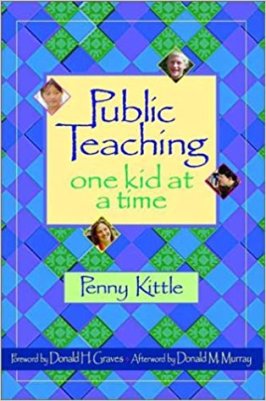
51A2WRYQAZL._SX312_BO1,204,203,200_.jpgThis week I tackled a title that’s long been on my to-read list:  Public Teaching: One Kid at a Time by Penny Kittle.  Published in 2003, it’s Penny’s first book, and has a foreword by Don Graves and an afterword by Don Murray.

(Yeesh…no pressure for when the rest of us thinking about writing our first books, right?!)

I loved this book, a collection of short essays plus an interview with Penny at the end.  It was readable, honest, and spectacularly well-written, as everything by Penny is.  I smiled as I read every page–except for the pages where I was crying.  Even in those essays I found myself impressed by the cleverness of Penny’s craft, both in her teaching and writing.

I bookmarked lots of pages and quotes to share with my preservice teachers this fall, but here are five lessons I took away from the reading that I believe are relevant to teachers of all content areas.


No one is perfect.

Penny begins her book with several amusing essays on mishaps from murderous crickets to accidentally-transparent skirts.  She eases us into the notion that even she, the great Penny Kittle, has had some missteps in her career, then launches into a few gut-wrenching essays on what she reflects on as her more weighty teaching failures:  a student we never say the right thing to, one we lose patience with, one we never teach to love learning or reading or writing.

We all have memories of those students, and Penny honors this with her writing.  I loved these vulnerable, humble essays that remind me we all ride a rollercoaster of success when it comes to our teaching.

Classroom management is a myth.

Penny tells the story of a novice teacher, struggling to manage her classroom, making wrong turn after wrong turn as a battle with her students escalates.  She has this to offer:

“Classroom management is really about the management of the heart and soul of your students.  The only ‘technique’ that works is a full-hearted human response to their lives, and to the conditions of school.  In some schools students sit in rows and listen, then rush to their next class, to sit and listen even more.  Try to understand the conditions in your particular school and view the entire day through their eyes. … You aren’t bad.  Your students are children, preoccupied with myriad distractions.  It is a natural state.  School is often the unnatural one.”

This advice was so much better, for me, than the age-old wisdom I got from mentors when I first began teaching and a lesson would crash and burn:  “don’t take it personally.”  I did take it personally, and still do, when I lose a class’s attention or a lesson falls flat.  When I learned the lesson Penny teaches here–“You must teach the students, not the content.  I want every student in my class to know that he or she is more important than what I am teaching”–I had far fewer of those flat moments and many more roundly satisfying ones.

Novice teachers need mentors, not critics.

We’ve all heard the statistics that half our teachers will leave the profession within three years.  As Penny says, “teaching, like marriage, is best when you make it past the courtship.”  The first few years are hard, and what makes them easier is exactly what improves my marriage:  talk.  As a young teacher simultaneously full of ambition and anxiety, I became more even-keeled when I found mentors.  I talked with them, they empathized, they advised.  I felt more prepared for my work, but I also felt less alone when I found a group of peers to encourage and support me.  “We have to mentor new teachers, listen to them, and I guess, hold hands once in a while,” Penny remarks.

Less is more.

“Somehow we decided that four short stories is better than one rewritten four times, and it’s a huge mistake.”

Penny’s assertion about the way many teachers conceive of writing is so true to my own learning experience, and as a result, my own early teaching experience.  I’ve been interested in the idea of simplifying my instruction for a while, and of course, Penny helped me see more clearly how to do it–with revision.

“I needed to have them linger longer over less,” she says, then backs it up with stories about an entire day’s work spent on fragments, the slow process of discovery learning, the work and power of weeks of revision on one genre of writing.  We have to jettison some things if we really want students learning, to keep it simple, to remember that less is more.

Teachers need to write.

By joining a writer’s group of teachers at her school, writing an essay for the local paper with her students, and carving out the time from motherhood to write, Penny learned to be a much better teacher by writing.  Her peer and student readers, as well as her editors, taught her to “be positive.  Encouragement works; criticism hurts.  Be careful with words.”

It’s hard to learn this lesson if you’re not a writer yourself, and Penny shows us her journey to becoming one throughout her essays.  She describes the early days of her writing group this way:

“Their criticism stung.  I didn’t like it.  You have to be careful when you’re correcting someone’s work.  I don’t think I was careful enough with my students all those years before.  It was so easy to just tell them what wasn’t working and think that was helping.  In writers’ group I learned quickly that compliments showed me what I could do and gave me confidence, criticism confirmed my fears and left me frustrated.  When I confidently approached a piece to revise it, I was playful.  When I went back to one in frustration, I usually made it worse.”

We become better teachers when we do what we’re asking our students to do–it’s only then that we can really know what we’re asking of them.  I highly recommend reading Public Teaching, doing some writing (how about with us?), and reflecting on your teaching by doing both.

43ccacd3aa51c2341980e1e34e34cba6.jpgAs we near the end of the school year, I hope you can find truth in one of Penny’s final statements:  “In my experience, it isn’t the stress that’s left the greatest mark, it is the joy.”
Shana Karnes teaches sophomore, junior, and senior preservice teachers at West Virginia University.  She finds joy in all things learning, love, and literature as she teaches, mothers, and sings her way through life.  Follow Shana on Twitter at @litreader.

Author Bios – A Follow-up

I collected these papers 20 minutes ago, and I am smiling so hard that my second period class coming in asked me what was going on.

A few days ago, Amy wrote a post about students writing their own author bios. It was an idea that snuck up on me a few weeks back when Amy Poehler’s author bio made me laugh out loud.

Following much the same format that Amy detailed earlier this week, I introduced the idea to my students of writing our own author bios by reminding them of what they have heard from me one thousand times before over the course of this year:

“We are readers and writers.”

To reflect this persona, I shared with my AP Language students a quick writing prompt that is turning out to be one of the best writing assignments of the whole year.

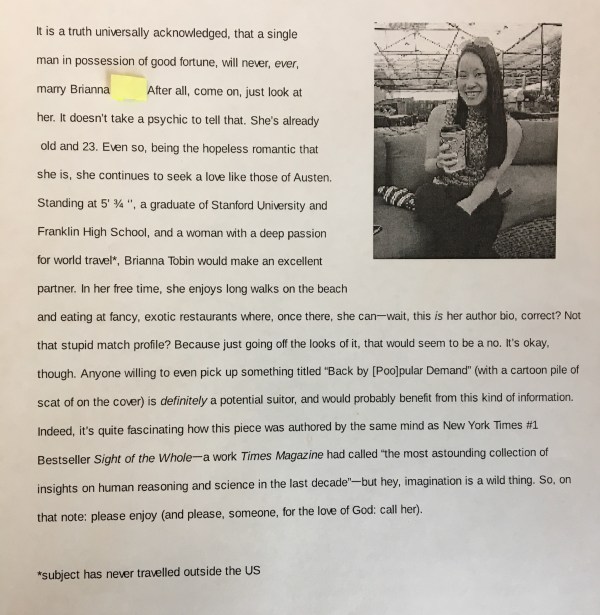
When Brianna turned her piece in this morning, she had a huge smile on her face. “I had SO much fun doing this.” Brianna, as studious, driven, brilliant, and stressed out as they come, was beaming ear to ear. What a testament to the power of writing with self reflective purpose.

To facilitate this assignment we:

  1. Looked over several sample bios from our book club books, some texts off my shelves, and a few internet suggestions.
  2. Students talked at their tables and came up with a list of “look fors” in this type of writing. I was impressed by not only the length of the list, in terms of what they noticed, but some of the insight. “If you are going to write a funny book, be funny. If you’re writing about the Nazi’s, that’s not a good idea.” True, true. Style and form must match purpose. I love it.
  3. Students then drafted both a current and a future author bio. The future bios were far and away the best. Students really embraced how wildly accomplished they will be as readers and writers after college. Additionally, this group is apparently going to rule the world.
  4. Peer feedback came next, with an inclusion of Shana’s “Push and Pull” feedback strategy. It was wonderful to see the details and voice emerge from their pieces. Celina had a line about winning the Nobel Prize, an Oscar, and a Grammy. I suggested she tell us what she won the Nobel for, who she co-starred with for her Oscar win, and how many albums she sold for the Grammy. “Oooo! I helped kids in the Sudan by supplying them with books (Mrs. Dennis swoons), Brad Pitt came out of retirement to play my dad in the movie, and I sold a record to every high school student in America, Spain, and the Ukraine.” Yes, yes, yes!
  5. Students took the peer and teacher feedback, went off to polish one of their bios, get an author picture, and turn in a final draft.
  6. These are HOT off the presses and I am so proud of their voice and creativity.

If you only look at one example, check out this first one. Brianna had me laughing out loud. No wonder she was beaming ear to ear.

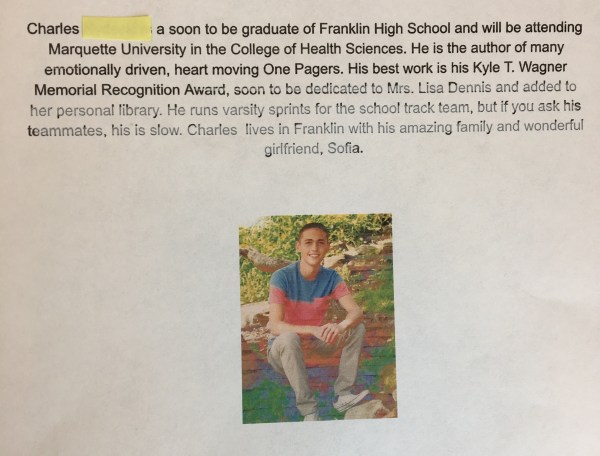
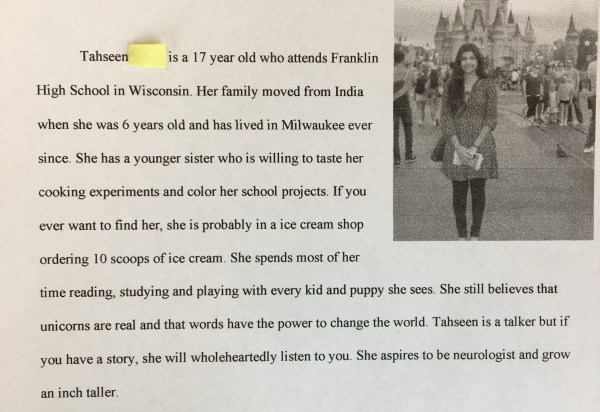
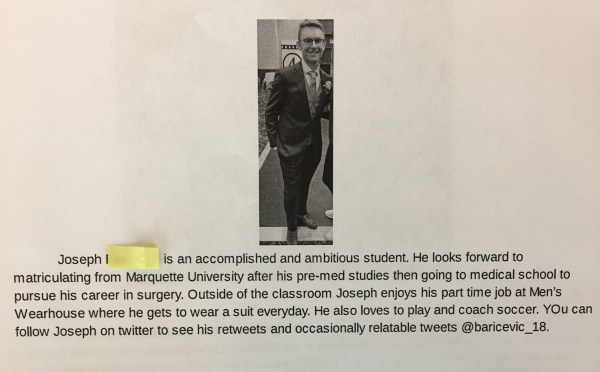
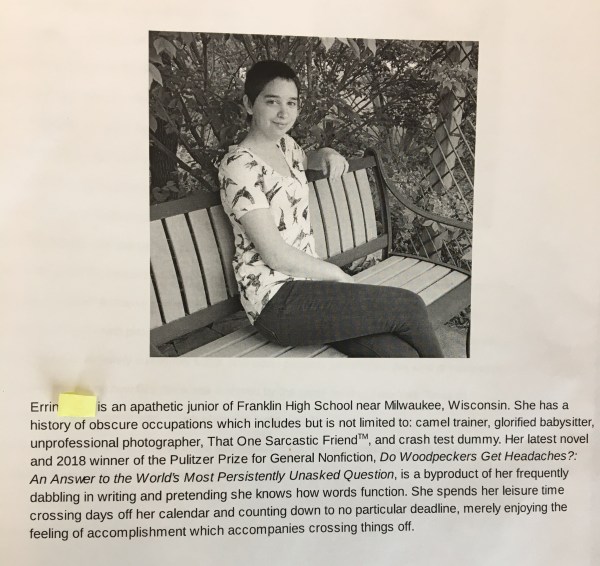
img_2524

From line one, this piece had me laughing out loud. Brianna could not be a more serious student, but this work let her voice shine. I LOVE it from start to finish. 

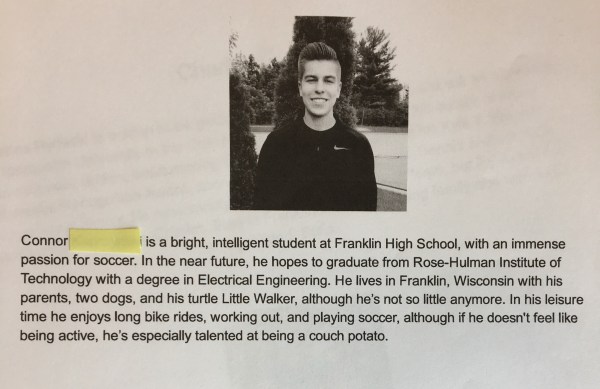
Connor is a pretty quiet kid in class. His writing fluency has improved A LOT this year. And look at that smile! 

Charlie just won the most prestigious scholarship Franklin offers, because of his service, incredible heart, academic achievements, and being an all-around amazing person. He really opened up in his one pagers this year. I could not be more proud of this young man. 

Tahseen is a very serious young woman, but the little quips in here brought out her true voice. 

JJ too had a ways to go with his writing fluency and voice development. I’m seeing it now! 

Errin is a young woman whose name you will know someday. I am SURE of it. She had this shirt on in class this morning. The picture was taken before 7:00am. 

Lisa Dennis teaches English and leads a department of incredible English educators at Franklin High School near Milwaukee. She delights in writing in the third person, claiming it’s akin to an existence in parallel universes. Follow Lisa on Twitter @LDennibaum 

An Idea: Author Bios and Some Focus, Wit, & Polish

I stole this idea from Lisa. She said it was okay that I write about it first. Bless her.

I finally feel like I’m getting a little of my writing mojo back. If you’ve been following my posts lately, you know I’ve had a hard time. I loved my student teacher, but I missed my students and how they inspire me to want to write and share.

It hasn’t been easy taking back my classroom. I am much more intense than Mr. G, and this translates to mean for some of my students. It’s true I grade hard, expect a lot, teach bell to bell. It’s not that he didn’t — maybe it’s just that I’m 50+, and he’s close to half my age. Whatever the reason, reinvigorating relationships hasn’t been easy.

Kind of casually one day, Lisa suggested she wanted to write author bios with her students next year. She said she’d read a few she wanted to use as mentor texts, thinking this little writing task would be a way to help her students develop their identities as writers. What a fantastic idea!

So last week for our writer’s notebook time, we wrote author bios, short, little, quippy, quirky writing that states who we are and why we write. (We still need work on the why we write part.)

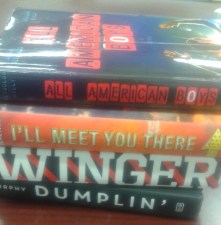
booksforauthorbiosI prepared first by reading the inside back covers of some of my hardback YA literature. I chose four bios with similar elements:  Andrew Smith, Winger; Julie Murphy, Dumplin‘; Heather Demetrios, I’ll Meet You There; and Jason Reynolds, All American Boys. {Bonus: four book talks, along with the author intros. Boom.]
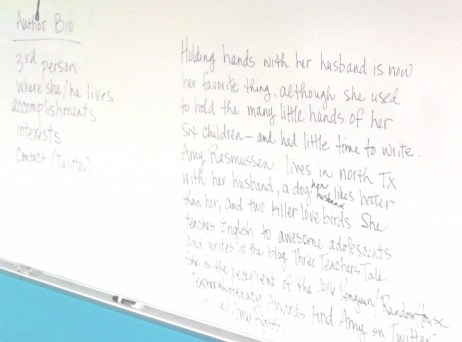
I explained the task:  We’re going to read four short author bios and then write our own. Listen to each one carefully, so we can pull out the similarities within each one.

We charted the elements of the bios on the board and then drafted our own.

authorbio

We spent five minutes on the writing, two minutes on revision, and six minutes sharing with our peers. We laughed. We wondered if the authors wrote their own book cover bios. We discussed our writing process.

“It would have been easier writing about someone else,” one student said.

“I need more time to think of how to say things,” said another.

“This would be fun to do at the beginning of the year,”

“I don’t do anything!”

“I’ve never won anything!”

“I cannot write that I am interesting when I am not interesting.”

“Can we write about what we want to do in the future instead?”

Oh, yeah, we stirred the pot, and ideas bubbled out. Throughout their questioning, my response remained:  Be creative.

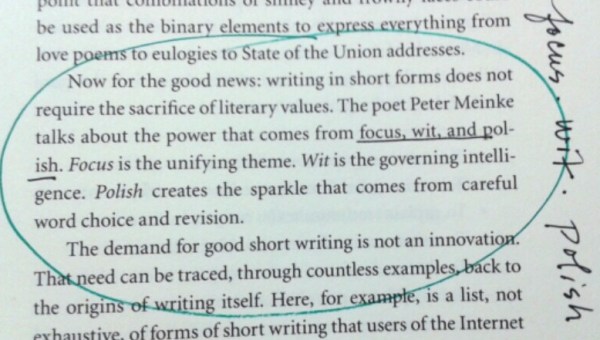
One of the best books I’ve read on writing is How to Write Short: Word Craft for Fast Times by Roy Peter Clark. I marked it up with lesson ideas:  “the whole chapter would make a great lead in rhetorical analysis” and “on annotating: read before starting 1st book club” and “use b/f narrative –teaches analysis with song lyrics” and “parallel structure & compound sentences!”

This paragraph from the introduction is a great reminder for all types of writing — and writing instruction:

How to Write Short

Focus, wit, and polish. My students and I talked about our identities as writers. We talked about the time it takes to develop our voice, our craft, our meaning.

As they read their author bios to one another, the cough of community clamored just a bit, and in a few minutes the whole classroom caught it.

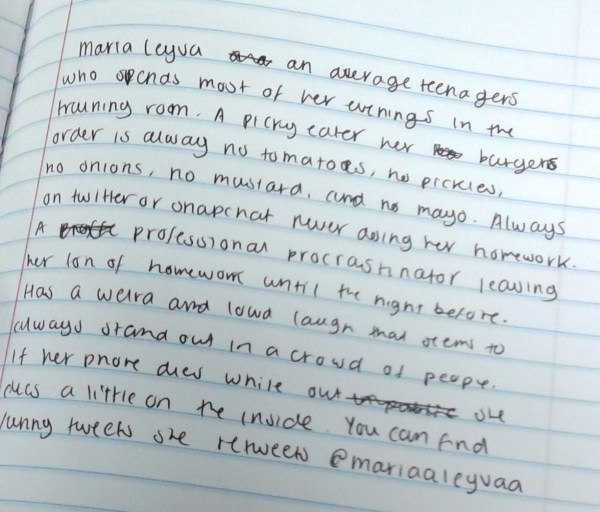
MariaLauthorbio

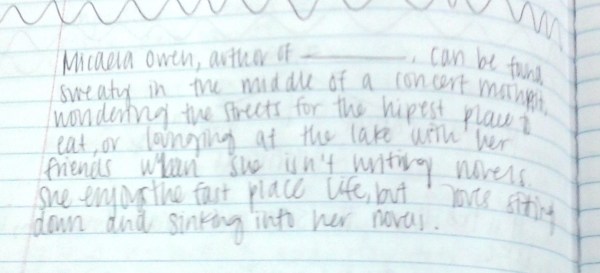
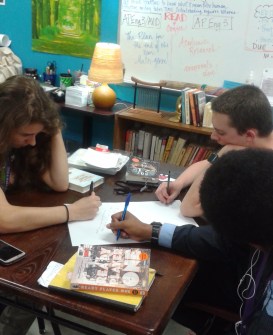
MariaCSkyauthorbioMicaelaauthorbioTreyauthorbioI reminded students as they write over the next few days — finishing their multi-genre projects, their last major grade — to write with intention, to write in a way that shows the answer to the last question I’ll write on the board this year:  How have you grown as a reader and a writer?
In the fall, I will do this exercise again. We will write our author bios at the beginning of the year, on day one, maybe. We will spent a good deal more time on them, and we’ll return to them again and again as we practice the moves all writers make to produce effective, convincing, creative writing. We will publish our writing with our bios. Hopefully, this will help us keep our sights on Focus, Wit, and Polish in all aspects of our writing.

How might you use this author bio writing activity? What tasks do your writers do that help them take on the identities of writers? Please leave your ideas in the comments.

Amy Rasmussen lives in north Texas and teaches AP English Language and English 3 at Lewisville High School. She loves talking books, daughters’ weddings (two this year), and grandbabies. Facilitating PD for other teachers making the move into a workshop pedagogy delights her. Amy adheres to the words of Emerson: “We aim above the mark to hit the mark,” and Jesus: “Love one another.” Imagine a world if we all aim higher. Follow Amy on Twitter @amyrass.

Have you asked students what they need? It is not too late

I am great at taking notes. I am lousy at looking back at them (a lot like my students).

But my student teacher is done with his semester, and am back reading and writing with my students each day. We’ve done a little AP exam crunch — our exam is today — and we are all ready for that test to be over. I’ve got 14.5 days before the summer bell rings, and my students leave me. Fifteen days to solidify my students’ identities as readers and writers, not just students reading and writing for an English class.

It’s been a hard row with this group. This group, especially my brightest students who let grades motivate their every move. There’s a disconnect the size of the Mississippi when it comes to showing evidence of learning and whining about grades.

Maybe I notice it more because I haven’t been with them every class period for the past six weeks. But something’s got to give.

So I opened up my notebooks and read notes from the class Penny Kittle taught at the University of New Hampshire Literacy Institute in 2014. Don Murray leaped from the page:

“If you understand your own process, you stop fighting against it.”

“We have to respect the student, not for his product, but for the search for truth in which he is engaged.”

“If you don’t leave a conference wanting to write more, there’s a problem with the feedback.”

“We work with language in action. We share with our students the continual excitement of choosing one word instead of another, in choosing a true word.”

“Mule-like stubbornness is essential for every writer.”

“One teacher in one year can change a child’s view on reading.”

All reminders of what I love about teaching writers and what I hope for all my students. And I’ve got 14.5 days before the summer bell rings, and my students leave me.

Recently, I read a great post by Tricia Ebaria titled “One Important Thing I Can Learn from Students.” This part resonates:

Rather than join the chorus of end-of-the-year countdowns, instead of giving in to fatigue (or cynicism), what if we reframed our thinking and asked ourselves: What’s the one important thing I can still do with my students? After all, it’s never too late to do work that is meaningful and important to our students and to the world.

Or how about this question: What’s the one important thing I can still learn about my students? studentswriting

So today I asked two questions to help me focus on students’ needs, and to help students focus on our need to keep learning:

1. Have your grown as a reader and a writer this year? And we talked about if the answer is no then we’ve both failed.

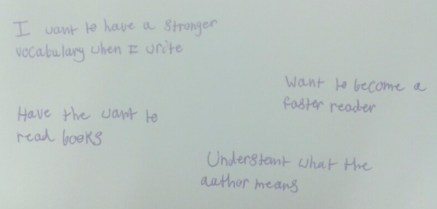
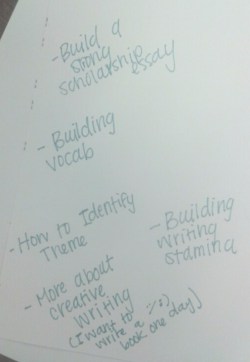
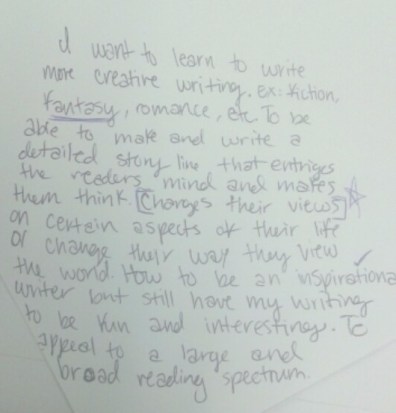
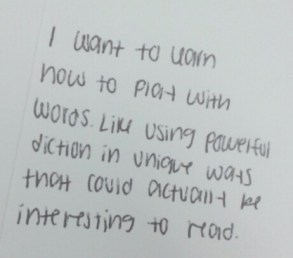
2. What’s one thing you still want, or need, to learn regarding reading and writing before your senior year and beyond? And students wrote their responses at their tables.

Some responses gave me pause. Others made me crazy. Many gave me hope that we still have time so every student can answer question one with a resounding YES.

student want 5

“Because we’ve really done nothing in class this year” is my first thought, right? But I have to wonder: Why does this students still feel this way?

student want 6

student want 8

student want 3

I’m celebrating the word PLAY.

student want 1

student-want-2.jpg

student want 4

Hmmm. 

We have to be willing to be vulnerable. We have to be willing to ask our students what they need from us as their teachers. If we don’t, we may miss the point of teaching them all together.

I learned valuable things about my students and how they feel about their growth. This lesson is enlightening and humbling. And frightening.

I am almost out of time.

So we started in our writer’s notebooks. Updating our currently reading lists and talking about the books we’ve read, we’ve started, abandoned, and we’ve finished. We updated our challenge cards and checked our progress.

I book talked Goodbye Days by Jeff Zentner, my new favorite (I wrote about it here), and American Street by Ibi Zoboi, and let students know I had a fourth copy of The Hate U Give by Angie Thomas. All books I’d read when Joseph was teaching and was dying to share with kids. Students eagerly reached for them, even tussling over Zentner’s book. (TBH I shudder just a bit when I think about not getting these new books back with it being so close to the end of the year.)

Next, I showed them an idea for their end-of-year writing — a pretty monumental task for teens already dreaming of days out of the classroom. But I think I sold them on how it can answer my question #2.

Multi-genre. Thank you, Tom Romano, and Shana for showing me how a marvelous multi-genre project can light a fire within my writers and let them showcase their interest, their talents, and the learning they’ve acquired this year.

We looked at samples. We talked about topics and research and genres. We talked about how the topics we choose can potentially help us learn the things we still need and want to learn.

We got excited about writing. I think some even got excited about learning.

So with 14.5 days left in the school year, we committed to a pretty intensive end-of-year plan.

I have a mule-like stubbornness when it comes to teaching readers and writers. Certainly some of that will wear off on my students, and maybe someday they’ll look back on their notes and their writing from their junior year in high school and recognize they’ve learned and grown in their “search for truth” as a writer.

How are you utilizing your end-of-year time? Please share in the comments.

Amy Rasmussen lives in north Texas and teaches AP English Language and English 3 at Lewisville High School. She loves talking books, daughters’ weddings (two this year), and grandbabies. Facilitating PD for other teachers making the move into a workshop pedagogy delights her. Amy adheres to the words of Emerson: “We aim above the mark to hit the mark,” and Jesus: “Love one another.” Imagine a world if we all aim higher. Follow Amy on Twitter @amyrass.