An enormous part of my teaching philosophy is centered around teaching students to question the “why” of what we learn. Not necessarily why are we learning, but why does what we learn matter? How does what we do in our classroom apply to their lives? I sincerely believe that if students cannot walk away from my class each day able to answer those questions, then I need regroup and question the purpose of my lessons.
 Kelly Gallagher, a high school teacher in California, is an advocate for getting students to think critically, read deeper into various texts, and along with several other educational rockstars, structures his classroom according to the workshop model.
In his book, Deeper Reading, he discusses the “Say/Mean/Matter” chart as a way to make any text relevant to students in addition to helping them become critical readers and thinkers.
I regularly use this strategy in several ways in my classroom which consistently provides me with opportunities to keep my lessons meaningful to my students. What I love most about using it is that it provides students with an opportunity to focus on what they are learning and why/how it matters. This also shows them that EVERYTHING we read, write, discuss, etc., has a purpose.
I recently completed novel studies with my students and was able to implement the “Say/Mean/Matter” concept with all 3 of my grade levels. In my experience, I learned that I needed to provide more scaffolding for my younger students versus my Juniors who were more equipped to take the concept and run with it. It seems like the older they get, the more eager they are to share their opinions and challenge what they read.
For my Freshmen
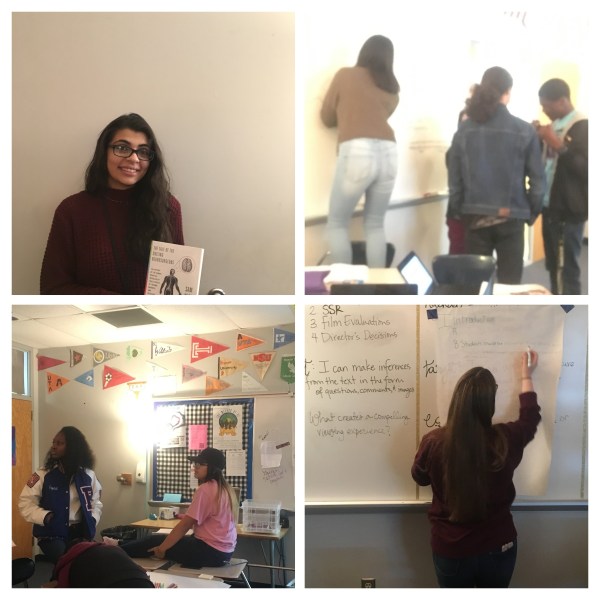
Earlier this school year, I was fortunate to have the opportunity to attend a professional development session that centered around Kelly Gallagher’s Say/Mean/Matter strategy. I was able to scaffold this lesson by targeting specific pieces of the novel, To Kill a Mockingbird, a few at a time in order for students to focus on examples of social injustice. Over a series of impromptu class discussions and informal reading/writing responses to various texts about inequity, I broke each section of Say/Mean/Matter down so that students were familiar with applying this idea to various forms of literature. Once we reached the pivotal point in the novel, we completed this with partners they chose (and some they didn’t), using sticky notes to frame discussion.


From there, we completed our graphic organizer together using our stickies from the day before. Students were asked to expand on the ideas they came up with together. After modeling my discussion notes and conferencing with students, their responses clearly showed that these examples of social injustice meant something to them. It became more than just an assignment to them, it was a chance for them to safely explore, discuss, and write about opinions that mattered to them.
Eventually, this led to a Socratic Seminar that took us 2 full class periods to complete. Every student was engaged and ready to share their ideas and ask questions because it was relevant to them. Not only was this a chance for their voices to be heard, but they truly cared about what each student had to say and remained open-minded throughout the process.
A Small Snapshot
This was just one of the incalculable ways to foster relevance and meaning to students that perfectly aligns with the benefits of teaching through the workshop model. Now more than ever, what we do as educators is of the utmost importance. By building these moments of discovery into our lessons, we allow students to create and develop meaning for themselves. The students are our purpose. Our profession centers around helping them develop and unleash their potential. Once students realize what we teach has applicability and value, there is no limit to what they can accomplish.
I would love to know other ways you make your lessons meaningful and relevant to students in your classroom in the comments!
Gena Mendoza currently teaches Freshmen, Sophomore PreAP, and Junior English in Texas. She is passionate about teaching her students to use their powers for good and not evil in her classroom. When not pouring over any written or spoken word by Jason Reynolds, or preparing her family for their next Disney adventure, you can catch her Tweeting/Retweeting at @Mrs_Mendoza3 on Twitter.



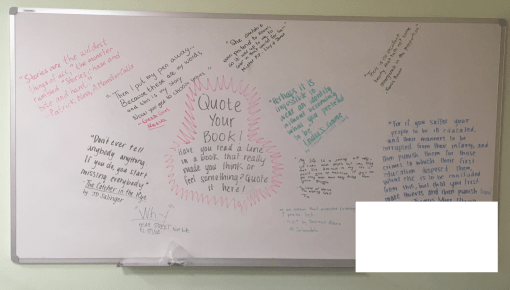
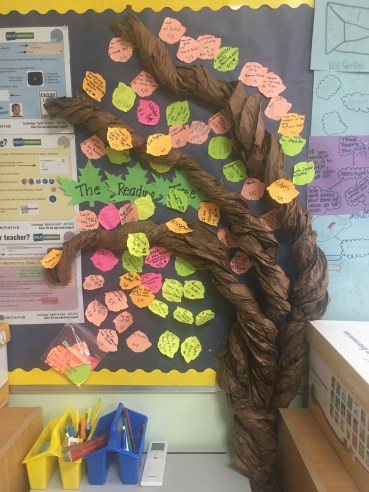 4. That same teacher also keeps a quote wall on her white board. The words we read can reach us in beautiful ways, and when students experience that kind of moment, they are encouraged to share those lines on the white board. It’s another public display of a healthy reading life. It’s a conversation starter, and it helps build a sense of community within the classroom.
 5. Another teacher in our department keeps poster paper on her walls. Students add titles to the lists as they complete their books. Because names are attached, students can reach out to one another with questions or when they want to talk to each other about a book that they read, too. It’s another public acknowledgment and conversation starter, which is part of what we need when we build reading communities.


 function in perpetual chaos. Every day I whack-a-mole them into their current book, notebook work, mentor text, draft, or just away from their phones.
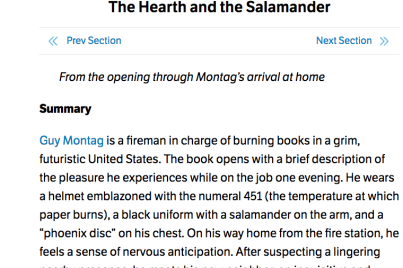 That day, the SparkNotes summary of the first chapter of Fahrenheit 451° (one book circle choice) was their writing prompt. There was some confusion: Were they supposed to write about whether they were going to choose that book? Or to predict what the book might be about? This prompt is like any other daily writing, I told them. Just write what it brings to mind.




 There were about two weeks of school when we came back that I wondered if I was doing something wrong. It seemed like I had WAY too much time on my hands, and I wasn’t quite sure if I was just forgetting about responsibilities, and therefore shirking them in some way, or if I actually was managing my time better.


 Three Teachers Talk