Classroom libraries are essential in the workshop model, as kids who have access to books will naturally read more books. I’m beyond thrilled that my school has invested so much into our classroom libraries. Now that the books are here, it’s time to get the students to read them!

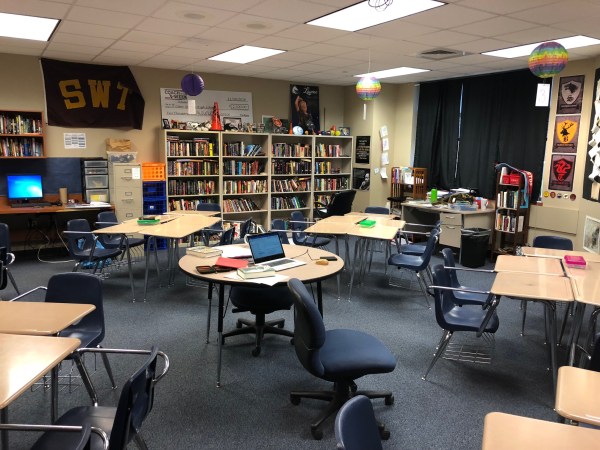
This is what my classroom library looked like in the fall of 2017.


Book talks are an essential way for teachers and students to discover new treasures hidden in classroom libraries, but they aren’t the only way.
Speed dating, student led book talks, and book tastings are all excellent methods for students to learn about books and develop healthy next reads lists, but they all take time.
Below are five ways to “book talk” without using valuable class time:


These are quick, easy to photocopy book recommendations written by students. I keep a stack of them on a shelf with the books, and as students return books they read and loved, they can choose to fill in the recommendation form. I’m sure there are more beautiful recommendation forms out there, but this is what we have, and it works.


2. Mini-whiteboards are easily changed-out, and both students and teachers can quickly feature new and different titles. It takes moments, and the written “grab” can be copied from the inside flap or the back of the book.
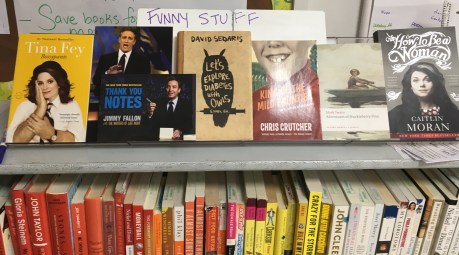
3. Themed book displays are easy to curate. All that’s necessary are a few display stands and either some mini-white boards or some heavy paper that can be switched out. I rotate my display about once a week, and sometimes my students ask me to “do a theme” with the display. I try to oblige. This one focused on humor, but anything is possible. I’ve currently got a music theme going, and it’s fun to find themed collections based on other random ideas – animals, travel, even the color of the covers. Imagination is the only limitation with this one.


4. We reinvented the old-school card catalogue by filling an organizing bin with book recommendations. The categories in the bin match the ones on the library shelves, and students add their recommendations as they are motivated to do so, but only after reading the books, and if they liked the title. I gave them some basic guidelines for making the cards: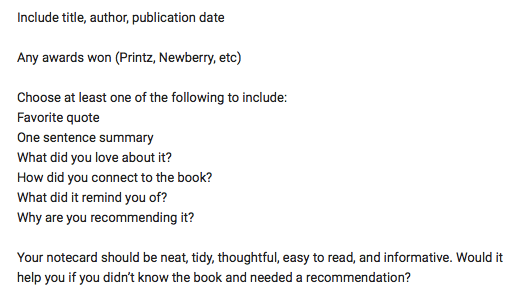
It takes students about five minutes to make a card, and they can even browse the “card catalog” at their desks.


5. The last method utilizes these frames from IKEA. They are double-sided, so on one side is a copy of the book cover, and on the other is the student recommendation.
I provided minimal guidelines for making the inserts to the frames:

We are displaying them on our classroom conferring tables, on our book shelves, and in our school’s learning commons.
The common denominator with all of these ideas is that they are easily displayed, often student-created, and require minimal class time for students to create and use. They also get kids talking about books that they love, about their next reads lists, and about their reading lives. It’s win-win-win!
The gradual removal of scaffolding (like book talks) and the journey to independent reading lives are a couple of the major goals of workshop. Helping students build a community of readers means that they will depend on each other’s recommendations rather than those of their teachers’, and that helps us all reach the common goal of student independence. When students are encouraged to talk to each other about the books they read without the interference of the teacher, then true independence is closer than ever.
How do you encourage your students to build a reading community? I’d love to hear your ideas in the comments below.
Julie has been teaching secondary language arts for nineteen years, spending the first fifteen in rural Central Oregon, and the last four in Amman, Jordan. She’s thrilled to report that she and her family will be moving across the agua to Managua, Nicaragua next year, where a new adventure will begin.
Follow her on twitter @SwinehartJulie



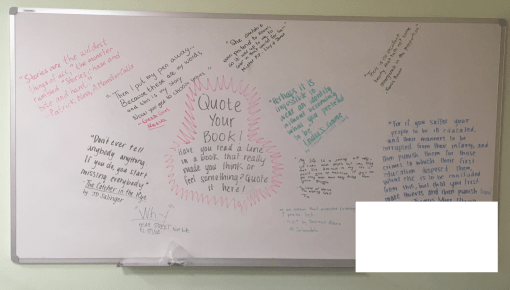
 4. That same teacher also keeps a quote wall on her white board. The words we read can reach us in beautiful ways, and when students experience that kind of moment, they are encouraged to share those lines on the white board. It’s another public display of a healthy reading life. It’s a conversation starter, and it helps build a sense of community within the classroom.
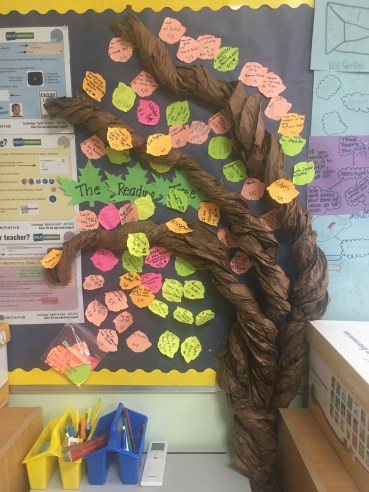
 5. Another teacher in our department keeps poster paper on her walls. Students add titles to the lists as they complete their books. Because names are attached, students can reach out to one another with questions or when they want to talk to each other about a book that they read, too. It’s another public acknowledgment and conversation starter, which is part of what we need when we build reading communities.


 function in perpetual chaos. Every day I whack-a-mole them into their current book, notebook work, mentor text, draft, or just away from their phones.
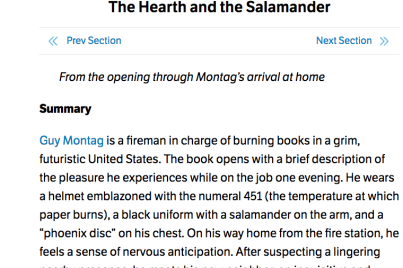 That day, the SparkNotes summary of the first chapter of Fahrenheit 451° (one book circle choice) was their writing prompt. There was some confusion: Were they supposed to write about whether they were going to choose that book? Or to predict what the book might be about? This prompt is like any other daily writing, I told them. Just write what it brings to mind.


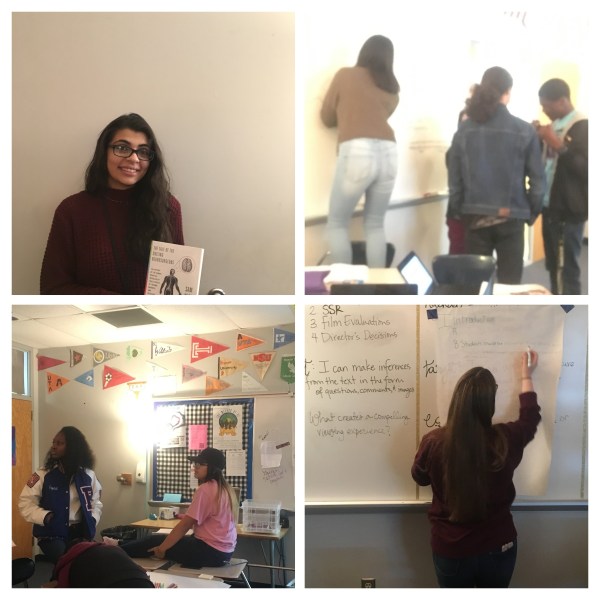 There were about two weeks of school when we came back that I wondered if I was doing something wrong. It seemed like I had WAY too much time on my hands, and I wasn’t quite sure if I was just forgetting about responsibilities, and therefore shirking them in some way, or if I actually was managing my time better.





 Three Teachers Talk