EDIT: Five minutes after scheduling this post last night I got the email from the Book Love Foundation informing me that I won a Book Love Grant. So….didn’t sleep much last night. Too full up with excitement to write this into the post in a more elegant way. My apologies.
Hello Friends,
Today is the 4th of June and this year, my sixteenth yearly journey through teaching, came to its inevitable conclusion. This “end” though is not only about the end of the school year, but the end of a major part of my life. It was a difficult year, full of hard realizations and tough decisions, floods of water and floods of bullets. Yet…I look forward to a new opportunity in August.
If you traced the path from my house to my school you’d see the tracks my tires have worn in the pavement. For the past 11 years I’ve driven to the same address every morning and traced that route home every night. For more than a quarter of my life Clear Springs High School felt like home. Change, I’ve learned, is/was necessary. Thankfully, I’ve been given the opportunity to transfer to another high school in our district and i I eagerly anticipate building a new beginning with a new team.
This is a season of change for me as I’m not just leaving the safety of the only high school in which I’ve ever taught- I’m leaving coaching. I can’t begin to list all the reasons why I’ve made that decision, but I will share that time with my family is no longer a commodity upon which I’m willing to negotiate. Its not a matter of letting go of “the dream” of coaching. I lived the dream, invested time helping so many boys grow into men, and felt the heat under the lights on Friday nights. Coaching was like poetry. Poetry can be happy or sad…devastating or celebratory.
While so much will change, a lot will not. I won’t forget where I came from. The thousands of hours I spent sweating on the grass still inform my instruction just like the classroom helped me be better on the grass. I’ll still watch football like a coach; I’ll just do it from the stands holding hands with my daughter or with my arm around my wife.
I’m still insatiably hungry; more eager to learn and grow than ever before. I’ll continue to seek out opportunities to meet people more knowledgeable than I am and who know a better way of doing things that I do. There are so many of those people out there. From national conferences, to team planning periods, its all new to me and couldn’t be more excited.
I will continue seeking the most effective means of maximizing the power of my instructional practices. I will continue devouring professional texts and building collaborative relationships with the teachers around me. I’ll keep applying to present at every possible venue from the campus level to the national level. I will spread the gospel of literacy and hope to help make a small change in this big world.
I will find ways to empower those around me to love what they do as much as I do. I’ll also seek those that already love it as much as I do and can empower me to share in their energy.
I will read and write because it makes me a better teacher of reading and writing.
What stands out when I look back?
- Our “Rooted in Reading” tree is one of the most successful moves I’ve ever made in the classroom. My students BEAMED when we talked about how many books they recorded on the leaves of that tree. Even when it was transplanted at semester, it continued to grow.
- I poured my heart into the kids more than ever before. The other evening when I asked a colleague when he was going to write his book, he replied: “I don’t know, but its going to be about how it is to build strong relationships with kids.” I couldn’t agree more. I would guess that I had a 97% success rate of telling each class that I loved them as the bell rang to release them to their next class. Next year = 100%.
- We all moved as readers and writers. Some more than others. Some of us (me) had further to move than others.
- Sponsoring Student Council was a massively formative experience for me. I could write a book about our year and how much we accomplished. Working with kids that signed up for the class, rather than other reasons, was incredible. These kids changed the world for the better. They changed me too.
What stands out when I look forward?
- The CCISD Literacy Institute!!! I can’t wait to get started (this morning) on this very important work. Cohort 2 gets to stand on the shoulders of giants.
- Life Changes: Not just the song by Thomas Rhett (which is great, btw) but I’ve made some big decisions about what is important to me and who are the people that I want to learn from and grow with.
- Making changes in this profession that give young people the tools to stave off the yoke of tyranny. (too idealistic?)
- Teaching Pre-AP classes. I’ve never taught anything but on-level classes so I’m thrilled for this opportunity.
The best stories are the stories of discovery. Its time to write Act II of my story.
Charles Moore is excited to join the faculty of Clear Creek High School. He recently discovered the joy of writing curriculum. He loves going to the movies with his wife, driving his classic Corvette and hates building gates (Its the worst). He just finished reading Ten Things We Did (and probably shouldn’t have).


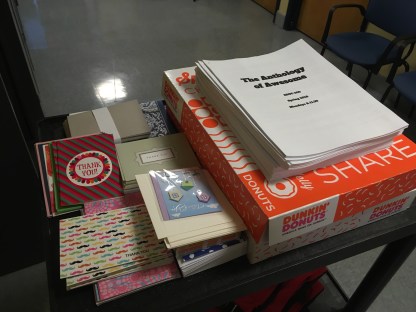

 students’ names and personalities. For my future teachers, I created our ideal school, in which we’d all teach and get to work together forever. In past years, I simply wrote a letter of well-wishes to my kids, and included each student’s name and a little compliment toward them all.


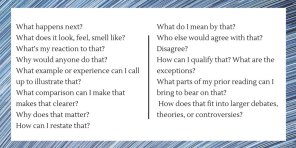 ng fluency and the value of “self-prompting,” and he included a list of a dozen+ prompts that foster such fluency. For Tom, these prompts “swirl in his head” as he writes. For our students, we need to build the habit of prompting questions into their process. Whether through daily writing, regular conferring, or sheer faith in the possibility, many students this year have discovered the true generative nature of writing — a sentence begets a sentence, begets a sentence, and so on. Alas, too many have not.
 to tell, proving we’re capable of what others believe we are not. Then they got students up out of their seats in parallel lines or inside-outside circles, so humans faced other humans, screen-free. First, students shared one-sentence stories based on prompts like “I felt [insert emotion] when …” or “Tell about a time when you … broke or ruined something … told a lie … received a gift you really wanted (or not) …” Lines and circles shifted and rotated to maximize the quantity of faces in contact.
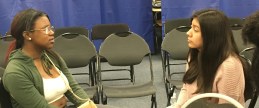 elaborating on one of the prompts from the first part of the exercise. I could hear the energy in the room even before I was fully in the door. Moving through pairs of students, I could hardly hear the stories themselves, but no matter.
  What mattered was that students were hearing them from their partners, many of whom started out as strangers (different classes were blended into one workshop). And not just hearing, but listening. They began, literally, to lean in, closing distances through shared stories and the natural empathy that results. When we return to our regular classrooms this week, students will begin recording their stories on FlipGrid, listening to and commenting on one another’s without the high stakes and vulnerability (even unfamiliarity) of face-to-face, real-time human interaction. Which reminds me …
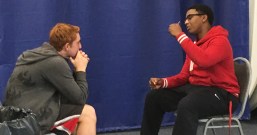 I’d like to pause briefly to offer this qualifier: On-demand, face-to-face, forced interaction with strangers is not every 10th grader’s cuppa tea. (Heck, it’s not every adult’s cuppa, either.) In fact, several students literally waited it out on the sidelines. But even these reticent, reluctant, and even recalcitrant folks couldn’t help but listen — and be drawn into — the stories of others. And maybe even, as a result, classmates who were still strangers became less “other” than they had been 90 minutes earlier. I’m even holding onto the possibility that the stories heard that day will sustain their generative power and elicit even more — not only more stories, but more listening, more “leaning in,” more empathy, even more inspiration: not from any divine spirit, but from engagement with each other and with the work of writing — and speaking — their truth.


 After a few minutes of writing, I ask for volunteers to share their thoughts. In a recent discussion, some students found the idea of carpe diem “frivolous” and thought that people should always stay focused on future goals. To them, “living for today” was short-sighted and irresponsible. This makes sense for teens who are driven to go to the right college and earn the right degree to live a “good” life. Other students said that since none of us are guaranteed a future and we’re “all going to die,” we should do something today: something of value, something productive. Such responses received a great deal of agreement, though students realized that “value” and “productive” are relative, subjective terms. One student wisely noted that we should remember that while we’re trying to live our best lives, others are as well. They discussed the complexities of when the lives of people with different goals intersect. Ultimately, my students saw how their seemingly disparate ideas actually overlapped a great deal, and they separated carpe diem from the trite YOLO idea that many of them initially equated as the same concept.


 Three Teachers Talk