Category Archives: Classroom Culture

Getting Feedback From Your Toughest Critics

Remember what it’s like to be a student, constantly wondering if your teacher likes you, worrying about your next assignment and your next grade?


Me too.


I give out periodic “teacher progress reports” to my students to coincide with the progress reports I have to fill out for them.


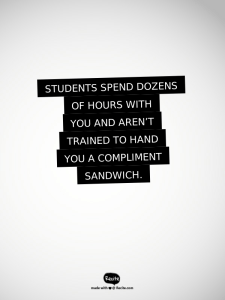
These “progress reports” are an opportunity to hear raw student voices enter the way I think about our work together and the way I plan future lessons and future units.   Unlike your principal, students spend dozens of hours with you and aren’t trained to hand you a compliment sandwich.

recite-1hilvei

Here’s some of what I learned by going through student responses:


Students really, really, really like independent reading time.   It’s clear from student feedback that independent reading is an important routine to their days.  Some wrote about how they look forward to coming in from lunch to a silent classroom for some reading.  Others wrote about how they enjoyed the time to do something they enjoyed.  Many students asked me for more independent reading time.  Aside from giving out candy (most popular suggestion #1) and going outside to play for class sometimes (most popular suggestion #2), more reading topped the list.  Some students even ask me if we’ll ever spend a whole period reading.


They love to write when they know what I am — and am not — grading for. One of the beauties of setting up strong workshop routines is that there’s always a good sub plan in the wings.  If I am going to be out of class for a period or two, I assign a “free choice” writing assignment.  Students are responsible for handing in a writing piece on a topic or genre of their choosing, and they are graded only on their attention to the grammar and mechanics concepts that we’ve reviewed in class.  By making the assessment so literal, students play with form, content, and message: I collect memoirs, mob stories, text message conversations (with graphics!), screenplays, journal entries,  epic fantasies, and more.


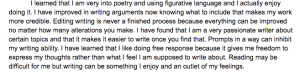
Students love “ghost grades” on major assessments.  I give students the option of a “ghost grade” on a draft for a major project.  That grade serves as a) a minimum final grade, and b) a benchmark for future improvement with concrete feedback on what needs fixing.  Students enjoy making changes and watching that lower “ghost grade” improve in the final draft.  This ghost grade helps make some of their writing progress visible as far as the literal gradebook is concerned.


Do you do elicit feedback from your students?  If so, what have you learned from that feedback?


Amy Estersohn is a middle school English teacher in New York.  She will probably never give out candy, but she will, on occasion, give out emoji stickers, which students pretend not to care about.  (But they do.)  Find her on twitter at @HMX_MSE

Letting Go in the Name of Book Love

letting go

I am a super fan of Pro/Con lists, although the true reflection of these lists never seem to govern my life as much as the making of them does.  Let me explain.

I can always think of a million reasons not to do something, but if I’ve already decided I want to do it, the Pros generally outweigh the Cons because of just that–weight.  Sometimes the reasons TO do something are fewer, but are so weighty that they can’t be ignored.

Workshop was that for me.

pro con

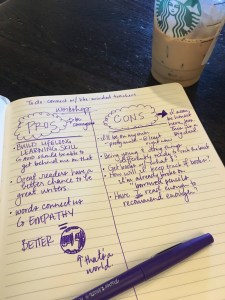
This is a real picture of my real notebook.  Please don’t judge the fact that I give myself pep talks within my P/C Lists.


Here are a few Cons of workshop from my list at the beginning of this year:

  • I’ll be on my own, pretty much.
  • I’m young, and everyone will think I’m just trying to rock the boat.
  • WHERE WILL I GET THE BOOKS?!!
  • Once I get those books, likely via my own dwindling bank account, how will I keep track of the books?  I already go broke on borrowed pencils–and those cost…well… can anyone break a penny?
  • What if I haven’t read enough to recommend enough?

Sure, all of these were true then, and are still true now.  However, I think the weight of the Pros on this list were hard to ignore:

  • I could truly build something that would become a lifelong skill that carries students through the rest of their lives as learners.
  • Great readers have the potential to be great writers.  You can’t do what you’ve never seen (at least not well).
  • Reading in builds empathy.  Reading far and wide builds empathy far and wide.

To be honest, the biggest fear on that list of Cons was the idea of losing books.  We teachers, just as Lisa pointed out yesterday, are notorious for going broke for the cause.

I started workshop anyway.  As soon as I met 3rd Period this year, Terri-Rose quickly became the actualization of my worst nightmare.  On the first day when we checked out books, she insisted on taking three home to peruse because she couldn’t make a decision.  My first endeavor into workshop, I wasn’t quite sure if that was a thing.  I gritted my teeth and slowly expelled a perfectionistic breath, attempting to inhale a free spirit (something which usually doesn’t hover near me much less inhabit my own body).  She held three of my shiny new bestsellers bought with my own money after the small grant I obtained already ran out.  I told her she could do that as long as she signed them out and brought two of them back to me the next time.  I glanced over my shoulder to my then-meager amount of books after the first checkout.  Who knew 300 books could go so quickly?  I might never see them again.  

But, you know what, I did.  Most of them.  Terri-Rose still hasn’t learned to make a decision.  Whenever she finishes one book, she takes two more.  She’ll get halfway through one, and then give it back to me.

I’ll ask, “You didn’t like this one?”

She’ll say, “I do, but I want someone else to be able to read it while I finish this other one.” We developed a system with her book marks.  She likes to use candy wrappers (always pristine) to mark her place, so she’ll hand me the candy wrapper, and I’ll put a sticky note on it with the book title and page number to hand back to her when she’s ready for that book again.  It’s a nice system.

The other day, she came into class raving about a book.  It’s a normal occurrence.  She’s never quiet about something she loves–a quality I’m hoping to channel more in the future.  She wanted to barrel her way through Everything, Everything because the movie is slated to release in May.

Then came the request.

“Mrs. Paxson, I have this pen pal in Weatherford and we’ve started talking about books.  I told her about Everything, Everything, and the movie coming out and now she really wants to read it.  Would it be okay if I mailed it to her to read and then she mails it back before school is over?  I can even ask her to write a review for it before she sends it back!”

The exhale and inhale was quicker this time, mostly because I was leaping for joy inside at the desire to share the Book Love.  I agreed to the terms of her proposal, and I can’t wait to get the book back with a long distance review.

All of those Cons, like I said before, still stand true.  I’ve lost some books this year–probably five or six.  But the weight of the Pros have grown heavier with success and small triumphs–more than I ever thought they might.

As I think of Terri-Rose, unable to make a decision, reading books halfway through and two at a time, always sharing with friends before she’s even close to done, I’m reminded of my own reading life.  It’s a real one, not one for a grade or to check a box.

Then I think: Holy crap–it works.

What moments have surprised you with sharing #BookLove and watching it grow?

Jessica Paxson is an English IV and Creative Writing teacher in Arlington, TX.  She frequently feels as though someone made a mistake in allowing her to hold the futures of over 100 teenagers in her jittery, over-caffeinated hands for the past two years.  If you enjoy watching her make a fool of herself by being unbearably vulnerable, you can catch more of that over at www.jessicajordana.com. Follow her on Twitter or Instagram @jessjordana.


Going Broke Buying Books

Disclaimer: There are countless ways to save money when securing books for your classroom library. I, however, often lack the patience for such measured and responsible procurement of texts. This is my story (and possibly my defense should my husband discover just how much I spend on books).


My husband Nick is a dear man. He has to be, to put up with the amount of time, energy, and hard earned cash I devote to this passion called teaching.

In the 14 years I’ve been at this, or rather the 2 years I’ve been building a genuine classroom library, I have probably spent $4, 398,291 (hyperbolic numbers are my favorite, because I’ve never been good at math).

It often happens before I know what I’m doing. Like those poor souls who sleepwalk and end up in the middle of a busy road in their pajamas, I find myself “just putting a book in my Amazon cart so I remember the title,” or “checking Thriftbooks for a minute (or 27), to see what’s new.”

Hi. My name is Lisa, and I buy a lot of books for other people’s children. 

doryThis “problem” sort of took me by surprise. With my head hanging low, I must admit there was a time, not too long ago, when there were very few books in my classroom. There were very few books in my life period, besides the ones I “taught” year after
year. My classroom was rich in many valuable thoughts, inquiries, and experiences before workshop, but it was not full of books.

How, as a teacher of literacy, had I allowed my classroom to become devoid of the very tools of reading I kept suggesting to my students would be their salvation in the face of collegiate ambitions, thematic exploration, and aspirations of world domination?

Apparently, it wasn’t important to me.

Ugh. That reflection looks ugly in print.

I didn’t purposefully create a text desert in my classroom, of course. If someone had said, “Hey, Dennis. You teach English. Where are all the books?” I would have smiled and pointed to the textbooks and countless copies of Uncle Tom’s Cabin. Students bought any books they needed for independent reading, and I happily progressed with assigning reading, providing study guides, giving content quizzes, lather, rinse, repeat. This is what I knew. This is what I had experienced myself. This is how I was taught to teach.

But then, one day, a big rock fell on my head. I dreamt of rows upon rows of bookshelvesryan gosling lining the walls of my classroom and students clutching copies of countless titles to their bosoms. Ryan Gosling walked into the room and said, “Hey girl. I really love the work you’re doing for public education. Let’s get those kids reading more. Cool?” When I came to, I was blushing, but more importantly, I knew that my students needed more choice. More challenge. More access to books.

Ok. Not really. But the conclusions I came to after some workshop research, training by the lovely workshop team of Three Teachers Talk, and logical reflection about how I wanted my students to view reading, that part is true.

There is still a very important place for whole class novel work in my classroom. There is still a place for short lists of books with a central theme to get kids working in book clubs. There is still a place for the classic and contemporary. But there is also now a place for a lot more choice right in my classroom, always located just a few steps away.

And though we might not want to believe that we have to hold our kids’ hands and walk them to our bookshelves, instead of trusting them to take their own time to go to the library or while away the hours at the local bookshop, at least in the beginning, we do. We need to make the books so wildly available, that kids can’t help but wade through them in the course of our time together.

Think of elementary classrooms. Books upon books, upon teachers reading aloud books. If books aren’t at home, they are certainly at school, and when kids are learning to read, they are showered with books. Why not shower them with texts when we are trying to reignite that love of reading?

Given time to read, talk about books, formative and summative work around independent novel study, goal setting, book challenges, quick writes on choice reading, daily book talks, a teacher who pours passion about books all over their every class period AND shelves of books three feet away, progress in building and rebuilding readers is very possible, and even, probable.

We can teach children to read, but for reading to become a habit, they need ready access to books. We also know, they need choice, choice, and more choice (thank you a million times for your brilliance, Donalyn Miller).

When it comes down to it, we might not want to believe our students evade the reading we ask them to do, but they often do. Many fake read very, very well. Others simply smile, or avert their gaze, or defiantly say, “I didn’t do it” or “I’m just super busy.”

I’ll put it this way, my dentist hands me floss, but I don’t use it as often as I should. There. I said it. I am a college educated, do-gooder, who knows she should floss…every day. I do not floss every day. I know my teeth will suffer for it. I know when I go to the dentist I feel bad for having to say that I could probably floss more. I know it’s with the best intentions for my own self-interest that the professional tells me to do it, but…I don’t do it. I’m just super busy.

Perhaps a bad analogy, but our students don’t always make the right choices when it comes to reading. They prioritize other things. If my dentist were handing me floss every day, chances are good, I’d get in the habit. Should he have to? No. Should I just do it on my own because I know it’s good for me, of course. But, I’m flawed. We all are.

So, at least for awhile, I’m going to care enough about my students’ teeth, er, reading habits to make it highly visible, readily accessible, and as entertaining as I can.

The payoff just this week is real:

  • Josh is a super smart kid who hadn’t been devoting time to reading. He, like so many others, used to love to read, but had fallen out of the habit. With our 10-15 minutes of reading a day, and my suggestion that he add just 10 minutes before falling asleep each night, Josh is back into books. Major texts, in fact, and just book talked The Name of the Wind by Patrick Rothfuss to our a class. A little bit here and a little bit there made the reading a habit again. I bought the book and handed it to one of his peers who flew through it too.
  • I saw Brianna standing at the bookshelf yesterday morning. Sort of swaying back and forth. I skipped over (ok, I was skipping in my head, but I was excited to help her find something magical).
    “What are you in the market for, my dear?”
    “Uh…I’m not sure. I just read Think Like a Freak: The Authors of Freakonomics Offer to Retrain Your Brain. It was really good, but I might be over nonfiction for a while.”
    “Makes sense. How about a really good story? Try this. Oooo! And this…and I had someone read this one last month. And…this (The Help). Have you read this one yet? Take a look at the reviews in the front from past readers. This is a great book.”
    Brianna was 20 pages into The Help and picked up the book between activities in class that day.
  • The somewhat shocked and surprised smile on JJ’s face when, after book talking Jodi Picoult’s Small Great Things: A Novel last week, I put in his hands a copy of her incredible new release. He had asked for my copy a few days later when he finished his latest read, but it had already been checked out. He looked crestfallen. When I saw it yesterday on the new release cart in the library, I checked it out, and hunted JJ down during our resource period. “Wow. Thank you!
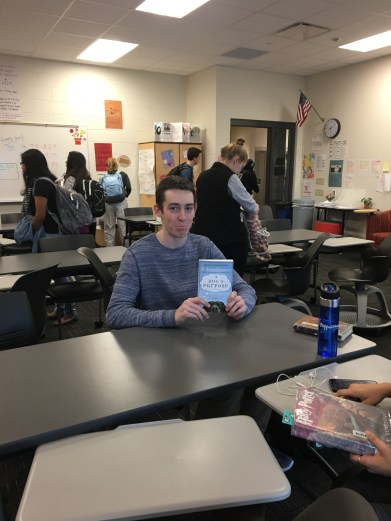
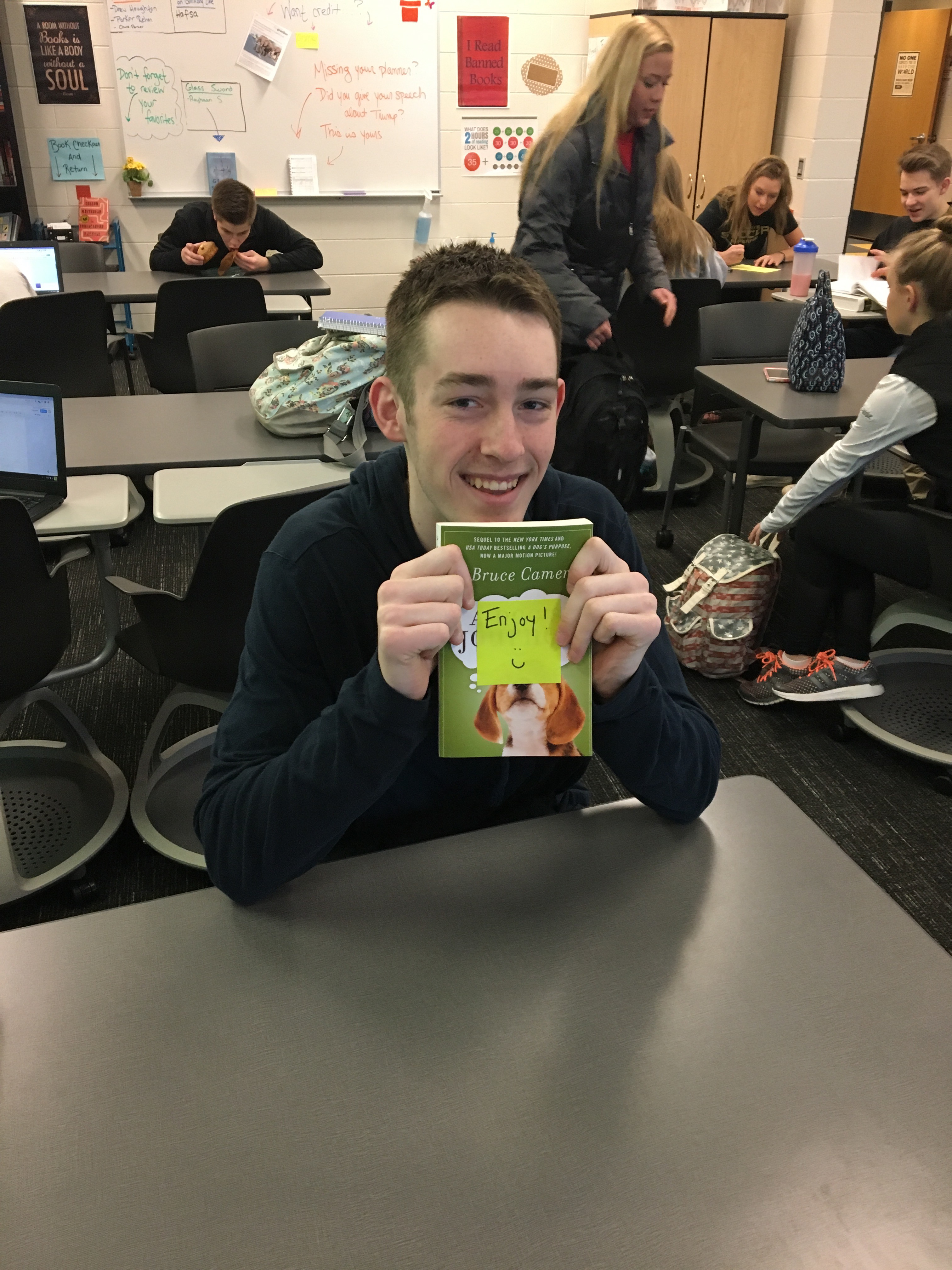
  • And this…You might remember Nathan from a few weeks back after he finished A Dog’s Purpose:
    img_0266
    I was at Barnes and Noble and used one of my gift cards to buy the sequel A Dog’s JourneyI think this smile is worth the expense:

Truth be told, I’m very lucky to work in a district that has put a huge amount of money into funding the classroom libraries of our English department as we’ve moved to workshop. And there are countless ways to put on your thrifty teacher cap and get the texts rolling into your room if your district isn’t yet on board with choice reading:

  • Write letters to your local bookstores and appeal to their sense of community pride, favorable Yelp reviews, and goodwill to all.
  • Loiter in bookstores and flash your teacher credentials. Sometimes a pleading jessicasmile and/or a small purchase will secure some free or discounted books.
  •  Apply for grants (Nothing says #booklove like free books…next year).
  • Rummage, thrift, estate sale your way through the summer.
  • Gather some research on classroom libraries and get it in the hands of your administrators. You might be surprised.
  • Ask Shana for books. She loves to give away books to fellow workshop teachers.
  • Befriend authors via social media! Jessica is trying her hand at scoring some Matthew Quick books through Shana’s connection. No shame, Jessica! Twirt (twitter flirt, I believe) away!

You don’t necessarily have to spend your own money on books, but I do. Something inside of me saying that I need more. I need more variety. I need more to recommend. I need more books.

I keep telling my husband that I’m helping to inform, inspire, and impassion the electorate. I’m also in charge of the money, so my little addiction should be able to continue a little while longer.

I consider you all my support group in this matter. Thank you for your support.

How do you surround your students with books? What titles have you added recently that keep flying off your shelves? We’d love to hear from you in the comments below. 

FTC guideline affiliate links

Lisa Dennis teaches English and leads a department of friends at Franklin High School near Milwaukee. Her latest classroom library purchases were The Hate U Giveby Angie Thomas, American Street by Ibi Zoboi,  and Violent Endsthe story of a school shooting told from various perspectives and written by 17 YA Lit. authors.  Follow Lisa on Twitter @LDennibaum. 

Need a Friend? Yup, Me Too.

Our juniors spent last Tuesday morning taking the ACT test, along with every other junior in the state of Wisconsin. I spent the morning watching them take the test. Talk about mind numbing.

“You will now be taking the fourth part of the test in Science. You will have 35 minutes to complete this test. Please open your test booklets and try not to fall out of your chairs after three hours of testing, during which I have listened to you sniffle, shuffle, and sigh to the point of my own mental health crisis. I mean…you may begin.”

On days when I hand out Kleenex and monitor bubble fill in, I long for interactive class periods of inquiry, exchange, and exploration. However, that sometimes is a pipe dream as well.

Lately, it’s been a bit like pulling teeth to get kids to participate. Pushing them to meet their reading goals feels less like inspiring work, and more like drudgery (How much more inspirational do you need me to be with this whole reading gig? Just DO IT already.). Their quarter three blank stares and exhausted sighs have me resisting the urge to fix my vacant eyes right back at them and mouth breathe until they see their reflections in the mirror of my face.

worksheet

 At times like these, I am reminded by fellow trench mates that we teachers need love too. I don’t want to feel tired, occasionally demoralized, and ill tempered, but I’m there, and part of the reason is that I know my kids are there too.

Workshop can be legitimately magical. Students reading more than they ever have, writing for authentic audiences, and hearing each other speak deeply and passionately about real life issues through literacy. But, Shana didn’t post 9 Books to Hook Your Holdouts for nothing. Amy had the Tissue Issue and needed to Write When It Was Hard.  Jessica is finding her way in a brand new workshop classroom. And countless sources across the web detail teacher burnout and student engagement struggles.

So when our newest contributor Jessica to 3TT reached out over the weekend with: “You ladies are rockstar teachers. Do you ever have discipline or complacency struggles in your classroom?” I had to smile. And then laugh. And then cry a little. And then…

I was taken back to a conversation with a colleague a few years back, where an offhanded comment poked me right in the teacher feels. We had actually been talking about this very idea – the slump we can all feel when teaching gets somewhat less Stand and Deliver and more, students loitering around the complacency trough.

“Well,” he had said somewhat smugly, “As long as you have engaging lessons, students don’t check out.”

Oh. Really? That’s awesome for you…

Listen, I get his point, and to some extent I agree, of course engagement has to be at the heart of what we do, but from personal experience as a learner, it’s not always possible to engage all of the kids all of the time (collective gasp, coupled with Lisa polishing her resume). And that can be exhausting and frustrating to educators, and disruptive to the class.

But today, I am not here to provide advice for how to move forward with this issue in the classroom (I happen to know for a fact that my 3TT ladies have several posts up their sleeves all about engagement. Stay tuned!).

strong

I’m actually here to quickly remind everyone, because I needed the reminder too, that when you are feeling like you could arrange for Big Bird to walk in the door and hand out cookies to everyone in the class, but no one would crack a smile, you need…friends.

Teacher friends.

In your building, down the hall, gathered at PLC, across the country, on the phone, send a quick note, smile at your neighbors, friends.

trouble

I, for one, am a lucky duck in this department. I work with friends. Dear friends.

Stand up in her wedding, give a quick tearful hug, giggle over buffalo chicken dip, join a bowling league, talk about Ryan Adams, compare Lularoe leggings, grab a drink, bake some cookies, geek out over Out of Print literary shirts, talk about being daddy’s girls, Irish Oatmeal, send each other lip sync videos, eye roll at the same time, laugh first and ask questions later, friends ( I think I hit everyone in the department. Seriously. I love you people). 

So, whenever possible, and especially when you feel like you might voluntarily throw yourself down the stairs rather than walk into 3rd period, find people to spill your guts to. Find people to share your successes and colossal failures with. Friends who share mini lesson ideas and friends who share unbelievable content knowledge. Fresh out of college and boundlessly energetic friends, and experienced, measured, and wise friends. Those who have seen decades in the classroom and those who weren’t born yet when you started teaching.

Take the time to engage with the people you work with, both as educators and as humans. Engagement at work increases when we have friends. Harvard said so.

And if the people you work with don’t do this for you, branch out.

The ladies at 3TT have been WhatsApp-ing (verb I just created) lately. We use voice messages, pictures, texts, and links to talk about classroom questions, vent about burnout, explore possible post ideas, and discuss who’s drinking which variety of wine tonight.

There are always ways to connect with like-minded, similarly leaning, comparably focused educators. And there are ways to connect with challenging, make you reflect on your practice, I can’t believe I used to do that too educators who can help reassure you that you are making the right moves, even when those moves are difficult.

Hand someone a cup of coffee and take a seat.

Open up Twitter and join a #chat.

Send one of the Three Teachers (really five of us now, how cool is that?) an email and we’d be glad to listen. 

Don’t close your door and let handing out Kleenex to kids feel like a highlight of positive, professional interaction.

Friends can help you feel sane, productive, positive, and human again. A few kind words, commiseration, a hug, and a maybe a quick snack.

Little else is needed to take the deep breath necessary and get back to 3rd period.

Except maybe, Spring Break.

We’d love to hear your shout-outs to fellow educators who help you right your ship, stay afloat, and just keep swimming! Please share in the comments below. 

shout out.png


Lisa Dennis teaches English and leads a department of friends at Franklin High School near Milwaukee. She almost left the profession in year one, and would have, if not for fellow English teacher Erin Doucette who took Lisa under her wing and taught her the importance of being yourself in the classroom, challenging you students, and celebrating St. Patrick’s Day every year without fail. I love the teacher you are and the teacher you have helped me to become. Follow Lisa on Twitter @LDennibaum. 


Window, Mirrors, and Gigantic Doors: Inviting Sound into Uneasy Silences

For weeks I’ve worked on a list of books to use for book clubs in our junior English classes. I believe that students must have options that challenge, yet engage, and allow them to see themselves and/or others within the pages. It’s that whole windows and mirrors and doors analogy. Jillian Heise describes it well in this post. I’ll just quote a part that struck me:

Dr. Rudine Sims Bishop originated the idea that many now reference. She talks about windows as “offering views of worlds that may be real or imagined, familiar or strange.” And about mirrors, “…we can see our own lives and experiences as part of the larger human experience.” But she also talks about sliding glass doors which “readers have only to walk through in imagination to become part of whatever world has been created or recreated by the author.” The thing is, it’s the third part of it, the sliding glass door that seems to often be left out, but is perhaps the most important part – it’s the part that, in my interpretation, allows us to step into those other worlds and become part of them for the time we are in that book – and isn’t that the power of reading? Being able to develop empathy, understanding, new perspectives by living in someone else’s shoes for a short time. Especially for books as powerful as the ones being written about these real issues that are affecting kids in their lives today, this mirror, window, sliding door access becomes even more important for them to see they have a place in our society, no matter what perspective they may bring.”

I’d like to offer an addition, not just sliding glass doors that  “allow us to step into those 8124672460_6b6f1ef826_zother worlds and become part of them for the time we are in that book,” although that interpretation is certainly vital to developing readers who love books and to gaining empathy.

What about other doors — like the kinds we have to push or pull to get through — the doors that make us work: cathedral doors, fortress doors, iron doors, or doors with scary knockers? These doors require effort. These doors may make us uncomfortable. And sometimes they require courage.

Some books can change us if we view them this way. They can change our students. And I’m not just talking about lexile levels, or complexity of ideas. I am talking about content. The content that exposes our flaws and weaknesses, the content that pushes our thinking, moves us out of our comfort zones, and makes us face, as Dr. Kim Parker puts it, “the lived experience of so many folks of color in this country.”

I am a white woman who teaches students of color. I grew up in a middle class family with conservative ideals. I go to church regularly, and I practice my religion. I had parents who were married for 55 years and taught me the value of hard work, education, and persistence. I am different from most of the students in my classroom. I enjoy a privilege in this country most of them have never experienced.

So what does this have to do with doors?

I choose the big ones.

Awhile ago I conducted a PD session with a group of teachers, mostly white women who like me teach mostly students of color. I showed some of the spoken word videos I use with my students:  “Spelling Father” by Marshall Davis-Jones and “Knock Knock” by Daniel Beatty. I shared articles about undocumented immigrants and Syrian refugees. I read an except from Homegoing by Yaa Gyasi where a character’s wife is kidnapped and he desperately tries to find her, showing her picture around the streets, and finally being accosted by a policeman after he accidentally brushes into a white woman. The policeman rips up the man’s only picture of his 8-months-pregnant wife. The year:  pre-Civil War.

We viewed and read texts. We wrote quickwrites and analytical responses. We discussed author’s craft and studied the moves the writers make to create meaning. Everyone read. Everyone wrote. Everyone engaged in the learning.

Later, the conversation turned to engagement, and I asked the questions:  “What are you doing to make the learning matter to your students? How are you discussing the issues that echo in their lives?”

I gave them time to talk, and I wandered the room, listening in to table discussions. I heard some valuable exchanges, but I also heard: “Oh, I don’t even go there. I’d lose control.”

Hmm.

How will we ever change as a society if we don’t ever go there? How will our students, no matter their color, ever learn to talk about tender and sizzling issues, ever learn to deal or challenge or change them, if their teachers never go there?

We cannot make excuses. We have to invite the hard topics into our classrooms. We have to provide books that are windows, mirrors, sliding doors, and gigantic wooden ones. Not only for the sake of the students we teach but for our profession.

How will we ever have more teachers of color if our students of color do not have better experiences in their English classes?

At NCTE last November, I met Dr. Kim Parker in person for the first time. She read her credo and she sealed a place in my heart with her sincere desire to do right by the students in her care. I share her credo here because it so closely echoes my own. I don’t think she’ll mind:

Ze’Voun tells me that he never knew that reading books could matter so much, could be so enjoyable. He is a young man who is Black, brilliant, and bored. He is a writer and a reader for whom schools seem to be increasingly less designed. When he disappears from my class without any explanation, I learn, a few weeks later, that he has been assigned to an out of school placement program, joining other boys who are–likely–as Black, brilliant, and bored as he.

I believe in rage, and I believe in action. I believe in a world where staying woke matters.  

My most essential work is making classrooms spaces where kids like Ze’Voun can read and write in ways that matter to them–from diss tracks; to letters to the local police department reminding them that Black Lives Matter, too, and that wearing their hoodies is not a crime; to Tweets to favorite authors thanking them for books that are just for him; to books that affirm, reflect, and extend his existence as a brilliant Black boy. Opening up spaces inside classrooms where they can speak a variety of Englishes as they explore the origins of Ebonics, where they can engage and delight with canonical and multicultural texts and write about their understandings, and where they are creators of texts that validate and stretch their identities is some of “the work my soul must have.”

Though Ze’Voun never returned, I continue to hold space in my classroom for other young people who have similar needs and desires, who are hungry for the diverse texts that reach them. I continue to hold on to a belief, and a dream, that the work I do must be as diverse as the students I teach. As escapist, as validating, as powerful as the texts they read. As whole, as free, as happy as we all wish, hope, and need to be.

This what I’ve dubbed Right Now Literacy. We have to give every student the commitment, resources, and opportunities they need to learn the reading and writing skills they need right now, to live and thrive in the world we are in right now.

Dear reader, I ask you the same questions I asked those teachers at that PD:  What are you doing to make the learning matter to your students? How are you discussing the issues that echo in their lives? 

Please answer in the comments. Let’s share our best practices and best resources for pushing ourselves and our students through the doors that can change us at the core. (And next week I’ll try to remember to share my new book club lists.)

FTC guideline

Amy Rasmussen lives in north Texas and teaches AP English Language and English 3 to the Fighting Farmers at Lewisville High School. She adheres to the words of Emerson: “We aim above the mark to hit the mark,” and Jesus Christ: “Love one another.” Imagine a world if we all love more than we think we can. Follow Amy on Twitter @amyrass.

8 Ways Listening Leads to Learning

not-listeningWe teachers often talk too much. Research on listening suggests that adults spend an average of 70% of their time engaged in some sort of communication; of this average, 45% is spent listening compared to 30% speaking, 16% reading and 9% writing. I would argue that this data does not represent teachers in the classroom. We tend to talk more than we listen.

I wonder how many of us have thought of teaching as communication.

Think about this definition of communication: “Two-way process of reaching mutual understanding, in which participants not only exchange information, news, and ideas and feelings but also create and share meaning. In general, communication is a means of connecting people or places.”

Now, think about how much richer our classroom environments could be if we planned, prepared, and presented our lessons through this lens of communication — with the goal of reaching mutual understanding, exchanging information, ideas and feelings, and creating and sharing meaning. To do so, we must listen more than we speak.

What about the time, we may ask, what about the content knowledge we must impart?

When we exchange our need to talk with our students’ vital need to have us listen, we

  1. transform our teaching by looking for ways to invite students into conversations
  2. better utilize the time we have with our students, meeting their needs in one-on-one and small group discussions
  3. deliver information in new ways, other than students listening to lectures or taking notes from slide presentations, or completing worksheets
  4. break down walls many adolescents have built against school and against authority — they know we see them as the unique individuals they are, and they respond
  5. provide opportunities for students to learn from one another so we may listen as they share with one another
  6. help students discover and take ownership of their needs, both personally and academically — talk often works as a lead into deeper thinking
  7. facilitate communication that leads students to take on the characteristics and behaviors of readers and writers — or in a biology class as scientists, or in a history class as historians.

Fostering room for more listening is the first move into creating a culture of conferring.

Does it make us vulnerable? Yes! and facing our vulnerability is where our growth as teachers takes root, taps into strategies that nurture our learners, and eventually blossoms into the instruction and learning experiences we want for all students.

How do you make room for listening in your classroom? Please share in the comments.

Amy Rasmussen lives in north Texas and teaches AP English Language and English 3 to the Fighting Farmers at Lewisville High School. She adheres to the words of Emerson: “We aim above the mark to hit the mark,” and Jesus Christ: “Love one another.” Imagine a world if we all love more than we think we can. Follow Amy on Twitter @amyrass.

Feel Good Friday

It’s been a looooooong week.

We had parent teacher conferences on Monday night. Monday night. It felt a little cruel and usual at the time. Then it just felt like this week might never end.

But end it has. Here we are..FRIDAY!

I feel like celebrating, because this, my friends, has been a week when feel good moments snuck up on my classroom when I was almost too sleepy to notice.

Such as…

Logan is a self proclaimed sports man.

His dad teaches PE here at Franklin and coaches our wildly successful football team. I believe Logan said not long ago that he “lives for sports.” But this week, it seems, he’s been living for books.

So far this year, Logan has completed four books ranging from Redeployment by Phil Klay to Sky on Fire by Emmy Laybourne. He is currently eating up Dark Matter by Blake Crouch, so much so that he enthusiastically book talked it this week before he even finished it.

Last class period, before the bell rang, I let Logan know that he needed to run to guidance and clear up a little confusion around signing up for AP tests. To my heart’s delight, Logan said the following words:

“Can I go after reading time? I want to read first.”

Amen.

img_0269

Logan devouring Dark Matter 


Priyanka stopped by my desk only moments ago.

association“Mrs. Dennis, do you remember emailing me about my one pager this week? You asked how I was liking The Association of Small Bombs.”

“I do! I was wondering how it’s going. You’re the first to read it and I was so excited to get that free copy at NCTE.”

“I LOVE it. You know how sometimes you aren’t sure what the theme of a book is? Like, you have to work to find it? This book’s theme IS THE COVER! All of these intricate stories and characters coming together. I can’t put this down.”

“Making you think, hmmmmm?”


Nathan was struggling to read at the start of the year.

Not his thing, he told me. Then…he found Suzanne Young’s The Program series. He couldn’t put it down and flew through all three books.

Then he launched into A Dog’s Purpose by Bruce Cameron. He finished it in class today.

img_0266

This was Nathan at the end of class. A fellow student asked him if he was ok.

“It was just…SO good.”

A few moments later, Nathan was at the bookshelf returning the text. And I observed, “Nathan, you look like a man without a country. You ok?”

“Mrs. Dennis, I just found out this book has a sequel. I wanted to read The Kite Runner next, but…a sequel. I want to read that now too!”

“How about I give you The Kite Runner while you wait to get the next Cameron book and you read that quick over the long weekend. You won’t be able to put this that down either.”

“Oooooo…good idea. Yeah, can you get me a copy?”

(Clapping excitedly in her head, Mrs. Dennis sprints next door to get a copy of The Kite Runner. He’s reading!!) 


We are fighting fake news in our classrooms.

Today, the posters I had made of the IFLA’s infographic on how to vet sources and avoid getting duped by fake news got delivered. I’m geeking out over these posters.

img_0267


Lastly, this just made me laugh out loud.

apple-2


Happy Friday, everyone!

What made you smile this week? Please share in the comments below! 


Lisa Dennis teaches English and leads a department of English superheros at Franklin High School near Milwaukee. Fridays make her happy, but so do books that smell old, buffets that include ice cream for dessert, and infographics made into classroom posters. 


Why Conferring Matters

Conferring is the interaction missing from many of our students lives.

Consider this:  the current generation thrives on one-on-one attention. They do not remember a time before social media, and many live much of their lives online via their smartphones. They turn to instantaneous interactions that have a direct impact on how they feel about themselves:  Snapchat, Vine, and Instagram over Facebook, which they are abandoning in droves because “it’s for old people.”

Our students crave immediate feedback. They seek personal communication — and they need it.

Think of the implications of this virtual-reality world on long-term relationships and problem-solving. We have already seen how it impacts our students in the classroom: short attention spans, skimming versus sustained reading to name a couple, not to mention the addiction to notifications.

Our students need to experience and understand the importance of eye contact, facial expressions, and body language, and how these physical features create non-verbal communication. They need to interpret and explicate tone.

The students in our classrooms today are different from Millenials. Anyone born after 1995 earns the new title of Generation Z, also called iGen, Centennials, Founders, and my favorite title: Gen Edgers.

As a whole, these students use technology as their primary source of communication — to validate, and to feel validated.

They also value genuine relationships, loyalty, and honesty and are increasingly more careful than the previous generation with the friendships they form online. They want to know their voices matter and that they are okay just being themselves instead of being the perfectly-phrased word count they must craft online.

Our students need opportunities to share thoughts, feelings, ideas, and knowledge in non-threatening situations through real face-to-face conversations.

Conferring opens opportunities to meet the needs of our students at the core of their longing.

When we invite students to talk and affective filters lower. Students relax. They respond.

When teachers confer with genuine interest in the well-being of the child, we grant students permission to be their genuine selves. Research on the brain shows that “positive comments and positive conversations cause a chemical “high,”” and with less pretense and stress, students experience more learning.

Conferring gives students the chance to share their stories; and besides creating trusting relationships, conferring allows us to meet them where they are and help them advance in knowledge and skills from there.

On-going regular conferences ensure that every student receives the one-on-one interaction and instruction they deserve. Peter Johnston reminds us that every student has a personal history that affects our ability to help them advance in their literacy skills.

Through conferring we learn the cultural and personal backgrounds that shape our learners, along with the experiences that shaped them in the past as readers. Both are important factors. By asking questions that invite students to recall their learning histories, we initiate future learning.

Conferring also sparks critical thinking, creativity, and curiosity.

No matter the teaching style — be it an English class where the teacher makes the choices about books and writing topics, or a workshop inspired classroom where students choose what they read and write, or even a classroom of another content area — when conferring becomes a norm, students proactively engage in learning, which results in more growth, independence, and mastery of content and concepts.

Our students learn to ask questions, ponder responses, and seek for interesting ways to show they are learning. Differentiation happens naturally.

Imagine the opportunities students may create and the innovative energy they will have in the future if they experience this kind of learning in their secondary schools.

The children in our classrooms are part of the fastest growing force in the workplace and the marketplace. Their influence is changing companies, marketing styles, and consumer habits.

This generation wants to make a difference in the world. They are pragmatic, self-aware, goal-oriented, and self-taught via YouTube. They’ve grown up “dealing with too much vs. too little information their entire lives.”

They will soon become our peers standing in voting lines, our colleagues standing near the copy machines, maybe even our bosses, or perhaps the officials that govern our cities and our states.

As adults we must provide each child with the education that prepares them for the future they are moving into.

We cannot keep teaching the way we have always taught with one-size-fits-all lesson plans and instructional models. We cannot keep making all the choices about books and reading or essay topics.

We must talk to our students one-on-one about what matters to them personally. Our future, and theirs, depends on it.

And for the teacher who worries about time, conferring provides a means of easy and accurate formative assessment, which saves valuable time spent grading:  time teachers may spend planning effective lessons or conferring with more students.

When done with fidelity, conferring improves the effectiveness of our teaching. I don’t know one teacher who doesn’t want that.

Please share your thoughts on conferring in the comments. What are your conferring routines?

Amy Rasmussen lives in north Texas and teaches AP English Language and English 3 to the Fighting Farmers at Lewisville High School. She adheres to the words of Emerson: “We aim above the mark to hit the mark,” and Jesus Christ: “Love one another.” Imagine a world if we were to all aim higher to love our fellow man. Follow Amy on Twitter @amyrass.

Looking to the Future: Students as Changemakers

As teachers, we have a unique opportunity, and I would say responsibility, to see our students not only as the beautiful (challenging, curious, and occasionally perplexing) people they are, but also as the adults we want them to be: consumers of information, thoughtful citizens, empathetic neighbors, considerate collaborators, creative problem solvers, and kindhearted souls.

Specifically as English teachers and workshop practitioners, we lay a foundation for these futures with classrooms rooted in a sincere passion for reading, writing, speaking, and listening. We advocate for our students through literacy, because their futures depend on a capacity to actively engage with the human condition.

P. David Pearson,  founding editor of the Handbook of Reading Research and professor of Language and Literacy and Human Development at the Graduate School of Education at the University of California, Berkeley, said that “a teacher’s job is always to bridge from the known to the new.” We work each day with students whose experiences, beliefs, passions, and preferences vary as widely as our own, but together we take what is fixed and challenge it to stretch, bend, and grow.

In the process, we end up with countless stories of students falling back in love with reading, challenging their opinions through talk with fellow classmates, digging into their writing to push past self imposed limits of where words and expression can take them. I shared a quote from Barbara Kingsolver with my students the other day, specifically for diction analysis, but probably more importantly for talk:

“Art is the antidote that can call us back from the edge of numbness, restoring the ability to feel for another.”

We discussed the far reaching definition of “art” (including literature and composition) and the suggestion in this line, art not only speaks to us, but heals us and build empathy within us. Several students throughout the day noted the need for this type of beauty in our current politically turbulent times.

“Congress should have a book club,” one student suggested.
“The whole country needs a book club,” another chimed in.
“Yeah, make them talk about feelings and stuff like Mrs. Dennis does.”
“Well,” I smiled slowly, “if they used our small group discussion rubrics for assessment, they would have to provide text evidence for their opinions, politely disagree with other members of the group and support their contrasting ideas with more evidence when necessary, and work to show leadership skills by actively engaging all members of the group. Sounds like a good place to start for all of us.”

See, even high school students know that art can be the mirror we need to lift up in order to carefully consider our actions and how those actions impact others and the community at large.

It is with this in mind that I share a few brief stories to further inspire your commitment to and passion for the work we do. Students that internalize the power of words, communication, and concentrated energy for making the world a better place become living mentor texts that we desperately need in order to motivate current students to keep pushing, keep questioning, and keep believing in their own capacity to make a difference.


Sam Kraemer was my student twice, and was the type of kid you’d like to fill your whole classroom with: thoughtful, inquisitive, charming, hard-working, funny, and smart. Having made the decision to be a newscaster in the sixth grade, Sam now finds himself as the weekend anchor for the 5:30 and 10:00 o’clock news at NewsCenter 1 in Rapid City, South Dakota, a position he was promoted to after less than a year on the job as a reporter. sam-2

Sam recently came back to school to visit and, of course I could believe the confident young man standing before me, but what struck me was the depth of understanding he already had about the role he is playing in this world. Having asked him where this passion for reporting came from, he said firmly, “the storytelling.”

samHe knows that his reporting efforts can show “the American people what is actually going on” and  that “the world is a better place when facts are clearly established and people have the right to think for themselves. I guess I just enjoy my role in presenting info & stories for people to use in that thinking process.”

How often do we all preach about the importance of clear and careful thought? And here is a young man, in an age when journalists have become a group too often mistrusted and maligned, whose believe in the power of educating the opinions of others, makes my heart swell.

Sam goes on: “A lot of people don’t have time to follow government closely, pay attention to how things happening nationally or internationally affect them, or even know about crime/incidents just down the street for them. Through ample & clear communication, I can be that trustworthy source of information. I can present the facts — not with opinion, but with context — for the viewer to consume and formulate an opinion on.”

What more could we want from our kids than for them to realize that their role in the future matters? That writing and storytelling and communication that ensues matters.

 As Sam concludes, “I know I can share relevant information that either gets people thinking or even spurs action. And that right there is how I try to make the world a better place.” (Shared with me like all of the convictions that truly make a difference in the world, via Facebook message at 3:15 a.m. Classic).

Here is one of Sam’s recent broadcasts. A piece, where as he says, that presenting both sides of an issue with national implications,  “let [his viewers] decide whose argument had more merit.” Fair and balanced news reporting? Sign me up.


Sarah Matuszak graduated from Franklin in 2012 and to say she was passionate doesn’t do her soaring spirit justice. A deep thinker with a kind heart, Sarah finds herself as a paramedic in North Dakota and recently took her “constant obsessive preoccupation with sarahthe world’s bleeding” to Standing Rock. Having worked with the United States Army, firefighting, and in law enforcement, Sarah says that “being a paramedic comes close to what sets my soul on fire, but I’ve found that activism is where I belong. I use all the skills I’ve learned from those aforementioned fields, and apply them to activism.”

Now, just as we’ve all encouraged our students to do, Sarah has taken her passion to print with an article for The Huffington Post detailing her position on and work at Standing Rock.

When she published her piece, “December 5th Is Not the End Of Standing Rock,”  Sarah posted it to Facebook and tagged me. Years ago, right before she took the AP Language test, I gave Sarah a note of encouragement, telling her that I not only knew she had no reason to be nervous for the test, I also knew I would see her writing in the New Yorker someday. Little did I know, she would keep the note all these years and dedicate her first published piece to me.

sarah-3

sarah-2

To say that Sarah is invested in the betterment of our planet, would be to shortchange the depth of her character and the depth of her commitment to humanity. Sarah was destined to take her educated opinions and make the world think about them long before she ever walked into my classroom, but the encouragement she received along the way, meant something. And just as she says, “firsthand experience makes it real,” seeing the potential of our students makes their dreams that much more real too.


Austin Bohn spent some time with me in the classroom last year. He inspired several of my students to challenge themselves, specifically Bennett Dirksmeyer. I wrote about it in a post about students inspiring students. Both young men credit our shared class IMG_0123experiences, and the books and essays they’ve read as a result, with teaching them how to think. Bennett, I’ll be writing about again in a few years when he becomes the first President of the United States to listen more than he talks, but Austin is already putting his passions to good use through writing.

His two published pieces appear on Medium, an app designed for “readers on the go.” Both selections, “New popularity for unpopular opinions…and new a responsibility for the unpopular” and “Dissonance of the Day: Is Twitterspeak Orwell’s Newspeak?” use Austin’s charismatic voice and probing curiosity to challenge readers’ thinking. In fact, I just went back and reread his piece about Twitterspeak and his insights from last January on Orwell’s 1984 are feeling eerily familiar as the novel is once again a bestseller in our age of alternative facts and fake news.


Our students listen.
Our students internalize our enthusiasm.
Our students have big dreams, and we can give them mirrors in the form of books, time to write, and safe places to develop and share their ideas, that allow them to see themselves more clearly.

If we’re lucky, they turn those mirrors around and hold them up to the world, so we can see each other more clearly too.


How do you encourage your students to be changemakers? Share some stories in the comments below of students and former students who are out there making a difference! 


Lisa Dennis spends her school days teaching AP Language and Honors/Pre-AP Sophomores, while also leading the fearless English department at Franklin High School, just outside Milwaukee, Wisconsin where she lives with her husband Nick, daughter Ellie, and beagle Scout.  She is a firm believer that a youthful spirit, a kind heart, a big smile, and a good book can ease most of life’s more troublesome quarrels. Follow Lisa on Twitter @LDennibaum.
10 Things We Did That Invited Initiative — and Growth

It is 6:00 am. I stayed up all night playing with this blog and our Facebook page and Pinterest and Instagram and exploring this app and that extension and whatever else called on me to click on it. I didn’t even realize I’d blown the night up until my Fitbit buzzed telling me to get up and workout. Thank God it is a holiday!

I cannot help but think (besides about how tired I will be all day) about engagement. I remember a while ago I read Danial Pink’s book Drive and then watched the RSA Animate video on motivation. We really will spend time, lots of time, doing the things we want to do be it reading, writing, learning a new skill, climbing a mountain, or sinking into the social-media–abyss. We just have to want to.

So how do we get our students to WANT TO do the things we know will make a difference in their lives, namely, read more, write more, communicate better, think more critically?

We keep trying.

i just finished a semester with my students. I wish I could say that every child read more than he ever has in his life, wrote better than she ever has since she held a pencil, learned to speak with ‘proper’ English and clear eye contact, and thought like a rocket scientist trying to get a man to the moon.

Some did. Some did, and honestly, the first few days of school, I didn’t think they would. But I kept trying.

Here’s a list of the top 10 things I kept doing, even when I was tired, even when I thought they weren’t listening, even when we all wanted to hide behind dark curtains and ring a bell for a cup of tea. (That will be me later today.)

We read at the beginning of class every day (almost — we had about six days throughout the semester when something somehow got in the way of that, i.e., fire drills, assemblies, wonky bell schedules, my car dying on the way to school).

We talked about books A LOT. Book talks, reading challenges, reading goals, tweeting book selfies, and more.

We wrote about our books enough to practice writing about our books. Theme statements, mirroring sentences, analyzing characters and conflict and plot — just enough to keep our minds learning and practicing the art of noticing an author’s craft.

We wrote about topics we care about. With the exception of the first essay students wrote, which was all the junior English teachers committed to as a pre-assessment, students chose their own topics or wrote their own prompts. Donald Murray in Learning by Teaching says the hardest part of writing is deciding on what to write about, yet we so often take that hard thinking from our writers. The worst essays my students wrote was the only one in which I gave a prompt, and before you think it’s just because that was their first essay, nope, I asked them. They just didn’t care — and that is the worst way to start off the year in a writing class.

feedback-on-prompts

feedback-on-owning-topics

feedback-on-self-selected-topics

We read mentor texts and learned comprehension skills and studied author’s craft. I chose highly engaging texts about current events in our society:  police shootings and being shot, taking a knee during the national anthem, race relations, our prison system, immigration issues — all topics that make us ask as many questions as the writers answer. Inquiry lived in our discussions.

feedback-on-writing-as-a-writer

We talked one-on-one about our reading and our writing. I conferred more than I have in the past, taking notes so I wouldn’t forget as students told me about their reading lives and their writing woes. We spoke to one another as readers and writers. We grew to like each other as individuals with a variety of interests, backgrounds, ideas, and dreams.

We shared a bit of ourselves — mostly in our writing — than we ever thought we would. Abusive mothers, alcoholic fathers, hurtful and harrowing pasts and how we grow up out of them. We talked about respect within families and how we can hurt the people we love the best when we ignore their love because it’s masked in fear and strict parenting.

a slice of Daniel’s semester exam essay

We celebrated our writing by sharing what we wrote, by performing spoken word poems, reading our narratives, or reading our quickwrites. We left feedback on sticky notes and flooded our writers.

We grew in confidence and that showed in our work. I held students accountable with high expectations — and lots of mercy. Most rose to the challenge, even those in their first AP class and those far behind who needed to catch up. Most exceeded their own expectations.

feedback-on-high-expectations

feedback-on-writing-as-a-writer

feedback-on-writing-confidently

We joined communities of readers and writers on social media, building a positive digital footprint that shows we are scholars, students who care about their literacy and want to go to college. We wrote 140 character book reviews and explored Goodreads and shared covers of the books we were reading. #IMWAYR #readersunite #FridayREADS #FarmersREAD

martina

rozlin

I will miss the juniors in my block class who are done with English for the year. They were a joy, although a challenge, pretty much every day. And my AP kiddos, they are ready for the kind of learning we will do to face down that exam come May.

We will keep doing what we do: Whatever it Takes to Grow as Readers and Writers (even if it means a lack of sleep.)

What do you do to motivate your learners? Please share your ideas in the comments.


Amy Rasmussen lives in north Texas and teaches AP English Language and English 3 to the Fighting Farmers at Lewisville High School. She adheres to the words of Emerson: “We aim above the mark to hit the mark,” and Jesus Christ: “Love one another.” Imagine a world if we all love more than we think we can. Follow Amy on Twitter @amyrass.

disclosure