This is a guest post by Dr. Helen Becker, and I owe her a big apology. I had agreed to run this post before her presentation at ILA. I have a million excuses: None will do. So I publicly I say, “I’m sorry for not following through,” and if you are reading 3TT today, know this: Helen is one of the smartest educators I know. ~Amy
To understand the instructional power of novels in verse in the high school English classroom, you must first know a bit about my former school. Clear Creek High School, a comprehensive high school in Clear Creek ISD in southeast Houston, serves 2500 students in grades 9-12. According to Texas Academic Performance Reports (TAPR) published by the Texas Education Agency (TEA), in the last five years, the campus has experienced a steady rise in the number of English Language students. Many of these students have come from Latin American countries.
What you must also know is that our district advocates student choice reading in a reader/writer workshop setting. Furthermore, to provide students greater choice in reading material, the district invested nearly a million dollars to flood classroom libraries with high-interest books. Self-selected independent reading has become a constant in the changing school landscape at Clear Creek High School.
Fast-forward to my fifth period Reading class two years ago: a group of thirteen boys and one girl who, despite the best of intentions and instruction, had still not passed both End of Course (STAAR) exams in English. Enrollment in a Reading course, coupled with co-enrollment in grade level English class, was meant to close the gaps in their reading and writing lives. This is where the workshop model and classroom libraries intersected with my fourteen EL students. When the District ELA coordinator brought a stack of newly released novels in verse to my fifth period Reading classroom, the students devoured the books. Thanks, Billy Eastman.
And so began my quest to know more about the power of using novels in verse in the EL classroom. I knew I had found a topic that I needed to know more about – for not only my use in my classroom but use in the classrooms of others as well. While researching the topic further, I encountered a noticeable lack of research-based information about using novels in verse with EL students.
In fact, the only direct source of data I located was from Farish (2013) who writes based on her first-hand work as a librarian at a school with a large population of EL students. Farish writes in School Library Journal that the poetic form of novels in verse mimics folksongs and tales that are part of many foreign cultures. As a result, EL students feel comfortable with the novel in verse genre because of this similarity. Farish (2013) adds, “Many who work with English-language learners and others who struggle with reading seek novels that promote fluency and a sense of competence in readers.” Verse novels accomplish just that. They can move fast and offer readers at any level a feeling of completion.
I broadened my research scope to consider the transferrable skills all students, not just ELs, could practice with novels in verse as an instructional medium. The arrangement of words and a sheer abundance of white space on the page makes these books, well, friendly and approachable. EL students have fewer words to decode. Furthermore, Young Adult novels in verse often involve a protagonist with the same issues the EL students themselves are encountering. In short, novels in verse promote student agency (Garud, Hardy, & Maguire, 2007; Oakeshott & Fuller, 1989; Tran & Vu, 2017), and self-efficacy (Bandura, 1977).
But my experience with novels in verse really concerns one Fifth period Reading student in particular: Emerson. Emerson moved to our community from Guatemala five years ago and had difficulty finding books in English to read in my class. He experimented with books at a lower Lexile (I, for one, feel that Lexile level hinder rather than encourage literacy. This Literature Review from ALA provides data to support my stance on Lexile levels), but he was quick to abandon them, shrugging and saying, “They are boring, miss.” When I put Booked by Kwame Alexander in his hands, I totally mean it when I say that I didn’t see Emerson’s nose for a long time…it was in his book the entire time. In fact, I’m pretty sure Emerson read the book several times over. When I asked him about the book and why he liked it so much, Emerson said, “It speak to me.”
I cried those tears you cry when a student finally connects with a book.
As a result of my experience with ELs, I authored and co-presented a workshop at TCTELA on using novels in verse to engage English Learners in the high school classroom. In the session, fellow teacher and now Instructional Coach Megan Thompson and I delved into ways to leverage this popular genre to encourage reading comprehension and improve writing craft. I reworked the presentation for the International Literacy Association (ILA) conference this month in New Orleans, and Megan and I and invited our fellow teacher and TCTELA High School Section chair, Charles Moore, to join the presentation team. Both Megan and Charles brought their expertise as literacy leaders to the presentation.

If you were not able to attend the presentation but want more information on novels in verse in the EL classroom, reach out to me at hbecker@ccisd.net. I’d love to share my learning with you.
P.S. I gave my copy of Booked to Emerson as his graduation present.
For research citation see here.
Helen Becker has taught all levels of English Language Arts as well as AP Capstone Seminar in her seventeen years teaching secondary English. Today, Dr. Becker teaches Senior English at Clear Brook High School in Clear Creek ISD. Any day now, a suitable replacement for her will be found, so she can transition to her new job in the CCISD Office of Assessment and Evaluation. Until then, every day is a workshop day. Which means every day is a good day in Room 406.


 Here’s a
 been in love with all things literacy and education for as long as she can remember. She believes to share that love with students and teachers has been the greatest of honors. She says, “I am proof that literacy and education can change a person’s destiny in the best ways.” Along with being an instructional coach and teacher, Bridget is also the mother of one adorable book-loving little boy and the wife of one giant man-child. Her life goal is to love like Lizzy Bennet, fight like Harry Potter, and live like Atticus Finch. Follow her on Twitter

 Which also means students need access to high-interest engaging books they want to read. Lots of access. And teachers need to read these books, not just so they can help match readers with books — but to use them to teach literacy skills.


 In my short time here as a regular contributor to Three Teachers Talk, this was the latest I’d waited before composing a post. Though, that’s not really true. I had a post mostly written last week where I reflected on this year we had and looked forward to a new start next year at a new school. It would have been similar to
  I struggled because I realized how comfortable I am using the term “active shooter” in a text message to my wife at 8:11 Friday Morning. This was the text message I sent her after I pulled up a local news website to see if it was true or anther false alarm.

 And for the past two years, as I have worked with preservice teachers of all content areas and grade levels, my students have been
 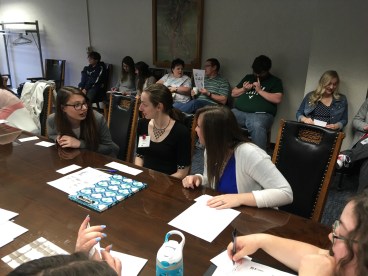 At our WV ELA State Conference, Elizabeth, Brittany, Sarah, Victoria, and Rachel shared one each of their tried-and-true strategies with participants.


 So, when we flew home on Sunday night, I got to bed at about 11:30 pm. Up at 5:00 am, Franklin had school through a half day on Wednesday. I then hosted Thanksgiving for 11 people on Thursday, managed a Black Friday marathon shop with my daughter Ellie (She’s four and up at 6 am anyway – might as well take advantage), cut down a Christmas tree on Saturday, and tried to be a teacher again on Sunday in order to tackle 70ish AP Language responses and plan for the coming week. Next week (I am so excited), we fly to Arizona to visit family for a long weekend.


 I had an amazing learning experience at NCTE in St. Louis. I met Twitter friends for the first time face-to-face. I got to present with my amazing and faithful blogging buddies — and Tom Newkirk! I loaded my shoulder bag with loads of new books for my classroom library complements of the book vendors in the exhibit hall. I talked with some fascinating educators and attended fantastic sessions — all tattooed my heart with meaningful messages. I saw Linda Rief talk about her heart books and Nancie Atwell, Kelly Gallagher, and Penny Kittle advocate for choice reading and more talk and more diverse books and more time to read and write with students. I attended CEL and presented with my newfound friend, Sarah Zerwin, who is writing a book on going gradeless, my newest quest. I did not sleep much. Does anyone sleep much at NCTE?


 Three Teachers Talk