Today is my last day with my AP English Language students. They test tomorrow and then a variety of pre-senior activities keep them from my class for the rest of the week. For them, summer is right around the corner. One more day of class, a test, a few orientations and then freedom.
So, tomorrow, we will make the most of our time: reviewing any last minute questions, calming any overly stressed nerves, reminding them they’re prepared and ready, saying our goodbyes. In short, wrapping up this year. All in all, it’s been a good year, and I’m sad to see them go.
However, I’m almost a little happy to see them go as well. It would be weird if I wasn’t. Wednesday morning when they step into the gym to test, I’m going to step into my room and give myself three hours to just think about next year. Guys. I’m so excited to let loose all of my pent-up “this is how to make next year better than ever before” brainstorming energy.

I’ve been feeding that desire bit by bit with my PLC (like a valve letting off steam to keep from exploding writers notebook ideas everywhere). We’ve been slowly working our way through Kelly Gallagher and Penny Kittle’s 180 Days, and it has already started to influence some ground-level changes in our curriculums for next year – namely, a big step away from whole-class novels and more fully embracing student choice not just in their writing but in their reading as well.
Honestly, I think even without the push from 180 Days, we would have landed in this direction eventually. We’re all a little burnt out on the whole class novel. Too often the works are shared only from one perspective, the students aren’t really invested in the readings beyond receiving a grade, and the literature we teach doesn’t line up with the goals of our course. And, by my count, I’ve read Gatsby at least once a year for the last decade. This may be blasphemous, but that’s too much Gatsby.
We’ve been hesitant to move away from whole class novels entirely. After all, can a student make it in the “real world” without having read The Scarlet Letter? Those thoughts about how ‘we’ve always taught this book, so, we should just keep teaching it’ have dogged our conversations for years. However, we recognize that some of those novels aren’t that representative of our students or their interests.
So, we’re going to make a change, take the leap, see what happens.
First, we decided we wanted our units to revolve around books of choice; so, instead of trudging through a whole class novel, students would be asked to choose from a list of genres throughout the year. Right now, we know we want them to choose a modern work of fiction, something nonfiction, and a podcast. We’ll flesh out the rest of the requirements over the summer. We also decided that we don’t really care when the student reads their work of fiction or listens to their podcast. I think this part of their choice is important too. It recognizes and validates that sometimes students are ready for some texts at different times or that their schedules can accommodate different texts at different times. At every point throughout this process we want our actions and our assignments and our practices to validate our students’ voices and choices.
Then, we decided to let essential questions drive our units instead of the novel. In the past, we would just pencil in Gatsby and something vague about economy, gender, the American Dream (that ‘the’ has always been problematic to me, but that’s another conversation for a different day), and then move on. Now, we have a list of fourteen possible questions we could feasibly spend time answering throughout the year. Student choice in reading is nothing new. Our twist has been to ask our rising juniors what they want to talk about for next year.
We collated the fourteen questions into a Google form; then, we gave the form to the rising juniors and watched the results roll in. Here’s what we found:
| Essential Question | Average ranked score | Ranking | My random thoughts |
| Education: to what extent do our schools serve the goals of a true education? | 3.36 | 5th | I can’t WAIT to have this conversation with my magnet school nerd herd. |
| Community: what is the relationship of the individual to the community? | 2.89 | 12th | |
| Economy: what is the role of the economy in our everyday lives? | 2.79 | 13th | So surprised this wasn’t dead last. |
| Gender: what is the impact of the gender roles that society creates and enforces? | 3.19 | 9th | |
| Sports: How do the values of sports affect the way we see ourselves? | 2.57 | 14th | Thank goodness! I was NOT looking forward to discussing my intense dislike of LeBron 😉 |
| Language: how does the language we use reveal who we are? | 3.82 | 2nd | Really surprised this was second – I have so many amazing essays in mind for this topic already. |
| Popular culture: to what extent does pop culture reflect our society’s values? | 3.92 | 1st | If we don’t use Childish Gambino’s “This is America” here, I will just be flabbergasted |
| Environment: what is our responsibility to the natural environment? | 2.95 | 10th | |
| Politics: what is the relationship between the citizen and the state? | 2.92 | 11th | |
| Work: how does our work shape or influence our lives? | 3.31 | 6th | |
| Science and Technology: how are advances in science and technology affecting the way we define our humanity? | 3.5 | 3rd | Yep, should have seen this ranking coming from a math and science magnet school |
| Government, Politics, and Social Justice: How do we decide what is fair? | 3.6 | 4th | Hmmm….are there any current YA novels or any current events that we could talk about with this question?? Gosh… YESSS!!! |
| Race and Culture: To what extent do these fulfill or limit us? | 3.3 | 7th | Surprised this one hit the middle of the pack |
| Arts and Literature: Are these still important? | 3.2 | 8th | This one too…. |
More and more, we want our class to reflect how much we value our students’ voices and choices. This is their space as much as it ours, maybe more so.Using this information, we can begin to plan our year, confident that students aren’t only reading books of high interest and value to them, but that those books are being read in service to answering questions that are important to them.
Sarah Morris teaches AP Language & Composition and Film as Literature in Murfreesboro, Tn. She has been bingewatching Buffy the Vampire Slayer and the title of this post comes from the musical episode “Once More With Feeling.” It’s a great episode ina great season (don’t @ me) and you can listen to the song here. She tweets at @marahsorris_cms.


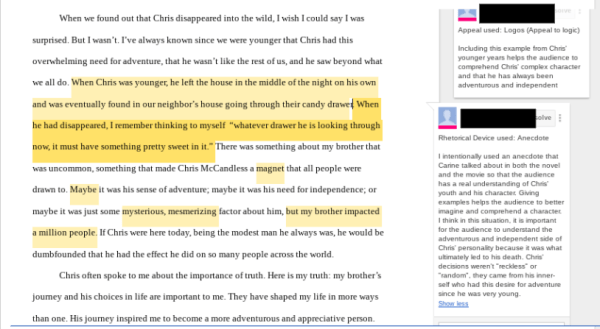


 While Sarah and I loved the story of her classroom those two days, we experienced less success the next attempt. But we’ll try again. We’ll schedule the AP Lit. students more specifically, we’ll partner students according to need, we’ll invite the AP Lit. mentors to support the sophomores throughout the writing process. We’ll even explore digital mentoring through Google Docs. Sarah’s optimistic that increased access to our living mentor texts would increase confidence in her writers, helping them to grow. And, I am too.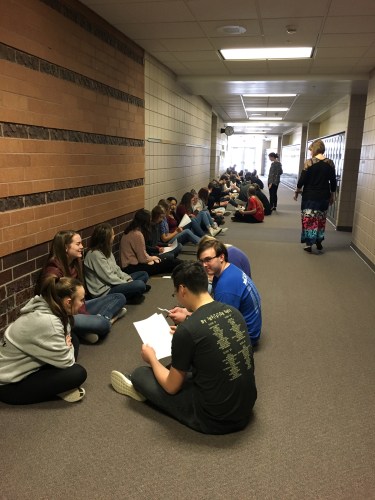

 After a few minutes of writing, I ask for volunteers to share their thoughts. In a recent discussion, some students found the idea of carpe diem “frivolous” and thought that people should always stay focused on future goals. To them, “living for today” was short-sighted and irresponsible. This makes sense for teens who are driven to go to the right college and earn the right degree to live a “good” life. Other students said that since none of us are guaranteed a future and we’re “all going to die,” we should do something today: something of value, something productive. Such responses received a great deal of agreement, though students realized that “value” and “productive” are relative, subjective terms. One student wisely noted that we should remember that while we’re trying to live our best lives, others are as well. They discussed the complexities of when the lives of people with different goals intersect. Ultimately, my students saw how their seemingly disparate ideas actually overlapped a great deal, and they separated carpe diem from the trite YOLO idea that many of them initially equated as the same concept.
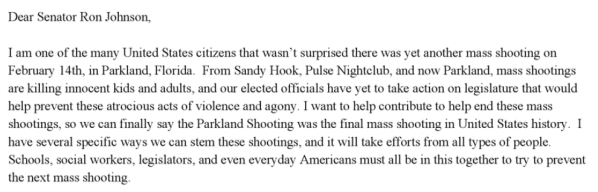
 We were clear with students from the very beginning that this was not an assignment in support of any particular political agenda. Instead, it was an exercise in better understanding our preconceived ideas and more deeply, and diplomatically, developing our rationale for how to bring about change As long as their research came from credible sources, students could argue for changes to gun laws, support of the 2nd amendment, mental health considerations, school security, or any other defensible position to end mass gun violence. They could write to state or local representatives, as long as they researched that representatives current position on related issues, providing students with key insights to audience consideration we’ve previously only talked about or tried to emulate through blogging.



 can we do things even better? How can we reach more kids? How can we ensure that every student feels connected to their school and their teacher? Don’t misunderstand me- I work with the best teachers around, who love kids and are passionate about the work they are doing in their classrooms. However, we can always do more and get better, right?
 important aspects- talking with our students. This area was a big learning curve for us. The tendency is to think that having a teacher table or holding daily student conferences is an elementary concept, but in reality it’s what’s best for students at all levels. The teachers I work with would say that conferencing with students has been a game changer. They know their students strengths and weaknesses in reading and writing better than before, and they are able to target specific skills that each student needs.


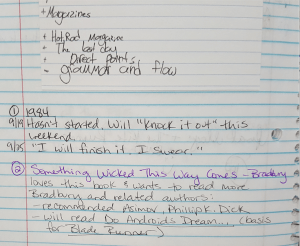 On the left-hand side, I pasted in a notebook card that students filled out on the first day of class with information about their favorite genre(s) of books, their favorite book, their least favorite book, one writing strength, and an aspect of their writing which they wanted to improve. Below this card, I kept a record of reading conferences with the student. Here, I not only kept a list of what books students read, but I also jotted down notes during our conversations about the text.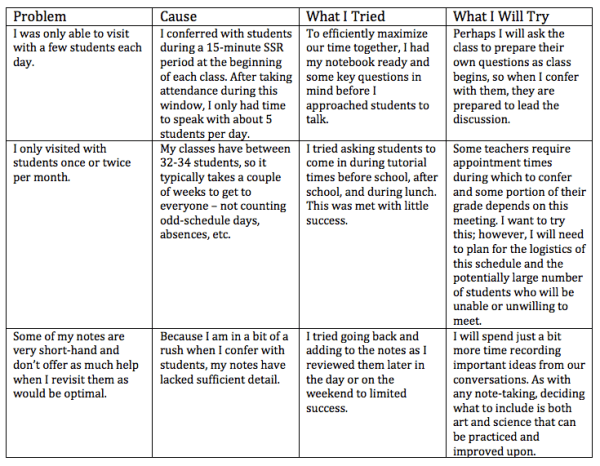

 Three Teachers Talk