Category Archives: AP Language

Mini-lesson Monday: A Matter of Perspective

I am thinking about the importance of perspective. Mine and others.

To truly understand how the world works, why decisions are made, what issues matter to individuals, when things do not go our way, we have to be willing to peer into the thinking of those who think differently than we do.

Sometimes — no, most of the time, this is hard.

It is especially hard for the sixteen year olds I teach. They wear their bias like badges, and they often silence those who disagree with them with blatant disregard. I fight against this every day, but last Friday we took a few steps forward. I want us to keep moving.

Objective: Students will formulate ideas while writing from a perspective other than their own: Who? What? Where? When? Why?; draw conclusions based on observations and interactions with peers.

Lesson: First, we’ll write. Students will take out their phones and take a photo of the person sitting across from them. They will then write for ten minutes, trying to convey that person’s point of view about their future. What do they want to do after high school? Where do they see themselves in five years?

We will then share our writing and discuss how difficult it is to know another’s thinking without ever having a conversation. We will tie this thinking into the conversations we had last week about stereotypes and making judgements.

Next, we will do the Crossing the Line activity as outlined here by Vanderbilt University. Of course, I will have to change some of the questions:  Coke vs Pepsi? Pshaw. This is Texas! I will have to say Coke vs Dr. Pepper.

This activity will inspire discussions about our similarities and our differences, and the poem will allow for even more discussion, analysis, and critical thinking around a text.

Follow up:  As we move into choosing topics for our Poetic Rhetoric unit, I will remind students of the importance of investigating all sides of a topic and the importance of considering alternate points of view as they compose their poems. I did not do this last year, and this will add a critical element to their arguments. Too many of the spoken word poems I’ve listened to seem like rants against some issue instead of including a shift or two that lead toward solutions.

In times like these, we definitely need solutions.

NOTE:  Shana, Lisa, Jackie and I are presenting at #NCTE16 this week. If you will be with us in Atlanta, we’d love it if you attend our session on Sunday, Nov. 20 at 1:30 pm. Room B211 of the GA World Congress Center. I will start our presentation with more on the value of perspective and how it relates to Advancing All Students in Readers-Writers Workshop.

screen-shot-2016-11-13-at-8-48-43-pm

Try it Tuesday: Taking a line

My AP Lang and Comp students have been writing. A lot.

We’ve analyzed arguments and written short analysis essays. We’ve read powerful OpEd pieces like this and this and this, and we’ve written responses and modeled these writers’ craft moves. We’ve written arguments on our blogs and had a bit of fun modeling Neil Pasricha’s Awesome writing as we practiced using figurative language and specific examples in our essays.  We’ve read about the importance of serious reading, and written one-pagers to defend, challenge, or qualify. Lately, we’ve studied the work of Bryan Stevenson in Just Mercy and watched his TED talk.

I sensed my students needed something a little different, but I needed to keep them writing. So with just one class last week, instead of using a full mentor text to inspire great writing, we used a sentence.

I pulled this quote from Stevenson’s talk:

screen-shot-2016-10-30-at-2-47-56-pm

And then I asked students to write anything they wanted: poems, essays, stories, whatever. The only requirement? Use that line somewhere in your own writing.

Then, on Friday, students moved to our “writer’s chair” and shared their writing. Our community responded with sticky note blessings.

Several students were reluctant to share. “Mine isn’t good,” more than one student said.

“We are a community of writers,” I encouraged. “This is a safe place, and we all want to know what you have to say. Truly, no pressure.”

After a few volunteers, Martina finally rose to share her response to Stevenson’s quote. Her voice was soft yet powerful:

It’s the sigh of relief and relaxed muscles from knowing you did the right thing. It’s liberating and lightweight–the world suddenly doesn’t seem to be positioned heavily on your shoulders. It can be the doubt and little knock of guilt on the back of your head knowing you did the wrong thing. It’s the tempting feeling of doing correct actions, but not being able to when you’re being held against a wall by your own conscious.

It’s difficult to see greener grass on the other side of the horizon when it’s fertilized with the negative aspects of your actions. Learning to realize and move on from what cages you in is the only form of developing into a healthier person–sometimes this ends up being all it takes for it to be “The right thing to do.”

“Always do the right thing even if the right thing is the hard thing”

As kids we grow up with love from family, the goodnight kisses from your parents after a bedtime story, the reassurances of  “It’s Okay” after a tumble on the playground, and the form of love that lingers in the atmosphere when you’re around the individuals that raised you. As we grow our love transforms into something deeper, something more emotional, something dangerous. It might have started with a crush on the new individual at work, the butterflies twisting and turning in your belly are a pure indicator that you’ve deeply fallen in a midst of hearts and dazy clouds of love.

Often times, things go wrong. Abusive relationships exist and they are common amongst the men and women in our society. Nearly half (43%) of dating college women report experiencing violent and abusive dating behaviors, Nearly 1.5 million high school students nationwide experience physical abuse from a dating partner in a single year, and one in seven men age 18+ in the U.S. has been the victim of severe physical violence by an intimate partner in his lifetime.

The right thing in this case is following your heart. Men and women trap themselves in abusive relationships because loving the one person that hurts you seems to be the right thing. Other times, allowing yourself to step away from the relationship/situation is not an option and it becomes a tough obstacle to get out of the arms that hold a restricting grasp on you. There’s always help, there’s always somebody there. Reach out for the right motives even if it’s the hard thing to do.

Never let a person of interest degrade your actions or make themselves superior to you. The most damaging thing to do–and often hardest–is staying in an abusive relationship. Love is a beautiful thing, don’t let anybody damage that for you. Instead, do the right thing for your health, mind, and body without the harm of anyone or anything. 

Two students shared poems, others shared why they think that quote is important, and others wrote arguments of a sort like Martina’s. All were important reminders to me to let students choose how they show they are learning.

Of course, the shared experience of reading their work was pretty fabulous, too.

One of the best things I can do as a teacher of writers is to offer opportunities for students to share their writing. I know the more we share with one another, the better our writing will become. If I remain the only audience (or even mostly their only audience — my students do write on their blogs and leave feedback for each other), some students may never make the connection between writing and truly conveying meaning. Too many just care about the grade.

By just taking a line last week and then asking students to write whatever they wanted, and then sharing… we built trust in our community and we celebrated that we really are on our way to becoming better writers.

What have you tried lately that improved some aspect of your classroom community? Join in the conversation and share in the comments.


ftc-guideline-%22affiliate-links%22

Mini-Lesson Monday: Do Teens Read Seriously Anymore?

It’s the end of our nine weeks. Well, kinda. I have one class of English 3 students that are at midterm since they are on accelerated block, and I’ve got two classes of AP English Lang who I share with AVID every other day in a year-long class, so they are at about the 4.5 weeks mark. Talk about crazy trying to keep the pacing straight and everyone moving.

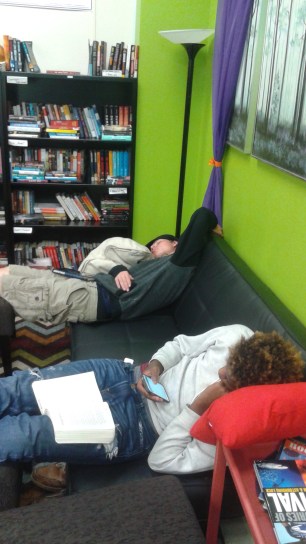
One thing I know:  All my readers need to revisit the goals they set for themselves the first week of school. We’re going to start with independent reading. I’ve seen a little too much of this lately:

joshandtajhnotreading

Taken after exams when I suggested students use the time to read.

and not enough of this:

juniorboysreading.jpg

Daily routine: 15 minutes of independent reading

I set the standard high and ask my students to read three hours a week. This is difficult for busy teenagers who are not used to reading (and if we are honest, many are not used to completing any type of homework).

We will read this article this week “Do Teens Read Seriously Anymore?” and create our personal reading challenge cards. But before we do, I want to get students thinking about themselves as readers and what reading can, and should, mean to them and what they hope to accomplish in their lives.

Objective:  Interpret a quote on the importance of reading and connect it to my own reading life; construct a plan to help me meet my reading goals.

Lesson:  Students will select up two literacy/reading quotes and glue them into their writer’s notebooks. They will then think about their reading habits over the past several weeks of school and write a response to the quotes that connects their reading experiences (or not) and begin constructing a plan on what they can do differently in the upcoming weeks to either continue to grow as readers, or start to.

Follow-up: Later in the week we will also read “The Insane Work Ethic of Mark Cuban, Jeff Bezos, and 15 Other Powerful Leaders” and write a synthesis-type response using the two articles and their personal goals for reading.

Please share in the comments your ideas for getting and keeping students developing their reading lives.

Why I Love My Writers (and some book suggestions, too) #FridayReads


Maybe you see this, too:

I’ve got truly brilliant, fun-loving, willing-to-learn students this year, but when it comes to writing, they are as sloppy as a room full of toddlers with their first plates of spaghetti.  Missing periods and capital letters, too many commas (or not enough), and the makes-my-eyes-bleed lower case i. That one’s all over the room.

And I keep seeing this new thing:  the missing “it.”

Take this for example, all sentences from a self-evaluation students completed last week:  “My reading’s good, is something I do to release stress,” or this one: “Is the same thing as going somewhere,” or this: “My reading improved is better because I tried more.”

What?

Do I worry about mechanics over ideas? Never. Do I worry that my students know better and are just not paying attention? Always.

I teach juniors in AP English Language. This string-your-spaghetti-anywhere-you- want-punctuation should not be happening.

So we slowed down a bit. Took a step back. Searched in our in our independent reading books for sentences that struck us as interesting.

Students wrote their sentences on notecards. Here’s some they chose:

“It’s easier to jump out of a plan — hopefully with a parachute — than it is to change your mind about an opinion.” Think like a Freak by Levitt and Dubner

“We looked over toward the echoes of burdensome chimes, the slip and boom of the clutch and rasp of gears as the ice cream truck entered the dead-end streets and curves of Las Lomas.” Always Running by Luis J. Rodriguez

“They played basketball the way basketball is supposed to be played, and in the end they lost — but not before proving that Goliath is not quite the giant he thinks he is.”  David and Goliath by Malcolm Gladwell

“The barber gazed in amazement at this man with long-thick and black hair and beard, which gave his head the appearance of one of Titan’s portraits.” The Count of Monte Cristo by Alexander Dumas

“When he smiles, she notices that he has a dimple on only one side, and there’s something about this that makes him seem endearingly off-balance.” The Statistical Probability of Love at First Sight  by Jennifer E. Smith

“At the end of the hallway is a boy so powerful, so fearless, that he’s set up shop in the middle of a sacred site and renamed himself Goliath.”  Vivian Apple at the End of the World by Katie Coyle

“I felt a hot, tingly sensation spread spread over my skin as I slid down a few inches against the bench seat, wishing I could just melt directly into it’s crusty upholstery.” We Should Hangout Sometime by Josh Sundquist

“This is an ordinary Monday morning school day.A Stolen Life by Jaycee Duggard

“You see, Cinderella and I know what it’s like to look in the mirror and not recognize the reflection.”  Skinny by Donna Cooner

Then, in small groups we categorized sentences long and short, many punctuation marks or few. And we discussed the whys:  How does that mark help create meaning?

We could have spent days on this lesson. I should have allotted more time, and we will certainly return to it (maybe next week — it’s that pressing).

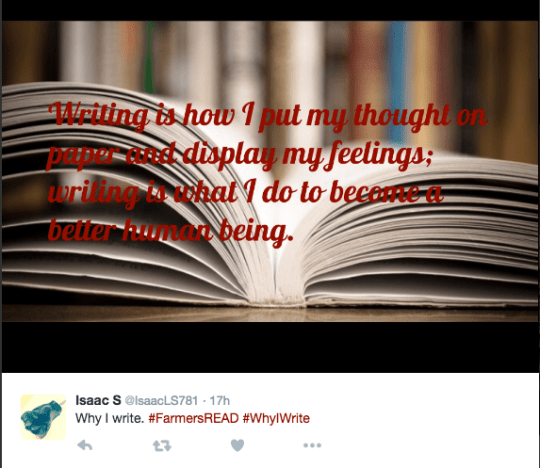
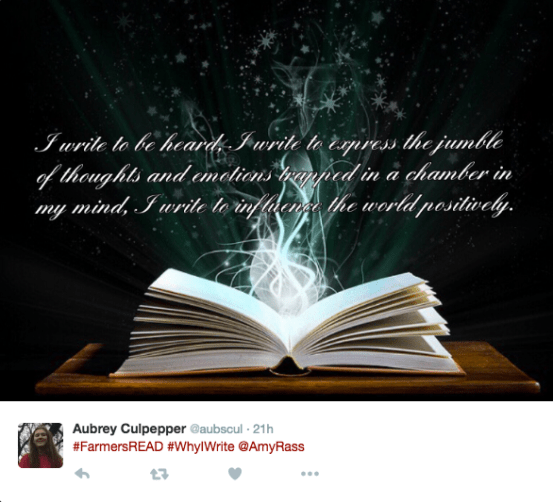
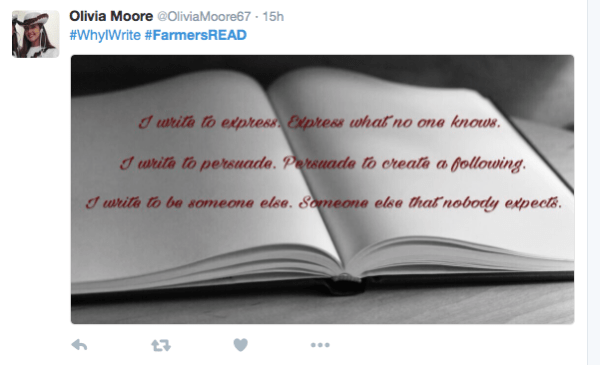
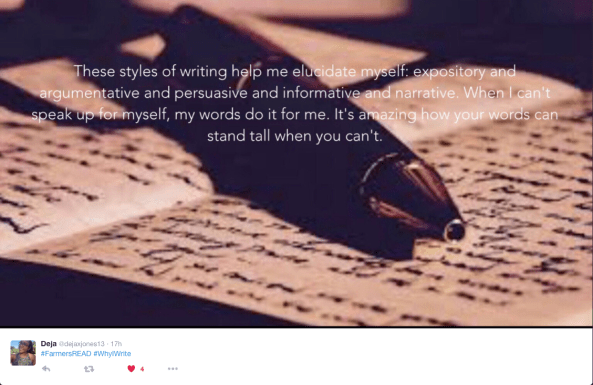
Then, yesterday as a way to join in on the National Day on Writing, I asked students to create a slide that explained why they write. Their slide needed to contain an image, a beautifully crafted sentence that included at least one of the literary or rhetorical devices we’d focused on recently, AND everything had to be correct: capitalization, spelling, punctuation. You might call me out on Olivia’s, but I think it works.

The ratio for correctness on this voluntary assignment was 22:6.

Here’s some of their tweets, evidence of why I love my writers. And also the reasons I hope we can take a little more care as we write. They have such amazing things to say.

screen-shot-2016-10-21-at-8-37-16-amscreen-shot-2016-10-21-at-8-35-42-am
screen-shot-2016-10-21-at-8-23-59-amscreen-shot-2016-10-21-at-9-23-40-amscreen-shot-2016-10-21-at-9-25-23-am


ftc-guideline-%22affiliate-links%22

Mini-lesson Monday: Deeper Reading


I posted this on the TTT Facebook page on Saturday, but I think it also makes for a good mini-lesson, so here goes:

I went to a session by Kelly Gallagher at #IRC2016. He shared ideas from his book Deeper Reading, combining ideas he’s using with his students now. I was reminded of his thinking around thinking from a text: What does the text say? and What does the text not say?

Gallagher shared a few images from the news, a fact statement, an ad for a truck, and he modeled how he asks his students these two questions as ways to get them thinking about their reading.

I’d heard these same ideas before, but they resonated with me again. Critical thinking matters. We cannot get thoughtful writing, if we are not helping our students to think thoughtfully through texts.

Objective: Read a visual text, make observations and inferences that push critical thinking about a text. Draw conclusions and write your thinking.

Lesson:  Tell students that critical readers don’t just pay attention to what a text says, we also must pay attention to what a text does not say. This ties into the idea that everything is an argument — sometimes overt, sometimes covert. Bias also comes into play. So to get into some critical thinking today, we’re going to watch a short video about the refugee crisis.

Draw a T-chart. Label one column with “What does it say? and the other column “What does it not say?” As you watch the video make lists that answer these two questions.

Watch the video “Your phone is now a refugee’s phone.”

After students have time to do their own thinking and writing their lists (and maybe watch the video again), have them talk in pairs or small groups about the things they noted.

Hold a short whole class discussion about what it does for our thinking when we consider what the author, or in this case, the video creator, intentionally leaves out of a text.

Follow up:  Ask students to find their own text and apply this same thinking. Tell them they can find an advertisement, a chart or graph, an info graphic, another video — any text that they can answer the following questions:

What does the text say?
What does it not say?
Why does it matter?

Continue to ask students to consider these questions with a variety of texts throughout the year. This may also serve as a good exercise to help students find writing topics. Bonus!


Do you have any videos, ads, or short text suggestions that you use in similar ways to get students thinking critically? Please share them in the comments.


ftc-guideline-%22affiliate-links%22

Mini-Lesson Monday: College Applications and the Six Word Memoir

College applications are a daunting endeavor for many of my students each year. Their mailboxes and email inboxes fill with opportunities to apply everywhere from the local community college, to pricey Ivy League schools across the country, to study abroad programs in countries they may never have heard of.

As if that wasn’t enough to sort through, lurking in these countless pages and pamphlets is another overwhelming prospect – The college application essay. Also known as the “tell us who you are as a human, what your soul’s greatest desires might be, and every intimate struggle you’ve had that define you as a young adult” essay. No wonder my announcement that our first paper in AP Language will be the college application essay is usually met with huge sighs of relief. However, that relief is also somewhat short lived as we start to take a look at prompts:

  • Reflect on a time when you challenged a belief or idea. What prompted you to act?
  • Please tell us why you think you would be a good fit for __________.
  • Consider something in your life you think goes unnoticed and write about why it’s important to you.

As I tell my AP classes, “Colleges want to know the real you. The honest, gritty, learned from your mistakes, can bring something unique to their campus you. Your transcripts say keep-calm-and-apply-to-college-27-resized-600a lot about your work ethic, experiences, values, and achievements, but once you put pen to paper, you are a writer, and your story might just help them see the real you and decide that you are far too good to pass up.”

Their horrified looks usually tell me I should follow up with an explanation along these lines:


Don’t worry. We are going to do this together. Sharing your story might not be easy, but take it from this girl, everyone has a story to tell. I was your stereotypical upper-middle-class white girl with loving parents and a blissfully happy childhood. I pretty much seized up when my senior composition teacher said that we needed to write something deeply emotional and challenging in our college application essays. He had me convinced my happy life was going to keep me from going to college. Without a car wreck, lost dog, or deeply wounded heart, what compelling story did I have to tell?

Well, it turns out that one can write from the heart no matter the circumstances, and that’s what I want you to use for your own applications. An experience, belief, value, or direction for your life, can all be deeply emotional and revealing of the type of person any college would want to accept. I spoke about my desire to be a teacher in my application. Teaching is in my blood, and I had known I wanted to be a teacher since I was little. My dad used to bring home an extra gradebook for me and I’d line up my babies and stuffed animals and teach class. See…? I have the beginnings of a narrative right there. I expanded on what it would mean to me to become a teacher and how I knew the patience and passion I already possessed would not only make me a good teacher someday, they would make me a great addition to any campus because true teachers know the value of lifelong learning.


So…how to help students concisely sum up who they are?

Examples, examples, examples.

Let’s try six words. Total.

Objective: Using the language of the Depth of Knowledge levels, students will create six word memoirs as written artifacts in their writer’s notebooks to either spark ideas for drafting their college application essays, or serve as possible opening sentences for those essays.

Lesson: The timing of this lesson is after several class periods of having students explore who they are and what they value through quick writes and other activities. On one occasion, I have students write a quick write on the story they would tell to demonstrate positive elements of their character. We share stories about helping those in need, commitment in the face of certain defeat, and encounters with temptation, and then bullet point some of the “college friendly” attributes these stories suggest.

During another class period, I had students read, analyze, and then emulate Amy’s recent suggestion of the poem “Possibilities.” This was the first year I used this poem during this unit, and I could not be more happy with the results. Students did some beautiful work in analyzing Szymborska’s structure in order to write a poem with their own preferences. I made sure to discuss with students the variety of topics that Szymborska uses in the poem from straightforward preferences of activities and food to those that reveal character and life experiences. I challenged students to do the same with some wonderful results.

Finally, for this specific lesson, I reminded students of my suggestion to keep their college application essays brief, as most applications would demand that they be so with limited word counts.

“So today, I want you to be really brief. Six words brief. We’re going to try to capture some of who you are and what you believe in exactly six words.”

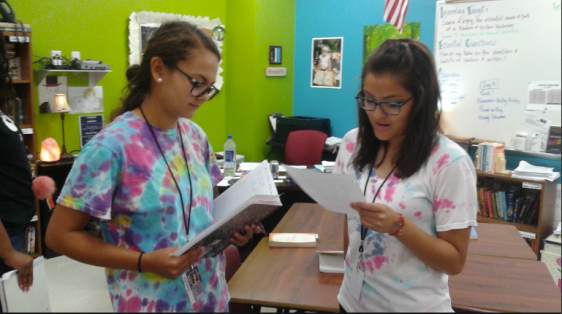
I begin by sharing with them a few six word memoirs of my own and talking them through sixwordthe back stories. We then head to Smith Magazine’s Six Word Memoir page so students can look around. They are to write down a few favorites and also write what they think the larger message of those snapshot memoirs might be. We discuss at our tables and then share out a few to discuss what their favorites might reveal about the authors that crafted them.

Throughout the lesson, I remind students that just as we saw in “Possibilities,” brief snippets can reveal an awful lot about who we are. This is our goal in the college application essays as a whole, and this is our goal in the exercise.

Students spend some time drafting, sharing, and then praising the work of their peers. I suggest to students that these memoirs might be great hooks for their essays, they might spark an anecdote they could include along the way, or they might simply keep students focused on their own beliefs and values in order to use those to guide what they write about themselves.

Follow-Up:  Students are working hard on their college application essays and will be doing some peer editing early this week with submission to follow later in the week. To extend the work even further, I’ll be sharing a unique extension activity with my classes.

On September 22nd, 2016, the team at Six Word Memoirs will be participating in the 3rd annual Character Day, which is a global discussion about the importance of developing true character in the world’s citizens. I’ll be encouraging my students to participate with some of the six word memoirs they’ve already created and perhaps with contributions they craft especially to speak to developing, according to the Six Word Memoir site, “curiosity, empathy, and grit.”

How do you challenge your students to write about themselves in meaningful ways? Please share your ideas in the comment section below! 

I Prefer a Community of Confident Writers — Our Jump into Understanding a Writer’s Craft


Before spring term was over, I’d written two pages of notes in the back cover of my writer’s notebook. I titled it “Remember to Do Things to do Differently.” I’m a bit ambitious — and I realize, often, too hard on myself. Although I knew my students learned last yearemember-to-do-things-differentlyr, I wasn’t confident that they couldn’t have learned more.

I imagine you’ve been there, too. Always second guessing.

One of the things I knew I needed to improve was my relationships with students — I needed them to be good and strong, faster.  I also needed to help students jump in quicker to the complexities of craft analysis without scaring the poor little dears.

So last week, the second week of school, I did what Lisa just wrote about yesterday. I “Encourage[d] Students to Start Sharing Who They Are,” and I did it by sharing a favorite poem by Wislawa Szymborska: “Possibilities.”

I asked students to study the poet’s language in each line and then write their own “Possibilities” poem, imitating the poet’s sentence structure and word play. I gave them a copy of my annotations and wrote my own poem as a model.

This proved to be an excellent lead into the rhetorical analysis students must be able to do in AP Language. I was able to see which students quickly understood how to look closely at an author’s craft — and which ones did not.

The best part though was what I learned about my students. All their preferences!!

Last Friday, when their poems were due, we did our first Author’s Chair share in class.

First, to help students build confidence, they read their poems to a partner.

faithsharing-possibilitiespoem

sharingpossibilitiespoems

Then, volunteers sat in our Author’s Chair and read their poems to the class.

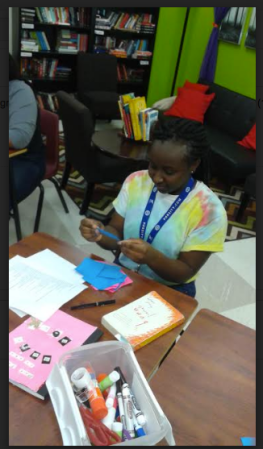
While the student read his poem, everyone else sat with sticky note and pen in hand ready to offer “blessings,” things they liked about the author’s use of language, or connections they could make to his ideas.

sharingintheauthorschair

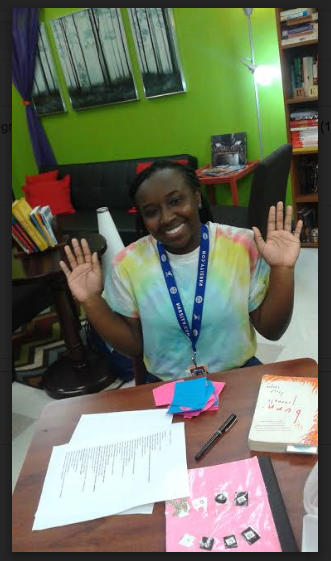
After each writer shared, the class flooded him with “blessings.” Smiles grew wide, trust blossomed, and the community that I felt was missing for too long a time last year took root.readingblessings

Bonus:  When students read their little notes, carefully crafted by peers who listened to
their writing, their confidence as writers grew. Too bad we ran out of class time. I might have run out of sticky notes if all students would have felt the desire to share.

readingblessings2

I wouldn’t have minded.

I would not have minded at all.

ciarawithblessings

I would love to hear your ideas on building community and/or introducing students to rhetorical analysis. Please join the conversation and share in the comments.

Try It Tuesday – The ‘Secret’ to Workshop Success

At this point in the school year, teachers do a lot of counting. Counting days, counting essays left to grade, counting books missing from a classroom library (Seriously people, it’s not cool to steal from teachers. Your growing passion for reading is the bee’s knees, but my own kid may have to pay her way through college at the rate I spend on books for you. Might you return them? Please? Thank you). At graduation this past weekend, I found myself counting seniors I had taught and I began imagining all the opportunities in front of them. Interestingly enough, this year, I looked at those seniors and saw…books.

Zak raved about Ready Player One early this year. It was one of my first workshop successes.
Zoey emailed me over the weekend a few months back about The Girl on the Train.
Jenna plowed through Brain on Fire recently, after Zoey’s recommendation.
Larissa swears that Walden will change your life.
Ellen blushed when she told me she absolutely loved The Sociopath Next Door.
I counted at least eleven kids that read and sobbed over A Monster Calls.

Birds singing and happy little clouds everywhere.

And now…for a moment of full disclosure in the opposite direction. As my department makes the transition to workshop, sometimes the numbers are overwhelming and scary. We are one of only a handful of high schools moving to this model in the entire country. The path before us is paved by K-8 workshop instruction, but the number of secondary schools already doing workshop is relatively limited. This makes the sheer volume of curriculum we’re creating staggering and models hard to find.

On top of those numbers we have extremely limited common prep time, surface level understanding of the best way to break up our 86 minute class periods most effectively, and hundreds of new classroom texts we are working to keep track of (not to mention read). All with three preps for most of my colleagues and a grand total of one hour of collaborative PLC time per week.

In short, this transition isn’t easy and it’s already had some pretty sobering/ugly/weep-worthy moments.

We’re wrestling with very real questions about how to hold students accountable for their skill progression, how to keep track of meeting student need most effectively, how to appropriately conference with all of our students in large classes throughout the school year, and how to balance a need for college/career readiness with our desire to afford students the choice that will fuel their passions for both reading and writing.

At the end of the day, and the end of school year in which we have all been working to

IMG_1112

AP Language Super Readers – Simrah discovered nonfiction, Louise (our school salutatorian) delved into the study of language, and Ellen and Kaley blew through Brain on Fire.

incorporate more and more workshop practice into our daily instruction (knowing we will be expected to operate in the workshop model to fidelity next year), we are tired. Tired, overwhelmed, and nervous.

However, the visual of an Escher-like hellscape I’ve just created for you, thankfully, isn’t the whole story. As I reflect back on this move to workshop, the overwhelming nature of the preparation involved ultimately pales in comparison to the positive feedback I’ve received from students.

I was sitting on the patio a few nights ago with my husband discussing the class-feedback forms my students had just emailed to me (What did you learn from this class? What did you enjoy? What should I work on for next year?) with the completion of our regular class work and impending exam week. I expressed to him how proud I was of the number of students who commented on reading more, enjoying writing more, and basically being more invested in English class than any other year I can remember.

It sort of dumbfounded me as I recalled the emails over the course of the year. The casual

IMG_1090

My 2A AP Language Crew – Dema read Black Boy after a book talk, Bennett read Ishmael and says it changed his life, and Larissa fell in love with American Classics.

conversations with kids that showed their deep thinking about topics they cared about. Countless peer to peer discussions with overheard snippets such as “Oh, I loved that book. You need to read it” and “Yeah, I just couldn’t put it down” and “This topic sentence is really good, but if you combine it with this idea, the paragraph will make more sense.”  The longer I talked with my husband, and the more I recounted the year in student snapshots, the more surprised I was to realize that my stories of the year had little to do with content I “taught” and everything to do with the students themselves – what they were doing with the content. The difference of 2015-2016 was choice and encouragement to be readers and writers. In short…workshop.

So with my recent numerical obsession (did you know it’s only two more sleeps until the last day of school?!), I compiled the following rundown of my first year of exploring the workshop model:


Workshop by the Numbers

1 – Teacher playing around with workshop. Discovering its benefits, its challenges, and its similarity to and differences from her current instruction. Exhausting in the way teachers love. Some call it masochistic. I call it professional development.

IMG_1100

We learned how to make paper cups on the last day with our seniors…a nod to the practicality of English class…then we read. 

3 – Teachers (Talk) who journeyed to the wild North during February to instruct the Franklin High School English department on the day to day of workshop instruction. Exhilarating.

11 – Colleagues opening their lesson plan books and starting almost from scratch to first play with and then make a full transition next year to the workshop model. Collaborative.

117 – Students who read for 10 minutes of every class period we shared, wrote and reflected during every period of second semester, and changed as readers and writers in ways I’ve not seen before in my 13 years of teaching. Thrilling.

180 – Days in the school year to remind students that they will grow as readers and writers with practice, passion, and a commitment to question, explore, and expand their views of the world. Daunting.

2088 – Hours of summer to read the 16,983 books on my “To Read” list (No time for love, Doctor Jones…or sleep for that matter). Delicious.


So many opportunities.

But now, I am going to be brutally honest once again. As previously stated, the move to workshop can be scary. It’s new. New to us, our students, and in a formal sense, it’s relatively new to secondary education altogether.

However, here’s the part that sort of sounds like cheating:

Though teachers, myself included, are very rarely afforded the opportunity to take it easy, there are few things easier than throwing open the doors on choice and seeing what happens. Of course, there are many systems that need developing in my classroom and so much of workshop requires routine and consistency, but the heart and soul of workshop is really
IMG_1116

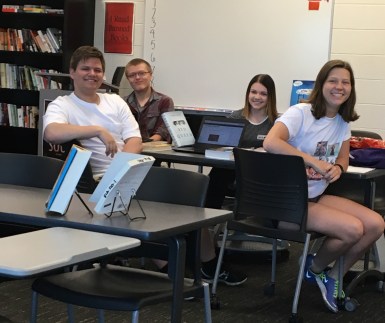
1B AP Language and Composition – The seniors have left us, but this crew still has final projects to present

choice – choice, talk, and lots of writing – all of which mainly require simply being honest with, invested in, and responsive to student need. No, it’s not totally easy. It can’t be a free for all. It can’t be totally haphazard. But it can be trial and error. It can be learn as you go. It can be beautifully impactful.

To provide proof, here is a sampling of student reaction from my class-feedback form this year. I tried a lot of different things. I messed up a lot. We backtracked often. I sometimes forgot to book talk. I sometimes didn’t provide enough modeling or take the time to write every time they did, but we worked with choice, we wrote more, and we talked more than ever before.

Here are just a few reactions from my AP Language and Composition class:


Hello,
This year I really learned to be literate. AP Lang actually taught me that I can read books that I want to read and no matter what they are I can discuss them in a scholarly way because even if the book is something like poetry or a comic it is still a book. I’ve learned that all books have something to teach and that’s why they were written in the first place. I’ve read some amazing books this year and I’ve learned how to discuss my opinions on things using a higher vocabulary and assertions that are beyond the obvious. I’ve learned that you can look at anything in life a little deeper and you might just learn something. My tendencies to look deeper into things was fostered and practiced through books and reading so thank you Mrs. Dennis for helping me become a scholar. The first time you called us scholars I didn’t really think you were serious, but now I feel it. I feel like I want to spend my entire summer reading and I plan on trying to finish a large chunk of my I want to read page because reading truly and utterly makes one a better person. Reading makes you a better thinker, citizen and friend. Language is truly a beautiful thing. Also, you should know that coming into this class I was intimidated and almost dropped. English is not my strongest suit as I want to go into premed, but now I can be a poetic Doctor am I right??
Thank you also for always being a nice person and a smiling face to see in the morning.
Love,
Nimmi
Mrs Dennis,
I loved this class, a lot. I’ve never really felt like I’ve learned much from English classes, but in AP Lang this year, I’ve grown so much as a writer and a reader and a thinker. Part of that is the class itself, part of that is the practice work we’ve done throughout the year that forced us to think for ourselves (I actually like doing one pagers now), and a big part of that is you as a teacher. You made us want to be smart. I wouldn’t change a thing, and I think that I’ll probably look back on this class as one of the most valuable I’ve taken in high school. I’ll miss having you as a teacher next year!
Thanks for everything,
Maddie
Mrs Dennis,
I always thought becoming a man would require some sort of coming of age. Some sort of ‘killing the beast and dragging it home’ type situation…
I began this year as a boy and ended it as a man. Throughout the year I became increasingly disillusioned with being a dependent, in ideology and in living situation. I read books about Manliness, articles about what it “means” to be a man and looked far and wide for what the distinction was.
There is no amount of *physical contact*, “macho” rites of passage, or waking up one day transformed that made me into a man. Oddly enough, it was sharing my feelings that made me a man. The turning point was the day you told us “Feel free to share more feelings in your one pagers”.
“Sharing my feelings” translated to me having to figure out WHAT I felt and believed and WHY.
Instead of having some book tell me that I should be principled and have virtue (which is simple enough for me, and not only a manly thing) AP Lang and you made me feel like I had a SAY in my own life and thoughts. AP Lang made me no longer dependent on others for what I believe and why, giving me the ability to evaluate, challenge, qualify AND support things.
AP Language and Composition MADE A MAN OUT OF ME.
I am eternally grateful,
Bennett
Encourage everyone to read Walden, strongly encourage. It’s life-changing.
Continue teaching everyone to question ideas or anything at all; I think that was really fundamental in my growth as a student as well.
Larissa

And here, ladies and gentlemen, is the secret formula…

It’s no secret at all.

These are the simple changes I made to my daily practice. And though I have a lot of work to do in regards to running a true workshop classroom each and every day, the results this year have felt amazing. Give it a try!

  • Provide 10-15 minutes per class period for students to read books of their choosing. It’s time well spent. Best spent, actually. 
  • Conference with students during that reading time to better understand what, how, and why they read. This will assist you in recommending further reading and in determining mini lessons your students need to make them better readers and writers.
  • Have students write each and every day. Encourage them to write without stopping (building fluency), revise something every time they write (building capacity to internalize the writing process), share that writing (to build community), and take pride in that writing by choosing and developing ideas.
  • Use additional class time for more conferences with students around what they are reading and writing. Students can work individually, in pairs, or in small groups during this time, depending on the mini lesson for the day.

Of course, readers and writers workshop involves so much more, but this is where I started this year. This is what resulted in the student response above.

If my calculations are correct, I have roughly 25 years left in the classroom (holy, holy, holy). That’s 3000 students (conservatively) over 4500 days. Talk about an opportunity. Or rather, 4500 opportunities.

What books will they love?

What great stories will they tell?

Whose life will change by becoming a reader and a writer?

I can’t wait to find out. Because the secret to workshop success is no secret…it’s the students.
IMG_1352

3A Sophomores – Trevor said he read more than he ever has, Errin and I read Metamorphosis  together, Josh read (and loved) Moby Dick, and Lauren’s “To Read” list is two pages long. 

What moves have you made to workshop that have made a difference in your practice? Please feel free to leave your comments and questions below!


Try It Tuesday: Getting Smarter After the AP Test (Now, with More Reading!)

“I just feel smarter when I read.”

Kathy smiled a bit nervously as she sat chatting with me after school the other day. We were days away from the AP Language and Composition test, and Kathy was nervous. Talk super fast, plead questions with your eyes, five questions without time for a response, nervous. She had little reason to be, and yet, here she sat, absentmindedly fiddling with the corner of her notebook, talking through strategy, looking for reassurance. How many essays again? How much time to write? How many multiple choice passages? “Will I pass?”

Ahhh. There’s the question.“Will I pass?”

“Do you feel ready?” I ask.
“Sort of.”
“You’re nervous, aren’t you?”
“Yes.”
“Why is that?”
“This isn’t my best subject, Mrs. Dennis. It’s not how my brain works,” she says looking me square in the eye.

I smile and change the subject a bit.

FullSizeRender (1)

Kathy seemed tickled I was going to write about our conversation, but this smile is a usual occurrence.

“Remember when you read A Room of One’s Own?”

Kathy smiles back and confirms, “I loved it.”
I pause. Let her take the bait. “Why is that?” I ask carefully.

“Her personality reminds me of…me. She talks about women and changing their place in
society for the better. It’s powerful,” her smile grows.

“It’s pretty empowering, isn’t it? To see yourself in someone else. To connect like that.”

“It is,” she said leaning closer,”You know…I just feel smarter when I read.”

After a brief chuckle from both of us, I told her I was going to quote her. I scribbled down her heartfelt admission in my notebook and looked back to Kathy.

“You’re ready,” I said smiling. “More importantly…you’ve grown.”

Amy has written beautifully about AP test scores. About how the score isn’t everything and about  how growth in an AP class is about more than testing data. Kathy’s sentiment solidified for me that come July, the scores will be what they are. Influenced by a million factors out of my control. But what is in my control is to advocate to my students that reading and writing are not only the best test prep, but in my humble opinion, the best way to grow as a human being. We become better communicators, problem solvers, compassionate adults, and the list goes on and on.

I found this youtube video recently and I plan to show it to my students at the beginning of next year. It speaks perfectly to the power of reading and how, in Kathy’s words, it can just make you feel smarter.

With that, I move confidently in the direction of my AP Language students’ final project for the year. It’s usually met with shocked surprise (Wait? We’re actually doing something after the AP test?), but ultimately, some of the best projects my students complete all year come out of the final few weeks of school.

My AP Language class uses mentor texts from The Language of Composition, an FullSizeRender (2)anthology of essays arranged thematically, throughout the year to explore a variety of topics. Students read several essays (some classic and some contemporary), bring in pieces they locate to synthesize with the unit, and write several long and short pieces in relation to the thematic unit’s essential question. We then use a unit to mirror one of the specific skills related to the AP Language exam.

For example, at the beginning of the year, we study a unit on Education. To answer the unit’s essential question of To what extent do our schools serve the goals of a true education?, we work with:

  • Francine Prose’s “I Know Why the Caged Bird Cannot Read” 
  • Emerson’s “from Education
  • Additional choices from James Baldwin, Sherman Alexie, David Sedaris, and David Foster Wallace”

Students focus on argument in the unit (one of the three types of essays they will write for the exam, but I would argue, one of the most necessary skills for college and career readiness), so we look for how the authors craft their arguments and write about whether we would defend, challenge, or qualify the claims they make. We practice argument prompts during this unit, students find current event articles and IMG_0130give one-minute speeches in defence or challenge of the editorial perspectives, and ultimately have a panel discussion where students take on the persona of an author from the unit and must represent his/her views and synthesize those views with the other authors in the panel.
For their final projects, students team up to select a unit of interest from the text that we have not worked with together. Topics include a wide variety of interesting reads and students explore questions that keep them thinking, even after the AP test. For example:

  • Language: How does the language we use reveal who we are? 
  • Popular Culture: To what extent does pop culture reflect our society’s values? 
  • Environment: What is our responsibility to the natural environment? 

With over half a dozen chapters not utilized in our class study, there’s something there for just about everyone.

Students select a unit and are responsible for:

  • Reading the central essay – from authors like Barbara Ehrenreich
  • Reading the classic essay – from authors like Twain and Orwell
  • Choosing three additional essays to add to their experience

Then, the synthesis begins. Students must create their own addition to the unit that thirdanswers the essential question from their own perspective. In the past, I’ve had students present TED talks, create satirical videos to “sell” the topic, and write essays to add their own voices to the thematic study. Somewhere, either in the introduction
to their product or as a part of it, students must include the voices of the authors they read from the previously published works as well.

Next year…poetry. I am baby-stepping toward multigenre and I can’t wait to see what poems my students can write and find.

In the end, I hope my AP students, some of whom I have had two years in a row now, realize that our time together was spent not to prepare them for a test (not solely, anyway) but to help them become more informed and understanding citizens.

In other words…smarter.

How are your post AP students fairing? What sorts of fun are you having to wrap up the year? We’d love to hear about it in the comments below!


Mini-lesson Monday: All Good Writing Begins with a Good Question

One of the hardest things I ask my students to do all year is choose their own topics. We start generating ideas on the first day of school. We watch video clips, read quotes and short passages, listen to poems, look at cartoons — and we write responses. We create various versions of writing territories in our writer’s notebooks. We have many ideas stored in our well-used notebooks by this time each year.

But with every writing task, students seems to always start the topic journey right back at square one, even when I remind them that they have a mine of ideas sitting in the pages of their composition books. I’ve decided that just like me they like the process of discovery.

My goal is to get them to move past topic discovery into writing discovery. Too often, students think they have to know what they want to say before they ever start writing. No wonder so many kids have a hard time approaching the blank page. (See NCTE’s 10 Myths of Learning to Write #4)

The last writing assignment my students complete each year is a multi-genre type piece wherein they show they’ve improved in the various writing modes we’ve practiced throughout the year. They have almost total choice in terms of what they write, and they have most of the choice in terms of the forms they write in.

I have just two mandatory suggestions (oxymoron intended):  one piece must be a Rogerian argument, and somewhere in their master piece, students must show they know how to use an academic database to find valid sources, and then they must use the sources in the correct context, and cite the sources correctly.

We look at a few mentor texts that use multiple genres within the same piece. Narrative, informative, persuasive — plus images and info-graphics, or other types of forms that present information, including videos and interviews. My favorite is the award-winning feature article, Snowfall: Avalanche at Tunnel Creek by John Branch.

Once students know their end-goal: the creation of their own multi-genre writing piece that shows off their writing journey for the year, they must choose a topic. Some will want to stick with a topic they’ve written about multiple times this year. Depending on the topic, and the student, I may be oaky with that.

This mini-lesson came about in an attempt to help students figure out a topic that they know enough about to ask questions but not so much about that they could answer all of them.

Objective:  Using the language of the Depth of Knowledge Levels, students will construct a list of things that make them wonder; they will formulate questions about a self-selected topic derived from their wonderings. They will then categorize the questions in sets that make sense. Finally, they will determine which questions may best be answered through a specific genre or form of writing.

Lesson:  I tell students that we are about to play in our notebooks. “Turn to a new page, and write a list of all the things you wonder about,” I say. They usually sit there writing nothing, so I get them started:  “I wonder if teens got paid to go to school if they would want to learn more.”

Most students start to write, but I keep wandering the room, stating things that make me wonder as students list their own wonderings in their notebooks.

“I wonder when the state of Texas will get wise to the lack of wisdom in state testing. I wonder why students choose to do their APUSH homework over AP English. I wonder if the Dallas Cowboys will ever win the Superbowl again.”

Once students have at least a half a page of wonderings, I ask them to talk with one another in their small groups. “Perhaps your peers will remind you of something else you wonder about. Add it to your list.”

“Okay, look at your list and zero in on one topic that you think you can find the answer to with a little bit of research. Now, let’s think all the way around this topic.”

I ask students which of my wonderings I should use as a model for their next step, and they tell me the one about the Cowboys. I write it on the board. “Okay, help me come up with questions that look at this from every perspective possible — like who has a stake in whether the Cowboys win the Superbowl again.”

When was the last time the Cowboys won the Superbowl?

Who led the Cowboys to the Superbowl in the past?

How many times have the Cowboys been in the Superbowl?

Is the Cowboys coach as good as the coaches in the past? Are the players as good as the players in the past?

What is different or the same about the NFL?

What do the Cowboys need to do to win more games?

Who would be a better quarterback than Tony Romo?

Does the current team consist of Superbowl quality players?

Which teams are in the way of the Cowboys going all the way again?

Some questions get silly — pretty sure the Dallas Cowboy Cheerleaders don’t matter all that much to the reality of getting to the Superbowl. Sorry, girls — but students get a hang of the idea. “Ask as many questions as you can think of. After you write a list of your own, ask your peers for help in writing others.”

Next, we need to put our questions in categories. I ask students to talk with one another and determine which of our questions about the Cowboys might go together. We decide we’ve got questions about 1. the history of winning the Superbowl, 2. similarities and differences in the game, the coach, the players, 3. current Cowboys, 4. the opponents.

We talk about what genres and forms might work to convey the best answers to our questions.

“Compare and contrast the differences. That’d be easy,” someone says.

“The history of the Cowboys’ past wins would be information, right?” another student says.

“What could be the topic of a persuasive piece?” I ask.

“The question about the ability of the current players. Easy.”

I tell students that they get the idea, and I charge them with reading through their questions and categorizing them into groups that seem to go together.

I remind them:  “All good writing begins with a good question.” And they’re off.

Follow up:  Students should use their questions and their categories to guide the choices they make as they write their end-of year multi-genre pieces. In conferences, I read through questions, helping students add to and clarify. I remind them that form helps determine meaning, so as they make choices, they need to think about the best way to share meaning with their intended audiences. Students will present their writing projects as their final exams.