Category Archives: AP Language

Writing Conferences: Stories, Schemes, and Strategies

Conferring is hard brain work. When do I listen? How do I listen? When do I talk? How much? How do I anticipate what a student needs? When do I step back and let them problem solve? Am I even conferring right? (Maybe not. So put your Judge-y McJudgers pants away while you read this.). As Shana explained in this post back in January, there’s so much value in talk, in engaging our students in conversation, in encouraging them–as Amy framed here— to tell the story of how their writing is going.

Because (as Tom Newkirk suggests) we have minds made for stories, over the years I’ve begun to recognize some common schemes while conferring. Recognizing these patterns frees me to listen and to respond. Perhaps you’ll recognize the stories of your own students in the stories I share. Perhaps you’ll pick up a strategy or two. 

The What-Did-I-Do-to-Myself Conference

This conference may typically begin from a position of fear–mine because my student’s eyes have suddenly become two daggers, piercing my helpful, loving heart. This occurred in a recent conference, where my student who chose ice cream as her multi genre research project topic hurled at me these words: “I don’t know how I’m supposed to write an argument about ice cream.” Was she complaining about lack of direction? Instruction? I took a deep breath to let go of any defensiveness I felt. Then I reflected on her question. Oh. Oh! The fear was not mine to have.

My student needed:

  1. to hear that to write about this is, indeed, possible.
  2. to understand the possibilities for executing the writing.

Conference next steps:

  1. I confirmed the correctness of my reflection by paraphrasing (So, what I think you’re saying is that you’re feeling pretty uncertain if you can, and if you can, what it looks like?).
  2. Once confirmed, I chose another seemingly tiny and narrow topic like tacos and verbally processed some options for how I could craft an argument for an audience on tacos. I did not do any written modeling or reach for any mentors at this point. My role in this early phase conference was to dispel fear, to affirm possibility, and to confirm faith in my student’s ability.

Student next steps:

Following this verbal modeling, my student disarmed with affirmation and a smile, she continued working in her notebook, mapping her argument and the rest of the multi genre.

The I-Need-to-Change-My-Topic Conference

This conference may typically begin from a declarative statement: “Just so you know, I’m changing my topic.” I’m being put on notice here.  But I delight in these William Carlos Williams “this is just to say” moments almost as much as ripe-n-ready plums. So, curious now, I say, “Tell me about why you abandoned the old topic” (I’m always thinking we can learn something from discarding topics) and “Tell me about the new topic.” That’s when my student in this case explains that the topic is music but that’s all he has. Hmm.

My student needed:

  1. To narrow his topic by sinking his teeth into the best tidbits of it.
  2. To get moving. And fast. IMG_2711.JPG

Conference next steps:

  1. With the topic so broad, I asked the student to tell me a story that shows his relationship with music.
  2. Once the student shared his story–one that involved him writing his own music and performing several songs at a local concert venue (Our students do amazing things!)–we mapped out a plan for the different parts of his multi genre text.

Student next steps:

With a story in his head (and probably a song) and a general plan mapped out, this student left for the day, ready to focus on more specific planning.

The So-Can-I? Conference

This conference may typically begin and end within a very short burst of time; a meteor shower during the Perseids, this conference starts with a short burst of light from the student, a recognition of how to apply a resource. In a recent case, the student examined a resource on possible argument structures I shared with the class, and ingenuity bursting forth, queried, “So, I can use the pro/con structure? And, can I make this modification to it?”

My student needed:

  1. To know that he has more freedom than he’s using.
  2. To have the affirmation necessary to keep burning bright.

Conference next steps:

  1. I replied,” Tell me a little more about that” and followed that with paraphrasing, “So, what you want to do is . . .?”
  2. Then I simply said, “Yes.” 

Student next steps:

Following this all-of-sixty-seconds-conference, the student returned to mapping out writing, synthesizing his own ideas with the resource. And, I spent five minutes with the next person instead of three.

The I-Know-I-Need-to ______ , But . . . Conference

This conference may typically begin with candor from the student. Like the first sip of lemonade on a hot summer’s day, it’s so refreshing to hear in response to my opening questions (How’s the writing going? What roadblocks are you running into?), “I know I need to _______, but I’m having a little trouble.” Ah. This can become an opportunity to model for the student or offer a micro-lesson; sometimes–like in a recent conference where my student wanted to build a more humorous tone–I help the student find or use mentors. **Note to self–I should probably start asking my students to tell me about mentor texts they’ve turned to when they’re tackling challenges. 

My student needed:

  1. To resolve gaps in skill level (impressively, one’s the student recognized).
  2. To access additional resources  for strategies.

Conference next steps:

  1. For this student working on narrative writing, I pulled David Sedaris’ “Let It Snow” and a couple of others.
  2. Then we talked through typical strategies a writer uses to develop humor.

Student next steps:  

Time well-spent, smiling now, my student worked on reading and studying the mentors.

 
The I’m-Avoiding-Letting-You-Read-My-Writing Conference. May also sometimes appear as the I-Don’t Have-Any-Writing-to-Show-You-Yet Conference

This conference may typically begin, well, haltingly–like a first time driver slowly circling around the empty high school parking lot. I’ll ask, “How is the writing going? What roadblocks are you hitting?” “Doin’ fine. No roadblocks.” Okay. Next approach. “Why don’t we look at a section together? Show me a section you feel really good about. Let’s celebrate what’s working!” Sometimes that gets us turned in the right direction (a smile and an oh, sure and we’re underway); sometimes we skid (uh, so, um, I don’t really have much yet. Uh-oh.). When I most recently tried this approach, my student offered, “Well, I really like this paragraph; but I’m not sure about how to develop it more.” 

My student needed:

  1. to feel safe enough–safe enough to embrace the opportunity or safe enough to admit to lack of progress.
  2. to have re-direction for what conferring might look and sound like. Sometimes they just don’t have the mechanisms down.

Conference next steps:

  1. In the first situation, I generally point out the parts that are really working in the section the student chose to share. I thank them. Then I ask if there’s anything else they want to share or questions they have. And, sometimes I get to look at more writing. I did in this particular case. And, had I not pressed gently, I don’t think I would have (I was kind of impressed that it actually worked!).
  2. In the second situation, I paraphrase what they might be feeling. I might say, “I imagine you might be feeling ___________ (stressed for not having more done; frustrated by how to begin; confused about the direction of your writing; etc.). They typically correct me if I’m wrong and we work together to plan next steps, even if it’s breaking down the process further.

Student next steps:

In the first situation, the student began applying feedback; in situation two, the student typically articulates what’s getting in the way and what resources are needed and then begins tackling a small goal (drafting a paragraph versus drafting the whole thing).

When I’m conferring, I’m listening, paraphrasing, questioning, re-teaching, modeling, affirming, finding resources, building possibility, and showing my students that what they write matters. No wonder my brain hurts.

Kristin Jeschke remembers with fondness the many teachers that encouraged her writing but especially Greg Leitner who always listened more than talked. And who always inspired her to keep writing. Now as an AP Language and Composition teacher and senior English teacher, Kristin appreciates the gift of moments spent conferring. Follow Kristin on Twitter @kajeschke.  


Elvis had it wrong: a little MORE conversation

End-of-the-school-year-Sarah is so hopeful, so starry-eyed, so confident that this will be the summer that it all gets done. See, at the end of every school year, I make a giant list of all of the ways I want to improve for next year. I go through all of my chicken scratch post-it notes on old lesson plans, through the emails I’ve sent myself throughout the year (often-times labeled “this” as if that’s helpful or useful), and the articles I’ve saved to my feedly account. I shove all of this nonsense into a google doc and then start working my way through this mess of things that briefly inspired me last year but was marked as not important enough to look at or implement in the moment.

I wade through the torrent of ideas throughout June. I keep some of it. I toss a lot of it. I look for trends.

This year I noticed that a lot of my ‘save for laters’ focused on feedback and building community – so many of my post-its from past-Sarah (who really over-estimated present-Sarah’s with-it-ness) focused on how community improves feedback and how both of these are built through conferencing. Feedback, building community, conferencing: these aren’t new topics for this blog. I’m just looking to add on to the wealth of information you can already find here from these fine people, like here, and here, and here.

I’ve approached conferencing in two distinct ways this year.

First, introduction conferences. We’ve been in school for three weeks, and in this time, I’ve conferenced with 95 of my 96 students for about ten minutes. Our conferences were simple. Students came prepared to answer five questions I gave them in advance, and I came prepared to listen/pepper them with lots of questions. Here’s a quick run down of those questions.

Question Follow-ups Intentions Realizations
How would you describe yourself as a reader? What have you read lately? What did you read for your summer reading book of choice?

Oh, you like this (genre/book)? Have you read ___? I hated/loved that book, what did you like/hate about it?

This is a softball question – it’s a simple yes or no but there’s a lot of room for impromptu discussions. For some of my students, we spent almost our whole conversation talking about our shared love/frustration with The Kingkiller Chronicles. I liked the opportunity to low-key assess who had already finished their summer reading. Some of their insights also prompted interesting conversations as well. I also liked that this first question highlights one of the most important parts of our class: reading. A lot of my students labeled themselves as “avid middle school readers.” They were big readers until the time demands of high school forced them to make some tough decisions. This conference, honestly, reinforced for my why choice is so important for high school students.
How would you describe yourself as a writer? Have you written anything lately? What does it feel like when you write? What about in-class writing? Or writing for fun? What did you write last year that you were proud of? When you sit down to write do you have a lot of ideas but it’s hard to get them out or…? I teach AP English Language so the majority of our class is writing focused. This allowed me to see who already thought of themselves as writers. We also had interesting conversations about idea generation which wasn’t intentional but it was useful information. Students’ perceptions of themselves as writers are deeply ingrained. Their definitions of what a “writer” is are also often limited. It will be fun to change some of those perceptions as the year goes on.
How do you learn best? What kind of learner are you? (For example, I’m a visual learner.) Not very many follow-ups here. This is a quick question. I want to group them by kind of learner homogeneously and heterogeneously throughout the year. LOTS of visual learners and, oddly enough, a lot who go home and rewrite their notes.
Last year, typically, how much time did you spend on homework? Why that amount of time? What other demands do you have on your time? What does your schedule look like this year? Honestly, I wanted to see what all these kids have on their plates. Some were very full:4 or 5 AP classes, jobs, sports, clubs. Some were less full. This also opened the conversation to talk about their interests as well. I teach at a Magnet school, and while I know that it can be a demanding school, sometimes I forget how demanding it can be. This reminded me to check with the APUSH and APCHEM teachers and make sure that we’re not doubling up or tripling up major assignments with students.
Do you have any questions or concerns or anything else that you’d like to share? No follow ups- just tried to ease some anxieties. My class has a reputation for being “worth it, but difficult.” I wanted to get ahead of any anxieties or nerves. This was so helpful. One, it allowed me to talk over strategies with kids BEFORE the strategies were needed. Two, it allowed me to walk through several accommodations with students BEFORE their IEP/504 meetings.


This was a highly time consuming endeavor, but I’ll never go back to not having these conferences in person. They were investments that have already started paying off – students are more willing to ask questions, to participate, to follow-up on assignments.

Secondly, I’m changing the way I grade in-class essays. Previously, students would write, we would workshop, I would grade, they would revise and then we’d all move on with our lives. Inspired by Catlin Tucker’s discussions of station work, I’m differentiating between grading (with feedback) and scoring (just the grade) this year. Students will write two AP English Language prompts in a six week period in class. For the first prompt, students will sign up for conferencing times during station time or before or after school, and I’ll grade the essay in front of the student, verbalizing my thinking, offering suggestions, answering questions. I’ll hold off on the grade (which goes into the grade book as a formative grade) until they have their conference with me. This will be a lot of time – ten minutes give or take for 96 students. BUT, I won’t take home a single essay. Then, after everyone conferences and I reteach as needed, students will write a second in class essay which I will only score (summative grade). Just scoring without the feedback will make grading these essays faster, but I’m also hoping that sitting down one on one will mean that we’re doing more with less, that more of the feedback will transfer to the student, that growth happens sooner.

Good teaching is about good relationships, and conferencing definitely helps to build relationships. What have you tried that’s worked for you?

Sarah Morris teaches AP English Language & Composition and Film as Literature in Murfreesboro, Tn. She has recently fallen down the rabbit-hole of Fallout 4, and she tweets at @marahsorris_cms.

Saying Yes

Over the last several months, I’ve been learning how to say yes. I know, I know. I should be learning to say no, right? When I run a Google search for articles about just that, it returns 571,000,000 results. Pressure, amiright? But I’m not talking about the kind of yes that over-commits me and zaps my time and energy. I’m talking about the kind of yes that disrupts the status quo, altering the time space continuum of my classroom. Here’s the snapshot of HOW I’ll be saying yes. 

Day Structure Notes
Mon. Deep Dive (1) with Reading: 40 minutes free reading, 40 minutes deep reading instruction Maybe start with a thinking puzzle or something that gets their brains going for a Monday.
Tues.-

Thurs.

Typical: Individual Writing Goal Work; Notebook Time (2); Reading Instruction; Writing ML; Independent Writing (3)

Special: Watch/discuss Othello, reading assessments, etc.

This is flexible.
Fri. Deep Dive with Writing: 40 minutes of writing, 40 minutes of collaboration (4) and reflection, 10 minutes of celebration (5) Maybe start with a class meeting or something that sets the tone of reflection and looking ahead.

Specific Ways to Say Yes

(1). Independent reading is important in my classroom: student reflections indicate the time dedicated to this reading helps some of my seniors (and my AP Lang. and Comp. students!) fall into books again. Recently, though, my students have clamored for more time. While ten minutes daily can significantly impact students’ reading skills, it is difficult for students (for a variety of reasons) to get into a state of flow with their books.

The yes: So, this fall my colleague and I are saying yes to Deep Dive Reading Monday’s, where students read independently selected books while we confer with them. We believe this may help us improve reading conferences as well (where I’ll continue to practice yes by not looking for correctness but rather conveying openness. Tell me more about that, I’ll say.). Deep study of reading skills–like closing reading a text or looking for dissonance in the text–follows. We want their thinking to flow

(2). Since we teach on the block schedule, too many transitions in a block prevent students from reaching a state of flow on anything. It’s a reason why I’ve struggled to integrate notebook time meaningfully and consistently. Embarrassment and the Emotional Underlife of Learning by Tom Newkirk along with Gallagher and Kittle’s 180 Days and Linda Reif’s Quickwrite Handbook challenged us to invent a schedule that allows for both deep flow and quick bursts. In particular, Newkirk notes the importance of thresholds, moments where we can invite our students to enter into writing without worry. If we want our students to build writing and thinking skills, we need to write– sometimes quickly and without censor.  

The yes: consistently integrating notebook time into our class schedules (I’m trying this for the first time, too, in AP Lang. Maybe it will help them generate ideas for Question #3 on the AP exam.).

(3). Of course there’s extended time for writers to write and for us to confer. Of course! Typically, I feel satisfied with the nature of conferences. An early stage conference this past spring gave me pause, however. When conferring on this student’s topic, I challenged the student to demonstrate his authority and knowledge on the topic, wanting only for him to successfully grapple with it, but mostly thinking to myself NO, NO, NO. He pushed back (NO, NO, NO.). I relented and said yes. Conferring a few days later, the student confessed he was in over his head and began a more open dialogue with me about next steps.

The yes: saying try it, try it and see what happens. In this case, the student discovered for himself, testing for himself whether or not his idea would work. There’s so much more power in that.

(4) Feedback is a critical part of empowering my writers. Yet with class sizes swelling, providing that nourishment becomes a greater challenge. I need to help my students improve the quality of the feedback they provide one another.

The yes: Friday Feedback groups. I’ll place my students into writing groups where students will choose some work from the week to share, critique, and ultimately celebrate. Yes, my students will receive feedback from others and from me, yet I’m optimistic that this consistency of the grouping will lead to feedback that truly feeds writers.

(5). In my last post, I wrote about ways to celebrate writing and reflected that I needed to regularly celebrate the progress of student writers, especially in the small moments. I intend to verbal high-five my way through conferring with students this year, yet I also want them to celebrate each other. We’re a family of writers, after all.

The yes: celebration. On Friday’s we’ll have students celebrate their writing–their words, phrases, moments. We’ll recognize the power and beauty and vulnerability in what they share, appreciating their progress, hearing how it starts to come together, in concert. 

The biggest yes, though, isn’t visible in this framework. This year we’re asking our seniors to create a multi genre research project. That in itself isn’t novel, not a new way to saying yes to possibilities for our writers. What we are saying yes to is time on the calendar that is only loosely planned by us, time for us–as Allison Marchetti notes in this post–to listen to our students. This is time to help them ideate, to help them plan, to help them read, to help them write, to help them think, to help them grow. How could we say no to that?

Kristin Jeschke actually says yes a lot, too much, in fact. She’s working on that. In between, she teaches College Prep English to seniors (soon to be re-named English 4) and AP Language and Composition. Follow her on Twitter @kajeschke.  

Persisting in the Face of Criticism

I have a confession to make…my AP scores were not what I was hoping they would be–wait, let me rephrase that: my students’ AP scores were not what I was hoping they would be. That’s the temptation; to take on the blame when the test scores aren’t what you hoped. I notice that most of us don’t take credit when the students do well, though. Interesting…

At any rate, back to my confession. This was our 2nd year of AP Lang at my school. Last year, my students scored fairly well–pretty similar to the national average–and I was pleased. This year, they had more 4s than they had last year but there were also more 1s. The average score dropped by .1. That doesn’t sound like a big deal, does it? In this age of high stakes testing, though, it is. There is always pressure to do better and better, to demonstrate that you are effective and that you’re doing the “right” things. I’m largely removed from that pressure because I teach in a private school, but the pressure comes from other places in that situation. Instead of pressure coming from admin or a central board, there’s pressure (real or perceived) from parents. I can make all of the arguments–different set of kids, 2nd year of AP (supposedly it takes 5 to really know the AP material and get “good” at it), etc. The arguments don’t matter, though; I want to give my kids the best opportunities that they can get, so it’s reflection time.

800px_COLOURBOX3156107

As I look forward to next year, I have to think about what worked and what didn’t, and already the pressure to drop my independent reading has begun, at least for my AP kids. Here are some of those questions and my responses to them:

  • How can you sacrifice 10 min of instructional time every day in an AP class?
    How can I not? My AP kids especially are so overloaded with classwork (plus athletics and extracurriculars–at my school, it tends to be the AP kids who do or join everything)–that they have precious little time at home to read. These kids see reading as a chore that has to be accomplished, something to mark off before they move on to the “real work” of AP Calc or AP Bio. They’re reading in a grind but not at all for pleasure. How can I not carve out a little time every day (from my 53 minute class periods) to help them reconnect with that love of reading just for the joy of reading?
  • What about more multiple choice practice? You could do that in the 10 minute reading time!
    I could, but I feel that building the reading lives of my students will pay off dividends, even on those multiple choice sections. After all, there’s a degree of that that’s based on reading comprehension, so I think reading is a pretty essential skill for them to work on. Sure, I probably do need to build in more m/c practice, but I’m not doing it at the expense of my independent reading time.
  • If you’re going to let them read, shouldn’t you make them read on-level AP-worthy books?
    First of all, what exactly is an AP-worthy book? On the AP Language exam, students are expected to make connections in their writing and to use evidence from their reading, among other things, to support their connections and observations. Nowhere in the instructions or scoring guidelines does it say that only “worthy” texts can be utilized. A student can make an insightful connection between a prompt on civil disobedience and Nic Stone’s Dear Martin or Bryan Stevenson’s Just Mercy (one a YA novel, one a contemporary non-fiction) just as easily as he might refer to Henry David Thoreau. One more argue that the connection to the newer pieces could be even more effective because they may not be used as frequently as Thoreau’s essay. In addition, there is much research to suggest that adding choice to a reading program (check out Donalyn Miller’s post “I’ve got research. Yes I do. How about you?” for more on this) does more to promote an increase in reading skill and reading volume than anything else. My kids are Juniors, which means they’ll be going off to college in 2 years. These kids who have largely fake read to survive their work load (yes, even the honors and AP kids fake read) will be expected to read 200-500 pages a week when they’re in college, and too many of them are NOT ready. One of our 2018 graduates is taking a couple of classes of summer school before the full academic year starts, and she was shocked that the material on her sociology test came from the textbook chapters that she was assigned and not from the class notes that she studied meticulously. Yep. Welcome to college.
  • Well, don’t you at least have to test them or monitor them? How do you KNOW they are reading?
    This one gets me because it’s such evidence of the educational climate right now. I KNOW that they are reading because I’m talking to them. I talk to them every day about what they’re reading and the connections they’re making and about what they’re going to read next. They stop me in the hall to tell me that they’re mad at this character or that I’ve got to read this new book they just discovered. I have them write about their reading, using whatever they’re reading as support for their points. And I see the growth in their reading–it’s a pretty powerful thing to watch a student who states that she’s never done more than skim or fake read a book since elementary school dive into a new series and then, when she’s done, ask me for a suggestion because she feels like she wants to challenge herself and read something with more bite.

So while I am thinking about what tweaks and changes I’ll make for next year, I know for certain that independent and choice reading will continue to be an important part of my classroom plan.

What about you? What challenges do you face in your reading program? How would you answer these questions? If you’re looking for more support for your reading choices, check out these posts by Amber Counts here and here. And these by Amy Rasmussen here and here.

Thinking About Next Year – Already?

black and white blackboard business chalkboard

Photo by Pixabay on Pexels.com

Confession: I really struggled with where to take this blog post. I was worried that the onset of summer would bring fewer ideas or less will to write. Instead, I’m starting week three of my break, and my teacher brain hasn’t shut off once. I have too many zipping thoughts percolating upstairs to just focus on one. I’m constantly jotting down ideas for next year. I find my friends zoning out as I bring conversations (sometimes gracefully, oftentimes not) back to my new plans for next year. My TBR list is full of books about teaching (Teaching Argument, anyone?). I’ve jammed my summer schedule full of teaching activities: working with the College, Career and Community Writers Program; attending the AP English Language Reading, AP English Literature training, and summer AP PLC meetings (fondly called AP Allies). The list goes on and on. I might be obsessed with my job.

Confession: That obsession wasn’t always the case. The 2014-2015 school year almost did me in. Long hours, too many responsibilities, too few ‘wins,’ and an overwhelming certainty that I was both doing too much and not enough at the same time had me considering other kinds of employment. The kinds where you can go home at the end of the day and just be home. The kinds that don’t have you bringing home stacks and stacks of papers to grade, that don’t have you dumping hours of planning time into the job, the kinds that allow you to leave the problems of work at work. I’m not a quitter, and I came dangerously close to quitting the profession. I know that I’m not the only one who’s ever felt this way.

Enter the Middle Tennessee Writing Project. Recommended by a fellow teacher, this program rejuvenated my love for teaching, changed the way I approach the profession, reminded me of why I love the calling. We were required to choose from a list of best practices (I chose student agency) and work on improving that aspect of our craft for an entire year. Having just one overarching goal to focus on made the  upcoming year so much more approachable, made measuring any growth I achieved so much easier to ascertain. Focusing on student agency put the students front and center in my classroom again, right where they belong.

In the years since, I’ve continued to work on improving just one best practice every year. Instead of splitting my 100% between various small projects and doing a lot of tasks decently, I try really hard to do one task really well (I’m paraphrasing Ron Swanson here…). I’ve worked on incorporating more writing workshop in my AP classes and offering better feedback.

This year, inspired by the slowchat #DisruptTexts, my PLC is moving away from the whole class novel and implementing more independent reading choice. While brainstorming how this change would affect our writers notebooks and socratic seminar discussion schedule, we came to a few practical realizations:

  1. Modeled after AP argument questions, our essential questions are fairly broad, allowing students can take the questions in lots of different places. This broadness means that we need to spend some time teaching students how to break down each questions into all of its parts and permutations before they can begin to answer the question. This approach models what students are expected to do with each argument question (and to some extent synthesis questions as well).
  2. To address this broadness, we’re building in “intro days” where we spend a short 45 minute period breaking down the question into all of its parts: stakeholders, universal nouns/themes, “so whats,” other questions, connections to the real world, places along the argument spectrum. All essential pieces to consider before beginning to answer the question. We want to demonstrate in our teaching the value of listening, thinking, and planning before speaking, writing, answering.
  3. To highlight each beginning “intro day” for each unit, we plan on giving students colored paper to insert into their writers notebooks and ask them to do their notetaking/brainstorming for that question on that piece of paper. The colored paper will cause each beginning of the unit to stand out in their notebook, clearly separating each unit from other units.
  4. We plan on ending each unit with a socratic seminar and an in class writing – an assessment pairing that will pull together all the rabbit trails and threads we’ve chased throughout the unit. Honestly, we have no idea where these units will go yet. Hopefully, into deeper and deeper questioning and thinking, so we need some way to track the journey. We’ll ask students to collect their final noticings, observations, and remaining questions on another similar colored sheet of paper in their writers notebooks, giving the unit a clear, visual beginning and end.
  5. As we’re introducing choice into student reading and moving away from the whole class novel, we’re asking that students work with a classic American novel, a work of fiction, a podcast, a documentary, and a book of their choice at least once throughout the year. Helping students choose selections will undoubtedly present its own unique problems, but we’re expecting that students will work closely with our amazing librarians, book talk their books in small groups and with the whole group. After each unit, we will ask students to include their book on a class wide google document organized by question, with each selection tagged with universal nouns/themes and a short review. Hopefully this will help other students choose future selections while also crowdsourcing a “if you like this, you might like this” text.
  6. We’re supplementing those independent reading selections with lots of smaller mentor texts. Because we’ll have more room for smaller texts for in-class discussions and the small texts sometimes get lost in the shuffle of the year, we’re going to ask students to create and keep a bibliography for each small text in the beginning of their writers notebooks. They’ll provide the citation for each smaller work and answer two small questions for each entry:What is useful about this text for rhetorical skills/writing? What universal nouns/themes/real world events does this text connect to? Hopefully, this will give students more practical knowledge to pull from for the synthesis/argument questions of the AP test and a way to organize their mentor texts.
  7. Finally, we need to model and practice on a smaller scale what we expect students to do throughout the year with these essential questions and independent reading choices. We can’t just toss kids into the deep end of our new approach to English. So, at the beginning of each semester, we will pose a smaller question and have students go through each step with more in-class support. We will use these smaller questions to teach independent reading selection and question brainstorming while substituting novels, podcast series and documentaries with essays, short stories, and individual podcast episodes.

MTWP’s insistence on best practices and focusing on one improvement a year was a game changer for me. This post is a very small glimpse into what those changes will look like for my classroom. And, to be honest, I feel a little bit like Tantor stepping into the river, but I’m ready to take the plunge. I imagine that if you’re reading this blog on your summer break, you, too, find it hard to turn off your teacher brain even on breaks. As you continue to plan for next year, my wish for you is rest, relaxation, and rejuvenation. But… if you, like me, can’t turn your brain off and you want to share, the comments and Twitter are open. We can tiptoe into that water together.


Sarah Morris teaches AP Language & Composition and Film as Literature in Murfreesboro, Tn. She has been binge watching The Wire and wishes she hadn’t waited this long to start the show.  She tweets at @marahsorris_cms. Happily posting from the AP Reading in Tampa, Fl.


Where Do We Go From Here?: Rethinking Next Year

Today is my last day with my AP English Language students. They test tomorrow and then a variety of pre-senior activities keep them from my class for the rest of the week. For them, summer is right around the corner. One more day of class, a test, a few orientations and then freedom.

So, tomorrow, we will make the most of our time: reviewing any last minute questions, calming any overly stressed nerves, reminding them they’re prepared and ready, saying our goodbyes. In short, wrapping up this year. All in all, it’s been a good year, and I’m sad to see them go.

However, I’m almost a little happy to see them go as well. It would be weird if I wasn’t. Wednesday morning when they step into the gym to test, I’m going to step into my room and give myself three hours to just think about next year. Guys. I’m so excited to let loose all of my pent-up “this is how to make next year better than ever before” brainstorming energy.

pexels-photo-1043514.jpeg

I’ve been feeding that desire bit by bit with my PLC (like a valve letting off steam to keep from exploding writers notebook ideas everywhere). We’ve been slowly working our way through Kelly Gallagher and Penny Kittle’s 180 Days, and it has already started to influence some ground-level changes in our curriculums for next year – namely, a big step away from whole-class novels and more fully embracing student choice not just in their writing but in their reading as well.

Honestly, I think even without the push from 180 Days, we would have landed in this direction eventually. We’re all a little burnt out on the whole class novel. Too often the works are shared only from one perspective, the students aren’t really invested in the readings beyond receiving a grade, and the literature we teach doesn’t line up with the goals of our course. And, by my count, I’ve read Gatsby at least once a year for the last decade. This may be blasphemous, but that’s too much Gatsby.

We’ve been hesitant to move away from whole class novels entirely. After all, can a student make it in the “real world” without having read The Scarlet Letter? Those thoughts about how ‘we’ve always taught this book, so, we should just keep teaching it’ have dogged our conversations for years. However, we recognize that some of those novels aren’t that representative of our students or their interests.

So, we’re going to make a change, take the leap, see what happens.

First, we decided we wanted our units to revolve around books of choice; so, instead of trudging through a whole class novel, students would be asked to choose from a list of genres throughout the year. Right now, we know we want them to choose a modern work of fiction, something nonfiction, and a podcast. We’ll flesh out the rest of the requirements over the summer. We also decided that we don’t really care when the student reads their work of fiction or listens to their podcast. I think this part of their choice is important too. It recognizes and validates that sometimes students are ready for some texts at different times or that their schedules can accommodate different texts at different times. At every point throughout this process we want our actions and our assignments and our practices to validate our students’ voices and choices.

Then, we decided to let essential questions drive our units instead of the novel. In the past, we would just pencil in Gatsby and something vague about economy, gender, the American Dream (that ‘the’ has always been problematic to me, but that’s another conversation for a different day), and then move on. Now, we have a list of fourteen possible questions we could feasibly spend time answering throughout the year. Student choice in reading is nothing new. Our twist has been to ask our rising juniors what they want to talk about for next year.

We collated the fourteen questions into a Google form; then, we gave the form to the rising juniors and watched the results roll in. Here’s what we found:

Essential Question Average ranked score Ranking My random thoughts
Education: to what extent do our schools serve the goals of a true education? 3.36 5th I can’t WAIT to have this conversation with my magnet school nerd herd.
Community: what is the relationship of the individual to the community? 2.89 12th
Economy: what is the role of the economy in our everyday lives? 2.79 13th So surprised this wasn’t dead last.
Gender: what is the impact of the gender roles that society creates and enforces? 3.19 9th
Sports: How do the values of sports affect the way we see ourselves? 2.57 14th Thank goodness! I was NOT looking forward to discussing my intense dislike of LeBron 😉
Language: how does the language we use reveal who we are? 3.82 2nd Really surprised this was second – I have so many amazing essays in mind for this topic already.
Popular culture: to what extent does pop culture reflect our society’s values? 3.92 1st If we don’t use Childish Gambino’s “This is America” here, I will just be flabbergasted
Environment: what is our responsibility to the natural environment? 2.95 10th
Politics: what is the relationship between the citizen and the state? 2.92 11th
Work: how does our work shape or influence our lives? 3.31 6th
Science and Technology: how are advances in science and technology affecting the way we define our humanity? 3.5 3rd Yep, should have seen this ranking coming from a math and science magnet school
Government, Politics, and Social Justice: How do we decide what is fair? 3.6 4th Hmmm….are there any current YA novels or any current events that we could talk about with this question?? Gosh… YESSS!!!
Race and Culture: To what extent do these fulfill or limit us? 3.3 7th Surprised this one hit the middle of the pack
Arts and Literature: Are these still important? 3.2 8th This one too….

More and more, we want our class to reflect how much we value our students’ voices and choices. This is their space as much as it ours, maybe more so.Using this information, we can begin to plan our year, confident that students aren’t only reading books of high interest and value to them, but that those books are being read in service to answering questions that are important to them.

Sarah Morris teaches AP Language & Composition and Film as Literature in Murfreesboro, Tn. She has been bingewatching Buffy the Vampire Slayer and the title of this post comes from the musical episode “Once More With Feeling.” It’s a great episode ina great season (don’t @ me) and you can listen to the song here. She tweets at @marahsorris_cms.


Eulogy writing as a way to employ rhetorical strategies

I find myself like I am sure many AP teachers do, searching for ways, strategies, assignments, etc. where students can apply the writing styles and tools in new ways that expand beyond the timed essay.  My students are developing the shift in mindset that is required for rhetorical analysis, shifting away from evaluating what was said to how it was said.  

During our culminating discussion of Into the Wild, students had divergent views on Chris McCandless–some students sympathized with his quest and others believed him reckless and arrogant (this later made for an amazing debate!).  The seminar shifted to discussing all of those that Chris’ choice to go into the wilderness, and death, impacted his parents, beloved sister, and those he met along his journey.  It was a student’s question, How do you think his parents felt going back to the bus?  Which  led us to consider those Chris left behind and what they would want to say to him.  

As Louise Rosenblatt discovered decades ago, the merit of a text for adolescents often lies in the connection a student has with the book (read more about a modern take on Rosenblatt’s transactional theory here and here).  Students want to connect with texts in meaningful ways, through their own experiences, beliefs, and preferences.  We want readers to have emotional reactions no matter what they’re reading, be it poetry, fiction, or nonfiction.  My students identified with Chris, his loving sister, or his longing parents.  Some students understood his adolescent need for adventure and freedom while others argued he had a duty to his family.

Tasking students with writing a eulogy for such a polarizing person seemed an ideal way for students to employ their rhetorical techniques as writers while defending their view of Chris.

Prior to letting them loose to write, we examined and discussed eulogies from famous people to use as mentor texts.  Our readings ranged from Bill Clinton’s eulogy of Richard Nixon to Amy Winehouse and Steve Jobs.  Through these mentor texts, students discussed how tone is established and reveals the relationship to the deceased individual, even the eulogist’s feelings towards the person, as well as the features of a eulogy.  From reading a range of eulogies, students came to their understanding that quality, emotional eulogies often employ a variety of appeals, noting that rhetorical techniques are for everyday use–yes!  There IS a use for these skills outside of the Language and Composition classroom, beyond the exam!

After students felt comfortable with the format, I assigned the eulogy and students selected the character they would become during their eulogy.  Then the writing and revision process took hold!

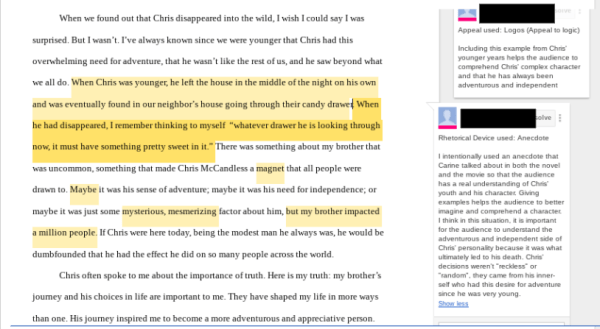
A powerful last step was for students to annotate their draft to identify and discuss the purpose of the devices they employed, like a reflective rhetorical analysis of their choices as a writer.  This was key to moving students towards understanding why writers make the moves they do.  Then, we delivered them to develop speaking skills in a low stakes setting and have the opportunity to hear rhetorical strategies used.


Two student samples through various perspectives with their annotations:

Screenshot 2018-03-12 at 2.18.56 PM

Screenshot 2018-03-12 at 2.18.40 PM

While this assignment was made for Into the Wild and specifically for Chris McCandless, the assignment could easily be modified for any text studied as a class or independently. Consider how the ending of The Great Gatsby would change if Nick delivered a eulogy. What would Daisy have said, with or without Tom in the audience?  What would Hannah’s classmates who received a cassette in 13 Reasons Why have said to memorialize her?   

This eulogy allowed me to assess students’ character understanding, a way for students to apply their rhetorical knowledge, as well as a low stakes way to practice speaking, all while synthesizing perspectives in the text.  Did I mention squeezing in a little rhetorical practice for the upcoming exam?  I also think students were able to sort out their views on Chris through the persona they took on, adding an invaluable transactive quality to their analysis. 

Maggie Lopez teaches juniors and seniors in Chicago, but is looking forward to a new adventure in Utah for the next school year.  Currently, she is working through her personal reading list of An American Marriage by Tayari Jones and Red Sparrow by Jason Matthews.

Champions Finish Strong

pexels-photo-332835.jpeg

About this time, every year, I begin to feel that itch, that urge to chuck everything I’m working on right now and start planning for next year. Maybe it’s the feeling of spring in the air, but I always find myself frustrated with how I spent my time this year and wanting to start fresh and clean for next year. So, as I move into test review mode, I begin my wish list for this year and vow to do better in August. It goes something like this:

     I wish that I had conferenced more…next year I’ll conference and here’s how…

     I wish that I had done a better job with writer’s notebooks…next year those notebooks are going to be cute and organized and here’s how…

     I wish that I had frontloaded this idea more in August….next year I’m going to frontload so hard and here’s how…

     I wish that I had taught this title instead or offered more choice here…next year I’m going to revamp every lesson plan and here’s how…

I think it’s pretty easy to recognize the “I wish” road as a treacherous one to travel down. But, honestly, for me, that urge to start planning for next year in the middle of this year is the real danger.

See, all of the end of the year countdown clocks act as siren songs, pulling me into the excitement of planning for a new school year: new pens (because they help me plan better), PD books (I’m starting with 180 Days), Google Folders (because I’m nerd, this will never not make me happy). I’m getting antsy just thinking about it.

And so I find myself eased into bright, happy, shiny thoughts about how perfect next year will be. I look forward to the excitement of a brand new group of students, of a summer spent immersing myself in practice, of all of the hope a new year of school brings.

And I know these are dangerous waters. I also coach volleyball, and, in that context, I would immediately recognize this behavior as problematic. Whenever my team thinks about Tuesday night’s game before Monday night’s game, we have a rough night. We can’t think about the district tournament in October until we’ve handled August. I would put a clamp on that kind of thinking right away on the court. And so, I’m realizing I also have to lock down my mid-April urges to plan for next year.

Why?

Because, in a nutshell, champions finish the way they start.

I think we have to approach the end of the year the same way we started it – fired up, focused on the tasks at hand, bringing that same excitement and hope and enthusiasm to each LONG day of testing and test prep. Don’t our students sitting in our classrooms right now deserve that? Don’t they deserve to know that we’re happy to see them each day they enter our classrooms, not counting down the days until they leave? Don’t they deserve more than filler? Don’t we deserve to be present in the moment, enjoying where we are right now in our journeys together?

But what is there to be excited for during testing season?

Great question. I teach in TN – testing has been… rough… this week.

However,  I’m particularly excited about three activities between here and our AP Lang and Comp test. These are pretty common activities among AP Language teachers, so I’m not presenting anything new here or even my own ideas (good teaching is good stealing according to Harry Wong), but sharing some ideas that have worked for me. They are tried and true ways to keep students involved, interested and invested on this downhill dash to the test:

1. Rhetorical analysis – Role playing. We’re currently role playing as Abigail Adams writing a letter to her son John Quincy. Students pair up (one is Abby, the other is a dear friend there to offer advice) and craft a letter to her son, encouraging him to take advantages of all of his opportunities. Then we read and analyze her actual letter to him. This is a pretty common AP lesson, but it’s new to this class. The simple act of role playing really deepened our discussion of rhetorical analysis and provided lots of AHA moments along the lines of “You’re right! She DIDN’T sit down and think ‘I need four rhetorical questions and one use of asyndeton. She thought about her large and small goals and worked from there!’” Students left with a better understanding of what to notice in a RA and how to organize their essay around ideas instead of devices. Surprisingly, these letters also showcased an almost aggressive level of voice. It was productive and fun – the perfect way to spend a test prep day.

Here are some examples culled from today’s writings.


  1. Synthesis – Pinwheel discussion. Again, more role playing. Students jigsaw a few short texts related to a topic and then come to a center table to discuss a single question in front of the whole class. They are encouraged to identify the attitude of the author and then converse with that attitude as that author. Unsurprisingly, they really get into it. The activity has them intentionally synthesizing  multiple perspectives on the fly and on their own in front of an authentic audience, reinforcing the idea of synthesis as conversation and elaboration.

3. Argument  – Speed dating. Five to six thought-provoking prompts are posted on the board one at a time. Students have four or five minutes to brainstorm claims, evidence, organizational structures and a theses. We whip around the room, sharing insights and approaches, curating a list of universal nouns or excellent pieces of evidence, creating ideas that students can tuck away in their back pockets before the test. I love this activity. There’s such great community in the sharing of ideas while also mimicking the time crunch of the written portion of the test.

Hopefully, none of the ideas feel like test prep. Hopefully, it’s just more learning. Hopefully, we find ourselves excited to be in English, fully present in the moment, enjoying our productive time together. The thoughts and ideas for next year can percolate until the end of May.

Sarah Morris teaches AP Language & Composition and Film as Literature in Murfreesboro, Tn. She plans on watching two episodes of Buffy the Vampire Slayer for Friday’s Film as Lit lesson. She realizes how very lucky she is that this falls under the category of  “Something She Gets To Do At Her Job For Money!!!!” She tweets at @marahsorris_cms.

Politically Motivated: Positively Harnessing Student Passion in a Time of Uncertainty and Fear


Yesterday morning, I stood outside for 17 minutes. Per the instructions of my administration to maintain the opportunity for all students to learn without interruption should they choose, after a moment of silence in our school for the victims of the Parkland shooting, if students chose to participate in the national walkout, teachers were to follow only if every student in his/her class left the building. After a few seconds of looking around at one another, one by one my sophomores stood up and filed quietly out of the room.

Outside, a small group of students had prepared statements to lead the several hundred students gathered in the chilly March sunshine through 17 minutes of reflection, support, and silence. The group was large, diverse, respectful, and unified, if not in purpose (likely a few students were carried out more by curiosity than conviction), then in the experience itself. A hush I’m not used to experiencing in the company of several hundred high school students quickly fell on the chilly March morning and the group stood in near silence, listening to their peers eloquently unite the crowd in peaceful purpose.

Teaching in time when I feel that I must often couch statements with a reminder that logic and facts should not be considered political, I must again come to you today and suggest that the overwhelming pride I felt in the students gathered in front of our school yesterday, and at the student-led debrief/discussion held during our resource period afterwards, had nothing to do with the politics of their statements. It has everything to do with the way I saw students, our students, standing together in support of one another to promote safety, unity, and empathy, not only for our schools but for our communities.

Several weeks ago, after the tragedy unfolded at Marjory Stoneman Douglas High School, I was compelled to write about how we can help our students (Shana too wrote beautifully about positive activism in the classroom), those young people who were not even alive when the shooting took place at Columbine in 1999, process such violence and uncertainty as a constant shadow to their educations. Little did I know that our school too would need to process an alleged threat to safety, a school day where several hundred students stayed home out of fear, social media-fed rumors of possible violence, and countless discussions with students who said time after time that even though this particular brand of violence has been taking place for the entirety of their educations, they didn’t know what to do. They didn’t know how to feel. They didn’t know how to cope.

They just want it to stop.

I looked at their faces and saw fear, anger, and pain that frankly frightened me, and for the millionth time this year, I knew I needed to figure out what we could do.

Discussion, writing, reflecting, sharing, and hugging was working, but much like this past month, something felt different.

These kids needed to DO something.

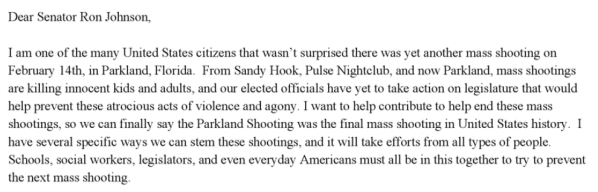
My colleague Sarah and I decided to have our AP Language students write letters to their representatives, expressing their researched opinions on how to end the violence of mass shootings. Their arguments would be their own, bolstered by research to better understand the issue, their own positions, and their audience.

social changeWe were clear with students from the very beginning that this was not an assignment in support of any particular political agenda. Instead, it was an exercise in better understanding our preconceived ideas and more deeply, and diplomatically, developing our rationale for how to bring about change  As long as their research came from credible sources, students could argue for changes to gun laws, support of the 2nd amendment, mental health considerations, school security, or any other defensible position to end mass gun violence. They could write to state or local representatives, as long as they researched that representatives current position on related issues, providing students with key insights to audience consideration we’ve previously only talked about or tried to emulate through blogging.

Supported with ideas from Kelly Gallagher’s incredible argument unit published over the course of 12 days on his personal blog, Sarah and I helped students through pointed research to build letters rich in ethos, persuasive argument, and pathos that could only be provided by the very students whose passions for activism have been flamed because they are so heavily and personally burdened with the threat of this particular brand of violence.

Over the course of the past two weeks, I have:

  • Seen students come in more for help/feedback with this assignment than any other throughout the year. When I asked a student after school yesterday, what had him so dedicated to crafting this particular summative he said, “Because my school work matters, but this assignment is going outside of the school. It matters outside of these walls.”
  • Watched young people who before could not identify who their state or federal representatives even are, research these people and their positions on key issues, and write directly in response to those issues in order to argue to an authentic audience.
  • Helped students channel their feelings of helplessness into purpose, simply by picking up a pen.

What these kids have produced is incredible. I am so proud of the way they have positively focused their overwhelming emotions into powerfully convincing letters to the men and women with means and opportunity to make changes to protect our students from further disaster.

Here are a few excerpts from letters that have started rolling in. In the coming days, we will get the letters printed, addressed, and mailed to Madison and Washington.


mass2


mass3


mass4


mass1


I am a firm believer that addressing issues in a constructive manner is a significant step toward positive change. We owe it to our students to provide them with, encourage them around, and support their efforts in making positive changes in their own communities. Though unequivocally necessary as a foundation to an informed electorate, we will not raise the citizens this nation so desperately needs on standards, skills, and summative assessments alone. A new reality is built on the combined knowledge and passions of the humans willing to take risks in support of that reality.

I will certainly never stop teaching my students that deconstructing a prompt is the best way to dig into a timed writing task or that commas don’t occur only where you would naturally take a breath, but I will also never stop supporting them in all they have to teach to us. Our students deserve our help in amplifying their voices to bring about a better world. In this, our jobs have never been so important.


Lisa Dennis teaches English and leads a department of incredible English educators at Franklin High School near Milwaukee. Follow Lisa on Twitter @LDennibaum. 


Creating a Culture: the workshop journey begins

“Mrs. Turner, I’m mad at you…”

This was the voice that greeted me the other morning before the first bell to begin school had even rung. I was surprised. Garrett is one of our seniors–a kid who I had taught for two years and who often called me Mom (and sometimes Dad, just to be funny). We are close, and I didn’t know why he’d be mad.

“I finished that book and now I don’t have anything to read and I can’t stop thinking about what happened in Winger and I’m mad at you.”

Ah…now I get it. You see, this young man was an avowed non-reader three years ago. He was almost proud of it–he wore it like a badge. Garrett was not alone. My classroom seemed to be filled with young men and young women who had lots of “better” things to do than to pick up a book. Many (almost proudly) said that they hadn’t read a book since they stopped AR testing in elementary school. Frustrated with lower reading scores than I thought appropriate and encouraged by industry greats like Kelly Gallagher and Penny Kittle, I was determined to change my kids into readers, one kid at a time.

I set out to fill my classroom with books. I bought used books, I bought books from Goodwill, I took donations from friends and family members–there were books everywhere!

IMG_3924

Then I took a bigger leap and decided to give up 12 minutes of my instructional time every day. We’re in 53 min classes 4 days a week with 39 minute classes on Fridays–251 min of instructional time; 12 minutes a day 5 days a week is roughly 20% of my instructional time. I believed the literature, though, and, more than that, I believed in the power of books. I’ve been a lifelong avid reader, and as the kid who took a book everywhere (and always had a spare book in the car), I’ve always used books as an escape but also as a way to help me work through whatever issue I was facing.

So back to my grand experiment. Through trial and error, lots of book talks, and lots of reading conferences, we started to see a change. All of a sudden (though actually after quite a lot of intentional hard work), I had 90% of my students reading and excited about it. There were several days a week when even my toughest audience would request more time to read. Garrett, for example, tore through Gym Candy by Carl Deucker, then Runner, then Payback Time, then Swagger. Swagger had the biggest impact, I think. Now it wasn’t just about the sports narrative–he was getting to something with meat and weight. He was also getting a little obsessed with Carl Deucker. After some encouragement and more than a little coercion, he tried Kevin Waltman’s High School Hoops series–Next, Pull, Slump, and Quick. It was somewhere in the middle of Slump when he admitted that maybe he didn’t just like to read Carl Deucker books–maybe he actually liked to read. (For ideas about using great sports writing as a hook for your students, click over to Shana’s mini-lesson.)

Now Garrett’s a senior, and he’s in my room about once every two weeks looking for something new to read. He’s not alone, either. It seems that there’s a constant stream of kids in and out of my room looking for a new book. I get comments in the hall about something new that someone is reading, or a former student stops me at lunch to recommend the book that he just finished. Another student might stop by in tutorials to ask if I’ve read anything about a particular topic that she’s struggling with. I’m not alone, either. My other colleagues in the English department are experimenting with different ways to institute independent reading time in their classes. It doesn’t look the same in any of our classes, but the bottom line is that our kids are getting time to read, and in that time, they’re getting time to think. It’s moving into other departments as well–one of the History teachers is toying with the idea of incorporating some reading time into his class as well. The funny thing is that we’re starting to see results on test scores, too. The Reading component average for ACT scores at my school is slowly moving up–progress! We are creating a community of readers at my school, and, in the process, creating a community of thinkers.

If you are looking for some books that are sure to jump-start even the most reluctant reader, check out this post from Jackie! Charles Moore also has a great list of books and an inspiring story of his own journey here.


Do you have a story of a reading workshop success? I’d love to hear it! I’m also always looking for books that grab your most reluctant readers so that I can be ready with ammunition!

Sinead Turner has been trying to find a balance between reading ALL of the books and reading/grading essays–reading is just more fun! She teaches English 11 and AP English Language & Composition in Alabama at a small Catholic school and has three beautiful girls, a saint of a husband, and a menagerie of animals. She’s also sticking her toe into the proverbial Twitter water at @SineadWTurner.