Tag Archives: writing

10 Pedagogical Must-Reads for Workshop Teachers

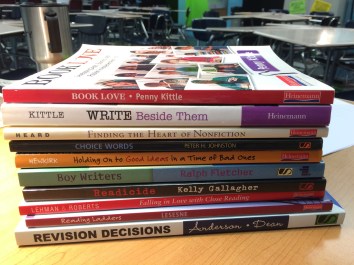
IMG_0650I met with my new student teacher a few weeks ago, and he asked me to borrow any books that might help him get going on the readers-writers workshop–the “theory” version of Jackie’s starter kit.  He’s been in my classroom before, so he knows the general routine and character of our work, but he wanted to know the ins and outs of how I thought and planned and conceptualized the whole thing.

I sat at my desk and looked at all of the titles I had on hand, remembering how influential reading them for the first time had been.  As a result, it was hard not to just dump my entire professional bookshelf onto a cart for him, but I managed to pick out a few titles that have guided me most adeptly in one aspect or another of my current classroom practice.

  1. Book Love by Penny Kittle – This was the book that helped to solidify my vision of an ideal classroom.  Before I read it, I had already been doing many of the best practices Penny mentions–writer’s notebooks, choice reading, personalized writing.  But I didn’t know how to bring it all together until Book Love.  As such, this is my #1 recommendation for any teacher looking to jump-start their individualized workshop curriculum.
  2. Write Beside Them by Penny Kittle – This book introduced me to the concepts of mentor texts, reading like a writer, and best draft/publication of writing.  I learned about quickwrites, constant revision, writing conferences, and a great deal more of what are now standard routines in my classroom.  This is the book for anyone curious about the big picture of writing instruction.
  3. Finding the Heart of Nonfiction by Georgia Heard – I was raised in the tradition of literature as containing mostly fiction and poetry, but Penny’s books helped me see the great value of nonfiction.  I wanted to know how to integrate it well into my thematic units, and this book helped me do that.  Georgia’s book is full of wisdom about finding the soul of good nonfiction writing and matching it to your students’ needs.
  4. Choice Words by Peter Johnston – This book taught me how to talk to students.  It is my #1 recommendation for anyone looking to address those pesky Speaking and Listening standards in the Common Core–this book teaches you about the delicate, volatile power of a few choice words between you and your students.  I re-read it every year, and it might be the most important book in this stack.
  5. Holding On to Good Ideas in a Time of Bad Ones by Tom Newkirk – This book is subtitled “Six Literacy Principles Worth Fighting For,” and Tom Newkirk certainly made me want to engage some of my former teachers in fisticuffs when I finished it.  This text is full of common-sense brilliance that will transform the way you think about why we teach reading and what kinds of texts we teach.
  6. Boy Writers by Ralph Fletcher – Why do my students keep writing about violent gun battles?  Why do they always ask if they can swear in their writing?  What’s up with the complete unwillingness of my boys to be vulnerable?  If you’ve asked yourself these questions…this book is for you.  Ralph writes about everything you ever wondered about boy writers and how to move them forward in their writing.
  7. Readicide by Kelly Gallagher – Schools have been killing reading for many years, Kelly argues, and then presents ways you can stop the slaughter.  He fires away at pop quizzes, assigned chapters, multiple-choice tests, and all the practices that steer our students toward SparkNotes.  Then he reveals ways to get students authentically engaging in literature in a way that doesn’t kill their love of reading.
  8. Falling in Love with Close Reading by Chris Lehman and Kate Roberts – After finishing Readicide and wanting to abandon the eight or so whole-class novels I once felt chained to, I wasn’t sure how to teach close reading skills.  This book answered that question for me, and more.  Chris and Kate reveal how to use poems, articles, short stories, and selections from novels to get kids interacting with the beauty and power of language in all kinds of texts.
  9. Reading Ladders by Teri Lesesne – When all of your students have finally found a book they will actually read–then what?  Teri Lesesne taught me how to help students climb a reading ladder of text complexity with this book.  It’s a tough battle to get all kids reading, but it’s even tougher to get them to all challenge themselves once they are.  Reading ladders are the solution to the increasing complexity question–now they’re a consistent part of my instruction.
  10. Revision Decisions by Jeff Anderson and Deborah Dean – After reading the first nine books on this list, I still wasn’t sure where grammar instruction fit in.  I knew to have students read like writers and learn from language and sentence structures that way, but I wasn’t sure how to structure my mini-lessons, until I read this book.  Jeff and Deborah helped me find strong craft study lessons and bring them into the classroom in a way that appealed to students and also benefited them immediately in their writing.

This is by no means an exhaustive list–That Workshop Book by Stephanie Harvey, Read Write Teach by Linda Rief, The Book Whisperer by Donalyn Miller, and many other integral titles were simply not on my shelf when I gave this stack to Mike.  But these top ten are ones I wouldn’t be the same teacher without.

What other titles are essential to your practice?  Please share in the comments!

Update:  Here are must-read folks that readers have suggested via Twitter and Facebook, as well as in the comments:

  1. Lucy Calkins
  2. Nancie Atwell
  3. Linda Rief
  4. Katie Wood Ray
  5. Donalyn Miller
  6. Don Graves
  7. Donald Murray
  8. Peter Elbow
  9. Ariel Sacks
  10. James Moffett
  11. Louise Rosenblatt

Mini-Lesson Monday: Mining Memories to Begin a Writing Unit

Narrative is, to me, the most powerful genre of writing one can do.  Whether the narrative rests in a fictional or true story, or acts as an anecdote within an argumentative text, or helps to illustrate a concept in an informative one, story is central to great writing.  Students know and live this, and are natural storytellers once they get going…but sometimes knowing what story to tell is easier said than done.

I find that stories students have rehearsed well through talk or reflection are the best stories to get them to write.  As a result, we mine our memories to harness our most powerful topics for writing all narratives.

Objectives — Using the language of the Depth of Knowledge Levels:  Identify memories that are rich with complexity to write from. Or, from the Common Core:  Write narratives to develop real or imagined experiences or events using effective technique, well-chosen details, and well-structured event sequences.

Lesson — My students in West Virginia are well familiar with the concept of a mine.  For them, a mine is “an abundant source of something,” while to mine means “delve into (an abundant source) to extract something of value, especially information or skill.”  Using this metaphor for brainstorming topics is comforting for them, since they know we’re digging for existing ideas and knowledge–not crafting something new.

img_0728

My scars maps

One of my favorite activities for mining memories came from Tom Romano, which he simply calls “Scars.”

I begin by drawing a stick figure on the board and then turning to my students.  I point to my knee, then draw a small dot on my stick-figure knee.  “When I was about eight,” I begin, “I really thought I could jump down a whole flight of stairs and land on my feet.”  I get them laughing as I tell them the story of how I got that particular scar.  Then I draw a little dot on my left stick-figure eye, and tell them the story of how I got chicken pox so badly that it went into my eyeballs.  They cringe in horror, so then I draw a little dot on my left wrist and tell them about how my new kitten just really won’t stop using my arm as a scratching post.

We laugh together.

“All scars have a great story behind them.  Draw a stick figure in your notebook and label your own scars.”

They do this, unable to keep silent as they show their neighbor their stick figures and begin to tell their stories in brief.

After a few minutes, I draw their attention back to the board and draw a large heart.

“All scars have stories, but not all scars are visible.  Sometimes we carry scars on our hearts, where no others can see.”  The classroom always gets eerily quiet at this point.  I write the name “MeMe” in my heart on the board, and tell about my awesome Tennesseean grandmother and her fabulous Southern drawl and feisty persona, and how she passed away on my very first day of teaching.

“It was basically impossible to get through my very first day of this career that I so love,” I share.

Then, I write the word “miscarriage” in my heart, and tell about that worldview-shifting event in my life.

“Go ahead and draw your own hearts and label your own heart scars.  We all have them.  Don’t be scared.  This is just for your notebook, for now.  It will stay private.”

img_0729

My scars story

The classroom falls silent and I open my notebook under the document camera while they scrawl, not telling any stories to neighbors this time.

“Beneath your stick figure and your heart, let’s take eight minutes to write about any one of these scars.  Tell the story of how it came to be.  It could be a funny story, or a sad one, or a scary one.  But tell the truth and tell it well.”

We write together, revisiting a routine that has become commonplace in our classroom–I model not just the act of writing, but the act of vulnerability, and my students dive headfirst into the tough stuff as a result.  This is just one practice that builds a strong community of readers and writers.

Follow-Up — After we write, we revise briefly, then elect whether or not to share at our tables only.

The next class, we mine another set of memories by creating a map of our childhood homes, then telling the story of one of the places on the map–a Penny Kittle gem.

Another day, we go through our playlists, choose a song that is the soundtrack of our life, then tell the story that made it so.

We continue with five seed prompts in a row, five class periods in a row.  Then we select one of those stories to refine and workshop into a narrative.  I teach a mini-lesson each day about a narrative skill, so that by the time we’ve really committed to a topic, students are well-versed in pacing, dialogue, descriptive detail, and the like.  We confer and workshop and revise.

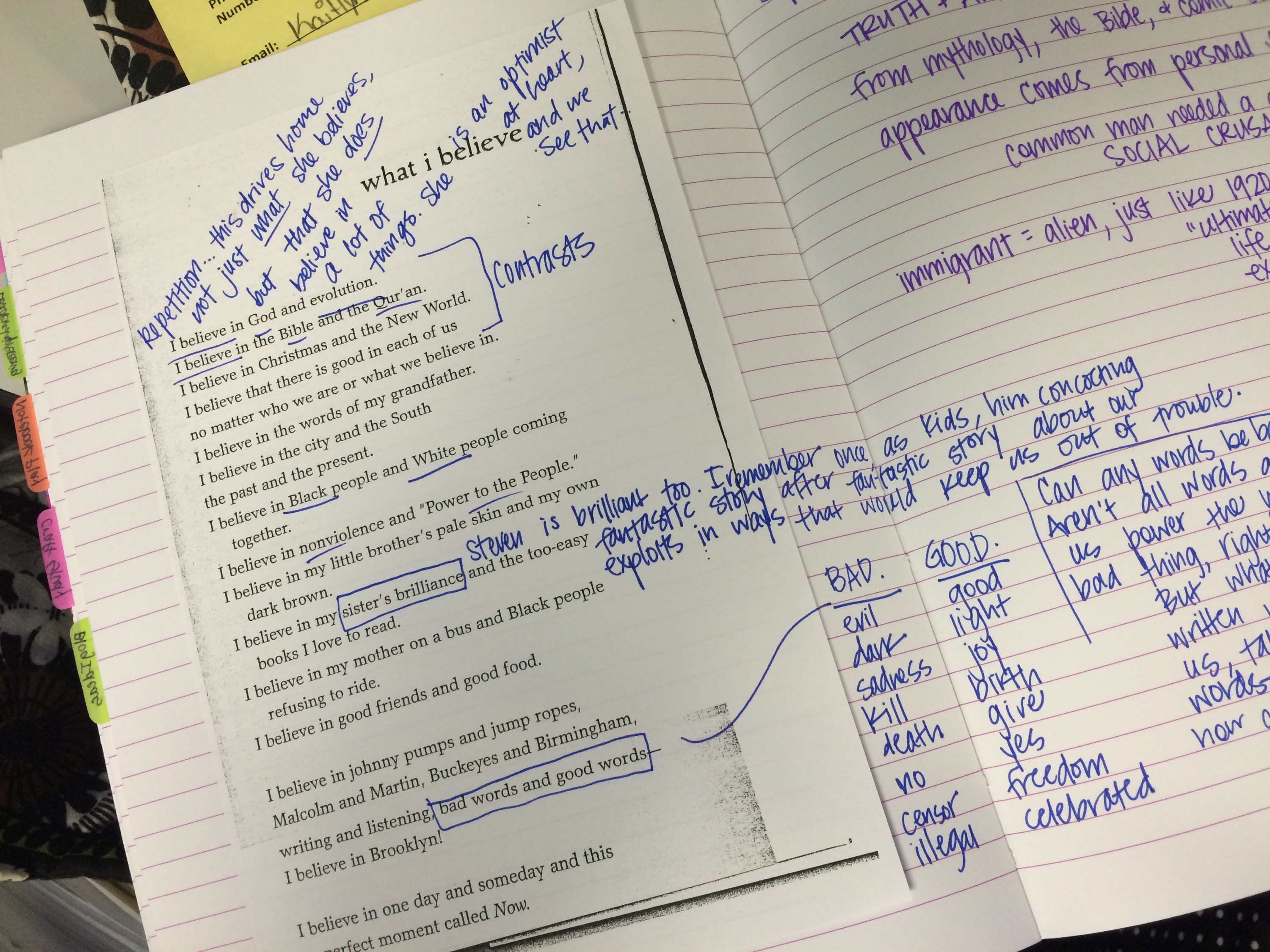
I’ll employ this routine when we return from break, focusing on reflection and rejuvenation and resolutions in the new year, working to craft multimodal “This I Believe” essays as we read Siddhartha together.

How do you get your students to come up with meaningful topics for writing?

5 Non-Negotiables When Designing Writing Instruction

IMG_0528

First draft of a unit plan in my notebook

I plan my units of instruction in three-week chunks, alternating between a reading-focused unit and a writing-focused unit.  In every unit, and in every class period, I keep some routines the same, much like Amy describes here.  While I do most of the big thinking about a unit up front, I do leave some holes in the plans to make space for mini-lessons that are responsive to what I discover students need during our conferences.  And every year, I design brand new units.

While each unit is unique, I was reminded while at the NCTE Annual Convention of five non-negotiables to keep in mind when designing writing instruction.

Writing should be low-stakes.  Students need to write a lot, and a lot of that writing should be ungraded, unread, or worth very few points.  I have felt liberated in terms of grading writing since I read Kelly Gallagher’s research-based statement that students should be reading and writing four times as much as a teacher could ever grade.

I think, since I embraced that philosophy, that my students also feel liberated.  Their notebooks are a “safe place for regular, ungraded practice,” as Penny Kittle described in her Ignite session.  While we write in our notebooks every day, and outside of class in one-pagers, I only collect notebooks every two weeks, and only carefully read and respond to one or two pieces my students have marked.  Indeed, 80% of the writing we do stays in our notebooks and never makes it to ‘published’ form.  This takes the pressure off writers to produce something perfect or error-free, because “our classrooms need to be a safe place to fail,” in the words of Taylor Mali.

IMG_0265

The first two weeks of Kelly Gallagher’s unit plan–week three is filled with revision and getting to best draft #3 at the ‘deep end’

Teaching writing is complex, layered, and nuanced.  In her session on revision, Georgia Heard shared the five things all students need in order to make authentic revision happen:  “opportunities for students to write, mini-lessons on craft and revision, choice in topics, mentor texts, one-on-one conferences with both teachers and students.”  Kelly Gallagher’s unit plan he walked us through adhered to those rules remarkably well.  “Assigning writing and teaching writing are two different things.  Grading writing and assessing writing are two different things,” he reminded us.  It is impossible for students to produce great writing if it is merely assigned.  Thus, when I plan a unit of writing instruction, I leave ample time for craft mini-lessons, modeling my own writing, and talk amongst students and myself.

When teachers are writers ourselves, and experience the process of topic choice, revision, and studying craft moves beside our students, we can become the most effective teachers of writing.  We have to walk the talk.  “Great, effective teachers must be informed AND inspired,” Kwame Alexander asserted.  To be a truly informed teacher of writing, a teacher must be a writer herself. I learned more about writing a strong narrative while participating in NaNoWriMo alongside my students than I ever did just trying to teach fiction before I wrote fiction.  I loved the experience six years ago during my first attempt, and I’ve continued to complete all assignments beside my students ever since.  When we write with our students, inspiration will spread through “the contagion of passion,” in Penny Kittle’s words.

Writing should be personal.  While I love to write about reading, and find it valuable for students to do so often, most of the writing in my classroom is personalized, choice-driven, and often remains private.  When we do a nonfiction writing unit, like the rhetorical analysis we’re in the midst of right now, our written products are focused on the students’ relationships to the texts they’re analyzing–in this case, the misleading rhetoric often found in American politics.  Mostly we write narratives, even in the midst of nonfiction, telling the stories of our connections to the topics we discuss in informative or argumentative genres.

“You can write yourself out of dark places. How much of the writing we do in school nurtures that?” Gary Anderson wondered in his session on reflection.  We have to honor the fact that students are not inherently motivated to write for their futures–for college, job applications, or resumes–but rather they are motivated to write for the here and now, and for themselves.  This is why choice is, and will remain, at the center of my writing instruction.

How do you design writing instruction?  Share your process in the comments!

#3TT Workshop: Assessing Writer’s Notebooks and Sparking Engagement

Three educators. Three states. Three demographics. All practicing Readers and Writers Workshop in our Secondary Classrooms. Read more about us here.

We are the Modern PLC, and every Wednesday, we share our behind-the-scenes collaboration as we talk about the most urgent moving parts of our classroom pedagogy.

Recently Three Teachers Talk received an inquiry regarding our use of Writer’s Notebooks.  Naturally, this question got us talking–what do notebooks look like between New Hampshire and Texas, Freshman English and AP Language and Composition?

We all agree that Writer’s Notebooks are one of the essential tools to a successful classroom, but integrating and sustaining them can prove challenging.  This week’s conversation between Jackie and Amy seeks to explore some of the ins and outs of writer’s notebooks by discussing what we, as teachers, consciously choose to include in our students’ notebooks and what we decide to leave out.

Make sure to visit the first installment of our conversation, and please join the conversation in the comments!

As the year progresses, how do you keep students engaged in their writer’s notebooks?  How do you help students to recognize their inherent value?

Screen Shot 2015-12-01 at 3.34.55 PMAmy:  Well, we do use our notebooks every day. Of course, this helps with keeping students invested in their use. This year I wish I had taken more time to have students decorate their notebooks, really take ownership of them. I love how Jackie setup collage stations and took the time for this with her students. Students care more about their notebooks when they have taken the time to personalize them.

My students also come to value their notebooks more during our conferences. For example, today I met with a student to talk about her reading life. I asked her how she felt she was progressing. She told me that she was stumped because “I keep abandoning books. I’ve started 10 this year, but I’ve only completed four.” I asked to see her Currently Reading List in her writer’s notebook. She did not have it updated. First, we took some time to write all her titles down, and then we marked ‘finished’ or ‘abandoned’ like I’d hoped she would do all along (my fault for not checking notebooks with more fidelity.) Once we had a complete list of the books this students had tried, I was able to talk her through why she might have needed to let them go. We zeroed in on the narrators. The books she has finished have unique narrators:  a dog, a voice in verse, an 11 year old boy, an autistic 16-year-old. We then talked about the narrators of the other books — all third person omniscient, which she did not know, so I taught her the term in a mini mini-lesson. Together we learned that when the narrator “goes off into some other character’s part of the story, I get confused.” This was a powerful learning experience for my student, and a great reminder to me. There is power in the IMG_0163writer’s notebook. It can be our primary teaching resource.
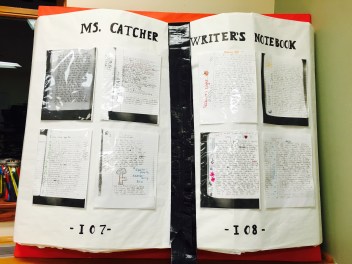
Jackie: Sustaining interest in writer’s notebooks throughout the year can be a difficult task; students must be invested in and committed to their notebooks to understand their full value.  I believe sustained investment comes with consistent use.  As Amy mentioned, the collages at the beginning of the year helped students connect to their notebooks.  Even now I have students adding to their collages or entirely recovering their notebooks.  

Using notebooks everyday also reinforces the value of these tools.  I talk about them constantly, conduct notebook checks throughout the year, and ask to see them during reading conferences.  I display example pages in a giant writer’s notebook, and I typically ask students to write their drafts by hand.

How (and how often) do you assess writer’s notebooks?

Jackie: Writer’s Notebooks provide a safe space for play within the writing process.  To become confident and secure writers, students must have a low stakes area to both visualize and enjoy the process of putting pencil to paper.  That being said, notebooks are also valuable because they provide me with insight into a student’s thought process, progress, and personal exploration.  

FullSizeRender

Students’ notebook pages are displayed in a giant writer’s notebook.

My grading process is relatively simple.  I keep a list of notebook contents on a board in my classroom, adding to the board every day.  Notebook checks take place every two-to-three weeks depend on the class content and units.  A week before we have a notebook check, I provide students with a checklist, with which they self-grade and return upon notebook submission.  On notebook check day, students use mini-sticky notes to mark two pages, one page they want me to respond to, and another page they want to display for their peers in our class’ giant writer’s notebook.  This process reinforces that students are writing for a wider audience than myself, while also embracing the messiness and imperfection that comes with writing.  I value the scribbled drafts full of doodles for the sole reason that they model the realness of writing, the fact that these pieces, while fun and entertaining still require molding and modeling to become a polished final piece.

While my grading is low stakes, I file writer’s notebooks under summative assessments for a few different reasons: it helps me assess student’s executive functioning skills, which is particularly important for my freshmen and struggling learners.  In my school, it allows students to “retake” the assessment, requiring them to revisit, revise, and refashion.  The more they return to the contents of their notebook and develop its structure, the more invested they become in the final product.  Finally, notebooks align with the common core, which is essential in my competency-based grading school.  They help “students develop and strengthen writing” (W.9-10.5), “write routinely over extended…and shorter time frames” (W.9-10.10), and “determine the meaning of words and phrases [in their dictionary section]” (RL.9-10.4).

Amy:  I’ve tried scoring the whole of the notebook. I even have a glue in for how I would if I did. I am not disciplined enough. I find short chunks much easier to manage, and I can zip around the room and look at everyone’s personal dictionary to see if it is up-to-date in the first 15 minutes of class while students are reading. Or I can collect notebooks and look at just the skill we practiced that day. These always equate to completion grades. Sometimes I’ll pass out sticky notes and ask students to mark whatever writing they’d like me to read. I learn important information about my students this way. When students share their hearts with me, I value it in a way that is so much more important than a grade. How would I ever grade that anyway?

How do you keep your students excited about their writer’s notebooks throughout the year?  How do you assess notebooks without stifling creativity?


Mini-Lesson Monday – Strengthening Dialogue With Punctuation

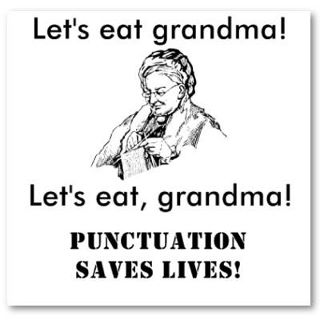
Punctuation_Saves_Lives2After reading second drafts of my students’ narratives, I was wowed by so much of their writing.  Thoughtful leads, powerful topics, intriguing plot structures.  But, despite a mini-lesson on the conventions of writing dialogue last week, some of their characters’ conversations were lacking.  I needed to design a responsive mini-lesson accordingly.

Objectives — Using the language of the Depth of Knowledge Levels: Synthesize your knowledge of how punctuation works with narrative speech conventions to craft thoughtful dialogue; Construct dialogue based on your knowledge of a character’s personality.  Or, from the Common Core: Write narratives to develop real or imagined experiences using effective technique, well-chosen details, and well-structured event sequences.

Lesson — While reading drafts, I set aside a few exemplary pieces of student work in terms of dialogue.  In each class period, there were at least two students whose dialogue was superior.  It was subtle, nuanced, and really added to the characters’ depth.

I asked students to open their writer’s notebooks to the Craft Study section and I projected one example of a student’s work on the board using my document camera.  “Good dialogue isn’t just about what a character says,” I begin. “It’s also about how they say it.  A greeting can really change based on phrasing or punctuation.”

I point to the example on the board.  It’s Logan’s, and in his dialogue, his mom is yelling at him for getting drunk:

“LOGAN WAITMAN SANDERS!” Mom hollered. “Just WHAT do you think you are doing, young man?!  And…and…YOU, Jeremy!  You should be ashamed of yourself!”

Everyone laughs, and I ask a volunteer to read the dialogue aloud.  Dylan does, with perfect angry-Mom-inflection.  He makes Logan shrink back in his seat a little.

I ask the class, “Why did Dylan know how to read that dialogue so perfectly?”  They volunteer: the capitalization helped; he knew when to raise his voice.  “How did he know to stutter?”  They say: the dots (ellipses, I add helpfully) told him to stutter.  “How did he know to sound kind of incredulous while yelling?”  They reply: the exclamation points, and especially that exclamation point mixed with a question mark.  “How did he know when to pause?”  They know: commas.

I put up other kinds of punctuation on the board–dashes, periods, italics–and we discuss what effect each of those would have on a character’s dialogue.  Students jot all this down in their notebooks.  Then, I pass back their drafts and ask them to find a partner.  “Now that you know how to really make dialogue more personal, revise your dialogue in your drafts.  Work with a partner to determine whether or not your dialogue has the effect you want it to when you revise–write a line, then ask your partner to read it aloud the way Dylan read Logan’s.”

Students take ten minutes per person to revise, then we launch into writer’s workshop with the remainder of class.  I write beside them on the board, working on my own dialogue in my NaNoWriMo novel.

In each of my other classes, we repeat this exercise with drafts that contain good dialogue.  It’s so important to use student work as mentor texts–students see that great writing is attainable, not just imitable, when we show them their peers’ successes.

Follow-Up — After today’s revision and writing workshops, students will have one more day in class to keep working on their drafts before turning them in again.  I’ll hope to see much improved dialogue, and as such, I’ll ask writers to answer a question on their self-evaluations about how their dialogue enhances their characterization.

#FridayReads: Learning to WRITE WHAT MATTERS with Tom Romano

IMG_9890With the release of his newest book, Write What Matters, this year marks the tenth year I’ve been reading and writing beside the words of Tom Romano.  If you’ve not discovered his wisdom on injecting writing voice into student work, his guidance about writing to discover, or his brilliance in coining multigenre…you’re missing out.

This summer, at the UNH Literacy Institutes, Tom Newkirk talked at length about the guts it took for Tom Romano to publish Clearing the Way in 1987–the first “teacher book” of its kind.  Guided by the research of Donald Graves and his contemporaries, Romano explains the text’s origins to his reader:

“This book is born out of my own struggles to write well and fourteen years of working hard with teenage writers.  Both the writing and the working have been worth it.  They are fine passions.

Thus began my pedagogical education–I read Clearing the Way in my very first English methods course in 2005.  Chapters like “The Crucial Role of Conferencing,” “A Creative Current,” and “Literary Warnings” showed me the possibilities if I created a classroom full of passion and verve and real writers.

IMG_9889Next I happened upon Crafting Authentic Voice, in Romano’s own writing methods class at Miami University in 2007.  A quote from page five of this book hangs prominently in my classroom to this day: “Voice is the writer’s presence on the page, the writer’s DNA.”  I point to those words when I endeavor to help students develop voice.  Chapters like “Enter Craft,” “The Five-Paragraph-You-Know-What,” and “Imitation” have guided my teaching of writing, and I see in those topics the work of Katie Wood Ray, Penny Kittle, and Georgia Heard.

Blending Genre, Altering Style I read in my Master’s level writing methods course, again with Romano himself.  This book helped me flesh out the nuts and bolts of teaching multigenre, which remains to this day both the most effective, enriching work I do with my students, and their very favorite thing.  Reading and writing about chapters like “The Many Ways of Poems,” “Genres Answered,” and the practical “Evaluation and Grading” led me to present with Romano on the many possibilities offered by multigenre at NCTE13.

I’d been teaching five years and was already living in West Virginia when I read Fearless Writing, seeking more guidance about teaching writing.  Practical chapters like “Easing into Poetry Through Imitation,” “Crafting Narrative,” and “Self-Assessment: Raising the Blinds” pushed me to take my teaching of many genres to new heights, with wonderful student results.

Last year, thrashing in the throes of a difficult PhD program, I sought wisdom from Romano in Zigzag, where his chapter “Meltdown” showed me empathy, peace, and guidance.  “I’d never been more at peace with a big decision,” Romano writes of leaving his own doctoral program.  I did the same, and I’m at peace too.

Now, as I prepare to welcome my first child into the world, I’m contemplating where my career will take me.  I’ve long known I don’t want to try to sustain my level of involvement with teaching high schoolers while trying to be a mom.  But I don’t want to leave the amazing, sustaining, nurturing community of teachers and writers and thinkers I engage with here at TTT, or at NCTE, or on Twitter.  I don’t want to leave my tribe, as Penny Kittle says.

Screen Shot 2015-10-23 at 5.34.59 AMAnd, again, Romano is here to guide me through my next steps–Write What Matters: For Yourself, For Others is lately ordered from Amazon and on its way to me.  I know that chapters like “Trust the Gush,” “Risk and All,” and “Who Are You to Presume to Write?” will guide me as I wonder about my future teacher-writer identity.  I know that this book is what I need right now:

Many want to write. But sometimes they lose heart. They are cowed in the face of so many fine writers of fiction, memoir, poetry, columns, and creative nonfiction. Their confidence wanes. If you want to write, but are hesitant, let Tom Romano lift your confidence. In Write What Matters you will find discussions of writing processes that make sense, demonstrations of effective strategies to try, advice about developing productive habits to get your writing done, and examples of illuminating writing from fearless writers, both professional and novice. Your voice, your vision, your way with words matter. They are tied to your identity. You know that you are more alive when you put words on paper. Accept that you not only want to write. You need to write. Write What Matters will help you learn to dwell in your written words and craft them into writing worth reading by others.

Pick up Write What Matters, or any of Tom’s many other works of wisdom and power.  Let Tom Romano lift your confidence–in your writing, your teaching, and your passion.  His words, and he, have been my single most reliable, important mentors as I seek to be a teacher of writing, a teacher-writer, and a plain old Saturday-morning-notebook-storyteller.

The Importance of Narrative: Stories That Stay With Us

I was reading a weekly one-pager yesterday and came upon this little note from a student:

IMG_9850

This student, Aleigha, had taken an elective writing class with me as a sophomore.  Now, as a senior, she wanted to revisit the story she’d begun two years ago, and give it a different ending.  I was surprised that Aleigha had remembered that story, and that its ending had nagged her for two years.  I was even more surprised, as I started to read her one-pager, that I remembered her story, too–a fictional narrative in which two soulmates are torn asunder by circumstance.  She’d ended the story unhappily, leaving the two protagonists separate.  In this year’s one-pagers, though, she’s slowly bringing them back together.

Aleigha’s narrative was powerful to her, and personal, despite its fictional genre.  Her peers’ feedback indicated that her characters’ situations were relateable–that everyone wants people in love to end up together, because it’s something we all strive for as humans.  Narratives give us something to root for.

During a Google Hangout this summer, Jackie talked about her students’ writing of narratives, and how “the transformative power of common stories” brought out their best and most vulnerable writing.  “Every child has a story to tell,” agrees Don Graves.  Because of this truth, narratives are my favorite genre to teach.

We all have a story to tell–a story that stays with us, that we can’t get out of our minds, no matter how long it’s been since the idea was seeded.

As my students write their narratives, I’m shocked by how naturally the words are flowing out of their pens.  When the topic is powerful, I feel like I have little to do in the way of writing instruction–I simply have to get out of the way and let them write.  I have mini-lessons planned on pacing, setting, sensory details, and characterization.  But I’m finding beautiful writing already extant in their drafts:

“Every time I step onto the ice, it takes me to my childhood,” Mitchell’s story begins.

Kaylee stuns me with: “The musky smell of burning wood rose into the air as the sound of water crackling split the silence.”

“Realizing you’re gay, and accepting you’re gay, are two very different things,” another story leads with.

The brilliant Tom Newkirk explains why students are able to effortlessly write this way in Minds Made for Stories:  “The hero of the story is a narrative itself…Narrative is there to help us ‘compose’ ourselves when we meet difficulty or loss. It is there to ground abstract ideas, to help us see the pattern in a set of numerical data, to illuminate the human consequences of political action. It is home base.”

We make sense of the world by weaving its happenings into a story–by the time our students come to their notebooks with an idea, they’ve already rehearsed this story many times.  They are just bursting to tell it.  It is home base.

While narrative may not be considered the most “rigorous” of genres, I believe it is the most important one.  It is the writing that demands to be done–the genre that is the most personally fulfilling, the most emotionally wrenching to write, but the most necessary to exorcise from our minds.  Let your students write their stories–write your own beside them–and watch your community of writers bloom.

Weekly One-Pagers to Develop Writing Fluency

IMG_9425

Janelle, now in college, appreciates the one-pagers belatedly

This summer, Amy and I talked a lot about what we wanted for our students.  While there were lots of complex ideas tossed around, we knew that our goals boiled down to two simple ones:  for our students to become real writers and real readers.

We had lots of structures in place to help our students become authentic, fluent readers–weekly reading homework, daily booktalks, reading conferences, reading workshops, and more.  But writing was a bit different.  Daily quickwrites and longer compositions were already in place, but I wanted to add something more to get students writing more regularly outside of class on topics of their choice.  I wanted them to gain the same fluency with writing that they did through their weekly reading homework.

So, I was reminded of something I used to require my AP and Honors English students to do–a weekly one-pager.  Every Monday, a one page, single-spaced, typed paper was due.  I offered topic suggestions, but ultimately, students could choose what to write about.  I decided to revive this routine, inspired by Kelly Gallagher’s powerful claim that students should be writing four times as much as teachers could ever assess.  Why shouldn’t all students–not just the AP and Honors level students–write this much?

This year, I only have one Honors class, but all four of my English classes write weekly one-pagers.  We have a section in our notebooks called “Weekly Writing,” which is rapidly filling up with writing on a variety of topics.  During bi-weekly notebook collections, I check to see that these weekly one-pagers are being completed, but I don’t “grade” them–that’s not the point.  The point is to build writing fluency.

These one-pagers are low stakes–ten points apiece, so on a particularly busy week, if students just don’t have time to write, it’s no big deal.  But the frequent follow-up and sharing activities we do in class with these writings, combined with the autonomy students have in their topics, make the missed one-pager a rare occurrence.

I was initially inspired to create this routine by some of my greatest college professors, for whose classes a written response was due each day.  Alan Frager’s “study guides,” Tom Romano’s “one-pagers,” and Don Daiker’s “reading responses” were handed in at the start of each class period.  By writing a short paper every single day for most of my college years, I developed incredible writing fluency.  I knew I wanted my students to develop this written fluency as well, partially in preparation for their own college experiences, but also to bridge the gap between a writer’s thoughts and his words on the page.

As evidenced by Janelle’s testimony above, building this writing fluency pays off.  Already this year, students are remarking that it’s becoming much easier to write a full page, after only writing eight of them thus far.  I’m enthused by the growth I see in all my students’ writing fluency, and looking forward to seeing how much they can develop as writers by the end of this school year thanks to the weekly one-pager.

What routines are in place in your classes to help build students’ writing fluency?

Why We Should Challenge Our Students–And Ourselves

I’ve recently found myself in a learning situation I’ve rarely experienced before–a classroom where I am the slowest, lowest, and neediest learner.  The one whose work is nowhere near the level of everyone else’s.  The one who asks the dumbest questions.  The one who is silent and stricken after asking the dumb question.

IMG_9356

My own messy attempt at a poetry exercise

Those of us who grow up to become English teachers are skilled readers and writers, for the most part, and we were generally successful in educational settings.  We loved reading, we enjoyed writing papers, we received positive feedback from our teachers about our work, and we got good grades.  This is eminently true of my own educational experience, so I’ve never been able to truly empathize with how my struggling students might feel about our class time together.

The work of learning is tough in general, but standing out as the worst learner is a pretty unsettling feeling, I’m finding out.

The poetry workshop I’m involved in, which has shattered my confidence as a writer (while simultaneously strengthening my writing skills) is taught by award-winning poet Mary Ann Samyn.  This Bolton Professor for Teaching and Mentoring is the leader of our little band of misfit poets, and has been “poem-ing it up” for decades.

Mary Ann’s resulting ease with the language of writing and teaching poetry is obvious to witness.  She has clearly internalized and automatized much of the vocabulary of poetry–she tosses out phrases about meter and iambs and syllables and line breaks with such grace that I can tell she’s been thinking and talking about poetry for years.  “A line of poetry is a unit of measure,” she said.  I hastened to write down that line, marveling at its simple wisdom.

IMG_9355

My classmate, an MFA student, scrawls her own messy poem

It occurred to me, as I jotted down that poetic utterance of Mary Ann’s, that this is how I must sound to some of my students–as though I’m speaking another language.

As I sit in the workshop on Thursdays, surrounded by MFA students who have years of experience as real writers of fiction, nonfiction, and poetry, as well as teacher-poets who have published their own verse, I feel so lost.  I am in a world I don’t feel I belong to–I do not yet identify as a poet, but I feel surrounded by them, trying to do the work of writing poetry and reading poetry and thinking about teaching poetry.  I wonder if I’ll ever get to their level as they gently question me about my writing, trying to make sense of my meaning, and give me suggestions about my work.

Regardless of how I view myself in the group, one thing is clear during the workshop–I am part of the community of poets, for 90 minutes every other Thursday.  I give and receive feedback in the same way the other writers do.  I participate in the exercises everyone else does.  I write poetry within the same time constraints as the others.  I am treated as a poet, even if I don’t think I am one.

Being part of a writing community with such rigor is hard, but it’s valuable.  I would never use the word “fun” to describe my time in the Bolton workshop, but I would argue that perhaps the best learning is not fun.  I find myself determined to write poetry alongside those real poets, even as I dread reading my words aloud to them moments later.  In Drive: The Surprising Truth About What Motivates Us, Daniel Pink argues that my drive to do this is innate to all learners:

“We have three innate psychological needs—competence, autonomy, and relatedness. When those needs are satisfied, we’re motivated, productive, and happy.”

I make an effort to improve as a poet because I need to feel competent, much like our students work to improve as readers and writers because they desire competence, too.  In all educational situations, learners perform not because of the dangling promise of a grade, the threat of failure, or the pressure to comply with a controlling teacher.  They perform because they want to prove competence to themselves.

I asked a few students about this topic.  This summer, Shailyn read the Pulitzer-winning All the Light We Cannot See by Anthony Doerr.  She said the vocabulary was difficult, the book was long, and the writing style was strange–it was one of the toughest books she’s read.  “Why did you have the confidence you could read it?” I asked her.  “When you encountered those challenges, what made you say, ‘I don’t care.  I’m gonna read this anyway.’?”

“Because I have goals.  I like to feel challenged, and when I finally figured out how [the protagonists’] stories came together, I felt satisfied.  And I felt like I learned a lot from that book when I finished it,” she said.  Shailyn wanted to know that she was a competent reader–comprehending that book showed her she was.

Hunter, too, recently finished a book that challenged him.  “I hate this book,” he told me in the midst of Lone Survivor.  “You can abandon it,” I reminded him.  “No!” he said, forcefully.  “I’ve gotten two-thirds of the way through it.  I’m not giving up now.”  Hunter finished the book of his own accord, exercising his autonomy.

Lakynn agreed that learning is intrinsically motivated.  “You feel better about yourself when you’re more educated about a topic,” she told me.  “If you’re not knowledgeable about something, you can’t relate to someone more educated.  You want to learn about things so you can have those conversations with people about them,” she explained.  The social aspect of a learning community is evident and powerful here–Lakynn sought information about the Republican presidential candidates to fulfill her relatedness needs.

The more I talked with students, the more I discovered that what I thought was frustration with my difficult learning experience was actually profound satisfaction.  Yes, my confidence was crushed–I thought I was a good writer.  But knowing that I had so much room to grow created a hunger for more knowledge–I needed to learn, to belong, to feel competent again.  And so, I leave the Bolton workshop energized, confused, and with my mental wheels turning, every time.  The rigor of that learning–the toughness of it–is what makes it so satisfying.  I’ll remember that the next time I sit down beside the accomplished poets in my class, and every day I design lessons for my students.

Our students flourish when we create an authentic, rigorous learning community for them to be part of.  Difficult books, intimidating writing pieces, and high expectations combine to create an ideal situation in which autonomous learning can occur.  The beauty–and the learning–lie in the challenge.

I’ll leave you with a gem from one of Mary Ann Samyn’s collections of poetry, Beauty Breaks In:

Beauty breaks in everywhere.
Welcome to the wind-powered poem.
Like the ocean or the woodcut of the ocean.
I heard the hardest thing and listened.
Syntax says, you first. Shimmer half-scolds.
I said, I am loved. Sometimes a correction happens.
Fear made it one full week. A human action.
I stopped making it worse than it was.

How to Respond to All Writers–Students and Professionals Alike

In a workshop classroom, all authors are mentors.  They are teachers of the craft of writing, and the foundation of the workshop model is built on acknowledging and celebrating them as such.  All writers are apprentices of other writers–Stephen King notes this in On Writing, Katie Wood Ray points this out in Wondrous Words, and Penny Kittle champions this in Write Beside Them.

This week, we’ve practiced treating two types of writers as mentors in our classroom–published authors and student writers.

Once we set up our writer’s notebooks, we began filling them with all things personal to us.  Heart maps, important photos, our hands, lifelines, reading histories, and more.  Then, we turned to adding the words of other writers.

IMG_9251

My writing atop Jacqueline Woodson’s

I wanted to show students the power of other writers’ words.  I wanted to teach them to read poetry not to “torture a confession out of it…to find out what it really means,” as Billy Collins writes, but to celebrate the act of simply reading that poem.  So, we glued in an excerpt from Jacqueline Woodson’s Brown Girl Dreaming.  I modeled for students how to respond to Jacqueline as a real writer, to notice and note her craft moves, to be inspired by her ideas and write more about our own feelings on those topics.  We wrote atop her poem, prioritizing our responses, reactions, and ideas rather than some analysis or “dulling down” of her meaning.  Responding personally and authentically to published authors will become an important part of our daily routine in our writer’s workshop.

I invited students to enter into a written dialogue with the authors we read.  So, as I settled down this weekend to begin reading a tall pile of student writing that had been turned in, I knew I had to walk the talk, as Amy always reminds me I must.  I ask students to treat authors as real people worthy of critical response, so why would I treat my student writers any differently?  I’ve always struggled with how to grade/evaluate/respond to student writing, but I’m thinking about it in a new way this year.  I just want to have conversations with my students about their writing, whether it’s in the form of a writing conference or in a weekend session with a stack of papers.  I know that when these conversations occur, student growth will follow.  In the excellent Portfolio Portraits, edited by Don Graves and Bonnie Sunstein, Linda Rief writes in an essay IMG_9248titled “Finding the value in Evaluation:”

I have discovered that students know themselves as learners better than anyone else.  They set goals for themselves and judge how well they reach those goals.  They thoughtfully and honestly evaluate their own learning with far more detail and introspection than I thought possible.  Ultimately, they show me who they are as readers, writers, thinkers, and human beings.

My thinking aligns with Linda’s.  When I remove myself from the role of “grader” or “evaluator,” I become an authentic reader of my students’ writing.  I invite students to assess their own writing, which in the words of Linda Rief “shows the value in evaluation.”

So this weekend, I read my students’ writing like I read books.  I noted beautiful lines they wrote, jotted down spiffy words they harnessed, and responded to thought-provoking ideas I saw them getting at.  I asked them questions, wondered about their meanings, and looked very much forward to reading more of their words in the future.  I will confer with students as I return their papers, and we’ll talk about how they might move forward with some of the topics, ideas, and stories they’d begun in these early writings.

In our classroom, we consider our responses to published writing as important as the writing itself.  The value of reading and writing lies in the interaction between the reader and the words, as Louise Rosenblatt describes.  When I transfer that value from the way I want my students reading writing to the way I want to read my students’ writing, new and important opportunities for student learning occur.