Matt de la Pena is scheduled to speak at TAIR in Denton, TX on September 30. If things work out, he’ll be coming to my school to speak on the 28. I am excited for my students to hear Mr. de la Pena’s story. It is so similar to their own.
Mexican White Boy is the first de la Pena book I’ve read. Ball Don’t Lie, We Were Here, and I Will Save You are rising on my TBR pile. I imagine my students might get at them first.
A passage from Mexican White Boy made me take note. It’s a great read aloud, but it’s also a great piece for a text study. It’s packed with literary and rhetorical devices and would be ideal for close reading for concrete vs. abstract details. Or, tone. Or, syntax, Or, all of them.
It all hits him as he stares at a half-finished love letter. No matter how many words he defines or love letters he composes or pieces of junk mail he reads aloud to his grandma while she waters spider plants potted in old Folgers coffee cans he’ll still be a hundred miles away from who he’s supposed to be.
He’s Mexican, because his family’s Mexican, but he’s not really Mexican. His skin is dark like his grandma’s sweet coffee, but his insides are as pale as the cream she mixes in.
Danny holds the pencil above the paper, thinking: I’m a white boy among Mexicans, and a Mexican among white boys.
He digs his fingernails into his arm. Looks up to see if anybody’s watching him. They aren’t.
Sometimes he’ll just watch his family interact in the living room. The half-Spanish jokes and the bottle of tequila being passed around with a shot glass and salt. The laughing and carrying on. Always eating the best food and playing the coolest games and telling the funniest stories. His uncles always sending the smallest kid at the party to get them a cold sixer out of the fridge and then sneaking him the first sip when Grandma isn’t looking. But even when she turns around suddenly, catches them red-handed and shots, “Ray! Mijo, what are you doing?” everybody just falls over laughing. Including Grandma.
And it makes him so happy just watching. Doesn’t even matter that he’s not really involved. Because what he’s doing is getting a sneak peek inside his dad’s life (89-90).
My students will start the year with a study of narrative writing. Thanks, Mr. de la Pena for this accessible piece to get us started.
Do you have any similar short texts that you use for close reading? Please share.
By far the best book I read this summer was Columbine by Dave Cullen. As part of my class at #UNHLit13, I chose to read this book and study it for craft with three other teachers. Maybe that’s why it’s my favorite.
I’ve been in book clubs before, and I’ve had my students conducting literature circles for a long while now, but I’ve never experienced the power of studying a book like this one. Maybe it was the subject matter. Maybe it was the amazing group of professionals who were invested in the process as much as I was. Whatever it was, Dave Cullen has crafted a masterful piece that moved me.
I want my students to experience this kind of emotion when they read a book. I also want them to see the art in crafting language. (I’ll use excerpts in mini-lessons throughout the year.)
These are the first clips I will show my students this year, and I guarantee my copy of Columbine will land in a student’s hand, and the waiting list will start out long. I better prep the school library to get their copy ready, too.
Earlier in the year I shared some data on literacy rates with my students. Some of the numbers made them mad; they called them “racist” because white readers by and large have higher literacy rates than Latinos. We had a decent discussion about why that might be the case, but I could tell my students still didn’t really “get it.”
Then, I came across this blog post at Literacy Learning Zone, and I knew I had a useful tool to help my students understand why their reading levels might be lower than some of their peers’ at the high school across town. We watched the YouTube video that explains the gaps created by a lack of reading during the summer. The timing was perfect. All morning administrators were busy calling individual students into the hall to discuss their recent STAAR EOC scores and summer school options. Kids were sad.
I’ve encouraged, begged, pleaded with students all year: “The single most importance thing you can do for your education is READ. Read books, magazines, newspapers. Read anything for extended periods of time.”
If only they would believe me!
So, today after watched the video linked inside that blog, I gave my soon-to-be sophomores their summer reading assignments. It’s pretty simple: Read any book of your choice that has some literary merit (we talked about what this means) and make a note of 5 significant quotes. [I suggested they look for the Notice and Note signposts. Thank you Kylene Beers and Bob Probst.]
I will read this summer, too. I am excited to be back in the classroom full-time. That district instructional coach job just didn’t line up with my passion– a lesson I learned from reading Ken Robinson’s book The Element. I miss the students, and I miss learning with my students. My schedule is heavy with three preps, but the trade-off will be worth it. I’m already excited about the reading I need to do to get back into the groove of an AP Language class.
Here’s a shot of what I start reading, and/or re-reading this week. Lucky me!
I wish I could definitively say that I know my students performed better on STAAR because of the activities we did with this zombie project, but that would be a bit like being overconfident in surviving when 200 of the “Undead” are trying to eat my arm off. The English I Reading and Writing tests are hard–at least for my non-readers.
In response to several requests I received via Twitter. Here’s an outline of the project:
First, I did some backwards planning. What are the primary skills students need to master in order to achieve satisfactory scores on STAAR?
Write a literary essay with engaging characters, plot, theme, etc
Write an expository essay with a strong thesis, good organization, solid supporting details, etc.
Respond to reading–literary, expository, poetry, etc.–in paragraph form with embedded textual evidence
Read critically and answer questions about content, text structures, author’s purpose, etc.
No Sweat! Well, actually, a lot of sweat, tears, blood. . . Well, not blood. Not really. But I worry about my students A LOT. They come from homes in poverty with hard-working parents. By and large, they are sweet, good-hearted teens. But– they do not read, and this one thing impacts their learning in pretty much every aspect of my English class.
Thus, Z O M B I E S. I can hopefully get them interesting in the reading, which will hopefully get them interested in the learning.
I set the project up like PBL, but since I have limited training in how to actually carry out a PBL project, and my students have no experience with the requirements of this student-centered approach, which requires strong student leadership, the PBL part of the project was the first victim of our zombie attack. PBL lingered but it didn’t take an active part of the learning process. My students were too needy, and I felt rushed for time.
Introduction: Entry Document/s
Part I. Silent Discussion. In my last post I shared the Intro to Zombie Project I used first to spark student thinking about the project. After students watched the video, they completed a Poster Activity (strategy idea from Bob Probst) where I gave them each a colored marker, and on each table I put a poster-size paper. I told students that they must use their marker to think on the paper. What things did you see in the video that you think you will be required to do in this project? Students wrote their thoughts in a silent discussion for about 15 minutes, and I circled the room, reading their comments and writing comments and questions to promote more thinking on their posters.
Part II. Memorandum. Next, I gave each student a copy of Zombie Apocalypse entry doc. They had to read it, and then I gave them time to talk with their table mates about their thinking. I gave each group a sheet of paper. On the paper, I had them make a T-chart. On the left they wrote what they KNOW about the project, based on their reading of the memo and the video; on the right they wrote what they NEED to KNOW. Finally, we had whole class discussion, and students helped me complete a class KNOW/ NEED to KNOW chart that stayed posted on the wall throughout the project.
[This intro worked better than I could have imaged. We did it on a day I happened to have a group observe my classroom: Student engagement high. Evidence of student thinking high. Collaboration high. Literacy in action high. Higher-level questioning high.]
Reading and Writing
Part III. Self-Selected Reading, Throughout the year I’ve required students to read books of their choosing. If you’ve read other posts, or seen Reel Reading on Fridays, you know I talk YA books incessantly. In an attempt to get students to read something that might tie into the texts and topics we were talking about in class, I wanted to bring in as many books about zombies as possible.
I turned to my Twitter PLN first, and with their help, I build this Zombie shelf at Goodreads.com. I hit the bookstore and spent way too much money on books for my classroom library. Then asked the awesome librarians at my school to pull all the books they had that dealt with zombies. They gave me about 45 titles that I book talked with my kids. The first book to go? World War Z. I had two copies and had to start a waiting list for checkout. Personally, I read the first two books in the Rot and Ruin series by Jonathan Maberry. Good, gory books. Too thick and intimidating for my kids though.
I didn’t care if students read a book about zombies. I just really wanted them reading something. If I do this project again though, I think I would like them all to be reading a book that ties in thematically. I have to think about this more.
Part IV. Expository Reading to Become Better Expository Writers. Expository is a big umbrella, but the state of Texas defines it as INFORMATIONAL. Our students must write an explanation of a topic, using a clear and organized structure and evidence to clarify their points and support their explanation. Essays only have to be 26 lines handwritten, or about 300 words typed. It sounds easier than it is–especially for non-readers.
Students also have to be able to answer short answer reading questions. I kind of hate that we call these short answers–they are really essay questions that require essay responses. You know, with embedded text evidence: Quote something, analyze it, make your response a complete paragraph? Again, it sounds easy, but for my students it is the most difficult thing. Ever.
I know that before I can get students to focus on the writing skill. I have to get them interested in the reading passage. I struck zombie gold when I typed “zombie” and “Valentine’s” into Google. Here’s a sampling of the articles and the questions my students answered to practice writing short answer responses.
We also read the introduction to SAQ Zombies vs Unicorns and practiced short answers. (These folks are serious and even have a Facebook page.)
News Articles. Most of my students have no idea what is going on outside of their own communities. I try to bring news of the world to them as often, and in any way, I can. To prepare them for their expository essay on STAAR, I wanted to expose them to as many types of expository writing, and as many topics in the news that I could. So, under the guise of “You are the survivors of this zombie apocalypse What would people 100 years from now what to know about your civilization?” I had students look up news articles, practice writing summaries, and explain.
Part V. Literary Writing. Another part of the Texas STAAR test for English I is a literary essay. Students are given a prompt, and they must write a little story that shows evidence of their understanding and ability to develop characters, conflict, plot, setting, and theme. Here’s the Literary Story- Zombie Project we used for our project. If you’d like student essay samples, let me know.
Part VI. Poetry. Finally, although students do not have to write poems for their STAAR test, they might have to read and analyze it. We had already read many poems in class, so for this project, I really wanted students to just play with word choice. Most did a zombie-like job on their poems. Plagiarism 5 times. Way below grade level work at least a 100 others. Here’s a sampling of Zombie poems. I especially like a few of the blackout poems:
the helpless
are able
to
be
a little daring
Rubric and Reflection
If I ever do this project again, I will allow for more creative time in class. Most of my students rarely do homework, so if I don’t capture the time I have them, I rarely see work once students leave the room. Most groups did not pay attention to the Zombie Project Rubric. They focused on one area much more than they focused on others. For example, I had one group that did a sensational job on the items in their survival backpack, but they did not take the time to write engaging stories or read and evaluate news articles. Therefore, their overall grade was low. A lot of this was my fault for not allowing equal time in class for each part of the project.
As our final event, the day after our second STAAR test, we watched the first episode of “The Walking Dead.” I wished that the movie “Warm Bodies” was on DVD because that would have been a great lead into our next unit: Romeo and Juliet. It’s loosely based on Shakespeare’s play, you know? Check out this video for a fun re-mix:
Do you have any ideas for Zombie test prep? I’d love to add your resources to my growing file. Who knew zombies could be so . . . well, alive?
A mere five days before the movie comes out, I have finally finished the book! This is now officially my third time to read the classic story and I loved it just as much this time as I did the first two times. I’m not sure if the visual images that I had playing in my head as I read were tainted by the movie previews, but I really think the glitz and glam of this era is purely mesmerizing.
Books I am going to read this week:
Texas Library Association Convention
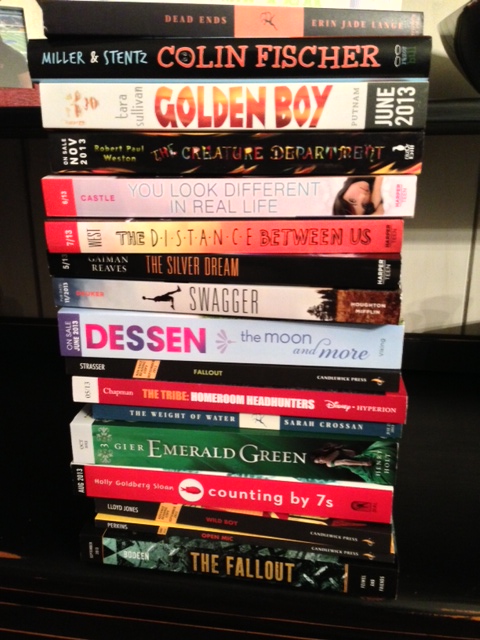
Empty book bag in hand, a couple of weeks ago browsed the isles of the exhibit hall at the annual Texas Library Association Convention. While there I was able to snag some great books that I am so excited about reading. Of course I won’t get all of these read this week. In fact, most of them will move on to my to read pile for the summer, but none the less a new stack of books is always invigorating to a voracious reader. I think of all of these, I will probably start with Dessen’s latest. I can always count on Dessen to provide a nice story with great characters!
I love to watch student-made book trailers, especially when the students are not mine, and I’ve already read the book. I guess I see with a teacher’s eye: Did the student get the gist of the book? Did she love it and want others to read it as much as I did?
I felt a thrill when I watched this trailer for Nancy Farmer’s The House of the Scorpion. The images and music parallel one another nicely, adding that touch of intrigue, which parallels the adventures in the book. The few errors in writing make me smile– my students will do that, too.
My kids will soon start creating their own book trailers. They got to choose the books they read. They get to figure out how to format and create a trailer that will get others to want to read that book. Should be interesting to see what they come up with.
I’m fully aware that it isn’t Monday – The way I see it is it really is better late than never, right?
Books I read (or am still reading):
Scarlet
For those of you who have been following my posts, you know my feelings about sequels/trilogy/whatever, but I was drawn to continue reading this series because of the indirect relationship the series has with traditional fairy tales. In the first book Cinder, the author weaves the classic tale of Cinderella in a post-modern society. In the second book, Scarlet, the story of Cinder continues to unfold while at the same time a new character, Scarlet, is brought into the frame. Of course, Scarlet’s character is based of the fairytale Little Red Ridding Hood. It truly was fascinating to see how Marissa Meyer was able to intertwine both fairy tales all the while maintaining the futuristic story line. I am certainly curious to see how the series wraps up in the third book.
Books I’m reading (going to try to actually read) this week:
The Great Gatsby
My goal this week is to get through Gatsby. The Great Gatsby is one of the very few books I have ever read more than once and the only book I ever loved being required to read in school. Clearly, I was excited when I saw that the book once again was coming to life on the silver screen. While I have no notion that the movie is going to be an exact replica of the book I am, once again, excited to see someone else’s interpretation of this book that I have enjoyed.
Brandon’s asked me every week if I had any books about football. Sadly, my classroom library is lacking in sports books. Then, while shopping at the EF book sale, I found this gem. I’d like to put Brandon’s name on it, but I won’t. I’ll show the trailer and let him beg for it in front of the class. I’m mean like that.
I’ve said it before. I wish I’d never have to say it again. But– I have reluctant, sometimes hostile, readers.
Last year I won a grant from the Carrollton-Farmers Branch Education Foundation, and with the money I purchased a whole set of these gritty, urban, teen-angst filled books that my students will at least smile (sometimes smugly) and commit to read. I know some lie, but every single student who finishes one of these roughly 120 page books has rated it at least an eight on a scale of 1 to 10. That’s pretty good, right?
I am grateful for the folks who’ve helped me get some of my chronically fake readers to at least try a book. ORCA Soundings, you are my hero.
I know to have the most success getting my students to read, I have to match books with students’ lives and interests. The only way to do that is to read books. Lots of books. My goal is to read every book in this 65+ title set. I have a long way to go, so this Monday? Here’s what I am reading:
Overdrive by Eric Walters
Exposure by Patricia Murdoch Bull’s Eye by Sarah N. Harvey
I’ve had this book sitting on my shelf for some time now. The red’s been calling to me. The scrawl on the front cover, meant to look like some rotten student wrote on my book, says: “Baby the first thing I need to know from you is do you believe I killed my father?”
Today I while searching for book trailers to show my kids on Friday, I came across this Audiobook excerpt. Take the time to listen. You’ll feel the chill, too, and you’ll think VOICE. Oh, my, gosh, what a great way to get my students to think about voice.
I am forever searching for books that will engage my reluctant readers, especially my boys. Maybe part of the problem with getting them to give a book a try is because they cannot hear the narrator’s voice. I doubt–for those of us who are readers–we think about that much, but imagine you struggle with fluency. Your reading is slow and laborious, so the meaning gets muddied. Honestly, I haven’t thought about that much. I need to do a better job at helping my struggling kiddos understand that the voice in the book can be as real as someone reading in their ear.
So, it’s Monday, and I want to read this book before I get it into a student’s hand. I’m reading: UPSTATE by Kalisha Buckhanon. Do you know of other titles that might appeal to my reluctant boy readers?
 Mexican White Boy is the first de la Pena book I’ve read. Ball Don’t Lie, We Were Here, and I Will Save You are rising on my TBR pile. I imagine my students might get at them first.






 Three Teachers Talk