Tag Archives: Readers Writers Workshop

How to Teach Writing

I might have actually reblogged this post before today, but I was searching through the TTT dashboard and found a draft I’d written reflecting on it. I miss conversations with Tess Mueggenborg, one of the best teachers I know. She pegs my thinking here, exactly. I don’t even need to share my reflections, but I would love to hear yours. Please leave your thoughts in a comment.

profmueggenborg's avatarProf. Mueggenborg

Want to create successful writers?  Want to raise them from seedlings, make them strong and resilient and capable of writing oak trees of essays, not saplings of deadwood?  The key has nothing to do with writing.  If a teacher wants to help their students to become successful writers, they must make their students into successful readers.  If a student isn’t a reader, they’ll never be a writer – no way, no how.  The reading should be both academic and for pleasure: students need to bask in the glow of words for fun, and struggle with a snarling sentence when needed.  They should delight in diction and syntax, but never be quite satisfied with them as-is – every student should always ask, “why this way?” and “why not like this?”.  And no, they probably don’t need to know what “diction” and “syntax” mean: we don’t need to understand the nuclear reactions…

View original post 85 more words

Today We Draw

A Five Day Checklist:

Chancellor visit. (Check!)

Superintendent visit. (Check!)

A posse of outside principals observing. (Check!)

Our CBO (community based organization) pulled out = no counseling…or any other services…for students.  Teachers are now ALL of that. (Continual check!)

End of the Cycle (think semester) and the accompanied wildness. (Checking…all week long!)

*THIS WEEK.  Yes, in one week.  And, it’s Wednesday only.

 —–

The above is an email I composed to Amy, Jackie, and Shana in one of our most recent communications. In response, Amy wrote:  You’ve got the world on your shoulders this week, E!  And, it wasn’t until I was greeted with this affirmation that I realized it most definitely felt that way.  I was too busy moving through it to take a moment’s pause and acknowledge the intensity of it all.   The. Weight. Of. The. World.

It got me thinking.  If I felt this way, I couldn’t imagine how students were feeling as they were the reason for all of the visits.  They were the ones ‘on display’.  I just kept it business as usual with our Readers Writers Workshop flow; rigorous expectations, Writer’s Notebooks being utilized, Independent Reading occurring, questions being raised; chuckles here and there.  Yet, it felt off.  As I looked around the room, it occurred to me that students have taken on the weight of the world too.

They’ve been trying to articulate their thoughts wrapped around their chosen literature when the Chancellor asked them about their favorite books.  They’ve tried to be loyal to our collective work and answer the Superintendent’s question about rubrics (aside from the thought provoking work they’ve been creating) knowing that we are currently exploring with our pens and ideas sans a rubric.  They have tried to find comfort in their movement over the last six months, but these pressures have made them second guess themselves.  And the reason I know?  They’ve told me.

Yet, their resilience astounds me.  So, I dug deep.

We needed a collective breath.  With all of the tension and uncertainty swirling about Room 382, we needed a class period full of calming zen.  I channelled my extraordinary experience at #UNHLIT13, as I was guided by Penny Kittle in sketching an already created piece of art.  Aside from my internal voices loudly telling me that there was no way I was going to be successful at this; I tried.  And regardless of how my sketch came out I knew the most important lesson is that I didn’t give up.

Calmly, yet intensely, sketching.

Calmly, yet intensely, sketching.

So, today we draw.

The weight lifted immediately and you could feel the energetic life seeping back into 382.  Students were riddled with questions: Wait.  We’re just going to draw today?  You mean, no writing?  We can do that?!  

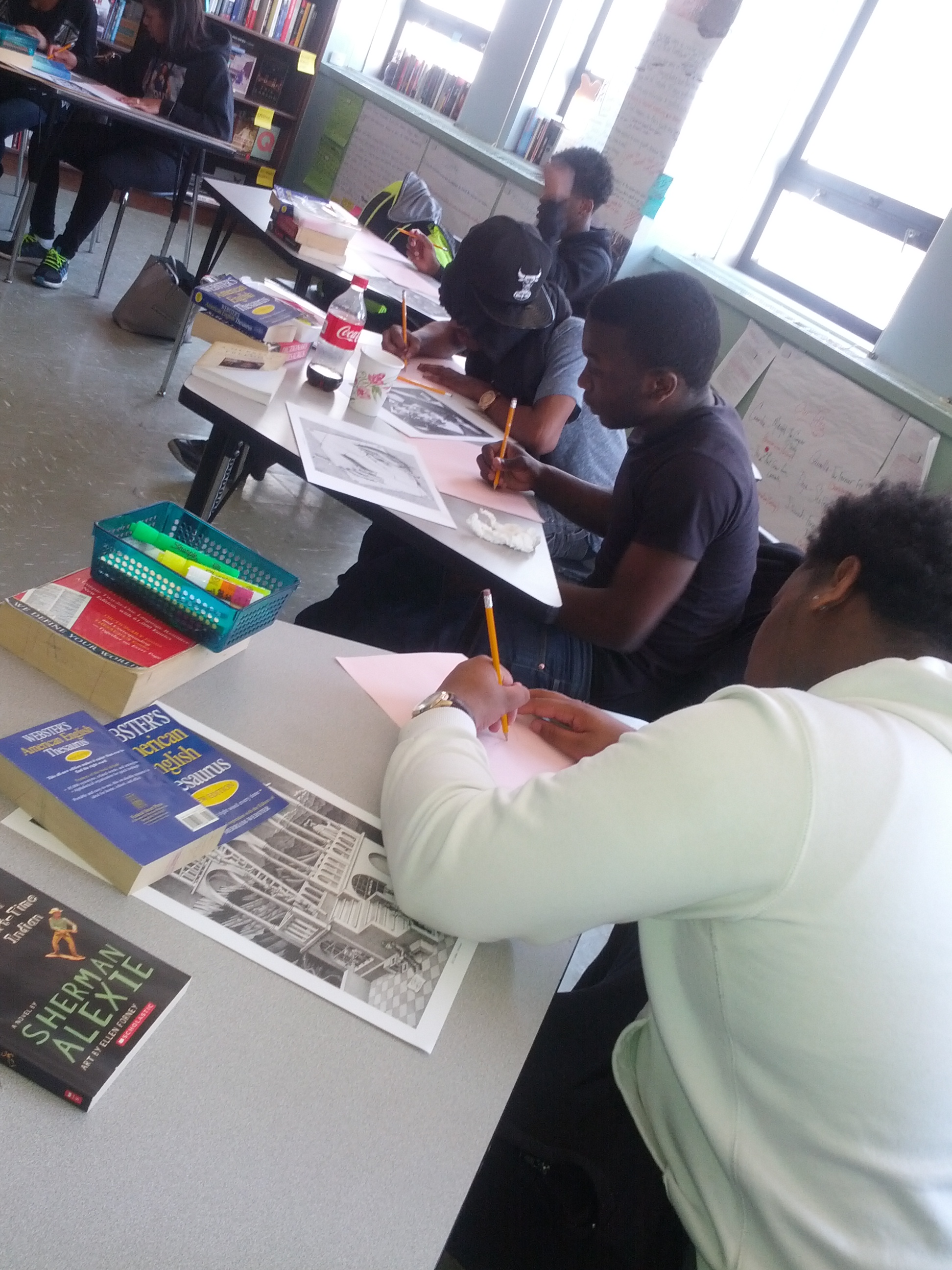
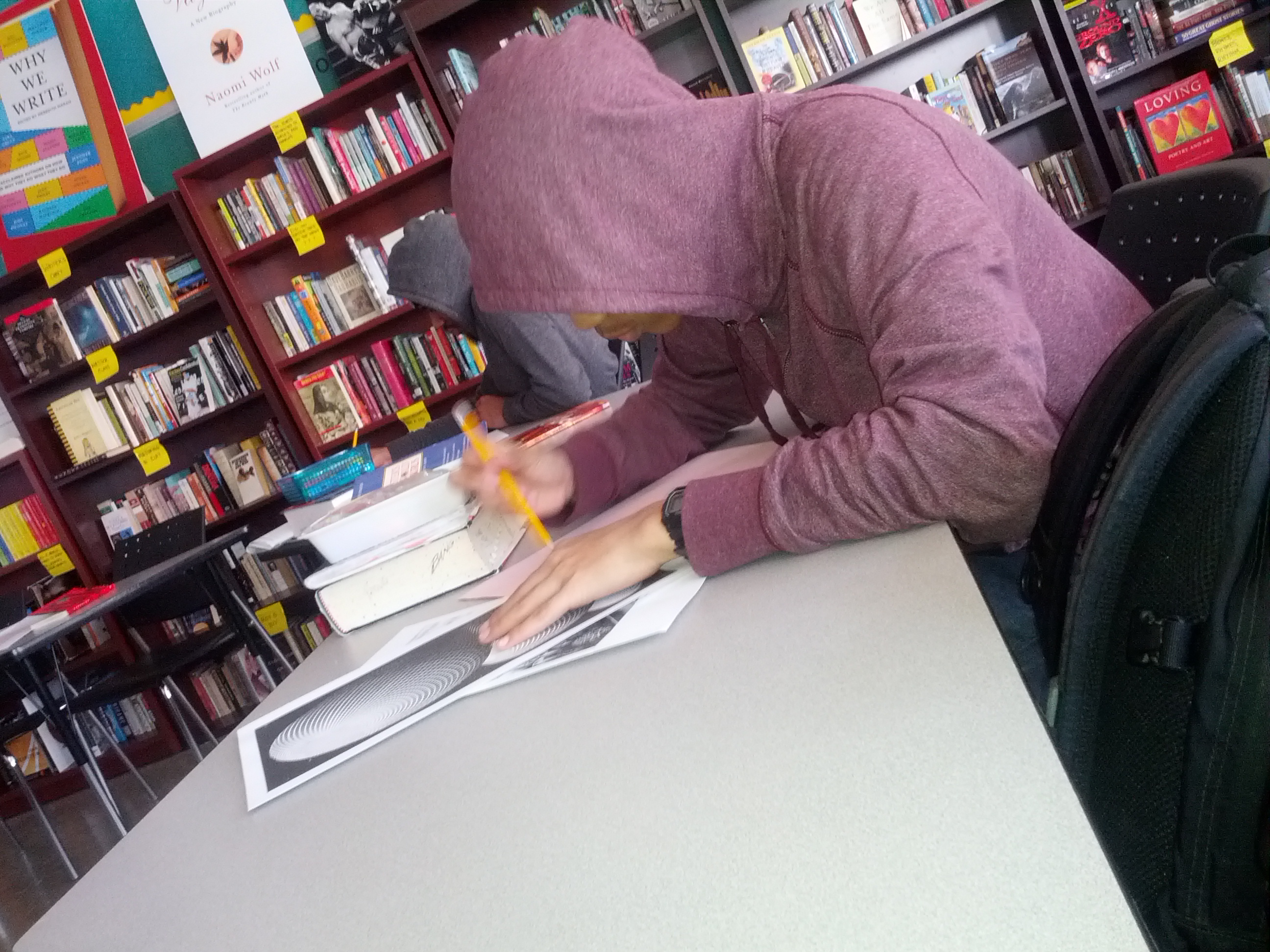
And, while some questions made me laugh and others prompted me to reflect, students were back.  So, everyone grabbed their newly sharpened pencils, chose the drawing that spoke to them most, and got to it.  I mean, really got to it.

Hoodies up.  Concentration in full effect.

Hoodies up. Concentration in full effect.


It was important for me to voice my intention: Folks as we partake in this together, I need you to know that I am wildly uncomfortable with all things drawing!  For the last six months I have asked you to find strength and courage in reading and writing that has challenged you to the core.  Today, I do the same.  (Deep breath)  Here I go…

While students zoned in, I followed their lead.  I sketched under the document camera so students could watch me struggle…and I mean struggle.  Yet, while drawing/sketching isn’t my forte, I needed students to watch me play with a level of discomfort they are not used to observing.  Students engaged in non-literacy conversation (as Shana brilliantly suggests here) while honing in on their focus.  Students approached me to lend their expertise on how to curve lines or align measurements or see the artist’s sketch with a different perspective.  It was exhilarating being the student!

Some of our masterpieces!  My attempt at creating a balcony.

Some of our masterpieces! My attempt at creating a balcony.

All said and done, here’s what I know.  The RWW is about so much more than always reading and writing; it allows the space to explore, mess up, build community, redefine rigor, and just enjoy.  On this given day, the latter is my favorite.

How do you find ways to calm the tension within your learning environment using the Readers Writers Workshop model?


Four Ways to Formatively Assess in Workshop

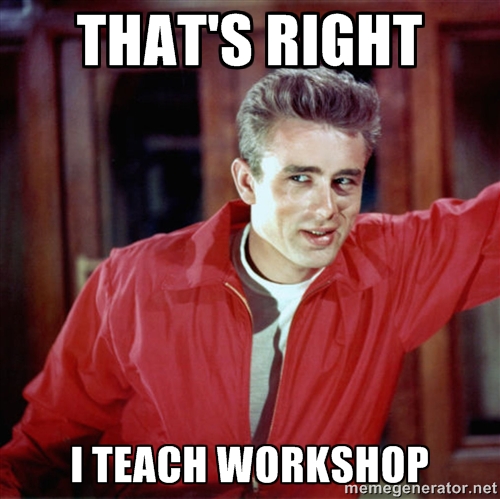
dtrfyguhujSometimes I wake up in the morning, thinking about what I’ll be teaching and learning that day, and feel like a rebel.  That’s right–I think to myself, feeling inexplicably cool–I teach workshop. Yeahhhhh.  Even though this is the most research-based, data-driven form of instruction I’ve encountered in my teaching career, a successful workshop is still such a rarity that I feel like I’m breaking all the rules by employing it every day.  I’m a rebel with a cause.

Still, when I stop feeling like James Dean and reality bites me in the butt, I know I need to be practical and follow the rules by putting some grades in the gradebook–once per week is the suggestion at our school.  If I had it my way, I’d go gradeless and celebrate the myriad acts of literacy within the confines of a classroom.  That’s not possible right now.  I needed another solution, and I think I found it in Amy, right here on this blog.  She writes powerfully about formative assessments in this post.  Her thinking mirrors mine:

I know when I am learning a new skill, I want to be able to practice–free from judgment–so that I might build some confidence before I am formally evaluated.  The same is true for kids.  We should give them opportunities to practice and build confidence.

One grade per week, when I’m grading to evaluate, is impossible.  We don’t master a different skill every single week.  Mastery requires practice.  So, I’ve focused lately on formative assessment for eight out of the nine-week grading periods, and summative for just one.  Here are the four categories I see formative assessment broken down into, and how I put them in the gradebook.

IMG_5605

Un-gradeable, amazing writing

1. Writer’s notebooks – I collect writer’s notebooks every two weeks, and students can receive up to 20 points per collection.  If all of our prompts and exercises are present, and I can see the student’s effort, he or she gets the full 20/20.  I also ask students to mark for me anything they’d like feedback on.  I check to see the status of their to-read, wondrous words (vocab), and cool craft (quotes) sections, but I also look for a telltale pink sticky note.  If I see one, I read the marked piece and write back–just feedback.

2.  Reading logs – Our reading logs are quite messy; you can see one example here.  There are arrows everywhere, new reading rates scribbled in, and tons of titles being read every week.  When students complete their reading goal of two hours per week–determined by individual reading rates–they get 10 points, every week.  Reading logs show me the big picture of a class’s progress, while conferences help me go deeper.  The reading log lets me know, at a glance, who’s soaring and who’s not–helping to give my conferences direction.

IMG_6904

Word play

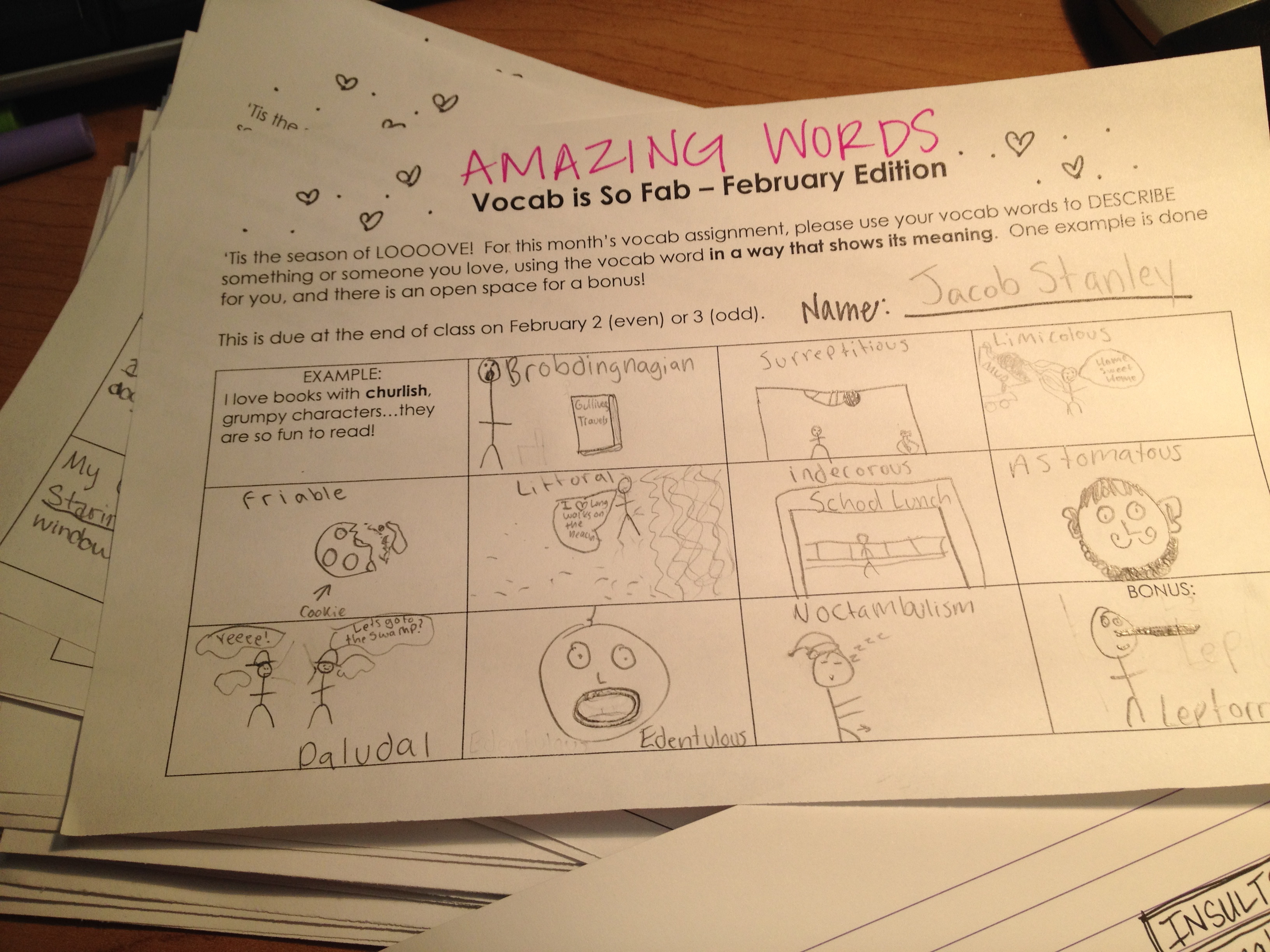
3.  Vocabulary – I still remember my orange Sadlier-Oxford vocab books from high school.  Those well-worn paperbacks were the source of many a cramped hand and a frantic fifteen minutes of homeroom before English class.  I know from personal experience that I don’t retain new words by completing fill-in-the-blank exercises–I learn by reading widely.  So, I ask my students to maintain a “wondrous words” section in their notebooks, writing down unfamiliar or unknown words as they read.  Then, I give them a different activity to complete with those words every two weeks.  The activities are worth 10 points each, and run the gamut from writing stories using the words to drawing pictures illustrating their meanings.

4. Honest self-assessments – When we finish a unit of any kind, usually about once a month–a writing unit, a reading unit, a book club, a challenge–I pass out a half-sheet with self-assessment questions on it.  I begin each half-sheet with a disclaimer:  “Be honest.  There’s no judgment here.  I just want to know why you were as successful as you were with this unit, and to know how I can help others be successful in the future.”  Students answer very truthfully, sometimes humorously so.  If their answers are thorough, they receive 15 points.

These four formative assessments total about 115 points per month.  With 9-week grading periods, students’ grades therefore are made up of about 2/3 formative assessments (230 points or so) and 1/3 summative assessments (100 points or so).  Well over half of the formative assessments are credit for the simple acts of doing the assigned reading and writing–no evaluation of those acts, just credit for the effort.  I value practice and process over product–and this grading system reflects that.

How do you handle grading, formative assessment, evaluation, etc.? Please share in the comments!

They Taught Me the Lesson Here: It’s About Time

Please tell me I am not the only one in a rush. Every spring I feel this pressure to teach more, do more, assign more. I know part of it is the AP exam date creeping closer and closer. I know my students are still not ready.

We still struggle with rhetorical analysis. Most students are getting better at recognizing devices in the texts of others, but when they try to analyze the effect? Well, the light bulb is still quite dim. And I have to practically beg to get students to add a device or two in their own writing. So many are afraid to take risks or to explore with words and sentences.

As a way to help students play with language, I turned to POETRY. (Yes, even in my primarily non-fiction AP Language class.)

We read Meg Kearney’s “Creed” poem together, and we talked through the moves she makes to craft it.

Students noticed the sound devices, the contradictions, the little story, the concrete details. They did a fine job of noticing.

But we have to do much more than notice. And that’s the hard part.

I found this “Creed” assignment by a Mrs. Rothbard online, which fit my hopes for my students exactly, and I asked students to read and study the poem themselves and then mirror the moves of our poet.

I still cannot believe how difficult this was for some of my students. Some simplified the assignment and just wrote their own lovely poems. Others made beautiful lists of their personal beliefs — but that was not the assignment. Others modeled Kearney’s first few lines and then rambled on about angst-filled beliefs that the student writers didn’t even care about when they read them to the class. (Note to self: Revision workshop must last much longer next year.)

But, some…some student writers took ownership of their own craft and composed lovely poems, modeled after our writing coach and poet Meg Kearney.

Here’s the links to JerashiaGuillermoNaWoon, Doreen, Josh, and Sydney-Marie‘s blogs where they posted their poems. They’d love it if you’d read them and maybe leave a comment (actually, they will probably die because they think publishing to the WWW makes them anonymous–so much scarier to read their poems aloud in class, which is a topic of another post I need to write.)

I learned some valuable things as a result of this writing task, and I am glad that my students talked to me about what worked and didn’t work for them. I am glad I took the time last week to let them talk.

The comment that will guide our learning the rest of the year came from a table in the back when one of my quiet ones said:

“Could we slow down? We need more time to write with you in the room to help us.”

Yes, I know that.

If I want to truly help my students grow as critical readers and writers, I must devote the time to letting them think, draft, read, write, revise, re-do, share, and all of this again and again with me in the room as their coach, their mentor, and their cheerleader.

My students need to talk to me and to their peers like I talk to my husband and my collaborators when I am writing.

I thought I had this down by now. But what I think is enough time is obviously not what my students think is enough time, so I’ll listen, and starting today.

Class time will be different.

©Amy Rasmussen, 2011 – 2015

Why I Applaud The Student Who Reads Only Two Books

imageedit_5_2583117499Author, teacher, and reading-writing workshop guru Nancie Atwell recently won the $1 million Global Teacher Prize. I have been a fan of Atwell’s work since I read her book In the Middle during my first year of graduate school. In fact, I was star struck two years ago when Atwell sat on the floor next to me during an NCTE workshop (note my shoulder proudly photo bombing Shana’s picture of the goddess herself). While I have subscribed to Atwell’s philosophy since I began my career in education, I was shocked to read in the media coverage that her students on average read 40 books per year.

My students do not.

Don’t get me wrong; the majority of my students read a large amount, yet while I could calculate the average, it would grossly misrepresent the true value of their accomplishments. I have some students who breathe books and complete them at breakneck speed. They add leaves to our book tree at an astonishing rate, yet admittedly not all my students are like that. By the end of the year, some have only completed two or three independent books in total. As a first year teacher (last year), I felt like I had failed these students. As far as I was concerned, the good teachers didn’t run into this problem. They only spoke about the record-breaking kids, not the ones that kept me wracking my brain for a solution. It felt like I was the only teacher who had the two-book-reader.

Last year, mine was TJ. TJ couldn’t seem to make it through a book. Many of my hesitant readers have learning disabilities or attention deficit disorders; in past classes, they have felt little success in reading whole class novels. When they arrive in my classroom they are resistant to choosing their own independent reading books. TJ was no exception; he had ADHD and struggled to focus on his reading both in and out of class. I’d watch him stare at a page for five minutes straight without being able to settle his mind and read a line. During conferences TJ discussed his book and claimed he was interested in it, yet he moved at a snail’s pace. By the end of his foray with Jarhead, I couldn’t imagine him undergoing the same tedious process with another book. I thought he’d quit. But he didn’t. Through reading conferences, daily reading time, and check-ins with his parents, I was able to help TJ develop a routine and gradually become a reader. Yet the greatest influence was TJ’s friends. Seeing so many of his peers reading on a daily basis motivated TJ to continue working towards his goals.

By the end of the year, TJ had read two independent reading books and three whole class reads, “more books than [he] had ever read before.” This was a feat arguably equal to if not mightier than some of my students who read 80 or more books. TJ developed persistence and stamina even if he couldn’t keep up with many of his peers. He was proud of his accomplishments and determined to become a better reader the following year. As a teacher, that’s what I want for my students—to push them to succeed and accomplish more than they thought they were capable of.

We all have those students (or maybe it’s still just me) but we must praise and hold these students in high esteem. We must brag about their successes and triumphs just as much as we praise the work of our highly motivated readers. After all, every book is a learning experience and an accomplishment.

Do you have a “two-book reader”? What is your story, and how did you work to motivate that student?

Students Need Real-Life Writing

suit-and-tieWe live in a technical world. People rarely see one another face-to-face anymore, which is why writing has become our hypothetical suit-and-tie. To get a job, one uploads and sends a cover letter and resume. To apply to college, one submits a college essay. To correspond with a colleague, one sends an e-mail. To be engage in online discussions or to communicate on social media, one must post or blog or tweet or comment. More than ever before, we are our words. We live in an age where we can look and act like slobs behind the screen while our words tell a different story. It’s empowering and liberating but also terrifying. Terrifying because too often our students don’t understand the value of formality in writing.

This has become even more apparent as I, a 26-year-old, am both exposed to and part of a generation of socially illiterate people. We, as well as our students, understand text language, chatting, posting, and tweeting, but our colloquial language seeps into our every day interactions, handicapping us in other ways.

While students can effectively communicate with their peers, they have not received the training to engage in formal written conversations—the types of conversations that drive the academic and business world. In turn, students arrive in college lazily piecing together informal e-mails to their professors that poorly represent their abilities and knowledge. We assume that because they have grown up as Internet babies and that because they are constantly on their phones, they understand the unwritten rules of Internet writing, but they don’t. This year I have made it a point to inject the discussion of voice, formality, and audience into my reading and writing units in an attempt to widen my students’ understanding of and comfort with writing.

In all of my classes I have sought to push my students outside of their comfort zones by exposing them to diverse mentor texts and assignments that force them to play with words. For many students, voice is a challenging concept. They struggle with finding a voice in their own writing, which makes it even more imperative students be exposed to comedic, sardonic, opinionated, and academic pieces. The only way to develop voice is to study it. Not all of the pieces I show my students are high brow; I pull from a variety of sources ranging from blog posts to articles from The Atlantic. But the pieces I choose are intended to show that a wide range of writers and voices exists. The more students understand that there is no one-size-fits-all structure, the sooner they will be willing to dabble in their sarcastic or silly side.

In learning about voice, students must also understand the value in formality and audience in their writing. Too often the e-mails I receive from students look like a long rambling text message. We’ve all received them—the ones riddled with grammatical errors, making us cringe and wonder if they’ve learned anything this year! Teens quickly become comfortable with the fact that teachers are the only people reading their writing. Students become overly comfortable with teachers reading their writing at times. We’re seemingly safe and familiar; we know their quality of work. Exposing their writing to new eyes and ears increases the stakes and makes their work more relevant.

This year, I was determined to push my lower level freshmen beyond the classroom and get them engaging with mentors. I could tell my students to work hard, which I did many times over, but in the general scheme of things, I was their teacher (akin to their mom). So I recruited a Navy Seal, an elementary school teacher, a forensic anthropologist, a photojournalist and others to do the job for me. Students were required to research a career. While they completed their research, I sat down with each student and helped him or her to draft an e-mail that they would send to a professional with which I paired them. Oftentimes I would return to find my students’ e-mails plagued with the same grammatical errors I’d seen so many times before,Depositphotos_7626816_m only this time, I was with them on the sending end.

My mini-conferences turned into minilessons on the importance of editing and the impression it had on the e-mail recipient. Students struggled with how to start their e-mails, how to address the recipient, and how to sign their name at the end. We practiced online manners, thanking the professionals for their time and answers while also noting something the student found to be interesting or appealing from the professional’s answers. In the end, their attention to detail paid off. A forensic science professor who teaches college students included the following in his e-mail:

“I was taken aback when I saw that he is only in ninth grade; I have students much older who do not bother to write properly and it disappoints me.  I am not your friend on FB nor are you texting me so no need for brevity at the expense of complete and correctly written sentences.  Salutations?  Maybe next year.

I have a 12 year old son so I think I will have him peer over my shoulder as I write to Carter so he can see how polished someone so young can be.  Thanks!”

Our students are going to college arguably without knowing or understanding the importance of voice, formality, and audience. To prepare them for life beyond high school, we must strive to incorporate real-life writing assignments into our classrooms. While some of my students may never write a research paper after they graduate from high school, I know that nearly all of them will use e-mail, apply for jobs, and engage on social media.

My role as an educator is to help mold and train productive and intelligent citizens and while giving them lifelong skills that translate beyond the classroom. Part of this is continuing to develop and adapt my classroom to better fit the needs of 21st century students. So regardless of what my students do in their free time whether they enjoy lounging in sweatpants with a tub of Doritos or taking selfies in a bathroom mirror, I want them to sound like poised, intelligent, and confident individuals. I want the world to be open to them—both online and in real-life.

The Value of Talk

Talk is one of the most powerful tools at work in my classroom.  Now, I’m talking about talknot discussion, sharing, peer editing, Socratic seminars, think-pair-share, or any other structured form of communication that might occur.  The simple act of letting our students just talk is invaluable, and we must create spaces in our curriculum for it to take place.  Here are three ways I encourage talk in my classroom.

Conferences – Reading and writing conferences aren’t just about assessment.  They’re also a valuable time for teachers and students to just talk to one another, getting to know each other as the humans that we are.  Creating a space for talk breaks down the teacher-student barrier, humanizes both parties, and by and large erases discipline problems in my classroom.  I begin every conference with a simple, “How are you today?”, and after genuinely listening for the child’s answer, direct the conference from there.  Some conferences, we don’t talk about books or writing–we just talk, because the student needs to.

IMG_6441

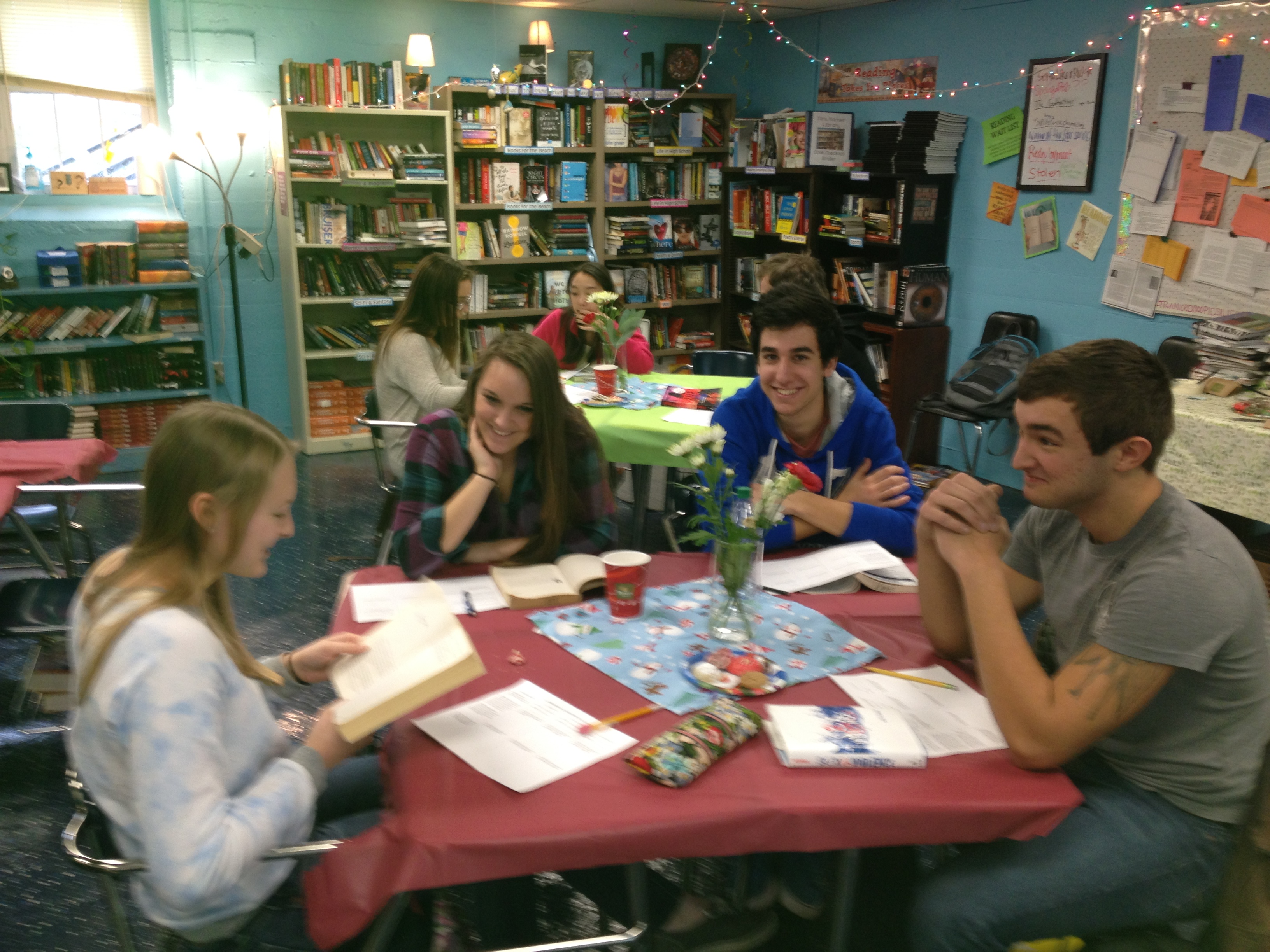
Students chat during the ‘Book Bistro’

Book Clubs – Not every book club meeting requires structure or an agenda to be valuable.  During this most recent unit, I simply asked students to keep the conversation going for 20 straight minutes.  They sometimes had to cast about for topics, but they always found something to discuss–mostly their books, but often text-to-text/self/world connections they’d made, which spun off into generalized, real-life conversations between kids who wouldn’t ordinarily find themselves chatting.  After finishing book clubs, Ana wrote, “I loved our book clubs because I felt like I got to know everyone better.”  She wrote other things about how she grew as a reader and writer…but she LOVED the unit because of the TALK that happened.

Root of the Writing Process – My journalism students consistently talk out their ideas at the very beginning of the writing process.  They chat in groups, usually starting with, “so what should I write about?”  It takes a few minutes, but enlightenment inevitably follows–the other day, Shay threw a few silly ideas out for Kenleigh about bathroom graffiti, but then they got serious about that as a story idea.  “You could call your piece ‘Signs from the Stalls,'” Shay said.  “AHHHH, that’s a great idea!!” Kenleigh enthused.  What kids like to talk about is often what they’d like to write about, and they need to talk to get to the heart of those topic ideas.

Talk builds community.  Talk is the tool that made my former student Emily say, “I felt like by the end of the year, everyone in the class became my best friend, including you.”

How do you see talk improving your classroom and its community?  What spaces do you create for talk in your classes?

Guest Post: Changing the Reading Culture in Our School One Book at a Time

Both Penny Kittle and Kelly Gallagher have transformed my thinking as a high school literacy coach.  As a former elementary school teacher, I had always used reading/writing workshop, literature circles, and choice in my classroom.  When I transitioned to being a reading specialist/literacy coach in a high school, I really struggled with the whole class novel approach.  It didn’t work for me with the little ones and I saw more and more of my students struggle with it at the high school level.  Attending workshops offered by Gallagher and Kittle, along with reading everything they have written has given me the reassurance and the research that this approach CAN work in a high school.  Here is what has happened at my high school in just six months:


More and more teachers are trying it…

It all starts with one teacher and the support of a department chair.  Last spring after sharing what I learned at Penny Kittle’s Book Love workshop, one teacher decided to drop everything he has been doing in English and take on the “Book Love” approach.  He had so much success getting students to actually read books and improve their writing that two other teachers decided to jump in second term and teach English through choice and mentor texts.  The results were astounding. Word spread at lunch and in our PLCs – students were engaged and excited to come to English class.  Then at the beginning of term three, we had four more teachers jump in.  I am not sure if it was the “positive peer pressure” or hearing about students’ engagement, but little by little teachers have been asking about how to structure their classes in a way to make this work.


Teachers are reading more and talking about books…

At times during lunch teachers used to vent about the struggles they had motivating students to complete the reading from the previous evening, or how students bombed the reading check, but now the conversations are about books. We are talking about what we are reading, what our students are reading, what mentor texts we are using, and what changes we see in our classrooms.

Thanks to one teacher’s organization and determination, staff members are swapping rooms once a week and book-talking to students that they don’t teach.  The other day the principal’s secretary came in to our freshman class and book talked The DaVinci Code.  After she left, I saw that several students had added that book to their to-read list.

None of this would even be possible if our teachers weren’t willing to read new books.  Teachers are setting their own reading goals, keeping to-read lists, creating book trailers, etc.  For the past two years we have had “I am Reading” posters outside of our classroom doors, but this is the first year teachers are updating their posters more often and students are noticing the books.


Our library is busier than ever before…

We have a beautiful library that has a lot of books that just didn’t get checked out.  This year that has changed.  Last year from August until the end of February, only 4821 books were checked out and 63 books were placed on hold.  This year in the same time period 7333 books have been checked out and 137 books were placed on hold.  That is over 2500 more books being checked out and 74 more books being asked to be held.  Why the change?  Student choice!

Students now come to the library with a purpose.  They have a to-read list (some that are pages long) and if all the books they want are checked out, they can give us a good idea of what they want to read next.  As one of our English teachers told me, “They are thoughtful about what they are looking for if they go to the library.”  He doesn’t worry anymore about students going up to the library trying to “leave class” or “waste time.” Another teacher shared how his students “know their favorite authors and/or recognize titles that have been book-talked.”  They are talking to each other about books and recommending new titles to each other.  They are even checking out 2-3 books at a time.

Our library staff is also trying hard to find ways to get books in our students hands.  Our librarian has shared ARCs with classes and spends time in the classrooms promoting tons of books – the new ones and some of the oldies but goodies that haven’t been checked out in a while. The staff has started creating competitions each month to encourage students to read (Abe Lincoln Award voting, March Madness book bracket challenge, etc) new books.  The library is no longer just a place for students to come and get homework done.


Students are reading….

They really are reading and not just the “YA” books that naysayers worry about.  Prior to taking this approach, students came into classes either as students who read all the time (1-2), students who only read assigned books, students who fake read assigned books, and students who didn’t even try fake reading the assigned books.  As one teacher pointed out to me, “As soon as choice became an option, reading, for the vast majority of the students, became fun again!”  They began forming a reading habit that had been lost so long ago.

The issue is no longer trying to get students to read anything. They are reading more consistently than ever before.   Instead of dealing with them reading zero pages in a week, teachers are finding ways to increase student stamina from 50 to 150 pages in a week. That in itself is a huge success.  Students come to class early and start reading their books.  They can even be found reading as they walk down the halls. One boy almost knocked over an upperclassman in his attempt to finish the chapter of his book.  Once a week I co-teach in a freshman English class.  Of those twenty-one students, I think only two students have finished three books.  The rest have read an average of six books in nine weeks (snow days and all). Instead of worrying how to encourage our students to read common texts and pass the reading checks, the challenge is having enough books that interest all of our readers.

Our students ARE challenging themselves – reading more, picking nonfiction, moving up the reading ladder, and trying new genres based on what others have recommended to them. I had one boy in my homeroom start with Hatchet by Gary Paulsen in January and stretched and read Escape From Camp 14 by Blaine Harden for book two.  It was definitely challenging for him, but he didn’t give up on it and was so proud when he finished it.  Other teachers are finding the same thing – students are willingly picking up books from Fitzgerald or Vonnegut, or Hemingway and are able to have real conversations about these books from their perspectives. Students are talking about books with each other AND coming up to teachers and discussing books with them. Because of the location of my office (the library), I tend to do book talks quite often when kids come upstairs and are looking for something new to read.  One of my favorite memories from this winter was a girl who had seen my Goodreads list and made her to-read list off of some of my favorites.  After she finished To All the Boys I’ve Loved Before by Jenny Han, she asked her teacher if she could come find me and talk with me about it.  She had loved it so much and wanted to thank me for introducing her to that book.These students aren’t afraid of looking smart or nerdy – they are proud.


The culture is changing…

Students are now immersed in books wherever they turn.  Between our March Madness Book Bracket challenge, I am Reading posters, Classroom Reading Trees, the Health class independent reading project, random teacher book-talks, etc. students are reading more than ever before.

Melissa Sethna @msethna23 is a high school literacy coach in Mundelein, IL. She has always had a passion for books, technology, and working with adults. In her free time, she loves to read.  She’s a strong believer in book choice and sharing her joy of literature with her family and students. She says, “I wouldn’t be the teacher I am today without my reading heroes: Penny Kittle, Kelly Gallagher, Kylene Beers, Bob Probst, and Donalyn Miller — who inspire me to take risks, and I try to encourage others to do the same.”

March Book Madness for Choice Reading Books

Can you believe it’s already the middle of March!?  This school year is flying by…and so is the list of titles I’ve booktalked so far.  I’ve exhausted the bestsellers of YA, dystopian sci-fi, classics, books for the beach, war books, and sports books.  At this point in the year, I’m starting to booktalk new purchases, which means I’ve often not yet read them–which means that sometimes, the quality of my booktalk decreases.

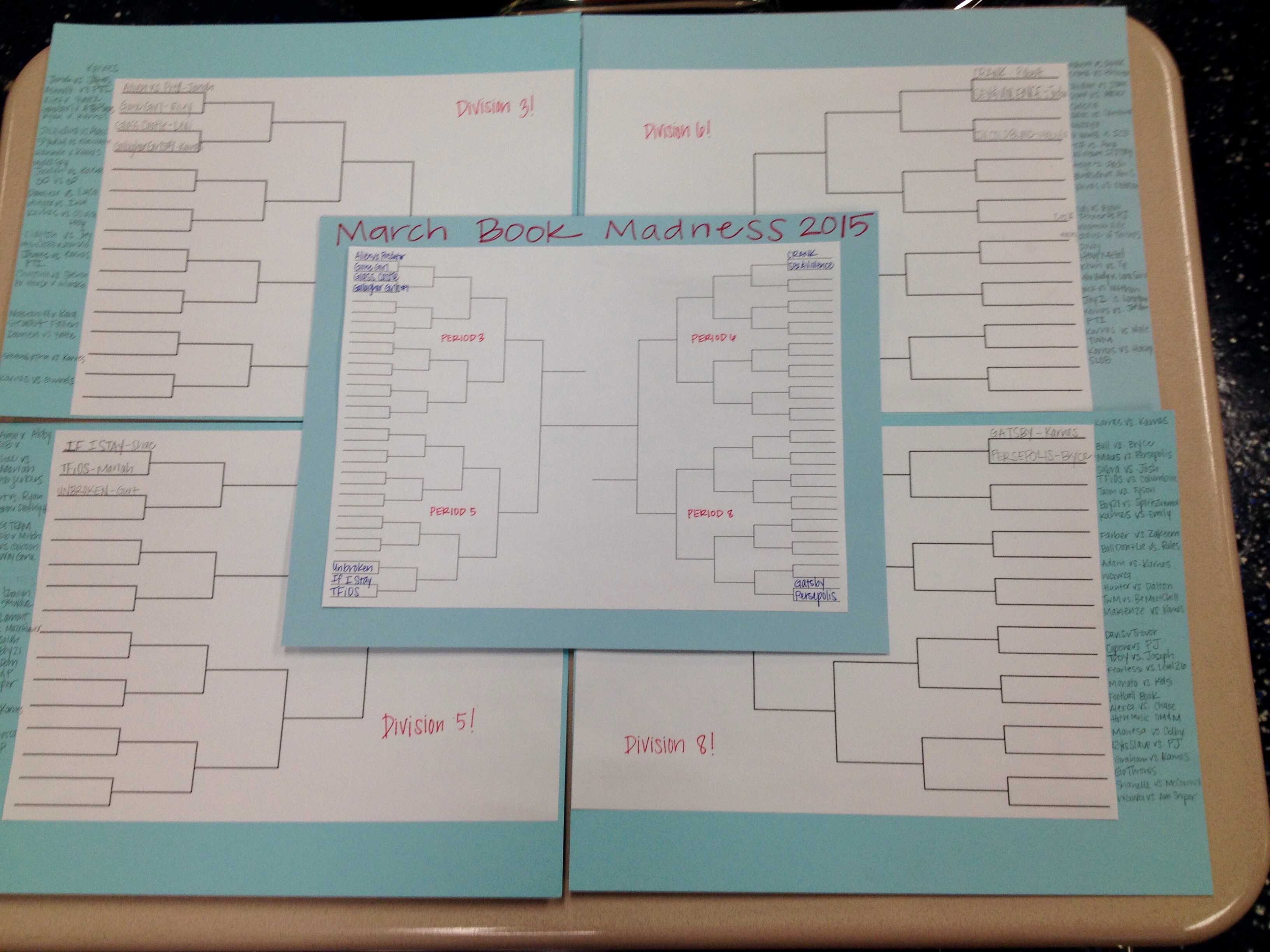
FullSizeRenderSo, because I want to shift the balance of not just grading from myself to my students, but also some of the teaching, I’ve turned to my own version of March Book Madness.  I heard about this competition from Tony Keefer’s Nerdy Book Club post, and I pitched it to kids, but they wanted to choose their own titles for the bracket.

So, blank brackets were printed, and to fill them, the guidelines were broad:  in each of my four English classes (which worked out well because they each get one corner of the bracket), students could choose a book and a partner to face off against.  Simple.

That was all I said, but as students began penciling in round one of the brackets, I was impressed mightily–they intuitively paired related books together, much like I do during booktalks.  Two boys in 8th period paired the excellent graphic novels Persepolis by Marjane Satrapi and Maus by Art Spiegelman.  Two girls in fifth period paired John Green’s The Fault in Our Stars and Gayle Forman’s If I Stay–two viral tearjerkers.  The Absolutely True Diary of a Part-Time Indian by Sherman Alexie will face off against Mexican White Boy by Matt de la Pena in sixth period.  And so on.

FullSizeRender (1)

Shae vs. Mariah in the Battle of the Tearjerkers…TFiOS vs. If I Stay

As book battles began, I laid out equally simple guidelines for voting.  Each student in a faceoff would give a short (1 minute) booktalk about their chosen text, and audience members could vote for one title based on any criteria–their own experience reading that book, the person’s booktalk, the presenter’s enthusiasm, the book’s stats on GoodReads behind the presenters, etc.

This modification to our daily routine–which is that students begin with reading, then hear my booktalks–has accomplished several wonderful things in our classroom.

First, students’ what to read lists, which had recently plateaued, are lengthening rapidly once more.  The sheer social capital of having a kid share his or her own reading experience of a book makes certain titles more tantalizing than I ever could.  Matthew Quick’s Sorta Like a Rock Star, for example, never quite flies off the shelves after I booktalk it.  It’s only after one or two kids read it and enthusiastically share it that it goes viral–and it does–year after year.  I see the same thing happening now during March Book Madness with lots of other books.  Kids are clamoring, suddenly, for several of the same titles.

FullSizeRender[1]Second, students are learning more about one another’s reading tastes.  They look at the brackets from other classes every day to see which books are advancing, and are sometimes surprised by who’s booktalking what.  “Huh…I didn’t know Jordan loved A.S. King too!”, I heard Hannah say yesterday.  “You read that book too!?  Wasn’t it awesome?!” Tyler said to Hunter, as he stood up with Ned Vizzini’s Be More Chill.  Despite my efforts to make their reading lives transparent with reading groups and notebook passes of book blogs, some of my larger classes haven’t quite unearthed the darkest corners of one another’s reading preferences.  MBM is fixing that quickly.

Third, this is not for a grade.  This is just a semi-structured celebration of books, with bragging rights as the purely intrinsic reward of the whole endeavor.  The five or so minutes we spend on this in class daily are a worthy time investment for the revelatory feel they bring to the start of our learning.  Kids are excited and upbeat after the two daily faceoffs, and excited to often add one or more of the four daily books discussed to their to-read lists.  The post-winter doldrums are quickly lifting…and the sunshine certainly isn’t hurting, either.

Is anyone else doing a version of March Book Madness?  How’s it going?  Please share in the comments!

Grading vs. Feedback

Let me be honest:  I hate grading.

Hate hate hate it.

I hate it, but you know what I love to do?  Read my students’ writing.  Talk to them about their reading.  Absorb the creative projects on display after they’ve completed a reading or writing unit.

So, if I love to listen to and read and wonder about their work, why do I hate to grade it?

The idea of reducing a piece of student work to a number, or assigning some arbitrary value to a reading conference, or trying to measure precisely the growth of a writer from one genre to the next is not only intimidating to me…it also seems a little ridiculous.  Unnecessary.  Trivial.  The beauty of a learner’s work is its creation, its completion, its courage.  It’s out there…for me to read, for their peers to see, for their creators to reflect on.

But, too many of my students only know how to think in numeric terms when trying to measure their own achievements.  Few are well-versed in knowing how to feel proud of finishing a tough book, or pleased with the revision of a piece of writing, or excited about the hard work that went into a project.  They don’t know how to authentically self-evaluate, because for years, they have relied too heavily upon someone else’s assessments of their work–mainly their teachers’.  I keep wondering how that’s fair.  I’ve had conversations recently with the lovely Amy about this, and Jackie wrote a great post about this same dilemma last October.

FullSizeRenderLast week, this tweet from the always-wonderful Kelly Gallagher helped to focus my wondering.  His words are not only true of writing, but of all other acts of learning as well.  A grade can’t improve a student’s skills.  Only feedback can do that–authentic, speedy, specific feedback.

So now, thanks to the combination of conversations with fellow teachers, Kelly’s words, and my own wondering, I know what I need to do.  I need to focus more on feedback and less on grading.  I know if I do less of the latter, I’ll free up time to do more of the former.

So, I’m pondering how to shift the balance.  I’d really like to return written drafts with my comments and questions, but no number or letter grade at the top.  I’d really like to have just one reading conferences without hearing the question, “what grade do I have in here?”  I’d really like for students to abandon the habit of looking to me for grades, and instead look within themselves to figure out how they’re doing.

Because I can’t entirely forsake grades altogether (we need to update our gradebook weekly), I’ll move my focus toward improving my feedback instead.  I’ll do this in three important ways:

During reading or writing conferences.  Until now, I’ve tried to stay fairly quiet during conferences in order to let my students do most of the talking.  Most of my talk is in the form of questions.  Now, I’ll shift to giving students more feedback–much more than the one or two statements I try to make at the end of a conference, which usually are to give suggestions about where to go in terms of goals and growth.  I’d like to comment more on my observations of students’ growth, strengths, weaknesses, and skills, so they can learn the language to begin evaluating themselves more effectively.

In writer’s notebooks.  Although I collect notebooks every two weeks, I don’t read everything my students write–I don’t have time, and shouldn’t–they should write much more than I could ever read.  Generally, I thumb through the pages, check that students have given a good faith effort in all of their various sections, and give a completion grade.  Now, I’d like for each student to flag one page in their notebook they’d like me to attend to–maybe a woefully short to-read list, a favorite quickwrite, or a particular reading reflection.  That way, they can decide what’s important to them, and I can give feedback accordingly…just comments and questions, mind you–without the pressure of a grade for reader or writer.

Through monthly “Meta Meetings.”  I’d like to sit down with each student about once a month and just have a whole-person conference…not a reading or writing conference.  Just a little checkup, to see how their brains and hearts are doing.  I adore alliteration, and I want these chats to encourage my students to be metacognitive…so I think I’ll title them Meta Meetings.  I’ll ask students a few questions about their strengths and weaknesses, and try to get to the heart of all the little bits of the language arts they’re curious about…strengthening their similes, or finding a system for keeping track of found vocab words, or writing metaphorical recipes (all questions I’ve had from students at random times).  I also think that during these meetings, I’ll get lots of awesome curricular ideas–what do my students want to learn how to do?  What things are they really wondering about that I might be able to help them discover?

What are your suggestions for improving feedback?  Shifting away from grades?  Providing more authentic evaluation?  Please share in the comments!