Tag Archives: Readers Writers Workshop

Good Writing Moves Us — THIS Writing Moves US

I want to include you in a celebration of the work of a student that represents several of my kids this year. If you teach, or have taught, ELL students, I know you will understand.

The last assignment was an intensive writing piece that we workshopped for about seven weeks. Writing in class almost daily, conferring regularly, and mini-lessons with mentor texts and modeling served as the routine. Students turned in their writing in three separate chunks, gave one another feedback at least three times, presented their final pieces (published on their personal blogs) as their semester exams. Formative assessments were student writing conferences and the checkpoints along the way. Summative assessments were a self-evaluation and a self-evaluation paired with my feedback from a rubric we crafted as a class.

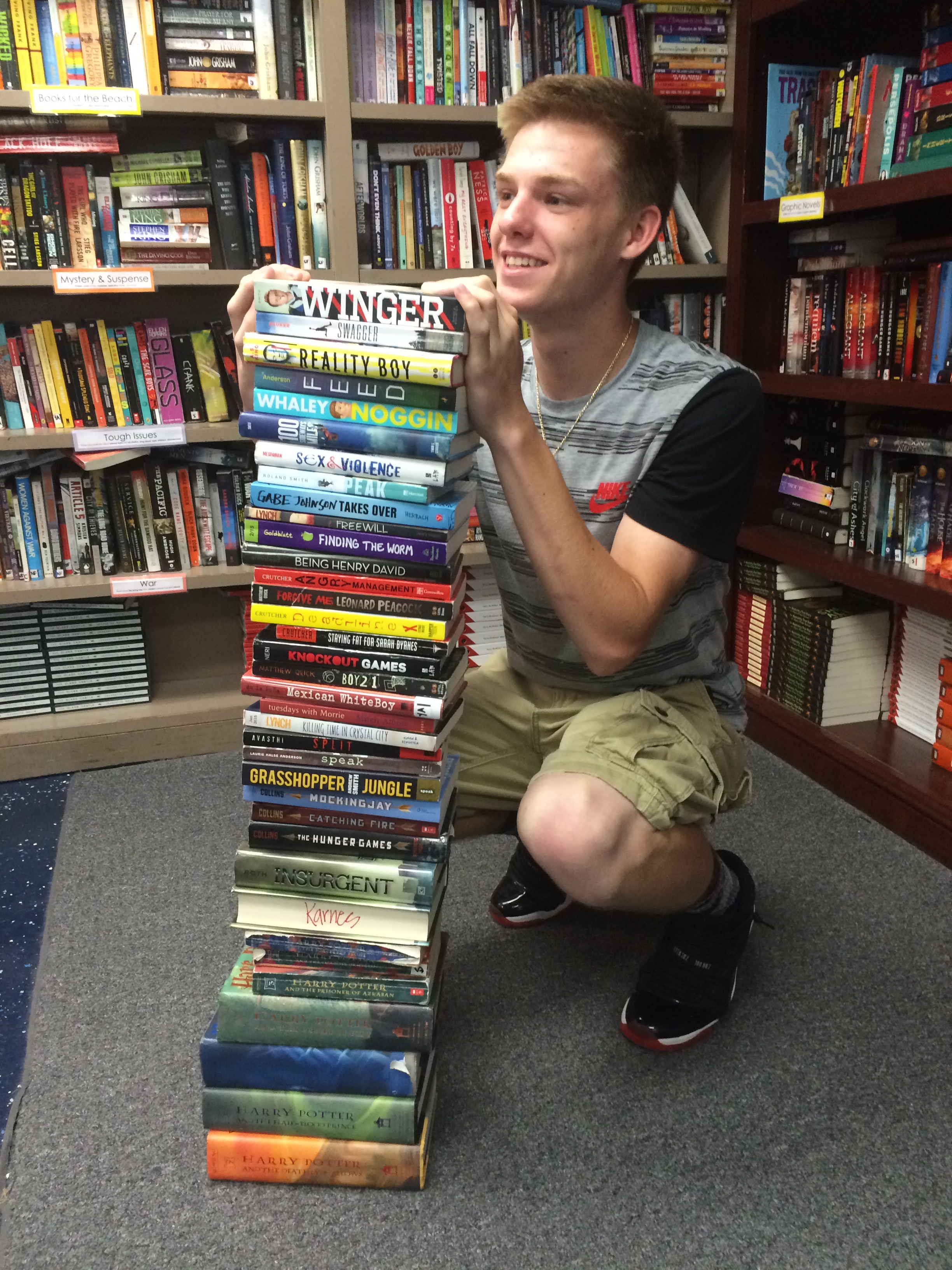
Biak with the book she loved the most this year. She read 12.

Please read the writing of Biak Par. The poems are original, and the story is her own. Just before school was out, I had to call Biak to my desk and let her know that she failed the state English II EOC. Again. That was nothing short of heartbreaking — for both of us.

Take several minutes and read Biak’s story. You will read the words of an improving and authentic writer. These words are elegant, poignant, and powerful. Good writing moves us — this writing moves us. 

Now, take a look at Biak’s writing from the beginning of the year— her first blog post is here, and her second is here.

Now, think about her end-of-year piece of writing. I know it is narrative, but you will note what I do — improvement. So much improvement. Voice, coherence, organization.

I wish I had another year with Biak, and several of her friends. We’ve come so far, and this is the work she should be allowed to celebrate — not a test score.

I know — preaching to the choir.

©Amy Rasmussen, 2011 – 2015

A Yearlong Community

The sense of camaraderie and fellowship in our workshop classroom has ebbed and flowed this year.  Some days, I watch with pride as the readers and writers in the room help guide each other to a higher level of understanding, appreciation, or excitement.  Other days, I see disengaged students annoyed with one another’s antics.

Getting this community established at the beginning of the year takes time, but once the foundation is laid, it’s easy to keep it in place.

…Until you have 15 snow days in a row.

Or a student teacher.

Or a six-day block of testing.

Or 75-degree weather with sunshine, just out the window.

All of those common interruptions can derail a classroom community.  This year, though, I feel as close to my students as ever, and they are as tight-knit a group as can be.  Here are four reasons why.

Passion.  I’ve written before about how fangirling helps create a community of readers.  But it’s not just being excited about books that helps a classroom community develop–it’s passion about the work we do here as a whole.

Jordan, a student who joined our class in September, told me yesterday, “I still remember the first time I came to this school.  Yours was the first class I came into.  You were yelling and all excited and stuff.  I thought, ‘Wow, is this how this school is?’  Then I went to the rest of my classes and I was like, awww, where’s the excitement at?”

The passion I brought to teaching stuck with Jordan for nine months, especially when he contrasted it to his other teachers’. Communicating our genuine excitement to our students models for them the lasting value of our content.  Without that enthusiasm, a classroom community may not seem worth building.  With it, students come to class ready to learn, which creates the first condition for a strong community.

Vulnerability.  Around my birthday in early September of each year, I share with my students a song my friend Joey wrote and recorded for me.  About a month after he gave it to me, he passed away.  I play the song for the students and we write, then, the soundtrack of our lives–which song it would be and why.  I write about Joey, my guilt and sadness over his suicide, how I slept with the lights on for months after his death.

Chelsea recently told me that at first, she wasn’t quite sure about me.  “Then you wrote that piece with us about your friend Joey, and that’s when I started to think differently about you.”  Modeling my vulnerability with my students encouraged them to do the same–they began to write about topics they once considered very private, and to share their writing in small groups, which I rotate monthly.

Sharing this story with my students, crafting and refining it alongside them, modeled for them not just vulnerability, but the writing process when it relates to a difficult subject.  I became, in their eyes, not just a model writer–but a model thinker, with emotions and difficult memories just like them.  Shifting from not just an English geek to a real human is the second condition for a strong community.

Guts.  This spring, I had a student teacher for eight weeks.  When she left, state testing began almost immediately.  After those two lengthy periods of disruption to our established routine, my students were sluggish and disinterested–frequently unprepared for class, slacking off on their reading, unenthused about their final multigenre projects.

Then, I shared with them my own multigenre piece for this year, about the miscarriage I suffered on Mother’s Day.  As I showed them my writing, the classroom became eerily quiet.  The stillness and silence was deafening.  After lots of hugging and passing around of tissues, the students worked with energy and reverence on their own writing once again.  Their enthusiasm was back.

“I thought it was cool that you would put that out there for the students to know,” Madison told me the next morning. “I was shocked that you wrote about it.”  The fact that I not only shared such a tough subject with them, but had the guts to write about it, was powerful.  This gave many students the boost of confidence they needed to confront a difficult issue and create beautiful writing about it–the third condition for keeping that sense of community strong right up to June.

DSC_7929

Two of my funniest students, Troy and Logan, smirk at me over lunch.

Humor.  We’re not morose all the time–we have lots of fun.  Whether it’s a humorous booktalk, a funny poem, or just a celebration of a student’s silliness, there is lots of laughter in our classroom.

A small whiteboard on one wall of our classroom is full of quotes that have made us laugh.  A word like “clementime” can crack us all up, remembering when Troy bemoaned the book Columbine‘s length but accidentally said, “Oh boy, Clementine, here we go.”  Or “overalls,” which calls to mind Kristen’s claim that “I woke up, put on my overalls, and everything just got really weird.”  These simple one-word phrases memorialized on the whiteboard can bring a smile to our faces when we need a lift, and remind me that my students aren’t just learners–they’re people, and pretty darn cool ones, too.

Talk.  Talk is such a foundation of workshop, but it’s important to talk outside of conferences, small groups, or minilessons.  Isaac, a student who has struggled with academic success in the past, has been sitting in my room during his lunch period all this month, working on his multigenre paper.  He chats at me as he writes, asking whatever questions come to mind, writing-related or not.  As a result, he is soaring.

“This is probably the first project in school I’ve ever worked this hard on,” Isaac keeps telling me. “This project is so awesome.”  I told our principal how hard he’d been working lately, and he complimented Isaac when he saw him in the hall.

“Oh my god, I can’t believe teachers talk about students outside of class!” Isaac exclaimed later.  I could tell by his little smile that he was secretly pleased that we had said nice things about him.  Talk has an impact far beyond its transient initial utterance.

Passion, vulnerability, guts, humor, and talk–all year long–make for a beautiful classroom community I’ll enjoy ending this year with.  What do you do to keep your learners unified?

What I Didn’t Teach This Year

The end of the year is upon us (finally!), and I’ve been reflecting as I always do.  This year, though, I’m thinking about something I’ve rarely considered before–not just what I taught, what worked, or what I want to do next year.  I’m thinking about all the things I didn’t teach this year.

There are 180 precious days in a school year, and the way my school is structured means I spend 90 days with each set of students.  That seems so fast.  There was no time to waste, so here’s what I didn’t fill that time with:

FullSizeRender

As Sabra stepped up for her reading ladder picture, she said, “This is pretty good for someone who didn’t finish a book until your class!”

Whole class novels.  This was a controversial choice for me, given that I love so many authors of American literature–Mark Twain, Walt Whitman, Nathaniel Hawthorne, etc.  But, no matter what novels I’ve chosen in the past, there’s always a student that book isn’t right for.  Fahrenheit 451, The Absolutely True Diary of a Part Time Indian, The Glass Castle, Maus–none of them is a perfect match for every child.  I’ve used a wide variety of strategies to get students to be able to read those books, and every ounce of passion I can muster to get them to want to read those books, but still–students have been conditioned to not read, to just get on SparkNotes, or ask an older sibling, or use Wikipedia.  When the stacks of matching novels come out, groans abound and engagement tangibly disappears.  I’ve seen this.  I’ve battled it.  No more.

So, I scratched whole class novels altogether.  Students worked in book club groups twice, and engaged in independent reading challenges two other times.  We read tons of short stories, articles, essays, and middle-length writings together.  But we didn’t read a single whole-class novel, and my readers still thrived.

IMG_8294

“I found myself as a reader this year,” Jordan writes.

Did my students grow as readers this year?  Yes.  I watched students who hated reading come to love it.  I watched students who couldn’t read well at all increase their stamina, passion, and skills related to reading.  I watched students who were good readers but bored with books fall in love with nonfiction, poetry, graphic novels, or award winners as they discovered new genres.  I watched students who loved to read flourish and challenge themselves with complex texts and childhood favorites alike.  Most of all, I watched a community of real readers spring up in my classroom–students recommending books to one another, self-selecting books and keeping long to-read lists, telling me all about their finds at Barnes & Noble.  These readers have become truly independent.  “Now,” Taylor writes, “I think I can read anything that’s put in front of me…and enjoy it.”

FullSizeRender

Isaac performs a poem for Nathan on poem-in-your-pocket day.

A movie.  As I’ve walked the halls this last week or so, I hear the unmistakeable sounds of cinema from behind closed classroom doors and darkened rooms.  I have no doubt that students are watching relevant films–movie adaptations of Romeo and Juliet in English, Forrest Gump in History, etc.  But this year, I felt I had absolutely no extra time…there was SO MUCH I wanted to do!  I used to love showing O Brother Where Art Thou with The Odyssey, and my students really delved into the symbolism of both texts.  But this year, my SmartBoard was full of YouTube videos, slam poets, or the still, quiet images of a document camera showing some writing.

I didn’t have time to show a movie, but I also wasn’t pressured by the crush of hours of grading that usually prompted me to show films in the past.  I’ve taken Kelly Gallagher’s rule about student work to heart–students should be doing four times as much reading and writing as we could ever grade.  So, I’ve read and responded to about a quarter of my students’ work, and let self-evaluations, peer conferences, and notebook passes do the rest.

Most of what I taught last year.  Last year was great, don’t get me wrong–but this year, my students were a new batch.  They’re different kids than last year’s group, so the same things won’t work for them.  After seven years in teaching, I know that.  I didn’t waste time trying to figure that out…I just started fresh.  I know I’ll do the same thing next year…out with the old, and in with the new.

IMG_0054

Shailyn read almost all of my YA fiction, and wrote reviews about nearly every book for our school newspaper.

Tests or formal essays.  Tom Romano likes to call the typical English essay a “five-paragraph you-know-what,” and it truly is a dirty little assignment.  At an NWP workshop I attended, each teacher was asked to bring some samples of student writing.  All around me emerged typed, double-spaced, Times New Roman, size 12, thesis-at-the-end-of-the-first-paragraph essays.  From my own bag came photocopies of messy scrawls in notebooks, multimedia This I Believes, strongly-voiced commentaries, poetic musings developed from quickwrites, and lengthy, involved, multigenre research papers.  No two pieces looked alike, and they certainly looked nothing like most other teachers’ samples.

I’d be lying if I said I didn’t feel a faint nostalgia for my own high school days, when I took pride in being able to punch out a perfectly formatted five paragraph essay in just under an hour, and which made absolutely no sense but looked great, and which constantly netted me As.  But I listened to my neighbors rant about poorly integrated in-text citations and incoherent thesis statements, I dismissed that nostalgia and read my own students’ work for what truly matters–good writing, heart and soul on a page, and authenticity at work.  As my husband said when he saw me dwarfed behind a pile of multigenre papers to grade, “I could read some of those for you.” “You wouldn’t know what to look for,” I said.

“Good writing is just good writing,” he replied, and he is right.  As the year ends, my students are good writers and good readers–not all of them are great, and there are kids I feel I could’ve pushed harder, but all are certainly better than they were when the year began.  I’ll look forward to our last day of class, when I’ll gift them each a new composition notebook and a pile of classroom library books to read over summer…and to months beyond, when I get to hear their stories of summer literacy in the fall.

Resources to Make Your Move to Readers and Writers Workshop

When you believe in the power of the workshop classroom, research that supports it starts jumping at you like my dog when he sees me put on my running shoes. “Okay, Jag, give me a second. You can go with me.”

So when educators ask me for resources that support my Readers and Writers Workshop instruction, I am happy to share. Come, go with me — and bring all of your students!

Of course, a pretty good resource is Three Teachers Talk, right? The four of us who write here all practice this pedagogy in our unique classrooms in WV, NH, NY, and TX respectively. Erika wrote a great post of our Year in Review that reads like a highlight reel.

Of course, we have different teaching styles, but we all value specific things that never change in our practice:  choice, time, talking, reading, writing, conferring, modeling, sharing, publishing. I wrote about these 7 Moves in My Workshop Schedule recently.

Our presentation at NCTE last fall was all about starting and maintaining workshop in high school English classes. Jackie shared A Reader’s Workshop Starter Kit to Jumpstart the Process. Erika shared Landscape of Workshop: We Have Arrived. Shana shared Non-negotiables Across the Landscape of Workshop. And I shared The Landscape of Workshop in AP English.  (Our proposal for 2016 was not accepted, but we are mostly over the bitter and will keep advocating for RWW every chance we get.)

If you need research to back the why of readers and writers workshop in addition to what we might share in our posts, you might start with Donalyn Miller’s blog post: “I’ve Got Research. Yes, I Do. I’ve Got Research. How About You?” — Donalyn shares a list of articles and books that support why readers workshop is the best pedagogy for all students.

My colleagues and I believe the best book for secondary readers workshop is Book Love by Penny Kittle. Her argument for independent, choice reading resonated with me the moment I read it.

Donalyn Miller’s the Book Whisperer is another great resource for readers workshop. Although Donalyn taught middle school, many of the ideas she shares work with my AP English Language and Composition students.

For writers workshop, Write Beside Them, also by Penny, is my favorite. That is the book that changed me as an educator.

Another excellent resource for writers workshop is Learning Through Teaching by Don Murray. This is the most recent book Penny recommended to me to help with my own writing. Oh, boy, is it helping!

So, yes, please ask for resources. And if you are already a workshop believer, please share them. Every student I know will thank you.

Do you have resources you share that we might find valuable here at TTT? Please leave your thoughts in the comments.

Book Clubs in AP English: Just let them talk

Some of it was great. Some of it not so much. I’m talking about the book clubs in my classroom this Screen Shot 2015-05-02 at 5.42.03 PMyear. The great was actually my students reading and talking to one another about that reading. The not so much — the way I did assessment.

This is what I learned and what I will change for next year:

Book Clubs serve as a way to challenge my readers into the more complex books that many of my students would never choose for themselves. Book Clubs also allow my readers to talk about books in an authentic way without the strictures of guided reading questions or anything else that might lead to Readicide. (‘Read-i-cide: noun, the systematic killing of the love of reading, often exacerbated by the inane, mind-numbing practices found in schools” –Kelly Gallagher) I wrote about the importance of balance literacy and how book clubs fit into that in this post.

I provide a short list of titles that I know contain fantastic stories of resilience, survival, hope, courage, and any other trait that prods readers to relate to the human experience. I introduce the books, usually with book trailers or video interviews of the author’s, and I include either on paper or a projected slide the synopsis and ratings from Goodreads or Amazon.

Students select their books, often talking with one another and making selections together. I ask students to purchase their own books, so they can annotate anything “interesting, intriguing, puzzling, contradictory, or you just plain do not understand.” Since most of my students come from less affluent families, we talk about the importance of libraries and surrounding ourselves with texts that can inform and influence our thinking. Often, students will purchase more than one of the books I introduce for book clubs. I also have a few copies of the texts in my room that students may check out if they cannot purchase their own. I always think my copies will be used more than they are, but I’ve learned that my readers like to buy books. Most feel the sense of ownership that I want them to feel.

Our first book club this year, I gave students a choice of the following titles, all centered around themes of family and parents and how they influence our upbringing and our choices:

Extremely Loud and Incredibly Close by Jonathan Safron Foer

Swamplandia by Karen Russell

The Curious Incident of the Dog in the Night Time by Mark Haddon

Girlchild by Tupelo Hassman

The Glass Castle by Jeanette Walls (literary non-fiction)

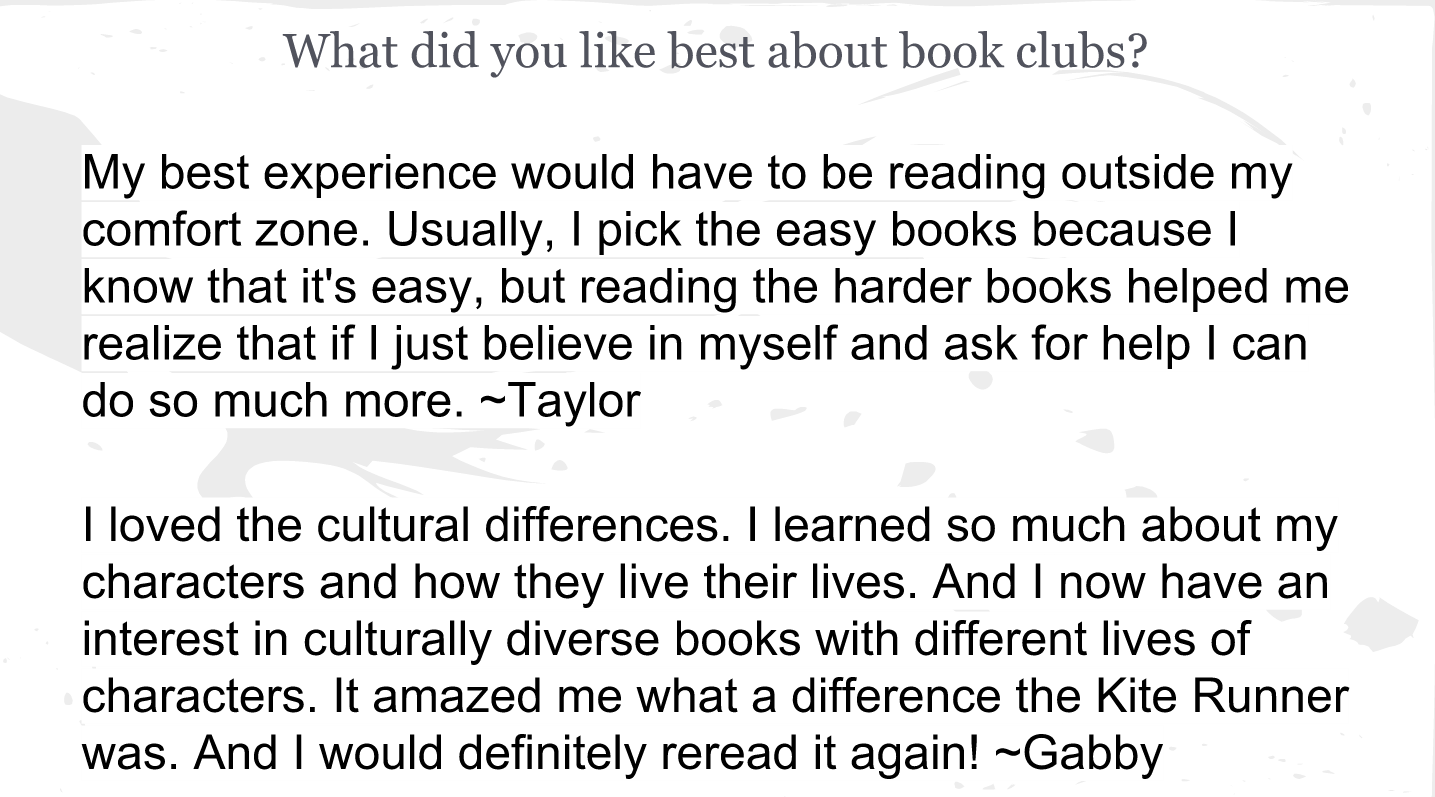
More students read The Glass Castle than any of the others, but every book was represented in at least one book club of three to six students. Students loved The Glass Castle, and they told me that they could relate to much of Walls’ upbringing.

Screen Shot 2015-05-02 at 5.42.19 PMAssessment:  For this first book club, I asked students to read with an eye looking for theme. They would work with their book clubs to craft a mind map that included numerous quotes from the book that contributed to the theme, and they would analyze these quotes as part of the mind map. They could create the mind map as a paper poster or online. As they read the book, they were to mark the text like I had taught with the short passages of text we’d read together in class, and they were to also look for sentences and phrases and passage that pointed to theme.

My students did not have a clue how to do that. Most did not mark their books, so when the project time rolled around, they ended up scouring through the book or searching for quotes on Goodreads or elsewhere to find enough quotes that they could plop into their mind maps. I needed to provide more guidance in annotating, and in reading for beautiful sentences, and in making thematic connections, and so much more.

Also, I allowed students to work in groups to create their mind maps. This did not work because no one in the group would rise up and be the leader. They were new in the class and new in their friendships with one another. Group work is a topic for another post, really. This time it failed, and I’ll need to do a lot more prep work before I spend as much class time on this kind of project ever again (if I ever do).

Our second book club, students choice a title from this short list, all centered around themes of culture and how these cultures influence us:

The Namesake by Jhumpa Lahiri

Little Bee by Chris Cleeve

Sarah’s Key by Tatiana de Rosnay

The Kite Runner by Khaled Hosseini

A Thousand Splendid Suns by Klaled Hosseini

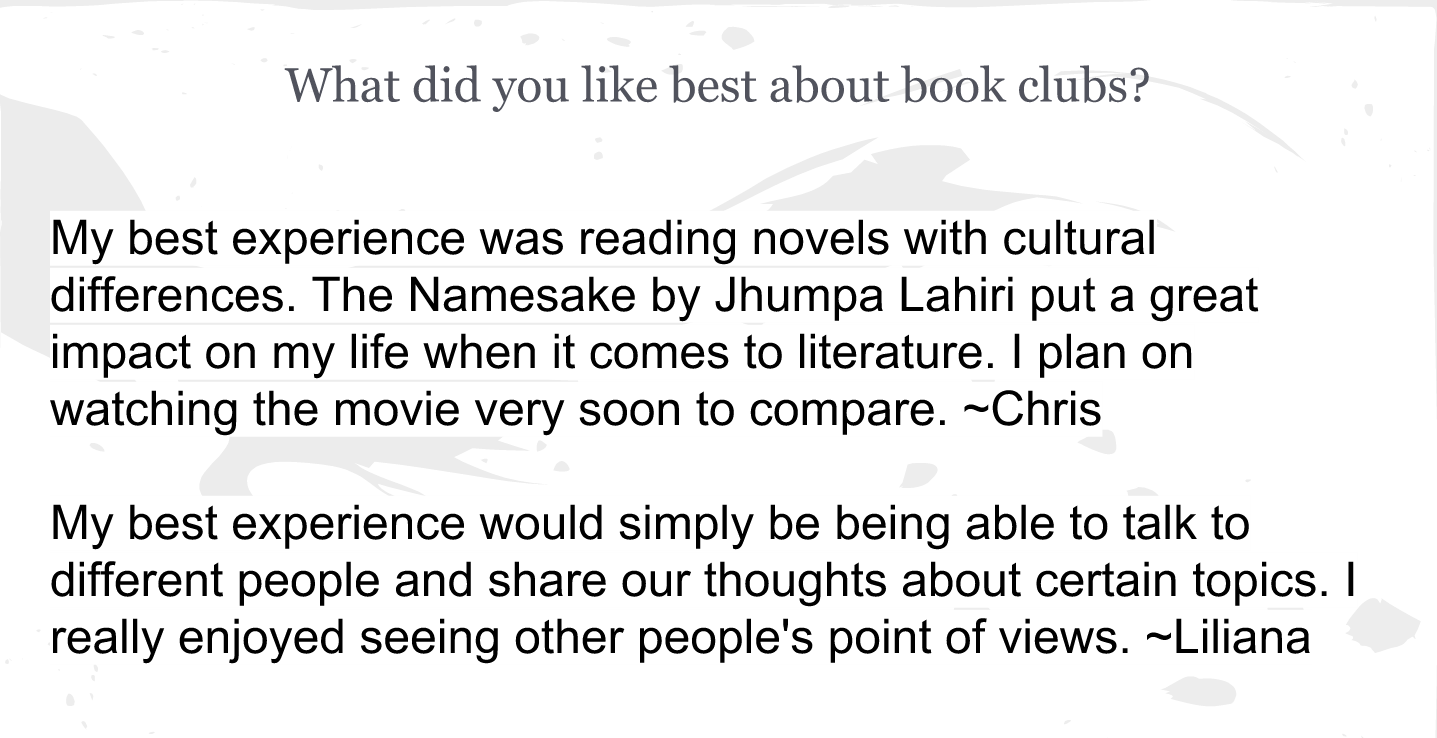
More readers chose Sarah’s Key than any of the others. Students find stories of the Holocaust fascinating, and that shelf is a popular one in my classroom library. (Erika’s, too.)  Many students read The Namesake, and at least one book club read each of the others.

Assessment:  This one was even more lame than the first. Sometimes I feel the pull to get back to a Screen Shot 2015-05-02 at 5.42.33 PMmore traditional pedagogy. I am the only one on my campus who fully implements readers and writers workshop, so I listen in often to what other teachers have their students do. If you teach AP English, at some point, you have probably had students write a hexagonal writing over a piece of literature. (Hexagonal because student write thinking about their knowledge, comprehension, application, analysis, synthesis, and evaluation as it relates to the book. It sounds like a great assignment.)
It was the worst writing my students completed this year — if they completed it at all.

I know why. There was no authenticity in it. Follow the structure I gave you. Each paragraph should be about this… No wonder they didn’t care about writing well. I was their only audience, and I was making them write something worse than a book report.

We wasted a lot of time. (The grading policy in my district requires that I reassess major grades. Hey, let’s write this paper again since you cared so much about it the first time. Right.)
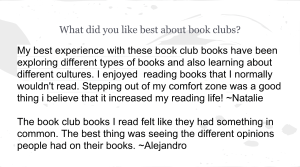
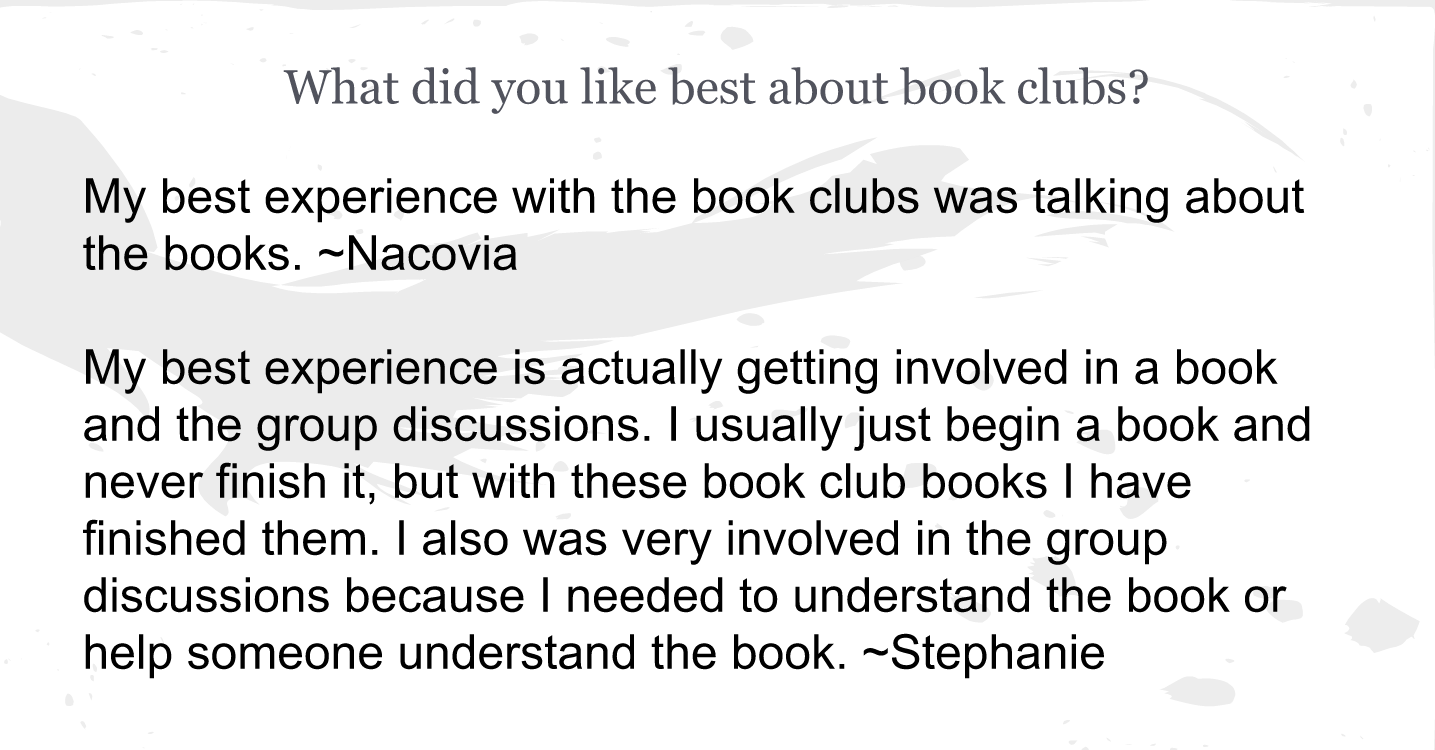
Screen Shot 2015-05-02 at 5.42.45 PMMy readers would have benefitted more from a gift of time to talk about the books more. Shana posted about the value of book clubs for talk earlier this year, and after two subpar experiences I began to agree:  “asking students to keep the conversation [about their books] going for 20 straight minutes provides valuable time for students to build relationships [around conversations about their reading.]”

I would just let them talk.

Our third book club students selected titles from this short list, all centered on war (or internal war) and its influences on individuals and humanity:

The Yellow Birds by Kevin Powers

Room by Emma Donoghue

Where Men Win Glory by Jon Krakauer (literary non-fiction)

The Bell Jar by Sylvia Plath

The Things They Carried by Tim O’Brien

The majority of my readers chose to read ROOM or The Bell Jar. They loved Room, and didn’t think The Bell Jar lived up to its hype.

I scheduled more opportunities for students to talk about their books. I wandered the room, sitting at Screen Shot 2015-05-02 at 5.42.57 PMgroups and listening in as conversations circled in and out and back again. Often, I placed a stack of TableTopic cards for book clubs in the center of their table, and students used these to guide their discussions. (Looks like the book clubs version of TableTopics is no longer available. Sad.)

Next year, I will do this again. I might ask students to look for significant passages so they can practice analysis on a page they select for themselves. Here’s a post that I’ll probably show them with a sample passage for craft study.

I might have them create a found poem or a black out poem.

Or I might just let them read and talk and read and talk some more.

That’s what I do in my own book club.


If you have your own suggestions for improvement, please share them in the comments.


©Amy Rasmussen, 2011 – 2015

Okay, I Will Share My AP Testing Data

A new friend asked me if I would share any AP testing data that I’ve gathered since embracing Readers and Writers Workshop. I had to think about it since I rarely think about it. I do appreciate the question though because it led to this post.

I need to tell you right up front:  While I appreciate the AP exam as a high-stakes test, I do not lay a lot of value on testing data for many reasons.

So many factors figure into how a group of students tests each year, and looking at figures from one year to the next, and trying to compare numbers with different groups of students has never made sense to me. The only real valid data is the growth I measure from the fall when students walk into my door until they leave me in the spring. However, I can tell you that the first year I implemented Readers and Writers Workshop and gave up whole class novels in favor of encouraging students to read books of their choice and taught skills with short, sophisticated, complex texts, my students’ scores were 12% higher than my students’ scores the year before.

The best I can do to respond to your question is to quote Stephen Krashen in the article “Free Reading:”  “. . .research strongly suggests that free reading is the source of our reading prowess and much of our vocabulary and spelling development, as well as our ability to understand sophisticated phrases and write coherent prose. The secret of its effectiveness is simple: children become better readers by reading.”

And…  “Research has . . .shown that SSR is at least as effective as conventional teaching methods in helping children acquire those aspects of reading that are measured by standardized tests, and pleasure reading provides a great deal that these tests don’t measure.”

The first two years I taught AP, I tried to do it like I learned at my APSI. I assigned the traditional novels taught in American literature: The Scarlet Letter, Huckleberry Finn, The Great Gatsby, The Awakening, The Grapes of Wrath — because the other AP teacher on my campus did. I can tell you, my students did not read. They even told me later that they didn’t — lots of joking about that on Facebook a few years after they left me. They knew how to play the fake-reading game perfectly.

I know Krashen’s research centers on much younger grades than our students in AP English; however, reading is reading, and students gain skills by doing it — skills that improve their lives far beyond those tested on one day in May as they sit for the AP English exam.

My students just wrote end-of-year reading evaluations on their blogs. Here’s a few of the highlights about reading this year in their own words. This is the kind of data I value:

“Being apart of a reading community has benefited me deeply within my entire life. Even though I didn’t read as much as I wanted to, the reading that I did do was very beneficial. Reading helped me expand my vocabulary a lot. Sometimes when I would speak to my mom I would use a word that I learned from the book I was reading and she would just look at me like she didn’t know who I was. Reading also helped me become a better writer. So many different books that I read helped me use different structures, understand how to use rhetorical devices, and use my upper level vocabulary.”  DeDe, currently reading Thirteen Reasons Why by Jay Asher

“Being part of a reading community as a student opened my mind how others thought of the book we were currently reading together. Occasionally, I’m an ostrich that’s always in the ground; thoughts to myself, ideas to myself, and the “this is what this means” mentality. I’ve slowly learned how to use the point of view of others by implementing it into my own work. In addition, this year’s English class did not feel like a burden compared to previous years. The freedom of choice we were given provided us with the decision to pick a book we enjoyed.” Doreen, currently reading The Goldfinch by Donna Tartt

“I believe the place I need to improve as a reader is being able to find the hidden meanings or putting everything together in order for me to understand a book. Sometimes without me noticing I just read to read and I forget what I read and have to read the paragraph or page again in order for me to understand it. I need to read and take everything under consideration and understand what it is that I’m reading and at the end put it back together. Maybe my problem is that I try to read too fast.” Johnny, currently reading The Alex Crow by Andrew Smith

“Being part of a reading community benefited me because I always felt like I needed to be reading a book. It felt splendid being a part of something, especially something I would of never thought I would be a part of.  I understood the importance of reading. The more you read, the better writer you will become. I realized what genre of books I liked and which ones I didn’t. Most importantly I explored a different variety of books and read a minimum of 12 books. Something I had never done before. Usually I would read a minimum of 3 books every year.” Lizbeth, currently reading Playing Dead byJulia Heaberlin

“My journey began with Escape From Camp 14. I moved through different genres and difficulty levels thereafter: Anna and the French kiss, Allegiant, High School Bites, The Glass Castle, The Curious Incident of the Dog in the Night-Time, Where’d You Go Bernadettte, The Art of Secrets, The Hot Zone, Little Bee, The Joy Luck Club, Down the Rabbit Hole, Room, Incendiary, The Wright 3, and most recently, Y. During this time, I abandoned The Kite Runner, The Thirteenth Tale, Ready Player One, Saving Fish From Drowning, Telegraph Avenue, and Station Eleven.   Even I find it odd, that out of the entire list, I enjoyed The Joy Luck Club more than any other. I say this because I’m not the patient type- I like constant action, fueled excitement. The Joy Luck Club almost counters that expectation, and if I had to describe it, I might even consider calling it boring.” Nawoon, currently choosing — just abandoned Station Eleven

This evaluation by Jasmine is too good to not share the whole of it. And this one by Shaniqua.

I just need to share one more thing, a little gift I got today as I read student reading evaluations. I know most teachers get these at one time or another.

It is the thing that keeps us going.

Laura wrote:

“I still need to improve on not judging a book by it’s cover. For us to GROW as people, we must get out of our COMFORT ZONE and pick up a shattered book because it needs someone to appreciate it’s language. As much as reading conference were sometimes nerve wrecking for me, they helped me get a second opinion on my progress in class as a human and not merely as a student. I can never thank Mrs. Rasmussen enough for dedicating chunks of her life to her students. Positivity in a world were criticism is many people’s issue is so rare and pure. She truly cares about each of us and sees past our struggles and attitudes and tries her best to help us understand it’s okay to have emotions and display them for others to see.  I’ve learned it’s more important to turn our conflicts into beautiful gifts instead of becoming a bitter person.”

Don’t you think that is better than any testing data?

©Amy Rasmussen, 2011 – 2015


Our Year-In-Review

As we round out the 2014-2015 academic school year, I would like share our Year-In-Review from us here at TTT and dedicate it to all of our loyal and contributing teacher friends who share in our experiences throughout the year.  Playing with the Reading Writing Workshop model is always exhilarating and fresh and exciting and freeing and thought-provoking.  It’s always propelling us, as educators, to break through barriers and teach with our most authentic teaching souls.

So, to capture the essence of how we have all explored the model this school year; here are highlights that allow us to celebrate the risks, the questions, the stumbles, the ‘ah-ha’s, the setbacks, and of course…the successes.  As we are all still progressing through this last month of our current school year, we hope that resurfacing some of our favorite moments will ignite the fire that keeps us all educating with fierce passion, deep inquiry, and continual evolution.

The calm zen of the RWW in Texas.

The calm zen of the RWW in TX.

First up: The lovely Amy Rasmussen who never ceases to amaze all of us with her wit, wisdom, and wildly insightful thinking.  Here is a woman who has taken the RWW by storm and has not looked back; the only time she does is to pick up, dust off, and gently guide those who are trying to find their way through the process.  She is an excellent mentor and extraordinary educator who ensures that her Advanced Placement students are gifted the wonders of the RWW. Here is a collection of how Amy has guided us through the intricacies of customizing the RWW for our own learners:

A Feedback Protocol for Revision Workshop

5 Reasons Why Reading Conferences Matter — Especially in High School English

5 Ways to Enjoy the Last Month of School


A reminder of student movement and achievement.

A reminder of student movement and achievement in NH.

Next: Jackie Catcher’s name could not be more appropriate.  We know the catcher’s responsibility on the field is to guide the team to strategic success; Jackie does the same infield – in her classroom. She moves her students with her unyielding dedication through continual infused literacy by craftily customizing projects and lessons that engage students. She is a powerhouse who, through all the struggles and obstacles of a second year educator, never ceases to find innovative ways to educate and inspire.  Most importantly, she is always a learner first and shares her inquiry with others to not only think collectively, but to create success-driven solutions.  Here is some of her story:

Building My Library Around My Students

Unraveling the Mystery of Poetry

The Question That Changes My Students’ Writing


A bright and energetic learning environment in WV.

A bright and energetic learning environment in WV.

Thirdly: The always-invigorating Shana Karnes. Shana is a shining light to her students, yet her light shines brightly for the world of evolving educators as well.  She is open to sharing her passion, her innovative thinking, and the way she creatively customizes the RWW for her students in the throws of West Virginia.  Shana never loses sight of how vital piles and piles of literature are for the growth of her young readers and emerging writers.  She knows how to roll up her sleeves and do the work right beside her scholars.  It is through the sheer joy of all things literacy, that Shana explores the world of the RWW:

We Learn Facts from Fiction

Teach Readers, Not Books: A Case for Choice Reading in ALL Classes

The Value of Talk


The shelves where our identities are qualified, our ideas solidified, and our passion realized.

The shelves where our identities are qualified, our ideas solidified, and our passions realized in NY.

Rounding it out: Erika Bogdany.  Through the RWW I have challenged my students, and they in turn, have challenged me.  They push me continually with their own inquiries and want to be more fluid writers.  They challenge my writing by offering suggestions and insight that I have bestowed upon them; the gift of creating a safe community for all learners to read, write, risk, and share.  It is through the RWW that students find pride in their work, volume in their voice, crafted secrets in their writing, and beauty in themselves.  It is with passion and grace that students flutter and flop; yet learn how to fly:

All it Takes is a Tutu and Some Focus

Beyond These Four Walls

Today We Draw


We hope that our moment of reflection and celebration continues to provide you ideas and inspiration throughout the remaining time you have with your unique readers and writers this year.  We’d love to continue hearing your voices, feedback, and generous insight while we round out this school year…and look forward to the year ahead!

7 Moves in My Workshop Schedule

Quite often teachers ask me what the daily schedule looks like in my workshop classroom.

This is a hard one. I think mainly because it is not about the schedule as much as it is about the routines, or manners, we start putting into place at the beginning of the school year.

I’ve had a lot of adapting to do this year. Moving to a new school and adjusting my lessons to fit 85 minute class periods where I see my students twice a week for sure and every other Friday — sometimes. This is quite a change from 50 minute class periods where I saw my students five days a week.

Our normal routines  — and these are non-negotiables that make workshop work — consist of reading, conferring with readers, talking about books, writing in our notebooks, revising in our notebooks, sharing a bit of our writing, and learning or reinforcing a skill, then….it all depends on our workshop task. That’s why writing about my daily schedule is hard.

Here’s the best I can do without going into a long explanation — that has to wait for my book (Penny keeps telling me that my book will never get written if I keep writing on this blog, and I know she is right. Only so much time.)

READ — 10 to 15 minutes. This is sacred and silent reading time. Students choose books that interest them. I CONFER with my readers, always with a specific focus, depending on my reader.

TALK about books. Sometimes I do a book talk, reading a few pages of the book, or holding a book interview like Erika does. Sometimes a student does a book talk, if I’ve talked to her first and know she’s passionate about the book she’s just read. Sometimes I ask my students to just talk about the books they are reading. Shana wrote about the Value of Talk, and I agree completely: “Talk is one of the most valuable tools at work in my classroom.”

WRITE in our writer’s notebooks. Everyday we need to have our students thinking on paper. When I forget, or think we do not have time, to open our notebooks and write — in response to a poem, or a video, or a story, or about the book students are reading, or about whatever — I regret it. Discussions are richer when we write first. Discoveries are more insightful when we write first. Writing is better when we write, just thinking about our ideas, first.

Then, something I learned from Penny Kittle, we always read what we wrote and REVISE. Penny modeled revising with a different color, and I ask my writers to do the same. I simply say, “Read over what you just wrote. How can you make your writing better? Maybe add a phrase or two that develops your thinking more. Maybe change a word or two that adds a punch. Maybe you can remove some words and make your thinking more concise. Where can you add figurative language or a list or an interesting style move?” (When I check writer’s notebooks, I always look for evidence of revision. We work on establishing the habit of revision, daily.)

SHARE some of our thinking. Sometimes we pair up and read our writing to a shoulder partners. Sometimes I ask for volunteers to share out their writing. Sometimes I randomly call on someone (and I usually allow them to opt out at least once if they are uncomfortable reading aloud). Sharing is an important part of our community, and from the first day of school we work on establishing a safe and respectful environment where we can all grow as readers and writers.

Learn or reinforce a skill via MINI-LESSON. (If I introduce something totally new, like one of the AP English Language exam prompts, obviously the mini-lesson will not be so mini. On these days, the mini-lesson time and the workshop time allotment swap places. Sometimes I need the focused direct instruction time because it saves time in the long run.)

Our routines usually take about 35 to 45 minutes. That leaves us about half the class period to hold a workshop. This might be a readers workshop if we are practicing close reading or if we are preparing for a Harkness discussion. This might be a writers workshop if we are composing a piece of writing or studying the moves of a favorite author.

Of course, if we are writing, I change my hat and confer with my writers.

I would love to know the workshop routines you establish with your readers and writers. Please share in the comments.

©Amy Rasmussen, 2011 – 2015


Why Assignment Sheets Might Be Killing Your Students’ Writing

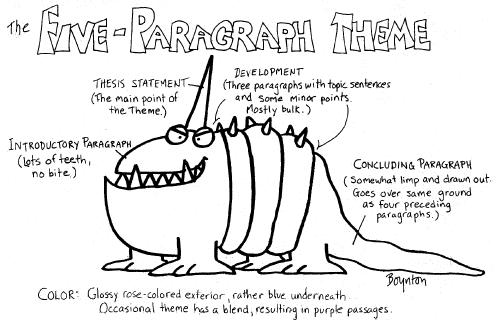
58090ec056811830ee936030edb1c9dbMy first year of teaching, I didn’t realize that the “five-paragraph essay” was a dirty phrase. My  internship year I painstakingly dragged my freshmen through the essay outlining process, watching them regurgitate homogeneous essays about symbolism in Lord of the Flies. At the end of our six-week study of the book, I slogged through 25 nearly identical essays, all of which had eloquent yet oddly familiar intro, body, and conclusion paragraphs. I’ll readily admit that despite the dull content, I felt victorious. My students had completed literary analysis essays and I had taught the foundation of essay structures.

It was that summer that my perception on structured essays changed. Two days into taking Penny Kittle’s writing course at the University of New Hampshire’s Literacy Institute, I realized that I had committed a cardinal sin of workshop teachers. Admitting to teaching the five-paragraph essay (let alone the sandwich method of paragraph-writing) was like confessing to enjoying McDonald’s burgers at an elegant chophouse: the cut (or concoction) of meat might serve the same purpose, to fill me up, but the quality was quite different. In turn, I was feeding my students homogeneous writing, a detailed equation to a subject that couldn’t be distilled down to simple mathematics. If I expected greatness, I needed to break beyond the boundaries of such a restrictive form of writing. After all, an introduction + body paragraphs + conclusion didn’t guarantee a solid essay; if anything, it guaranteed an entirely unspectacular essay.

This process of digesting the material and then providing a summary of the structure was far too easy for students. Not only did it place the onus on me to provide a set guide of instructions, but it also required me to complete the majority of analysis. Instead of my students engaging with the text and delving into the intricacies of structure and craft through individual exploration and group discussions, I was basically pre-digesting the material before offering it to them.

IMG_1845

Students analyzing an author’s craft in front of the class.

This year I have made a point to wean my students, particularly my juniors and seniors, off the assignment outlines they so desperately desire. Instead, my students now receive a half-page sheet simply telling them the type of essay they are writing (cause and effect, definition, personal narrative, etc.), the mentor texts they may refer back to, the page length requirement, and the due date.

Initially, they were frustrated with this format. As one student said during our career building unit in which we practiced writing cover letters and resumes for celebrities, “Ms. Catcher, do you have an assignment sheet for this or something?” When I pointed out the paper I had given to him previously, he replied, “No, I mean something that tells me how to write this paper.” We discussed the numerous mentor texts we had read and dissected and how these as well as our class discussions ultimately provided the basis we to develop our pieces. As a class, we asked questions of the text and author, starting broad by looking at the overall tone, voice, structure, intended audience, and progression of the piece. Then, independently or within small groups, we delved into more of the intricacies—what examples were provided, word choice, sentence structure, punctuation, and transitions. Students have gradually learned that there is no set solution for getting an A, which also means that they are forced to read and reread mentor texts to gain a firm understanding of a piece’s intricacies.

My problem from the beginning was that I was too busy telling my students how to write an essay to allow them to discover the messy albeit enlightening connection between reading, writing, and modeling. As we complete the last six weeks of school, I have noticed a significant difference in the structure and craft of my students’ work. They are relying more readily on mentors to help guide them in their process, and I can see both their group and independent analysis directly translate into their writing. For the past three years, I have harped on my students about showing rather than telling, but as the year comes to a close, I can finally say that I have internalized my own advice when it comes to my teaching.

How do you inspire students to rely on mentor texts instead of assignment sheets?  What steps have you taken throughout the year to make them more independent and confident writers?

Reflection, Rejuvenation, Rebirth

May and June always bring sunnier skies, feistier students, and more hopeful days.  Like Amy, I enjoy the last weeks of school, and often spend many of them feeling proud of my students, making big plans for the next year, and reading a ton in order to ramp up my booktalks.  This time of year is my time for reflection, rejuvenation, and rebirth.

ReflectionFullSizeRender

This spring, I’m excited that I have the opportunity to participate in a National Writing Project course, which is uniting me with other English teachers from my area.  Talking with them has helped to energize me even more so than usual at this time of the year, and some of their words have really helped me reflect.

First, my notebook musings during our first class led me to a powerful play on words–listening is at the heart of our teaching.  I’ve written before about the value of talk, but I’m thinking long and hard now about the power of listening…truly hearing our students’ hopes and strengths and worries and wonders.  I’ve paid special attention to emphasizing listening in my lessons these past few weeks, because I know I won’t get to hear these wonderful students’ words after the year ends.

Later in the NWP class, while assessing some of our students’ written products, we were asked to identify the skill we had been aiming to teach, and then evaluate how well our students internalized that lesson.  Claire, an elementary teacher, said that it was impossible to look for just one thing–“Writing is so…big,” she said.  I couldn’t agree with her more.  As I read my own students’ work, I saw themes of my own pedagogical beliefs running through their writing.  They were using beautiful language, inspired by our daily poem or craft-study quickwrites, in all of their writing–nonfiction too.  They were writing strong pieces thanks to the risks they felt safe taking in their choice of topic, genre, and style.  They were producing prolifically, writing long, short, funny, serious, sad, exciting, fiction, nonfiction, poetry, prose–everything.  Their portfolios are thick with creation.  Writing is big, indeed.

IMG_8049Rejuvenation

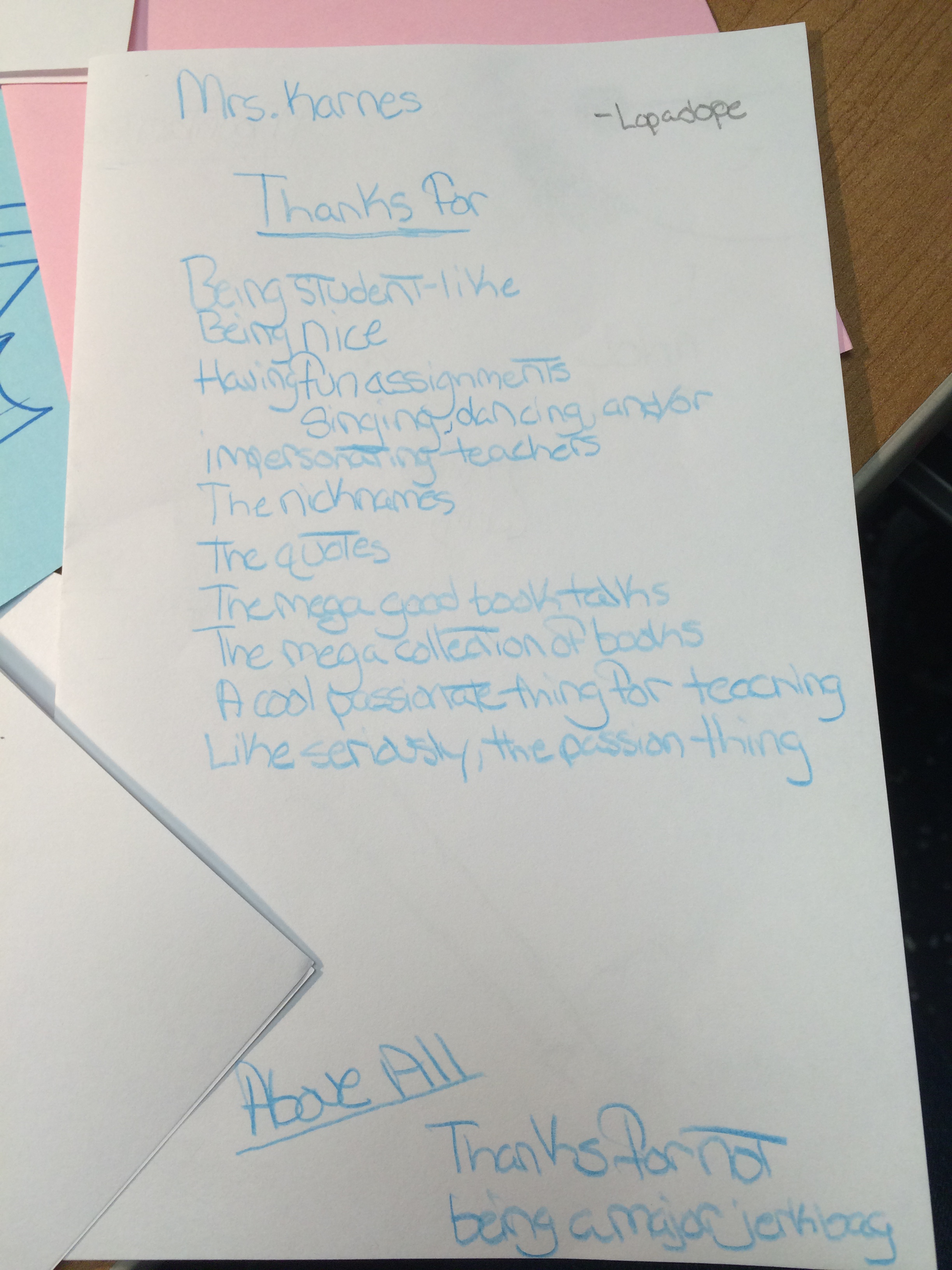
It’s Teacher Appreciation Week, and with that came some delightful thank-you notes from my students.  One student made a list of things he was thankful I did, and he repeated how thankful he was for my “cool passionate thing for teaching…like seriously, the passion thing.”  I recently read an article in the Chronicle of Higher Education that claimed the four properties of powerful teachers were personality, presence, preparation, and passion.  I like to think of passion as fangirling, which I do on a daily basis about books, student writing, authors, and all things bookish.  I’m never sure how much of that passion reaches students, but since this one specifically noted the “mega good booktalks,” I think it gets through to at least some kids.  This thank-you note really rejuvenated me, and now that I know my booktalks are working, I’ll keep at them with new gusto until June 12.

IMG_8027Rebirth

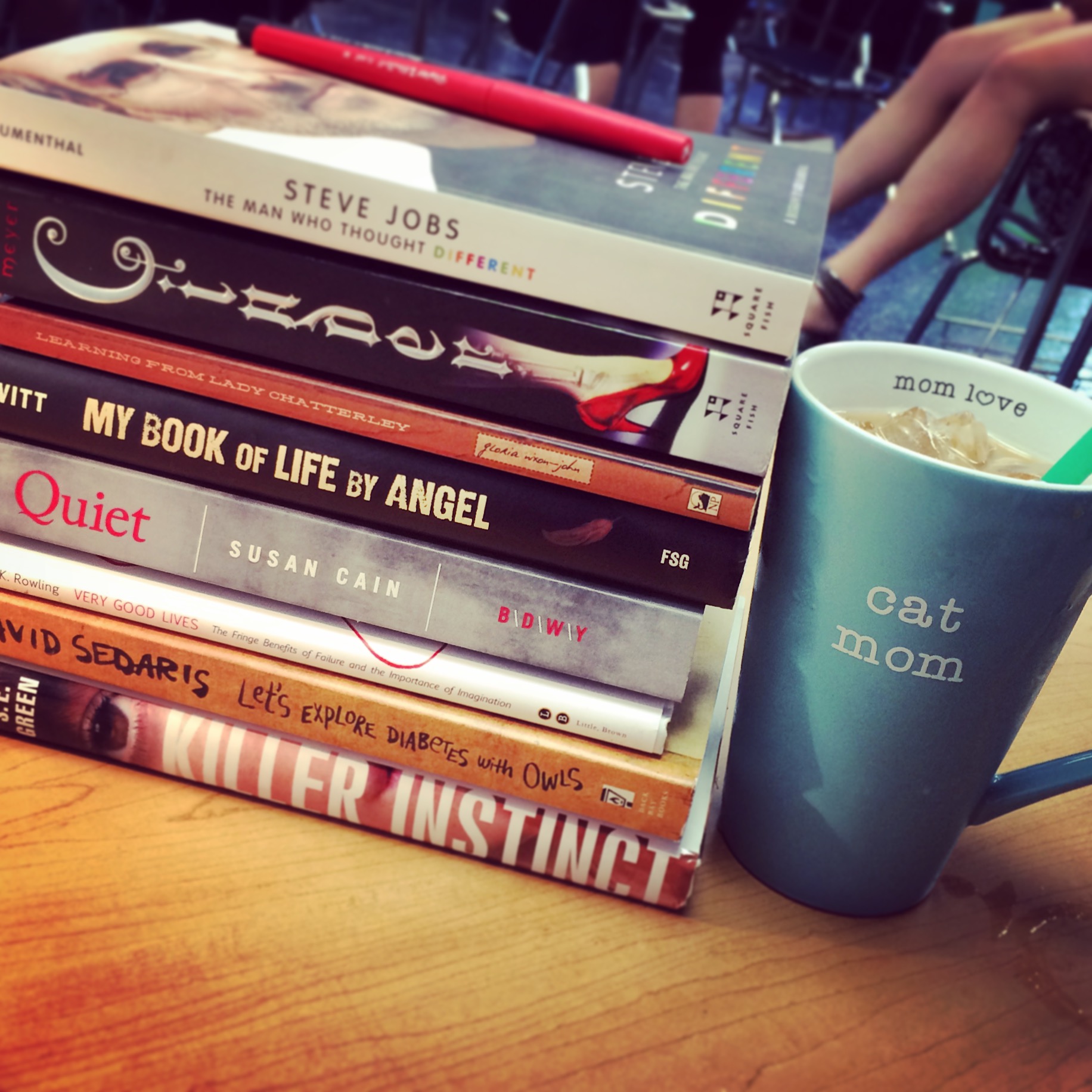
Continuing to revise and change my curriculum doesn’t stop because the year is nearly over.  I’m still wildly out of control on Amazon, buying titles as I get ideas for new units, themes, or genres (like the huge list of novels in verse I jotted down during our #poetrychat Monday night).  A new focus on science fiction, poetry, and nonfiction has been what I’ve noticed in my cart of late.  I am changing as a reader and a teacher, valuing those genres more than I once did, making a strong effort to transfer that new passion to my students.

My teaching philosophy is constantly shifting, evolving, being reborn.  Its biggest shift this year, I think, can be best summed up with a quote from another NWPer from my class last week.  While talking about meeting and learning from great teachers at NCTE, he said he felt like they were “the Wizards of Oz, but they were inviting me to peek behind the curtain.”  I love this analogy, because while great teaching may seem like unattainable magic, I now feel like I understand how to be effective.  I’ve studied living, breathing mentor texts like Penny Kittle, Tom Romano, Amy Rasmussen, Jackie Catcher, and Erika Bogdany, and am looking forward to learning from Tom Newkirk at UNH this summer.  In the past two years, I’ve been reborn as a teacher, whose confidence has grown as I’ve continued to strengthen my practice by dissecting and imitating the successes of others, just like my students do when we analyze mentor texts in class.

Springtime is a time for reflection, rejuvenation, and rebirth.  Nature is no different from my teaching as I think about this year and next, and about the beauty of its constant blossoming and change.  I know our last six weeks will fly by, so I’ll enjoy every moment of them before the luxurious summer begins!

What are you reflecting on this spring?  What has rejuvenated you as the year comes to a close?  What elements of your teaching will be reborn this year or next?  Share in the comments!