Tag Archives: Readers Writers Workshop

Stop, Celebrate, Revise, & Repeat by Amy Menzel

guest post iconNERD ALERT: I have no fewer than 89 “notes to self” regarding teaching ideas for the upcoming year.  You’re reading this, so I bet you can relate.  The problem (sorta) is that most of these ideas are brand new.  I mean, I think some of them are pretty darn good.  (For instance, infusing more Malcolm Gladwell into the curriculum is always a good idea.)  But in the cyclone of nerdiness, I often forget to note teaching successes of the past.  This means I’m missing out on the opportunity to revise some already solid approaches.

rememberAgain, I’m betting I’m not alone on this.  We teachers often get caught up in innovation.  And innovation is a good–no, a great thing.  But innovative educators have been innovative for years and careers.  We don’t always have to start from scratch.  I suggest we all take some time to stop, celebrate, revise, and repeat.

Step 1: Stop.

Think back to a lesson or unit that was especially successful.  I’ve just been thinking back to how I kicked things off last fall.  Prompted by this article from The Chronicle of Higher Education, published last August, I composed my own written address to my new students.  I titled it, “Here’s What I Need You to Understand,” and shared it on the first full day of classes.  Of course, my message wasn’t the end-all-be-all, and I extended the invitation (eh hem, assigned students) to compose a written response.

Step 2: Celebrate!

Take time to acknowledge your awesome approach and relive that “Woohoo!  It’s working!” feeling.  For me,  this initial writing activity accomplished a few things.  First, it allowed me to share my philosophy with my students.  Second, it showed my students that I, too, am a writer.  And, third, it prompted our journey of written conversation.  I was pleased with my efforts, but thrilled when a student wrote, “Honestly, there are not many teachers who dedicate this much time on the first day of school to explain what they value and expect from their students.”  While I can assure this gentleman that there are, in fact, many teachers who dedicate a lot of time and thought into such efforts, I’m glad he saw me as one of them.  Success!

dac14c846c912159e8a8c0bf9ccf42f025e3897c420b7955c8277d82b1e5abecStep 3: Revise.

It’s time to take another look at what year-ago-me thought, reconsider, and revise.  (I can already tell you that I don’t love the wording of belief II.)  With any luck (and a whole lot of writing revision), I can make this fall’s class kick-off even more successful.  Perhaps I’ll also incorporate a conference into the student writing process.

Step 4: Repeat.

T-minus 30 days…


So what teaching successes do you need to remember, celebrate, revise, and repeat going into the 2016-2017 school year?

Amy Menzel is an English language arts teacher who has taught at Cudahy High School, Franklin High School (WI), Emerson College, Wheaton College (MA), and is excited to continue her career teaching at Waukesha West High School (WI) starting this fall.  She is a teacher-consultant through the University of Wisconsin-Milwaukee Writing Project and holds an MFA in creative writing from Emerson College.  She wants (needs) to write more.

Making Workshop Work in 45 Minutes

Kerry wrote:

“One of the seemingly overwhelming hurdles I feel I have is to engage my students with only 45 minutes each day! Do you have any tips or tricks for me to do this?”

Screen Shot 2016-08-23 at 7.52.17 AM.png

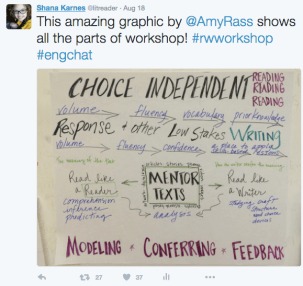
Amy’s diagram of all the moving parts of workshop

So many teachers ask this question.  When one considers all of the moving parts of workshop instruction–reading, conferring, mini-lessons, booktalks, quickwrites, workshop time, choice–it’s tough to conceptualize how to fit it all in to any duration of class time.


What’s important to consider is what Penny Kittle referred to as the “currency of time”–what you spend your time on, and what will give you your biggest return for the investment of that time, is equally as important as what you DON’T spend your time on.  You can make workshop work in any time period, with or without all of these elements in one class period, if you invest your time wisely.

What’s most important for our students?  What is the most valuable use of our time?

Time to read.

Time to confer.

Time to write.

That’s it.  If I have those three elements in every single day of workshop, I feel our _Time_-_is_money_095207_.jpgtime has been well spent.  Every workshop classroom will–and should!–look a bit different.  That’s one of the most valuable things about workshop:  not only does it provide for student choice, it gives teachers autonomy, too.

Here’s what I responded to Kerry:

“What I did when I taught those shorter classes was essentially break up my typical workshop into two days, plus I had lots of activities that I always did on certain days of the week.  Fridays, for example, were free-write Fridays in writer’s notebooks, and every Monday always had a sentence study lesson to learn grammar.  We always started with 10 minutes of independent reading, then moved into EITHER a mini-lesson or a quickwrite, then had either a reading or writing workshop.  We had a long workshop every few days or so applying the previous day’s mini-lesson, which they only had a short time to practice the day before.
So, let’s say I’m teaching Macbeth:
Monday: 10 min Independent Reading, 10 min sentence study (using a mentor sentence from the text or a related thematic text like a poem), 15 min mini-lesson on some aspect of whatever part of the play we might be reading that day, 20 min of reading the text with a directed reading activity (close reading type of stuff)
Tuesday:  10 min IR, 15 min mini-lesson or quickwrite (maybe a journal prompt on the nature of evil or something), 20 min reading of the play
Wednesday:  10 min IR, 5 min reminder of yesterday and Monday’s mini-lessons, 30 min reading of the play
Thursday:  10 min IR, 15 min vocab activity, 20 min directed reading activity (discussion, etc.)
Friday:  10 min IR, 10 min free write, 25 min reading of the play
I’d do that for about 3 weeks until the unit was done. (I try not to let a unit go longer than 3 weeks.)
Let’s say I’m teaching narrative writing:
Monday:  10 min IR, 10 min sentence study (using a mentor sentence from a model narrative), 15 min mini-lesson on a writing skill, 20 min writing time (content creation day)
Tuesday:  10 min IR, 10 min mini-lesson follow up, 25 min writing time (lots of revision or tweaking here)
Wednesday:  10 min IR, 5 min reminder, 30 min writing workshop (lots of one-on-one conferring with a combo of content creation and revision)
Thursday:  10 min IR, 10 min vocab activity in notebooks, 10 min writing mini-lesson based on previous day’s workshop, 15 min tinkering workshop
Friday:  10 min IR, 10 min free write, 25 min writing time (straight content creation)
Those days were PACKED.  There was really no free time, so kids who were absent, kids who had questions beyond workshop or conference time, etc. really had to come and see me outside of class (after school, lunch, etc.).  And, there was a lot more homework…we just didn’t have time for everything during 45 minutes.”
How do you make workshop work in any duration of time?  Share with us in the comments a brief outline your daily schedule, please!!  It will be invaluable to see the variety.

Every Opportunity on Day One and All Year

Every Opportunity

You’ve probably seen this video. When I watched it this afternoon, it had over 8 million views. If you haven’t seen it, I challenge you to watch it. Then, think for a bit about where you see yourself. I did.

And it’s humbling.

As I start a new year with new students today, I want to remember the me I want to be every single day — the adult with the smile who takes the time to greet each student with a genuine hello, the teacher with a voice of care and concern — even when I’m tired or frustrated or worried about something completely unrelated to school. I want to show every student that they matter — because they do.

We teach students as much by our actions and attitudes as we do by our instruction. We know this, and we love children — that’s why we went into education in the first place, or at least I hope it is.

So today, when my students come to my door, I’ll be there to greet them. I’ll talk to as many of my juniors as I can. I’ll look into their eyes and invite them to think and write and share as much as they are willing to about their lives.

How will I extend this invitation? You guessed it. Our first response of the year will be to this Every Opportunity video. I’m eager for the conversations.

Building community on day one and then working to strengthen community every day throughout the year.

I’d love to hear your ideas for building classroom communities that work to ensure all students feel seen and heard. Please share in the comments.


Keeping it Simple: Setting Up a Writer’s Notebook

Teresa wrote:  “I have a few questions about how your students setup their writing notebooks. What are the sections in the notebook, and how many pages do you have them section off for each? Also, does one composition book usually last all year, or do they have to get another one at semester?”

I met Teresa at a workshop training I conducted this summer. She’s getting ready for her school year to start, and I am glad she sparked my thinking about how I will have my students set up their notebooks this year. This is it:

First of all, and you probably already know this:  it’s hugely important to have students personalize their notebooks.  So during that first week of school, my kids will be using scrapbook paper, wrapping paper, and whatever to make their notebooks into something that represents their life or their personality in some way.

I’m thinking of having students email me three photos from their phones, and I’ll get those printed (since I doubt many would do that on their own), and they can use those photos to decorate inside and outside the covers of their notebooks. It’s also a way for me to build a contact list of all my students. Doubling up on purpose there.

Last year I skipped this important step of personalization, and it was a mistake. Students must take some time to make the writer’s notebook their own — it can make all the difference as to the care they take regarding ideas and writing they put into that notebook.

Now, to get to your question –the notebook set up:  For years I’ve made it complicated — so this year I am simplifying. Thanks to some discussion I’ve had with Shana about our writer’s notebooks, I finally have a plan for this year.

Since the focus of my instruction is to advance all readers and writers, I need to make sure my students know that their writers’ notebooks will be the tool we use to measure their movement. So on the very first page, I ask students to write big and bold at the top:  My Reading Goal for my Junior Year. Then I ask them to draw a square in the center about the size of a standard sticky note.

“Write your goal in the center,” I tell them, “How many books will you read this year?”

Most students write a goal of 4, 5, or 6. They don’t think in big book numbers yet — they are used to reading (sometimes) the assigned texts in their English classes. They don’t know about reading volume or choice or the engaging titles in my classroom library — yet.

I model and write my reading goal in the center of my square on the first page of my notebook:  37. My students gasp.

Then, I show them the list I’ve kept of the books I read this summer — and the stack of books I pull from under the table. “I read all of these just this summer,” I say and watch their eyes grow real wide.

“My goal for you is that you will read many more books than you think is possible this year. Let’s set those goals a little higher.”

Sometimes during the same class period, sometimes a day or two later, we read our choice books for ten minutes and then calculate our reading rate. (# of pages read in 10 minutes times six equals how many pages you can read in an hour for that book. Multiply that number by three (the amount of reading I expect my students to do each week) and that equals your individual reading goal for the week) We draw little charts of the Reading Rate formula at the bottom of our goal page right there in the front of our writer’s notebooks.

After we calculate reading rates, we often have to return to goal setting. Students realize that if they plan to meet the expectations I have for them, they will read many more than the four-book-goal they originally set for themselves. This discussion often leads into important discussions about reading volume and how it leads to fluency, vocabulary development, more background knowledge on a variety of topics, and improved writing skills. This is where I start the mantra that I repeat over and over throughout the year:

The only way to become a better reader is to read. 

Next, in our writer’s notebooks we move into our plan as to how we will reach our reading goal. First, we have to have a plan. Readers have a plan. They listen in on conversations about books. They become familiar with book titles. They come to know topics and genres they like to explore. A big part of helping students come to love reading is helping them identify themselves as readers. So many of my students do not know how to do that.

An easy way to start identifying as a reader is to walk the walk of one. We make a plan, and our plan looks like a “What am I going to read next? List.

We make this list on the back of our goals sheet. This is where we write down the titles and the authors of books we learn about through book talks, talking with peers, exploring the bookshelves, etc — all books we think we might like to read throughout the year.

This list serves as an accountability piece. If students’ lists grow, I have one way to measure their involvement in our reading community.
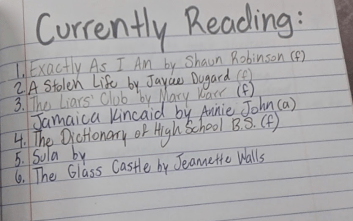
Screen Shot 2016-08-17 at 11.18.56 PM

I like the idea of having students include genre and start/finish or abandoned dates. I can learn more about a reader at a glance.

We also need a “What am I Currently Reading List.” We keep this list on the next page — right across from our TRN (to read next) list. This way students see how to transfer a “hope to read” into a “now I’m reading.”

Students record the title of the book, the author, the genre, the date they started the book, and the date they finished it or abandoned it. If they abandoned the book, which is absolutely fine — there are too many awesome books to suffer through too many we do not enjoy — I want short notes about why the book is being abandoned. I model statements that may work here. “It was boring” is not one of them.

“The narrator annoyed me because he seemed like a whiner,” or “I thought this book would be an engaging story, but it’s really a non-fiction book about information I don’t really care about” are both appropriate “I-am-abandoning-this-book notes.”

This list serves as an accountability piece. As students lists grow, I can see at a glance the titles and genres they are reading. I can see the start and finish dates to gage if their reading rate goals match with the dates recorded on this list. I can see where I might need to confer with a specific student about abandoning book after book after book — just from a scan of their CRL (currently reading list)

We need a space in our notebook for Response. We skip a page after our CRL and label this section of the notebook for what it is. This is where we will write our thinking. We will respond to a variety of texts: videos, news reports, poems, articles, stories, etc.

This is where we will deposit our initial reaction to and thinking about provocative things. This is a place for our quickwrites, our thinking on the page. We need a lot of space here, so in a composition notebook of 100 pages, we will reserve at least 20 for this section. (And we may need another notebook all together in the second semester.)

This serves as an accountability piece:  are students engaged in the writer’s community? Are they giving a ‘best effort’ at capturing their thinking on the page? Are they showing revision moves in their quickwrites? Are they playing with language like I’ve suggested as they develop their thinking and writing abilities?

Now, to really keep the set-up of the writer’s notebook simple, we just need three more sections:  reading, vocabulary, and writing.

Reading. In this section, we will record notes from reading mini-lessons, academic words
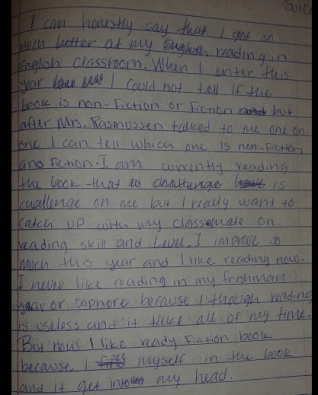
Screen Shot 2016-08-17 at 11.10.17 PM

Low-stakes student writing about her reading life. We can learn a lot about a student’s reading and writing this way.

that live in those lessons (and highlight them), tips on reading strategies, and our writing about our reading that we will complete on occasion.

This serves as an accountability piece:  Are students engaged in the reading community? Are they doing their part to advance their reading abilities? Are they competently writing about their reading?

Personal Dictionary. I used to give lists of vocab words for kids to student and then take a quiz over. Little authentic learning took place around those word lists. A much more authentic and useful way for students to learn vocabulary is for them to generate their own lists. Ask them what they do when they encounter words they do not know as they read. They’ll tell you: They skip them. No more.

We capture words we do not know in our choice reading books, and we record them in our own personal dictionaries. I ask students to record five words a week. They list the date of the week, then the title of their book (even if it’s the same book a few weeks in a row). Then they make a list of the five words they found in their reading that week, define them in context of how the author uses the word, and write down the sentence in which the word is used. We do this week after week, collecting words throughout the school year.

This serves an accountability piece:  If students are not reading, they will not have any words to record. If students are not reading a complex enough book for them, they will not have any words to record. I can help students determine if they are reading a book suitable for their comprehension abilities if I take frequent looks at their personal dictionaries.

Screen Shot 2016-08-17 at 11.17.32 PM

What started as a brainstorming activity to think about topics, lead to opportunities for discussion with this student I would not have had otherwise. Students reveal their lives to us in low-stakes writer’s notebook writing.

Writing. This is consistently the greatest chunk of our writer’s notebook. In the writing section, we craft a variety of writing territories. We take notes on writerly moves that we learn in mini-lessons and from mentor texts. We practice imitating the craft of our favorite writers. We take notes on grammar and mechanics. We practice sentence structures and the moves of writers we study as a class and in small groups. We build a tool set here of craft moves we can experiment with in our own writing. And we brainstorm and draft in this section of our notebooks.

This serves as an accountability piece:  Are students engaged in the writing process? Are they giving their ‘best effort’ attempts to create a toolbox of tools to use in their writing? Are they understanding the writing mini-lessons and practicing the application of those skills? In their drafts, is their thinking evident? Do they have strong ideas that will carry a piece before they every work on revision and craft?

And that’s it. Our writer’s notebooks are set up — with sections labeled and homemade sticky-note tabs to separate each section. These notebooks become gold. They are precious to the learning that takes place in my workshop classroom. Not only do students have one central place to keep notes and ideas. They have a personal place to practice their craft and write.

The writer’s notebook– and all these accountability pieces– mean relatively easy, though sometimes time-consuming, formative assessment for me:  I can choose to check the whole of student notebooks say every three weeks, or I can choose to check a section (I usually choose this option.) Either works to see if students are engaged in the workshop classroom and advancing readers and writers, which is my ultimate goal for all students all year long.

See more on writer’s notebooks by searching the TTT categories.

Please share your ideas for the set up for writer’s notebooks. I’d love to know if you think I’m missing something important that will further advance my students’ learning. And I wrote this post without having access of photos of each step. I hope the description will be enough.
Top Books for Reluctant High School Readers

return and talkThis summer, we’d like to return and talk about some of our most useful, engaging, or popular posts.  Today’s post, written by Jackie in 2015, shows us some great possibilities for back-to-school booktalks.

Please return to this topic and talk with us in the comments–what are some hot titles you’ll booktalk as we return to school this year?


IMG_2877“I’m not a reader.” I hear this multiple times during my first weeks of conferencing. The non-readers are easily identifiable; their body language alone speaks volumes of their disdain for books.

“You just haven’t found the right book,” I tell them, and they smirk, knowing they’ve heard that statement before.

The first week of school is a vital week of matching students with books, and while I itch to recommend titles, I hold back, giving my freshmen the independence and freedom they so desperately crave in high school. Too often students blindly accept recommendations without so much as a thought to the contents. They lack self-awareness when it comes to their reading interests or style, which is why those first two weeks are essential to not only organizing but also empowering them through choice.

Throughout the week, I book talk popular titles, engage in “speed dating” with books, and provide ample free time for students to explore our classroom library, but I also get out of their way. Instead of telling them what to read, I model ways to find a strong candidate, considering reviews, awards, contents, genres, and summaries.

While the majority of the class tends to quickly settle into their books, there are always stragglers who remain convinced they’ll never enjoy reading. These students sometimes grab the first book they see off the shelf, and oftentimes these books are too dense, difficult, or in some cases “boring.” That is okay! I settle into conferences with these students, getting to know their hobbies and eventually handing them two or three books that might pique their interest. In the end, they still choose what to read, but in the process they might require some initial guidance.

IMG_2870Regardless of who picks the book, the end result remains the same—to find a plot that envelops and consumes students, forcing them into the story. Here are some of my number one titles that tend to break down the shell of even the most reluctant readers.

Ready Player One by Ernest Cline

I’ve already had three students read this book, one of which is Leah, a gamer and self-identified non-reader. When I asked if she has ever had a favorite book, she thought for a second then said, “I think this one might be the only book I’ve ever really liked.”

The Compound by S.A. Bodeen

Adrian initially picked a sequel to a book he read last year. “You must have liked the first one then?” I asked.

“Not really,” he replied. “I just didn’t know what else to read.” The next day he picked up The Compound, which is full of the fast-paced suspense he craves.

Paper Towns and Looking for Alaskaand basically everything by John Green.

I chased Emily up the stairs for this recommendation. When I asked her which one sparked her interest in reading, she said she couldn’t remember which had sucked her in. She just knew that despite her protestations at the beginning of the year, by the end she “loved them both.”

The Eleventh Plague by Jeff Hirsch

Damion had only ever loved one book and he was bound and determined not to like any in my classroom; that is until he came across this futuristic, survival story. Upon sitting down beside him for a mini-conference last year, he looked away from his book briefly to say, “Ms. Catcher, I’m at a really good part and I can’t talk right now.”

Gone Girl by Gillian Flynn

“I’ve had people give me ‘dark’ books before, but they aren’t dark at all,” Sarah tells me. I hand her three options, one of which is Gone Girl. Three days later she tells me, “I’ve spent my whole life hating books, and you’re the first teacher who ever found one I actually liked.”

Unwind by Neal Shusterman

I book talked Unwind second this year. It’s a given crowd pleaser because of its twisted plot and graphic scenes. The fact that I only have one copy of my four originals is a testament to its popularity.

The Perks of Being a Wallflower by Stephen Chbosky

Carter claims he hasn’t read a book cover-to-cover since third grade, but he has fallen in love with Chbosky’s classic on teenage life. He said to me today, “Ms. Catcher, I love that this book talks about real things, things that are actually happening to us.”

“That book is only the beginning, Carter,” I said

What books do you recommend for reluctant readers?  Which titles are most popular in your classroom?

The Power of (very short) Stories

return and talkThis summer, we’d like to return and talk about some of our most useful, engaging, or popular posts.  Today’s post, written by Amy in 2014, shows us a great back-to-school writing activity.

Please return to this topic and talk with us in the comments–what are some of your tried-and-true writing activities for the first days of school?


As soon as I created my own very short story, modeled after VISA’s Go World videos, I knew I would have my students create their own.

For our introductions at the Book Love class I attended with Penny Kittle this summer, she had us watch a few of the Go World videos, and then imitate one of the structures. This is harder than it seems.

Here’s a few of the ones I watched and transcribed. They all represent moments that matter in the person’s life, and they are only in 35 to 60 words.

Lopez Lomong started running when he was six. And he didn’t stop for three days and three nights as he escaped life as a child soldier. Twenty years later he was still running; he just had a different thing driving him every step of the way.

Hours before his race in ’88, Dan Jansen’s sister Jane passed away. He’d promised her he’d win gold. He didn’t — until six years later. Then he skated a victory lap with his daughter — Jane.

Derek Redmond didn’t finish in first place in the 1992 400 meter. He didn’t finish in second or third or fourth. He, and his father, finish dead last. But he and his father finished.

People had been leaping over the high jump bar the same way since the sport began until one day when Dick Fosbury came along and moved the whole sport forward by going over the bar backwards.

You should watch a few of you own. Then write down the words and look at the structure of these very short stories. Then, I challenge you to write your own.

Think about your writing process as you write. Revise in your notebook. Pay attention, so you can share your process with your students. I’ve learned that the best thing I can do as a writing teacher is let them see me struggle as I try to make meaning.

I ended up writing four different versions with four different structures before I wrote a version that pleased me.

Here’s mine:

I am introducing this writing activity to students next week. I thought about having them write a full-blown narrative first and then having them cut their stories down to their own Go World stories. That would be an interesting exercise in word choice. I decided instead to have students write and create their own videos first — then we will tackle descriptive writing and work on exploding our very short stories into ones with a little more substance.

I opted for the fast-track to build community.

Story does that, you know.

Any ideas on how you might use this type of mentor text with your students? or any others you’ve had success with?

5 Non-Negotiables When Designing Writing Instruction

return and talkThis summer, we’d like to return and talk about some of our most useful, engaging, or popular posts.  Today’s post, written by Shana in 2015, shows us her process for designing writing instruction.

Please return to this topic and talk with us in the comments–how do you design instructional units in the workshop classroom?


IMG_0528

First draft of a unit plan in my notebook

I plan my units of instruction in three-week chunks, alternating between a reading-focused unit and a writing-focused unit.  In every unit, and in every class period, I keep some routines the same, much like Amy describes here.  While I do most of the big thinking about a unit up front, I do leave some holes in the plans to make space for mini-lessons that are responsive to what I discover students need during our conferences.  And every year, I design brand new units.

While each unit is unique, I was reminded while at the NCTE Annual Convention of five non-negotiables to keep in mind when designing writing instruction.

Writing should be low-stakes.  Students need to write a lot, and a lot of that writing should be ungraded, unread, or worth very few points.  I have felt liberated in terms of grading writing since I read Kelly Gallagher’s research-based statement that students should be reading and writing four times as much as a teacher could ever grade.

I think, since I embraced that philosophy, that my students also feel liberated.  Their notebooks are a “safe place for regular, ungraded practice,” as Penny Kittle described in her Ignite session.  While we write in our notebooks every day, and outside of class in one-pagers, I only collect notebooks every two weeks, and only carefully read and respond to one or two pieces my students have marked.  Indeed, 80% of the writing we do stays in our notebooks and never makes it to ‘published’ form.  This takes the pressure off writers to produce something perfect or error-free, because “our classrooms need to be a safe place to fail,” in the words of Taylor Mali.

IMG_0265

The first two weeks of Kelly Gallagher’s unit plan–week three is filled with revision and getting to best draft #3 at the ‘deep end’

Teaching writing is complex, layered, and nuanced.  In her session on revision, Georgia Heard shared the five things all students need in order to make authentic revision happen:  “opportunities for students to write, mini-lessons on craft and revision, choice in topics, mentor texts, one-on-one conferences with both teachers and students.”  Kelly Gallagher’s unit plan he walked us through adhered to those rules remarkably well.  “Assigning writing and teaching writing are two different things.  Grading writing and assessing writing are two different things,” he reminded us.  It is impossible for students to produce great writing if it is merely assigned.  Thus, when I plan a unit of writing instruction, I leave ample time for craft mini-lessons, modeling my own writing, and talk amongst students and myself.

When teachers are writers ourselves, and experience the process of topic choice, revision, and studying craft moves beside our students, we can become the most effective teachers of writing.  We have to walk the talk.  “Great, effective teachers must be informed AND inspired,” Kwame Alexander asserted.  To be a truly informed teacher of writing, a teacher must be a writer herself. I learned more about writing a strong narrative while participating in NaNoWriMo alongside my students than I ever did just trying to teach fiction before I wrote fiction.  I loved the experience six years ago during my first attempt, and I’ve continued to complete all assignments beside my students ever since.  When we write with our students, inspiration will spread through “the contagion of passion,” in Penny Kittle’s words.

Writing should be personal.  While I love to write about reading, and find it valuable for students to do so often, most of the writing in my classroom is personalized, choice-driven, and often remains private.  When we do a nonfiction writing unit, like the rhetorical analysis we’re in the midst of right now, our written products are focused on the students’ relationships to the texts they’re analyzing–in this case, the misleading rhetoric often found in American politics.  Mostly we write narratives, even in the midst of nonfiction, telling the stories of our connections to the topics we discuss in informative or argumentative genres.

“You can write yourself out of dark places. How much of the writing we do in school nurtures that?” Gary Anderson wondered in his session on reflection.  We have to honor the fact that students are not inherently motivated to write for their futures–for college, job applications, or resumes–but rather they are motivated to write for the here and now, and for themselves.  This is why choice is, and will remain, at the center of my writing instruction.

How do you design writing instruction?  Share your process in the comments!

3 Ways to Jump-Start Reluctant Writers

return and talkThis summer, we’d like to return and talk about some of our most useful, engaging, or popular posts.  Today’s post, written by Jackie in 2015, shows us how to engage teens who may be more resistant to writing.

Please return to this topic and talk with us in the comments–how do you jumpstart your reluctant writers?


IMG_1703My younger sister Brittany is a phenomenal writer; in school, she excelled in all subjects, including English, but I never saw her struggle quite as much as when she was required to keep a writer’s notebook. For me, writer’s notebooks had always been liberating. I kept one in my spare time after having read Ralph Fletcher’s A Writer’s Notebook the summer before sixth grade. This was not the case for my sister though who, at the urging of her teacher, would write, “I do not know what to write” for ten minutes straight. Her teacher would tell her, “You’ll figure out what to write after a while,” but she clearly didn’t know my sister who is not only brilliant but also strong willed and persistent. In turn, when I told my sister I’d be integrating writer’s notebooks into my classes, she groaned, saying, “I hated those things.”

Brittany’s PTSD was reasonable. When used without encouragement or prompting, writer’s notebooks can become tedious and painful. Students can easily learn to loathe this tool that should otherwise be fun and stimulating. In turn, when my students explore their writing, I make an effort to help fuel their ideas and interests through a variety of writing activities and exercises that oftentimes help even the most particular writers.

  1. Prompt Board: At the beginning of the year, I ask students to write 3-4 pages in their writer’s notebooks. This helps students establish a writing routine and it helps me to learn about my students quickly. That being said, many students stall when it comes to putting pencil to paper. After running into this problem early on, I began posting five writing prompts per week on the side of my main white board. These topics included personal questions about students’ interests or extracurricular activities as well as sentence starters and fictional scenarios intended to lead into creative writing. I compiled the majority of these prompts off of social networks like Twitter and Pinterest, but I also use sentences from my book talks during the week as prompts as well. I post these prompts on my website in a separate section so students can always go back and revisit the prompts from past weeks.
  1. Ideas Shelf: Teens love thumbing through the pages of oddly shaped writing books. One of my most well-loved books is a cube shaped book called The Writer’s Block, which has “786 ideas to jump-start your imagination.” That being said, there are plenty of fantastic average size books that I store on an ideas shelf, which also includes 642 Things to Write About, Now Write: Nonfiction, Now Write: Fiction Writing Exercises From Today’s Best Writers and Teachers, and 100 Quickwrites by Linda Rief. When stuck, students gravitate towards this shelf. In addition, with the help of my Writer’s Club, I am hoping to add a jar of words, images, and prompts this year for students to pull from whenever they are struggling.
  1. Self-Guided Activities: As the adviser of Writer’s Club, I always have trinkets on hand Rory's Story Cubes for StADato help students put their pencils to paper. Some of my students’ favorite toys include Rory’s Story Cubes, which are dice with small pictures on them. Students can toss a handful of dice and incorporate the images into a story. I also have a collection of old skeleton keys I bought at a craft store. Tied to each key is a tag with a sentence starter that discusses where the key might have been found or what the key opens. Another easy activity involves collecting paint strips from your local hardware store and having students write stories involving the absurd color names on each strip.  Finally, I love utilizing found photography like the pictures from Miss Peregrine’s Home for Peculiar Children or old calendar images to get students thinking. I have a collection of small Dana Heacock calendar images, which are brightly colored drawings of New England scenery or objects.  These images oftentimes stir up students’ memories of childhood and lead to fantastic personal stories.

How do you help inspire your reluctant writers?  What methods do you use to jump-start their independent writing process?

5 Reasons Reading Conferences Matter–Especially in High School English

return and talkThis summer, we’d like to return and talk about some of our most useful, engaging, or popular posts.  Today’s post, written by Amy in 2015, reminds us that conferences aren’t just for assessment–they’re for nurturing, too.

Please return to this topic and talk with us in the comments–how and why do you confer?


The Attention. Every child needs one-on-one conversations with an adult as often as possible.  Adolescents, by nature of their age, struggle with identity, fairness, stress, and a slew of other issues that contribute to all kinds of problems. The National Center on Addiction and Substance Abuse (CASA) at Columbia University. reports that “9 out of 10 Americans who meet the medical criteria for addiction started smoking, drinking, or using other drugs before age 18.” This is not surprising since according to this study, “75% of all high school students have used addictive substances, including tobacco, alcohol, marijuana, or cocaine.”

I know there are many reasons for teenagers to partake in these substances. I also know that many students think that adults do not care, or will not notice, if they are in class, participating in class, or lucid in class. One way to show our adolescent students that we care is to talk with them. And face-to-face conversations about books and reading is a pretty safe way to do so, not to mention that we model authentic conversations about reading when we do.

Try questions like:

  • How’s it going? (Thanks, Carl Anderson)
  • Why did you choose this book?
  • Do you know anyone else who has read this book? What’d she think?
  • How’d you find the time to read this week?
  • What’s standing in the way of your reading time?

The Relationship. Once students know they can trust us, they will tell us things about their lives, their struggles, and their hopes beyond high school. According to the Zur Institute, teen internet and video game addictions, violence in the media, online bullying, and violence in the home top the charts as some of the major influencers of teen behavior. On the Zur website, there’s a section titled “What You Can Do.” We find language that mirrors the words and phrases that lead to the most effective reading conferences, like “learn what [it] means to your children by talking with them about it,” and “be genuinely curious about what draws them to [whatever it is],” and “discuss balance,” and “keep the conversation active.”

We hear so much talk in education circles about engagement. Engagement comes as a result of relationships. When we talk to our students about their lives and the things that matter to them, and we help them see that somewhere in some book a character has experienced similar situations, conflicts, and heartaches, we show our students that literature is a living breathing source of hope. This Psychology Today post explains it clearly:  “Books are friends we can choose without restriction,” believed John Ruskin, an English art critic of the 19 Century who influenced Marcel Proust “who developed the idea of a novel that was not just a friend, but a friend who enables us to become intimate both with other minds and with our own.” Proust called readers of his own work “a sort of magnifying glass … by which I could give them the means to read within themselves.”

My students and I talk about windows and mirrors. This is why we read literature:  to learn what it means to be human. How do you see yourself in the characters, conflicts, situations, and how do you see out into a world that is very different from your own? The more we grow in empathy, the better relationship we’ll have with our friends, our families and all other people we associate with — at least the idealist in me will cling to that hope as I continue to talk to students about books and reading.

Try questions like:

  • What character reminds you of yourself or someone you know?
  • What part of the story is the most similar/different to your life?
  • Why do you think the author makes that happen in the book?
  • What does he want us to learn about life?
  • How does this story/character/conflict/event make you think about life differently?

The Learning. There are times when I’ve done a mini-lesson, I feel like I’ve talked to myself. I see little application of a skill I know I’ve taught. Sometimes students completely miss the point of the lesson. However, when I take the time to talk to each student individually, and reinforce the skill in a quick chat, the application of that skill some how seeps into their brains much deeper. And you know those students who are super apprehensive — the ones who have to ask “Is this right?” and show us a teeny bit of work before they will really produce any work? Holding a regular reading conference has solved this problem.

Students know they will get a chance to talk with me about their progress, and they are more willing to take risks than when we talk infrequently. Time for reading conferences, and conferences timed to meet the needs of each one of our learners solves many at-risk behaviors and promotes deeper learning.

Try questions like:

  • Tell me about _____ that we learned in class today. How does that relate to your book/character?
  • Remember when we learned _____, tell me how/where you see that in your book.
  • Think about when we practiced ___, where does the author do that in your book?
  • You’ve improved with ___, how could you use that skill for _______?

The Literacy. Sometimes I think we forget that the purpose of our instruction must be to develop the literate lives of our students. We must provide opportunities for our students to grow into confident and competent readers and writers in order to handle the rigor and complexity of post high school education and beyond. We must remember to focus on literacy not on the literature — just like we must focus on the reader not just on the reading. We must validate our readers, ask questions that spark confidence, avoid questions that demean or make the student defensive, and at the same time challenge our readers into more complex texts. We can learn if a child has read a book, or the assigned pages, with a few quick questions. Then we must turn the conversations to the why, the what, and the how that will get students to choose to take a step up the ladder of complexity.

When students know that we care more about them as the person than we care about what or how much they have read, they will trust us. And it’s trust between the adolescent and the adult that creates the most movement as a reader, a writer, a student, a young person emerging into adulthood. Students will read the rich literature we bless because they know we are leading them into literature that will in turn bless their lives.

Try questions like:

  • On a scale of 1 to 10 how complex is this book for you? Why?
  • What do you do when the reading gets difficult?
  • Of all the books you’ve read this year, which was the most challenging? Why?
  • How’s it going finding vocabulary for your personal dictionary?
  • Tell me how you are keeping track of the parallel storyline?

The Reward. We can experience powerful rewards as we meet with our students in regular reading conferences. (I wrote about one here.) Every year, after students get to know me a bit, they tell me things like: “We were scared of you at first. You seemed so strict,” and “You intimidated me, and I was afraid to talk to you.” I get how students see me. I’m tall for one thing. For another, I get right to the point and state the learning that will happen in my classroom. Structure and routine are important for the work we do here, and I explain what that looks like within the first twenty minutes of day one. We work bell to bell with very little down time. I get that many students are not used to such habits, especially in our 85 minute classes.

My students experience breakthroughs regularly.  It’s during our reading conferences that they tell me my instruction works. “Miss, I only read two books in all of 10th grade. I was so behind. This year I’ve read SO many. I can’t count. You’ve helped me so much. I wish I could go back in time and read this much in 10th grade,” one girl tells me. Another says,  “I never thought I would like to read. Now, look at me,” as she shows me the copy of Anna Karenina she bought over the weekend. (We’d done a mini-lesson on beautiful sentences, and I talked about the books our mentor sentences came from — not really expecting anyone would want to read that one. Oh, they can surprise us!)

I ask students about their confidence levels in our little chats, and they tell me they know they have grown as a readers. This is the best kind of reward.

Try questions like:

  • How has your confidence grown as you’ve read this year?
  • What do you think is the one thing we’ve done in class that’s helped you improve so much as a reader?
  • How will the habits you’ve created in class help you in the reading you’ll have to do in college?
  • Why do you think you’ve grown so much as a reader the past few weeks?
  • What’s different for you now in the way you learn than how you learned before?
  • Describe for me the characteristics you have that make you a reader.

What kinds of questions work for you in your reading conferences?

©Amy Rasmussen, 2011 – 2015

“Why Should I Trust You?”

return and talkThis summer, we’d like to return and talk about some of our most useful, engaging, or popular posts.  Today’s post, written by Erika in 2013, reminds us that the real reason for so many of the non-negotiables of workshop (conferring, feedback, reading, writing) is to build trust.

Please return to this topic and talk with us in the comments–how does the workshop model help you cultivate rapport and trust with your students?


Our Compass Shifts 2-1Every year at this time just as I’m about to focus on, and plan for, this upcoming school year; I remember a very powerful moment I keep with me – always.  This moment, and more specifically this very innocent yet profound notion, continually resonates with me.  I make sure to put myself back in my Day One shoes, standing in front of my class comprised solely of eager male high school freshmen looking to challenge me, test me, but ultimately, accept me (as their educator).

*****

“Good Morning!  I’m Ms. Bogdany.  I am…”

(And we’re off!  This introduction (being oh-so-carefully crafted and rehearsed) had a very distinct mission: do not lead on to the fact that this moment marks your very first day educating in Brooklyn, one of the five boroughs of New York City; the most comprehensive public school system within the United States.  Breathe.  Just keep breathing!  You’ve got this!)

As my introduction was coming to a close, it was time.  Questions.

“So, does anyone have any questions for me?”

At that, I see one particular student’s hand confidently emerge into the air.  This unique student coolly, and wildly presuming, asks:  “Why should I trust you?”  (Wait, Wait, Wait.  Wait!  No one prepared me for this!  Ok.  Just keep breathing, Erika…I mean Ms. Bogdany.  I mean…   Breathe and answer the question.  Quickly, all eyes are on you.) 

I found myself simply replying, “You shouldn’t.” (Did I just say that?!)

 At that, he put his hand down, smirked, and the weight in the room (for all of us) lifted.  The truth surfaced.  I realized what I just admitted.  This unique student was satisfied.

 *****

Throughout the years, I’ve come to realize that Day One truly defines and shapes the journey we all embark on together as a class community, so I need to be ready.  While each year presents unforeseen opportunities and obstacles, I ask myself endless questions before the school year even commences; before I know who my students are; and way before I know how our community is going to function as a whole.  Annually, I will probably continue to do so; yet I always end up finding my way back to this guiding, eight-year-old question, “Why should I trust you?”  Once this question rests its reassuring presence on my question-filled mind, I settle back into the comforts of the same revelation: It’s simple, in order for students to trust me, I need to trust myself.

Disclaimer:  Starting the school year needs to feel authentic…for students and educators alike.  In answering my student’s question for him and the students in that same class; and for all of my students to come…I am not certain of much, but I am certain that the following three intangibles prove to create trust among all of the communities in which I have been fortuitous to be a part of.  For me the most authentic success resides largely within the art of teaching, not the science. 

Create the classroom you’ve always dreamed of!

See beyond the institutional green walls and peeling paint.  Do you see the mismatched desks, tables, chairs, bookshelves…?  You shouldn’t.  This is your canvas so paint it.  There are limitations to all of our working environments, and we know it.  Take charge…change it around…move things…turn things upside down…whatever it takes.  Students know when we’ve invested our time and energy into our shared space; and they are appreciative of it.

Students are less resistant to become a part of a class community when they know educators are doing the best we can to make them feel welcomed in a space that lends itself to learning, teaching, challenging, questioning, struggling, and movement.  Give them the paintbrush, they’re sure not to disappoint.

Where’s the library?!

The inquiries students have about the world never cease to amaze me.  They internalize their own struggles, or struggles of their families and friends, and don’t often know how to process what they’re experiencing.  Hill Harper guides our young men and women via Letters to a Young Brother and Letters to a Young Sister as Esmeralda Santiago does in When I was Puerto Rican.  Other times students want to explore worlds beyond their own; they want someone to guide them through the land, culture, religion…differences.  The Alchemist by Paulo Coelho takes them on quite the journey.  Sometimes students want to just escape; don’t we all?  Speak by Laurie Halse Anderson is comical, relative to students’ lives, and wildly crafty.

Despite the content area in which we educate, it is powerful beyond measure to have literature lining our walls, stacked on tabletops, and accessible to students.  Teaching math this year?  Stock up on biographies of mathematicians such as Emmy Noether: The Mother of Modern Algebra.  Science educators, have you thought about The Hot Zone by Richard Preston or The Last Lecture by Randy Pausch?  Art and Music educators, books with visuals, lyrics, memoirs, and struggles of artists (of all kinds) are empowering for our young emerging artists; it makes it real.  Howard Sounes takes on an enlightening journey with Down the Highway: The Life of Bob Dylan.  History.  Non-fiction heaven!  Night by Elie Wiesel, A Long Way Gone by Ishmael Beah, The Autobiography of Malcolm X by Alex Haley.  There are more…

Make a decision! 

There are so many unknowns we face daily as educators: We take risks before we even realize we’re doing so.  We find ourselves as the ‘go to’ when we know we don’t have answers.  We internally battle if students should leave their ID card in return for a writing utensil.  We wonder when to push a student verse when they have truly reached their limit (for the time being).  We grapple with riding the waves of a ‘teachable moment’ or tossing aside our planned lesson.  We all know, the list is endless.

Rest assured.  When we allow ourselves to make decisions we are giving ourselves permission to trust ourselves.  We are setting the tone for students that while decision making can be difficult, we must trust ourselves in the process, and make students privy to the journey through this process.  Because here’s the reality, when we model our own decision making, students start to follow our lead.  When we exhibit our ability to be independent thinkers and change agents, students are inspired to do the same.  Before we know it, students are showing us the way.

And so, as we all gear up and find ourselves in the midst of the ‘get ready whirlwind’; let’s think about how we can answer (so our students don’t have to), “Why should I trust you?”