Tag Archives: Mini-lesson: Writing

Mini-lesson Monday: Thinking about Complexity

Many of my writers seem stuck in simple sentences. I think this has something to do with their reading fluency. When I ask them to read me a few lines out loud, they read in monotone with faltering phrases and seemingly little knowledge of the workings of punctuation. One of the best assessment tools I have for knowing what my readers need to help them become better writers is these few moments of one-on-one read alouds– them to me — in conferences. These conferences also remind me how closely my reading and writing instruction must be aligned. If my students cannot read well, I cannot really expect them to write well. (And it shows the huge variance of abilities in my AP Language classes.)

In an effort to move my readers and writers into more complexity, and to get them to start paying more attention to sentence structure in their independent reading, I know I must expect them to take action with what they learn. But I do not want to mandate anything I cannot keep up with, nor anything that will make students not want to read. So I decide to start a new challenge with our “quotes board” — the one that’s remained largely empty for most of this year.

Objective:  Using the language of the Depth of Knowledge Levels students will recognize and identify interesting and complex sentence structures; they will then copy the sentence into their writer’s notebooks and/or onto a notecard to use it as a mentor; then in their weekly blog posts, they will write and practice their craft, including at least one beautifully constructed sentence in their post. (If they choose to share their mentor sentence, they will pin it to our “quotes board” to display it for the week.)

Lesson:  First, I remind students that we’ve talked about sentence boundaries and sentence structure since the beginning of the year. I tell them that today we’re going to learn two different types of sentences:  periodic, and loose or cumulative, and look at how writers link details and ideas within sentences that create description and often rhythm.

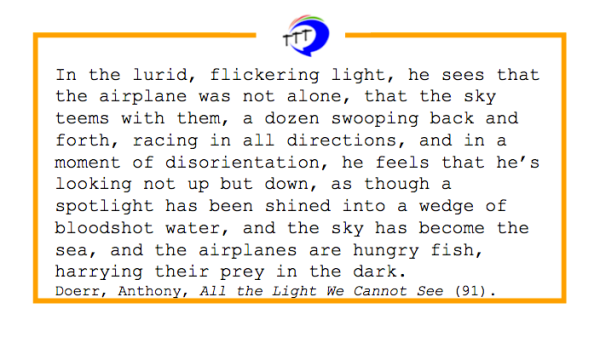
I say, “We are going to study sentences from the 2015 Pulitzer Prize Winner All the Light We Cannot See by Anthony Doerr. Doerr is our writing coach for the week. Let’s see what we can learn about writing more interesting sentences.”

I project the loose sentence, and we talk about where the independent clause lies within it. “How do all the details trailing off of the main idea make the sentence more interesting? What do you notice?”
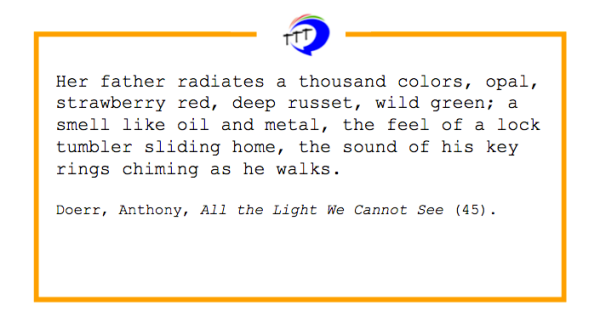
loose sentence 1

After we’ve discussed the loose sentence, and I feel like students understand what makes it loose and how to identify this type of sentence, we move to the periodic sentence.

I project the following periodic sentence, and we talk about where the independent clause lies within it. “Why put the main idea of the sentence at the end?” I ask.

periodic sentence 1

We discuss why the author might have chosen to craft the sentence this way. “What does putting the main clause of the sentence at the end do for the meaning?” I ask.

Next, we study a few other beautifully crafted sentences I pulled from the novel. (There are so many!) Each time encouraging students to talk with one another to first identify the independent clause and then determine if the sentence is loose or periodic or an interesting combination. I remind them to discuss the meaning of the sentence and why the structure might matter.

We study.

beautiful sentence

and

beautiful sentence 2

And before we move into searching for loose and/or periodic sentences in our own independent reading books, I ask students to practice reading these four sentences aloud to one another.

“Pay attention to the rhythm of the sentence and what the punctuation does to create that rhythm,” I say. I give them a few moments to read sentences to one another at their tables. Low stakes. They know one another well, and there is no pressure. They help each other read, which is exactly what I want in my community of learners.

Follow up: I ask students to pay attention to the sentences in their independent reading books. “Watch for loose or periodic sentences,” I say, “and here’s the challenge:   When you find one, write it out on a notecard, and post it on the quotes board. Let’s see how many of these beautiful sentences we can collect this week.”

And remember to write at least one loose or periodic sentence in your blog post this week. Let’s work on crafting beautiful sentences like Doerr in our own works.

Mini-Lesson Monday: Mining Memories to Begin a Writing Unit

Narrative is, to me, the most powerful genre of writing one can do.  Whether the narrative rests in a fictional or true story, or acts as an anecdote within an argumentative text, or helps to illustrate a concept in an informative one, story is central to great writing.  Students know and live this, and are natural storytellers once they get going…but sometimes knowing what story to tell is easier said than done.

I find that stories students have rehearsed well through talk or reflection are the best stories to get them to write.  As a result, we mine our memories to harness our most powerful topics for writing all narratives.

Objectives — Using the language of the Depth of Knowledge Levels:  Identify memories that are rich with complexity to write from. Or, from the Common Core:  Write narratives to develop real or imagined experiences or events using effective technique, well-chosen details, and well-structured event sequences.

Lesson — My students in West Virginia are well familiar with the concept of a mine.  For them, a mine is “an abundant source of something,” while to mine means “delve into (an abundant source) to extract something of value, especially information or skill.”  Using this metaphor for brainstorming topics is comforting for them, since they know we’re digging for existing ideas and knowledge–not crafting something new.

img_0728

My scars maps

One of my favorite activities for mining memories came from Tom Romano, which he simply calls “Scars.”

I begin by drawing a stick figure on the board and then turning to my students.  I point to my knee, then draw a small dot on my stick-figure knee.  “When I was about eight,” I begin, “I really thought I could jump down a whole flight of stairs and land on my feet.”  I get them laughing as I tell them the story of how I got that particular scar.  Then I draw a little dot on my left stick-figure eye, and tell them the story of how I got chicken pox so badly that it went into my eyeballs.  They cringe in horror, so then I draw a little dot on my left wrist and tell them about how my new kitten just really won’t stop using my arm as a scratching post.

We laugh together.

“All scars have a great story behind them.  Draw a stick figure in your notebook and label your own scars.”

They do this, unable to keep silent as they show their neighbor their stick figures and begin to tell their stories in brief.

After a few minutes, I draw their attention back to the board and draw a large heart.

“All scars have stories, but not all scars are visible.  Sometimes we carry scars on our hearts, where no others can see.”  The classroom always gets eerily quiet at this point.  I write the name “MeMe” in my heart on the board, and tell about my awesome Tennesseean grandmother and her fabulous Southern drawl and feisty persona, and how she passed away on my very first day of teaching.

“It was basically impossible to get through my very first day of this career that I so love,” I share.

Then, I write the word “miscarriage” in my heart, and tell about that worldview-shifting event in my life.

“Go ahead and draw your own hearts and label your own heart scars.  We all have them.  Don’t be scared.  This is just for your notebook, for now.  It will stay private.”

img_0729

My scars story

The classroom falls silent and I open my notebook under the document camera while they scrawl, not telling any stories to neighbors this time.

“Beneath your stick figure and your heart, let’s take eight minutes to write about any one of these scars.  Tell the story of how it came to be.  It could be a funny story, or a sad one, or a scary one.  But tell the truth and tell it well.”

We write together, revisiting a routine that has become commonplace in our classroom–I model not just the act of writing, but the act of vulnerability, and my students dive headfirst into the tough stuff as a result.  This is just one practice that builds a strong community of readers and writers.

Follow-Up — After we write, we revise briefly, then elect whether or not to share at our tables only.

The next class, we mine another set of memories by creating a map of our childhood homes, then telling the story of one of the places on the map–a Penny Kittle gem.

Another day, we go through our playlists, choose a song that is the soundtrack of our life, then tell the story that made it so.

We continue with five seed prompts in a row, five class periods in a row.  Then we select one of those stories to refine and workshop into a narrative.  I teach a mini-lesson each day about a narrative skill, so that by the time we’ve really committed to a topic, students are well-versed in pacing, dialogue, descriptive detail, and the like.  We confer and workshop and revise.

I’ll employ this routine when we return from break, focusing on reflection and rejuvenation and resolutions in the new year, working to craft multimodal “This I Believe” essays as we read Siddhartha together.

How do you get your students to come up with meaningful topics for writing?

Mini-Lesson Monday – Strengthening Dialogue With Punctuation

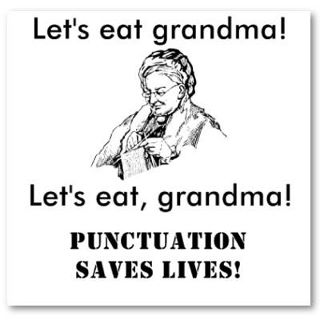
Punctuation_Saves_Lives2After reading second drafts of my students’ narratives, I was wowed by so much of their writing.  Thoughtful leads, powerful topics, intriguing plot structures.  But, despite a mini-lesson on the conventions of writing dialogue last week, some of their characters’ conversations were lacking.  I needed to design a responsive mini-lesson accordingly.

Objectives — Using the language of the Depth of Knowledge Levels: Synthesize your knowledge of how punctuation works with narrative speech conventions to craft thoughtful dialogue; Construct dialogue based on your knowledge of a character’s personality.  Or, from the Common Core: Write narratives to develop real or imagined experiences using effective technique, well-chosen details, and well-structured event sequences.

Lesson — While reading drafts, I set aside a few exemplary pieces of student work in terms of dialogue.  In each class period, there were at least two students whose dialogue was superior.  It was subtle, nuanced, and really added to the characters’ depth.

I asked students to open their writer’s notebooks to the Craft Study section and I projected one example of a student’s work on the board using my document camera.  “Good dialogue isn’t just about what a character says,” I begin. “It’s also about how they say it.  A greeting can really change based on phrasing or punctuation.”

I point to the example on the board.  It’s Logan’s, and in his dialogue, his mom is yelling at him for getting drunk:

“LOGAN WAITMAN SANDERS!” Mom hollered. “Just WHAT do you think you are doing, young man?!  And…and…YOU, Jeremy!  You should be ashamed of yourself!”

Everyone laughs, and I ask a volunteer to read the dialogue aloud.  Dylan does, with perfect angry-Mom-inflection.  He makes Logan shrink back in his seat a little.

I ask the class, “Why did Dylan know how to read that dialogue so perfectly?”  They volunteer: the capitalization helped; he knew when to raise his voice.  “How did he know to stutter?”  They say: the dots (ellipses, I add helpfully) told him to stutter.  “How did he know to sound kind of incredulous while yelling?”  They reply: the exclamation points, and especially that exclamation point mixed with a question mark.  “How did he know when to pause?”  They know: commas.

I put up other kinds of punctuation on the board–dashes, periods, italics–and we discuss what effect each of those would have on a character’s dialogue.  Students jot all this down in their notebooks.  Then, I pass back their drafts and ask them to find a partner.  “Now that you know how to really make dialogue more personal, revise your dialogue in your drafts.  Work with a partner to determine whether or not your dialogue has the effect you want it to when you revise–write a line, then ask your partner to read it aloud the way Dylan read Logan’s.”

Students take ten minutes per person to revise, then we launch into writer’s workshop with the remainder of class.  I write beside them on the board, working on my own dialogue in my NaNoWriMo novel.

In each of my other classes, we repeat this exercise with drafts that contain good dialogue.  It’s so important to use student work as mentor texts–students see that great writing is attainable, not just imitable, when we show them their peers’ successes.

Follow-Up — After today’s revision and writing workshops, students will have one more day in class to keep working on their drafts before turning them in again.  I’ll hope to see much improved dialogue, and as such, I’ll ask writers to answer a question on their self-evaluations about how their dialogue enhances their characterization.

Mini-Lesson Monday: Learning Concrete Details with Independent Reading

More than any other writing, I love reading my students’ narratives. We start the year with narrative for many reasons, but my favorite is that I get to know my students faster than I can get to know them during one-on-one reading conferences or during group activities and discussions.

Here’s a short list of what I’ve learned from student stories just this week:

  • several of my male students wish they had a father who showed interest in their lives
  • a few of my girls live with their fathers because of their mothers’ poor choices
  • several boys and girls journeyed long and far, walking miles through jungles, so their families could escape oppression, rape, and murder
  • many of my teenagers have experienced heartache because of love interests, friends, and family members
  • a few are still grieving the loss of grandparents, aunts, uncles, and friends who died from suicide
  • at least one young woman still holds anger toward her mom because of the way she handled a brother’s addiction and abuse

Personal and powerful, all of these stories matter. My goal as a writing teacher is to help my writers harness the words so emotion reigns in the heart of the reader. The problem?

Abstract language.

Objectives — Using the language of the Depth of Knowledge Levels: Show understanding of the terms abstract vs. concrete; in your independent reading books, identify concrete details and figurative language; analyze the effectiveness of the author’s language; revise your writing to include fresh concrete details and figurative language as you create a text that evokes powerful emotions.


Lesson
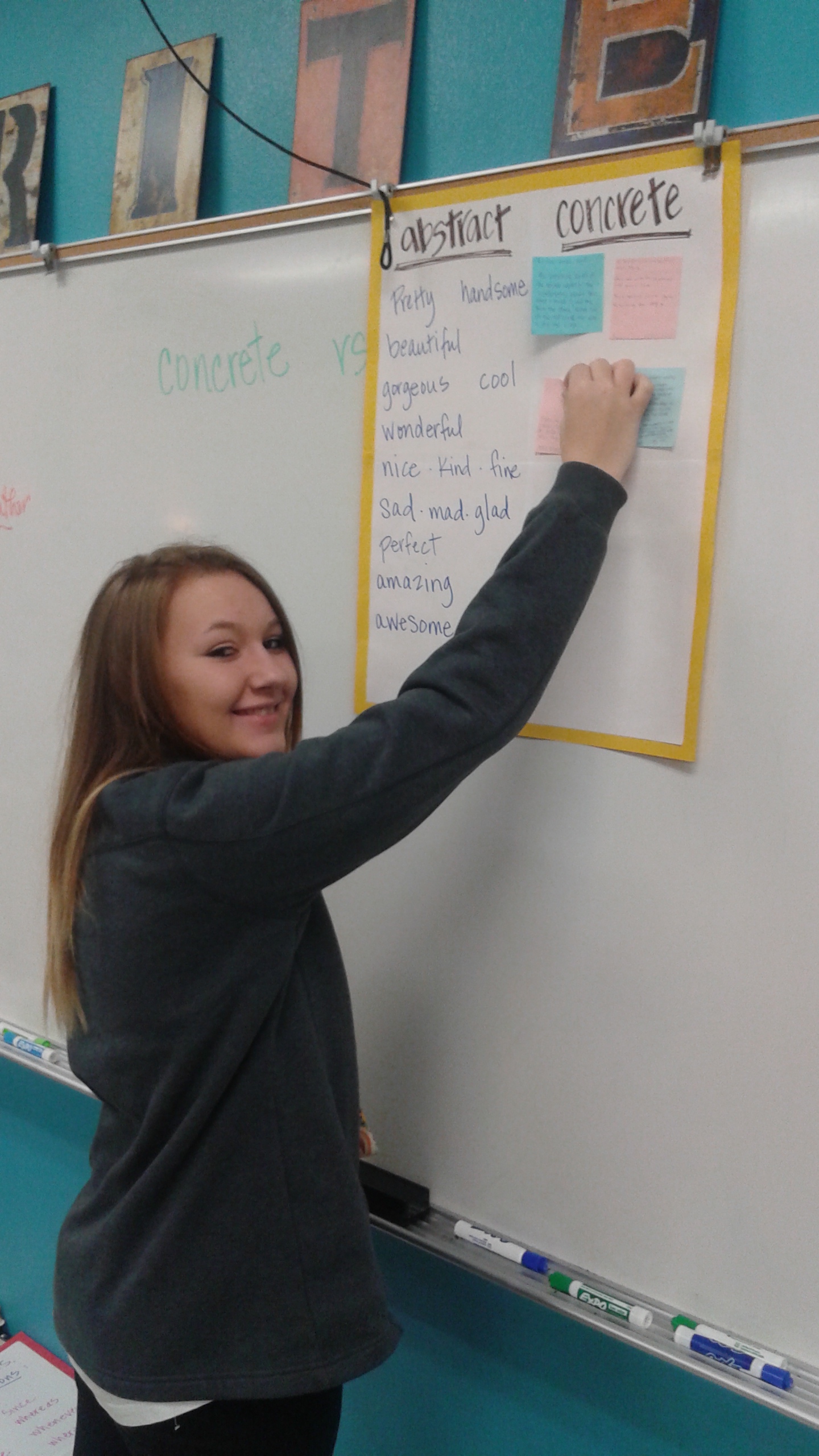
— Before the mini-lesson, students have already drafted a few pieces, narratives or poems. I abstractconcreteusually do the mini-lesson after silent reading time, but for this lesson I begin before because I want to give students a specific purpose for reading.

First, I write on the board ABSTRACT and CONCRETE and we review what these terms mean when it comes to writing. I try to use only abstract words as they begin to discuss this with me.

“Awesome, you might get it,”

“Wonderful, I think you know what I mean,”

“Hey, that’s pretty good…”

Eventually, they will pick up on what I’m doing, and we make a list of abstract words. Then I give each table-group a word and challenge them to come up with a concrete description that shows us that abstract word. They get 1-2 minutes, and then we share out as I write the concrete details on the board. We discuss the difference in how an author can create emotion.

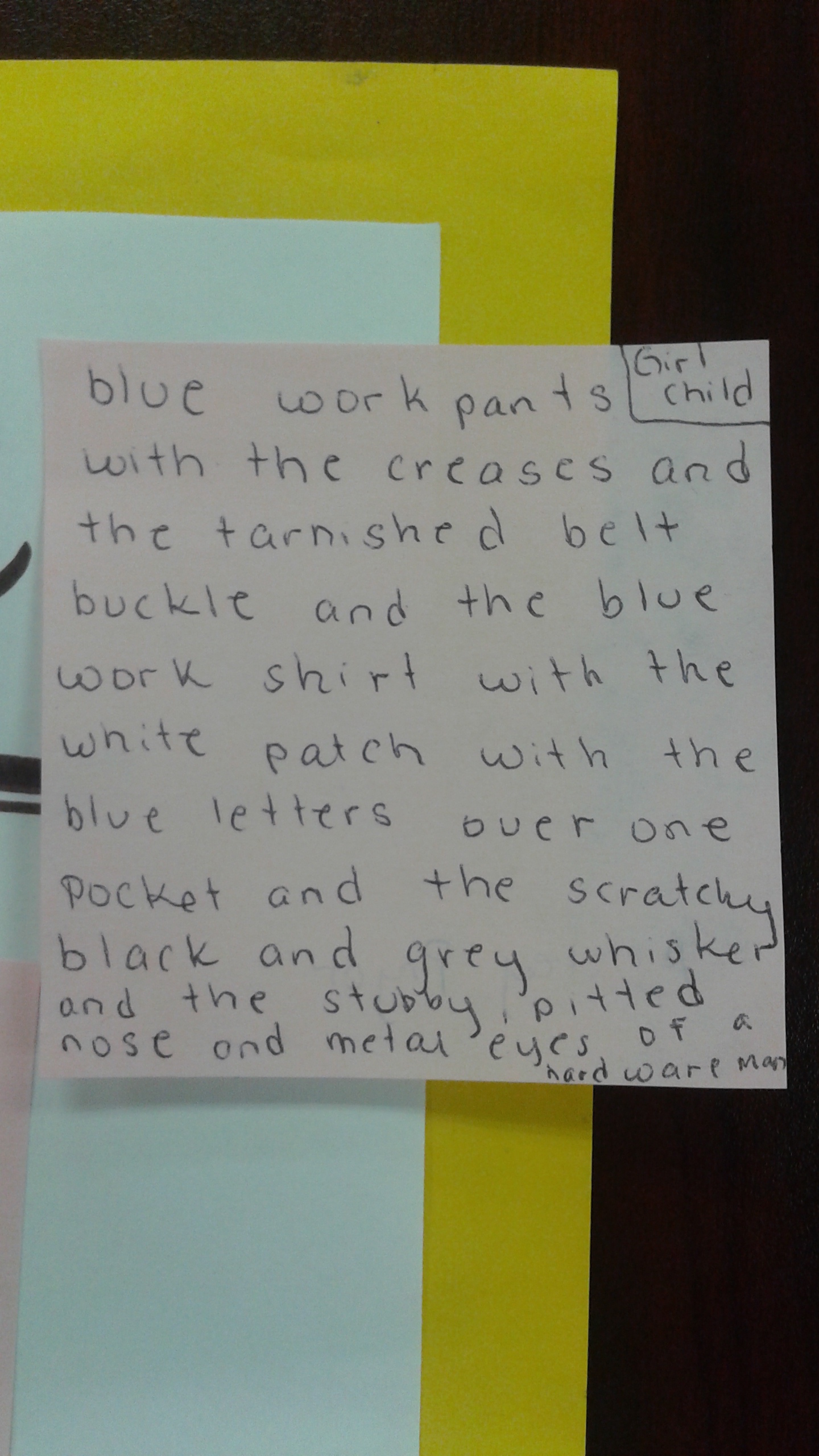
Next, I ask students to pay attention to the concrete details in the book they are reading, and I give them each a sticky note. “As you read today find at least one sentence where the author does something really clever with concrete details and/or figurative language,” I say.

Students read for 15 minutes, pen in hand, paying particular attention to the author’s craft. When time is up, I ask students to share their sentence in small groups and to analyze the effectiveness of the author’s word choice.

AllieTate“Think about what he’s trying to do there. Why did he mention the color of the sweater, or the smell of the breeze?” If they feel like the author’s accomplished creating emotion, they put the sticky on the board (or as in the photo here –poster).

Students need to not only recognize the details and know that they create some kind of imagery, they need to think about how effective the word choice is for what the author is doing at that moment in the story. If I can get them to start thinking about this, I can get them to begin making purposeful choices in their own writing.

Next, I ask students to search their own writing for concrete details that create images and to add a lot more. “Where can you add a phrase or line similar to what you found in the book you are reading? Is there somewhere you can add color or shape or texture?”

And we revise.

Follow-Up — When students immediately apply learning we’ve practiced using their personal reading materials, they begin to see the connections between becoming active readers and purposeful writers. This is the kind of lesson I do again and again with a different literary or grammar skills students to master. Next up:  subordinating conjunctions.

A few lines from students’ published narratives:

“Each body turned to watch as the green army, blurry, entered the gate. The ground only knew sadness and the sky transformed into a dark night, roaming like a lion.” –Tha Sung

“My first impression when I met Lucila:  petite, chunky, short red-velvet hair, wearing a sweater that covered her sins, mysterious face with a sealed silent mouth.” –Karina Rangel

“My brothers slept like angels with devilish grins.” –Geovanni Medina

Mini-Lesson Monday: Imitating Poetry

Reading more poetry with my students has been a goal of mine these past few years, and it’s been a goal I feel has been readily achieved with ideas like creating Heart Books or reading novels in verse.

But writing poetry–well, that’s a different story.

Students who aren’t accustomed to writing poetry need a scaffold before they can leap into free verse composition without a topic, genre, or form prompt.  For this scaffold, I use imitation.

Objectives — Using the language of the Depth of Knowledge Levels:  Identify patterns of language, structure, and punctuation in a given poem; Modify the style of the given poem to suit your purpose; Create a poem in the style of a given poem.

41KeFnbnPfL._SX330_BO1,204,203,200_Lesson — Before the mini-lesson, I will have already booktalked two of Mary Oliver’s books–A Poetry Handbook and Dog Songs, which is always a favorite with my students.  As the mini-lesson begins, I’ll read to them from Oliver’s chapter on imitation.

“You would learn very little in this world if you were not allowed to imitate,” Oliver begins. “Before we can be poets, we must practice; imitation is a very good way of investigating the real thing.”

“I have some poems here today for us to imitate and investigate,” I follow up.  I pass out the following options, lately garnered from my incredible poetry seminar with Mary Ann Samyn:

“Read over these quickly, and choose one you’d like to imitate.  Then open to a fresh page in your notebook.”

“I’m going to write with you, and I’m going to choose ‘A Display of Mackerel,'” I say.  “It seems long, but look how short the lines and stanzas are.”  I put my chosen poem under the document camera.  “Now, this poem is about a display of fish, and I want to imitate it and write about a display of something.  There’s a pretty big display of colorful objects in my room…” I trail off.

“Your library!” Nathan helpfully supplies.

“Yep,” I agree.  “I’m going to imitate this poem and write about my bookshelf.  I’m just going to change a few words per line, but I’m going to keep all the punctuation and the numbers of words the same.  It’s so easy to write poetry this way.”

On the document camera, I begin my imitation next to Doty’s original:

They lie in parallel rows,                   They rest in slumped rows,

on ice, head to tail,                           on shelves, spine to spine,

each a foot of luminosity                   each a sheaf of wisdom

“See how easy that is?  I keep Doty’s structure, punctuation, and even some of his words.  I just change a few to make the poem about my display of books, rather than his display of mackerel.  Now you take a few minutes to give this a start.”

We set about writing together.

After 10-15 minutes, we each have a full imitation poem.  We break into small groups, working with others who imitated our same poem.  We read our poems aloud.  Feedback is given on what we notice–similarities to and diversions from the original, and the effects of both.

Follow-Up — We’ll practice imitation a few more times before we leap into writing poetry independently.  When we do, I’ll ask, as always, that my students create a small anthology of their work on that genre–some samples of their early forays into poetry through imitation, as well as a few examples of their own independent attempts.  I’ll definitely include my “A Display of Books” in my own anthology, as I find it a lovely description of my library that I’d like to preserve.

My Imitation Poem: “A Display of Books”
by Shana Karnes & Mark Doty

They rest in slumped rows,
on shelves, spine to spine,
each a sheaf of wisdom

creased with cracked spines,
which divide the plots’
most gripping sections

like bands of color
in a double rainbow.
Vibrant, luminous

prismatics: think indigo,
the wildly rainbowed
spectrum of a springtime rain,

think sun spearing through clouds.
Wonder, and wonder,
and all of them in every way

unique from one another
–everything about them
a onetime blend of letters. Thus,

they’re all creative expressions
of a million different souls,
each a tenuous effort

of the soul’s footprint,
writer’s essence. As if,
after a lifetime of drafting

at this printing, the author’s
taken irreversible steps,
each as permanent

in its inked completion
as the one next door
Suppose we were shoulder-to-shoulder,

like these, the same but different
from our universe
of neighbors—would you want

to be yourself only,
unduplicatable, doomed
to be in print? They’d prefer,

plainly, to be award winners,
forever honored. Even now
they seem to be straining

forward, heedless of their lifelessness.
They don’t care they’re ink
and simple paper,

just as, presumably,
they didn’t care that they were imagined:
all, all for all,

the rainbowed shelf
and its acres of brilliant words,
in which no verb is singular,

or every one is. How eager they seem,
even on shelves, to be different, selfish,
which is the price of publication.

Mini-Lesson Monday: This lesson stinks, literally.  Teaching Sensory Details in Narrative Writing.

FullSizeRender-1I, like many of my students, am a kinesthetic learner.  Not only do I learn by doing, but for many tasks, I require a hands-on approach to fully grasp the complexity of a concept.  Yet as a teacher, applying kinesthetic techniques to English concepts can be somewhat challenging.  While we write and read and physically play with words, I try to create simulations and activities that allow my students to experiment with writing in unique ways.  This activity, which is one of my favorites of the year, uses students’ olfactory sense to stimulate sensory detail writing within their personal narratives.

Objectives:  Using the language of the Depth of Knowledge levels, students will identify personal memories associated with unidentified scents.  Recalling prior and newly acquired knowledge, they will translate their observations into descriptive writing by constructing sentences that rely on sensory details.  Finally, students will apply their understanding of descriptive writing to their own personal narratives.

Lesson:  This mini-lesson takes preparation, but students’ responses are worth the extra time.  First, collect the following supplies: Plastic cups (I use blue Solo cups), a permanent marker, tinfoil, a toothpick, rubber bands (optional), and a variety of objects that have a scent.  This year I used lime juice, perfume, scented wax blocks from Walmart, BBQ sauce, apple cider vinegar, garlic, mint extract, crayons, and Play-Doh.  Every year is different though and I typically rely on what I have around my home.

I put the scented sauces, liquids, and objects in each of the cups, cover the cups with tin-foil, and wrap a rubber band around the top to secure the foil.  I label each cup with a number and poke holes in the tin-foil with a toothpick.  Next I place the cups around the room. After taking some notes on the concept of “show don’t tell,” students walk around the room smelling the contents of each cup.  They must not peek (believe me they will try)!

FullSizeRender

My students were convinced I had a tiny Abercrombie and Fitch model in this cup. In reality, it was a block of scented wax from Walmart.

I provide each student with a grid in which they fill in the cup number, adjectives to describe the scent, and personal memories the scent conjures.  They must then write a two-to-three-line story or scenario in which they describe the scent without identifying what the scent is.  By the end of the activity, when we come back together as a group, students excitedly volunteer to read their sentences in order to reveal the contents of the cup.

Follow Up:  Following this activity, we identify sensory details within our independent reading books and take turns discussing these details within our groups.  Finally, during workshop time, students add sensory details to their personal narrative rough drafts, in turn “showing” images rather than “telling” them.  The process of digging into their narratives and writing in the margins reinforces the messy, step-by-step process of revision that many of my students struggle to grasp.  If time allows, students partake in a whip share in which we each share one line from our narratives that includes sensory details.

What are some untraditional writing activities you use? How do you get your students moving around the classroom?

Mini-Lesson Monday: Sentence Boundaries and Adding Some Variety

Sorry, I forgot to record the book’s title.

Even the students in my AP English class struggle with correct punctuation and varying their sentences. In one-on-one conferences, I’ve started to remind them more often to pay attention to how the author of their self-selected books craft meaning. I used to get glossy-eyed blank stares, but students are beginning to understand that writers make intentional moves to draw us in, and keep us within, the pages of their books.

“As a writer, you must do that, too,” I remind them.

This lesson grew out of a conferring conversation with a student who told me:  “I just do not understand all the comma and semicolon stuff, but I have a pretty good idea of what I want to say in my writing.”

Objective:  Using the language of the Depth of Knowledge levels, students will recognize the sentence boundaries and the variety of sentence structures in their self-selected books. They will make observations about the author’s use of punctuation in these sentences, assessing the writer’s effectiveness in crafting meaning. Students will then use their author as a mentor as they apply their knowledge of sentence boundaries and sentence variety and create, revise, and rewrite sentences in their own pieces of writing. Finally, through peer-to-peer conferring, students will evaluate the accuracy and effectiveness of one another’s sentences.

Lesson:  Every student needs their independent reading book. If a student is reading a book of poems, or a graphic novel without many sentences, you will want to supply a stand in book for this lesson or ask the student to find a book she’s previously read.

Tell students that you’ve noticed in their writing that they are ready to make their sentences more sophisticated. Correctness is one way to do this. Varying the length of sentences is another way. Instruct students to turn to a random page in their books, say page 51. Ask them to read the page in search of one long sentence and one short sentence. Give students sentence stips or blank paper and have them write out the sentences they find in their books. They should spell and punctuate the sentences exactly like the author does.

sentence boundaries lessonNext, in small groups, ask students to discuss with one another the structure of the sentences. They might put all the short sentences together and compare them. Then they might put the long sentences together and look at how the authors use commas to separate ideas. Some students will know more about grammatical terms than others, and that is okay. The idea is to get students noticing how writers compose within the boundaries of standard English and to get them to understand how punctuation works to craft meaning. Ask questions that help them discover why boundaries and variety work to produce effective writing.

You may choose to have students imitate the sentences they chose from their books. Imitation is a useful tool for many writers.

Using self-selected books, not just to practice wide reading, but to teach students to read like writers, adds an important element to the workshop classroom. Our writing improves when we take the time to notice and apply the skills of professional writers.

Follow up:  Have students review a piece of their own writing. The writing can be in any stage of the writing process. They should study their writing to evaluate their use of sentence boundaries and variety. Encourage students to revise their writing as necessary, remembering to use the author of their books as their mentors.

Extension:  This lesson works to have students study leads, similar to what Jackie wrote about in the mini-lesson Pick up Lines and Leads. It also works to have students search their books for sentences that include imagery.


©Amy Rasmussen, 2011 – 2015

Mini-Lesson Monday: The Power of “I”

Recently, Jackie humorously infused pickup lines and leads into her lesson to engage students in narrative writing.  It got me thinking.  While I am not nearly as funny as she is, I still needed to find a way to minimize the angst with starting a written piece.  Students deserve an opportunity to look at opening lines so they are innately thinking like writers.  Providing them the opportunity to authentically explore various ways to open their stories is key.  So, we gave it a whirl.

Objectives:  Students will recall moments in their lives that have shaped who they are today.  Drawing from their own life experiences students will distinguish what moments they are willing to chronicle in their personal narratives.  Students will construct meaning about their personal experiences by creating a written piece that utilizes author’s craft that has been studied and analyzed.

Lesson:  Let me say that I typically do not focus on opening lines, hooks, what have you until after students have written their pieces.  I find that students are able to more easily and comfortably play with their opening once they know where they’re going…or have gone… with their narratives.  Yet, I was curious to see how this would pan out.

 As we started to jog our memories for those defining moments that have occurred in our lives, we started thinking about questions that would help us dig deep into our own thinking.  A few included:

What do I believe?  (About life, the world, society, family, education, etc.)

What moment has occurred in my life that I am (still) confused by?

What is the most life changing experience I’ve encountered?  What decisions have I made during this situation that have shaped who I am today?

Who is important to me?  Who has made a tremendous impact on me (positive, negative)?  Do I find conflict in this?

What simple pleasures do I relish in when times get tough/stressful?

These questions, among many others, started getting our process underway.  Students had choice and freedom in picking what they wanted to write about – as we know personal narratives are sometimes brutal to compose: sometimes we want to forget what we’ve been through.  Yet, in order to foster the writers in room 369, these questions were written in the first person.  When we write questions for our writers in the second person (What simple pleasure do you relish in when times get tough and stressful?) we are providing them an opportunity to take a step back; to be a bit removed.  When we shift our curiosities to “I” “Me” “My”, it becomes personal.

IMG_20150928_083251

Then, we played with various different ways we could open our stories.  Each student played with concepts, moments, memories, and experiences after seeing how the authors of our independent reading books played with theirs.  Having heard about fifteen authors’ opening lines, students were willing to really dive in and try different ways to start: sounds, quotes, internal thinking, advice they’d been given, visuals, third person…

This visual represents our thinking at the very beginning of this school year.  Students are playing with this deep level of thinking and crafting for the very first time.  There is still some apprehension and hesitation, but for the most part students are willing to try…and play…and craft…and find their inner brave.


Follow Up:  Once students have created numerous ways to start their piece, they will narrow it down to two.  From there, students will start their narratives.  Yet, they are being asked to start their narratives using two different openings…

As writers we know that it takes much patience and practice to feel satisfied with our writing; specifically our opening lines.  Asking students to try writing their pieces from two different starting points allows us to see where our writing goes.  Maybe one start is stronger, prompts more thinking while the other falls flat.  Maybe they both prompt great confidence in continuing to see how they develop.  Maybe the best draft ends up being an infusion of both.

Regardless of where our personal narratives go, starting the process with options both in craft and experience, the pressure of writing is minimized and students feel more at home reliving some of the moments that would have never made it to the paper prior.

How do you foster the willingness to write when fear or apprehension stand in the way of our writers?  What techniques do you use as a writer that you channel to your student writers?

Mini-lesson Monday: Exploring a Page’s White Space in the Writer’s Workshop

PrintCircling the room, I hand out books in preparation for book speed dating. I place Ellen Hopkins’ Crank on a student’s desk.

“There’s no way I’m reading this,” she mutters to her friend. “This thing is huge.”

“Open it up.” I turn towards her, waiting for her to crack the book. She flips to a page and realizes the entire book is in verse. She flips again and again, every page has a minimalist feel, the text spread out, placing emphasis on each word within the sea of white. The sheer length of the book disappears and she is sucked into Hopkins’ narrative.

The more time I spend with teenagers, the more I value the use of that essential “white space.” I love book talking Patricia McCormick’s Sold or Jonathan Safran Foer’s Extremely Loud and Incredibly Close; despite their complex and emotional content, the books are instantly more accessible simply because of their unique structure.

This is why when we discuss paragraph breaks in writing and aesthetics and structure in reading, we also discuss the glory of giving the reader’s eye a break.

Objectives: Using the language of the Depth of Knowledge levels, students will recognize the use of white space within a piece of writing. They will make observations about the author’s use of this tactic, assessing the writer’s effectiveness in employing the use of white space. Finally, use choice reading and whole class examples as mentor texts, they will practice using white space within their own writing by formulating paragraphs at various lengths, revising these paragraphs through peer conferencing, and applying this craft in future writing assignments.

Lesson: Divide students into groups of three or four and have them open up their independent reading books to any page. Ask them to brainstorm what they see based on the page—tell them not to look at content, but instead the structure of the page—the text, paragraph breaks, and length. Have them compare their pages to each other, noting the similarities and differences. Once they have completed this, bring them back together into a whole class discussion. While they discuss their observations, compile a list on the board of what they noticed.

I love to breathe life into authors and remind students that a writer consciously makes decisions on the craft of their pieces. In turn, I have them to return to the structure of their page, focusing mostly on the line breaks, white space, and the spacing and formatting of the text in general. They reflect on this in their writer’s notebook, asking themselves: why do you think the author made this decision? What did they want the reader to think and/or experience?

IMG_2906Following their reflection, we return to discuss their individual pages as a class. Students volunteer to share why their author might have made the stylistic or structural decisions they did, which in turn, inspires other students to reflect further on their own page choices.

We discuss “one sentence paragraphs” and how they stand out surrounded by the white space of heavier paragraphs. They explore how white space can frame longer paragraphs and why exactly writers might use longer paragraphs to convey their point or tell a denser story. We notice how the white space of line breaks can show the passing of time and why it is important for readers to visually have a moment to internalize this time lapse. And finally, as readers, we share how we respond to cramped passages versus double spaced books.

The process of using choice books paired with class discussion helps students recognize the value of their role as a reader as well as how they can utilize these methods within their own writing.

Following our discussion, I take a few minutes to reinforce the points we’ve made either on the white board or through a prepared PowerPoint. These slides provide visual examples from books I am currently reading as well as some tips for applying this knowledge to our own writing.

Follow-Up: At the beginning of the year, students complete a snapshot narrative followed by a longer personal narrative. Using the mentor examples as well as the examples from our choice reading, we look at how we can integrate white space into our own pieces either through line breaks, diverse paragraph lengths, or one-sentence paragraphs. Based on this mini-lesson, they can also trade narratives and provide peer feedback to one another.

What are some mini-lessons you use to help students analyzing the structure of books? How do you help them integrate these observations into their own writing?

Mini-lesson Monday: Student Writing as Our Mentors for Sentences

I read Learning by Teaching by Donald Murray this summer, and I finally understand the importance of using student writing as the main text in my writing class. While I’ve believed students can learn from

I lurked on this chat. Many positive examples of learning from student writing.

I lurked on this chat. Many positive examples of learning from student writing.

reading one another’s work, and I’ve often asked them to read and give feedback — on drafts and published pieces — I’ve never thought to actually use the text to teach a concept. I don’t know why. I supposed I’ve always relied on mentor texts by The Pros for that.

I am changing my tune. Here’s a bit of a lesson that worked better than I could have imagined.

Objectives:  Using the language of the Depth of Knowledge levels, students will write about their lives, and share their writing. They will recognize a wide variety of sentence structures. They will identify patterns, devices, and/or figurative language and discuss its effectiveness in creating meaning. They will revise their writing, formulate their own sentences, and apply their understanding to future writing assignments.

Lesson: Project the image, and ask students to write in their writer’s notebooks one sentence that answers the question. Remind them about what they know about various sentence structures and how punctuation works within a sentence.

“We can pack a sentence with a lot of information if we punctuate it correctly. Pay attention and see how you do. You can write any sentence, but try to not write a simple one.”

Give students about five minutes to write.

Next, ask for a couple of volunteers who are willing to write their sentences on the board. Be sure they understand that there is no judgment.

“We just want to talk about sentences.”

While two or three students write their sentences on the board, ask the other students in the class to read their sentences to each other.

one sentence

One at a time, read the student sentences on the board. Ask:  “What do you notice?”

Ethan sentenceTalk through the various comments students make, noting parallels, punctuation, clauses, word choice, etc.

Watch for teaching points. Ethan’s sentence on the left gave us a lot to talk about:  parallelism, use of semi-colons, colons, …

Next, ask students to return to their notebooks. “How can you make your sentence better?”

Allow time for revision (and time permitting, more sharing.)

Why this lesson works, especially for a writing lesson at the beginning of the year:  It’s just a sentence!

And sometimes we get a bonus gift like this one my class got from Edward:Edward C sentence

“I am the guy who picks people up when I, myself, am down; I am the guy who cares so much over things so little; I am the missing piece to a puzzle that has been forgotten; I am now by a sad and quiet shell of my former self; I am Edward Campos.”

The class hushed. All eyes turned to Edward.

“Wow,” I said, “Thank you for sharing this writing today. You’ve made yourself vulnerable, and we value that.

“First of all, we need to know that you are okay. Will you explain a little more what you mean here?”

Edward explained that he used to be fun and outgoing. He felt strong and powerful. Then at the end of last year and over the summer he learned his friends weren’t really his friends so much. Now, he feels alone and like he’s not the person he used to be.

“Hey, everyone, how many of you have ever felt like Edward?

“Look around, my friend, do you see all those hands? Everyone here has been where you are. We understand. You have new friends here.”

Two girls at Edward’s table leaned forward and touched his arm. “We’ll be your friends,” they said smiling.

And he smiled back.

Of course, because I am me — and I never leave a teaching moment untapped — we talked about the structure of Edward’s sentence. And we talked about the word choice:  “Why ‘forgotten’ instead of ‘lost’?”

When we watch for teaching moments in student writing, we will find them. Every single time.

Follow up:  In class the next day we did some free-writing in our notebooks in response to the spoken word poem “Hands” by Sarah Kay. Before we wrote I reminded students to pay attention to their sentences. Then instead of sharing the whole of what we wrote with the class, we only shared our favorite sentence. I consider this valuable formative assessment.

Now, I will hold students accountable for crafting their sentences with care in their upcoming writing assignment.

“The words of the world want to make sentences,” said Gaston Bachelard. I say, “We have to help them.”

Please share your best tips on getting students to pay attention to their sentences.


©Amy Rasmussen, 2011 – 2015