Tag Archives: Jackie Catcher

Students Need Real-Life Writing

suit-and-tieWe live in a technical world. People rarely see one another face-to-face anymore, which is why writing has become our hypothetical suit-and-tie. To get a job, one uploads and sends a cover letter and resume. To apply to college, one submits a college essay. To correspond with a colleague, one sends an e-mail. To be engage in online discussions or to communicate on social media, one must post or blog or tweet or comment. More than ever before, we are our words. We live in an age where we can look and act like slobs behind the screen while our words tell a different story. It’s empowering and liberating but also terrifying. Terrifying because too often our students don’t understand the value of formality in writing.

This has become even more apparent as I, a 26-year-old, am both exposed to and part of a generation of socially illiterate people. We, as well as our students, understand text language, chatting, posting, and tweeting, but our colloquial language seeps into our every day interactions, handicapping us in other ways.

While students can effectively communicate with their peers, they have not received the training to engage in formal written conversations—the types of conversations that drive the academic and business world. In turn, students arrive in college lazily piecing together informal e-mails to their professors that poorly represent their abilities and knowledge. We assume that because they have grown up as Internet babies and that because they are constantly on their phones, they understand the unwritten rules of Internet writing, but they don’t. This year I have made it a point to inject the discussion of voice, formality, and audience into my reading and writing units in an attempt to widen my students’ understanding of and comfort with writing.

In all of my classes I have sought to push my students outside of their comfort zones by exposing them to diverse mentor texts and assignments that force them to play with words. For many students, voice is a challenging concept. They struggle with finding a voice in their own writing, which makes it even more imperative students be exposed to comedic, sardonic, opinionated, and academic pieces. The only way to develop voice is to study it. Not all of the pieces I show my students are high brow; I pull from a variety of sources ranging from blog posts to articles from The Atlantic. But the pieces I choose are intended to show that a wide range of writers and voices exists. The more students understand that there is no one-size-fits-all structure, the sooner they will be willing to dabble in their sarcastic or silly side.

In learning about voice, students must also understand the value in formality and audience in their writing. Too often the e-mails I receive from students look like a long rambling text message. We’ve all received them—the ones riddled with grammatical errors, making us cringe and wonder if they’ve learned anything this year! Teens quickly become comfortable with the fact that teachers are the only people reading their writing. Students become overly comfortable with teachers reading their writing at times. We’re seemingly safe and familiar; we know their quality of work. Exposing their writing to new eyes and ears increases the stakes and makes their work more relevant.

This year, I was determined to push my lower level freshmen beyond the classroom and get them engaging with mentors. I could tell my students to work hard, which I did many times over, but in the general scheme of things, I was their teacher (akin to their mom). So I recruited a Navy Seal, an elementary school teacher, a forensic anthropologist, a photojournalist and others to do the job for me. Students were required to research a career. While they completed their research, I sat down with each student and helped him or her to draft an e-mail that they would send to a professional with which I paired them. Oftentimes I would return to find my students’ e-mails plagued with the same grammatical errors I’d seen so many times before,Depositphotos_7626816_m only this time, I was with them on the sending end.

My mini-conferences turned into minilessons on the importance of editing and the impression it had on the e-mail recipient. Students struggled with how to start their e-mails, how to address the recipient, and how to sign their name at the end. We practiced online manners, thanking the professionals for their time and answers while also noting something the student found to be interesting or appealing from the professional’s answers. In the end, their attention to detail paid off. A forensic science professor who teaches college students included the following in his e-mail:

“I was taken aback when I saw that he is only in ninth grade; I have students much older who do not bother to write properly and it disappoints me.  I am not your friend on FB nor are you texting me so no need for brevity at the expense of complete and correctly written sentences.  Salutations?  Maybe next year.

I have a 12 year old son so I think I will have him peer over my shoulder as I write to Carter so he can see how polished someone so young can be.  Thanks!”

Our students are going to college arguably without knowing or understanding the importance of voice, formality, and audience. To prepare them for life beyond high school, we must strive to incorporate real-life writing assignments into our classrooms. While some of my students may never write a research paper after they graduate from high school, I know that nearly all of them will use e-mail, apply for jobs, and engage on social media.

My role as an educator is to help mold and train productive and intelligent citizens and while giving them lifelong skills that translate beyond the classroom. Part of this is continuing to develop and adapt my classroom to better fit the needs of 21st century students. So regardless of what my students do in their free time whether they enjoy lounging in sweatpants with a tub of Doritos or taking selfies in a bathroom mirror, I want them to sound like poised, intelligent, and confident individuals. I want the world to be open to them—both online and in real-life.

Is Everyone Hanging Out Without Me? (And Other Concerns) by Mindy Kaling

10335308I work north of Boston in that pocket of New England that keeps getting blasted with snow this season. I know I shouldn’t complain—I live in New Hampshire after all—but the snow banks have far surpassed my height, making me even more stir crazy than usual. Even now as I write, snow is lightly falling outside my window. While I will readily admit that my state looks breathtaking blanketed in white, she is getting a bit narcissistic at this point. So for those of you who need a good laugh during these dark days of winter, I highly suggest Mindy Kaling’s Is Everyone Hanging Out Without Me? (And Other Concerns).

I rarely watched The Office and I’ve seen one episode of The Mindy Project, but for some reason I was drawn to this clever and quirky actress. She is relatable and down-to-earth, a self-made woman who details her rise to fame in this book. What I love most about her book though is her identification as a writer. In fact, one chapter called “How I Write,” which I share with students, is entirely devoted to her process. She writes:

I’ve found my productive-writing-to-screwing-around ratio to be one to seven. So, for every eight-hour day of writing, there is only one good productive hour of work being done. The other seven hours are preparing for writing: pacing around the house, collapsing cardboard boxes for recycling, reading the DVD extras pamphlet from the BBC Pride & Prejudice, getting snacks lined up for writing, and YouTubing toddlers who learned the “Single Ladies” dance. I know. Isn’t that horrible? (Kaling 143).

While that doesn’t mirror my own writing process exactly and it certainly isn’t a method to aspire to, I know there are days when I sit refreshing Pinterest for inspiration. I imagine our students can relate as well.

In the end, readers will have a good chuckle given Kaling’s eclectic chapters that bounce around to different topics. Her energy and humor are just enough to brighten even the snowiest of days.

Sitting on the Hogwarts Express

“You must be a first year,” he asked the girl sitting across from me. Her brown bangs framed her eyesphoto 3-7 as she looked up at him, holding her mother’s hand. Her mother chuckled in the seat beside her. “And you two must be fourth or fifth years?” he continued, miming in the direction of my sister and I. I blushed at the thought of this man implying we were around 15 years old, the same age as my actual students. But I let him indulge.

“We are alumni, friends of Dumbledore.” And for a moment, I could see it—his hands perched on the head of his cane as he motioned towards his wife who sat wedged into the corner seat beside him. She nodded in affirmation, giggling at her husband’s show. I was on the train to Hogwarts at Universal Studios, a mecca for Harry Potter nerds like myself who never grew tired of the magic, the story, the wonder.

This was the first time that I truly gave into the commercialism of my favorite book. I had grown up alongside Harry; I was the same age as him when the series began and each new release marked my own maturation as well. Yet I was a selfish reader. I wanted the world between the book covers for myself. While some children indulged in sharing books with their friends, I loved the escapism of reading. Books made me feel special, unique, like somehow the author’s imagination was for me alone. I so desperately loved these worlds that I had come to indulge in that I refused to believe others could feel or even revel in the same universe I had come to know and appreciate.

As I entered the Wizarding World of Harry Potter, I let go of the resentment and anger I had as a child—the feeling that somehow the world of magic had been poisoned. For the first time, the books my mind had lived in came alive around mphoto 1-11e. Throngs of readers surrounded me as I walked the streets of Diagon Alley, weaving my way through shops I had only dreamt of as a child. Flowing black robes enveloped children waving their wands and watching scenes awaken before their eyes as parents looked on sipping foamy pints of butterbeer. A stone dragon teetered atop Gringott’s bank, breathing fire towards patrons below.

Had I known when I was eleven that I would become an English teacher who presses students for their thoughts and opinions on what they’re reading, I would have to sought to share my relationship with books instead of internalizing it. Sitting on the Hogwarts Express that day with four generations of readers proved the unifying power of literature as I chatted with complete strangers from across the country about the intricacies of the series. We had each discovered these stories at different times in our lives and we had each read ourselves into the books, deriving different meanings from our separate readings.

I see this power every day in the turnover of my classroom library and the popularity of certain books. While the stories stay the same from year to year, my students do not. They ride the climaxes and lulls of common stories as groups, suggesting certain books to each other based on their own personal experiences. They laugh aloud in the middle of reading time and they cry quietly curled around their books in their bedrooms. They engage in the terror of The Maze Runner series then quietly lend the books to their friends only to excitedly discuss their individual experiences during down time. Books elicit reactions; they cause people to feel, and because of that, students pass on their suggestions to friends. The transformative power of common stories never ceases to amaze me—how such books can help define the path of one individual or bring together multiple. I spent years of my childhood believing that sharing my passion somehow devalued it, but I have learned that the uniqueness of reading lies in the fact that no two people ever read the same book. In the end, we can hold our individual experiences close, while still sharing the magic of common worlds.

Unraveling the Mystery of Poetry

My first year of teaching I learned that my students thought poetry was a convoluted, confusing, incomprehensible jumble of words. They believed the more muddled the language, the better the poem. Students would write poetry in their writer’s notebooks and then ask me to translate it for them: “what do you think this means?” or “what do you think I’m saying here?” They’d ask, and I knew it was a dangerous game. I felt like a psychic, asking vague enough questions to pull out some story I could piece together. The students who weren’t writing in garbled tongues were crossing their arms in protest of the poetry unit.

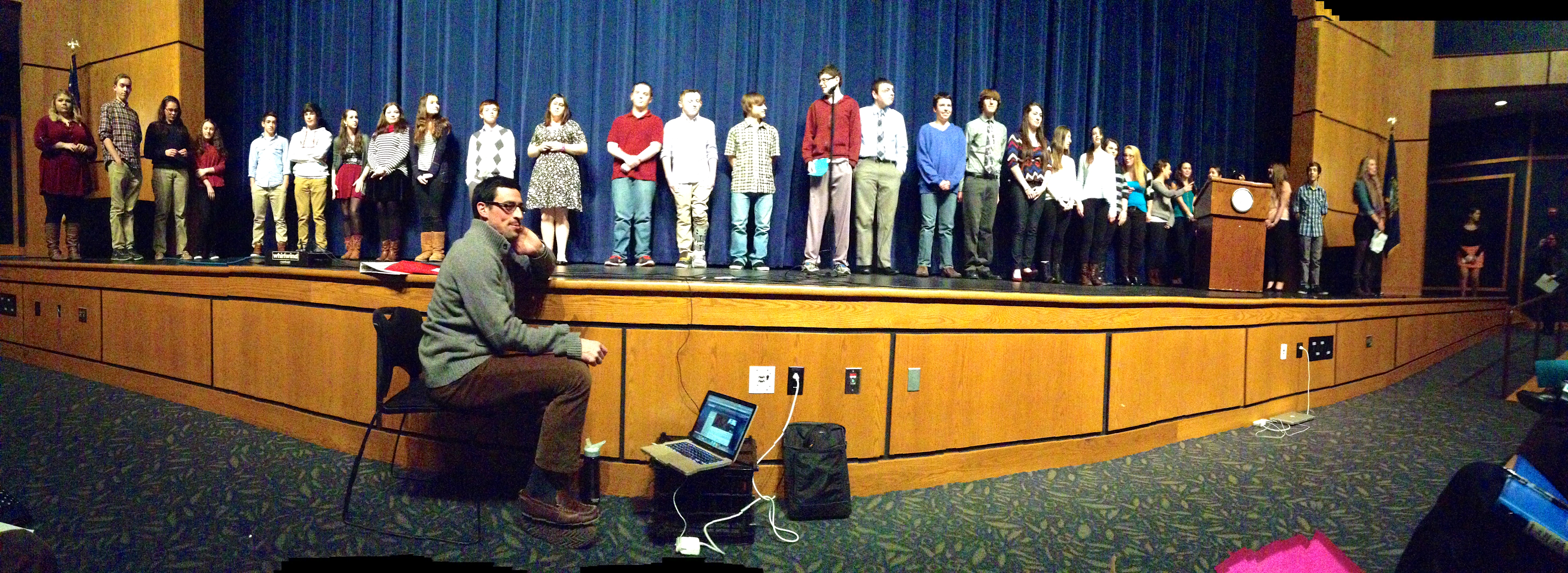
I quickly learned that my students needed to hear contemporary poetry, poetry that pulled them in as readers and allowed them to feel something, anything. Over the years I have sculpted my poetry unit to meet the needs and wants of my students. It has become my favorite unit because it is the one that fits flawlessly into the workshop model; it provides the greatest opportunities for differentiated instruction and unique output. While I integrate poetry into my lessons throughout the year, I eagerly ramp up student exposure during the few weeks that surround our school wide Poetry Out Loud (POL) competition, a national oratory competition in which students perform a poem from the POL website (http://www.poetryoutloud.org/). I have found that four main components within my poetry unit have proven successful in educating students on what poetry has to offer.

 1. Flood students with contemporary poetry

The easiest way to help students connect with poetry is to provide them with examples that speak to them. I begin my poetry unit by playing two songs. They could honestly be any songs that have a story, but my choice this year was “The A Team” by Ed Sheeran and “Wings” by Macklemore. I explain to my students that poetry is all around them. In fact, poetry is the most accessible form of writing they come in contact with on a daily basis because it is used in music, and how many students walk around with ear buds jammed in, listening to the words of poet-musicians.

Students warm up to this thought quickly, but it’s the spoken word poetry that tends to catch them off guard. I lead poem talks instead of book talks during this unit and I expose students to a variety of spoken word performances, my favorites being from Taylor Mali, Sarah Kay, and Shane Koyczan. I also find that spoken word poetry tends to pop up throughout the year. Oftentimes students send me their favorite pieces and I collect these for this unit. This year’s popular video, which was performed by a trio of teenage girls from a program called Get Lit, is called “Somewhere in America.” (http://queenlatifah.com/lifestyle/heroes/get-lit-power-of-poetry/). Last year’s viral video “Look Up” by Gary Turk served as a call to students to put down their technology and start living in the moment (https://www.youtube.com/watch?v=Z7dLU6fk9QY).

Students complete quick writes based on these poems to help them explore the meaning and depth of the poem. I ask them to write about their reaction to the performance, to pick a line from the poem that speaks to them, or to write about memories the poem might stir up; the goal is to get them responding to and talking about poetry in some way while recognizing that their reaction as a reader is valuable.

2. Put Poetry on Display

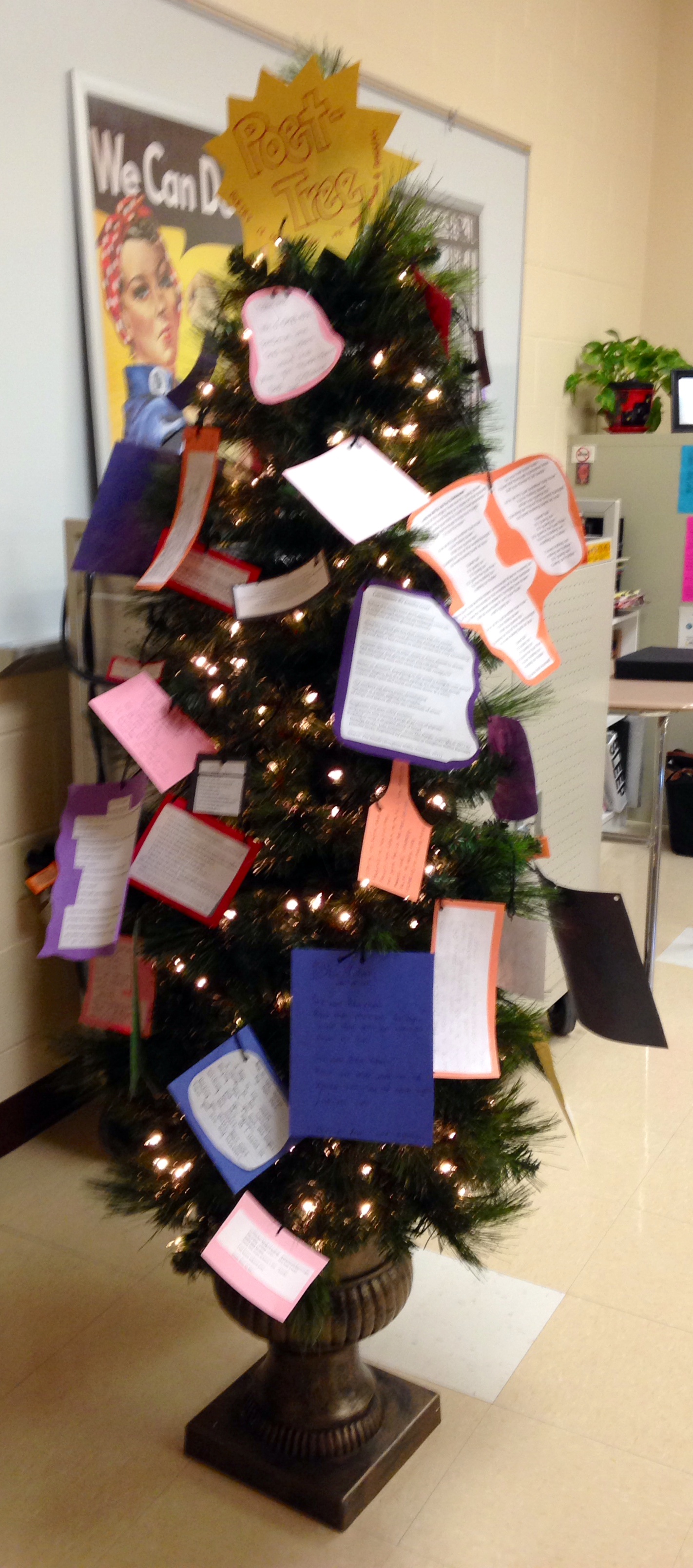
Our class Poet-Tree

Our class Poet-Tree

Part of exposing students to contemporary poetry also involves helping them to recognize poetry within their surroundings. During the poetry unit I make a point to both display and discuss books that include poetry. I like to discuss Ellen Hopkins’ books and use Brian Turner’s war poem anthology Here, Bullet as well Jay-Z’s book Decoded, which includes annotations of his rap lyrics, as mentor texts. I also integrate classic poetry to make sure students are exposed to a wide variety of poets and pieces.

Inspired by a Pinterest pin, I started a Poet-Tree this year. I asked students to take a week to find poetry surrounding them. They could bring in a poem they enjoyed, favorite lyrics from a song, excerpts from a book, or anything they deemed to be poetry. The goal was to reinforce that poetry exists all around us, and judging by the final product, students were able to recognize the larger implications of the poetry unit.

3. Have students Participate in Poetry Out Loud or a poetry reading

Ownership is central to the poetry unit. Students oftentimes give into poetry because they have a say in what poem they would like to memorize, analyze, and perform. Furthermore, they are invested because their peers

A poem displayed on our class Poet-Tree

A poem displayed on our class Poet-Tree

hold them accountable.

I give students ample class time to explore the available poem choices on the Poetry Out Loud website. Once they choose their poem, I lead them through a variety of activities intended to help them fully analyze and understand their poem. We explore the meaning behind the poem, creating a word dictionary to understand the significance of word choice. They research the poet’s background and historical events/facts that might have played a role in the writing of the poem. They learn about the appearance of the poem and how author’s choice plays a role in line lengths and stanza breaks. Finally, we discuss sounds within poetry and how poetic elements affect how a piece is read. This intimate look at the structure and development of the poem prepares students to perform their poetry at our final poetry café.

 4. Create a poetry and post cards match between schools

The post card I traded with the elementary art teacher at one of our local schools.

The postcard I traded with the elementary art teacher at one of our local schools.

Every year our freshmen classes pair up with a group of fifth graders from one of our local elementary schools to participate in a program we call “poetry and postcards.” Fifth graders paint or draw a post card in their art class to send to a high school buddy. In return, our students write a poem to match the post card while also sending a letter to the student with some information about themselves as well as advice for the fifth graders as they move up to middle school. My students are invested in the project and oftentimes receive notes back from their fifth-grade buddy.

While my poetry unit is packed, students move on with an understanding that the process of comprehending and connecting with poetry isn’t so different from the process of reading a novel. They see the relevance and beauty of language and tend to leave with a greater appreciation of an art they otherwise despised.

The school-wide Poetry Out Loud competition

The school-wide Poetry Out Loud competition

Craft Study–The Glass Castle

51iqte2Ed-L    At the beginning of The Glass Castle is a brief four-paragraph acknowledgment, the type of side note readers skip over to get to the story. The last line reads, “I can never adequately thank my husband, John Taylor, who persuaded me it was time to tell my story and then pulled it out of me.” The line is sentimental and sweet, but to me, a teacher, it speaks volumes. The idea of unfurling a sordid past like Jeanette Walls’ elevates this book from a simple autobiography to an outright journey, the same journey our students undergo as they explore their own stories.

In turn, every year, I book talk The Glass Castle, a book that sends my students on a roller coaster of emotion. In my upper level Advanced Composition course, I use the first chapter in “Part II: The Desert” as a mentor text since it begins with a brilliant snapshot in time which both startles and intrigues my students:

“I was on fire.

It’s my earliest memory. I was three years old, and we were living in a trailer park in a southern Arizona town whose name I never knew. I was standing on a chair in front of the stove, wearing a pink dress my grandmother had bought for me. Pink was my favorite color. The dress’s skirt stuck out like a tutu, and I liked to spin around in front of the mirror, thinking I looked like a ballerina. But at that moment, I was wearing the dress to cook hot dogs, watching them swell and bob in the boiling water as the late-morning sunlight filtered in through the trailer’s small kitchenette window” (Walls 9).


The opening line is brilliant: “I was on fire.” It quickly ropes in my students as they are caught by the innocent voice of the next few lines: “It’s my earliest memory. I was three years old…” The interjections of childlike wonder make this passage even more haunting as students go on to learn that Jeannette’s beautiful tutu catches on fire and lands her in the emergency room with third-degree burns.

The chapter, which is six pages long, includes a plethora of craft marks that get students thinking about opening sentences, sensory details, one-sentence paragraphs, and the manipulation of time. The chapter can easily be broken down into shorter snapshot segments, which I have students dissect and analyze within smaller groups. These small discussions culminate in a larger whole class discussion that has students drawing out examples from the text to support their readings and interpretation. The best part though is after reading this mentor text most students are hooked. In turn, The Glass Castle becomes one of the most sought after books in my classroom library.


Building My Library Around My Students

My first time at NCTE, I played supermarket sweep alongside the other teachers. I didn’t have one of those grandma-rolling-carts to gather my goods in, but the victory was still sweet as I tossed book after book into my free bags. But lo and behold, as I returned home with my goods, I realized that some of the books were middle grade, a tad too young looking to impress my high schoolers, while others were sequels to books I didn’t own. My humble pile was quickly halved as I weeded out and gave away the books that just wouldn’t fit into my classroom library.

This year I took a different approach; I arrived at NCTE with certain students and issues in mind. Suddenly my mission to collect free and heavily discounted books turned into a mission to fill the holes in my classroom library. This not only narrowed my search but also made it easier to discuss potential titles with booksellers. The following are some of the gems I scored at NCTE 2014:

What I needed…Books that help students cope with a friend’s suicide

20726924Sadly, suicide is a tragedy that has touched my school a few times over the past few years. I am reminded of this at the beginning of every year when I receive personal narratives relaying the stories of students’ past friends or relatives. The wounds are deep and raw and fresh, which is why my students need literature to help them cope with such atrocities. This year, I left NCTE with two books that filled this niche: Rumble by Ellen Hopkins and The Last Time We Say Goodbye by Cynthia Hand. I have a growing group of Ellen Hopkins devotees who bask in the poetic prose of her books as well as the gritty subjects. Rumble attacks heavy issues through the story of Matt Turner, whose younger brother commits suicide 17285330after being bullied for being gay. The Last Time We Say Goodbye, which is due for publication in February 2015, tackles similar themes, only in this book, the female protagonist Lex loses her brother. Lex struggles to cope with her brother’s death and can’t let go of a text message she received from her brother the night he died.

This is unfortunately a topic that will continue to ripple through and impact my students as I receive students who are impacted by the deaths of friends and family members they have lost to suicide. There are no answers to such a devastating event, but I do hope that these books will help show students that they are not alone.

What I needed…Books that are low level but high interest

I fervently believe that students need a dose of success to give into reading. Too often my students 8011arrive turned off to reading simply because they haven’t been exposed to books that interest them. Furthermore, the students who are most resistant tend to be those who are not proficient or only partially proficient in reading and can’t seem to find books that are at a lower reading level yet a high interest level for their age group. My greatest find was a small bookstall towards the back of the convention room that included books from the Sidestreets and Real Justice Series. These books involve gritty stories with heavy hitting topics such as drug abuse, mental health issues, and social problems. While the books I received were between third to fifth grade reading levels, the sepia and black and white photo covers leant a more mature tone to the story—a strong selling point for low level, reluctant readers. I walked away with Jailed for Life for Being Black by Bill Swan, Blow by Jodi Lundgren, and Off Limits by Robert Rayner, all books I’m looking forward to introducing to my reluctant readers.

What I needed…Books that discuss LGBTQ Issues

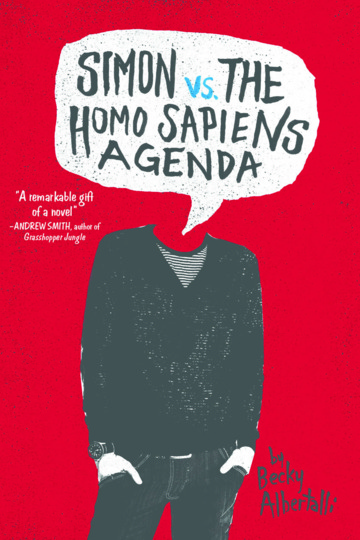
openlystraight_cvThis is the first year I have had openly gay students who have written either personal narratives or stories about homosexual relationships. The more I read their papers, the more I began to evaluate what sorts of LGBTQ mentor texts I had available. While I had a modest collection of book including Shine by Lauren Myracle, Everyday by David Levithan, and Will Grayson, Will Grayson by John Green and David Levithan, I needed more. That’s when I stumbled upon Openly Straight by Bill Konigsberg in which Rafe, an openly gay teenager, transfers to a New England boarding school where he decides to keep his sexuality a secret. A funny read, this book forces Rafe to question who he is and what it means to fit in. 10015384In a similar vein, I also procured an advanced reader’s copy of Simon vs. The Homo Sapiens by Becky Albertalli, which is due for publication in April 2015. This book follows 16-year-old Simon who is not openly gay. Simon is blackmailed after one of his flirty e-mails to a boy he has been talking with falls into the wrong hands. These books diversify my library and address issues that many of my students are both facing and writing about.

These are only a few samples from the stacks of books I received, but as I returned to the classroom on Monday, I told all my students about the exciting run-ins I had with famous authors like James Dashner and David Levithan and Ally Condie. I spoke with the students I had “shopped” for, letting them know what books I had bought and how I had them in mind when I purchased them. While I hope the books leave an indelible mark on my students, I know that ultimately my students leave an indelible mark on the growth and construction of my library.

What books did you bring home from NCTE? Are there any holes that need filling in your classroom library? What might you be searching for?

Finding A Teaching Family Outside of School

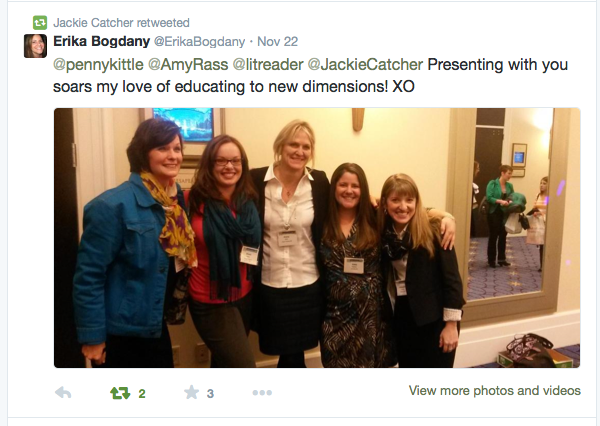
“It’s funny how my closest friends live states away,” Amy said to me as we crossed the convention center’s atrium during NCTE. I agreed; our group of four, Amy, Shana, Erika, and I, might live in different parts of the US, but we share a unique bond, one that has carried me through both the highs and lows of teaching.

Teaching is an anomaly: for being such a social career, it is also quite isolating. I learned this my first Screen Shot 2014-11-26 at 9.37.08 AMyear when I went from sharing a classroom during my yearlong internship to suddenly being by myself at the end of the hall. I found that while my colleagues and I would sit down for lunch everyday, we struggled to find common times to chat about our work or pedagogy outside of professional development days or staff meetings. Despite being within the same building, we’d oftentimes take to the Internet to discuss our plans and work with one another. Over the summer I would receive messages from Jenn about a fantastic new book we could incorporate into our academic English curriculum or recently I received a Pinterest pin from Kristina pointing out a fun way to teach sentence diversification.

Social media has changed the face of my professional learning network. While many of my teacher-friends are at my school, my core group doesn’t just involve those within my state anymore. I have discussed pedagogy with teachers in Canada, talked shop with friends in Washington D.C., and connected with educators across the country. Teaching is no longer the isolated occupation it once was. Over the past two years, these discussions have had a profound effect on my development as a teacher. Many teachers have helped to shape the workshop model within my classroom by being honest about their successes and struggles. My PLN has given me a place to geek out over reading, writing, and discussing literature. And ultimately, this passion online translates into my enthusiasm within the classroom.

With Thanksgiving right around the corner, I cannot be more thankful to my online peers as well as to Screen Shot 2014-11-26 at 9.33.43 AMthose teachers who I have met at conventions and in classes. I am grateful for the relationships I have garnered via social media and e-mail. No teacher should feel alone in this occupation—there are countless resources to uplift and inspire even the most isolated. After all, teaching is an occupation composed of charismatic, committed, and loving individuals who not only see the best in their students but also search for the best in each other.

It goes far beyond your Everyday story

51i318LHixL._SY344_BO1,204,203,200_If you doubt, question, or undermine the complexity or rigor of young adult literature, read Everyday by David Levithan. Despite the book’s bland beige and gray cover, there is nothing dull or colorless about this story. It is a philosophical and, in my opinion, a political statement that calls into question what it means to be an individual in today’s world.

In the book, A is a genderless soul that inhabits a different body everyday (hence the title). The conflict is that A, in the first chapter, falls in love with Rhiannon, the girlfriend of a boy whose body A currently inhabits. Don’t worry; it isn’t as confusing as it sounds. This simple love story leads its readers to question what defines gender and even love as A inhabits different bodies throughout the book. Furthermore, A questions what the difference is between the soul and the body and how they can function as one or even two distinct beings.

David Levithan captures the beauty and innocence of being human through the simple yet straight forward perspective of A, an old soul with deep knowledge: “If there’s one thing I’ve learned, it’s this: We all want everything to be okay. We don’t even wish so much for fantastic or marvelous or outstanding. We will happily settle for okay, because most of the time, okay is enough.” A goes on to one of my favorite passages of the book, a passage that is great for book talking and providing a brief teaser without giving anything away.

I am a drifter, and as lonely as that can be, it is also remarkably freeing. I will never define myself in terms of anyone else. I will never feel the pressure of peers or the burden of parental expectation. I can view everyone as pieces of a whole, and focus on the whole, not the pieces. I have learned how to observe, far better than most people observe. I am not blinded by the past or motivated by the future. I focus on the present, because that is where I am destined to live.

“I learn. Sometimes I am taught something I have already been taught in dozens of others classrooms. Sometimes I am taught something completely new. I have to access the body, access the mind and see what information it’s retained. And when I do, I learn. Knowledge is the only thing I take with me when I go” (Levithan 6).

As a teacher, it is easy to love this passage. After all, it ends with the value of learning, but beyond that, this page (the entirety of page 6) shows A’s struggle with defining him/herself as an individual. Not only is there minimal diversification in the sentence starters, but A uses the personal pronoun “I” 25 times in just one page: “I would,” “I took,” “I felt,” “I am,” etc. This practice goes against the rule of what we oftentimes teach to young writers—stray away from using I at the beginning of every sentence. Levithan’s willingness to break the rules and question the norm is what makes this piece both a masterful mentor text and thought provoking must-read.

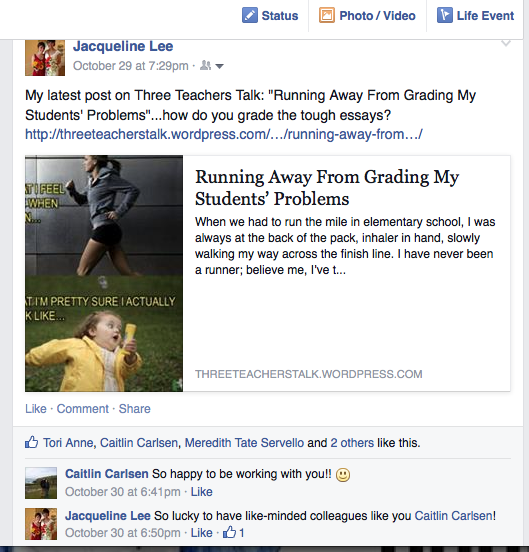
Running Away From Grading My Students’ Problems

when-i-runWhen we had to run the mile in elementary school, I was always at the back of the pack, inhaler in hand, slowly walking my way across the finish line. I have never been a runner; believe me, I’ve tried. So on Saturday afternoon, when I got the urge to hit the pavement in a light, albeit slow, jog, I was running away from more than my problems—the heaps of papers, laundry, meetings, assignments, and work I had waiting at home. I was running away from grading the problems of my students.

In the beginning of the year I always find that students are hesitant with their writing, cautious to share with one another, eager to find personal stories that are interesting yet not too revealing. I don’t blame them—after all, as much as we want to believe high school is a safe space to share our feelings and experiences, it isn’t. Bit by bit though, students unravel, some sooner than others, and slowly I begin receiving stories that are raw and honest. This last set of personal narratives I received included stories about the deaths of parents and grandparents and the suicide of a close friend. Students spoke about dealing with anorexia, suicidal ideations, and clinical depression. At 16 and 17 years old, many of these students have lived more life than some adults.

Part of this process has to do with the fact that my students peer review each other’s work. I find that as they are exposed to one another’s writing they tend to open up further. In addition, I share my own writing with them, in particular one piece on the complications that happened after my father had open heart surgery two years ago. I pick and choose what classes I share this piece with. Some classes are ready to hear that their teacher is capable of fear, anger, anxiety, and hurt; some classes aren’t. The piece is revealing of who I am as a daughter and sister instead of pigeon holing me into the role of a leader and teacher.

The problem with this dynamic is that it doesn’t fit into the traditional education system. While I am not an advocate of grades, I am also not anti-grades. Still, I find that no number can adequately convey the power of writing or the strength and guts of these students. As a teacher, I have to look at the structure, craft, mechangrade-620x425ics, and formatting of a paper, but no matter how much I observe the concrete aspects of a piece, I cannot help but remember that my job isn’t just about correcting punctuation or spelling; my job is to do justice to the stories of my students, to help them tell these stories in the most compelling way possible, which is what led me to my run on this fall day.

Unfortunately, my tromping across scattered leaves with heavy breathing and a stitch in my side didn’t bring any clarity, and when I returned to my kitchen table, the same stories sat underneath my pen, covered in blue ink that praised their bravery, their craft, their story. But still, these stories were gradeless, waiting for a number, waiting for the end of the quarter, waiting to be put into my online gradebook. So my question for all of you teachers, those of you who have been teaching and grading for far more many years than I, how do you tackle these difficult papers? How do you tack on a number to something that has so much more value?

Growing Readers

Autumn in my New Hampshire school district.

Autumn in my New Hampshire school district.

In New England, where I teach, time is measured by temperature. New Englanders cherish Indian summers (the bout of warmth before fall settles in); we sense the bite of autumn, and can smell an oncoming snow. We are a community of seasons, and ultimately these changes dictate the course and development of our year. In turn, to show the development of my classes’ reading progress throughout the year, I drew my inspiration from what New England is famous for—its foliage. To visually represent my classes reading progress within the reading workshop, I developed a reading tree.

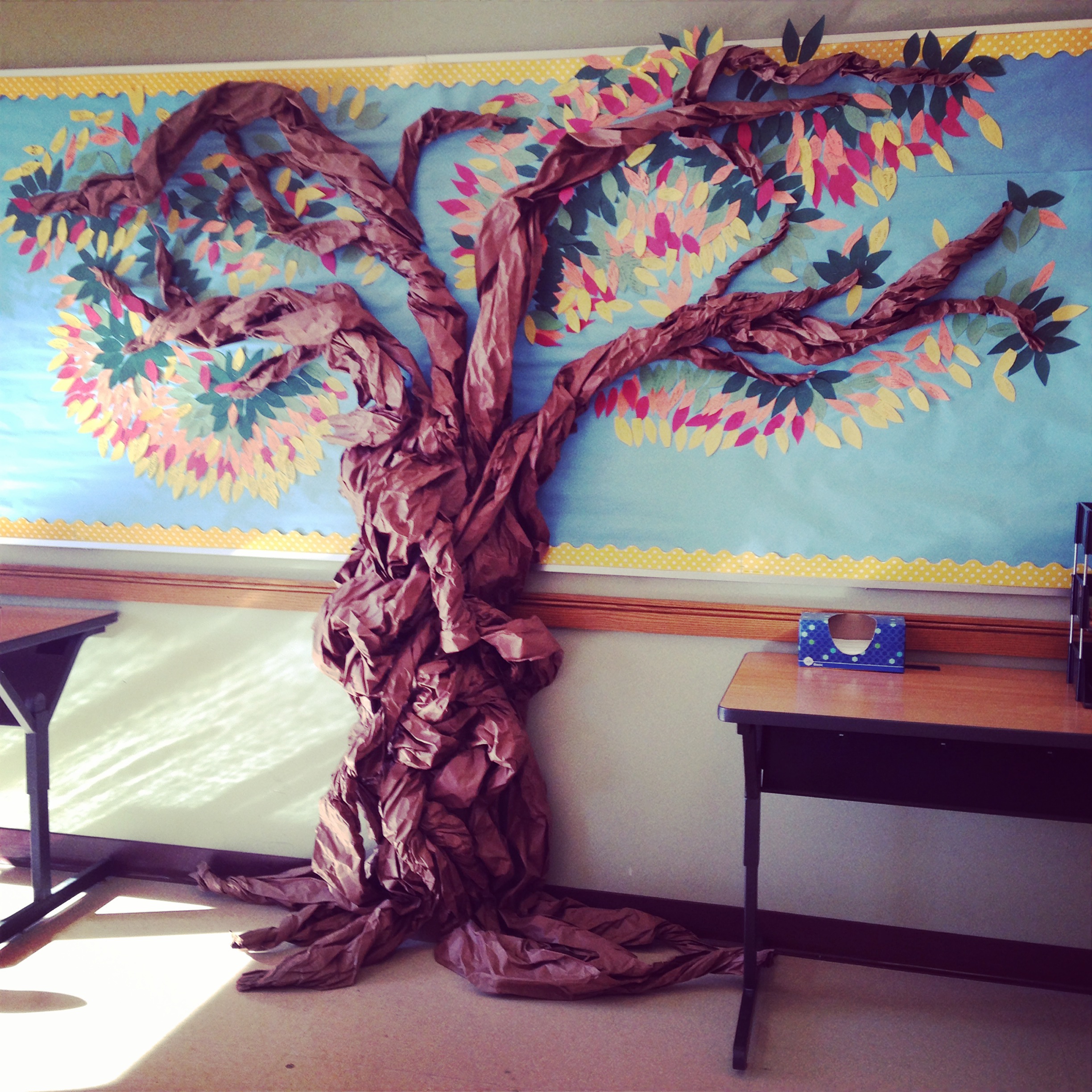
The concept of the tree is simple: for every book read, students received a leaf. On the leaf they wrote their initials, the book they read, and the author. They would then staple the leaf to their class’ branch. In turn, students had a visual representation of their individual progress (because they put their initials on the leaves) as well as their class’ progress. They would look to the tree to see what books were the most popular/appeared on the tree most often.

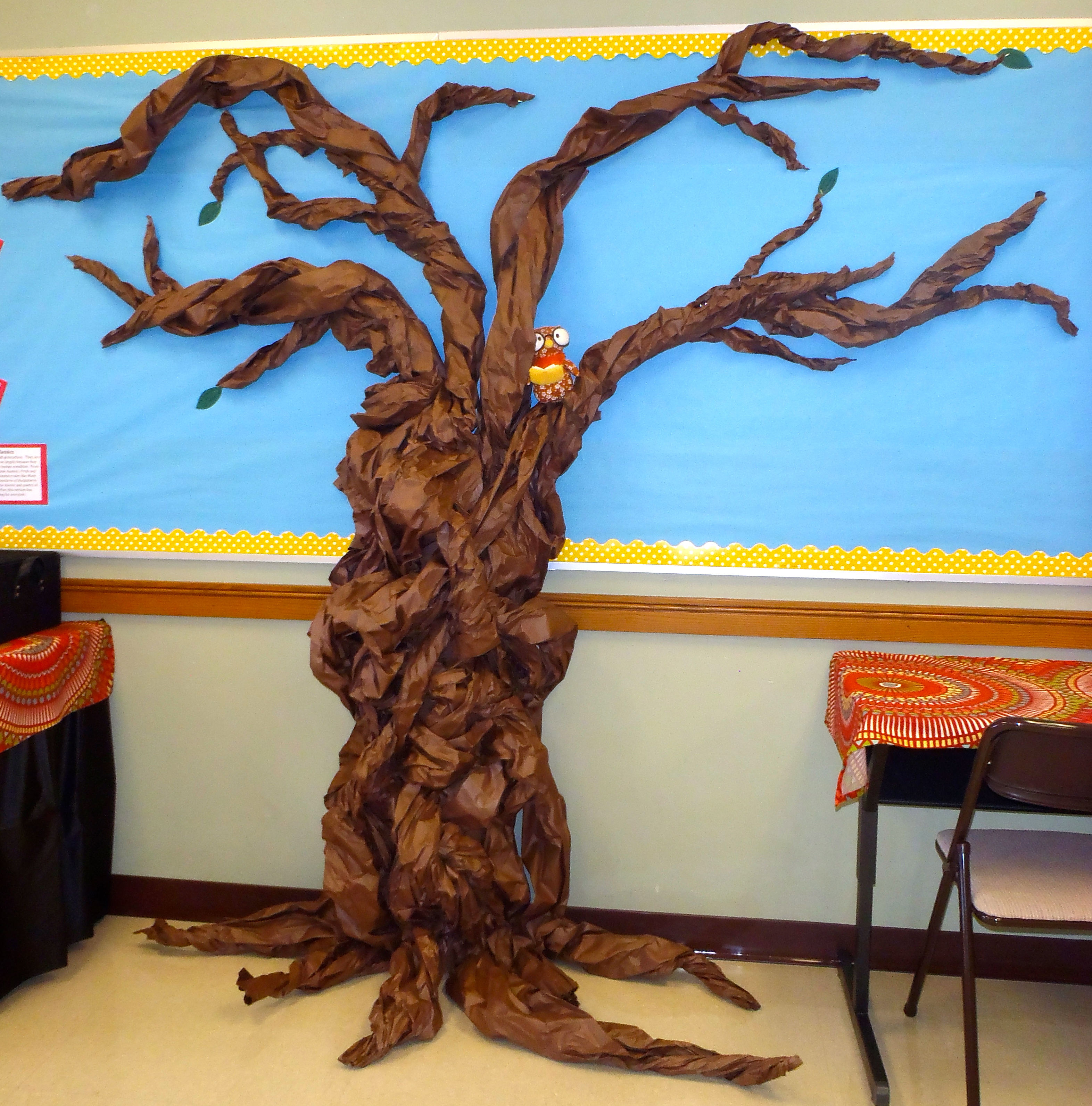
The bare tree before students arrived.

The bare tree before students arrived.

The reading tree exhibits student work and promotes individual success. In addition, it also reinforces teamwork since students look to see how their class is doing as a whole. Furthermore, the tree inspires friendly competition between classes. When I first introduce the tree, I tell students that the class with the most books read wins an ice cream party at the end of the year. This year, due to increased federal health regulations on snacks during the school day, my rules have changed. Instead, students will be able to drop two of their lowest reading scores. Unlike last year, I will tally the total books per class every quarter instead of at the end of the year to determine each quarter’s winner.

Construction for the tree is relatively simple and can be used from year to year.

Materials:

  • One concrete form tube sawed in half. I purchased mine from Home Depot and they sawed it in half for me
  • Two cans of brown spray paint. I used a textured spray paint similar to Rust-oleum’s multicolored textured spray paint, but you can use any type
  • A ream of brown paper—the same type you use to cover bulletin boards
  • A staple gun and staples.
  • Four packs of different colored paper for the leaves.
  • Brown or black duct tape
  • Bulletin board

Process:

  1. Spray paint the concrete form tube with the two cans of brown spray paint. This will serve as your trunk.
  2. Pull large sections of the paper of the ream and begin twisting the paper. As you twist the paper, begin stapling it to the concrete tube using the staple gun. Continue ripping off multiple pieces of paper from the ream, twist and intertwine them as you go along. This will make your trunk look three-dimensional and more realistic. Leave long ends on the bottom. Twist these to a point to create the roots of the tree.
  3. Before you get to the top of the trunk, fashion what looks like a strap. I did this by taking a piece of the brown paper and folding it to make a 2’ X 6” rectangle to wrap around the top of the trunk and affix to the wall. I reinforced the back of the piece of paper with brown duct tape. I then put this strap around the front of the trunk where the bulletin board first meets the concrete tube. I stapled the strap to the tree then the excess ends of the strap to the bulletin board to ensure that the tree wouldn’t fall over once it was complete.
  4. Finally, I continued twisting individual brown pieces of paper and then layering them by twisting multiple pieces together to create a thicker branch. Make sure to create a branch for each of your classes that will be participating.
  5. As you create the larger branches, staple them to the bulletin board. Because the paper is pliable, it is easily to manipulate to look more like a tree. Add smaller branches by twisting additional paper scraps.
  6. Cut out small leaves and store them in a jar or bag to give out to students as they finish their books. I usually have a volunteer cut them out for me so that I have a bulk amount for each quarter.
  7. Get excited to watch your tree (and readers) blossom!
    The reading tree full of leaves at the end of last year.

    The reading tree full of leaves at the end of last year.

While the tree may look complex, it does not take an extraneous amount of time to complete or teach to students. Last year, I allowed my classes to pick which branch they would like to use. Furthermore, I color coded the leaves based on the quarter. Each quarter, I would let my students pick the new leaf color. Green was the first quarter, red was second, orange was third, and yellow was fourth. Just as fall foliage shows the change of seasons in New England, the changing leaves showed my students their development and growth as readers throughout the year.