Best Books About Life and How to Live It

Amy and I have been talking a lot lately about how to help our students connect meaningfully to the books they’re reading independently.  This focus on personal connections stems from our recent reading of  Louise Rosenblatt’s work, our effort to make our instruction authentic, and our noticing of the ease with which our students disconnect from the world.

One activity we gave our students the option to complete was the creation of their own Top 10 Lists, like this one.  Emily’s list is titled “Life and How to Live It,” and it is full of her own personal connections.  It’s reflective of Emily’s desire to become a published other, full of her love for literacy and learning about the world through reading.  I hope her passion spreads to your students when you share this list with them.

img_1502Emily’s Top 10 List: Life and How to Live It

Here, I present to you my top ten favorite books all loosely based around my personal favorite theme to read about: life and the different outlooks different people have on life. Some see the good in life, some see the bad, and others get to see both. Each one of us will face hardships throughout our lifetime while later on finding that one thing that makes us feel as if we have a purpose to exist. When we first open our eyes at the beginning of each day, we are faced with the option to treat this day like a curse, hiding away from this beautiful life we are given to live, or to focus our attention on the positives we have. The choice is yours.

The Giver by Lois Lowry

The Giver is hands down my favorite book of all time. I first read it in middle school and have been in love with it since then. The idea is basically that Jonas, the main character, lives in a utopian society with no bad whatsoever. At age 12 everyone in this society receives their career, and Jonas has a difficult time dealing with the career he has been given. I love this book for a few reasons: one is the way that the book itself is written, and the other is the story behind it. I love the idea that Jonas is the only one who gets to see the bad in the utopian society, because to me it sends the message that what may seem perfect, deep down has repressed secrets we all can’t see.

Of Mice and Men by John Steinbeck

Of Mice and Men: a classic. In this tale Steinbeck tells the story of George and Lennie, two friends who take on the hardship of the Great Depression. Lennie, however, takes on more considering he is practically a father figure to George. Times get hard, but they don’t give up on each other. In the end, Lennie realizes that sometimes no matter how much you love something, if it’s not what is best for you then you can and will be able to survive without it, no matter how hard it is. I think overall this is the reason why I love this book so much.

Tuesdays with Morrie by Mitch Albom

This book brings me to tears–a lot of tears. Based on the true story of a young man who is happy in his life, living a life full of money and materialistic things. On the other side of the story, his old college professor Morrie is diagnosed with a deadly disease and must reunite with Mitch to teach him the things in life that are truly important. I love the idea behind this story, that in life we get lost in materialistic things and lose sight of the things that are most important in this short life we are given.
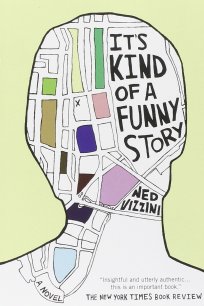
717Tx5+P+7LIt’s Kind of a Funny Story by Ned Vizzini

The relationship between myself and this book is remarkable. I can honestly say that I personally connect to it more than most other readers. This book is about a young man who deals with severe depression and one night decides to admit himself into the hospital after contemplating suicide. He then spends a week in a psychiatric hospital, learning things about himself and everyone else. Vizzini actually spent time in a psychiatric hospital before writing this book which makes it that much better considering he can grasp the inside look on what it’s really like. I, myself, have spent time behind the doors of a psychiatric hospital, and strangely enough my story started off almost the same way Craig’s did.

Perks of Being a Wallflower by Stephen Chbosky

Yet another amazing book that has the ability to bring tears to my eyes. The Perks of Being a Wallflower follows the story of Charlie, a freshman in high school who is struggling with depression and anxiety issues. Through letters, he talks about the good days and the bad, along with what is going through his mind. Charlie befriends Patrick and Sam who being to show him that it is okay to be different from everyone else.

Looking For Alaska by John Green

Looking for Alaska by John Green is a beautifully written story of a young boy who develops the nickname Pudge at a private high school where he meets and falls in love with the beautiful Alaska Young. So much happens while they are there together and he learns a life lesson. She teaches him to not be afraid of life, to go out and grab it because it can be a lot shorter than we expect.

Paper Towns by John Green

Paper Towns tells the heart-warming story of Quentin Jacobson who has secretly been in love with the girl next door, Margo. Margo taught Quentin a lesson which is the main reason I love this book so much – she taught him to go through life without being afraid of adventure. This is one of my top favorite books because I relate to Margo and her adventurous personality. I love Morgantown but I have always wanted to move somewhere where I can start completely over – the idea of recreating myself in a new place is thrilling.

410BrI9l37L._SY344_BO1,204,203,200_Skinny by Ibi Kaslik

Many teenage girls face a deadly mental illness – anorexia. Skinny tells the story of Giselle and how her battle with anorexia has flipped her life around. It also tells the story of her younger sister, Holly, and how her sister’s disease is effecting her life as well. The writing in this book was not my favorite, but it was still a great read. I love the idea that someone would want to put the issue of anorexia into words. My favorite part of the book, and the main reason it made my list of favorites, is the fact that it not only goes into the mind of the person facing the anorexia but someone close to her as well.

Afterparty by Ann Redisch Stampler

When I first started reading this book I didn’t think I would make it through but I’m glad I decided to finish it. Afterparty follows the story of a quiet girl who moves to a new town and decides it’s time for a change. She meets new people and gets to experience new and exciting things. This is something I have always wanted to do, which is why it made this list. Getting into a new place where you get to start completely over is more than exhilarating.

Everyday by David Levithan

Have you ever wondered what it would be like to be someone else for a day? To get inside of their minds and read their deepest secrets? A, the main character in Everyday, gets to wake up in a new body each and every day. To me, the idea of this is both terrifying and fascinating. When I was reading this I was thinking about the psychological aspects of this because I want to become a psychologist one day so I will be in people’s mind, understanding then, just as A does.

What other titles teach readers about life and how to live it?  Please add your recommendations in the comments!

What Teachers Need

img_1463-2

Love this meme Mike teased the students with!

I’m thinking of Taylor Mali’s “What Teachers Make” this morning, but I’m thinking about what teachers need.  I know I need something right now, because this job has me in the winter of some serious discontent, as Shakespeare says.

After this year, I am leaving the high school classroom.  I am starting to get very nervous about it.  Perhaps part of my anxiety comes from the fact that I’m seven months pregnant, but I think the majority has to do with the fact that a big part of my identity is teacher…and when I’m no longer one, who am I?

Next year holds lots of promise for me–motherhood, PhD work, teaching some Education courses, presentations, and more time for writing.  But I know that I’ll miss working with the teens in my classroom.

Right now I’m struggling with finding things to sustain me, because I have an excellent student teacher.  He’s teaching all six of my classes, doing all of the grading, and generally thriving on his own.

I get to plan with him, but then I sit in the back of the room and observe.  There’s always something that needs to be taken care of, whether it’s editing pages in the yearbook, running copies, or filling out paperwork.  But I am still so bored.

img_1470-1

Running into two of my students at the gas station was the highlight of my day yesterday.

I miss conferring with kids–our daily meetings at the bookshelf to talk about what to read next, or poring over their notebooks together, or sharing an exciting mentor text.  I miss the active work of discovering texts that I want to share with my students and urge them to reproduce.  I miss doing booktalks every day.  I miss conducting the symphony of rustling notebook pages, shuffled piles of books, or scribbling around poems.

A former student teacher observed that my typical day only consists of about 50% teaching.  The other 50% is made up of grading, making copies, lesson planning, running errands, going to meetings, and all of the not-so-fun tasks of our jobs.  They’re all essential to being prepared for the big show–the lesson–but I’m learning that I really hate those parts of my job when they don’t lead up to the ultimate experience of teaching.  It seems that they are mindless and pointless, and it makes me wonder about how teachers who have mandatory curricula, or who choose to teach straight out of a textbook, sustain themselves in this profession for decades.  I worry about their health!

I am craving the autonomy I’m accustomed to in my teaching.  Choice, independence, and purpose are just as important for teachers as they are for our students.  They sustain us in our quests to create lifelong readers and writers.  Without them, we’re just going through the motions of any job that doesn’t require creativity and energy and dynamism.

authenticityWe teachers need everything our students need:  timely, specific feedback (a great deal of it positive); the resources to do our work well; someone to listen to us and thus validate us; choice in what we teach and how we teach it; an identity as a teacher who is part of an authentic community of educational professionals.

It’s not every educational community that offers those conditions.  We often must go beyond our own school walls to fulfill those needs.  I’m thinking of Meenoo Rami and her excellent work to connect and sustain educators through Teacher2Teacher, and her important championing of the needs of teachers in Thrive and through #engchat.

I am depending upon Meenoo’s wisdom to get me through this winter–a winter both literal and figurative–and upon the wisdom and inspiration I find in my friends on Three Teachers Talk, Twitter, and more.  If you find yourself struggling, too, remember what teachers need–and do whatever you can to get it!

How do you sustain yourself in the winter of your teaching?  PLEASE share in the comments–I, for one, am dying to know!

From John Green to Jane Austen: Student Choice and Motivating Non-Readers

Anyone who knows me knows I talk a lot about moving readers and writers by offering choice in the classroom. Without a doubt, the more I study the research on reading acquisition, the more I confer with my students and try to write about it, the more I immerse myself so I can immerse my students in engaging YA and award-winning literature, the louder my voice gets.

I am a full fledged advocate of readers and writers workshop at the secondary level.

And I’m not backing down.

This semester I have a student teacher who hears it from me every second of every day. Almost.

My ultimate goal is to tattoo Zach’s brilliant young mind with everything I’ve learned about teaching the past ten years. Everything that sent me to and cemented my pedagogy in workshop. And I think choice seals the ink that may change his teaching career forever.

But this pedagogy is not easy. Just like in a traditional classroom, students put up their fists and sometimes fight dirty. Sometimes they want to be told what to read and what to write and how to think. Sometimes too often.

And that is when this job gets hard.

Lately, it has been hard, and Zach has seen my frustrations. But he is smart, and he sees through student b.s with laser-like charm, problem-solving as I vent and complain.

I should be more controlled I tell myself every morning. Careful-what-you-say-Ame. But I can’t help it — my job is my sleeve. If I didn’t care so much about my students, their lives, their futures, I’d call it a day and tell Zach to take charge and have fun.

But I want him to learn. I want him to last in this profession that eats ’em up and spits ’em out. So I’ll share.

I’ll share what I’ve learned and how I’ve learned it. I’ll encourage. I’ll prod. I’ll challenge.

He’s a keeper I can already tell.

How do I know? Well, I asked if he’d write a post for this blog about reading YA literature for the first time. What does Zach do?

Oh, he writes, but he starts his own blog and tells me today: “I’ve got this friend who’s student teaching over in Northwest ISD, and she’s started blogging, so maybe we’ll start this new-teacher blog thing….”

You can still see my smile.

Here’s Zach’s post about his first adventure into YA literature. You’ll read it, and then you’ll want to hire him.

Yeah, I know.

Choice Doesn’t Necessarily Mean Personal Connection: A reflection for a do-over


I have started this post four times, and I cannot think of a pithy way to begin. You know, some clever opening, some hook to get the reader’s attention — some startling statement.

My creativity got swallowed by analysis. Well, kind of.

I figure I must be doing something wrong because my students cannot analyze to save their lives. They can talk around a text and say absolutely nothing quiet well though.

So all afternoon and into the evening I’ve thought about thinking. I’ve thought about my students’ thinking.

And I’ve determined the problem: Many of my students are not doing it.

They sit and wait, looking around the room, waiting for someone else to speak up and do the thinking for them. It’s like a Mexican standoff, and something’s gotta give.

105997-clint-eastwood-mark-wahlberg-s-jkzn

Last week I listened to Dr. Margaret Hill talk about the importance of connections and how standards must include opportunities for students to make both efferent connections and aesthetic ones. The only way to truly learn is to make personal connections, Peg reminded me, citing Louis Rosenblatt’s Transactional Theory.

How can I provide more opportunities for students to connect to the learning?

Yesterday I read an article about mindfulness and how when it’s practiced in schools it is helping children’s well-being. Some experts say the practice of mindfulness is even an essential —  a way to reduce depression, extend focus, truly learn.

How can I help students get and stay in the present?

This morning I watched the TED Talk by Shonda Rhimes “The Year I Said Yes to Everything,” and how playing again has helped her find “the hum,” the thrill and joy in her life and in her life’s work.

How can I introduce more play into my classroom?

Today in class most of my students crashed into a brick wall of higher-thinking they could not go through, over, or around. Many didn’t even try. I came home from school worn out and weary.

Then I read this post by Tricia Ebarvia, and I stalked her blog until I read the post “Steps toward an Inquiry-based Classroom,” and a missing piece walked right into my puzzle.

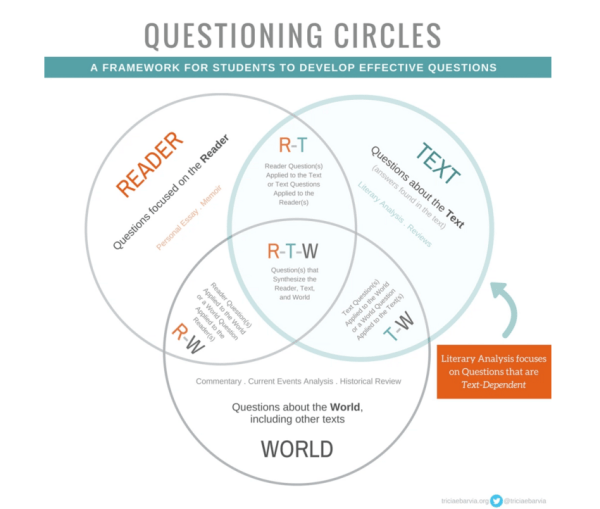
Tricia made me think about the on-going need for curiosity and student-generated questions. The ongoing need for purposeful and personal inquiry. She shared the chart below, citing the work of Christenbury and Kelly, NCTE, and Jeff Wilhem. And I got it.

Screen Shot 2016-02-18 at 7.18.15 PM

My students do not care enough about the books they’ve chosen to read. They do not care enough about the topics they’ve chosen to write about. I haven’t been paying enough attention, or I would have realized this sooner:  Choice does not necessarily mean personal connection.

I am glad I have time this year for do-overs.

It’s time to back up a few steps, so we can step into better opportunities for engagement, growth, and learning.

Maybe we’ll mediate.

Maybe we’ll play.

But we will certainly play with developing effective questions.

Applying Essential Questions in Workshop by Cyndi Faircloth

guest post iconAfter almost twenty years of teaching, I’m starting to think I might be getting the hang of it. I’ve used essential questions over the past few years, but they weren’t producing the deep discussion and analysis that I’d hoped for. It wasn’t enough to use the EQ to help us approach whatever we were reading together. I needed to do more with it.
This past year, after reading “Text Dependent Questions” by Fisher and Frey, and What’s the Big Idea by Jim Burke, something clicked. Now, the EQ has driven pretty much everything in my planning –my selection of informative texts, some of the prompts for their Writer’s Notebook, even some of the vocabulary that I select. (Though I am also having a lot of success with student choice in vocabulary, thanks to a November post on 3TT!) Now, my students are leaving class and discussing the essential question and issues from our text in other classes. A colleague mentioned (complained?) last month that he had trouble starting his class, after students leaving my class were continuing our class discussion into his room.

They are struggling with real-world questions and topics and thinking about how they really want to approach them.

Here is what that looks like in my current English class:

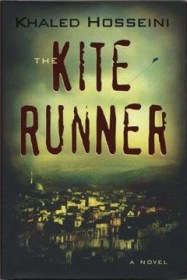
Kite_runnerWe are reading The Kite Runner together. Our EQ has been “When is forgiveness important?” Their final assignment will be writing about their own answer to that question.

Along the way, we are reading news articles about Afghanistan, which include the idea of someone being wronged. Students respond to guiding questions (and generate their own questions) about the articles, and they struggle with those questions in their Writer’s notebooks. We’ve read about forgiveness from people betrayed by their families, by the government, and by strangers. [To find these, I used my subscriptions to the NY Times and Washington Post and searched “forgiveness” and “family”. Sadly, a wealth of resources came up…]

One really rich pair of stories I found for them to consider centers around the shootings in South Carolina in 2015. One article highlights the teenaged children of one of the victims having expressed forgiveness toward the shooter. The other is an opinion piece that says the children forgave too quickly because “the almost reflexive demand of forgiveness, especially for those dealing with death by racism, is about protecting whiteness, and America as a whole.” The author points out that there has been no rush to forgive after any of the ISIL beheadings or 9/11. Students really dug into that idea and explored it.

In their Writer’s Notebooks, students have been responding to the idea of betrayal and forgiveness in a number of ways. They chose a quote from a list and responded to it. They reread parts of the book and considered how ‘betrayal’ or ‘forgiveness’ played a role (Thank you Fisher and Frey). They used words from their vocabulary list and wrote a poem about betrayal.

While they haven’t written their final products yet, I expect the students will have differing answers to the essential question. I believe that their writing will express the wrestling match they’ve had with the ideas. Thank goodness Burke’s book helped me see how I can use more aspects of my class to help students explore a “big idea”, and give them examples and smaller pieces of writing that they can draw from in writing an answer to the essential question. I believe my students are developing the skills to wrestle with the big questions that life has thrown (and will continue to throw) at them. They will look for more than one point-of-view, consider the source, and question the message so that they can form their own opinion based on more than something they read on Facebook.

Cyndi Faircloth teaches English, Social Studies, Art, and Journalism at Paradise Creek Regional High School in Moscow, Idaho. The school is small – with only two full-time teachers – so it’s easier to say that she teaches everything that isn’t math and science. As an interdisciplinary teacher, she works to incorporate writing in all of her classes and is learning to incorporate the writing workshop into her classes. Cyndi is a National Board Certified Teacher in English Language Arts – Adolescence and Young Adulthood.

Mini-Lesson Monday: Freezing Time

dumplinIt’s -4 degrees in West Virginia today, which might explain why I’m thinking about the narrative skill of freezing time.  I’m also thinking about it because I’m reading the fantastic Dumplin’ by Julie Murphy, the story of an unconventional small-town beauty pageant contestant.  As I read, I was aware of how quickly the writing hooked me–I began to look for reasons why, inspired by Writing With Mentors.  My noticing of Murphy’s freezing of time to show me the thoughts and feelings of her narrator, Willowdean, reveals two skills I’d love for my students to utilize: the skill of reading like a writer and imitating the craft they notice in their own writing.

Objective:  Using the language of the Depth of Knowledge levels:  students will identify and categorize Murphy’s craft moves, then revise their own narrative drafts to apply the concepts they learned.  Or, in the language of the Common Core:  Analyze the impact of the author’s choices regarding how to develop and relate elements of a story or drama (e.g., where a story is set, how the action is ordered, how the characters are introduced and developed); Use narrative techniques, such as dialogue, pacing, description, reflection, and multiple plot lines, to develop experiences, events, and/or characters.

Lesson:  I’ll introduce Dumplin’ during book talks by describing the plot and passing out the following excerpt:

The car behind me at the drive-thru backfires, and I rush inside.  My eyes take a second to adjust to the dim light.  “Sorry I’m late, Bo,” I say.  Bo.  The syllable bounces around in my chest and I like it.  I like the finality of a name so short.  It’s the type of name that says, Yes, I’m sure.

A heat burns inside of me as it rises all the way up through my cheeks.  I run my fingers along the line of my jaw as my feet sink into the concrete like quicksand.

The Truth:  I’ve had this hideous crush on Bo since the first time we met.  His unstyled brown hair swirls into a perfect mess at the top of his head.  And he looks ridiculous in his red and white uniform.  Like a bear in a tutu.  Polyester sleeves strain over his arms, and I think maybe his biceps and his hips have a lot in common.  Except the ability to bench-press.  A thin silver chain peeks out from the collar of his undershirt and his lips are red with artificial dye, thanks to his endless supply of red suckers.

He stretches an arm out toward me, like he might hug me.

I drag in a deep breath.

And then exhale as he stretches past me to flip the lock on the delivery door.  “Ron’s out sick, so it’s just me, you, Marcus, and Lydia.  I guess she got stuck working a double today, so ya know, heads up.”

“Thanks.”

I give students a specific purpose for reading, since we’re looking at this text as a mentor.  “While I love a lot about this book–the author’s diction, how her word choices change the narrator’s voice and reveal her personality and sense of humor, and the fantastic chemistry between Bo and Will, today I just want to pay attention to how Julie Murphy paces this scene.  As you read, you’ll notice how she just freezes time so you feel like you’re holding your breath.  Annotate how exactly she does this, and we’ll talk about it in five minutes.”

I read alongside my students, modeling notes on craft with the document camera.  After five minutes I ask them to share at their tables, very specifically, what they noticed.  Then, I solicit from each table group one craft move they saw, and where it was in the text.

“Well, dialogue kind of brings you back into the present, like at the end when Bo says something and kind of snaps Will out of her daydream,” one student offers.  I write on the board, dialogue–keeps you present.

“Awesome.  What else?”

“The long description of Bo’s appearance stops the action,” another says.

“Yep.”  I write on the board, description–freezes action.

We continue until each table has shared a craft move they’ve noticed.

“Okay, so today during workshop, I want you to think about how you might play with freezing time in your narratives.  Use what we talked about to help you revise the pacing in your scenes, and if you think Dumplin’ sounds good, add it to your what-to-read list.”

Follow-Up:  During that day’s workshop, I’ll confer with students and see where they might be strengthening existing moments of freezing time, or adding some brand new ones, in their narratives.

Later, as we finish the narrative unit, we’ll return to the anchor chart we’ve been adding to and create a rubric that reflects the skills we’ve focused on, one of which will be pacing.  I’ll also hope to see lots of students reading Dumplin’ over the coming weeks–doubling a booktalk with a craft study lesson is usually a highly effective way to get kids hooked on a book.


Writing With Mentors: A Nonnegotiable of Writers Workshop

41dIMvzIynL._SX395_BO1,204,203,200_

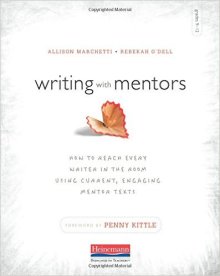
WRITING WITH MENTORS by Allison Marchetti & Rebekah O’Dell

Reading Allison Marchetti and Rebekah O’Dell‘s Writing With Mentors is reminding me of the summer, three years ago, that I committed to making the move to readers and writers workshop.  Like my new friends in Franklin, Wisconsin, I already had many of the structures of workshop in place–I just didn’t know how to fit them all together.

As I read and wrote and thought beside the likes of Penny Kittle, Amy, Jackie, Erika, and my other UNH friends, I learned quickly which parts of my instruction to keep and tweak, and which parts to flat-out jettison.  While I felt like my reading workshop practices were solid, I knew I needed to completely rethink the way I designed writing instruction.

I wish I’d had Writing With Mentors that summer.

That summer, I learned that I shouldn’t be designing lessons around a staid form like a persuasive essay or a literary analysis.  I needed to begin thinking about having my students write authentic, interesting pieces on topics of their choice–but I didn’t know how.

img_0791

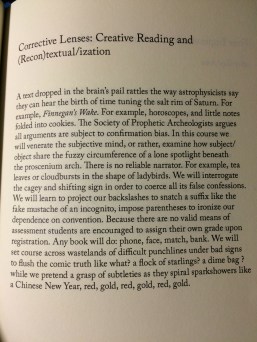
I immediately saw Gregory Pardlo’s DIGEST, full of prose poems, as a mentor text.

I learned how to read like a writer, how to look at the craft and structure of my favorite authors’ works.  I began to see mentor texts everywhere, and in fact too many places–I was exhausted by trying to keep track of everything I wanted to share with my students, and even resolved to read less as a teacher.  I wanted to offer a variety of rich mentor texts to my students without losing my mind–but I didn’t know how.

I learned that my writing process was as unique as my handwriting, and that process has value just as much as a written product does.  I wanted to restructure my unit planning, my gradebook, and my classroom routines to reflect that–but again, I didn’t know how.

Over three years, through trial and error, I’ve figured out how to reckon with a lot of those issues, but I would have known instantly had I read Writing With Mentors then.  This book succinctly showed me great writing units and products, how to plan for them, and how to select and organize current, engaging mentor texts.

img_0480

Books are at the center of my writing instruction–literally.

It reminded me that when we read–even to study the craft moves of a mentor author–we must read as readers first, for the “pleasures of story time” and to “hear the rhythms of good writing” (65).

It affirmed my habit of designing new units each year, complete with brand new mentor texts, to meet the needs of my current students and the sociopolitical climate in which we live and read and write.

It helped me cement mentor texts, alongside the writer’s notebook, conferring, and authenticity, as nonnegotiables of a successful writers workshop–because, in Allison and Rebekah’s words, “mentor texts enable complete creativity and individuality to emerge in student writing and writing instruction” (3).

And it reminded me that when students leave our classrooms, “mentor texts will always be present” (167).  When we teach students to write with mentors, they remain capable of reading like writers as they engage with print and media and other real-world texts.   Since getting my students to become lifelong readers and writers is my ultimate goal, this book is now an important mentor to me.

Writing With Mentors is the book to pick up when you put the textbook down, toss out your binders of writing rubrics, or throw up your hands when you read your 94th crappy plagiarized paper in a row.  If you’re seeking to rejuvenate, organize, and revamp your writing instruction, don’t undergo three years of trial and error like I did…let Allison and Rebekah help you write, more happily, successfully, and authentically, with mentors.

Have you read Writing With Mentors?  Share your feedback in the comments!


An Honest Reflection: No Ugly Crying Required

I just finished an ugly cry. You know, the kind where you sob until your eyes close so tightly that you wonder if you might hurt yourself? The delicious, exhausting, purge of a cry that leaves you breathless and wholly satisfied at the same time? In my humble opinion, it’s the type of weep-fest that only great writing can deliver, and I am delighted to report that I just slobbered my way through another story’s end that left me wanting to pick up the book and start right over again. On the recommendation of colleague, I picked up A Monster Calls on Friday afternoon during last period and finished it by Sunday afternoon.
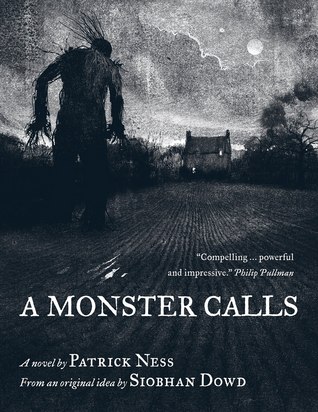
Though I could go on for pages about how amazing this book is, and how excited I am to 8621462book talk this story tomorrow, and how transformative I think this text could be for some of my kids, it’s what led me to this text that I find really important right now. As a result,  approximately eight minutes after finishing that book, seven minutes after shoving a copy of it into my husband’s hands and insisting he “Read this. Read this immediately” (thankfully we’ve been married long enough that he can recognize a literary induced meltdown and not fear for his own safety), five minutes after texting half my department to tell them of my ugly-cry recommendation, and three minutes after blowing my nose one more time and pulling myself together enough to see the screen clearly, here I am. Counting the minutes until school starts, so I can tell students about this text. It’s the best feeling and it’s fueled by what I have deemed A Workshop Whirlwind.
A Workshop Whirlwind. And that’s not just cutesy alliteration either. It’s representative of an urgent and necessary flurry in my teaching career. And I, for one, could not be more excited. You see, it was this past week that Workshop came to knock on the door of the Franklin High School English Department in a real and meaningful way. And this is the story of how we’ve started down a path that I believe will change our practice and lead our students to see themselves as both readers and writers in a way we would not have thought possible.

Our journey with workshop is a unique one. We are going to be moving to this new delivery method as a whole group in one glorious leap. Thankfully, by a bit of divine intervention, we have had the support of the lovely and overwhelmingly talented ladies at Three Teachers Talk. It was TTT that gave us a place to land and see that workshop is not only possible at the high school level, but it can make a world of difference for our kids. And it was a little over a year ago, with the knowledge that my department was being asked to drastically change our day to day practice, that I pored through post after post on this blog searching for guidance. How to plan, how to assess, how to hold kids accountable, and how to organize, but most importantly…how to inspire our students. How to help them see that reading and writing could be so much more than an assignment. That our study of English could be a study of what it means to be. What it means to feel.

Now, change is rarely easy. In fact it sometimes leads to a brand of ugly-crying that is reserved for just these circumstances, where you feel the happy ship you’ve been sailing on has hit something substantial and the band has already started playing “Nearer My God to Thee.” Everyone find a lifeboat! We’re never going to make it out of here alive! I liked this boat a lot better before you put this big hole in the side.” And that, my friends, is what change does to a person. What change can do to an English department. Like the seven stages of grief, change too has its stages, and I’ve both felt these stages and watched my department try to stay afloat as this major shift comes our way. See, we aren’t individual contractors, coming at this move to workshop only out of our own desire to do so. This is a district level move that has led to the following:

Shock They want us to do what? I can’t even. I just…can’t.
Denial This isn’t happening. This isn’t happening. This isn’t happening.
Anger Nope. Just nope. You people are crazy. We should just set  the place on fire, while we’re at it.
Bargaining I can still teach __________ right? I’ll do this workshop thing, but only if I can still    teach ________.
Depression Whatever. It’s fine. More change. Not like we aren’t used to it. What does it matter, anyway? What does any of it matter? I’ll be in my room, reading __________ (please see stage above).
Testing Well, I guess I could give them time to read at the start of class. That makes sense to me. I love books too, so, natural move.
Acceptance I too am a reader and writer. I can do this.

And now, I am happy to report an eighth and amazing stage to this move – genuine enthusiasm.

In the last week, since Amy and Shana came to lead our department in two incredible days of professional development, I have felt a surge of excitement at everything I want to do in my own classroom and I’ve seen my entire department rally around this initiative in a way I would not have thought possible. In the last week, the halls of Franklin High School have echoed with book talks, students are curled up in corners with texts, and  teachers are chatting about trying out new strategies and putting together mini lessons. In the last week, the Wisconsin  “Bleak Mid-Winter February” has been anything but.

The teachers I am privileged to work with have been doing phenomenal work for years, since long before I joined their team. Their skill and passion, which has long fueled their sincere desire to help students learn, makes this an incredible place to work. And so, while my team would collectively injure me if I announced that everyone feels totally relaxed and ready to hold hands and sing Kum Ba Yah, I can confidently say that our journey has begun. We are poised and now also excited, to continue learning with and inspiring our students in new ways.

No ugly crying required.

Lisa Dennis is the English Department Manager at Franklin High School in Franklin, WI. Her energetic leadership and insight leads her department into the wonderful world of workshop instruction. TTT appreciates Lisa’s candor and drive to do right by her colleagues — and all their students. We thank God for teachers like Lisa!

#3TTWorkshop: Asking Good Questions When Making the Move into Workshop

IMG_1279

Book talks about NF like Columbine by Dave Cullen and talking about the writer’s research process capture many readers

Shana and I recently conducted a two-day professional development workshop in Franklin, WI — such inspiring teachers in Franklin!

Franklin administrators asked that we help their teachers move into a workshop pedagogy, which is, of course, a favorite topic at Three Teachers Talk. We shared the background of workshop, which stems from the work of Don Murray and Don Graves, and from the work of our mentor Penny Kittle, whose ears had to be ringing and ringing since we said her name a million times throughout those two days.

Franklin teachers caught the vision and the value of letting loose the reins and opening their hearts to choice reading and writing. They just needed to experience it themselves from the seats of their students.

The discussion covers five of the pressing questions teachers asked during our pd.

They:  Where are some great places where I can get resources for books and materials for my classroom library?

Us:  The good news for Franklin teachers is the buy-in from their insightful administrators who have reserved funds to begin building classroom libraries. Not all teachers who catch the vision for choice independent reading, and the need for engaging, well-curated classroom libraries, are so fortunate. We weren’t. But finding resources and is certainly possible. Shana wrote this great post awhile back about grants she’s been awarded and the many businesses that give funds to buy books. Amy’s had great success with Donor’s Choose, one of the options Shana mentions. Three grant projects funded there so far! Lewisville Education Foundation has also been a great resource for Amy’s students and the books they love. Be sure you check out the grants offered through your own EF.

Other resources besides books are important, too. We spent time watching and responding to spoken word poetry with our new friends, modeling quickwrites, and studying the craft moves of these poets. Some of our favorite spoken word poets are Shane Koyczan, Sarah Kay, Phil Kaye, Marshall Jones, and Amy’s new favorite Harry Baker. Search online, and you’ll find YouTube videos and posts with the texts.

Engaging non-fiction articles are an essential in workshop instruction. Mentor texts, craft studies, and pairings with literature all make for authentic engagement with thought-provoking non-fiction. Find interesting articles at NewsELA, Izzit.org, Essay5W, and The Learning Network at the NY TImes. And, of course, the excellent mentors curated by our friends at Moving Writers.

They:  How can I design units that foster inquiry-based outcomes for my students?

Us:  We lead teachers in a gallery walk activity where they explored ideas of what authenticity, modeling, dialogue, inquiry, and other workshop essentials look like from both a teacher and the students’ points of view. It was interesting for us to see the many iterations of inquiry these teachers listed and how closely they overlapped with authenticity. Yes, they should.

However, getting students curious about learning does not always happen instinctively — especially when they come to us hardened by years of sit ‘n git classroom instruction. We must provoke inquiry, pique imaginations, inspire curiosity.  Of course, the move to choice opens doors to many of these needs. Providing, introducing, and talking about highly engaging literature helps. But so does allowing students to decide how they want to read it and what they want to do with it to show they are learning from reading it.

Teachers have to let go of control. We have to trust that students want to learn. We have to stop doing all the hard thinking for them. What if we let them find the mentor texts that best suit their needs as writers? What if we give them chances to determine themes they want to study, and then let them take those themes into other genres and ideas?

Let’s invite students into authentic and on-going research, so we move far far away from the one-unit-one-major-research-paper. Shana’s multi-genre project and my students’ engaging in our multi-modal feature article unit are good examples of how we apply this thinking in our own classrooms.

They:  I write every day for my job, but I have never written a “persuasive essay” for my job. How do I design authentic instruction that mirrors what my students might have to write in the future?

Us:  Read like a writer. Look for mentors everywhere. And know your kids. 

We know, if the answer was really that easy, everyone would do it. Although we do believe every teacher could. One way we’ve found to incorporate authentic instruction is to conduct regular craft studies of a variety of texts. We read a lot, and we look for texts in which we can discuss with our students topics like structure, literary and rhetorical devices, tone, etc. We call this reading like writers.

Shana and I agree, we first learned the value of reading like writers from Katie Wood Ray in her book Wondrous Words. Here’s a great Pinterest board to get you started. Shana and I will post the craft studies we find and use with our students more often. You’ll find several we previously posted when you search the “craft study” category.

They:  How do we hold students truly accountable?

Us:  In a word, conferring. We must talk to our students often and with purpose. 

sticky conferences

Modeling Silent Reading Conferences

Amy remembers when she first started moving students into self-selected texts how her conferences revolved around the books students read. Eventually, she realized that if she wanted to truly move readers, she needed to talk more to the student — as a reader — than about the book she was reading. This is an important shift in mindset and practice.

If we only encourage students to talk about the plot, summarizing this or that, maybe describing the characters, we miss out on valuable opportunities to help the reader stretch and grow in the skills she needs to mature as an independent reader. Identity matters.

Teachers foster a love of reading not by focusing on the books but by focusing on the reader of those books and helping those students identify themselves as readers. If you need ideas on conferring, Amy and Jackie discussed conferring in this #3TTWorkshop post, Amy wrote about conferring in a crowded classroom here, and Shana wrote about a what to read conference here.

Another important thing to remember about accountability:  We can ask students to write about their independent reading. Shana and I both ask students to evaluate their reading lives — several times a year. We consider these summative assessments, and students provide thoughtful commentary on how they struggle, grow, and succeed as readers. Amy quotes many of her students’ evaluations here. They are honest and insightful.

img_0331

Speed dating with books increases student talk about books, which increases students reading good books

When we ask students to write about their reading, it must be a task they see as worthwhile — and one we see as a support to our ultimate goal:  developing life-long readers. Too often, we read about teachers who punitively assign tasks to “catch their students not reading.” If this is you, please stop.

They:  How do I create engagement not compliance due to grades?

Us:  Choice. Choice leads to engagement. Engagement leads to autonomy. Autonomy leads to independence. Independence is engagement.

Trust the process, and see for yourself.


Mini-lesson Monday: Taking on the Thesis Statement

Right now, my students and I are writing spoken-word poems. I’ve wanted to play with language this way for a long time now, but finally mustered the courage — and figured out a way to make this kind of poetry fit into my AP Language goals and the needs of my students as they prepare for the AP Lang exam.

While watching and listening to many spoken-word poems, I realized that most of them are an argument, filled with not only beautifully crafted language — devices galore — but they also show craft in the use of the appeals. With the help of my student teacher, Mr. Zachery Welch, we designed a unit that centers around the rhetoric in spoken-word poems. And we are all writing our own. (This is a challenge for me, but I absolutely believe the the importance of a teacher writing beside her students. Thanks, Penny Kittle, for teaching me that!)

The performance task for this unit reads:  Craft a spoken word poem that addresses a personal conflict and/or a social issue, include rhetorical techniques and literary and rhetorical devices to convince your audience of the need for positive change. Perform your poem for the class live, or create an automated slide show with visuals, or a video recording as a way to digitally perform your poem.

This lesson stems from our work  — and the need for students to include stronger thesis statements in all of their argumentative essays.

Objective:   Using the language of the depth of knowledge levels, students will identify powerful lines in a spoken-word poem that serve as position statements. They will discuss and then categorize these statements in order of importance as it pertains to the poet’s overall theme. Students will then formulate three powerful thesis statements of their own and revise their drafts to include these powerful thesis-like lines.

Lesson:  Watch and listen to “Paper People” by Harry Baker. Ask students to pay particular attention to the lines of the poem that hold the weight of the poet’s position. They must listen carefully because Baker’s poem is primarily crafted with the alliterative “p”. Give students a copy of the lyrics, and on the second listening, having them mark specific lines they think represent Baker’s position. Then, ask students to discuss the lines they marked with their small groups. As a class, determine the line that best serves as Baker’s thesis.

Next, instruct students to write three thesis statements for their own poems. They should discuss their thesis statements within their groups and help one another develop powerful statements that hold the weight of the meaning in their poems. Then, instruct students to revise their poems, including all three of their new strong lines.

Follow up:  Students continue to revise and strengthen the arguments within their spoken-word poems. They should also remember to write three powerful thesis statements in their argumentative essays and challenge themselves to use all three in their writing.