Knowing Where to Look by Amy Estersohn

I’ve discovered a way to pack more reading conferences into my day.

No, I do not possess the ability to extend class time (though I wish I did!) and no, I am not able to talk to multiple students at once (though I’m sure my students wish I could!)  

4816266197_7805b15db2_z1However, I have been able to sharpen my powers of observation, and through these observations I’ve been able to deepen my sense of the readers I work with.

I begin observing before the Pledge of Allegiance.  Who is using the minutes before the bell to read?  Who comes to my classroom looking for a new book because he finished one on the way to school this morning?  Who approaches me in the hallway to ask if I have the sequel to a book finished long ago?  Who remembers that she owes me a book?  Who mumbles apologetically because he loaned the book that he borrowed to a younger sibling?

I continue observing the hallways.  Who is carrying a book?   Who brings comics to lunch?  Who brings books to a school assembly?  On a field trip?

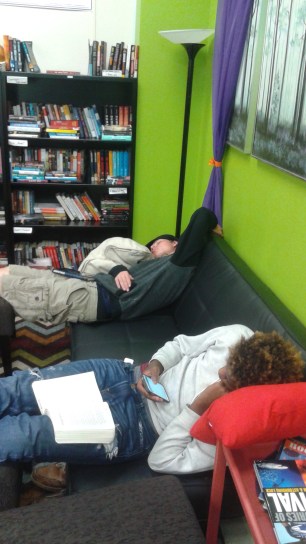
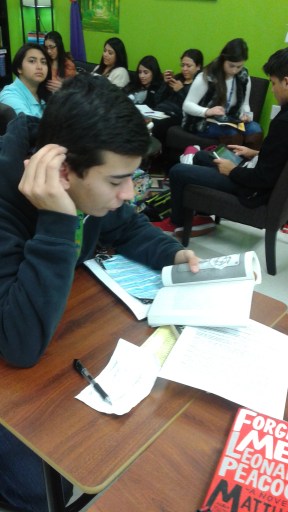
student-147783_1280When students have an opportunity to read in class, I observe body language.  Different readers have different methods of getting physically “into” a book.  Some fold the book in half like a newspaper and bring the book inches from their eyes.  Others put their heads on their desks.   To the untrained eye, teen readers can look slouchy, lazy, or inches away from napping.  These are students who have entered what Nancie Atwell calls “the reading zone” — they are so immersed in a story that they are lost to the outside world and are unaware of how others are perceiving them in that moment.

The conclusion of independent reading time gives me another time to collect observations.  Who is eager to close the book?  Who is reading to the end of the page for a sense of closure before placing a bookmark?  Who doesn’t hear the first warning and needs additional cueing away from the reading zone?  Who softly moans, “Noooo”?

When students browse for a new book, how do they navigate your classroom library?  Is there a section that they zoom towards?  Do they pick up the first book in their field of vision, or do they spend time weighing and considering their next book choice?

The data to help us build better readers is all around us when we learn how to look.

Amy Estersohn is a middle school English teacher in Westchester County, NY.   She also reviews comic books for http://www.noflyingnotights.com.   Follow her on Twitter at @HMX_MSE.

Try It Tuesday: 7 Ways to Shake Up Notebooks

October is nearing its end, and you know what that means…’tis the season of needing inspiration! The back-to-school spark of fierce, creative lesson planning has ended, and now we’re all just praying Thanksgiving gets here ASAP.

So, if you’re getting a little worn out from reading the same-old same-old genres in your writer’s notebooks, try these seven ways to shake them up.

Write down the language you hear around you.  From quotes in independent reading books to funny things our friends say, the act of noticing language helps us think like writers and expand our linguistic repertoires.

img_5205

Annotate a booktalk.  Instead of a focused craft study, or a question-and-response to a booktalk, try just taping it into your notebook and noting what stands out.  This, too, helps build the skill of reading like writers.

img_5200

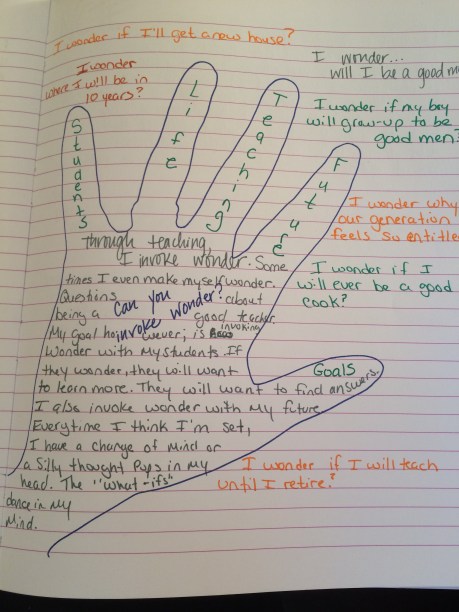
Write in someone else’s notebook.  Shake up page after page of your own handwriting by switching notebooks with someone else when responding to a prompt.  Here, my friend Bethany wrote in my notebook as we wrote about invoking wonder.

img_5211

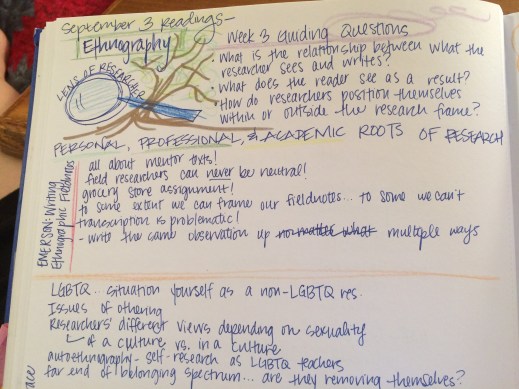
Try beautiful note-taking.  Sometime, somewhere, everyone needs to just jot down some notes…whether it’s in for readings from a class or in a staff meeting, try to beautify those notes with some doodles or colors.

img_5203

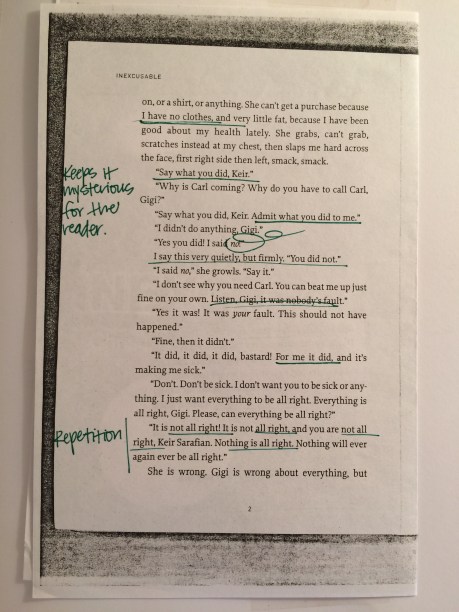
Attempt some literary analysis.  I love the classics, and I bet many of you do too–but sometimes we beat their beauty to death when we spend hour after hour analyzing them with our students.  Try pasting in a page of whatever you’re reading and just responding to how amazing the writing is.

img_5201

Jot down fun vocabulary words.  I love to note down both words that I don’t know and words that I just love, with no pressure to define them or use them in a sentence.  It helps me notice wordplay and attempt it myself.

img_5206

Paste in things you’d like to remember.  It’s too easy to throw keepsakes in boxes or delete emails that flatter us…so glue them into your notebook and flip back through when you need a lift.

img_5199

Shaking up notebooks in these seven ways will help your students curate a scrapbook of sorts–a place to return to and look back at long after it’s been filled up and the year has ended.  A notebook is a wonderful place to practice reading and writing skills, but it becomes most effective when it’s an authentic placeholder for growth, play, and memory.

How do you shake up notebook time with unconventional genres and prompts? Please share in the comments!

Mini-Lesson Monday: Do Teens Read Seriously Anymore?

It’s the end of our nine weeks. Well, kinda. I have one class of English 3 students that are at midterm since they are on accelerated block, and I’ve got two classes of AP English Lang who I share with AVID every other day in a year-long class, so they are at about the 4.5 weeks mark. Talk about crazy trying to keep the pacing straight and everyone moving.

One thing I know:  All my readers need to revisit the goals they set for themselves the first week of school. We’re going to start with independent reading. I’ve seen a little too much of this lately:

joshandtajhnotreading

Taken after exams when I suggested students use the time to read.

and not enough of this:

juniorboysreading.jpg

Daily routine: 15 minutes of independent reading

I set the standard high and ask my students to read three hours a week. This is difficult for busy teenagers who are not used to reading (and if we are honest, many are not used to completing any type of homework).

We will read this article this week “Do Teens Read Seriously Anymore?” and create our personal reading challenge cards. But before we do, I want to get students thinking about themselves as readers and what reading can, and should, mean to them and what they hope to accomplish in their lives.

Objective:  Interpret a quote on the importance of reading and connect it to my own reading life; construct a plan to help me meet my reading goals.

Lesson:  Students will select up two literacy/reading quotes and glue them into their writer’s notebooks. They will then think about their reading habits over the past several weeks of school and write a response to the quotes that connects their reading experiences (or not) and begin constructing a plan on what they can do differently in the upcoming weeks to either continue to grow as readers, or start to.

Follow-up: Later in the week we will also read “The Insane Work Ethic of Mark Cuban, Jeff Bezos, and 15 Other Powerful Leaders” and write a synthesis-type response using the two articles and their personal goals for reading.

Please share in the comments your ideas for getting and keeping students developing their reading lives.

Why I Love My Writers (and some book suggestions, too) #FridayReads


Maybe you see this, too:

I’ve got truly brilliant, fun-loving, willing-to-learn students this year, but when it comes to writing, they are as sloppy as a room full of toddlers with their first plates of spaghetti.  Missing periods and capital letters, too many commas (or not enough), and the makes-my-eyes-bleed lower case i. That one’s all over the room.

And I keep seeing this new thing:  the missing “it.”

Take this for example, all sentences from a self-evaluation students completed last week:  “My reading’s good, is something I do to release stress,” or this one: “Is the same thing as going somewhere,” or this: “My reading improved is better because I tried more.”

What?

Do I worry about mechanics over ideas? Never. Do I worry that my students know better and are just not paying attention? Always.

I teach juniors in AP English Language. This string-your-spaghetti-anywhere-you- want-punctuation should not be happening.

So we slowed down a bit. Took a step back. Searched in our in our independent reading books for sentences that struck us as interesting.

Students wrote their sentences on notecards. Here’s some they chose:

“It’s easier to jump out of a plan — hopefully with a parachute — than it is to change your mind about an opinion.” Think like a Freak by Levitt and Dubner

“We looked over toward the echoes of burdensome chimes, the slip and boom of the clutch and rasp of gears as the ice cream truck entered the dead-end streets and curves of Las Lomas.” Always Running by Luis J. Rodriguez

“They played basketball the way basketball is supposed to be played, and in the end they lost — but not before proving that Goliath is not quite the giant he thinks he is.”  David and Goliath by Malcolm Gladwell

“The barber gazed in amazement at this man with long-thick and black hair and beard, which gave his head the appearance of one of Titan’s portraits.” The Count of Monte Cristo by Alexander Dumas

“When he smiles, she notices that he has a dimple on only one side, and there’s something about this that makes him seem endearingly off-balance.” The Statistical Probability of Love at First Sight  by Jennifer E. Smith

“At the end of the hallway is a boy so powerful, so fearless, that he’s set up shop in the middle of a sacred site and renamed himself Goliath.”  Vivian Apple at the End of the World by Katie Coyle

“I felt a hot, tingly sensation spread spread over my skin as I slid down a few inches against the bench seat, wishing I could just melt directly into it’s crusty upholstery.” We Should Hangout Sometime by Josh Sundquist

“This is an ordinary Monday morning school day.A Stolen Life by Jaycee Duggard

“You see, Cinderella and I know what it’s like to look in the mirror and not recognize the reflection.”  Skinny by Donna Cooner

Then, in small groups we categorized sentences long and short, many punctuation marks or few. And we discussed the whys:  How does that mark help create meaning?

We could have spent days on this lesson. I should have allotted more time, and we will certainly return to it (maybe next week — it’s that pressing).

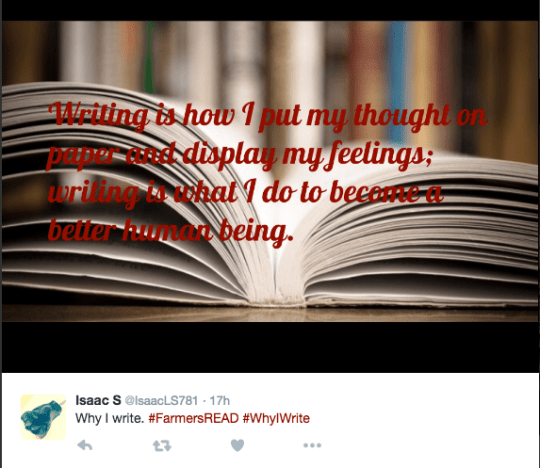
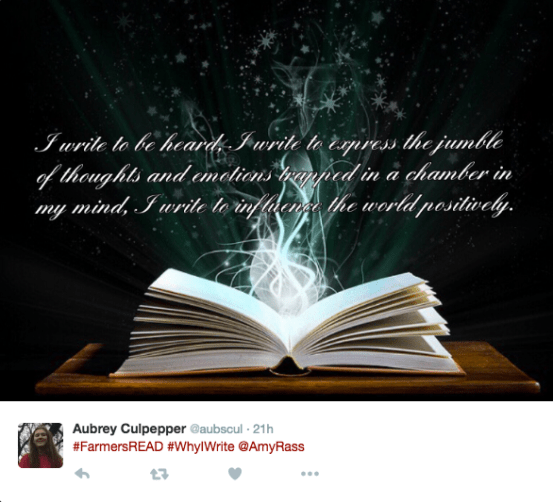
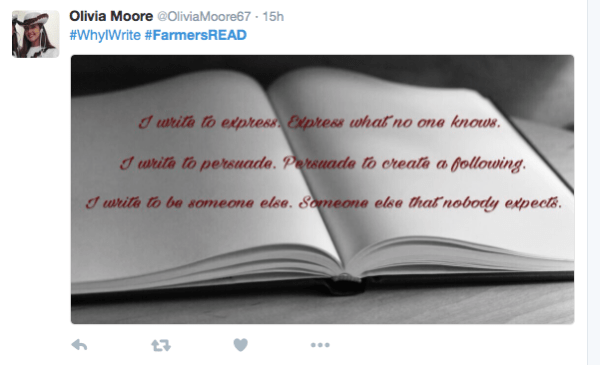
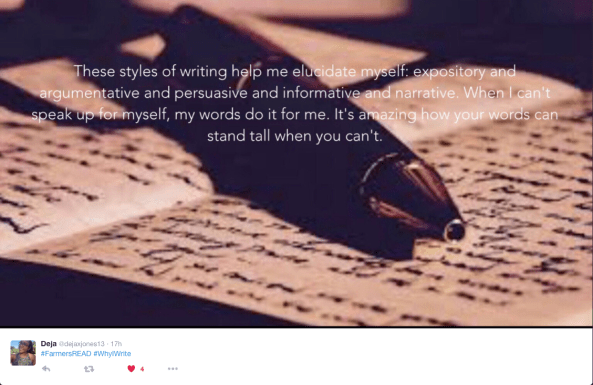
Then, yesterday as a way to join in on the National Day on Writing, I asked students to create a slide that explained why they write. Their slide needed to contain an image, a beautifully crafted sentence that included at least one of the literary or rhetorical devices we’d focused on recently, AND everything had to be correct: capitalization, spelling, punctuation. You might call me out on Olivia’s, but I think it works.

The ratio for correctness on this voluntary assignment was 22:6.

Here’s some of their tweets, evidence of why I love my writers. And also the reasons I hope we can take a little more care as we write. They have such amazing things to say.

screen-shot-2016-10-21-at-8-37-16-amscreen-shot-2016-10-21-at-8-35-42-am
screen-shot-2016-10-21-at-8-23-59-amscreen-shot-2016-10-21-at-9-23-40-amscreen-shot-2016-10-21-at-9-25-23-am


ftc-guideline-%22affiliate-links%22

Try it Tuesday: Revising a Goal…Card

Part of being relatively new to the workshop model is acceptance of personal limits on time, resources, and physical strength (I carry a lot of books around these days, but my twig arms persist). What workshop instructors can’t be short on is creativity, sales skills, or copies of  All the Light We Cannot See

So, as I start my second year exploring workshop, I find that some things need major overhaul (my capacity to read all of the books I want to read and share with kids) and some need tweaking (I’m going to try not to tear up while book talking The Kite Runner next year,..but no promises).

Last spring, I wrote about trying to motivate my readers with a visual reminder of the goals they were setting for their weekly reading. We created goal cards and placed them in our choice reading text at the point we wanted to read to (and beyond!) in the coming week. The card looked like this:

IMG_0172

Great. Except…not so great.

The goal card, meant to be inspirational, looked like a standings report at a track meet. Numbers, checkmarks, and most hideous of all, math. 

So, in the spirit of innovation, I went back through our former posts to find one I remembered from Shana about self-monitoring reading homework by calculating reading rates and then making bookmarks out of paint samples to inspire her readers. Beautiful shade progressions to symbolize change, quotes to inspire reading greatness, and reading rates, all tucked neatly in a text: IMG_9336

Great. Except…not so great.

Wisconsin hardware and paint stores now seem to only carry single color swatches or detailed color wheels in elaborate weekend warrior pamphlets, neither of which hold a place in a book in influential fashion.

Enter, my revised goal cards. A marriage of inspiration, functionality, and good old fashioned visual cues:

Students spent a few minutes finding quotes about books and reading that spoke to them. With my sample under the document camera as a guide, students created goal cards that reminded them of the importance and power of reading, and of not only setting goals, but keeping those goals visible in their daily reading.

Instead of using these cards as bookmarks, however, we calculated our reading rates (How many pages did you read during our ten minute reading? Multiply it by six and then double it for a two hour goal in your current text.), wrote them on the first page of our writer’s notebook under our text goals for the year, and then put the goal card in the book at the approximate place we’d reach in the text when we’d read for two hours.

Goal setting is important. As I tell the kids, it’s so important that we need to get our goals in print and on our minds to see them daily and make reading a habit.

Visual cues can help. In fact, sometimes they make the difference between passive participation (Sure, Mrs. Dennis. I’ll read for ten minutes in class…) and the active engagement we all seek.

What tweaks have you made to your workshop practice this year? Any major overhauls? Please share your ideas in the comments below. 

Mini-Lesson Monday: Developing Social Imagination by Making Connections

imgresI’ve been reading Peter Johnston’s excellent Opening Minds with my preservice teachers, and it’s a must-read.  One of the skills Johnston says the most open-minded students possess is that of social imagination, or being able to understand “what others are feeling, to read people’s faces and expressions, to imagine different perspectives, to make sense of abstract ideas, and to reason through this.”  In other words–empathy on all levels.  It strikes me that this is both a reading skill and a life skill.

To have your students practice social imagination, as well as grapple with a complex issue, try the following mini-lesson–which I believe I’d stretch out over two class periods.

ObjectivesDistinguish the differences between meaningfulness and happiness according to the article; Connect the concepts of meaningfulness and happiness to yourself, the characters in your independent reading books, and people in the world.

Lesson: First, I’ll emphatically booktalk Viktor Frankl’s 1946 classic, Man’s Search for Meaning.  This book, written in just seven days while Frankl was imprisoned in Auschwitz, argues that life is always worth living as long as one feels they have a purpose.

Next, I’ll distribute copies of The Atlantic‘s article “There’s More to Life than Happiness,” which pairs Frankl’s book with current research on happiness vs. meaningfulness.  To give students a purpose for reading, I’ll ask them to read the article with a pen in hand, noting the differences between a happy life and a meaningful life.  

To get kids synthesizing the information, I’ll ask, “Once you’ve finished the article, answer this in your notebook for a quickwrite: which do you think is more valuable–a happy life or a meaningful life?”

The article is lengthy, and I’ll allot 30 minutes for students to read and respond in writing before we debrief.  As a whole class, we’ll have a discussion in which we focus on what the article argues, what the students believe, and how culture may have nudged us to believe those things.

imgres-1The next day in class, we’ll refer back to the article before beginning independent reading time.  “As you read today, pay attention to the characters in your book–are their lives more happy, or more meaningful?”

When we wrap up silent reading time, I’ll ask students to turn to a neighbor and tell about the characters in their book, and whether they’re happier or more purpose-driven.  This time will double as peer book recommendations as well as a quick assessment of the text-to-text connection.

After asking students to share out any really great characters they heard about (to give the class more reading recommendations), I’ll ask students to open their notebooks and quickwrite about a text-to-self connection–“is your life right now filled with happiness or meaning?  Or both?  What do you want for the future–happiness or meaningfulness?  Freewrite about this issue in general.  These responses will stay private.”

After writing, I’ll ask students to grab a post-it note and make a text-to-world connection–from their parents to friends to public figures to entire communities, countries, or cultures.  I’ll collect the post-its for a quick assessment.

Follow-Up: I’d like to return to the idea of meaningfulness vs. happiness with a reading or writing unit on the issue.  We could collaboratively study almost any novel, poem, story, or article in reading workshop through the lens of identifying purpose vs. happiness, or explore the issue further in a writing workshop geared toward either narrative, informative, or argumentative pieces.

How might you have your students consider the issue of meaningfulness vs. happiness?


Using a “Traffic Light” System to Explore Readers’ Interests and Sensitivities by Amy Estersohn

9kThis summer my social media has been clamoring about content warnings and safe(r) spaces within an academic community.  To what extent do we as educators bear responsibility for how our students respond to the material we may present to them?

I’m sure some educators probably feel that such gestures are a product of an over-coddled generation at best or somehow reduce literature to mere plot points at its worst (spoiler alert: Johnny dies), but I decided that I wanted some way of understanding my students’ emotional lives and some understanding of what topics upset them or get them excited.

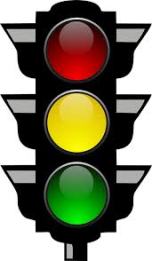
On the first day of school this year, I introduced and modeled a traffic light system in response to independent reading:

Green — topics I like to read about and topics that interest me.

Yellow — sometimes I like to read about these topics, and sometimes I don’t

Red — topics that upset me.  If I come across this topic in an independent reading book, I stop reading.

I modeled a response for my seventh graders, using touchy subjects that often come up in middle grade fiction.  I described divorce as a red topic for me, autism as a yellow topic, and illness as a green topic.  

Reader responses were fascinating.  Death and illness books were by far the most divisive, with some readers describing death as a green topic and others as a red topic.  Holocaust books were similarly divisive.  Many readers described enjoying books that were “sad, but not too sad.”  Some readers identified red topics that I would have never identified on my own as a potential tough topic (e.g. car accidents, physical disfigurement.)

imgresAlso interesting was that what I know about my readers’ personal lives didn’t always square with what they wrote about their reading topics.  Some of my readers seem to want to read books that mirror their real-life struggles.  Others want to veer far away from those topics.

Based on these responses, I adjusted some of my lesson plans slightly.  I had been planning to use parts of Lisa Graff’s phenomenal Lost in the Sun as a whole-class model for character, but based on these responses, I’m not sure all of my readers would appreciate reading about survivor’s guilt as much as I did.  Instead, I’ll use parts of Jason Reynolds’s As Brave As You to teach the same concepts.

I don’t see myself swooping in to warn a student before starting a book as lovely and potentially upsetting as Ms. Bixby’s Last Day by John David Anderson or The Seventh Wish by Kate Messner.  However, I want to continue the conversation about red, yellow, and green topics. As independent readers, we have a right to establish limits, and when we read a part of a book that approaches or goes over our limits, we have a right to put it down and talk to somebody about what’s upsetting us.


Amy Estersohn is a middle school English teacher in Westchester County, NY.   She also reviews comic books for http://www.noflyingnotights.com.   Follow her on Twitter at @HMX_MSE.

Try it Tuesday: Partnering Up for Reading Conferences

Sometimes inspiration strikes at the most opportune times.

One day last week I had the honor of hosting two small groups of teachers from a different high school as they observed my classroom, one class period in the morning and another in the afternoon. Many of the teachers on their campus have been exploring and practicing with the workshop model for a while now, and they wanted to see my workshop classroom in action.

After each lesson, we met to debrief and hold a kind of question and answer session. Talk about an awesome experience (except for the voice in my head that kept saying “When did you become the expert on workshop? Yikes.)

I think one of the best things we can do as teachers is invite others into our rooms to watch us teach. Talk about keeping on the A Game. That’s a Try it Tuesday suggestion all in itself.

Here’s another one:

During one of those debriefs, one teacher asked about the conferences I conducted as my students read for the first 15 minutes of class. “What questions did you ask?

I explained that it depends on the student.

If I go with “How’s it going?”

My students answer, “Fine.”

If I go with “What are you thinking?”

My students answer, “Nothing.”

So I usually lead with “Tell me a little something about …will ya?” And then I listen to see what direction the conference might take.

That’s pretty much the genesis of every conference with my readers.

Another teacher mentioned that she and a colleague had been thinking about asking students to bring a question, thought, or problem to their reading conferences. You know, kind of like we ask students to do when we meet with them about writing. I’d never thought about it for a quick reading conference though. She wanted to know if I thought it was a good idea.

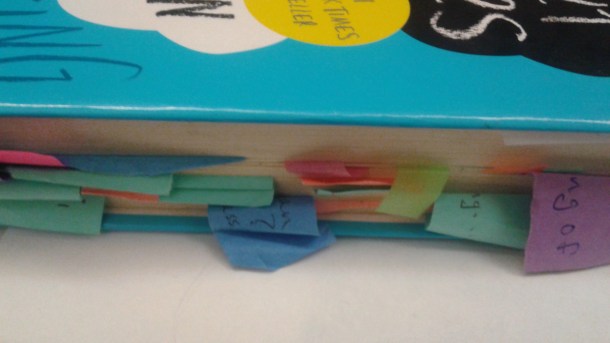
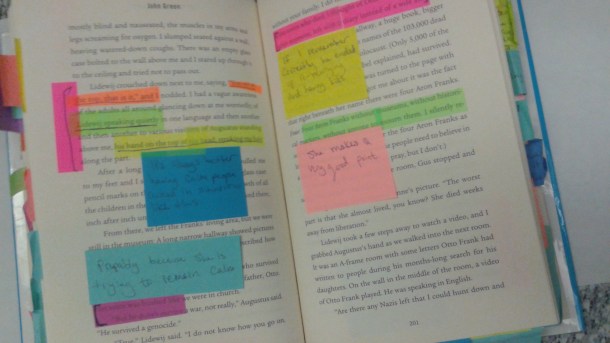
The image of this book came into my head. I found this copy of The Fault in Our Stars at a thrift store. It looked just like this:  plastered with sticky notes that reflect the student’s thinking. Now, I have no idea why this book is tattooed with notes, but I can imagine a not-so-great idea.

tfiosmarkup2tfiosmarkup

I hope a teacher didn’t assign this book and ask students to bring ideas to a reading conference. If that happened, I doubt this student got into reading flow. I doubt this student enjoyed this lovely, heart-wrenching book. I doubt she felt the beauty of the language and felt the loss of a beloved character. Maybe all that happened, but it wouldn’t have happened for me.

I want my students to love to read. I think we have to be careful with what we ask them to do with their independent reading books besides fall in love with the story and the language. Sure, they may recognize craft, they may recognize characterization. But the important thing is that they recognize that they are liking to read. That is so important to so many of my readers. They have to realize they like reading.

I do believe we can, and should, ask students to revisit passages — and maybe even the whole of a book — from time to time, even quite often. We can teach many important reading and writing skills that way, but we have to temper our desire to teach a book to death, even the books students choose to read themselves.

What I told my inquiring friend:  What if before independent reading time, on any given day, we ask students to read for a specific purpose.

Read to find interesting figurative language. Read to notice clever imagery. Read to discover how the writer shares an insight about a character. Read to find a beautiful or startling sentence. Or maybe a sentence that’s not really a sentence.

fabian

Fabian before class sharing his awe at the writing style of Jonathan Safron Foer in Extremely Loud & Incredibly Close

Isn’t this what readers do? I do. When I read a passage that strikes me in some way I want to share it. And let me tell you:  When my students start to do this on their own? That’s celebration time.

“What about the student who cannot find anything to share?” you might ask.

Well, that’s important information, isn’t it? I don’t know, maybe like the kind we might discover in a one-on-one reading conference.

Right?

I’d love to know your thoughts on this. What ideas do you have that work for your reading conferences? Please share in the comments.

Big thanks and shout out to @Sean_G_Hood and @mrs_friend and the inspiring teachers at Hebron High School!


Mini-Lesson Monday: Narrative Analysis with StoryCorps

We all have a story to tell.

In fact as writers, we have countless stories to tell. We tell of our experiences, fears, hopes, dreams, and even those trivial events that sometimes add up to more “life” than we could have imagined.

We tell the stories of others too. Real and imagined people that speak to us in words we’ve heard and sometimes, in the words we long to hear.

I wax poetic with my students like this often, but especially early in the school year. I want them to feel my passion for the power of stories and encourage them to develop their own passion for expression. As Morris (protagonist from one of my daughter’s favorite children’s books The Fantastic Flying Books of Mr. Morris Lessmore) beautifully states, “Everyone’s story matters.” 

With this in mind, my American Literature collaborative team (Shout out to Brandon, Catherine, and Erin!) worked this year to develop a unit of narrative writing that asks students to look at the stories they tell and how those stories can be interconnected. Everyone’s story matters, and in this case, they get to have even more meaning as students craft individual tales that relate to their chosen thematic focus.

Students, having already selected, listened to, and analyzed an episode of This American Life for elements of author craft in a narrative (hook, chronological/detail choices, and word choice), partnered up or formed a group of three, and selected a theme out of a hat (dangers of conformity, vanity as downfall, the power of choice, etc.) they would explore, both individually and in their groups.

The overarching assignment is to craft an individual narrative that fits the theme and ultimately orally record the stories in a podcast that highlights the interconnectedness of the individual work. Students are graded individually on their narratives, but the podcasts are a group effort and will be played for the class.

storycorps


Objectives — Students will listen to several examples of 2-3 minute stories from NPR’s StoryCorp in order to practice narrative technique identification and analysis one more time before drafting their own stories. Students will discuss and share their insights on narrative impact of what they heard in an effort to purposefully craft their own narratives.

Lesson  — According to their website the initiative of StoryCorp is to “preserve and share humanity’s stories in order to build connections between people and create a more just and compassionate world.” 

In class, we had spoken already about the power and purpose of stories and students had come up with some wonderful ways stories enrich and fulfill us. Stories:

  • explain, or attempt to explain, where we come from and/or why we are here.
  • allow us to express what we believe or hope.
  • reveal who we are or who we want to be.

I shared with students that we were going to listen to some short pieces that told unrelated stories on the surface, but each would link back to some of the reasons we tell stories at all. Students were asked to record what they heard in the hook, insights on which details were included and why, and word choice (all elements they will be scored on when writing their own narratives).

I started by playing a sample story and then walking them through my own analysis. “Traffic Stop” is a piece that details police brutality in 2009 against a black man who was raised by white parents. The piece pretty brutally (I did have to mute three or four seconds of the piece where a police allegedly uses a racial slur that is inappropriate for the classroom) relates the story of a young man who is pulled over by police, searched but cleared, and then is assaulted by police when he questions why the officers are searching his car.

After I played the piece, I projected some of my own analysis. The hook involved the young man’s mother saying that she never would have thought skin color would make a difference for her son, but she painfully learned she was wrong. Word choice vividly captured the pain, fear, and confusion of the young man who was beaten by police. The chronology includes context for the horror of the event, a play by play of the few moments of the traffic stop, and details about the young man’s mother seeing his injuries in the hospital. My analysis was that the elements chosen were specifically selected and organized to convey the disbelief that something like this could happen to an innocent person and the role that race played in the event.

We then listened to two more stories. Students wrote down their take-aways in their writer’s notebooks and discussed after each piece. We shared out ideas and pulled insights back to those class generated elements of why we tell stories.

Finally, I had students listen to one last piece, detail their analysis on a half sheet of paper and turn it in to me for some formative feedback.

Follow-Up — We are about to start mini-lessons on hook, chronology, word choice, and parallelism (thank you Common Core) in drafting these narratives. I plan to reach back to the insights shared during this class in order to help students make purposeful choices in crafting and revising their narratives.

Everyone’s story matters. 

What tools do you use to get students thinking intentionally about their writing craft? Please share your ideas in the comment section below! 

Using the Whole Book: A Nose-to-Tail #FridayReads

“Some books you read. Some books you enjoy. But some books just swallow you up, heart and soul.” 

I love this quote from Joanne Harris. I love her book, Chocolat, and truth be told, I really love the movie adaptation’s casting of Johnny Depp as Roux… for aesthetic reasons. Seems there’s a lot of love up in here.

Speaking of book love. It’s a rare and wonderful treat to see a student experience this type of consumption through reading, but it’s delicious when it happens in my own life as well.

My heart has been most recently consumed by Gloria Steinem’s new memoir My Life on the Road and this week it became a text I was sharing with everyone.
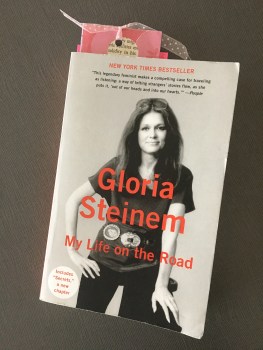
Now, don’t hurt me, but I’m a bit too young to have really appreciated Gloria Steinem’s political prowess, revolutionary movement for equality, and inspirational professional ascension to feminist icon firsthand. I had, however, heard the name and when I heard an interview with Steinem on NPR, I was immediately hooked by her candor.

Steinem was on All Things Considered, discussing the inspiration for her new book, and I caught the interview on my way home from work.

img_6045

Bookmark courtesy of one crafty Shana Karnes

Safety alert: I used the Amazon app on my phone to purchase the book while at a stoplight. Unwise, but enthusiastic. Book love makes you crazy.

Steinem’s explanation of her text as part analysis of family dynamics, part travel journal, part personal exploration of leadership, and honest look at how we all live, had me intrigued. The fluency of her voice had me convinced that her prose would float off the page as beautifully as her words were floating through my car radio. Her stories had me laughing and almost crying just in the course of a six or seven minute interview.

In short, I knew this would be a captivating book.

What I wasn’t prepared for was just how relatable, inspirational, and downright touching this memoir is.

And thus began my very public consumption of and by this text. In the course of a week, I have:

  • Book Talked this book to all my classes. I explained the above reading story to my kids and shared a passage with them where she talks about being a reader and writer. Perfect for my readers and writers! “Writing, which is solitary, is fine company for organizing, which is communal” (40). 
  • Shared several pages with my 9th grade colleagues working on character development in their classes. Steinem goes into rich detail about her father and the struggles her family endured at the whims of his wandering spirit. She then talks pointedly about how her own travel (detailed later in the book and familiar to those that know and devoured Eat, Pray, Love by Elizabeth Gilbert) was most likely inspired by her youth, even though she wanted nothing more as child then stability. Students could relate to those first few instances in life where we start to see our parents in our behaviors. (I’m personally turning into my father).
  • Used that same section on character as a mentor text with my sophomores to discuss narrative purpose. Steinem’s anecdotes about her father in this section are reminiscent of The Glass Castle by Jeannette Walls, but at the same time made several of my students laugh out loud when we were reading. The author’s voice here shows poignancy through her choice of heartwarming and heartbreaking stories about her youth. We analyzed each of the anecdotes that Steinem shares in this section by having students break up into groups and evaluate how the author might have intended to use that anecdote in her self-proclaimed purpose to show how she had long been embarrassed by her father.
  • Utilized a specific quote with my AP students for a quick write. We are currently studying education and focusing on an essential question of “To what extent do our schools serve the goals of a true education?” I projected Steinem’s quote of “When humans are ranked instead of linked, everyone loses”(44) on the board and asked students to quick write on their reactions to this in light of our unit essential question.

I have also raved about this book to my husband, colleagues, friends, and three-year-old daughter, to whom I’ve suggested that she must travel, embrace her power as a woman, and learn from everyone she can. She asked if we could play Candy Land. I may have a ways to go with that one.

But at the end of the day (and week, yay!), this is a book that tells the story of what it means to explore the world and find a home wherever you are and does so with a voice that will make you want to read, share, and repeat. As a bonus, it details the life of a budding writer. For students to read and digest the struggles, joys, and challenges involved speaks deeply to what we ask them to explore in our classrooms each day.

What texts have consumed you recently? How are you sharing them with your classes? Please comment below! 

Steinem, Gloria. My Life on the Road. Random House, 2015.