I didn’t respond as well as I would have liked. You know that after-the-fact missed-it-moment we sometimes get when the wit and wisdom leaves us wordless? I had that.
I was presenting on the topic of rigor in the workshop classroom at an ELA PD day in a district I’ve worked with quite a lot. So many fantastic teachers there are taking risks, celebrating choice, modeling reading and writing lives, and working to revise their practices so they significantly impact the reading and writing lives of every learner. This is truly a district initiative with support and resources from many levels.
I started the session by referring to the work of Simon Sinek who teaches that great leaders Start with WHY. (I wrote previously about the impact of Sinek’s work on my own thinking here. ) When we know why we teach, and we let our why guide our planning, it becomes much easier to let go of control and design instruction that keeps the focus on developing readers and writers. We teach children, not books. We teach readers and writers, not reading and writing. We become open to, and then protect, the space that allows for more time to read, more time to write, and more time to read and write beside our students.
Take a look at this graphic. I first saw in in a tweet by George Couros and modified it a bit to fit ELA.
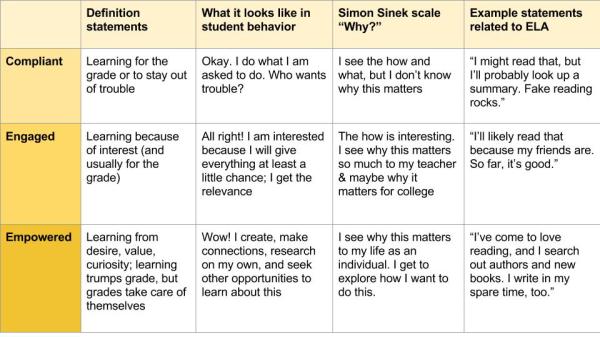
original: @gcouros #InnovatorsMindset
Don’t we all want our students to feel empowered? How many of us can say with fidelity they are? I cannot — at least not all the time. I struggle with time and texts and mandated tests and so much more, and just when I think I have it figured out, the year ends and a new group of students show up with different needs. (Or our preps change like mine did this year.)
But workshop is the model that helps the most. My focus stays on the individual: What books will help him identify as a reader? What books will challenge her so she sees her growth? What do they need to feel the pull of the pen and want to write, revise, and publish?
Honestly, I am struggling with a lot of that this year, but I’ve taught the other way with whole class novels, one after another; and study guides, worksheets, and tests over books. I will never go back. However, I still feel the pull at times when a colleague shares some activity she’s created, and it sounds cool or she says students liked it. I nod and thank and think: Does this reflect my why? Does it fit within my philosophy of workshop instruction?
See, I wasted so much valuable time. Time I could have used to help students gain a greater sense of themselves as readers, writers, and contributors in our world. When we spend all that time teaching the history behind a novel, so students are more apt to understand the novel, and then either read the book aloud in class, or then task students to read it at home on their own (so many don’t), and then assign worksheets and annotation minimums, and then give multiple choice tests — we forfeit valuable time.
And we often teach kids to hate reading.
That is what I wish I would have said in that PD session.
It doesn’t matter that I “love teaching literature” and “that is why I wanted to teach English.”
What matters is our students. What do they need?
Amy Rasmussen teaches readers and writers at Lewisville High School in N. Texas. She’s an advocate of kids, big or small, and works tirelessly to try to fit all the pieces in all the right puzzles. Follow her on Twitter @amyrass
















 Three Teachers Talk