Independent Reading and Accountability: a Paradox

The paradox persists, every year. Here are some basic principles of my sophomore RWW course last year with independent reading:

  • Students were allowed complete choice in their independent reading.
  • Part of their writer’s notebooks were connected to their independent reading: Writer’s Craft and vocabulary
  • Students kept their own track of page progress.
  • I conferenced as much as teacherly possible.

Like many teachers I know, I tend to dwell on what didn’t work. So, here it is:

  • A few students chose to not read or to fake read, all year.
  • As a result, these same students either did not complete or faked their notebooks.
  • It’s not hard to keep track of zero.
  • Conferences became predictable: repeated proclamations of non-readerhood followed by a polite acceptance of yet another suggestion for a book, which would yet again be not- or fake-read.

Struggling yet again with this issue as we plan for next year, my colleagues and I find ourselves in the waters between the unstable shore of no grades and the concrete ledge of grading, that deep roiling vortex between theory and practice. In this post, Shana cites Pernille Ripp and Janice Pilgreen and translates some of their basic principles into a RWW model. We all believe in these principles and are committed to exercising them every day in our classrooms. Regarding practice, at the end of our most recent meeting we had been focusing on this one: a lack of graded formative assessment and an emphasis on summative assessments for learning, not of learning.” We even got down to the tools we might use to do so: Padlet, Flipgrid, video book trailers, even good old-fashioned book reviews and “live” book talks. We even discussed scaffolding these summative assessments to support growth toward the formal speech that is a requirement for fourth quarter.

Yay. Right?

Still, won’t there still be students who remain entrenched in — even empowered by — their non-reader status?

Last year, I had students who were able to earn a B- in the course while never reading a single word. They participated in the writing process. They faked their way through the reading-based components of their writer’s notebook. They even wrote about their non-reading in their “quarterly reading reflection.” This consequence of the grading policies of the course is not enough for me to revert to grading independent reading, but I can’t help but be preoccupied by it.

bbbSo, readers, I’ll leave you with these question: Is it realistic to expect 100% participation in independent reading? Must we accept that there will inevitably be non- and fake-readers among us? And if so, is success for the majority — when it includes those students who may not have succeeded with assigned reading — enough?

ILA 2018 Conference Run-down!!! (and an epiphany!)

Am I the only person who feels super awkward meeting new people?

So I’m standing in the “New to ILA!!!” section of the Austin Convention Center early Saturday morning.  Several well spoken women and men address the throng of newbies and supply us with important information about the conference.  Remarks concluded and we are encouraged to visit with those around us, meet new people, and hang out.

I’m there by myself waiting for Gretchen Meyer, my fellow literacy advocate, to arrive. She shared this conference experience with me and I couldn’t ask for a better guide.

IMG_4479

Can you imagine a more awkwardly handsome face?

So I’m scanning the crowd looking for familiar faces, assuming there won’t be one.  I’m an award winning people-watcher and for those of you who aren’t, teachers can be incredibly fun to observe.  Anyways, Marcie, an incredibly nice women with a bright smile introduced herself to me and we talked about the conference and how excited we were to listen to the speakers at the General Meeting that was to begin shortly.

Both of us, my new ILA friend and I, massively underestimated the level of brilliance that was about to wash over me.  I listened to Adan Gonzalez talk about his success in the face of poverty and bigotry and how he works to fight those demons today.  Nadia Lopez blew the crowd away with the statement, “I opened a school to close a prison.”  So…um…wow.  If that wasn’t enough, we got to experience the passion of Cornelius Minor and his charge to consider, “How can we not stand for our children…when the traumas of the world weigh them down in our classrooms?”

I had to pinch myself.  Was the rest of the conference going to be this amazing? (It was.) Was this euphoria and uplifting feeling of being re-energized going to fade as I left this hall and moved on to the other presentations? (It didn’t.) Was I ever going to see my new friend, Marcie, again? (I did, on the big screen, at the end of the general meeting.)

Marcie

Meet Marcie Post, the Executive Director of the ILA.

Even now, back in League City, I can’t stop reflecting on the lessons I soaked in at ILA.  Maybe the biggest realization I came to, and there were many, wasn’t about books or kids or literacy.  This realization encompassed all those ideas, but was really about me.

I realized that above all else, I’m a “culture” guy.

I’ve identified myself by so many labels over the years: Football guy, Coach that can teach, Book Lover, Literacy Advocate, Student First Teacher… all those things. But, when its all said and done, after 16 years in the classroom, culture means everything to me. The culture in my classroom is, obviously, important. Just as important, perhaps, and, for the most part out of my control, is the culture of the people around me.  I want to be around teachers that are happy people.  I want to feel like we are all in this together and that the kids will be the big winners in this world.

I think this seed might have been planted by this blog post by Lauren Ambeau, an intermediate school principal in my school district that posts on her own blog. Or it might reach all the way back to my first two principals, Marlene Skiba and Deanna Daws; two women that made me feel confident and valued in my teaching role.

I think, also, the people I learned from at my most recent, and longest, stay had a lot to do with it.  I have the honor of presenting with the brilliant Jenna Zucha next week and this woman took time out of her summer, twice actually, to visit with me about our upcoming opportunity to present about writing to the leaders and stake-holders of our district.  She guest posted on this blog back in May.  What’s funny about our second meeting, is that one of my best friends happened to be at the very same Starbucks. He’s a genius, and famous.  You might have heard of him… Ashton Kutcher thinks he’s cool.

bro

This summer’s Literacy Institute, our own sort of ILA, comes to mind as well.  Billy Eastman and Amy Rasmussen build a culture of respect, trust, and love that I try to recreate in my classroom.  The huge win came from spending three weeks with the beautiful souls whose teaching team I’m so looking forward to joining.   We laughed enough to get stares from the other groups and cried buckets on the last day as we bared our souls through our writing.  Sarah Roy guest posted about that process just two weeks ago and then Austin Darrow guest posted for Amy the next day!!!  Amanda Penny is one of the most fun loving people I’ve ever met. Looks like the culture I’m joining at my new place is strong, and, having gotten the opportunity to interact with the instructional leaders there, I know this is by design.

Kylene Beers, Sunday afternoon, said, “Our democracy requires that we hold onto our own literacy and not turn it over to a few pundits on this network or that one.”  This statement reminded me that I posted about this very same idea back in February.  Thus I’m reminded further that this blog, this digital workshop, is a culturally supportive space for teachers like me.

There is so much more to write about.  I plan to sprinkle those tidbits through my posts this year.

Understand this: I’ll fight for culture.  I’ll seek out good people and happy teachers for the rest of my teaching career.  The kids deserve it.

Charles Moore has his pool looking as clear as crystal.  He’s done a horrible job being a reader this summer. His kids spend most nights sleeping in a blanket fort in the boy’s room (thick as thieves, those two.)  He’s looking forward to sharing the experience of discovering a new school with the incoming 9th graders at Clear Creek High School.

I Survived: Subbing the Last Three Weeks of School (with 140 freshmen)!

I am a literacy coach. That means I spend my days supporting teachers: teaching mini-lessons, co-planning, developing (hopefully) high-quality PD. I adore my job, though sometimes a little voice niggles in the back of my mind, a voice leftover from my classroom days, the teacher voice that’s always a little skeptical of anyone who’s not currently in a classroom:

Do these ideas (still) really work?

Yeah, but you’re not in a classroom anymore…

This sounds great … but what about kids who [insert reality here].

When a long-term sub position opened up for the last three weeks of school, teaching freshman English in a district where I had been coaching, I jumped. I was excited, energized, eager to get in there. Sure, I’d be spending my days with 140 freshman. For the last 21 days of school. I got this. I felt like I could get some answers for that niggling voice.

Plus, I can do anything for three weeks, right?

The first day was hard. Like, haaaaarrrrrdddd. I texted my husband, a 20-year veteran high school math teacher.

8:45 am

IMG_1675

10:15 am

IMG_1673 2

2:45 pm

IMG_1674 2

It was so good for me to be back with students, to spend even just three weeks in the shoes of a teacher. I think it’s something folks who support teachers should carve time out for on a regular basis.

Day two was much better (read: I instituted seating charts — rookie mistake! And used my “deep voice” as needed.). We spent the last days of the school year immersed in a writing unit using writing workshop principles to structure our time. (We studied multigenre writing, which you can read more about here and here and here.)

One of the best parts of those three weeks was that I left affirmed in the work we do as writing workshop teachers. While I was reminded how challenging teaching is, it also confirmed how powerful it is when we carve space for students to explore their thinking. Students grew as writers in those three weeks. It didn’t happen by magic, though. There are intentional choices that workshop teachers make along the way.

Belief 1: Community (before curriculum)

Many of us are great at building communities within our classrooms. We start the year with narrative writing, or getting to know you writing, poems about our lives. We fill the space with student writing and take time to really get to know our students. We all have fresh notebooks and sharpened pencils.

How many of us, though, have been guilty of still having those early products hanging up at Thanksgiving break? If you’re like me, by the time January rolls around, the idea of community building is a distant memory as you begin to feel the pressure of testing season roll around.

It doesn’t have to be that way. In workshop, community is the catalyst for success, and building that community is never finished. In my time with students, I was reminded that before I can move into teaching the curriculum, I need to make sure that students feel safe and seen. We do that in lots of ways. Our favorite was using quickwrites (check out Linda Rief’s new book The Quickwrite Handbook) to launch workshop time. Then we’d share, sometimes with partners, sometimes whole group, sometimes just a line from our own writing. I noticed a community growing (in some cases one had already been in place, but in other classes not). From there, kids were more willing to take risks.

They wrote about brave and honest topics. One student wrote about his childhood spent playing in the woods. Another girl wrote about coming out and how she felt like nobody believed her. Other students wrote about church camp, horse camp, and The Office. Some kids designed google sites, others published in booklet form. They were brave because they felt like they were part of a community of writers and they had something to say.

Belief 2: Choice is crucial

We know from our own experiences how powerful it can be to make choices as writers, especially beyond choosing a topic. Writers make choices about all kinds of things — length, genre, tone, craft, font. We know, though, that often giving kids choice leaves them feeling paralyzed, crippled with self-doubt (or lack of motivation). I remembered that kids need to be taught how to make choices.

I started small. I was amazed at how powerful it was to let them choose how to store their pesky phones. They resisted turning them into me, but had no argument when I let them charge them at a makeshift charging station. I noticed too that when I let kids decide where to sit, even if just on the floor by the window, they were more willing to dig into the writing.

This led us to be able to have discussions about their most often asked questions, like how long? am I done? is that what you wanted? It’s tempting to just give them the checklist, to create a template and let them fill in the blanks (I’ve done it, okay? It was awful for all of us!). Instead, though, we worked towards empowerment so students could make choices that made their writing their own.

Belief 3: Teacher is the heart

If students are the life blood of a writing workshop classroom, then the teacher is the heart, pumping, motivating, breathing life into the space. That’s not to say we’re at the center, of course. But we are busy making sure we do our share so that all the other systems can keep working.

I noticed that when I wrote right in front of kids, they leaned in. They referenced my writing. I noticed that when I conferenced with them, they were more willing to share later. I noticed that when I asked them questions, they would think about their responses. Conversely, I noticed when I sat at my desk and tried to get caught up on grading or emails, well, they tuned out too. I set the tempo.

Writers need us in the background, nudging, nurturing (sometimes nagging). They need our steadiness.

Caveat

This is not to say that every kid dug in. There were several who chose to spend the last three weeks with their heads down. A few showed up every single day yet still ended the year with a staggering 25%. Writing workshop isn’t magical, after all. We invite students, show them the possibilities. They choose what to do next. But every day, we invite them. I’d say to one student, “I’m happy to see you today.” To another I might whisper, “you’re always invited to the writing table.” Out of the 15 or so kids across the day who refused to work, I was thrilled when one of them, Will, finally decided it was easier to write than to sit there every day. I’ll take it.

Conclusion

I am energized after my three weeks with students (6 weeks of summer has helped with that). I’m more committed than ever to the principles of writing workshop and to supporting teachers as we carve out space in our curriculum for students to grow as writers. I know that my time was short, but look at all they accomplished in just three weeks! If we can make this happen in just 1/12 of a school year, think of all we can do throughout a year!

Angela Faulhaber is a literacy coach in the Cincinnati area. She’s currently trying to get through the stack of books she hoped to read this summer, while also squeezing in pool days with her three kids, and maybe a nap or two before school starts. 



Assigned Reading Works as well as Assigned Flossing

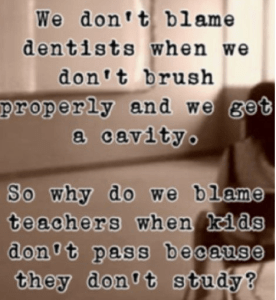
Every few months, I notice a meme recirculate with some variation of “Judging teachers on their students’ test scores makes as much sense as judging farmers on their crops without accounting for drought, freezes, or disease.” Still reflecting on my students’ lackluster AP scores as I sat down in the dentist’s chair this morning, I considered this meme. Then, like most teachers I know, I still wracked my brain trying to figure out what I could do differently to help my students score higher on that exam. As I mused, and chastised myself for taking their scores harder than I should, I endeavored to distract myself a bit by trying to remember the other meme out there that connected the professions of dentistry and teaching based on clients’ results. Ultimately, I looked it up when I got home, and it reads: “We don’t blame dentists when we don’t brush properly and we get a cavity. So why do we blame teachers when kids don’t pass because they don’t study?” Or read enough prior to twelfth grade, I thought.

Screen Shot 2018-07-24 at 1.57.38 PMMy cleaning ensued – painfully, I might add, as my technician was unnecessarily rough, and I wanted to ask her if she remembered that a person was attached to those teeth, but I found it too difficult to ask such questions with someone’s hands in my mouth. I waited for the post-cleaning check-up with the dentist, knowing the only question I had for him was about the dark staining I’ve been experiencing lately despite my careful brushing and (sometimes) flossing regimen.
During the 3 minutes he spent with me (I see why he earns the big bucks compared to me, I thought cynically) he responded to my question with one of his own.

“Do you drink a lot of tea?”

“Well, I guess so. I gave up soft drinks a couple of years ago, and tea became my go-to beverage.”

“Well then, that’s why your teeth are stained. You should expect that if you drink tea. It’s the worst thing you can do to stain your teeth. It’s worse than drinking coffee for stains.”

I didn’t hear the rest of what he said because it devolved into chastisement. I didn’t Screen Shot 2018-07-24 at 1.55.01 PMexpect him to congratulate me on the steps I’d taken for my overall health in giving up on sodas, and I didn’t expect him to have sympathy for how hard that habit must have been to break, and I didn’t even expect him to think logically about how much less acid was wearing away at my enamel now that I don’t drink soft drinks, but I also didn’t expect to feel as though I had done something so very wrong.

That’s when my English teacher brain went back to thinking about what we do (or fail to do) for our students. I thought about how many students have been made to feel “less than” when they want to read a YA book instead of a classic text. Just as my dentist was so set on his vision of how I should live solely focused on the effects on my teeth that he forgot about the person attached to them, how many well-meaning English teachers are so hyper-focused on their well-chosen texts that they forget about their students’ needs? How many forget or do not understand what can be gained with YA or self-selected books?

Screen Shot 2018-07-24 at 1.58.46 PMMy teeth will continue to stain, I guess. I’ll brush with baking soda once a week to combat that. But I’ve gained better health and energy. I’ve lost the migraines I used to get when I drank colas all the time. And if we allow our students to read what they want and need to read, they might lose content knowledge of some of the classics that we read (or fake-read) in high school, but they will gain an authentic love of reading. They will find connections with characters in their books. They will connect with each other as they enthusiastically discuss their books. They will feel empowered and in control of their lives as readers. Their reading levels will improve. And yes, the test scores will follow.
Prescribing all the texts our students read, even when doing so comes from a place of good intentions, works as well as prescribing flossing. Everyone does that at least twice a day, right?

Amber Counts teaches AP English Literature & Composition and Academic Decathlon at Lewisville High School. She believes in the power of choice and promotes thinking at every opportunity. She is married to her high school sweetheart and knows love is what makes the world go around. Someday she will write her story. Follow Amber @mrscounts.

Analog Mind in a Digital World

Last year in my AP Lang & Comp classes, we read “Is Google Making Us Stupid?” by Nicholas Carr, published in The Atlantic in 2008. Many students were set off just by the title and took Carr’s argument personally, even though the “us” of Carr’s title includes himself and his highly-educated colleagues. Carr argues that the tools we use influence the way we think, and he speculates on the impact of a tool as powerful as Google to direct our thinking. Most students vehemently defended technology as wholly beneficial to their everyday experience, even arguing that a shortened attention span is not necessarily a detriment and even a worthy sacrifice for the breadth of information to be gained. However, many had trouble distinguishing between “information” and “knowledge.”

1*8P_dPIZZ-9aKVz2Ji4nOtgWe discuss and experiment with so many ideas for students to develop the habits of a writer, even down to the practical tools — both “analog” and digital — for doing so. And we all have our own. One of my most prolific students keeps everything on her phone, including her award-winning spoken-word poetry complete from draft through final version (although she dutifully complied with the traditional notebook requirements of the course). Mariana swears by the Notes app on her phone in addition to her written notebook. I’ll use my Notes app when it’s the only tool I have, but I always forget about it.

I’ve always been a napkin scribbler. Even my notebook is an assemblage of scraps, some of which do lose context when I return to them. Still, most of the scraps elicit entire experiences or trains of thought because of the legibility of my scrawl or the color of the ink. When I use the insights from Roxane Gay’s talk in my teaching, I’ll always picture the orange ink bleeding through that napkin and the way I had to write around the grease spots. And I’ll remember the event, being there with Mariana, drinking wine, listening to Roxane Gay’s lovely, distinctive voice as she talked about the power of our stories (more on Gay’s insights in a future post). For me, indistinct lines of digital type on the same tool I use to pay bills and order takeout becomes more like information rather than inspiration. But I can’t help but feel outdated and outpaced.

And this is to say nothing about the role of the digital world in our students’ reading flower_-_analog_vs_digitallives, which Amy discusses here. Maybe it’s inevitable that physical books and paper notebooks will go the way of snail mail and brick-and-mortar. For the near future (i.e., next year), I’m holding to the requirement of a physical book for independent reading and a physical notebook for quick writes and writer’s craft lessons.

Has anyone made the switch to a fully digital reading-writing workshop? I’d love to hear about your experience. What is lost and what is gained? 


Persisting in the Face of Criticism

I have a confession to make…my AP scores were not what I was hoping they would be–wait, let me rephrase that: my students’ AP scores were not what I was hoping they would be. That’s the temptation; to take on the blame when the test scores aren’t what you hoped. I notice that most of us don’t take credit when the students do well, though. Interesting…

At any rate, back to my confession. This was our 2nd year of AP Lang at my school. Last year, my students scored fairly well–pretty similar to the national average–and I was pleased. This year, they had more 4s than they had last year but there were also more 1s. The average score dropped by .1. That doesn’t sound like a big deal, does it? In this age of high stakes testing, though, it is. There is always pressure to do better and better, to demonstrate that you are effective and that you’re doing the “right” things. I’m largely removed from that pressure because I teach in a private school, but the pressure comes from other places in that situation. Instead of pressure coming from admin or a central board, there’s pressure (real or perceived) from parents. I can make all of the arguments–different set of kids, 2nd year of AP (supposedly it takes 5 to really know the AP material and get “good” at it), etc. The arguments don’t matter, though; I want to give my kids the best opportunities that they can get, so it’s reflection time.

800px_COLOURBOX3156107

As I look forward to next year, I have to think about what worked and what didn’t, and already the pressure to drop my independent reading has begun, at least for my AP kids. Here are some of those questions and my responses to them:

  • How can you sacrifice 10 min of instructional time every day in an AP class?
    How can I not? My AP kids especially are so overloaded with classwork (plus athletics and extracurriculars–at my school, it tends to be the AP kids who do or join everything)–that they have precious little time at home to read. These kids see reading as a chore that has to be accomplished, something to mark off before they move on to the “real work” of AP Calc or AP Bio. They’re reading in a grind but not at all for pleasure. How can I not carve out a little time every day (from my 53 minute class periods) to help them reconnect with that love of reading just for the joy of reading?
  • What about more multiple choice practice? You could do that in the 10 minute reading time!
    I could, but I feel that building the reading lives of my students will pay off dividends, even on those multiple choice sections. After all, there’s a degree of that that’s based on reading comprehension, so I think reading is a pretty essential skill for them to work on. Sure, I probably do need to build in more m/c practice, but I’m not doing it at the expense of my independent reading time.
  • If you’re going to let them read, shouldn’t you make them read on-level AP-worthy books?
    First of all, what exactly is an AP-worthy book? On the AP Language exam, students are expected to make connections in their writing and to use evidence from their reading, among other things, to support their connections and observations. Nowhere in the instructions or scoring guidelines does it say that only “worthy” texts can be utilized. A student can make an insightful connection between a prompt on civil disobedience and Nic Stone’s Dear Martin or Bryan Stevenson’s Just Mercy (one a YA novel, one a contemporary non-fiction) just as easily as he might refer to Henry David Thoreau. One more argue that the connection to the newer pieces could be even more effective because they may not be used as frequently as Thoreau’s essay. In addition, there is much research to suggest that adding choice to a reading program (check out Donalyn Miller’s post “I’ve got research. Yes I do. How about you?” for more on this) does more to promote an increase in reading skill and reading volume than anything else. My kids are Juniors, which means they’ll be going off to college in 2 years. These kids who have largely fake read to survive their work load (yes, even the honors and AP kids fake read) will be expected to read 200-500 pages a week when they’re in college, and too many of them are NOT ready. One of our 2018 graduates is taking a couple of classes of summer school before the full academic year starts, and she was shocked that the material on her sociology test came from the textbook chapters that she was assigned and not from the class notes that she studied meticulously. Yep. Welcome to college.
  • Well, don’t you at least have to test them or monitor them? How do you KNOW they are reading?
    This one gets me because it’s such evidence of the educational climate right now. I KNOW that they are reading because I’m talking to them. I talk to them every day about what they’re reading and the connections they’re making and about what they’re going to read next. They stop me in the hall to tell me that they’re mad at this character or that I’ve got to read this new book they just discovered. I have them write about their reading, using whatever they’re reading as support for their points. And I see the growth in their reading–it’s a pretty powerful thing to watch a student who states that she’s never done more than skim or fake read a book since elementary school dive into a new series and then, when she’s done, ask me for a suggestion because she feels like she wants to challenge herself and read something with more bite.

So while I am thinking about what tweaks and changes I’ll make for next year, I know for certain that independent and choice reading will continue to be an important part of my classroom plan.

What about you? What challenges do you face in your reading program? How would you answer these questions? If you’re looking for more support for your reading choices, check out these posts by Amber Counts here and here. And these by Amy Rasmussen here and here.

Guest Post by Austin Darrow: A Summer Party

I’ve always stressed to my students the importance of titles: “It’s the FIRST thing your reader will see! Make it exciting! Take a risk!”

Clearly, Billy, our district ELA coordinator, had internalized these ideas when he, the Friday before our summer Reader/Writer Workshop Institute began, sent out an inter-district email titled “Welcome to the Summer Party!” His email began, “Friends, I’m very excited to spend the next few weeks with you at our summer Workshop Institute! This is basically going to be just like summer camp, but for nerdy people who love to read, write, teach, and learn. 😊”

As both a millennial (who loves emojis) and a long-time self-identifying super nerd (who loves all the aforementioned activities), this introduction made the proceeding dozen bullet points of logistical details and harrowing announcement of a 30-minute daily BYO working lunch much easier to digest.

So here I was on a Friday afternoon, just a stones-throw away from college and having just finished my first year of teaching that day, actually excited to go back to school! What happened to the days of skipping morning university classes? I pinched myself, checked my pulse, and drank a third cup of coffee, wondering what this year had done with the old Austin.

Day one began. I observed a few things as we got started: most teachers, myself included, sat with others from their own high school (I promised myself to remember this next time I asked my students to sit with somebody they didn’t know); there was a mixed aura of both excitement and uncertainty in the air; there were stacks of intriguing books and composition notebooks all around. But the most significant observation I made was about my internal expectations. Having just finished a year of implementing R/W workshop, I was excited to hone that craft. I knew I had significant room to grow in helping students become writers. I was fully expecting to love the time spent with colleagues each morning. But—I was also expecting to enjoy my time spent with students less—students who were there because they had failed the English STAAR test. Students who had likely been beat down by the system the majority of their lives. Students who probably lacked motivation or engagement. I was prepping myself to “push through” each afternoon. Boy, was I wrong.

Our daily schedule for context:

  • 9:00-11:30—Billy and Amy lead us through model workshop lessons mixed with reading, writing, and discussing best practices as teachers
  • 11:30-12:00—An exciting working lunch where 30 teachers competed for two microwaves
  • 12:00-2:00—Separate into pairs and adapt the morning’s lessons/prepare to teach
  • 2:00-5:00—Co-teach 20 students

Our days were jam-packed. Our brains had to be ON, the wheels turning from 9-5 every day. Though we learned and planned and ate and laughed as a professional (most of the time) community for the majority of each day, I quickly discovered that the true heart of this institute was the three hours we got to spend with our students each afternoon. This was not a mandatory or graded institute, yet rain or shine, most of the class I shared with Angie showed up day after day. Contrary to my initial deficit thinking, most students put their skin and bones into the game, trusting us to help them pass if they just did the crazy, seemingly unrelated to the STAAR test tasks, we asked of them. Contrary to my low expectations, these kids poured their hearts out to me and to each other and gave it their all. I did not internalize this all at once, but through a series of powerful moments, which are so numerous I don’t know what to do but list them:

  • Zubia and Ana teaching me about their faith, how they were celebrating Eid, and what the beautiful and intricate Henna tattoos that covered their hands meant
  • Our entire class helping me work through my essay about my brother’s drug addiction and how it was hurting our family, empathizing with me and giving me ideas that I incorporated into the piece
  • Orion checking in with me to make sure I was okay after I read my piece to them
  • Having a heated debate on cell phones
  • Matthew asking me to write down a list of books he should read and him buying and finishing three of them in the three weeks we spent together
  • Looking up during our sacred reading time and seeing every student entranced, realizing it was so quiet I could hear my heart beating
  • ______ sharing his written piece with me about him struggling with his sexual identity in a family that would consider it out of the question to be gay
  • Reading Lester’s experiences with racism toward Hispanic people; Ana’s desire for her older siblings to want to hang out with her; Orion’s extended metaphor of a volcano (his family) exploding and him getting burned by the lava, even though he would shut the door to block it out; Zubia’s story of Pakistan and its people and cultures, and her desire to show people a new perspective; Syed’s story on how strong his mother is, and how we live in a seemingly fatherless society; Raelynn’s essay on why girls should stop competing and pushing each other down and should instead lift each other up; Ethan’s argument on why enjoying one’s education is so vital, yet so rare; and so many other pieces of these kids’ hearts.

Summer PartyAs I reflect on these moments, I ask myself whether these moments would have occurred if we had done STAAR test packets and STAAR test prep. I ask myself whether the students would have continued to show up day after day. I ask myself if I would have grown as a writer myself through the help of these kids. But I already know the answers.
These experiences were made possible because of workshop, because we engaged in real reading and real writing. These experiences were made possible because I loved and trusted students enough to be vulnerable to them.

I can hardly wait for the next summer party.

Among other things, Austin Darrow was an English major in college, and so he knows that he’s supposed to write things like, “Austin Darrow is <fill in the blank>.” Except he hates writing about myself like he’s not in the room. He also knows he’s not supposed to plagiarize, so he credits that intro to Ilsa J. Bick. Here’s the need to know: Austin Darrow is currently planning his summer school curriculum, next year, his wedding in December, his honeymoon, and his grocery list. And he loves it.

Read the essay Austin wrote at the Clear Creek ISD Summer Readers-Writers Institute here.

Guest Post: The Authentic Writing Process

Writing is one of the biggest struggles among the students who visit my classroom each year, much like many classrooms across America. The traditional, sterile way students are taught to write stifles the authenticity of what writing is naturally. The writing process is often the most confusing because the students are told they can only write one way through a certain formulaic expectation. Instead of teaching a formula and using a one-size-fits-all graphic organizer, we need to teach students how to write authentically; teach them the process of writing, not the product. By teaching a student how to master the process of writing we teach them how to overcome the struggle that so many of our students experience.

This summer I excitedly attended the Summer Institute with some of my fellow Clear Creek ISD English teachers and was able to really absorb and practice the writing process through Reader Writer Workshop.

The writing process began when the class was tasked with mimicking a mentor text. Students need to see the moves that writers are making in their own pieces and use what they have seen and learned to inspire their own writing craft. Using mentor texts is a great way to help students improve their writing through reading. We read a few texts, responded with writing about those texts and then briefly discussed in our groups what we had written, then moved on to our writing task. We were given about 8 minutes and told to respond in writing to a piece we felt a connection with, to not worry about the way we began, but just to write. I chose to write alongside The Poem Mami Will Never Read from The Poet X by Elizabeth Acevedo. Something about the way she wrote the poem for someone who, for one reason or another, would never read it, really spoke to me. For the last two years I have been dealing with grief over the death of one of my best friends, so I decided to write a poem to him that he would never read.

I began by mimicking the line from the poem, “You will never read this poem that…” and took it from there. I poured my heart onto this page in my notebook revealing all the pent-up emotions I have been pushing to the back of my mind and ignoring in my heart for two years. Quite possibly, it could just be that it took this long for my heart and mind to process the shock and grief that came with his death. I wrote about a page and a half before the class moved on and I was able to come up for air and let the poem be. Having permission through the process to just write without a formula is what gave my piece the ability to become something great.

The next class day we were given time to draft more on our piece. I began by reading back through what I had written and began adding to it. At the end of the writing period we were encouraged to share with a peer at our table what we had written so far. Fear surged through me, I could feel my heart begin to beat so quickly I was sure everyone at my table cold hear it or see my shirt move up and down with each beat. I reminded myself that as a teacher, I will ask my students to do this. How can I ask my students to share their vulnerable hearts with me, if I do not do the same. At the beginning of Summer Institute, I vowed to dive in 100% with the Workshop process and way of teaching, so I shared my piece with a partner at my table. I immediately felt fear but also a feeling I didn’t expect; liberation. Handing him my notebook, with my heart on the page, was like handing the emotions over and validating that they are real; my first step to find healing within myself, and my first big leap in the writing process.

I remember feeling anxiety begin to pour into every crevice in my body as I watched him read every word on the page and begin to make notes about my writing, my feelings, my emotions. I remember being scared as he handed back my notebook with a look I could not discern on his face. As I read through the notes I began to feel empowered, my writing was validated by my partner and friend as a touching and creative. He pushed me to write more specifically and pour more of myself into this piece. Sharing became a significant and empowering tool in my writing process. By seeing what others thought and how readers read my writing, I was able to revise and edit my piece in a way that ensures my readers hear what I am wanting them to hear and learn what I want them to learn.

I intentionally took a day away from my piece after sharing and revising for a bit. I think this is one of the most important things I did in the process. It allowed me to step back and process my feelings and thoughts and let the piece breath for a bit before I dove back in. I felt refreshed and was able to refocus when I came back to the piece. I worked on this piece for another three or four days before sharing again to learn more about what was lacking in my piece for my reader and continuing in the process of writing.

notebook

During my revision of my third draft, I heard the terrifying words, “Let’s all share with our groups our best lines.” I had to remind myself that I committed to fully experience this process; what I ask my students to do each day in my classroom. I shared. I cried. I kept writing. My face flushed with heat and my voice shook as the words were spoken aloud for the first time, in front of other people. It felt as if the world stopped and all eyes were peeking into my soul. I hated it. But loved it at the same time. I loved it because I saw the process working. I didn’t stop writing, in fact, I wrote six more pages. Six. More. Pages. Imagine if we model with our students with as much vulnerability and dedication as we ask them to share. Imagine if we give ourselves over to this process, as scary as it might be for some. Change is never easy but almost always, in my experience, worth it.

On the last day I was to present my piece. When it was my turn in the circle I pulled on my memory of the last three weeks and the process I took to get to get this “final” piece. I channeled the empowerment I felt through sharing and after about 60 seconds of steady tears and intentional calm breathing, I read my whole piece aloud for the first time.

I sobbed as I read, remembering how death stole from me. I shook at the overwhelming feeling of grief’s grasp on my heart. I breathed through the memories of never getting to say goodbye to someone I loved so dearly for more than 16 years. Each exhale taking with it another line from the poem, another piece of my shattered heart. I painted a picture with words of my precious best friend’s soul, smile and life that I never thought I would be able to. At the end, when I was done, the room was silent for a many long seconds and I remember feeling the weight and shackles of grief release in the slightest bit. A start to more healing; therapy through writing.

My experience this summer was messy, beautiful, difficult, liberating, scary, healing and most of all empowering. Reader Writer Workshop allowed me to experience the writing process in a way that renewed my love of writing and freed my creative mind previously bound by the limits of traditional, templated writing curriculum. The whole writing process gave me so much confidence in myself and my writing and I can’t wait to instill this same confidence in my students next year.

A few things I took away from my time as a Workshop student about the writing process:

  1. The writing process needs to be authentic and organic. It is different for each writer.

  2. Being a reader is so important. Reading as a writer is what helps the writer find their voice and authentic process of their own writing.

  3. The writing process is not a one size fits all formula. It is far from that, so throw away your essay outline template and let your students follow your lead on becoming a true writer. The writing process is something that happens naturally, authentically, differently, for each writer.

  4. Authentic writing is not a formula. I have found that I don’t really “brainstorm” or “pre-write” or make webs and charts… I just write. Whatever it is I feel, whatever it is I want to say – or sometimes what I don’t want to say.

  5. My first draft is often messy and there is so much beauty in that mess. It is often unorganized, drowning in imperfect sentences and awful cheesy metaphors, and that is okay. Our students need to know this as well, that as writers, we are never going to get it on the first try. That is why this is called the Writing PROCESS. There are many steps to writing an essay, a story, anything at all, and if we are to do it well we need to be 100% committed to the Workshop Process.

  6. Sharing is necessary. This was the most difficult part for me and my writing piece this summer. Letting others read my scorched and broken heart on a page was not something I was immediately ready to let happen, but without it, I would not have gone through the writing process and created my piece with the depth I did. The piece I wrote is raw and full of anguish. It was, and still is, terrifying to share but more therapeutic than I could have imagined. Hearing what my friends and peers had to say was encouraging and gave me confidence that what I was writing and what I was writing about was important to more than just my healing, but others’ as well. Knowing this is what made the tear stained pages a little easier to share.

  7. Revision is a balance. Knowing when to resurface before diving back into the emotions and write more, write with deeper purpose and meaning is essential to a successful writing process.

  8. Writing is never really done. I read my “final” piece aloud in our read around on the last day of this class and I still find myself wanting, needing to dive back in a make it more than it was.

Although a piece may never feel “finished”, knowing when to leave well enough alone is important.

  1. The writing process gave me power and bravery to keep writing. I feel like more of my heart is ready to pour out into this one piece, but maybe that means there is another piece lying within me. This is the beauty of this process, seeing clearly what the purpose is of each piece and moving on to another when you need to.

  2. Our students need to experience this each and every day in our classrooms.

This next year I will continue my growth as a writer alongside my students in the Reader Writer Workshop classroom by modeling what true writers do. I will be sharing my experience with the writing process and encouraging my students daily to find their voice through this beautiful, necessary process. Yes, it is less conventional, but so are our students. I hope to free them from the traditional approach to writing and watch them create and find empowerment in their creations. It is up to us, their teachers, to model and write alongside them vulnerably and intentionally, showing them what real writers and readers do. They deserve the chance to learn in a way that will empower them for the rest of their life. Imagine the writing we can experience from our students if we let them find their writing process.

Sarah Roy is a mother to three amazing, energetic, creative little boys and wife to a Marine turned Texas State Trooper who is braver and more selfless than anyone she has ever known. She is a Disney addict and is excited to surprise her sweet boys with a trip to Disney World in 10 days. Her passion for reading and writing overflows into her students each year and she loves watching them grow on their journey to be readers and writers.

Reading and Writing about TV

You’ve read before on TTT about how summer is that time for necessary rejuvenation, even if it comes with guilt.  

Summer is also the time for our best ideas to grow.  I just came back from the inspiring NCTE Summer Institute, where I made teacher friends from around the world and I maxed out my library holds in about twenty minutes of talking to fellow teachers.   And if that’s not enough to remind you that summers are important, I’ll remind you that Hamilton wouldn’t be a musical if it weren’t for summer.

LinManuel

One of the ways I am taking time for myself is by watching television.  Lots and lots and lots of television. And I’m not talking thoughtful, high-quality, content-rich TV: I’m talking vote-em-out reality shows where portmanteaus like “showmance” are frequently used.

swaleigh

Chris (Swaggy C) and Bayleigh found each other inside the Big Brother House this summer.   Will “Swaleigh” last or is one of them going home?  

I am not going to try to convince you that you should waste your time like me watch these TV shows.  However, I have noticed that I spend about as much time reading about TV shows and writing about TV shows as I actually spend watching the show.

Using myself as an example, I have some thoughts on how to bring this television into our classrooms for reading and writing.


Reading about TV — research and mentor texts:

  1. People, Entertainment Weekly, and Rolling Stone all have solid and consistent coverage of television shows with articles and interviews that are sufficiently detailed and not too sensational.
  2. For reality TV in particular: The New Yorker has this wild story about a failed reality TV concept.  Reality Blurred covers the underbelly of the TV shows and provides a glimpse into casting, productions, and trends.  My fellow Survivor friends would be disappointed if I didn’t include a link to Rob Has a Podcast.
  3. Medium is a good medium (ha!) between social media discussions about TV shows and something more professional.  You can do a search for specific shows or do a search by topic.


Writing about TV: prompts to get writers started in notebooks.

  1. What are five TV shows that other students/people should watch?  Why?
  2. If you’re a fan of a specific TV show, what’s the best/worst season?  Why?
  3. You are a producer of your favorite TV show.  What would you change/fix/add?
  4. What TV show was a big disappointment for you?  Why were you looking forward to it? Why didn’t it meet your expectations?
  5. How does where the TV show takes place influence what happens in an episode?
  6. What episodes do you rewatch?  Why?
  7. Who are some of your favorite characters?  Why?
  8. What’s a funny TV show for you?  What makes it so funny?
  9. How does this TV show portray race, class, gender, and relationships?  Does that portrayal line up with how you see your life?
  10. Reality television is often distorted by “the edit” – the snips and clips that make the final cut and represent a fraction of a percent of what a contestant does.  How might the edit differ from the real story?  Why?


Now that I’ve laid bare some of my passions — what are you up to this summer?  Do you think it will influence how you teach next year?


Amy Estersohn is an English teacher in New York. Her favorite season of Survivor for entertainment value, strong characterization, and sociological discussion is Marquesas (Season 4). 


Make Sure We Are Momma Bears for Our Students by Lindsey Cary

I had a momma bear moment this weekend.
images.jpg

You probably know what I mean.  This bear came out at the baseball diamond, mid-day, in 90-degree weather and a blazing sun.  It was the kind of day where I had to eat my popsicle from the concession stand in three bites or I’d be wearing it.

Despite the heat, my six-year-old finally had a hit (yea!), but unfortunately, he saw the throw to first hit the baseman’s glove, so he turned to run back to the dugout thinking he was out. However, the first baseman dropped the ball.  If my son had kept running and ran through first as he was taught to, he would have been safe. Most fans were encouraging albeit disappointed in his rookie move. But, one older gentleman, decided to yell and bark his feelings about the mistake and then about how he could correct it.

According to my sister, I was a subdued Momma Bear.  I gave my mean look, which if we are being honest still looks fairly nice, and I quietly responded from a safe distance that “He is six.  This is not the Majors.” I don’t think there was any damage done…at least my non-confrontational self hopes there wasn’t!

Although it is summer break, my teacher mind is still churning, and this episode caused me to think about how we give students feedback.  I came to the realization that I need to be more of a Momma Bear for my students. I think I generally orchestrate feedback fairly well, but there is always room for improvement.  Here are some guidelines or some points to ponder for being a “Momma Bear” for our students.

  1. Constructive Feedback Doesn’t Need to be Public

Whether I’m redirecting a behavior or providing a student with writing feedback, I DO NOT need to broadcast this to the whole field…err, I mean classroom.  This is probably a no-brainer, but we’ve all had that student at some point when gentle nudges and private hallway or after class chats don’t seem to be working.  We are frustrated and just want to do our jobs. As our temperatures rise and our patience levels fall, we slip up. Little good will come from this. And just think, how would this student’s momma bear handle hearing your feedback broadcasted from across the classroom?  Let’s keep exploring other avenues other than public embarrassment to redirect our students’ behavior or to provide writing feedback (see number 4 below).

  1.  Feedback Overload Doesn’t Work

The gentleman from the baseball game had all the best intentions I’m sure just as we, as teachers, do.  He wanted to help my kid understand, make him a better player, and win a close game. In his mind, barking out five different suggestions to my guy seemed like a helpful and sensible idea.  However, there was no way my son was going to process all that! He just learned you can run through first base this year!

I’m guilty as a teacher of what this man did.  I want to help my students so much, so I’m often tempted to point out mistakes and improvement suggestions all over their papers.  But, we need to put ourselves in our “players'” and “Momma Bear” shoes. My son was not going to remember all five things he yelled at him; he was only going to head back to the dugout discouraged and confused.  We need to purposefully provide a reasonable amount of constructive feedback that focuses on improvement and growth. A student can tackle a few changes at a time. Then, we can add new skills to work on once they reach mastery.

  1.  Praise Goes a Long Way

I knew I would need to talk to my son about the incident in the game, but I tried to approach the topic in a kind and nurturing manner as any Momma Bear would.  After the game as we walked back to the car, we stopped and looked down first base line. I shared with my son how proud I was of his hits during the game and how he scored his first run on a close play.  As we reminisced, I brought up how cool it is that he can run through first base in baseball so that he doesn’t have to lose any of his speed. We discussed what he should have done instead when he was out at first, and I made sure he understood.  He walked away from the game laughing and happy but determined to do better next time.

Isn’t this what we want for our students?  When giving feedback to our students, we have to look for the positives.  Our brains aren’t always trained for this; I know that my default setting is correction mode.  Maybe this is because that is the way many of us were taught by most of our language arts teachers, or maybe it is because of the stress we all feel from above to raise student standardized test scores.  Regardless, we need to take a breath and consider the awesome writerly moves our kids are making.  

Ralph Fletcher wrote, “Even with a “bad” piece of writing, a good teacher will reach into the chaos, find a place where the writing works, pull it from the wreckage, name it, and make the writer aware of his or her emerging skill with words.”  With a growth mindset philosophy, no writing is “bad” as students work toward improving their craft. Furthermore, we can’t just say “good job,” but we need to give specific praise. When we honor what our students are doing well, they are more receptive to what we want them to improve.  We need to retrain our brains to look for the positives. Maybe we make ourselves a cheat sheet of different writing moves we can praise, maybe we look for the most recent mini-lesson skills we’ve worked on and appreciate how the student attempted to incorporate them, or maybe we notice the effort our student put into a new piece.

  1.  Relationships, Relationships, Relationships!

My son didn’t know this older man.  All he knew was that he was someone’s grandpa and came to most of our games.  Momma Bear brain was screaming, “Let his coach explain it to him. He doesn’t even know you!”  

The same goes for our students.  We can’t be that well-meaning, grumpy old man on the sidelines to them.  If we want them to take our feedback to heart and mind, we have to be someone to them.  In Write Beside Them, Penny Kittle describes a time she received feedback on a piece of writing from a stranger and how upsetting it was because that person didn’t even know her.  She later reflects on this incident, “You just can’t develop a relationship with a writer by trying to fix everything.”  

We have to build that trust and show students that we care about them and their writing from day one in our classrooms, and we have to foster these relationships every day all year long.  Students have to know that once they step foot in our classrooms we have taken on Momma Bear responsibility and will do whatever we can to make them a better person and learner!


Are these four reminders earth-shattering? Probably not.  But do we all fail at these from time to time? I know I do.  Come August I plan to arrive at school ready to be a protector, a guide, a cheerleader, and a full-out Momma Bear for my students.

Lindsey Cary is an ELA teacher of 12 years, a graduate of the Indiana Writing Program Summer Institute, and an Apple Teacher working to make reading and writing relevant for all learners. Connect with Lindsey on Twitter at @lindseyacary.