Being Changed

baby-changing-chest-of-drawers-4518766_1920Before I became a teacher, I was a district manager for a women’s retail chain. One year the company went through a major change in their customer service program that included hours of new training. Our management team was under enormous pressure to perform, and no one was happy about the change. Marilou, our human resource manager, told us, “The only people who like to be changed are babies.” That quote has stuck with me all these years.

As a teacher, I have gone through so many changes. From grade levels to buildings and administrators to teaching partners and new standards to new testing and to the next how-to-get-higher-test-scores program. These changes add additional stress to already stressed-out teachers.

Change is simply a part of education; however, being changed is more accepted by reflective teachers. As I look back at the changes I have made in my classroom, implementing reading and writing workshop has been my most challenging, yet also the most rewarding.

In the early stages of this journey, I read books and blogs and attended conference sessions on reading and writing workshop. I met educators on social media who have been using workshop successfully for years. They made it appear so easy. In their perfect (in my mind) classrooms, independent reading was at the forefront, writing mini-lessons moved seamlessly into work time, and conferring with students was productive. I thought this was how teaching was supposed to look and was how I wanted my classroom to be.

I started my teaching career as an elementary “basal teacher” because that was what I knew and was how the other teachers taught. Prompt writing was our curriculum because that was how writing was tested. After moving to middle school and becoming a mentor teacher, I knew this would be the perfect time to make a change toward the workshop approach.

Independent reading has been the heartbeat of my classroom for many years and was already in place. Once I made the commitment to try the workshop approach, my mini-lessons became focused on the skills and strategies my students needed to become successful readers and writers. Conferring became routine, and reading and writing became engaging and authentic for my students. None of these changes happened overnight, and I am still changing.

If you have decided to make the change to workshop, then I encourage you to think about these three ideas to get you started:

  • Think Big–Start Small  When deciding to implement reading and writing workshop, see the big picture. Have a goal of where you want to be but begin with little steps to get there. Implement small pieces of the workshop model. I began with choice–giving students choice in the topics to write about and the books to read. I slowly began creating mini-units that included a series of mini-lessons with work time and conferences built in. You could begin here, or you might begin with collecting mentor texts or focusing on making your mini-lessons “mini.” The important part is that you take that first small step.
  • Allow Failure and Accept Grace  Many days I wanted to quit and go back to what was easy. I wanted my workshop to look, sound, and feel perfect. Most days it wasn’t. But then I realized I needed to give myself some grace because change takes time. My students were beginning to see the connection between reading and writing and that the work was authentic. It was what real readers and writers do. I knew I was going in the right direction.
  • Make Connections  I come from a district that does not use workshop, so any learning has always been on my own. Making connections with mentors made it easier. Three resources that I read at the beginning of my journey were Donalyn Miller’s The Book Whisperer and Book Love and Write Beside Them by Penny KittleThese three books gave me the courage to do what I knew in my teacher’s heart was right, and I never turned back.

The Three Teachers Talk blog has a wealth of resources on implementing reading and writing workshop. Penny and Donalyn were the “big picture” and Three Teachers Talk has been the “small steps” I needed for my own professional development. 

My journey is far from over as I continue to learn, reflect, and change every day. I am no expert, but I share with you what I have learned in hopes to make your journey to workshop teaching a little bit easier.

I think I may need to revise Marilou’s quote to: “The only people who like to be changed are babies and reflective teachers.”

Change is hard; being changed is amazing.

As teachers, we are all on a journey, but we don’t have to go it alone. Please share your journey with us in the comments section.

Leigh Anne Eck teaches 6th grade English language arts in Southern Indiana and loves to learn. She recently recieved her Master’s degree in Curriculum and Instruction at the young age of 55. She loves partnering with her husband in parenting their young adult children. Connect with Leigh Anne on Twitter @teachr4.

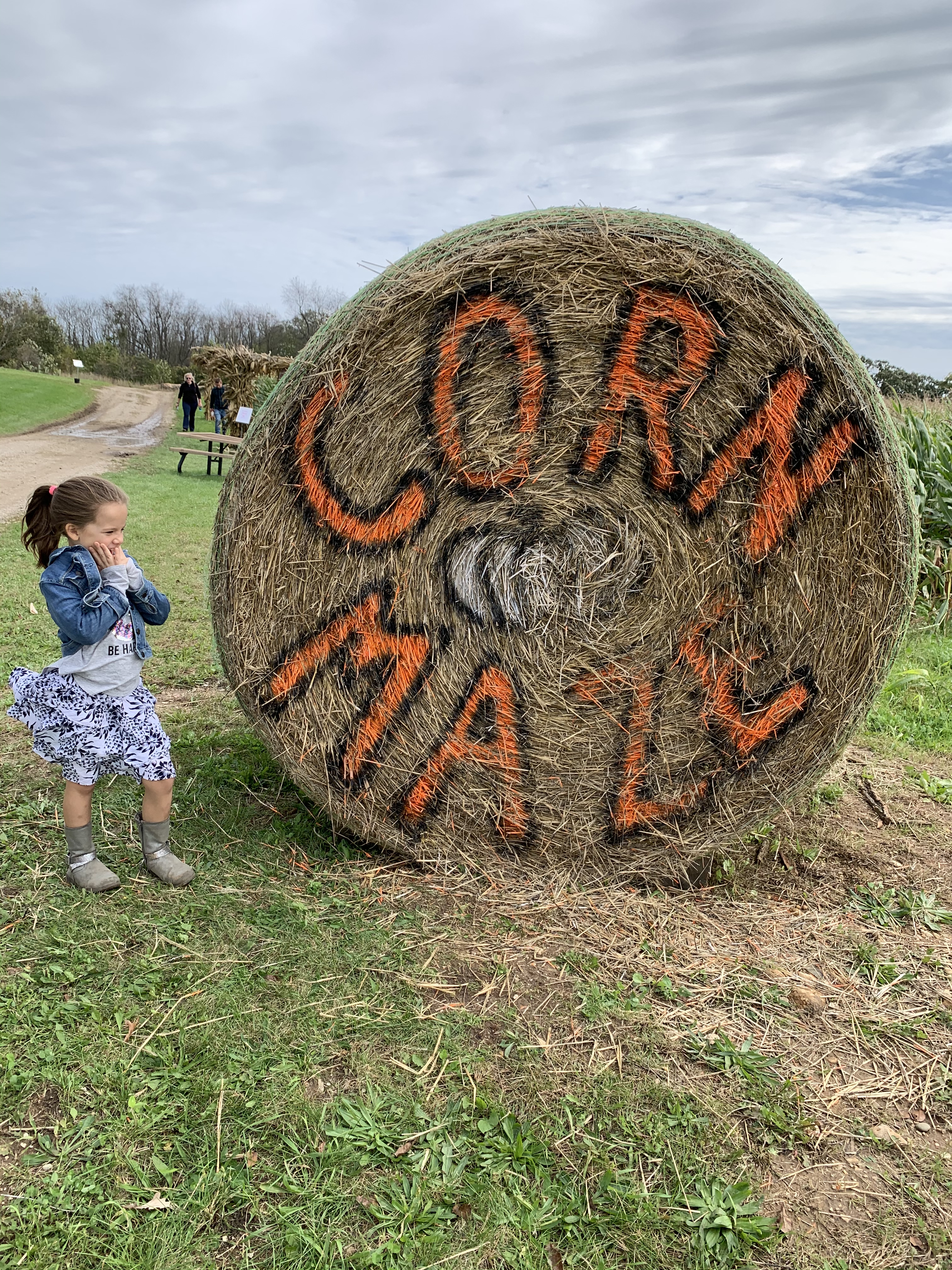
Embrace the Chaos – How Getting Lost in a Corn Maze Brought Me Some Clarity

This past weekend, I found myself unexpectedly lost. An innocent trip to the pumpkin farm to enjoy a beautiful fall day in Wisconsin quickly deteriorated to a literal Children of the Corn situation as my six-year-old and I spent almost 45 minutes lost in a corn maze. It was a maze of maise, as it were, and the two of us were no match for its twists, turns, or other cleverly landscaped stalks of doom.

As our enthusiasm for our new adventure began to wane, my panic level began to rise. It was no surprise that my daughter needed to go to the bathroom. It was no surprise that we hadn’t had lunch yet and were both starving. It was no surprise that the stalks of corn kept thwapping me in the face. I started having visions that we might be stuck in there for quite a while. What if it started to get dark? What if we turned in circles for hours and couldn’t find the entrance or the exit? What if the mini donut stand closed before I could make my way out?

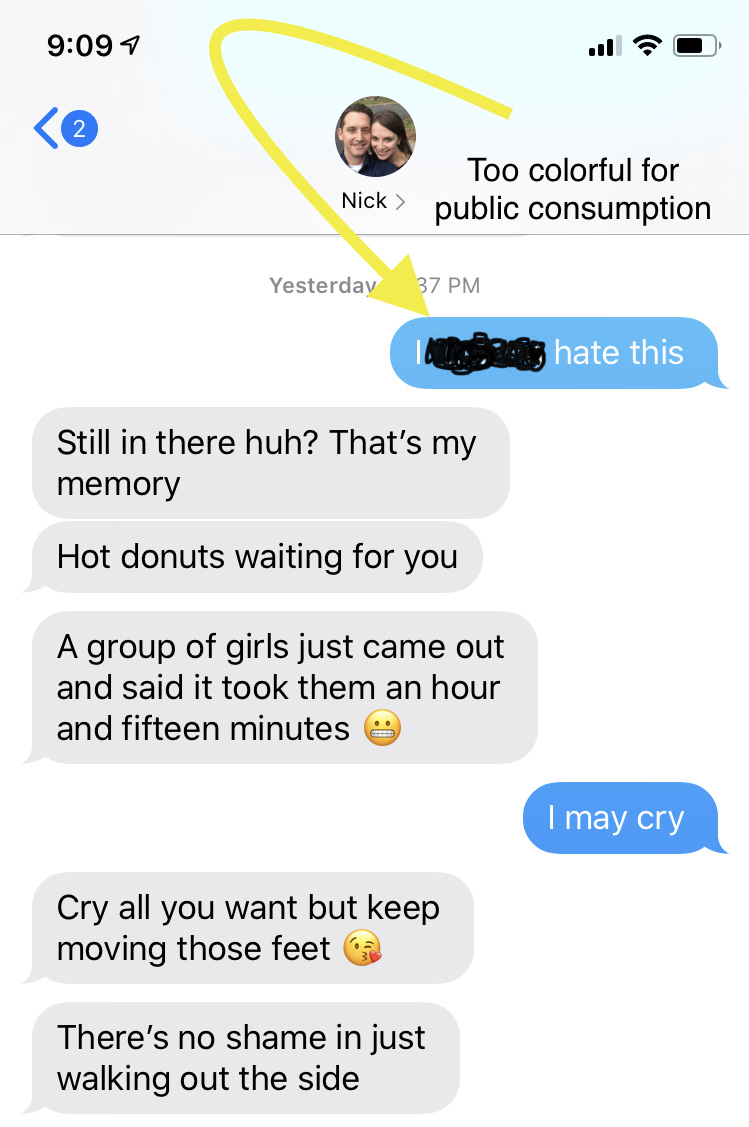
In desperation, I texted my husband. Using some inappropriate words, I conveyed how disappointed I was that I had thought this would be a good idea and that I was getting sincerely scared about how long it would take us to find our way out. Thus far, my daughter and I had been rather innocently complaining about wanting to be done. Thankfully she hadn’t caught on yet to my growing concern about our situation.

A few moments later, we passed a young couple, headed the opposite direction. Trying to defuse tension with humor, as I often do, I smiled brightly and quipped, “Been in here long? Feels like we may have to spend the night in a corn field!”

“Yeah, we’re sort of stuck too,” the woman replied with a sigh. “We’ve been in here almost 90 minutes.”

***Insert Awkward Fake Laughter Here***

As my panic reached a fever pitch, a text came in from my husband.

“There’s no shame in just walking out the side…”

There might not be shame…but there’s a bit of fear for sure.

What if I pull my daughter off the path and into the corn only to lose my bearings completely? What if we walk toward a landmark that just happens to be in the middle of more corn? What if I have to utter the word “corn” one more time and I lose my mind?

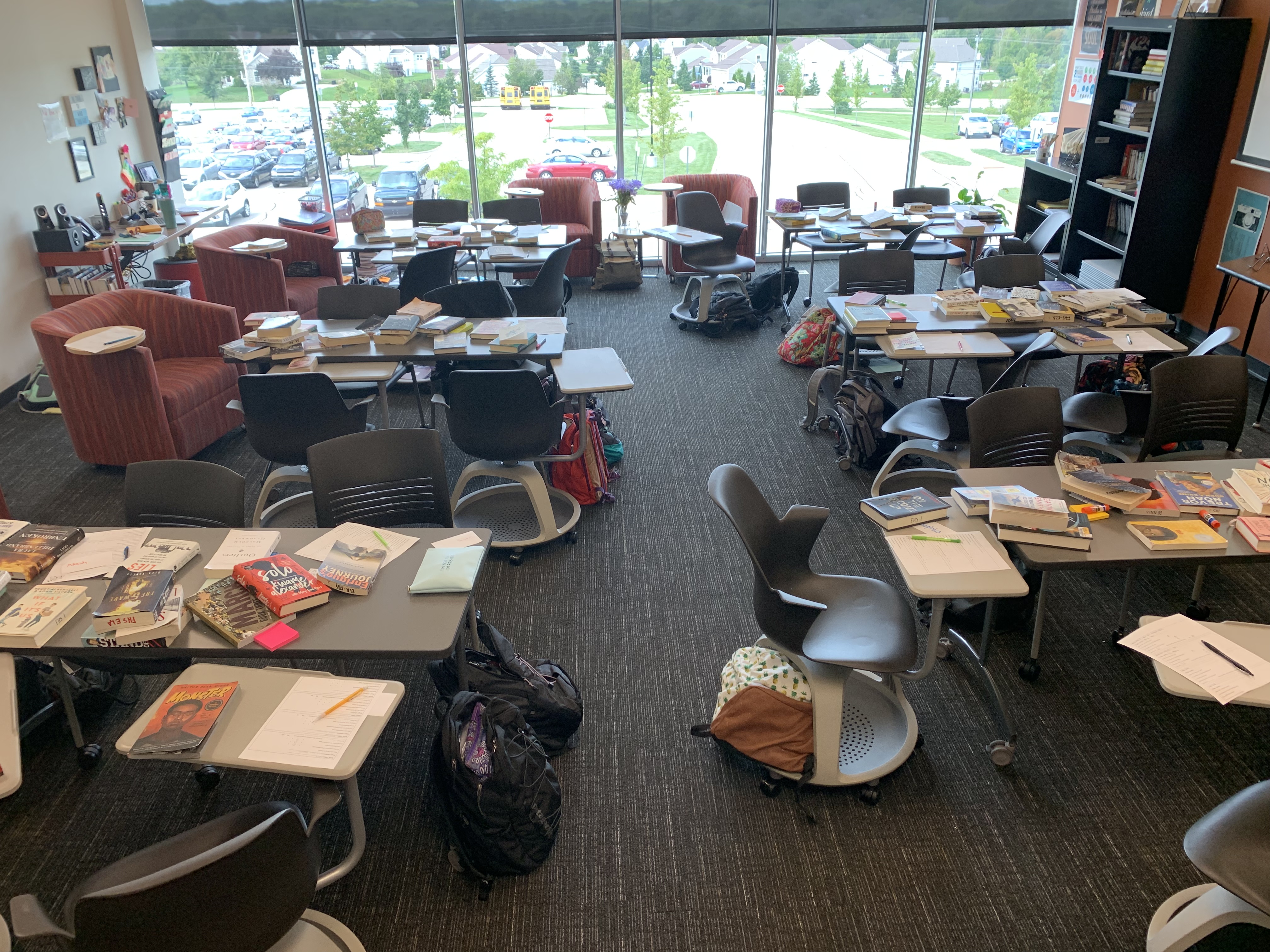
Speaking of losing one’s mind. How’s the start of hour school year been for you? (Nice segway, hmmm?) If it’s anything like mine, there is a very thin line between the enthusiasm of this beautiful fresh start, and the disorienting chaos of being lost in the middle of what is indeed familiar, but no less overwhelming. 30 freshman (13 of whom have professed to hate reading. Hate.), will do that to a person. And that’s just one period.

Split lunch makes for quite the scene

But short of diving for the exits (or the pandemonium of a course forward without a path) what’s a passionate educator to do?

  • Routines – Remember to fall back on the routines of workshop when in doubt. When the crazy of homecoming week has your students climbing the wall, starting the class with 15 minutes of silent reading is not only beneficial, but a soothing balm of calm. I don’t compromise on this time – ever. We read no matter what and we read because no matter what, it’s one of the most important things we do. It gives my students time to change the crazy, amped up rhythm of their day, it gives me time to confer with kids, and it sets the tone for the whole class period of learning. Chaos be gone (eventually, as freshmen are still learning this quiet skill).
  • Build relationships – When I take some time to reflect on what’s causing me anxiety in the classroom, it is rarely the students. It’s the grading, the planning, the politics, the meetings, the everything that takes my time away from getting to know my students. So, when I’m struggling (this time it just happened to be in a field of corn), I try to remind myself that knowing my kids (academically and personally) makes all the difference. We can get through the tough together when we’ve established a connection as a class that makes us a community. When that community is focused on building readers and writers, all the better.
  • Self Care – I texted the Three Teachers last night with a bit of a plea/cop-out/desperate cry for help. I wasn’t sure I could post today. Last week saw PD on Monday, a department meeting Tuesday, School Improvement Team time out of the classroom on Wednesday, English Department Review Thursday morning (also out of the classroom) and PLC on Thursday afternoon. Then I got lost in corn. I’m behind and feeling disconnected from my kids. Amy’s simple advice “Self care, self care, self care” reminded me of a very important fact. One, I’m not alone in this treading water scenario and that brings some comfort. Often, in panic, we feel very isolated. In the community of educators, however, there is a lot of support for the over-committed, overtired, over-stimulated teacher. Instead of wallowing in it though, the mindful practice of self care and acknowledgment of our feelings can go far in helping us seek the balance we need.

In these reminders, there is nothing new. And in that, should be the calm in the chaos we all need. When the rows of corn feel stacked against you, choose a path and head in one reassuring direction. You will emerge. You will be in one piece. You will avoid corn mazes from now on, but in terms of the analogy…you’ll have come out the other side with a new appreciation for seeking the type of calm that can positively impact your day, your teaching, and your sanity.


Lisa Dennis spends her school days teaching AP Language and English 9, while also leading the fearless English department at Franklin High School, just outside Milwaukee, Wisconsin where she lives with her husband Nick, daughter Ellie, and beagle Scout.  She now tries to live life based on the last pieces of advice her dad gave her – Be kind. Read good books. Feed the birds. Follow Lisa on Twitter @LDennibaum

In Pursuit of Something New


photograph of a pathway in forest

For the first 11 years of my career, I coached high school volleyball. This is my first year not coaching, and, well, there are mixed feelings. I love the increase in time at the beginning of the year; I miss the girls.

Coaching was never one of my life goals. While I enjoyed playing and loved the game (regardless of what game I happened to be playing), I never wanted to coach. After all, I spent four years accruing debt while training to become an English teacher, not a coach. So even though I thought I was prepared to teach,  I wasn’t prepared for the realities of the job market. I was offered a job in my first interview – a job that was conditional upon my agreement to coach volleyball. I hesitated in the interview long enough that the principal repeated himself, thinking I hadn’t heard him make the offer. 

In retrospect, I’m so thankful for that condition; I fell in love with the profession, with the competitiveness, with the players. Volleyball became a refuge during that challenging first year of teaching. I would leave the classroom, wondering if anyone had learned anything, feeling as if I was just tossing spitballs at the wall and praying something stuck. But then I walked into practice. In practice, I could offer advice for hitting harder, watch the player take that advice, and see immediate improvement. It took me, embarrassingly, four years to see that the two professions weren’t mutually exclusive. Once I began to apply some of my instructional best practices to the game, I became a much stronger, more effective coach. Getting there was a struggle, though.

Even though I’m no longer coaching, I still find myself thinking like a coach in my classroom at times. Of late, I’m reminded of one of MY high school coach’s favorite sayings: don’t lose what we have in pursuit of something new. Her point was that when students or players or even people are learning something new, sometimes they start to falter with a skill that they already possess. Essentially, the already learned skill gets put on the back burner as the brain processes a new skill and finds room for both in their new “map” of their brain. (I linked to a blog series there by Eliezer Yudkowsky – it’s a deep dive, but worth it.)

Teaching a jump serve often meant being patient with a flat-footed serve getting a little wonky.

Teaching a new kind of genre of writing (like rhetorical analysis) often means being patient with students conflating genre conventions. 

So what to do? Well, I’m still pulling from my bag of coaching/teaching tricks – so much of strong teaching is predicated on timely, accurate, accessible feedback. 

Here’s what not to do: When I first started coaching, I found, for good or ill, my first team was motivated by high expectations and immediate negative feedback. I became quite accomplished at breaking down incorrect movements and offering players extensive negative feedback (don’t hold your arms like that, feet together, faster, slower, higher) but not so adept at offering positive feedback (good job, nice hands, did everyone just see how she hustled after that ball? wow!). My positive feedback tended to be vague and repetitive. Shouts of “Yes!”  and “Way to go!” peppered our practices. Completely ineffective. The players knew explicitly where their struggles were (I had made that public knowledge for the entire team), but their successes weren’t being praised, and their growth both as players and as people was stymied. Even though we had four successful seasons together – three trips to the state tournament, lots of hardware and local recognition – I failed to create players who thought of themselves individually as successful. We would all agree that the team was successful, but I doubt their inner monologues were encouraging, and I know the way in which they spoke to each other wasn’t always positive – their constructive criticism skills left something to be desired, a trait they acquired from their coach. In this gym, I was the sage on the stage – not the best example for my girls. However, I was blessed enough to work with a group of girls who managed to flourish even when given such weak soil from their coach.

How does this transfer to the classroom? Modeling and conferencing and workshop, oh my. 

We look at multiple samples to remind ourselves of what we should be doing. We conference together focusing on finding positives and one trend to work on for the next round of writing. We workshop multiple smaller versions of the final larger piece, focusing on higher order concerns and lower order concerns in low stakes settings. Knowing that good teaching is often recursive teaching, we revisit previously learned knowledge in mini-lessons and in class discussions so that the new knowledge and the old knowledge can be held in tandem in the brain.

None of this is a ground-breaking, panacea for some of the hiccups inherent in teaching new skills, particularly new writing skills. It’s just solid teaching, and for me, a reminder that learning is a complex process and that I have to plan effectively for students so that we don’t lose what we have in pursuit of something new. 

Sarah Morris teaches AP English Language & Composition, AP Seminar,  and Film as Literature in Murfreesboro, Tn. She is currently contemplating a re-read of The Name of the Wind – reading this book is like those conversations with friends who you might not speak to every day but pick back up with as easily as if you did. She tweets at @marahsorris_cms. 


AP Lang Learning

This year my conference period falls in the dead the middle of the day.  Periods one through three are versions of English II, featuring students who are learning English as second language and students with accommodations, along with general education students.

The last three periods of my day bring (mostly) juniors into the classroom for our AP Lang classes. Just like the morning classes, these classes feature learners who vary wildly in ability and performance levels. In the past, teachers have shared with me the opinion that AP classes don’t require a great deal of consideration with regard to differentiation and that these classes don’t lend themselves to reader’s and writer’s workshops.

Some teachers might say that having a conference period splitting two different preps would be a chance to switch gears and shift to a more traditional style.

I couldn’t disagree more.

I’m learning more about more about the content of AP lang, and I’m learning how to deliver that content through routines and practices in which I believe. Those routines and practices are grounded in workshop pedagogy.

Take, for instance, this recent lesson cycle:

Formative assessment data told me that the students were feeling comfortable with the “rhetorical situation” and identifying it’s elements. Assessment was also telling me that many of the writers struggled to express their understanding in their writing.

In my mind, this indicated they needed to see authentic responses where real writers wrote with a purpose similar to what I was asking them to write. Luckily, College Board recently released sample essays with scores and commentary. I could have (and will soon) shared my own writing, but these examples were too good to pass up, and I wanted the writers to start to make a connection between their writing abilities and what they will be asked to write between now and May 13th.

img_5796Taking one paragraph each from the sample essays, we read them like writers and explored the decisions and moves made by those writers. Our process of discovery put the cognitive load on the students and allowed me to serve as a “tour guide.” We learned how our argument skills can be applied to this specific writing task, finding new words to add to our personal dictionaries and use in our own writing.  We debated the use of claim and evidence and the utility of being intentional with the length of the direct evidence we blend into our argument. We examined the sentence structure decisions made by the writers and noticed how combining sentences can make our writing, and our argument, clearer.
A good friend of mine, someone with AP Lang experience, recently reminded me that a big part of analysis is about looking for repetitions and contrasts. Bringing this idea into our conversation unlocked deeper meaning and more writing territory we could explore.

Before we finished looking at the mentors, they were ready to dive back into their own writing. They moved into the independent practice portion of the lesson with confidence, but also questions, and I set about conferring with individuals and groups depending on the needs of the learners.

I won’t say it was a mystical vortex of learning, but I will say that this turned out to be exactly what they needed at that moment. Meeting their needs based on what I learn from many different streams of data helps me get there. The data part is a conversation for another day.


Charles Moore is attempting to recover from the beat down he received in fantasy football ….from his wife. He is thrilled to look forward to ILA 2019 this weekend as he is co-presenting with two amazing teachers about how novels-in-verse can be used to help English learners.  Their session is Saturday at 11 am in room 295.

Disturbing My Beliefs

Okay, reader, I have a challenge for you before you read this blog. If you were to read a student’s IEP and learned that he had been diagnosed with all of the following, what would be your first thoughts?

  • Chronic anxiety
  • Obsessive compulsive thinking
  • Tourette’s syndrome
  • Asperger’s syndrome
  • Depression

 Really, don’t read any further until you’ve thought about teaching this student. How would you plan for him? If you were to predict his future, what would your prediction be?

Now read on.


I’m not sure when I ran across Peter Smagorinsky’s work, but I’m guessing it was sometime in the 80s while studying writing pedagogy, and for literally decades his writing has influenced me. So it was quite a shock when I encountered an article by him in Maureen Downey’s Get Schooled column. Writing about the “mentally ill,” he explains:

In fact, I am among them, as are several people in my family. Various people in my gene pool have been diagnosed with Asperger’s syndrome, Tourette’s syndrome, chronic anxiety, depression, obsessive compulsive thinking, oppositional-defiance, and other conditions. I suspect that many readers can say the same.

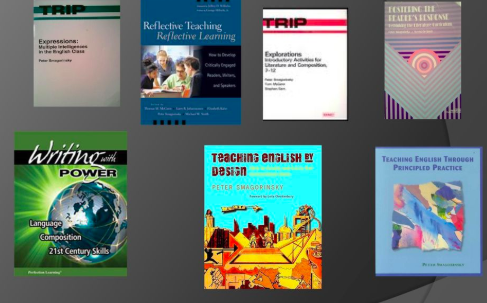
Reading this sent me into the research mode. From his vita, I discovered that he has Screen Shot 2019-10-02 at 11.55.53 AMwritten or co-written over 15 books and a ridiculous number of articles for professional journals, has been honored with numerous awards, and currently holds the title of Distinguished Research Professor of English Education.

Have you ever had one of those moments when you knew you needed to rethink an assumption that you didn’t even know you held? An assumption that carries serious implications for a sound readers/writers workshop? That’s what happened to me. All too clearly I recall in the past saying something like, “For a special ed kiddo, he’s doing okay.” Or – I confess this with great embarrassment – “I’ll cut him some slack. After all, he is in special ed.” And as a consultant, I don’t know how many times I nodded in empathy with a teacher when she talked about low test scores and all of “those” students or I indicated my understanding when the teacher said, “Oh, she has an IEP. Of course, she’s struggling.”

I’ve been thinking a lot about beliefs lately, and Peter’s story has stirred up beliefs that lay dormant, beliefs that I hadn’t examined. My discomfort reminded me of what Margaret Wheatley describes in her essay “Willing to be Disturbed.”

DisturbedLately, I’ve been listening for what surprises me. What did I just hear that startled me? This isn’t easy-I’m accustomed to sitting there nodding my head to those saying things I agree with. But when I notice what surprises me, I’m able to see my own views more clearly, including my beliefs and assumptions.

And Peter’s column dredged up assumptions that I would have denied. For years, I’ve argued for thinking of kids from an asset perspective, but buried deep within me reigned a deficit orientation.

As I kept reading more of Peter’s writing, I encountered his push for neurodiversity in which teachers recognize that there is a range of neurological orientations and, therefore, it’s important to “foreground potential, not disorder.” Peter argues:

Rather, I think that I follow a different order, like many who share my classifications. In fact, it’s quite ordered. There probably is no more ordered way of being than to live on the autism spectrum. It’s a life of pattern, ritual, and clarity of purpose. The problem is that those purposes can seem odd to those who believe that having a narrow or unusual way of being in the world is a problem to be fixed, a sickness to be cured.

Looking at more of his writing, some in blogs and some in academic essays, I found provocative gems such as these:

  • “My ability to complete work quickly and efficiently is, I believe, a consequence of having Asperger’s in conjunction with OCD.”
  • “As part of my rebellion against … stereotype, I have begun referring to my Asperger’s Advantage, especially when Asperger’s is bundled with my anxiety and obsessive-compulsive thinking.”

In one essay, he credits Tourette’s for his prodigious writing career, explaining that when he reads, he picks at his nails and goes into endless tapping routines, but writing channels his nervous tics into productive and satisfying work.

What if I had viewed my students with “special” needs – just think of the condescending tone of that phrase – as seeing the world differently and my job was to figure out their strengths and ways I could build from those strengths? My buried beliefs were madly disconnected from my espoused beliefs.

Yes, Peter disturbed me, surfaced my beliefs, and challenged my assumptions. And the troubling question is: what other negative beliefs are tucked away, needing to be disturbed?

For over 25 years, Stevi Quate taught middle and high school English in Colorado. Even though she no longer has her own classroom, she is in classrooms throughout the US and internationally. Currently, she consults in international schools and with Public Education and Business Coalition. When she’s home, she’s playing with her dogs, reading in her backyard, and realigning her beliefs. Follow her: @steviq


Listening & Speaking More and Better

Sometimes in the blur of teaching readers to read and write more — and better — we forget the importance of teaching them to listen and speak more effectively. At least I do. This is one of the reasons I love the workshop approach in my English class. Talk is a intregal part.

No doubt, I am an idealist. I tend to think if my students can orally communicate their speech-bubbles-303206_1280thinking and truly listen to one another, our society, and our country, have a chance. The bellowing from every side wears me down, and I think the classroom can be a tiny little microcosm of what communication in the world could be if we were all a little more well-versed in listening and speaking skills. Call me hopeful.

For this reason, my seniors and I are focusing on more talk than ever before. I am trying to remember to teach specific speaking and listening skills — not just telling my students to talk about issues. We worked up a list of norms for our discussions, and as a class, we are working to hold one another accountable. It’s becoming a group effort. It’s hard. And it’s challenging.

Every day we still talk about our reading. Right now, we are in our first round of book clubs. Most days we still talk about our writing. We just finished college application essays. Some days we talk about texts that help us be better at talking, listening, and having better conversations. There’s some interesting TED Talks here and here.

Every Friday we engage in whole class discussions around particularly “hot” topics, all with a focus on using the text to support and expand our thinking. So far, we’ve discussed racism, hacking, and the benefits, or not, of marijuana.

Soon, my students will be the ones choosing the texts and facilitating the discussions. They’ve already talked about issues that concern them, make them wonder, and ones they want to explore together. Here’s a few:  climate change, mental illness, vaping, teens and sleep schedules, cultural appropriation vs cultural appreciation, artificial intelligence and the workforce, biases in Hollywood, investing in the stock market, sex trafficking in the U.S., college and the expense of it, memes and what they say about the people who make them, four-day work weeks, Area 51, will Amazon control the world?

Young people are curious. I am curious. And I certainly do not want to do all the work in choosing texts and inviting students to talk about them. I just needed to get them started and model how to choose rich texts, how to write open-ended questions, and how to facilitate an engaging discussion. Now I just have to trust that they can do it.

I believe they can.

If you know of some interesting articles that would spark great discussions, I’d love it if you shared them in the comments. My students will be doing some flash research this week to locate texts for their turn leading our Friday discussions. We’d all appreciate the kick start.

Amy Rasmussen teaches senior English at a large suburban high school in North Texas. She’s excited to be back in the classroom after a year on hiatus. She thinks young people today are just the greatest. Follow Amy @amyrass

The Power of Wonder & Mentor Texts (a post inspired by Kwame Alexander)

Last week my 12-year-old son and I attended an event with Kwame Alexander at our local book store, Joseph-Beth Booksellers.

You have never heard someone read a book like Kwame Alexander reads a book. This man takes his time. He lets the words fill up the air. He chews on a pause, taking his time, stre-e-e-e-tching it out. He understands the power of pacing and performance.

I’ve seen Kwame perform before; he and his partner Randy Preston put on a show. Randy plays guitar beneath Kwame’s words, punctuating, pacing, elevating the performance. Sometimes they break into song, or rap, or they just riff.

Sharing this experience with my son was important. Reading Crossover broke him out of a reading rut a few years ago and he’s devoured so many of Alexander’s titles. I’m looking forward to sharing the graphic novel with my other children, who are big GN fans, and with the students I see, who I know will love it.

But what’s really staying with me about this experience is what I found while wandering around the bookstore. Tucked in a back corner, I stumbled across this collection of poems, Out of Wonder: Poems Celebrating Poets. Kwame Alexander, along with Chris Colderley and Marjory Wentworth, and illustrator by Ekua Holmes, have created a beautiful book and I can’t wait to share it. 

IMG_6447

I flipped through the collection and while I recognized many of the names —  Giovanni, Oliver, Hughes — I realized they weren’t the writers of the poems. Rather, they were the inspiration. The whole book is a celebration of poets, full of pieces written in the style of the poets themselves. I’d found a treasure trove of mentor texts!

For example, this one by Wentworth, “(Loving) The World and Everything In It”, inspired by Mary Oliver’s poem “My work is loving the world …”


The collection is broken into three sections:

  1. Got Style: where the poets imitate the style of a famous poet.
  2. In Your Shoes: poets imitate the tone and voice of other poets.
  3. Thank You: poets pay homage to their favorite poets, “sharing with the world how awesome we feel about the poet and the poem.”

I love thinking about being in conversation with poets and their poems in these ways. Wouldn’t it be powerful to give kids the opportunity to find a poet that resonates with them, or to explore different poems (maybe in a gallery walk like the one talked about here in Teach Living Poets). Then to let them choose a path to enter into dialogue.

Share with us the way you have students talk back to their favorite poems. (And we hope you have the chance to see Kwame Alexander on his upcoming tour.)Screen Shot 2019-09-29 at 9.20.36 PM


Angela Faulhaber is a literacy coach in Cincinnati, OH. She’s in the middle of having the honor of attending several amazing author events this fall: Angie Thomas and Kwame Alexander in September, and now Bryan Stevenson, Ruta Septys and Raina Tegelmeir in October. In her spare time she likes to ask her kids’ friends what they’re reading and making book suggestions to pretty much everyone. 

Maybe the Best #MentorText I’ve Found Lately

Don’t you just love to find mentor texts that make your head spin with ideas? Okay, maybe it’s just me.

But take a look at this one and see what you think:  The 25 Songs That Matter Right Now, published in the NY Times.

I’m not sure how I’ll use it yet — I’m still trying to get my head wrapped around teaching seniors everything they can possibly need to know to be successful as readers and writers beyond high school when I only have them in class one semester. (We are on accelerated block.) But this text is way cool, and I think most of my students will like it.

It’s got music and images and music started playing without me even doing anything.

It’s got analysis and commentary and reflection. It’s multi-modal!

As I begin thinking and planning for what comes next in my instruction, I’m moving this to the top of my mentor text stack.

I’d love to know your ideas on how students might write beside it. Please leave your ideas in the comments.


Amy Rasmussen teaches senior English at a large suburban high school in North Texas. She loves her school, her students, and adding mentor texts to her ever-growing lists of “We Could Do This to Learn That.” She’s a bit of a fanatic about matching readers to books and writers to whatever it takes to help them amplify their voices. Follow Amy @amyrass — and if you’re reading this, our team would love it if you follow this blog if you aren’t already.

Empowering Students by Celebrating Banned Book Week Any Time of Year

It’s banned book week, which means many of us teachers are highlighting books that have either been controversial in the past or are controversial now. I love that banned book week gets our students and colleagues talking about what we should all be allowed to teach, read, discuss, and learn about. It makes us all feel smart, in the loop, and empowered.

Because I displayed and highlighted some banned and frequently challenged books, students asked some great questions which have generated some important conversations. They felt smart and important when they learned about banned and challenged books.

When students express an interest in these books, or any book for that matter, I let them know that I appreciate that they are challenging themselves. Maybe they are challenging their thinking about a certain topic, they are exposing themselves to new experiences through books, or they are reading a complex text, but banned and challenged books can be problematic for many reasons, and those problems often lead to new learning and ideas. However, if a book becomes “too much” for any reason, whether it be their hearts aren’t ready for it (I explain that Marley and Me is still too much, several years after the death of my beloved dog, Bart), or the text is too challenging, or the words or situations make them uncomfortable (especially for the middle school students I teach), they can give themselves permission to drop the book or save it for later.

It’s empowering to be able to choose your own book. It’s also empowering to be able to drop it.

These conversations this week started because of a simple book display I put together because I was inspired by the fact that it is Banned Book Week. I used the ALA’s list of frequently challenged books as a resource so I could pull books from my classroom library shelves. A couple of my colleagues shared similar displays in their classrooms, so many students are curious, asking questions, and talking about censorship.

This is the type of display that can be shared at any time. Banned Books Week is a great time to start the conversation, but the conversation might take more than a week. In fact, I think it should.

Because that conversation takes more than a week, I’d like to suggest a unit around research, argument, and banned books.

Last year, a colleague and I did just that. We based it off of a Read Write Think lesson about banned and challenged books, and it went really well. Even thought Banned Books Week is in September, we worked on this unit in May, because talking about banned books is important all year long.

Screen Shot 2019-09-24 at 3.57.11 PM

Students researched, read about, discussed, and wrote about banned and challenged books.

They looked at Laurie Halse Anderson’s statement about intellectual freedom and felt empowered.

They read the NCTE statement on The Students’ Right to Read and felt empowered.

They watched Trevor Noah and Jason Reynolds discuss what it means for books to be mirrors and windows and felt empowered.

Essentially, when students researched and read about titles that have been censored, they felt empowered that they were able to access these books. When students saw the display of challenged and banned books, they felt empowered that they could access them in their own classroom libraries.

Teaching students about banned books empowers them. Banning books removes the agency from students and teachers, but exposing that censorship empowers that same demographic. My students feel empathy for those who have been denied access to these important and powerful books. They are also grateful that they have easy access to these same titles.

By exposing censorship, teaching about intellectual freedom, and providing access to all types of books, students, teachers, and communities are empowered.

Aren’t we all about empowering our students?

Julie has been teaching secondary language arts for twenty years, spending the first fifteen in rural Central Oregon,  four in Amman, Jordan, and the most recent school years in Managua, Nicaragua. 

Follow her on twitter @SwinehartJulie

3 Ways to Help Students Tell a Story They’ve Never Told

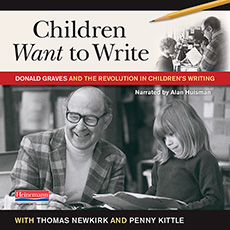
This morning, with the new audiobook release of Don Graves’ Children Want to Write (narrated by two of our teacher heroes, Penny Kittle and Tom Newkirk!), I’m thinking about that true fact: children do want to write. We all do. Our minds are, after all, made for stories.

Children Want to Write (Audiobook)

But to tell our stories is a challenge in so many ways. We live in an age of distraction, many of us are often silenced by society, or we struggle to find an audience we trust.

But most of all, many of us don’t know how to tell a story if we’ve never seen a story like ours told before.

Stop and think about this concept, etched in my mind by Dr. Rudine Sims Bishop with her concepts of books as windows, mirrors, and doors. I’ve spent a good deal of my planning time outside of school finding books that can act as windows, mirrors, and doors for my students to either see through, see themselves in, or walk beyond.

But I’m interested today in the way we go further with that discovery. Once you find yourself in a story, how can you tell your own? I realized years ago that I wasn’t just reading voraciously to find my own story; I was looking for a storyteller with whom I could identify: a living, breathing mentor text. I found it when I met Penny Kittle at the New Hampshire Summer Literacy Institutes, a teacher-writer-mother who counseled me on sustainable ways to balance my young children with the work of teaching well.

Until I met Penny, and was bolstered by her support and willingness to share her own story of struggling to be a mom-slash-teacher, I didn’t know how to tell my story. And until I did, I couldn’t be a living, breathing mentor text for my own students, who were thirsting to tell their own stories.

As English teachers, we are blessed to have the opportunity to be that mentor text for our students: teacher-writers who practice, every day, finding and telling stories that resonate. It’s my favorite part of this work, the joy of getting to read and write powerful stories alongside our students. We can offer space for storytelling in our classrooms in three key ways–with vibrant mentor texts, opportunities for playing with genres, and the time to tinker and devote our study to narrative.

  • A well-stocked classroom library, frequent and varied book talks, and mentor texts that flood our students with diverse voices and stories offer our students windows, mirrors, and doors through which they can discover empathy for others and themselves. Seeing a range of stories disrupts the concept of “normal” and helps students see the world in shades of grey, rather than just black and white.
  • Quickwrites and mini-lessons that allow students to play with genre offer possibilities for storytelling they may not have considered: poems, lists, fiction, memoirs, vlogs, podcasts, and multimodel texts show how we can allow the concept of story to flourish in any medium.
  • Time to write: every day, in quickwrites and in workshops, but also over time–when we devote more than just a unit, or a quarter, or a set of standards to the idea of story. We put our money where our mouths are when we return to story again and again, through concepts of argument, informative writing, or creative fiction and nonfiction.

When we offer our students these ingredients, we create a recipe for storytelling that brings authenticity, relevance, and power to our classrooms. A community of readers and writers can be transformed into a workshop of storytellers, who speak and listen through the powerful lens of narrative.

We invite you to share in the comments how you bring story into your classroom!

Shana Karnes loves to read, write, and find stories everywhere in Madison, Wisconsin alongside her two young daughters, hardworking husband, and inspiring teacher friends. Connect with Shana on Twitter at @litreader.