Poetry in AP Lang

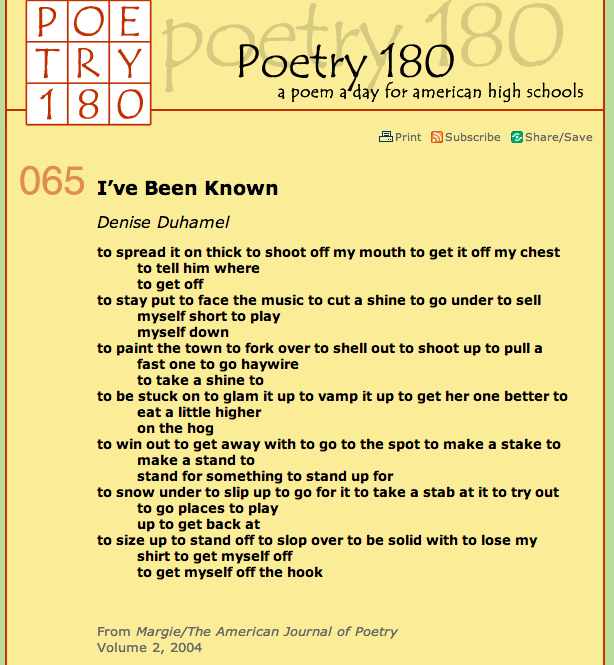
Do you subscribe to Poetry 180 through The Library of Congress? It’s probably the single most valuable thing I’ve done as a way to remind myself to use poetry in my AP English Language and Composition class. We read and write many an argument. I often forget about the poetry.

But I read a poem every day. You can, too. Sign up for a poem in your inbox here.

Some days it’s a natural fit to incorporate the poem into my lesson. Some days it’s a little more complicated. Some days I don’t even try to make the poem fit — we just enjoy the language.

Like this one today:

Screen Shot 2014-12-10 at 6.26.56 PM


Conferring: On the Lookout for Gifts

“I think parents should read this book — these kinds of books, too,” Monica said as we chatted about the book she just finished, Impulse by Ellen Hopkins. “They need to know what we go through and how we think about things. It would help so much.”

I listened as she shared her feelings. She needed me to hear her disappointment at the ending. The characters mattered to her, so I knew they needed to matter to me.

The relationship between student and teacher changed in that moment. We gave each other a gift in that brief conversation about a book.

When we consider our conferring moments with students, do we give enough gifts? Do we allow our students to?

Think about the origin of confer:  Latin conferre to bring together, from com- + ferre to carry.

At the end of that three-minute conference with Monica, I carried a bit of the burden she had on her heart, and she carried the knowledge that one more adult cares about what she thinks. A conversation about a book brought us together.

I love that.

At NCTE I asked a room of teachers what part of their workshop classroom they struggle with the most. They all said student conferences.

Finding the time, being consistent, knowing how to prod students into thinking, allowing students to do most of the talking —  these concerns all emerged as trouble spots that we’d like to overcome.

In a perfect classroom with perfect students it would be easy. What’s the big deal? Just talk to your students. Yeah, right.

I asked one colleague how she conducts her reading conferences. She replied quickly, “Oh, I don’t do those. I cannot talk to one kid without the other 35 talking.”

Yes, that can be a problem.

I don’t think we stop trying though.

One-on-one conversations with students create the heart of my workshop classroom. Our relationships grow and change as we gift one another with ideas and information. We learn and change together as individuals who are trying to make sense of our world. Regular conversations make this happen.

I’m reminded of a line I boxed in bold when reading Choice Words by Peter Johnston: “Talk is the central tool of their trade.” Their meaning teachers who create environments wherein through language they help students “make sense of learning, literacy, life, and themselves” (4).

Talk is central

That’s what I want as I create opportunities to confer with the students in my classroom. I want to help my students make sense of all it:  what happens in the classroom, what they read in books, what they’ll face in the future, and what they see in themselves. That’s a tall order, and the only way I know how to do it is to talk to more of my kids more often.

My burning question now circles on student conferences. How can I improve the precious moments of time I have with each of my students?

I am paying a lot more attention to the gifts we give as we converse with one another.

What about you? What are your ideas, concerns, questions about student conferences?

©Amy Rasmussen, 2011 – 2015
Craft Study – Brown Girl Dreaming

20821284Jacqueline Woodson is a native first of Columbus Ohio, then of Greenville, South Carolina, and finally, Brooklyn, New York.  Her nomadic childhood during the tumultuous 1960s and 70s inspired this incredible memoir in verse, which is surely the only autobiography I’ve ever read in poetry.  Layered with tales of tragedy, uprooting, defeat, dreams, and hope, Woodson conjures a nostalgia for her unique upbringing with ease.  She explores themes of family, race, poverty, education, and our life’s callings in this beautiful text.

I can’t wait to share Brown Girl Dreaming with my students. There are so many amazing poems that make up the text as a whole–from the spot-on “stevie and me” (If someone had taken/ that book out of my hand/ said, You’re too old for this/ maybe/ I’d never have believed/ that someone who looked like me/ could be in the pages of the book/ that someone who looked like me/ had a story) to the haunting “what’s left behind” (Sometimes, I don’t know the words for things,/ how to write down the feeling of knowing/ that every dying person leaves something behind.).  But the one we’ll imitate for craft is “what i believe,” which brilliantly combines repetition, deliberate contrast, and an elegant articulation of Woodson’s beliefs.  I hope it will lead my students toward a “This I Believe” essay, and toward wanting to read this book in full.

From Brown Girl Dreaming, p. 317-318

I believe in God and evolution
I believe in the Bible and the Qur’an.
I believe in Christmas and the New World.
I believe that there is good in each of us
no matter who we are or what we believe in.
I believe in the words of my grandfather.
I believe in the city and the South
the past and the present.
I believe in Black people and White people coming together.
I believe in nonviolence and “Power to the People.”
I believe in my little brother’s pale skin and my own dark brown.
I believe in my sister’s brilliance and the too-easy books I love to read.
I believe in my mother on a bus and Black people refusing to ride.
I believe in good friends and good food.
 
I believe in johnny pumps and jump ropes,
Malcolm and Martin, Buckeyes and Birmingham, 
writing and listening, bad words and good words–
I believe in Brooklyn!
 
I believe in one day and someday and this perfect moment called Now.

We Learn Facts from Fiction

NCTE is always so magical, isn’t it?  It’s a five-day frenzy of learning and teaching and connecting and wondering and writing, which should be exhausting.  But it’s not.  Somehow, I come back to school every year with so much energy, revitalized by the conference and its plethora of ideas and inspiration.

This year at NCTE, as the words and wisdom of my teacher heroes washed over me, I was drawn in by one theme that kept recurring–the role of narrative in informational text.  Given that the theme of the conference was “Story as the Landscape of Knowing,” this wasn’t surprising.  What did surprise me, though, was that almost everyone I heard speak discussed how narrative helped learners in the context of nonfiction.  I began to wonder–what about narrative in its most accepted place–fiction?  What information do readers learn from reading fiction?

ptiIn addition to hearing from many teacher-researchers, I also got to hear from many authors.  David Levithan, e. lockhart, Libba Bray, Lester Laminack, Paul Janeczko, Georgia Heard, and more spoke about their writing processes.  Every one of them mentioned research at length, and I jotted a note–“research processes are as multigenre as its products.”  All of those writers had a unique research process, but they were all strong.  These authors put work into making their fiction as fact-based as possible.  Others discussed putting their own lives into their fictional works–Sherman Alexie has too many parallels with the narrator of Part-Time Indian for it to be a coincidence.  What’s more authentic and research-based than a lived experience?

bsogMy brain was whirling.  How many fictional novels have helped me fill gaps in my understanding?  Between Shades of Gray enlightened me to the fact that there was a Baltic genocide.  The Absolutely True Diary of a Part-Time Indian taught me about culture on a reservation.  Extremely Loud and Incredibly Close brought 9/11 to life for me.  Peak showed me the world of Mt. Everest in a new light.

Fiction transports us to other worlds…it lets us know we’re not alone…and it saves our lives.  But it also teaches us a great many facts.  We don’t ask our students to read in order to just make them better readers.  We ask them to read because we know it will improve their lives…help them attack the “idea poverty” they suffer from, in Kelly Gallagher’s words.  Fiction, especially the YA fiction that is so popular in my classroom, is educational at an informational level.  Readers acquire knowledge of topics they had limited prior knowledge about by reading fiction.  They also gain understandings of universal themes and grand ideas, but they also learn facts.

Forgetting this is a grave oversight, and perhaps is at the root of why YA lit isn’t always considered “serious” literature.  Kelly Gallagher also said that “there is wisdom in Hamlet that is not found in Gone Girl,” and he’s right.  But there’s also factual information in Elizabeth Peters’ Amelia Peabody series about Egypt and archaeology that I did not get out of Antony and Cleopatra.  We do a disservice to authors when we discount their research processes just because they write in a genre called fiction.

All that we learn, and that our students learn, may best be processed in narrative form…but information doesn’t just have to come from nonfiction.  This is an important lesson–it’s why reading needs to be a schoolwide, nationwide, worldwide focus–not just the job of English teachers.  Reading EVERYTHING helps us acquire knowledge, expand our schema, make sense of the world, and become productive, intelligent, informed, democratic citizens.  And it also makes us pretty damn happy.

What fiction are you and your students reading that helps you acquire knowledge?

Talking Choice Reading, NPR Radio

When Highland Park ISD banned (suspended, officially–then reinstated w/parent permission required) some books during Banned Books Week, my students and I paid attention.  Of course, I pulled the books in question from my shelves — and book talked them right then and there.

The True Story of a Part-time Indian is one of the hottest titles in my classroom library year after year. I know it gets raw in places. I know that it’s the grit that makes kids want to read it. I get that this book is not for everyone.

Few books are.

And that is why choice is so important.

I had the chance to share my thoughts on this in an interview for KERA,  NPR nor the Texas. You can read/hear the news article here.

In a few days I will return to my classroom, fresh from NCTE and ALAN with boxes of new books for my students to read.

image

My box of books at ALAN

We talk a lot in my class about books being windows and mirrors. Windows help us see outside ourselves into the lives of others. We grow in empathy. Mirrors help us see ourselves so we know we aren’t alone. We read literature to learn what it means to be human afterall.

It would be hard to learn the truth if we never read the raw and the grit that makes humanity humanity.

Building My Library Around My Students

My first time at NCTE, I played supermarket sweep alongside the other teachers. I didn’t have one of those grandma-rolling-carts to gather my goods in, but the victory was still sweet as I tossed book after book into my free bags. But lo and behold, as I returned home with my goods, I realized that some of the books were middle grade, a tad too young looking to impress my high schoolers, while others were sequels to books I didn’t own. My humble pile was quickly halved as I weeded out and gave away the books that just wouldn’t fit into my classroom library.

This year I took a different approach; I arrived at NCTE with certain students and issues in mind. Suddenly my mission to collect free and heavily discounted books turned into a mission to fill the holes in my classroom library. This not only narrowed my search but also made it easier to discuss potential titles with booksellers. The following are some of the gems I scored at NCTE 2014:

What I needed…Books that help students cope with a friend’s suicide

20726924Sadly, suicide is a tragedy that has touched my school a few times over the past few years. I am reminded of this at the beginning of every year when I receive personal narratives relaying the stories of students’ past friends or relatives. The wounds are deep and raw and fresh, which is why my students need literature to help them cope with such atrocities. This year, I left NCTE with two books that filled this niche: Rumble by Ellen Hopkins and The Last Time We Say Goodbye by Cynthia Hand. I have a growing group of Ellen Hopkins devotees who bask in the poetic prose of her books as well as the gritty subjects. Rumble attacks heavy issues through the story of Matt Turner, whose younger brother commits suicide 17285330after being bullied for being gay. The Last Time We Say Goodbye, which is due for publication in February 2015, tackles similar themes, only in this book, the female protagonist Lex loses her brother. Lex struggles to cope with her brother’s death and can’t let go of a text message she received from her brother the night he died.

This is unfortunately a topic that will continue to ripple through and impact my students as I receive students who are impacted by the deaths of friends and family members they have lost to suicide. There are no answers to such a devastating event, but I do hope that these books will help show students that they are not alone.

What I needed…Books that are low level but high interest

I fervently believe that students need a dose of success to give into reading. Too often my students 8011arrive turned off to reading simply because they haven’t been exposed to books that interest them. Furthermore, the students who are most resistant tend to be those who are not proficient or only partially proficient in reading and can’t seem to find books that are at a lower reading level yet a high interest level for their age group. My greatest find was a small bookstall towards the back of the convention room that included books from the Sidestreets and Real Justice Series. These books involve gritty stories with heavy hitting topics such as drug abuse, mental health issues, and social problems. While the books I received were between third to fifth grade reading levels, the sepia and black and white photo covers leant a more mature tone to the story—a strong selling point for low level, reluctant readers. I walked away with Jailed for Life for Being Black by Bill Swan, Blow by Jodi Lundgren, and Off Limits by Robert Rayner, all books I’m looking forward to introducing to my reluctant readers.

What I needed…Books that discuss LGBTQ Issues

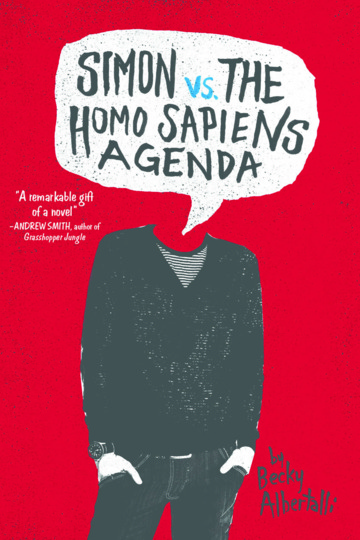
openlystraight_cvThis is the first year I have had openly gay students who have written either personal narratives or stories about homosexual relationships. The more I read their papers, the more I began to evaluate what sorts of LGBTQ mentor texts I had available. While I had a modest collection of book including Shine by Lauren Myracle, Everyday by David Levithan, and Will Grayson, Will Grayson by John Green and David Levithan, I needed more. That’s when I stumbled upon Openly Straight by Bill Konigsberg in which Rafe, an openly gay teenager, transfers to a New England boarding school where he decides to keep his sexuality a secret. A funny read, this book forces Rafe to question who he is and what it means to fit in. 10015384In a similar vein, I also procured an advanced reader’s copy of Simon vs. The Homo Sapiens by Becky Albertalli, which is due for publication in April 2015. This book follows 16-year-old Simon who is not openly gay. Simon is blackmailed after one of his flirty e-mails to a boy he has been talking with falls into the wrong hands. These books diversify my library and address issues that many of my students are both facing and writing about.

These are only a few samples from the stacks of books I received, but as I returned to the classroom on Monday, I told all my students about the exciting run-ins I had with famous authors like James Dashner and David Levithan and Ally Condie. I spoke with the students I had “shopped” for, letting them know what books I had bought and how I had them in mind when I purchased them. While I hope the books leave an indelible mark on my students, I know that ultimately my students leave an indelible mark on the growth and construction of my library.

What books did you bring home from NCTE? Are there any holes that need filling in your classroom library? What might you be searching for?

Finding A Teaching Family Outside of School

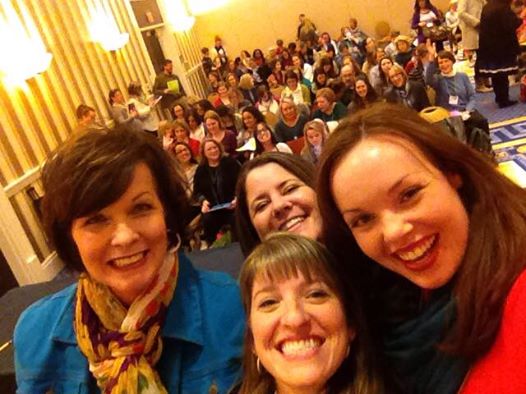
“It’s funny how my closest friends live states away,” Amy said to me as we crossed the convention center’s atrium during NCTE. I agreed; our group of four, Amy, Shana, Erika, and I, might live in different parts of the US, but we share a unique bond, one that has carried me through both the highs and lows of teaching.

Teaching is an anomaly: for being such a social career, it is also quite isolating. I learned this my first Screen Shot 2014-11-26 at 9.37.08 AMyear when I went from sharing a classroom during my yearlong internship to suddenly being by myself at the end of the hall. I found that while my colleagues and I would sit down for lunch everyday, we struggled to find common times to chat about our work or pedagogy outside of professional development days or staff meetings. Despite being within the same building, we’d oftentimes take to the Internet to discuss our plans and work with one another. Over the summer I would receive messages from Jenn about a fantastic new book we could incorporate into our academic English curriculum or recently I received a Pinterest pin from Kristina pointing out a fun way to teach sentence diversification.

Social media has changed the face of my professional learning network. While many of my teacher-friends are at my school, my core group doesn’t just involve those within my state anymore. I have discussed pedagogy with teachers in Canada, talked shop with friends in Washington D.C., and connected with educators across the country. Teaching is no longer the isolated occupation it once was. Over the past two years, these discussions have had a profound effect on my development as a teacher. Many teachers have helped to shape the workshop model within my classroom by being honest about their successes and struggles. My PLN has given me a place to geek out over reading, writing, and discussing literature. And ultimately, this passion online translates into my enthusiasm within the classroom.

With Thanksgiving right around the corner, I cannot be more thankful to my online peers as well as to Screen Shot 2014-11-26 at 9.33.43 AMthose teachers who I have met at conventions and in classes. I am grateful for the relationships I have garnered via social media and e-mail. No teacher should feel alone in this occupation—there are countless resources to uplift and inspire even the most isolated. After all, teaching is an occupation composed of charismatic, committed, and loving individuals who not only see the best in their students but also search for the best in each other.

Please Don’t Ignore the Repetition: a Mini-lesson

My students are pretty good at noticing rhetorical devices in texts; they aren’t so good at analyzing what effect they have on meaning. Since we immerse ourselves in independent reading all year, and we read bookshelf after bookshelf of YA novels, I find that using bits from those books and then talking about why the author wrote the text that way helps when students need to analyze these devices in more complex texts. Somehow this practice takes their tentative and repetitive “for emphasis” away and makes their analysis so much richer. (Most of the time.)

Like this passage from Please Ignore Vera Dietz by A.S. King:

I wonder if I’d called the police back when I was ten or thirteen or fifteen, would Charlie be alive now. I regret it. I regret every minute I lived keeping that secret. I regret every time I didn’t talk to Charlie about it. I regret having parents who couldn’t try to help or seem to care. I regret not being reason enough to make them care more. I regret never saying what I was thinking, never saying, “But what if that was me? What if I marry some loser who hits me? Would you care then? Would you help?” And I regret not called the police that first day we met the pervert. Because I’m sure he had something to do with how Charlie was acting at the end. p264


Exhausted but Renewed #NCTE14

NCTE pres

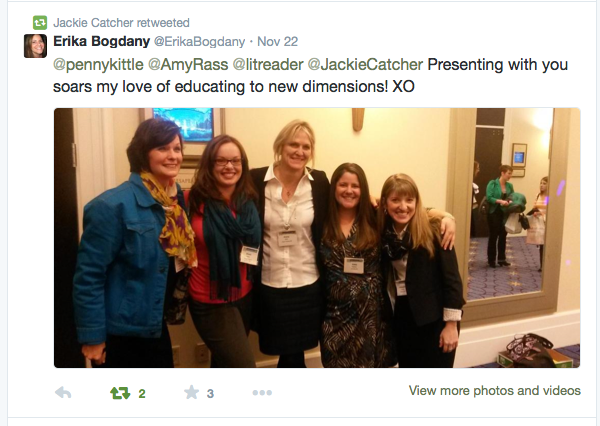
After our presentation at #NCTE14, I stood in the hotel lobby talking with Penny. We’d wandered from the hallways outside our session room, meeting several teachers along the way who had attended our presentation. They complimented me on my work and told me to praise Jackie, Erika, and Shana for theirs. They told Penny how much her work meant to them, and how her ideas and presentations had shaped their teaching. This happened a lot. I felt a little like Robin to her Batman. For a heady moment.

While standing in that lobby, one particular educator grabbed my heart. She reached out to Penny, thanking her so genuinely. Tears pooled in her eyes as she said, “I almost left the profession, and then I read your books. I’ve changed, and I love teaching again.”

I couldn’t help thinking of my own situation last year. I almost left the profession, too. (I wrote about it here: Grateful November)

I almost wrote a Grateful November part 2. Something along the lines of how the NCTE conference infuses a renewal in the soul, like running through sprinklers in Texas in August. Laughing with colleagues, old and new; learning from teacher-heroes we’ve read about and learned from through books and professional development from afar; stock-piling ideas scribbled in notebooks that we cannot wait to share with students because more than anything we come here to learn how to help them learn.

Penny tweeted about her experiences at this conference:

Screen Shot 2014-11-23 at 5.49.45 AM

Profound shifts in thinking.

So true. And so powerful I’m taking it with me.

The memory of presenting “The Landscape of Workshop Across America” with the brilliant educators Jackie Catcher, Erika Bogdany, and Shana Karnes will keep my mind singing. They challenge my thinking regularly and help me find clarity when the chaos in my head gets too loud to hear the silence.

The memory of speaking to Katie Wood Ray in the hallway just prior to our session will keep me spinning as I continue to write.  As Shana says, “a living mentor text.” Such grace and insight. I’m acting on her counsel. [Want to join me in @lindaurbanbooks #writedaily30 challenge?]

The memory of hundreds of beautiful book covers screaming at me until I picked them up in the exhibit hall will keep me sinking into YA novels, devouring stories, so I can share them with my readers who need to devour them, too. Toomanybooksnotenoughtime.

I am exhausted but renewed.

And today I go to ALAN. If you’ve never stayed for that conference, if you love teens, books, authors, and reading, you might want to put it on your bucket list.

Blessings to you all this Thanksgiving week.

God is Good.

NCTE pres w Penny


#NCTE14 J.44 A Reader’s Workshop Starter Kit to Jumpstart the Process

Erika, Amy, Shana, and I are presenting at the NCTE conference today at 2:45pm! Penny Kittle is our Chair, so please join us to discuss the landscape of workshop. We are session J.44.

Think back to your first day of teaching on your first year of teaching. What were you feeling? Happy, nervous, excited, afraid?IMG_1776 Fear. Fear was the first thing I experienced when I stood in my classroom on the first day of school. That and enthusiasm, excitement, eagerness, and hope, but ultimately, I was afraid, knee shaking, stomach churning nervous as I stood in front of my new class. Fear comes with the unknown, which is why my nerves of being a new teacher were compounded by my entry into the workshop model. The concept of the workshop model is simple, yet it’s a structure that so few of us grew up with. In turn, as I transitioned my classroom, I found my nerves could be categorized into the fear of breaking tradition, the fear of parents, the fear of students not reading, and the fear of proving rigor. I was not alone though. Interns and teachers who were new to workshop model faced many of the same fears. In turn, I created a reader’s workshop starter kit to provide my colleagues with concrete documents that helped them establish the workshop model in their classroom. The starter kit includes the following documents:

  • Elements of a Reading Workshop by Penny Kittle
  • Reading Letter for parents
  • Calculating Reading Rates & Reading Rates Log Sheet
  • Weekly Reading Recording Sheet
  • Excel Sheet Weekly Reading Recording Sheet
  • Book Conference Log
  • Questions to Ask While Conferencing
  • Book Talk Outline
  • Resources for Helping Students to Find New Books

Whether you are a new teacher or simply new to the reader’s workshop, I hope this starter kit will make your journey a bit easier. Enjoy every step and savor even the smallest successes. If you have any questions or comments about starter kit, please feel free to contact me at Jackie.catcher@gmail.com.

Click Here to Download the Reader’s Workshop Starter Kit