Why My #onelittleword Will Work

My friend Jackie sent me a link to this blog: Setting a Work Schedule to Make Us Better, Saner Teachers. Somehow she sees inside my head.

My teaching world grew when I changed my pedagogy to readers and writers workshop. Over time, I also became so passionate about helping my students move as readers and writers I kind of lost my love for what started this change in the first place. Sometimes I get so busy reading the next great YA novel, or searching for mentor texts, or inventing new ways to get my reluctant students to write that I forget that I really just love my students. I love them.

I need to let them know that.

With all my musings about resolutions, (If you haven’t seen my posts for the past three days…) I probably need to give it up and follow the trail of those leaving the #onelittleword hashtag.

My word is L-O-V-E. sunshine-wallpaper-6

Do you remember when you first learned to spell it? I do. I wrote it everywhere. On notebooks. On desks. On the wooden slat holding my sister’s bunk bed above my head. (Years later I would also write the names of every boy I ever crushed on. It’s quite a collection.)

I need to reclaim the feeling I felt when I first learned to spell love. I need to spread it like I spread the lead of those pencils so long ago. My students will respond to my urgings to read and to write with quality and care, if they know I love them — not as readers and writers, although that is true, but as humans who deserve it because all humans do.

So, I’m thinking about how. How do I show my students love?

I read this post by my friend Jennifer: Teach Like An Artist. I like this idea of minimalism. I need to clear the clutter and refocus on the things I know work. My values are similar to Jennifer’s, and it’s by focusing on these things that I will show greater love for the students in my care. [It only looks like I copied Jen’s values. We just hunk alike.]

The Core Values of My Classroom

1. Empathy. We talk about windows and mirrors in my class a lot. We read to know what it means to be human. Do you see yourself in this book? What do you learn about someone else in this one? Do we make connections with individuals and characters as we read. Do we try to learn where their thoughts and feelings are coming from?

My classes are more diverse than they’d been in years. We have an incredible opportunity to step inside another’s shoes — if we only will.

Also, I must learn about my students lives.

(from Empathy in Education) Empathy has long been an intrinsic part of the education system, “if schools are involved in intellectual development, they are inherently involved in emotional development” (Hinton, 2008, p. 90). A student’s emotions coming into the class affect the way, and how much they learn. Educators must be able to connect to, and understand their students in order to best serve those students’ needs “focused on nurturing learning rather than judging performance” (Hinton, 2008, p. 91). Teachers in the classroom face students from all different backgrounds, sometimes very different from their own.

I think about this at the start of every school year. I am glad I’m thinking about it again now. I can do more now.

2. Authenticity. I cannot keep touting choice when I sometimes forget that “Choice without boundaries is no choice at all,” per Don Graves. I need to make sure that students are able to explore what matters to them, but I must guide them in directions that truly help them explore. Too many are afraid of the struggle of research and evaluation. They take first pick or rely on me to share my opinion. I want them learning how to form their own. I believe this is where TALK in the classroom is so important. Students are free to be themselves because we’ve established a comfortable learning environment — it’s safe — so students know they can express and share their beliefs.

I mentioned in another post that I used to write every assignment I gave my students. I commit to doing that again. They need to see me struggle and grow and share as a writer just like I ask them to.

3. Quality.  Somewhere along their learning journey, many of my students missed the bit on producing and turning in quality work. They focus on completion instead of quality. So far this year, it’s been an uphill battle with students expecting to do well on work that is poorly done. I spoke with a colleague just today. She said that she’s noticed the same problem in the business world:  a bank telling a customer to go to a different branch because “I’ve never done this before,” instead of attempting to learn how to do a task. Imagine if doctors, mechanics, the engineers who build our roads just shirk their duties and look for the quick and easy way through tasks? We are in trouble. My students need to know the value of producing work they know represents their best selves. I will refuse to take anything less.

“If it’s not worth doing well, it’s not worth doing,” my mother often said (mostly about chores around the house, but still.) I must make sure my students see the value in the tasks I ask them to complete. The quality of these tasks will reflect the quality of the work students put into them.
photo

More talk, better conference, additional Harkness discussions. That is how I will show my love for my students, and how I will help them have an even better than the first second semester.

Penny Kittle taught me that “writing floats on a sea of talk.” Natalie Goldberg taught me “Talk is the exercise ground.” I believe that when students talk about their thinking, about their plans for writing, they write more — and they write better. I believe that when the classroom is lively with energetic voices we learn and grow together. We learn to listen and to care for the thoughts and feelings of others. It’s through our formal class discussions that my students have learned how to analyze a text. It’s through my one-on-one discussions that I’ve learned where they struggle and how to help them grow as individual readers, writers, thinkers, and contributors in our society.

I’ve started writing notes to my students. Here’s another thing I used to do that brought positive results. I bought nice cards (Half Price Books has a lovely selection as teacher-friendly prices.) Every day I write one or two notes per class period. I highlight traits that I admire. I encourage. I notice. Students respond with higher quality work, more participation in class, sometimes even happier faces. My handwritten message, signed “Warmly, Mrs. Rasmussen” often works better than any conference with a student face-to-face.

And tomorrow students think and explore and decide upon their own #onelittleword.

My Take on Your Resolution Tricks

Before I wrote anything down for 2015, I needed to think through this idea of resolutions. (If you read yesterday’s post, you already know that.) Maybe more importantly, I started reading posts about resolutions and how I might make mine actually come true this year.

I found this article “The Tricks Psychologists Say Make Resolutions Stick.” Okay, then.

(Of course, I get the gist of the article, but let’s look at it through the lens of an educator.)

Don’t Have a Back up Plan

Evidently, “having a plan B at the back of the mind or simply using the wrong language to frame our resolution can end up scuppering the best intentions.” I’m not sure I buy it for every goal we set, but I really like the word scuppering.

I get that we can sabotage our best intentions when we frame our goal-setting around failure, but imagine if we never have a back up plan in the classroom? Many a day I conduct my first period, thinking I’ve got a good plan, all is well, students will learn, and BAM! it doesn’t work and slams right into the hardwood door. I have to do some fast thinking to create a better learning opportunity for my second period.

A teacher’s job is all about alternatives, especially in a readers and writers workshop classroom. We reflect on our practices. We rewrite lessons. We revision our classrooms.

So, really, when it comes to setting goals, we have to use language that allows us the freedom to change our minds without feeling like we’ve failed. It is okay if I set the goal to read 101 books this year, and I only read 58. Really, 58 books is a lot. And every one of them I can talk about with knowledge and passion and place in a young reader’s hand.

Sleep on It

This is a hard one. Every teacher I know is sleep deprived. If this is true, every school in the nation is in big trouble: “New research from the University of Hertfordshire found that lack of sleep can reduce self-control.” Of 1,000 people, “Sixty percent of people who slept well said they were able to achieve their resolutions, compared to just 44 per cent of those who slept poorly.” Teachers, we get an F.

Wouldn’t it be great if sleep were a talking point in ed reform conversations?

I could engage more students if I had more sleep. I could teach them how to have grit. I could create better assessments. I could prepare more kids for mandated tests.

Not really.

I lose sleep because I have a student whose mom has cancer. How can she focus on school work when she might lose her mom?

I lose sleep because I have students who read far below grade level. They want to go to college, but they are far from college ready.

I lose sleep because I’ve had students who were abused by uncles and fathers and strangers. They are still hurting deep within their beautiful souls.

I lose sleep because I am always learning, trying to find new ways to reach my hardest-to-reach kids. They are happy and out-going, but they are not ready for the challenges of 21 C literacy.

Don’t Say Don’t

We know we must use positive framing as we teach. We must be encouragers, facilitators, even hand-holders sometimes. Yet is a powerful word when students try to turn to the negative. “I am not a reader” so many of them say. “Yet” I interject, and they usually smile and repeat me. “I am not a reader yet.”

There is a time and place for the word don’t in education though — I’ve said it plenty when it comes to testing. I imagine you have, too.

Chop it Up

“Why give yourself one tick when you you can have 20? It’s more gratifying to work towards lots of smaller goals than one enormous (and potentially overwhelming) one,” the article says, and I know this strategy works, especially with students who do not identify themselves as readers.

We set small reading goals. Sometimes they are for overnight, sometimes a week, sometimes a semester. And we celebrate achieving them. Often in my conferences with students who’ve been stuck in a book for a long time, or they’ve been fake-reading way too long, I will challenge them to finish a book in a certain number of days. They come tell me when they reach our goal, and this usually turns into a happy dance (usually mine, not theirs).

Of course, short writing goals work, too. That’s what a focus on process in writing workshop is all about. We use mentors to show us how to frame our thinking. We practice writing leads and using supporting evidence, or whatever skills we need. We provide mini-lessons that target these specific skills. And we write and confer and write some more. Chopped up, little bits of effective and powerful instruction.

The large goal:  “My students will be prepared to write all three of the essays on the AP English Language exam in May” can only be reached in tiny bite-size writing instruction in one workshop after another.

Try ‘temptation bundling’

“This idea is to bundle ‘should’ activities with ones we have a strong desire to do.” I do this all the time. When I work out on the elliptical machine, I read. When I run, instead of listening to music, I listen to audio books. I read right before I go to sleep. This calms my mind much quicker than scanning my Twitter or Facebook feed.

I share these ideas with students, too. A few of them told me that they now read on the bus to and from school, or on the way to extracurricular activities. One student told me that she loves to read when she is babysitting her siblings. “They don’t bother me as much,” she said. (Of course, I want here reading, I hope she still pays attention to the children!)

One of the biggest problems I face with reluctant readers is what they perceive as a time factor. “I don’t have time to read,” they like to whine. In conferences, we often chart our time, hour by hour. Teaching students to not only monitor their time — few really know what that means — we have to teach students how to value their time. The cell phone in their hands is a mean master when it comes to the value of our young people’s time.

Raise the Stakes

Here’s a new take on high stakes:  money-losing incentives to help us reach our goals. Seriously, there are companies out there where we can bet against ourselves. StickK.com is one of them.

“The site asks users to sign a commitment contract, which they say helps define the goal. Users then decide how much money they’ll put on the line and where the money will go if they don’t fulfill that contract. (For extra motivation they can even designate an ‘anti-charity’, a cause you don’t believe in, to receive their funds.)”

Who’s in?

I did play along with something similar at my former campus. We’d have Hollywood Weight Loss Challenges. Choose the name of a celebrity, so you are incognito on the weight chart. (I always chose the pseudonym of Queen Latifah because she’s so beautiful.) Pay $20 to the pot. Weigh in weekly, and at the end of say three months, the biggest loser gets the cash. I did this challenge four times. Four times I gave my money, just gifted it really, to the biggest loser and didn’t lose a thing.

Obviously, $20 didn’t cause enough pain. High-stakes testing does.

It will be interesting to see how Texas Education deals with the huge number of seniors this year who have not passed their state mandated exams needed for graduation. They are seniors, credits earned and all, but they will not graduate according the House bill if they do not get qualifying scores on all five of their exams. Many of these kids have taken this test six times now. Failure after failure after failure.

Raising the stakes does not work when it comes to the benefit of a young person about to take her place in the world. Somehow there has to be a better way to see our students off into their futures.

Personal goals not withstanding, I wish the psychologists quoted in this study would conduct a study on the yearly goals of educators and how we put it all on the line to honor and serve and teach our students, year after year after year.

7 Ways I Read for Resolutions

I’m pretty sure I started making New Year’s Resolutions in about 1976, the year I got my first notebook for Christmas. I was 12. I’m pretty sure that every list of resolutions since then had “lose weight,” and “keep closet organized” penned on the page. Thanks to my daughter and her contagious 5K-junkie attitude, in 2014 I lost a lot of the weight I’d been lugging around the past several years, but I’ve given up on the closet. (That’s what doors are for.)

This year? I hesitated even thinking about my goals. I simply did not know where to start.

With the hope of getting ideas, I turned to my Personal Learning Network, some I know personally and some online.

1. I read my online-friend Elizabeth Ellington’s “Top 10 Reading Goals of 2015” and got a tiny inkling of ideas and a little overwhelmed. Elizabeth is a sharp educator and a brilliant and prolific blogger. I learn from her often.

2.  I read this post, which I saw Sir Ken Robinson tweeted. It begins like this: “This New Year’s day I will not be trying to moderate Sancerre consumption, cut back on Nicorette gum, exercise more or aim to finish my next book by Easter. I have decided to postpone all resolutions until February 19th which according to the Chinese calendar is the ‘ Year of the Sheep.’”

“Year of the Sheep?! Hmm. More time to think of good resolutions,” I say to myself.

3. I read my colleague Erika Bogdany’s post “Cliche No More,” and it takes me to my knees. Erika writes:

“. . .every morning with the heat blasting . . . there’s an essence that is viscerally undeniable.  I walk into a space, a quiet and waiting space, that invites risk, mistakes, setbacks, and quite frankly – the undeniable ugly.  Yet, there is no judgement, discerning undertone, nor slight anticipation that today there will be no progress.

Why would I want to leave all of that in 2014?!”

The last few weeks before the break were hard. My failure rate was out the roof, and after contacting parents via email and a translator, and meeting with an assistant principal for an hour and a half, and forcing myself to leave a stack of 120+ essays on my desk at the demands of my worried husband, I began to question everything I’d accomplished in the fall. All that choice reading. All that critical writing practice. All the relationships with my students. All of it.

I’ve grown because of my challenges. My students have grown as readers and writers. Why would I leave all of that in 2014?

For some reason God wants me teaching in high poverty schools. (This article helped a few things make more sense: “What if Finland’s Great Teachers Taught in U.S. Schools“)

4.  I read at Electric Lit, one of my favorite new sites: “Writers and Editors on Their Literary Resolutions.” Read it. You’ll see why it made me feel better.

5. I read Seth’s blog: “Used to Be.” And these words resonated:

“Used to be,” is not necessarily a mark of failure or even obsolescence. It’s more often a sign of bravery and progress.

If you were brave enough to leap, who would you choose to ‘used to be’?”

I repeat to myself, “Who would you choose to ‘used to be’?”

6. I read my poet-friend Dawn Potter’s “New Year’s Letter,” and felt the burn of my own candle. Dawn reminded me of my love for words. She sent me back to The Frost Place and the hope I had last summer.

Tweet this: I can do this. I can set goals for the new year. I can push through the closet and other things that annoy and exhaust me. I can be better. Do better.

7. I read a message from my friend Whitney Kelley. She asked if I followed Poets & Writers and got their daily prompts. I do now.

Today’s poetry prompt:

Screen Shot 2015-01-01 at 5.57.16 PM

I pulled out a new notebook that Whitney gave me for my birthday in December. I uncapped a new pen. And I wrote.

I don’t even care that it’s not very good. Just like this new year — It is a beginning.

I’d hope for world peace but

inner peace matters more to me right now

My daughter left this morning

She’s driving to her new life 2,000 miles from mine

I want her to go

Until I don’t —  I can be selfish like that.

I hope for greater love and

out-of-my-way kindness that he needs

That I need

I hope for burning lights and blurring lines and bold declarations

Be me. Be you. Be decisive and strong.

Let’s live a little and live a lot

Seek for understanding and

Understand for seeking


I’ll meet you at the airport with the camera

The Subtle Art of Breathing

You know when you’ve been hit…hard. Hit so hard you call up your favorite friend who you know will feel the impact as well and say, “Listen to THIS…”.  Or, when you dance into class so excited to share [with students] you don’t even wait until the bell has ceased ringing to start reading the opening line.  Or, in those wildly personal moments when you quietly take to your Writer’s Notebook and allow your heart to connect to words you never knew how to form yourself.

Welcome to The Subtle Art of Breathing.

There is so much power, resiliency, and breathtaking beauty found within every, single page of this compilation.  The way asha details the real, raw, and rendering experiences she, and those she writes about, leaves me awed.

She annihilates barriers with a writer’s craft that caterwauls to be reread over and over again: never to be forgotten. You cannot help but to highlight and underline and annotate and scribble ideas on post-its while making sure, before you leave the page, you have dog-eared it so you can find your way directly back to where you were hit….stopped in your tracks…changed.

Here’s an excerpt from asha’s brilliant piece titled Resolve :

against our childhoods

with their shifty foundations

and their creaking floors

our childhoods with their cobwebbed

corners and their rattling chains

I was 14 then, I think, maybe 15

You were 16, maybe 17

but that is not the important part

the important part is

you were my first love

It would not be fair of me to give anymore away.  But, you can imagine how asha traverses through time, not in ballet slippers, but with steel-toed boots tiptoeing her way through the most vulnerable moments of human existence: love.

Cliché No More

Yes, I’m going there.  I’m making it wildly obvious and apparent that we have made it to the end of yet another year.  Cliché, I know.

cli·ché – klēˈSHā/ noun –a phrase or opinion that is overused and betrays a lack of original thought.

As if we haven’t been counting down the days for sometime now or looking forward to a fresh start as 2015 rolls around in less than 24 hours; this is a time when we allow ourselves the luxury to think about everything we’d like to leave in the past (and slip into the belief that we actually can leave whatever it is we don’t want anymore in 2014 – simply because the clock strikes twelve).  We’ve been detailing and tweaking our New Year’s resolutions to complete and utter perfection (because in these euphoric (some would argue – desperate) moments we believe perfection actually exists).  We’re ready for a change.

But, should we be?

I’ll be the first to admit that my 2014 was as tumultuous as tumultuous can be.  No, really.  Room 382 has been turned up, shifted around, marked, bruised, taken advantage of, and sadly (at moments) not utilized to its fullest potential.  Yet, every morning with the heat blasting (awaiting student complaint) there’s an essence that is viscerally undeniable.  I walk into a space, a quiet and waiting space, that invites risk, mistakes, setbacks, and quite frankly – the undeniable ugly.  Yet, there is no judgement, discerning undertone, nor slight anticipation that today there will be no progress.

Why would I want to leave all of that in 2014?!

I want these feelings, these realities, these quiet moments of hope to stay tightly tucked in my pocket as I make the invisible leap into 2015.  I don’t want to leave the struggle, nor the beauty, behind – it has become a part of who I am (as an educator, woman, thinker, problem solver, learner…).

can’t forget those moments when students found their way through pieces of literature that sparked their love for reading.  And I’m talking: “we’re-so-thirsty-we-can’t-get-enough”esque love of reading!

won’t allow myself to pretend none of this happened – because it did.  I know it.  Students know it.  It’s been what we’ve all held onto when it seemed there wasn’t anything else to keep us grounded, or stable, or…moving forward.

But, we have moved forward, right into the New Year.IMG_20141223_083315

And, while we are half way through our 2014-2015 winter break, I hold tightly to this: Our Reading Plan for Winter Break.

Students have committed, willingly, to really think through which books they want to explore during our hiatus.  Every student’s list is vastly different than the next, yet their pride in taking on this challenge (an hour of reading per day) is evident.  They are playing with genres; being honest about time constraints and the length of specific books; some wildly ambitious, others playing it safe.  Regardless, this is the tangible that will be welcoming us all into the New Year.

This will be the first thing we talk about upon re-entering room 382 and our time together on January 5, 2015.  We will be exploring all we learned about reading in 2014 and see how we all (myself included) challenged ourselves independently.  How did we fly?  When did we feel our wings getting clipped? What did we learn?  What do we want to share?  And so on and so on.

So, as the New Year always brings new promise and a sense of intrigue, I challenge us all to not lose sight of the beauty of the year past.  Bring with you the moments that challenged you the most. Capture, in vivid detail, the time you (and students) felt alive and connected.  Take a moment to massage the inner strength you know has become dormant sitting right below the surface and embrace it.

We owe it to ourselves and our students to relish in the relaxation, adventure, and exploration that this break offers, yet continue to embrace the challenges of late and invite the unforeseen new ones in.  This year, I am shouting loudly and proudly,”Cliché No More!” because with every year comes a newness balanced with a familiarity of knowing.

Here’s to a happy and healthy to you and yours!

Practice Makes Perfect

While scrolling through my Twitter feed, I came across the following two tweets:

image image

So in case you aren’t savvy in the language of professional basketball:

During warmups, Dirk, a player for the Dallas Mavericks, believed the rim on the goal to be slightly off from where it should be all because he felt that he was missing too many jumpsots. Upon close inspection, it was discovered that the rim was in fact off of where it should be.

This got me thinking, how many shots a day does one have to take to be able to realize the subtle nuance of a rim slightly off center. While I am not sure, I can only imagine that it would be a lot! Clearly, Dirk spends a significant amount of time practicing and honing his craft.

There are implications for educators and students alike here. As an educator, how much time do you spend practicing and honing your craft? How much time do you spend not just studying but actually practicing the nuances of both reading and writing? It’s one thing to know a lot about reading and writing because you have studied it, but it’s another thing to know about it because you yourself are a reader and writer.

Also, our students need the same kind of practice and exposure to the language. They need to physically feel the movement of the pen as it scrawls across the page. They also need the repetitive practice from reading story after story, book by book.

Dirk knew about the rim because of the countless hours he spends shooting. What about you? What about your students? How are you perfecting your craft and how are you creating opportunities for your students to do the same?

Craft Study–The Glass Castle

51iqte2Ed-L    At the beginning of The Glass Castle is a brief four-paragraph acknowledgment, the type of side note readers skip over to get to the story. The last line reads, “I can never adequately thank my husband, John Taylor, who persuaded me it was time to tell my story and then pulled it out of me.” The line is sentimental and sweet, but to me, a teacher, it speaks volumes. The idea of unfurling a sordid past like Jeanette Walls’ elevates this book from a simple autobiography to an outright journey, the same journey our students undergo as they explore their own stories.

In turn, every year, I book talk The Glass Castle, a book that sends my students on a roller coaster of emotion. In my upper level Advanced Composition course, I use the first chapter in “Part II: The Desert” as a mentor text since it begins with a brilliant snapshot in time which both startles and intrigues my students:

“I was on fire.

It’s my earliest memory. I was three years old, and we were living in a trailer park in a southern Arizona town whose name I never knew. I was standing on a chair in front of the stove, wearing a pink dress my grandmother had bought for me. Pink was my favorite color. The dress’s skirt stuck out like a tutu, and I liked to spin around in front of the mirror, thinking I looked like a ballerina. But at that moment, I was wearing the dress to cook hot dogs, watching them swell and bob in the boiling water as the late-morning sunlight filtered in through the trailer’s small kitchenette window” (Walls 9).


The opening line is brilliant: “I was on fire.” It quickly ropes in my students as they are caught by the innocent voice of the next few lines: “It’s my earliest memory. I was three years old…” The interjections of childlike wonder make this passage even more haunting as students go on to learn that Jeannette’s beautiful tutu catches on fire and lands her in the emergency room with third-degree burns.

The chapter, which is six pages long, includes a plethora of craft marks that get students thinking about opening sentences, sensory details, one-sentence paragraphs, and the manipulation of time. The chapter can easily be broken down into shorter snapshot segments, which I have students dissect and analyze within smaller groups. These small discussions culminate in a larger whole class discussion that has students drawing out examples from the text to support their readings and interpretation. The best part though is after reading this mentor text most students are hooked. In turn, The Glass Castle becomes one of the most sought after books in my classroom library.


The Gift From One Teacher to Another

33cef1aI had one minute to complete the “holey card,” a card riddled with rows of holes in which I filled in the answers to multiplication facts. One minute. And then time was up. Only half of my card was completed; I had failed. The embarrassment and discouragement welled in my eyes and for the first time in my elementary school career, I cried in front of the entire class. That’s when it all began.

Fast forward through high school geometry and calculus, extra help sessions with teachers, and math team meets so I could simply accrue extra credit. I never did poorly in my classes but I always felt like I just got by without fully understanding the concepts, scraping out As and Bs in a subject I knew so little about.

Needless to say, my math education has culminated in my hating, loathing, despising numbers. So when I enrolled in a graduate level statistics course last semester, I had high anxiety and low expectations. I could do this, I told myself; I was no longer an intimidated high schooler or struggling college student. Until two weeks into the course when the textbook and my professor began speaking a foreign language.

In my frantic search for help, I found Kevin, a baseball coach and AP Statistics teacher who worked at the opposite end of the high school. On that first day Kevin assuaged my fears, told me he could help me easily and opened his schedule to meet with me after school. I am not crier, but in that moment, I almost shed tears over math for the second time in my life. Kevin gave me hope that somehow I would make it through statistics, somehow I, the queen of number avoidance, would do well.

Kevin made me feel valued. When I first arrived in his classroom I was overwhelmed and uncomfortable. I felt bad asking for extra help from a teacher who already had a full course load and plenty of students to attend to, but Kevin never made me feel like a nuisance. He welcomed me into his classroom and told me I was helping him prepare for his future units of study. These afternoon minilessons, he told me, were helping him develop his second semester lessons. I’m not sure whether or not that was true, but he convinced me that somehow my presence was valuable.

Kevin made himself available. Every day Kevin would stay after school to help his students on their math. I remember one time distinctly when I arrived fifteen minutes after school to find him excitedly reviewing concepts with two of his students. I sat at the back of the room and waited my turn in line. There were no time restrictions and Kevin always cast aside whatever he was working on to pull up a chair alongside me. One week he spent two hours sitting with me on a Friday afternoon, long after the janitor swept circles around our desk.

Kevin made me feel like an equal. Walking into his classroom for the first time felt exposing; I was acknowledging to another teacher just how much math baffled me. Yet Kevin openly admitted his perplexity with English. He told me how mentors and friends had helped him throughout his life in areas he had struggled with, and that because of their guidance, he was able to succeed. I told him that I would edit or write anything he needed—I’d pay him back with my pen. Somehow this trading of trades made me feel less weak and more empowered as both an educator and student.

Finally, Kevin acknowledged my hard work and determination. Too often we grade based on whether an answer is right or wrong. I got my fair share of answers wrong, but Kevin praised my work. He actually saw the countless hours I committed to my assignments and study instead of discrediting me for being slow. He praised the fact that I was balancing a job and class; he was understanding of my determination to succeed both as a teacher and a student.

Ultimately, Kevin’s compassion and kindness brought me to reflect on my own classroom and the students who arrived at my door, terrified of reading, loathing writing, shutting down simply because they too had a scarring moment or incidence that defined their disgust for my subject. I learned more than math from Kevin this semester. I learned that to lead students into our subject, we must make them feel valued within our community. We must work to acknowledge their strengths and show them that we are all equals when it comes to developing as readers and writers. We must praise their hard work and determination far more than their failures, and we must make ourselves available both in and outside of class to have meaningful conversations and connections. In the end, we are never too old to change our outlook and education. After all, one teacher can make the difference.

A Book About Food?

IMG_20141216_210906You better believe that when Steven Spielberg and Oprah Winfrey collide (behind the big screen) an emulsion of magic erupts.  The One Hundred Foot Journey written by Richard C. Morais turned film was two hours and four minutes of robust richness, immaculate vastness, and intense human connection.  So, no…this book is not solely about food.  Although food, most of the time, tends to be the main character.  I love when authors and film makers do that!

Immediately following my trip to the theatre, was (obviously!) a trip to the bookstore.  Yes, at 9 p.m.  I wasn’t worried about the bookstore not being open but I hadn’t even thought to think that they would be out of the book.  I should have!

An immediate login to Amazon.com and my book was on its way — to be delivered a quick two days later (Thank you, Amazon Prime).  And it wasn’t long into the book when I came across this:

But this you must know:  the violent murder of a mother – when a boy is at that tender age, when he isIMG_20141216_205952 just discovering girls – it is a terrible thing.  Confusingly mixed up with all things feminine, it leaves a charred residue on the soul, like the black marks found at the bottom of a burned pot.  No matter how much you scrub and scrub the pot bottom with steel wool and cleansers, the scars, they remain permanent.

Did anyone else just witness the intense power of Morais’s carefully chosen craft?  Imagery, word
choice, symbolism…shall I continue?  When students ask me what I’m reading or why I’m even reading it; I turn to this page and let them read it for themselves…it’s already tagged.  Most times students’ responses start with a sigh followed by a “Wow” or “Whoa”.  Then the conversation begins.  And, just like what Spielberg and Winfrey have created, our conversations chronicle the richness of this sentiment, immaculate precision and craft of Morais, and the intensity of this reality.

What books have you stumbled upon that have hidden gems in them that you love to share with your students?

An Important Invitation


“WHAT THE [insert expletive]?!”

I do not move.

“NO WAY!  I can’t believe it!  How the [insert expletive #2]?!  Miss Bogdany, come here!”

I’ve been invited.

As I slowly walk toward Christian, both legs extended and perched atop his desk; he need not move. His eyes are bulging.  Is his look one of momentary panic?  Complete disbelief?  A moment of sadness? Regardless, the look on his face is all the body language needed to understand; this young man has just experienced the beauty of literature.  (Although I bet he would beg to differ that ‘beauty’ may not be the appropriate word choice.)

————

This year has been remarkably challenging in ways that I have had yet to experience.

All gritty yet beautiful.

After three and a half months of trying to persuade…breathing (deeply!) through rejected book recommendations…buckling up for the daily roller coaster ride of never really knowing what opinion will be formed about reading that particular day; this invitation could not have come packaged anymore suiting.

While there have been constant shifts, differentiated activities, mentor texts, book talks (on countless genres), writing topics, unsuccessful attempts at captivating student interest…(we all know how long the list gets); one thing has remained constant.  I committed, at the very beginning of the year, that no matter how many changes are made to our learning community, the Reading Writing Workshop goes nowhere!  Student choice has remained constant…and thank goodness it has because the expletives, the lounging student…this is exactly how today’s position on reading needs to be explored; gritty yet beautiful.

 ————

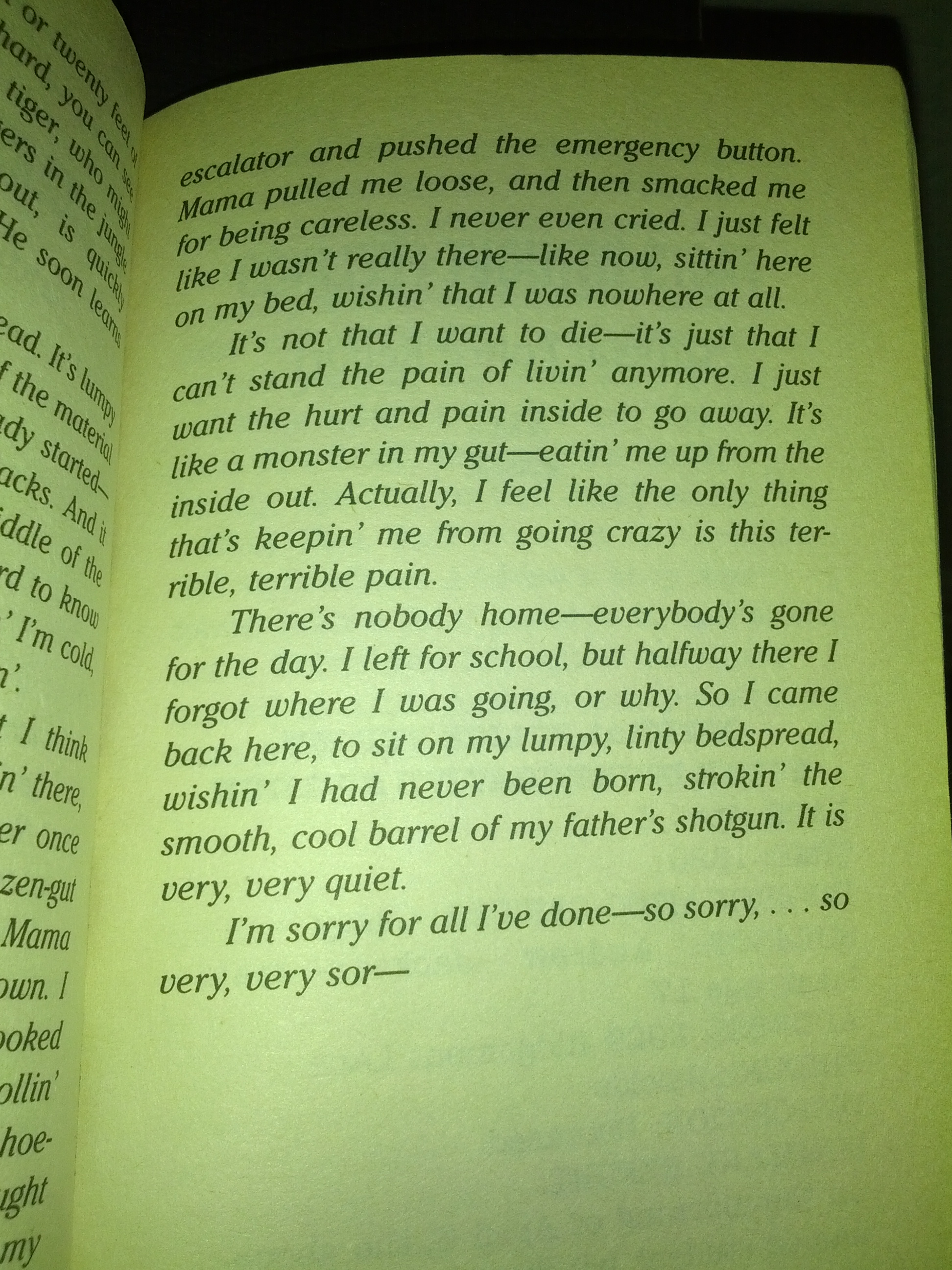
As ChrisIMG_20141215_175627tian holds tight to Tears of a Tiger by Sharon M. Draper (a popular read among students and the first book in the Hazelwood High trilogy), he points to this passage and invisibly underlines each word as he flies through the paragraph that starts “There’s nobody home – 

He then pauses.   His finger moves to the last line, lingers there as he looks up at me, and continues…”I’m sorry for all I’ve done – so sorry, …so very, very sor-

“Ms. Bogdany, did you SEE that?!  He kills himself!  He doesn’t even finish his sentence!”

I am most definitely taken aback.  First by Christian’s intense grasp on the craft of the writer and secondly by the wild intensity of a young man taking his own life.  My eyes bulge too.

Then Christian continues.  Again, his finger leading the way…

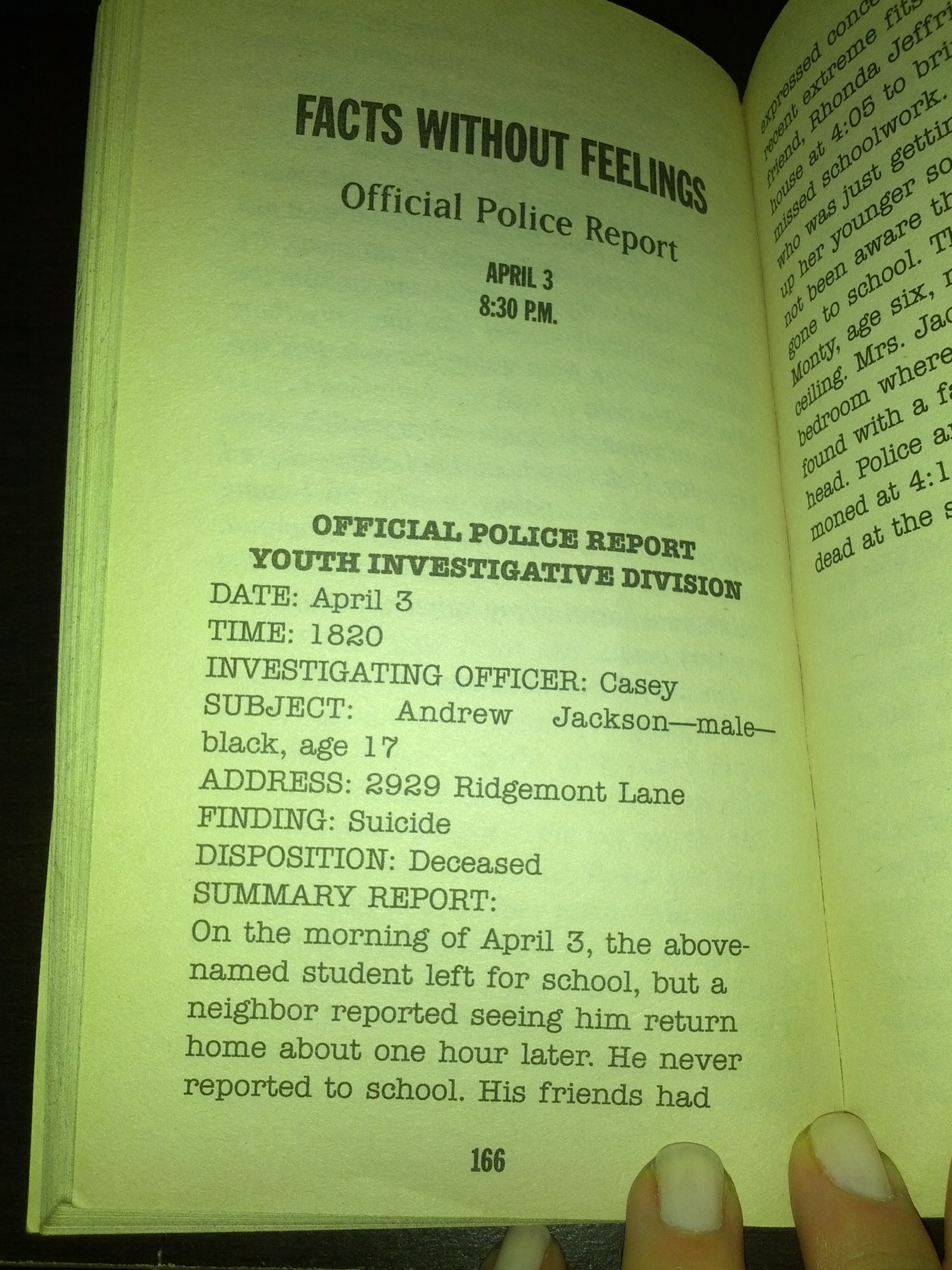
IMG_20141215_175604

“Suicide!  This is the police report.  He killed himself.”

We both pause.  The weight of the word.  We both feel it.

“Ms. Bogdany, I just can’t believe it.  I knew it on the page before, but here it’s confirmed.  I had no idea this would happen.”

————

Christian has chosen many-a-piece that deals with Post Traumatic Stress Disorder (PTSD) and this piece is no different.  Here you have the main character who deals with survivor’s guilt after accidentally killing his best friend in a car accident.  You can only imagine how difficult life, for Andy Jackson, must be.  While attempting to ask for help throughout the piece, Andy feels as though he is alone.  Very alone.

This piece chronicle’s Andy’s journey and the fatality in which it brings.  Please note that students may want (and actually need) to talk about their feelings regarding this heavy issue.  Christian did, albeit the way in which he initially hinted.  Through the expletives I realized that Christian couldn’t be silent about the tragedy he just witnessed.  He needed to voice (in whatever way that surfaced) his knee-jerk reaction to the shock of Andy’s decision.

This piece has connected Christian and I.  It has given us the opportunity to chronicle his study on PTSD…and the real consequences that are associated with it.  He was able to walk me  through the craft of Sharon M. Draper.  This book will remain important for Christian for very specific reasons as it may very well be the piece that is forever etched in his mind.  This piece will also remain incredibly important for me, but for very different reasons.  Regardless of the reason, we are both grateful to Ms. Draper for her dedication to addressing real issues that touch the lives of our youth.