Poetry makes no sense to many of today’s learners–many educators, too. We were lousy at teaching poetry so did something about it: spent a week at Frost’s Farm at the Conference on Poetry & Teaching. We’ll “Provide, provide” highlights on how to transform instruction with poetry at the core.
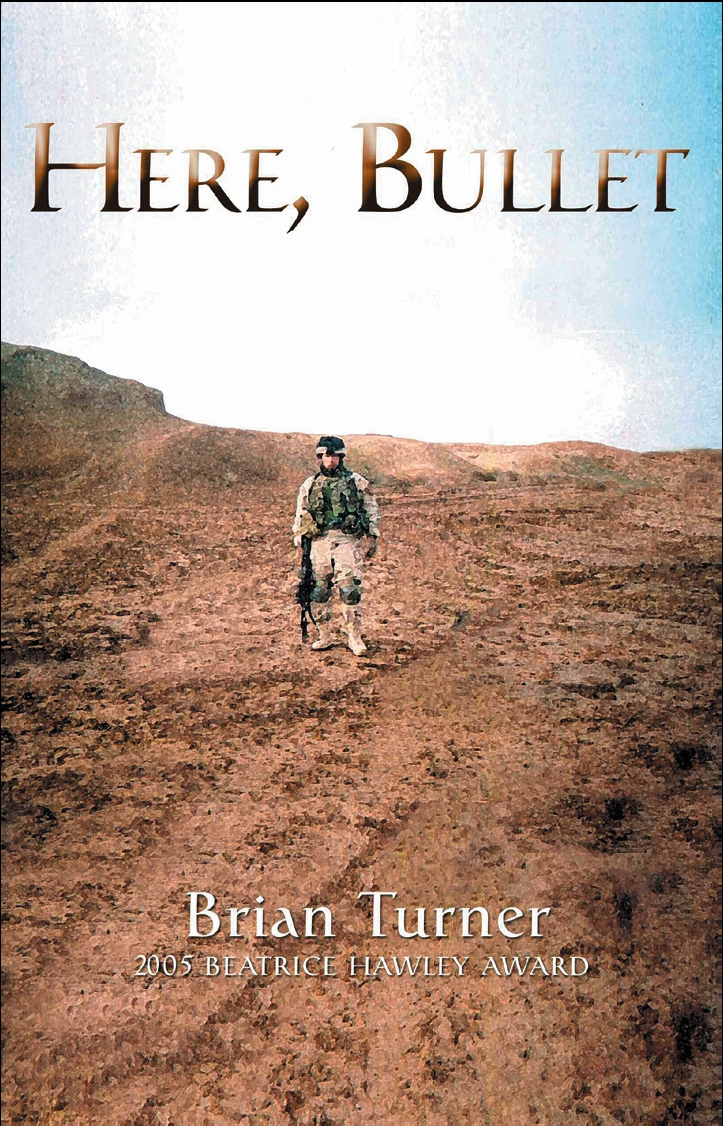
My “war” section continues to be one of the most popular areas in my classroom library, and while I do not naturally gravitate towards this subject, I have made a point to find hot titles that excite my students. One of my favorite war books is Brian Turner’s anthology of poems, Here, Bullet. This book is a different type of war story. Not only is this one of the only war books I have read cover-to-cover, but it is also one that breaks down the stereotypes of poetry by transforming what many of my students consider to be a fluffy form of writing into a stark, honest, and emotional portrayal of battle. Ultimately, Turner is a master of painting the pulsing images of war through poetry.
Turner’s poems, which are short and succinct, are also raw and relatable. He draws from his seven years of experience in the US Army where he was deployed to both Iraq and Bosnia-Herzegovina. I use this anthology to draw in the students who otherwise are resistant to reading or even studying poetry. While my copy is heavily annotated and marked up, I still make it available for my students as an independent reading book and even as a mentor text.
I read the following poem as an excerpt from the book during a book talk:
Here, Bullet (From Here, Bullet by Brian Turner)
If a body is what you want,
there here is bone and gristle and flesh.
Here is the clavicle-snapped wish,
the aorta’s opened valves, the leap
thought makes at the synaptic gap.
Here is the adrenaline rush you crave,
that inexorable flight, that insane puncture
into heat and blood. And I dare you to finish
what you’ve started. Because here, Bullet,
here is where I complete the word you bring
hissing through the air, here is where I moan
the barrel’s cold esophagus, triggering
my tongue’s explosives for the rifling I have
inside of me, each twist of the round
spun deeper, because here, Bullet,
here is where the word ends, every time.
I love how Turner intertwines the imagery of a gun with a human body. The juxtaposition between the hardness of weaponry against the softness of flesh is eerie and makes it as if the two become one: “Here is where I moan the barrel’s cold esophagus, triggering my tongue’s explosives for the rifling I have inside of me.” He is a wordsmith whose lines inch their way into your psyche, leaving you repetitively combing through each poem word by word.
My first year of teaching I learned that my students thought poetry was a convoluted, confusing, incomprehensible jumble of words. They believed the more muddled the language, the better the poem. Students would write poetry in their writer’s notebooks and then ask me to translate it for them: “what do you think this means?” or “what do you think I’m saying here?” They’d ask, and I knew it was a dangerous game. I felt like a psychic, asking vague enough questions to pull out some story I could piece together. The students who weren’t writing in garbled tongues were crossing their arms in protest of the poetry unit.
I quickly learned that my students needed to hear contemporary poetry, poetry that pulled them in as readers and allowed them to feel something, anything. Over the years I have sculpted my poetry unit to meet the needs and wants of my students. It has become my favorite unit because it is the one that fits flawlessly into the workshop model; it provides the greatest opportunities for differentiated instruction and unique output. While I integrate poetry into my lessons throughout the year, I eagerly ramp up student exposure during the few weeks that surround our school wide Poetry Out Loud (POL) competition, a national oratory competition in which students perform a poem from the POL website (http://www.poetryoutloud.org/). I have found that four main components within my poetry unit have proven successful in educating students on what poetry has to offer.
1. Flood students with contemporary poetry
The easiest way to help students connect with poetry is to provide them with examples that speak to them. I begin my poetry unit by playing two songs. They could honestly be any songs that have a story, but my choice this year was “The A Team” by Ed Sheeran and “Wings” by Macklemore. I explain to my students that poetry is all around them. In fact, poetry is the most accessible form of writing they come in contact with on a daily basis because it is used in music, and how many students walk around with ear buds jammed in, listening to the words of poet-musicians.
Students warm up to this thought quickly, but it’s the spoken word poetry that tends to catch them off guard. I lead poem talks instead of book talks during this unit and I expose students to a variety of spoken word performances, my favorites being from Taylor Mali, Sarah Kay, and Shane Koyczan. I also find that spoken word poetry tends to pop up throughout the year. Oftentimes students send me their favorite pieces and I collect these for this unit. This year’s popular video, which was performed by a trio of teenage girls from a program called Get Lit, is called “Somewhere in America.” (http://queenlatifah.com/lifestyle/heroes/get-lit-power-of-poetry/). Last year’s viral video “Look Up” by Gary Turk served as a call to students to put down their technology and start living in the moment (https://www.youtube.com/watch?v=Z7dLU6fk9QY).
Students complete quick writes based on these poems to help them explore the meaning and depth of the poem. I ask them to write about their reaction to the performance, to pick a line from the poem that speaks to them, or to write about memories the poem might stir up; the goal is to get them responding to and talking about poetry in some way while recognizing that their reaction as a reader is valuable.
2. Put Poetry on Display
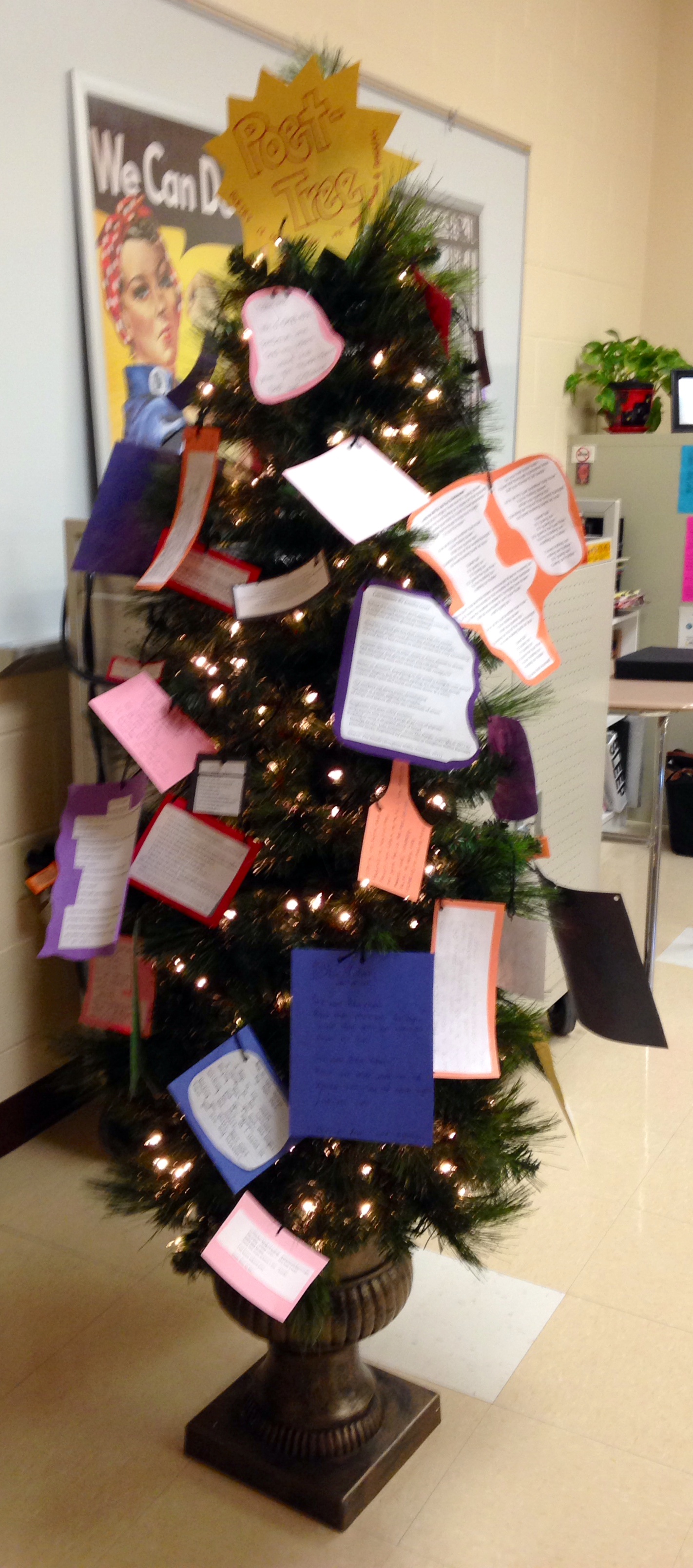
Our class Poet-Tree
Part of exposing students to contemporary poetry also involves helping them to recognize poetry within their surroundings. During the poetry unit I make a point to both display and discuss books that include poetry. I like to discuss Ellen Hopkins’ books and use Brian Turner’s war poem anthology Here, Bullet as well Jay-Z’s book Decoded, which includes annotations of his rap lyrics, as mentor texts. I also integrate classic poetry to make sure students are exposed to a wide variety of poets and pieces.
Inspired by a Pinterest pin, I started a Poet-Tree this year. I asked students to take a week to find poetry surrounding them. They could bring in a poem they enjoyed, favorite lyrics from a song, excerpts from a book, or anything they deemed to be poetry. The goal was to reinforce that poetry exists all around us, and judging by the final product, students were able to recognize the larger implications of the poetry unit.
3. Have students Participate in Poetry Out Loud or a poetry reading
Ownership is central to the poetry unit. Students oftentimes give into poetry because they have a say in what poem they would like to memorize, analyze, and perform. Furthermore, they are invested because their peers
A poem displayed on our class Poet-Tree
hold them accountable.
I give students ample class time to explore the available poem choices on the Poetry Out Loud website. Once they choose their poem, I lead them through a variety of activities intended to help them fully analyze and understand their poem. We explore the meaning behind the poem, creating a word dictionary to understand the significance of word choice. They research the poet’s background and historical events/facts that might have played a role in the writing of the poem. They learn about the appearance of the poem and how author’s choice plays a role in line lengths and stanza breaks. Finally, we discuss sounds within poetry and how poetic elements affect how a piece is read. This intimate look at the structure and development of the poem prepares students to perform their poetry at our final poetry café.
4. Create a poetry and post cards match between schools
The postcard I traded with the elementary art teacher at one of our local schools.
Every year our freshmen classes pair up with a group of fifth graders from one of our local elementary schools to participate in a program we call “poetry and postcards.” Fifth graders paint or draw a post card in their art class to send to a high school buddy. In return, our students write a poem to match the post card while also sending a letter to the student with some information about themselves as well as advice for the fifth graders as they move up to middle school. My students are invested in the project and oftentimes receive notes back from their fifth-grade buddy.
While my poetry unit is packed, students move on with an understanding that the process of comprehending and connecting with poetry isn’t so different from the process of reading a novel. They see the relevance and beauty of language and tend to leave with a greater appreciation of an art they otherwise despised.
I asked my students to turn to a new page in their writers’ notebooks. I told them that I would read aloud a poem. Slowly. I would repeat each line twice. I would spell words that I thought were difficult. I’d tell them where the punctuation went. I’d tell them where the line breaks were. I’d give them time to write.
All they had to do was listen.
You would not believe the moaning.
I explained that to truly understand language they would need to listen to how language works. They needs to hear the words, the rhythm of the sentences, the length of the sentences. They needed to quiet their minds long enough to block everything out but the sounds of each and every word.
“The sound of sense, then. You get that. It is the abstract vitality of our speech. It is pure sound–pure form. One who concerns himself with it more than the subject is an artist. But remember we are still talking merely of the raw material of poetry. An ear and an appetite for these sounds of sense is the first qualification of a writer, be it of prose or verse.” ~Robert Frost
I didn’t expect students to understand so much Frost’s meaning, but I did realize the value of getting students to find a center and make the words their own as they write them down.
I’d experienced this first hand at the Conference on Poetry and Teaching at The Frost Place last summer. Every morning, we’d sit on metal chairs in the small barn behind Robert Frost’s house and listen and write what we heard.
The practice is called DICTATION. “It’s a slowing down and feeling the language in your bones,” says David Cappella, co-author with Baron Wormster of A Surge of Language — Teaching Poetry Day by Day. (Here is a sampling from Heinemann.) Wormster explains, “[Dictation] is a kind of reading aloud to think aloud so you can live out loud. Poetry is life in the slow lane. Poetry tells us to slow down and to pay attention. Poetry directs our attention.”
I have used dictation three times with my students so far this year, and three times we have experienced a calming of the mind that moved us to specific and powerful learning.
1. We focused on word choice, paying particular attention to words we found interesting and unique. This lead to better word choice in our Go World video stories.
2. We focused on sentence length and variety, paying particular attention to the rhythm in the poem. This lead to more purposeful syntax patterns in our next blog post. (All of my students manage their own blogs. See this post here to know more about our blogs.)
3. We focused on figurative language, paying particular attention to the sensory words that created the images. This lead to more colorful, intentional and moving language in our notebook play leading up to narratives.
My second semester starts today. Today I will dictate a poem to get us started, I think it will be this one by Anais Nin:
While skimming one of my social media feeds I saw an article from the Huffington Post, Arizona Education Officials Say It’s Illegal To Recite This Poem In School. Of course, because Amy and I are presenting about poetry at TCTELA at the end of the week, the title itself peaked my interest. Briefly scanning it, and not thinking much of it, I sent it on to Amy as just one piece in a dozen I’ve scanned while preparing for our presentation.
In Amy fashion, like she always does for me, she shoots back, “Good one. What’s your take on it?”
Well, honestly I hadn’t really thought about my take on the subject, I was really just thinking about it as a reference that there is censorship in schools even in the genre of poetry. But as I started thinking about it I really generated more questions than answers:
1. What role should a state or federal government play in the specific materials that are used in an individual classroom? I certainly know that this question will continue to linger for me as the state legislators are about to reconvene here in Texas.
2. How do we prepare students for the culturally diverse world they live in when they are not given the opportunity to learn about different cultures? The article mentions that, “The law forbids classes that promote … or treat students as members of a group rather than individuals,” but I wonder to what end. Isn’t my individuality in some way tied to my identity to a particular group? And that’s not to say just ethic group, but also as an educator, a mom, a writer, etc.
3. The article also mentions that if the school district will receive 10% less in state funding if they do not comply with the state mandates. I’m not naive enough to believe that a simple slap on the wrist would be an effective punishment, but if there is a funding cut who are they really hurting, the school district officials or the students of that district?
Above all though, if you read the portion of the poem that is included in the article, I find it most interesting that there are no terroristic anti-democratic overtones, as one might suspect based on the opinions of those that oppose the piece, rather a sentiment of mutual understanding and respect.
I would now like to return the question to you, Amy, and anyone else who would like to join in the conversation. “What’s your take on it?’
Sometimes others write my thoughts. Shana did that this week in her post about Reading Resolutions.
Well, not the part about traveling to England and visiting all the awe-inspiring places she mentions. (“Someday,” I tell my self daily.) But the part about losing her way as a reader, and the part about needing to “read my roots.” This is so me.
When we run a readers and writers workshop classroom, we read so we can encourage our students to read. Sure, we can book talk titles that we’ve only heard of — there is a little art to that though. Sure, we can have students book talk to one another — this works well when we’ve modeled talking books enough times. And while most of the YA literature I have read over the past several years has held my attention and given me insights into the minds and hearts of my students, it is still not my roots. (Honestly, I get a little tired of all the teen angst that my students love to read.)
Like Shana, my roots run deep into literature. I love the classics. I mean the real old classics — a little Homer, Greek tragedy, a comedy or two, definitely a book of Will’s plays, maybe some Milton, and more.
I teach none of it. And I’m okay with that.
In AP Language, our focus in non-fiction: speeches, essays, op-ed pieces, arguments, and I have managed to include literature in our book clubs and poetry into our writing workshops. This works great for the purposes of my course design and my teaching. I just sometimes miss the me kind of reads.
Right now I need to think about me.
Here’s three things I’m doing to focus on the Reader who responded to Shana’s post with a “Yes, yes, yes, a thousand times yes”:
1. Participate in a Book Club. We’ve only met twice, but we’ve read two interesting texts: State of Wonder by Ann Patchett and Unbroken by Laura Hildebrand, and our next book is Station Eleven by Emily St. John Mandel. Grown up talk about books we read for pleasure. That’s about my favorite thing.
2. Challenge myself to read author’s I’ve never read: James Joyce, Kurt Vonnegut (ok, I read “Harris Bergeron”), J.K. Rowling. I have many more, but these are the first three that came to mind.
3. Attend an event at the Dallas Institute of Humanities. A new colleague filled me in on the offerings here. I had no idea. On-going classes, and then in the summer a Teacher’s Institute to study Tragedy/Comedy and Epic Tradition.
For the past few years, all of my reading has been for the purpose of research. I read pedagogical teaching texts or young adult lit almost exclusively, and when I branched out from that, it was to read complex books that I thought I might use to challenge my students to use for craft examples in class. I read only as a teacher, and not as a reader. In 2015, I’m determined not to do that.
Poet’s Corner
Ten days ago, I was in London, England. Pretty much every moment of every day since then has been spent either reliving a magical moment there, or frantically trying to catch up with everything I fell behind on here in real life.
Much of that trip of a lifetime was spent flitting around different literary sights in London. My husband and I had a beer at The Plough, the famed pub of Dickens, Woolf, and Darwin. We visited Poet’s Corner in Westminster Abbey and saw graves of and memorials to my heroes Jane Austen, William Shakespeare, C.S. Lewis, and more. We enjoyed a visit to the home of the most famous fictional character in England, Sherlock Holmes. The Globe Theatre, The British Library, Southbank Book Market…we saw it all. Awash in the history of English literature, my trip made me desperately want to revisit much of it. I can’t think of the last time I read a classic for pleasure. So, I made my first reading resolution for 2015: read my roots. My degree is in literature, but I’ve missed out on a lot of its classics–probably because they were assigned as boring whole-class novels and I knew about SparkNotes, but I digress.
So, I knew I wanted to read some classics for fun. But I also wanted to make sure I read lighter, easier things too, for a different kind of escapist fun. I got curious about bestsellers I’d never bothered exploring…Janet Evanovich. James Patterson. Sue Grafton. I’ve never read any of their books, but millions of others have. So, that’s another resolution–read my age. I’m a 27-year-old female lover of mysteries, and I’ve never cracked the spine of an Agatha Christie! So much of my reading life is focused on the 11th graders in my classroom, but I need to read my age, too. I want to read what everyone is reading and talking about–all of the New York Times bestsellers, not just the Young Adult list.
Heaven in Outer Banks
My last resolution is to relax and read. I recently read an article about a woman deciding not to participate in the GoodReads Reading Challenge because she felt like it stressed her out and diminished her intrinsic love of reading. The comments were overwhelmingly negative and unsympathetic, but I found myself in complete agreement with her! I was always “behind schedule” on the challenge, always feeling like I couldn’t take the time to read anything massive like The Goldfinch or pondering like The Poisonwood Bible or immersive like Will in the World. Those books would take me way too long to read, and how was I supposed to find new things to booktalk for my students then?! Well, I’m done with that. I want to return to the days of my vacation in North Carolina last summer, where it rained for seven days straight and all I did was read. It was the perfect beach vacation.
My selfish to-read list
2015 is my year to stop feeling guilt, obligation, or stress about books. Yes, reading saves lives, changes the world, and creates empowered, literate citizens, but that’s not why people read. And that’s not why I try to get kids to become readers. Reading is an exercise in imagination, in escape, in adventure. It’s joy and pleasure and heartbreak. It’s empathy and knowledge and understanding. I’ve been so busy trying to teach that that I’ve forgotten it myself. This year, my resolution is to remember that. What’s yours?
Share your #readingresolutions and see others’ on Twitter.
“There are creative manners, there are creative actions, and creative words; manners, actions, words, that is, indicative of no custom or authority, but springing spontaneous from the mind’s own sense of good and fair.” ~Ralph Waldo Emerson, “The American Scholar”
I’m thinking about the #NCTE15 proposal that I’ll submit this week with my TTT writer-friends, and I know my topic must be about conferences with students.
I used to be more cold than hot when it came to meeting with students regularly. I’m happy to say that I’ve learned how to manage my time and my focus. I’m getting closer to really really warm.
I know it’s the consistent one-on-one and sometimes small group chats that yield the most growth in my readers and writers. This might also be the hardest thing for me to do consistently. Good intentions and all that.
I love Emerson’s language and this idea of creative manners, actions, and words when considered through the lens of conferring with students. Sitting together writer to writer and/or reader to reader, I hear my students connect the dots. I see them reach inside for ways to improve. The more we meet together, the more I know these learning moments happen spontaneously. Students understand that they do not need me to help them think. They grow in confidence and competence. Their manners, actions, and words change as they believe in their abilities.
I want them to believe that they can grow as readers and writers.
Recently, I’ve been reading Reading Projects Reimagined by Dan Feigelson, and I know I can do more as I talk with my learners. Feigelson offers me advice when he outlines the steps for a successful reading conference that would lead to a student-selected project. I think it works for most of the reading conferences I conduct with my students, project or not, and it’s made me more intentional in having my students look for patterns in the literature they read. This will help with analysis, a skill most of my students struggle with — a lot.
These are Feigelson’s steps (a bit abbreviated) from p.30 of his book:
1. What are you thinking about this text?
2. Listen for the most interesting thing the reader says or does.
3. Ask the reader to say more about that thing. [Jot down words or phrases.]
4. Name what the reader is doing in a way that is about more than the current book…strategy for future reading. Teach him to go further…how it will help in future reading.
5. Come up with a project that allows the reader to follow his or her line of thinking by collecting evidence in the text.
6. Agree on a specific task.
7. Articulate the teaching point again.
“See? It doesn’t have to be complicated,” she reminds herself.
Yesterday, I read the transcript of a Choice Literacy podcast conducted by Franki Sibberson with Cris Tovani called Readers Workshop with High School Students. It’s worth the time to listen or read it. This is my favorite part:
Franki: You might have answered this one but what are the challenges of running a good reading workshop at the secondary level?
Cris: I think the challenges of running a good reading workshop at the secondary level is recognizing that you’ve got such a wide range of abilities as well as interest in that classroom and I think keeping in mind that every student deserves at least a year’s worth of growth whether it’s a struggling reader, on grade level reader or somebody who is an advanced reader. Each one of those kids we have to morally help them get smarter by at least a year.
And so I think it’s key to figuring out who your learners are, what they like, what their interests are, what their strengths and what their weaknesses are and then allowing for some differentiations.
Really, it all comes down to knowing our students and knowing their needs, and every student deserves an on-going conversation with a caring teacher. Every student deserves at least a year’s worth of growth as a reader — and a writer.
My spring semester starts in a week, and I know that I can improve my conferences. I’ve set some
conferring goals for myself with the hope of doing a bit of research and improving student outcomes. I know that when I make goals public, I am more apt to meet them, so here goes:
Now, it would help me out if I knew you struggled, too. Not really, but I would like to know where you are at with student conferences. Please take this simple poll and let me know. You’ll help me with my research. Thanks!
“Children born into families that raise them with love and with care to see that they acquire knowledge, values and discipline that will make them valuable members of society have far more chances of economic and other success in adulthood than children raised in families that lack these qualities.
Studies show that children whose parents have professional careers speak nearly twice as many words per hour to them as children with working class parents — and several times as many words per hour as children in families on welfare. There is no way that children from these different backgrounds are going to have equal chances of economic or other success in adulthood.” -Thomas Sowell
Read the whole of “The ‘Equality’ Racket when you get a chance. I would love to know what other educators think in terms of how this argument relates to your experiences with your students.
I’m struggling and would love to have a conversation.
Posted on the bookshelf behind my desk is this quote from Horace:
“Nulla Dies Sine Linea”
It means “Never a day without a line.” I learned it from Penny Kittle who I assume learned in from one of her mentors.
I thought if I posted the reminder, it would help me write more. It didn’t.
Sitting on my desk right behind where I place my laptop is this quote that I found in one of the many books on writing that pack my shelves:
“Write when you write.”
I thought if it stared at me everyday, it would help me avoid distractions. It didn’t.
I’ve learned.
The only way for me to write is to create some discipline. I almost said find discipline. Then develop discipline. Neither quite work. Knowing myself quite well. I know I have to carve out the time and cleverly create some. I can be tricky like that.
So, this is my five step plan to meet my writing goals this year. Maybe something similar can help you meet yours:
1. Get a part time job. That’s how I’m going to have to think about it — as a job. I’m committing to leaving the school an hour after the bell and going to my writing place: the public library just across the street, or the Starbucks around the corner, or the Barnes and Noble down the Interstate. I cannot stay in my classroom and write. I find a million other things to do — plan, grade, organize the books on my shelves in alphabetical order. I cannot go home and write. I find other things to do — cook or clean or lay on the couch or pet the dog.
2. Start a writing club. I started a book club with my friend, Tess, and some friends I used to work with in my prior district. The idea started as a way for us to stay connected because we know how hard it is to stay friends with folks we never see. Now, we meet once a month, late in the afternoon at a cute little restaurant not too far from where we all teach, and we talk about a book. We’ve only met once so far. Our next meeting is soon, but I’ve read two books I would not have read without these friends and this book club accountability. The same will work for a writing club. If I will really write and not just meet for scones and hot chocolate (like I did the last time I tried it).
3. Free the notebook. I have a perfectionist problem in all aspects of my life, except for my mess of a closet. The throw rug on the floor in my classroom has to be straight, the markers lined up in neat rows on the whiteboard rail, the anchor charts on the wall in absolute alignment. The blank page in a new notebook. Why is it so hard to just write? If my handwriting is weird or sloppy or whatever, even if it’s the pen’s fault (you know how your writing changes depending on the pen), I hate it. I have to stop hating it. Who cares? Absolutely, not a soul. My husband says that my parents put too much pressure on me as the first daughter after three son and then being followed by four younger sisters. Middle Child Syndrome with complications of being the oldest daughter. Really? That’s what makes me afraid to mess up on a page in my notebook? Whatever it is, I must set it loose. I have to free my mind and let my thoughts loose on the page.
4. Join a writing challenge. I found a welcoming group of writers called My 500 Words in a Facebook group. The encouragement and kindness is contagious. I found myself reading others’ posts and sincerely commenting. I also began following Poets & Writers. They have a “Tools for Teachers” page with prompts. I wrote my first poem of the year after reading one. It’s at the end of this post. I know that a lot of my problem with putting in writing time is the blank that envelopes my head at the end of a long day. While I have a love/hate relationship with prompts in my teaching life, I do think they are valuable tools to get stagnated thinking flowing.
5. Write as much as writing students. For several years I prided myself on writing every assignment that I gave my students. They wrote weekly blog posts. I wrote them, too. They wrote reflections on literature. I wrote them, too. They wrote analysis essays in preparation for the AP Lang exam. I wrote them, too. Everything my students wrote, I wrote, too. Then, I stopped. I don’t even know why, but it has made a difference — and not a good one. I know that if I want to be a credible writing teacher, I have to show my students that I am a writer. They must see me struggle through the thinking, the planning, the drafting, the revising. I used to be great at all this. I need to be great at it again. I saved a slip of paper that one student wrote at the end of the year on her last evaluation: “I love it that Mrs. Rass writes everything she asks us to write. I’ve learned to love writing because of her. Thank you, Mrs. Rass.”
Anything else? Help me out here, dear reader, what are your suggestions for helping busy teachers meet our writing goals?







 ©Amy Rasmussen, 2011 – 2015


 Three Teachers Talk