Category Archives: Shana Karnes

When Choice Becomes an Imperative

I’ve been fascinated with the language I hear in classrooms for a long while now.

My TTT friends and I like to use welcoming, inclusive phrases to describe what goes on in our classrooms–we practice offering choice, inviting learning. But many classrooms I visit use more permissive phrases that emphasize teacher control–“I make them;” “they have to;” “I let them.” Often, without ever stepping foot into a classroom, we can make inferences about what kinds of work students are doing just by hearing a teacher describe their learning. Is the learning situated as an invitation, a choice, a welcome pastime–or a mandate?

I worry that, for many critics of the readers-writers workshop, this language might be what convinces them that student choice lacks inherent rigor, as if choice is something to be offered on a menu. A luxury. A privilege.

This article details nicely the evolution of the readers-writers workshop in the last 40 years. Veteran teacher Lorrie McNeill, after visiting Nancie Atwell’s classroom, wiped away tears and described Atwell’s students as “so fortunate.” “It makes me sad that my students can’t have this every day,” McNeill said.

Student choice is depicted this way often–as a privilege a lucky few students are given. But in an era of increased measurement, standardization, and monologic thinking, I believe choice is not something that should merely be offered to students. Choice has become an imperative if we want our students to be successful, purpose-driven citizens.

We’ve all read Robert Frost’s poem, “The Road Not Taken,” and are doubtless familiar with its final stanza–“I took the road less traveled by, and that has made all the difference.” However, I find that the first stanza is far more descriptive of the students I’ve had in the past several years:

75854-Robert-Frost-Quote-Two-roads-diverged-in-a-yellow-wood-And-sorry-I.jpg

“Sorry I could not travel both.” Our students, often unaccustomed to making meaningful choices, are paralyzed when they come to roads that diverge in their lives. Growing up in a culture that is saturated with meaningless choices–social media, Netflix, and smartphone games come to mind, combined with an academic and social culture that emphasizes standardization and sameness–is devastating a generation.

So many of our students lack the agency afforded to them by frequent, authentic opportunities to make choices and mistakes–both low-stakes and high-stakes–at a young age. Too often, kids are paralyzed by indecision, faced with the paradox that too many choices becomes similar to having no choice at all:

I’d been thinking about this concept for a while, but it was driven home for me by one of my students, Sara.

Sara was one of my favorite kids, a secondary English major with a penchant for words and a passion for education. She seemed an indomitable force, never bogged down by her workload, her multiple jobs, or the high expectations she put on herself.

Until a few Fridays ago, when she asked to meet privately, and told me that she wanted to drop out of our education program.

Four years into her schooling as an English Ed major, and she was just now realizing she didn’t want to be a teacher–and no less, a potentially really awesome teacher?!

That was my initial reaction…until we talked, and I realized that she was just now finding the courage to decide she didn’t want to be a teacher.

“I cried when I got my acceptance letter into the program,” she told me. “I was hoping I wouldn’t get in and the choice would be made for me.”

Sara is part of a generation of students who have been shepherded through their education without getting the opportunity to make important decisions about her future. Like many millennials I know, while Sara enjoyed learning and higher education in general, she didn’t really know what she wanted to be when she grew up. How do any of us, really? Still, she toed the line, went to college, and was a senior before she realized she was in too deep.

On a large scale, Sara is one of many “college-track” students who, while in high school, have very little say in if they’ll go to college–if they’re lucky, they get to choose their major. On a small scale, this looks like a school experience that prizes correctness, conformist thinking, compliance. It looks like a school culture that positions kids in a binary: college or career-ready. It looks like a nation of kids who grow up believing in a new, sinister American Dream: that college is the path to success, despite a growing trend in research that shows it’s really not.

To help kids like Sara–and all students–we need to make choice less of an offering  in schools, and more of a necessity. How can we graduate teens who have to ask to go to the restroom on Friday and expect them to make responsible decisions about where they might live or work on Monday?

Our students need to grow up, K-12, in a culture of choice. They need to not only self-select what to read, but should be guided toward choosing their own purposes, evaluations, and goals when it comes to that reading. The same is true for their study of writing, mathematics, and the social and natural sciences.

Students should make their own choices, early and often, so that when they no longer have a parent, a school, or an institution making those choices for them, they know what to do. Making good choices is a life skill that requires practice like any other. We get into dangerous territory when we ask students to make their first real decisions when the repercussions of poor financial, employment, or relationship choices are often irreversibly permanent.

For me, this makes my quest to spread the love of readers-writers workshop even more meaningful. I believe that the power of letting students choose what, how, and when to read and write empowers our students far beyond the ELA classroom.

Don’t you?


Shana Karnes is mom to 1.5 spunky little girls and wife to a hardworking surgical resident.  She teaches practicing and preservice English teachers at West Virginia University and is fueled by coffee, a pregnancy craving of peanut butter and jelly sandwiches (this week), and a real obsession with all things reading and writing.  Follow Shana on Twitter at @litreader and read more of her writing on the WVCTE Best Practices Blog.

Snapshots from My Students’ Notebooks

img_2714.jpg

This weekend, I spent some time reading and responding to my students’ Teacher-Researcher Notebooks. These TRNs, my preservice teachers’ versions of the writer’s notebook, are where my college students’ thinking about their learning, teaching, students, and growth intersect.

Their notebooks inspired me–so much so that I began making a list in my own notebook of all the techniques and sketches and thoughts I saw so I could utilize them myself. I saw some ideas I’d given them, based on what’s in my own notebook, but I also saw some fresh genres that were new to me.

These five excerpts from my students’ notebooks illustrate that when given the choice afforded by workshop’s emphasis on frequent, low-stakes writing, balanced with the structure of routines, mentor texts, and feedback, the writer’s notebook is a powerful tool in any teacher’s arsenal. I’ll share them in the hopes that you and your students will try them out, too!

Orientation Pages. Making lists of writing territories, drawing heart maps, or tracing your hand like Penny Kittle often does are great ways to orient yourself in your notebook. I often ask students to do this both at the beginning of the semester, when our notebooks are fresh and empty, as well as periodically throughout the year to orient ourselves.

img_2711

These “orientation pages” center us, remind us who we are and what’s important to us, and double as a handy list of writing topics when we don’t know what to write. I love how Kourtney blended this technique with what she was noticing in her students.

Artifacts. Glue-ins not only serve to remind us of a particular time or place, but also act as inspiration for future writing. Many of my students glued in their name badges from their schools last year–a tangible marker of time’s passing that helped them see how much closer they were to becoming “real” teachers.

img_2720

I love that Megan glued in her Tutor badge–she’s graduated to a Participant this year, and will be an Intern next year–and how faded it is. She also glued in a final feedback note I gave her after she presented her end-of-semester research project last year. Her title “Things That Keep Me Going” is a handy thing to have around when the stress of teaching gets to be a little much.

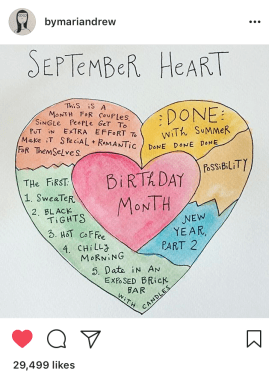
Imitations of Mentor Texts. Like many of my Twitter friends, I am obsessed with the lovely and poetic Mari Andrew. Her art serves as a frequent mentor text for my students, and we studied this image about how we define our passions, and they don’t define us–then imitated it.

img_2716

I love Julie’s illustration, which shows not only how many “Julies” she is beyond just teacher Julie, but also serves as inspiration in the form of an orientation page and a source for high-interest lesson topics she might pull in when she’s searching for some imaginative planning ideas.

Quotes. We learn so much from studying others’ words, not just for their message, but for their craft. Gluing in quotes, poems, essays, emails, and other bits of writing inspires us, teaches us, and motivates us to put pen to paper in ways that are meaningful.

img_2719

This quote Cat glued into her notebook is a wonderful one that I copied down myself, the better to write around, be inspired by, and imitate. It’s an apt metaphor for both teachers and writers, and served for Cat as a reminder of her potential and power as a blossoming educator.

State of the Writer. I urge my students to pause every two weeks or so and create a “big-picture entry.” This could involve doing a little reflection about themselves, looking at the undercurrents of what’s going on in their teaching, synthesizing some of the learning they’re doing in their classes, or a combination of those.

img_2717

I love that Elizabeth chose to do a little sketch of herself surrounded by the myriad thought bubbles typical to a teacher’s brain. Lesson planning, fretting about money, digesting Freire’s Pedagogy of the Oppressed, and the black hole of Pinterest…I mean, how spot-on is this!? I’d love to use this as an alternative to a written quarterly reflection with high school students to illustrate the intersections between who we are and what we’re learning.

Will you share some of your students’ notebook wisdom with us? Tell us about what your students write in the comments, or using the hashtag #whatsinanotebook on Facebook and Twitter!

Shana Karnes is mom to 1.5 spunky little girls and wife to a hardworking surgical resident.  She teaches practicing and preservice English teachers at West Virginia University and is fueled by coffee, a pregnancy craving of Honeycrisp apples (this week), and a real obsession with all things reading and writing.  Follow Shana on Twitter at @litreader or read more of her writing on the WVCTE Best Practices Blog.
Teachers Are Awesome. Let’s Learn from Them.

i-love-my-students-bags-backpacks.pngToday, I’m reflecting on how much I love my students.

There are 52 of them, all pre-service teachers from a variety of content areas and grade level specializations. Despite all the ways we are misaligned pedagogically, we have fantastic discussions every Friday about the work of education–the broad strokes that define good teaching, no matter the topic, age level, or context.

My students and I have opened one another’s eyes to so many things during our time together. If there’s anything that they’ve taught me, it’s that we can all learn from each other.

I feel much more knowledgeable, passionate, and informed about teaching reading and writing now that I’ve studied with elementary literacy specialists for over a year. I’ve learned from my history teachers how to spin what seems an ageless interpretation of a text into something new and fresh. My math and science preservice teachers have shown me more about process-oriented teaching, learning, and feedback than all my disconnected reading on the subject.

In studying with these young teachers, I am reminded of how much we can learn from one another, if only we try.


I think the most frustrating thing for me about teaching is the isolation.

Not just the physical isolation of our classroom spaces–being the only one who seemingly holds our role in the room, alone as the adult–but also the way that we never get to see one another practice our craft.

We rarely get to see other teachers teach.

As a result, most of our information about what other teachers are doing comes from secondary sources–our students, their parents, our colleagues, or, more professionally, from books, articles, blogs, or journals.

What would education look like if we changed this?


In my many roles this semester, I’ve gotten to be in lots of West Virginia classrooms. As a supervisor of English Ed interns, I’ve gotten to visit 7th graders and their teachers. As a teacher of preservice teachers, I’ve gotten a glimpse inside the myriad classrooms they’ve been placed in. And as a substitute teacher, I’ve gotten to “be” ten different practitioners so far this year.

I love, love, love going into these other classrooms. From the first impression I get from the empty space, to the first students who walk in the doors, to the ways I see teachers and students interacting as I study them–I love all of it.

There is beauty in every single classroom.

Getting to see all of these learning environments supports, strongly, the idea that no two teachers will ever teach alike. There is value in that truth–if the instruction we value for our students involves choice, authenticity, rigor, and relevance, then the instruction we want our teachers making involves those things too. That means providing time and training and encouragement for teachers to design their own curricula, assessments, and and products.

Because we don’t live in a perfect world, many teachers don’t get to do those things–but what does become reality is the fact that no two classrooms are alike, nor should they be.

What we can do is embrace that reality and learn from each other. Collaboration is a goal for many of our students’ thinking; why not apply it to our teachers’ learning, too? Here are four ways you might do this with your colleagues soon.

Ask Questions. As you’re enjoying your school’s delicious lunch special in a tiny student desk with your teacher friends, don’t just talk about what happened last on The Walking Dead. Ask questions: what are you guys working on this week? How do you approach grading that? What struggles are your students having? Where do you wish you could improve?

These questions help not just the asker, but the answerer, too. How many times do we actually get to talk about the pedagogical aspects of our work? I know when I tell stories over the dinner table I don’t talk about my methodology or lesson planning. I talk about the kid who tooted incredibly loudly in the middle of an active shooter drill, causing the whole class to burst out laughing in the dark classroom (that happened yesterday). Asking questions helps us learn not just about one another, but about our own teaching, as well.

Observe One Other. It can be tough to fit everything a teacher has to do into 24 entire hours, let alone the free moments we get in a school day. But take some time, even if it’s just once a month, to pop into a friend’s classroom on your lunch, plan period, or PLC bell. Just see what they’re up to for 15 minutes and learn from them–the way they arrange their space, the precision of their language, how they have kids organizing materials, or who and what and how they’re teaching.

We can always learn from one another, even across content areas. Invite others into your room, too; you never know what good someone else’s eyes might see that yours have missed.

Share Resources. Standing in line at the copy machine? Have a glance at what your peers are xeroxing. And do steps one and two, too–ask questions about those questions, or mentor texts, or essay samples, or whatever it is you see. Get talking about the work we do on the most nuts-and-bolts level–how do you organize your planning? Are those copies for today or tomorrow or next week? How do kids turn them in? How do you grade them? Let your curiosity guide you.

Listen. The final step, of course, is to listen thoughtfully to what you learn during this process. We have to open our eyes, ears, and minds to what good we can see in one another’s practices. Don’t pre-judge the math teacher making a thick stack of copies of practice problems. Don’t assume the English teacher relying on the textbook comprehension questions has nothing for you to learn.

Every teacher does good work–young and old, new and veteran, AP and on-level, quiet worker or school-wide leader. We spend too much time assuming the worst of people in our world–we don’t need to make our jobs harder by doing this at school too. Look for the good. Teachers are awesome. All you have to do is remember that, look for it, and prepare to learn.

Imagine would education would look like if we did.

Shana Karnes is mom to 1.5 spunky little girls and wife to a hardworking surgical resident.  She teaches practicing and preservice English teachers at West Virginia University and is fueled by coffee, a pregnancy craving of orange jello (this week), and a real obsession with all things reading and writing.  Follow Shana on Twitter at @litreader or read more of her writing on the WVCTE Best Practices Blog, where a version of this post originally appeared.

Building Community Through Tough Conversations

We need to invite conversation into our classrooms, and sometimes that means having controversial conversations. Provocative topics will get anyone talking–we’ve all seen evidence of this in our Facebook feeds–but teens, especially, need to flex their opinion muscles often.

Like any other developmental milestone, kids need a safe place to practice and fail at these skills before they master them. Talk, argument, the subtle art of making claims, supporting them with evidence, and persuading listeners with ethos, pathos, and logos, are developmental milestones. As such, it is our job as educators to provide the safe space needed for that practice.

But as we know, you can’t just leap into the tough conversations a few weeks into the school year–you have to build community, and trust, and a sense of values first.

img_2578Right?

I happen to think that having those tough conversations is the way to build community.

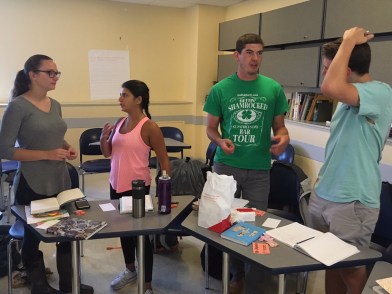
We have to read, think, and write what matters in classrooms. So last Friday, my preservice teachers and I unpacked a tough topic: institutional racism in education. We didn’t just leap in and invite uninformed debate–instead, we did lots of work before our conversation to help us navigate the waters we were about to enter.

First, we read.  Our assigned reading for the week was Peggy McIntosh’s “White Privilege: Unpacking the Invisible Knapsack.” A women’s studies scholar, McIntosh coined the term “privilege” in the late 80s, when this article was published. It’s a thoughtful read, strengthened by its narrative of McIntosh’s discovery about her previously-unseen privilege.

We drafted our thinking in pairs. After reading, students wrote one-pagers about their thinking and submitted them to our class Google Drive. Each student has a critical friend this semester, so they receive feedback on their thinking from both me and a peer. These low-stakes spaces for thinking help students get their initial reactions down on paper

Screen Shot 2017-09-25 at 8.27.30 AM.png

We talked. To open our conversation, I asked students to speak generally about what surprised or interested them about McIntosh’s writing. Many students volunteered ways in which they agreed with McIntosh, but a brave few spoke about how they weren’t so sure about her claims. One student even prefaced his comments with, “I feel like kind of a douchebag for even thinking this, but I’m going to say it.” I thanked him for his willingness to be honest, and that opened the floodgates for other students to share more readily.

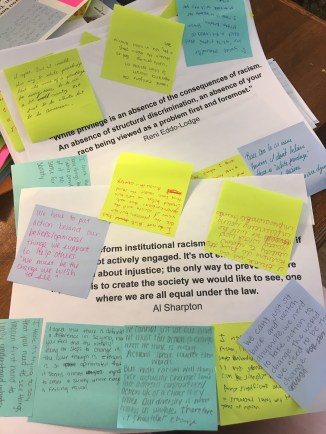
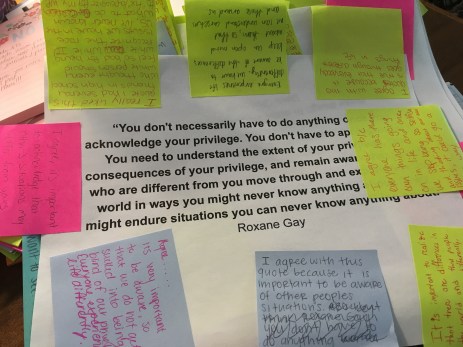
We extended and re-drafted our thinking. After several minutes of back-and-forth, I presented students with a variety of other points of view on this same topic in the form of quotes about institutional racism and white privilege. I asked students to read and respond to one quote anonymously via Post-its.

img_2517

They did this, then passed their Post-it laden quote to the next table, who read both the quotes and comments and added their thinking.

img_2577

We continued in this vein, then talked in small groups about what the post-its said, negotiating agreement or disagreement with each writer, then conversing about the ways our own opinions had evolved.

We left the conversation unfinished. Because how can you really ever arrive at a definitive understanding of any topic so complex? Our thinking must keep evolving. I have several next steps in mind.

I’m going to send my kids Peggy McIntosh’s fantastic TED Talk on how studying privilege systems strengthens compassion. They’ll respond to their critical friend’s comments. In their notebooks, they’ll write a bit more about how they see evidence of institutional racism in the schools in which they observe. Next class, we’ll discuss ways to enact actionable change in classrooms, using this topic as a starting point for something we may want to reform in education.

In just our third class meeting, our conversation was a good start to the kinds of deep thinking and grappling with issues I want students doing in the course of our two years of seminars together. By offering plenty of opportunities to draft and revise thinking in small-group and low-stakes ways, students got comfortable enough with their thinking to share it with the class thoughtfully and respectfully.

We’ll continue to dialogue about this topic and other difficult ones, revising our thinking through the lenses of our learning and experiences, and discuss why discussing these topics matters. In just this one class meeting, my students and I learned more about one another than we had in our previous weeks of just writing and talking about safer topics. Through reasonable risk-taking, vulnerability, and honesty, we grew not only as individual thinkers and teachers, but as a community of reflective practitioners as well.

How do you help your students have controversial conversations? Please share in the comments!

Shana Karnes is mom to 1.5 spunky little girls and wife to a hardworking surgical resident.  She teaches practicing and preservice English teachers at West Virginia University and is fueled by coffee, tortilla chips (this week), and a real obsession with all things reading and writing.  Follow Shana on Twitter at @litreader and read more of her writing on the WVCTE Best Practices blog.

We Remember Our Students; They Remember Us, Too

img_7247.jpg

Bryce photobombing me in 2014

Sometimes I go months without seeing any of my former students. Then, I’ll venture to the grocery store at 5 pm on a Tuesday and see six of them in 15 minutes.

Sometimes I worry about the ones I never bump into. How are they doing? Are they okay? I wonder.

Bryce is one of those students I worry and wonder about. I had him for two years, and he made incredible progress from a squirrelly junior who couldn’t sit still in his desk, to a serious senior who devoured first graphic novels, then dystopian classics. He wrote pages of essays I couldn’t get him to care about, then progressed to delivering measured country wisdom.

Bryce, along with his class, wasn’t a kid you could easily forget–he was part of my MTEC crew, the rowdy country boys who attended our high school for half a day and worked on their vocational certifications for the rest. Bryce and his pals Troy and Bull leapt at the chance to build my bookshelves rather than read books, give my husband advice on how to fix up the ’92 Bronco he bought rather than write poetry, or sneak their dip spit into Gatorade bottles rather than revise an essay.

So, when my husband, a spine surgeon, saw Bryce come into the ER one evening, he knew who he was. He knew his face from his visits to my classroom; he knew his personality from my stories over the dinner table; he knew my frustration as I lamented over trying to find him a book to read. He knew what that kid meant to me, and he also knew he wasn’t allowed to tell me about the horrific car crash it was evident Bryce had just been in.

But the news was all over social media–Bryce had flipped his Jeep over an embankment, rolled down a hill, and broken his spine in several places. I knew that since my husband was on call, he’d be the one taking care of Bryce, fixing his shattered bones. I also knew that Bryce wouldn’t be returning to school this year, that he’d be assigned to homebound instruction, and that not just anyone would be able to shepherd him through his classes.

So I was worried right away–worried that for all of Bryce’s progress, this accident outside the classroom would erase the growth he’d achieved so painfully, in an equally painful way. Would he walk again? Would he be himself after rolling his prized Jeep down one of our state’s famous country roads? Would he finish his junior year classes successfully and stay on track to graduate?

Since I had an in with his doctor, I got to visit Bryce in the hospital the day after his surgery. He wasn’t paralyzed, but he’d have a long road to recovery–and to a successful finish to his school year.

A week later, Bryce was at home, in a back brace, scars all over his body, and his face still bruised and battered. I was there too, my arms filled with binders full of his assignments from all six of his classes. His mom, whom I’d met when I visited the hospital, brewed me coffee in the kitchen and sorted out the pills Bryce needed to take every afternoon. He blushed when she had to help him use the restroom, or nagged him to get out of his recliner and take a walk, or shuffled the thick stack of hospital bills I saw on their kitchen counter.

For three months, this was our routine–I’d arrive at Bryce’s house two afternoons per week with all of his homework and gently prod him through it. I’d bring him Gatorade and Cheetos from the gas station on the way to his house to help bribe him through the math and history assignments he hated. Science, he enjoyed, and his vocational class homework never failed to bring a smile to his face. But it took him twice as long to finish all of his required work–between his concussion and injuries, his fear about getting hurt again if he were to return to school, and the exhaustion brought on by physical therapy and trauma, it was no wonder he had trouble concentrating.

Screen Shot 2017-09-18 at 7.10.30 AM

Bryce included a photo of his totaled Jeep in his MGP

But I knew that English would be a tough subject to approach. I wanted Bryce reading and writing meaningfully–frequently and deeply enough for the acts to be therapeutic.  Outside the workshop community of our classroom, it was harder to guide him toward this kind of cathartic literacy, but we got there.

By the end of the semester, he’d read nine books with damaged protagonists, written poetry about how his accident had created new gratitude for his mother and sister, and crafted a multigenre paper about his accident called “Anything With Wheels Will Cost You.”


My Jeep is my peace keeper. It’s the thing to let me get rid of reality. Some people have books, walks, or something else, and I have riding. No one is able to get ahold of you and all it is, is you and the woods and the roads.

After reading that line from his MGP, I knew he’d get another fast car, and he did. By the next year, he had new wheels and a new attitude. I got to have him in class again. He was a different kid–subdued, quiet, focused. He worked just as hard in class as he did outside of school, holding down two jobs to be able to buy a new vehicle so he could feel like his old self again. He flew largely under the radar in my 28-person class, graduated in the spring, and finished his vocational certification.

img_2433.pngI hadn’t seen Bryce in over a year, but had wondered what became of him. Then, last week, I spied him pulling out of a gas station. He was easy to spot, driving a truly West Virginia tricked-out truck, complete with lift kit, muddin’ tires, and chrome roll bars. His hair was longer, and he was smoking a cigarette. I pulled out my phone, wondering if I still had his number, and I did.

His reply to my message makes me continue to worry and wonder about him, perhaps more than I did before I’d seen him.

Life after high school isn’t easy for any of our students. When they leave our classrooms and we continue to worry about them, it’s for good reason–the transition from a “much simpler” time to the responsibilities of adulthood is tough for anyone.

But they remember what we teach. Maybe they don’t remember things like apostrophe use, but they remember that we care, that our concern for them goes beyond whether they can read and write well, and into whether they can live well beyond our classrooms.

I know you have kids you’ll never forget, too. And I know they haven’t forgotten you, either. We remember them; they remember us. Let’s teach them what’s worth remembering.

Shana Karnes is mom to 1.5 spunky little girls and wife to a hardworking surgical resident.  She teaches practicing and preservice English teachers at West Virginia University and is fueled by coffee, Reese Puffs (this week), and a real obsession with all things reading and writing.  Follow Shana on Twitter at @litreader or read more of her writing on the WVCTE Best Practices blog.

4 Ways to Get Kids Talking…To Each Other

af115350d91f58bfb8c402b3b6159935--changes-in-life-quotes-change-your-life-quotes.jpgToday is a day worth talking about.

For one, it’s been 16 years since the Twin Towers fell. Sixteen years.

For two, much of Florida is waking up to the terror of Hurricane Irma, probably in the dark, without power–but not without hope. And Texas is still recovering from Harvey’s rage. But they’re Texas, so they’re tough.

Days like today should never become routine. And these are the things we should be talking about in our English classrooms. But to have the heavy talks, of course, we need to be able to listen.

“English teachers have rare opportunities to get to the deep, real work of an education,” Mitch Nobis writes. Yes, we do.

We have a multitude of opportunities for important, valuable, world-changing talk to happen in our schools. Before these kinds of conversations can happen, we need to be comfortable being vulnerable, truly listening to one another, and confidently articulating our thoughts–and then revising them.

img_1629

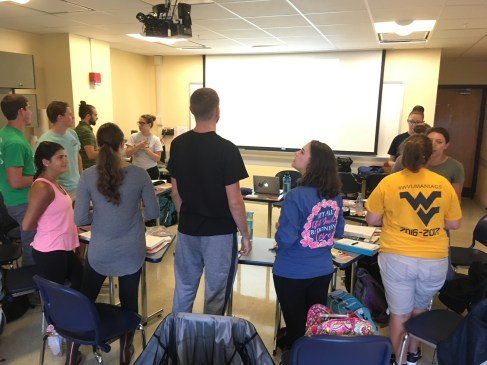
We make time for talk in my college classroom every day

Reasons like these are why I make talk a priority in my classroom every day. In such a digital world, it’s not as easy to get kids making noise as it used to be. Where early in my teaching career I had to work to settle down a chatty room, now I have to exhort myself to hear the sweet sounds of uncertain arguments and not the click of a quickly-locked iPhone.

Like all other skills we want our students to master, thoughtful speaking and listening is something we must teach. Rather than being frustrated by our students’ silence, we need strategies for helping kids close their apps and open their hearts and minds to one another. Here are four of the most effective I’ve used this year:

img_2223.pngQuickwrites that make us vulnerable – Getting to the heart of our wonders and fears and hopes and dreams in our writer’s notebooks builds community, sets a precedent for the type of writing we’ll be doing, and gets down on paper what’s really important: who we are, and how hard it can be to say that definitively. Strong mentor texts that invite this vulnerability are essential–imitating Mari Andrew’s illustrations is a great place to start. Writing about our scars is another favorite early-year activity. These first pages in notebooks don’t often get shared, but they get kids to do the early scaffolding work of honest thinking that leads to honest talk.

Turn and talk and LISTEN – The “turn and talk” directive is a common one in ELA classrooms, I hope, but I kind of want to change it to “look at your partner and LISTEN.” I tell students before a turn and talk that we’ll be sharing what we hear, so the purpose shifts from drafting their thinking through talk to expanding their understanding through listening. After the chatter has subsided, I ask students, “Who heard something great? Share with us what you learned from your partner.” This is a subtle shift, but one that cues students to turn their ears away from their own voices and toward their peers’.

On the record strategyWritten feedback is amazing, but if I’ve learned anything from doing a million reading and writing conferences over the years, it’s that the power of talking with someone about your thinking is incredible. For this reason, when I ask students to conduct peer writing conferences, I ask them to record themselves. Using apps on their phones, kids begin this practice by simply talking about the student’s writing they’re reading, but gradually progress to leaving one another specific, recorded feedback to be replayed at home. While “on the record,” I find that students become much more deliberate, thoughtful, and thorough in their feedback by simply slowing down their thinking.

Silent discussion – An early mentor of mine used this strategy to scaffold his students up to sophisticated Socratic seminars, and I still love using it. Students bring in a written response to a question, or a draft of a piece we’re working on, or a favorite quote from their independent reading book they want to mine. We hang these nameless papers all around the classroom, then kids get their earbuds, a stack of post-its, and a pen and progress into a silent discussion. The classroom is magically quiet–almost sacred. This is my favorite part.

First, they circle the classroom, writing lengthy responses to their peers’ thinking on large post-its. Each student receives two responses this way. Then, we do a counter-clockwise circle with small post-its where more feedback is offered in the form of short remarks or questions. Each paper receives three additional comments in this round. The following day, I redistribute the papers to their original writers and watch students drink up the feedback, which is made all the more valuable because it didn’t come from me.


I hope these four strategies for student talk make your classroom a little more conversation-friendly this week. Please share with us how you get your teens talking in the comments, on Facebook, or via Twitter!

Shana Karnes is mom to 1.5 spunky little girls and wife to a sleepy surgical resident.  She teaches practicing and preservice English teachers at West Virginia University and is fueled by coffee, no-bake cocoa oatmeal cookies (this week), and a real obsession with all things reading and writing.  Follow Shana on Twitter at @litreader or read more of her writing on the WVCTE Best Practices blog.

Alternatives to Reading Logs

c5e2590b7277d0516b78e67e6021b540Ahhh, Labor Day weekend–that first glorious three-day respite from back to school, or the last vestiges of freedom before it begins.  Whatever this weekend is for you, I hope you’re using it to relax and recharge before we see bright, smiling faces (or sleepy ones) tomorrow.
I bet you’re using a book or two to help you enjoy this weekend–what are you reading?  I’m reading little bits of Bill Bryson’s The Mother Tongue whenever I can squeeze it in (usually as I fall asleep).  In longer chunks, I’m reading Scaachi Koul’s memoir, One Day We’ll All Be Dead and None of This Will Matter, which is a perfectly-sized series of essays for my busy days.

In quiet moments on long weekends like these, I wonder what our students are doing.  Do their reading lives mirror mine?  If the answer is no…what can I do to help them become readers?

And, more pressingly–is there something I’m doing that’s preventing them from becoming readers?

Reading homework, requirements, levels; book reports, assignments, due dates.  None of these are what I’m tying to the books I’m reading this weekend.

But is that true for our students?

This article from School Library Journal talks about the work done by librarians to match a person to a book.  They call it readers’ advisory.  Then, they lament that so many classrooms discourage the important work of “talking with a child, observing body language for clues, and walking together through the stacks while offering suggestions” and rely on leveled bins, assigned texts, or assessment-bound reading units to get kids to read.

How much of what goes on in my classroom is readers’ advisory–and how much damages that work?

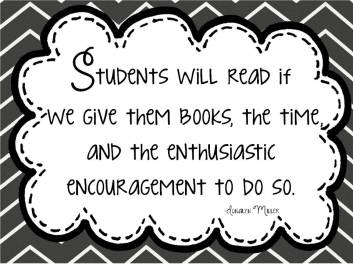
Slide2I’ve been thinking since last May about how we should stop grading independent reading.  The best and brightest in our teacher hive give us their advice and wisdom in books, blogs, and articles, with quotes like this one from Donalyn Miller.  Books, time, encouragement–these are themes we see repeated in what students need to blossom as independent readers.  Nowhere do we see that we need to measure, assess, or grade them.

 

To be sure, our kids need our instruction and guidance to grow as real readers.  Conferences, follow-up activities, book clubs, goal-setting, talk, and self-assessment are powerful tools to help move students forward.  How can we prioritize those things instead of more measurable (and infinitely less revealing, rewarding, or authentic) methods like reading logs, records, and quizzes?

Well, we really want to know.

Please share with us:  what are your alternatives to reading logs?  How do you approach a gradebook that must be filled, and fill it with meaningful activities tied to reading?


Screen Shot 2017-09-04 at 7.15.11 AM


In that Google Doc, we’ll work to compile a series of alternatives to reading logs, and share them here for everyone to benefit from.  You can also leave a comment on this post, write on our Facebook page, or tweet to us.  Together, we can create a repository of ideas and strategies for approaching independent reading in a way that’s authentic and helpful this school year.

Shana Karnes is mom to 1.5 spunky little girls and wife to a sleepy surgical resident.  She teaches practicing and preservice English teachers at West Virginia University and is fueled by coffee, chocolate (this week), and a real obsession with all things reading and writing.  Follow Shana on Twitter at @litreader or read more of her writing on the WVCTE Best Practices blog.

A Reader’s Manifesto

After a hectic summer of being well behind my fellow Book Love Book Club readers, I finally finished Kylene Beers and Bob Probst’s latest book, Disrupting Thinking.

giphy.gif

Yay for me!

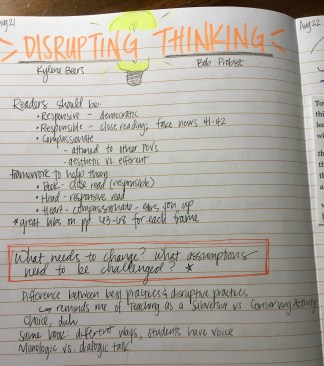
Its ideas had been disrupting my thinking since page one.  I loved its premise, which centered around two questions the authors returned to again and again–what needs to change?  And in order to make those changes, what assumptions need to be challenged?

These questions are as good an acid test for our teaching as Louise Rosenblatt’s 1956 article of the same name.  Too much of education today rests on the status quo.  To disrupt that status quo, “good teaching sometimes feels like a rebellion,” as Penny Kittle wrote in our book club chat this summer.

img_1952

Sharon’s slide on transactional reading

Rebelling has always come naturally to me in teaching.  It’s no different now that I teach at the college level, but I’m lucky to have many like-minded peers to work alongside at WVU.

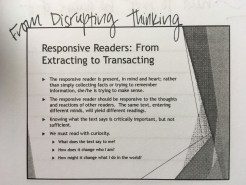
In our collaborative planning meeting last week, my friend Sharon shared her thinking about a different kind of reading and writing she really wanted our preservice teachers doing–the work of transacting.

448bf2b22af9be31dbc183a082a3f9fb.jpg

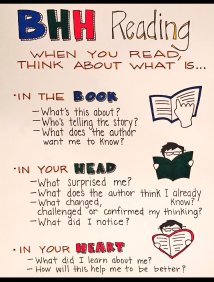
The BHH framework from Disrupting Thinking

“It’s from a book I read this summer,” she explained, and I exclaimed, “Yes!  I read it too!  I was just wondering how we could bring Book, Head, Heart into our weekly readings!”

Our students are proficient readers and writers, and it’s easy to assume that they don’t “need” a technique like BHH to help them interact with a text.  But to me, helping students of all skill levels become responsible, responsive, compassionate readers is the point of teaching reading.  Who cares about comprehension without understanding?  What’s the point of decoding if we don’t connect to the ink on the page?

Sometimes my college students forget that reading is more than a means to an end.  During my whole reading of Disrupting Thinking, I wondered how I could remind them about the aesthetic rather than the efferent purposes of reading from Rosenblatt’s transactional theory.

Because the truth is, the book, head, heart framework–or the aesthetic stance, or helping readers become responsible, responsive, and compassionate, or whatever you’d like to call it–is more than a guideline for students just learning to be strong readers.  It’s a manifesto for all readers.

img_1951

My notebook jots on the book

We’ve gotten away from teaching kids WHY we read and focus too often on simply HOW to read.

And that’s the problem–how to read is too simple a standard.  Yes, learning how to read is difficult.  Teaching kids how to read is hard, too.  But how to read, like so many standards we must adhere to, can be measured.  There’s a formula, an algorithm, a process:  first you decode, then you do the mental work of meaning-making, and sometimes in there you need some fix-up strategies to help you scaffold the story into your schema.  Just employ all those buzzwords and voila!  You’re a reader!

But when I shirk a pile of grading on a Sunday afternoon to finish a book, it’s not because I’m all about practicing my phonemic awareness.  And I didn’t spend an hour googling “Hurricane Harvey” at 4:00 this morning because I wanted to try out my word recognition skills, either.

Our highest standard is to help our students become real readers and writers.

It’s a standard that’s difficult to measure, but so are all of our most important, difficult goals–and it’s scary to teach all day, all week, all year, and feel like you can’t prove on paper that you’re making a difference.  The fear that we might be asked to offer evidence of our effectiveness might be what keeps teachers teaching novels and prevents them from teaching readers.  It might be why teachers persist in teaching essays instead of teaching writers.

Any good self-assessment will give you all the data in the world about how important and effective your instruction is, so if that’s what you need, again I say voila.  But if you’re searching for a way to make reading meaningful and engaging for your students, check out Disrupting Thinking, the book-head-heart framework, and their roots in Louise Rosenblatt’s work.  You’ll find a reader’s manifesto that truly shows you that why we read matters most–at every level, in every grade, across every content area.

How will you frame reading in your classroom this year?  Please share your strategies and ideas for helping students become engaged, authentic readers in the comments, on our Facebook page, or on Twitter!

Shana Karnes is mom to 1.5 spunky little girls and wife to a somehow-energetic surgical resident.  She teaches practicing and preservice English teachers at West Virginia University and is fueled by coffee, sugar, and a real obsession with all things reading and writing.  Follow Shana on Twitter at @litreader or read more of her writing on the WVCTE Best Practices blog.

First Days of School: Listening Leads to Learning

‘Tis the season of back to school–that time of year that is ripe with fresh school supplies, empty notebooks, and an as-yet-un-ransacked classroom library.  This time of year always delights me, and I got to experience it early because today marks week two of having students for me.  I hope you’re one of the lucky ones who hasn’t seen students yet, but if not, cheers to being back already!

Untitled presentationI’ve been thinking carefully about what tone I’d like to set in the first days of school.  I didn’t want to leap into things with a review of the syllabus, a distribution of the many forms my preservice teachers will need to fill out, or a review of the big tests that loom large for them at the end of this school year.

I wanted to start with something, instead, that would build our community into one of support and anticipation, rather than one of anxiety and pressure.

Naturally, we began with writing.  I asked students to brainstorm four questions they’d like every teacher to be able to answer.  We spent some time in our writer’s notebooks writing, then paired off to ask one another a few of our questions.

img_1627

After a few minutes of talk, which is always invaluable, I asked students this question to elicit some sharing:

Who heard a good response they’d like to share?

Students began their replies with, “I loved what Sara said,” or “I thought Sean made a great point,” or “Jake had an interesting answer.”  As many of our responses touched on the importance of building communities that were inclusive, we noted how simply shifting the way we shared responses to focus on listening rather than talking emphasized the former.

As we moved through our day, I returned again and again to this theme:  we selected critical friends to partner with who would read our work and provide feedback; we read an article about student-faculty partnerships before setting professional development goals we’d work toward in teams; we set up a Google Drive folder to encourage collaboration and negotiated feedback protocols and submission guidelines; we did some yoga to encourage the notion of disequilibrium and read an excerpt from Pose, Wobble, Flow about being teacher-writers.

My first day of school thinking around listening hearkens back to my work with the C3WP Institute I led through NWP this summer, which is focused on argument writing and how we can encourage students to consume, create, and negotiate real-world arguments more skillfully.

It also reminds me of a passage I read about compassionate readers in Disrupting Thinking this morning (a book I refer to as Interrupting Thinking, thanks to a certain 16-month-old in my life):

Compassion should sharpen the readers’ ability to see other points of view, other perspectives, and to imagine the feelings of those who hold them.  It should enable readers to take, if only momentarily, the perspective of someone else and thus understand motivations and thinking.

But to be willing to take on another’s perspective…you must be willing to enter into a dialogue with the text, to interact and not merely extract.  And through these transactions with texts, we might learn how to better enter into conversations with those in the real world who offer us another perspective.   (45-46, emphasis mine)

AAEAAQAAAAAAAAUQAAAAJDI2MTU1ZjY0LTdhNzgtNDdjNy04MmZiLTc4ZmNjY2YzMTczZQ.pngFar too much of the reading, writing, speaking, and listening that our students do is for the purpose of extraction, and not interaction.  Of course it is–what can be extracted is easier to measure than what can be inferred, experienced, or connected with.  We’ve taught students to read in order to answer a question; to listen in order to reply.

As a result, in our schools and in our self- and social media-saturated society, our students are all too practiced at speaking, and out of practice at listening.  If we want our students to learn, to engage with texts and peers and the world in a more authentic, dialogic way, we must teach them to listen.

This year, I will ask students to more thoughtfully listen to and engage with the ideas of others.  The teachers they’re observing, the authors they’re reading, the students with whom they’re working, all have notions my students will agree and disagree with–but they will learn nothing if they don’t slow down to listen.

How will you encourage your students to learn by listening on the first days of school, and beyond?  Please share in the comments, on our Facebook page, or with us via Twitter!

Shana Karnes teaches sophomore, junior, and senior preservice teachers at West Virginia University.  She finds joy in all things learning, love, and literature as she teaches, mothers, and sings her way through life.  Follow Shana on Twitter at @litreader or read more of her writing on the WVCTE Best Practices blog.

What’s in a Notebook?

It’s that magical time of year when my writer’s notebook is almost full, and I get to start a new one.  I love setting up my notebook, personalizing it, giving it value.  But I love, nearly as much, to look back at a full notebook–and today I want to share mine with you.

I’ll preface this overload of snapshots with a caveat that my sharing is unusual in terms of the writer’s notebook.  Whether we ask our students to use these tools as playgrounds, workshops, or repositories, notebooks belong to students.  Ownership is key if our students are to take on the identities of writers.  This means that for some, a notebook is private, while for others, sharing is essential.

So, with that said, let’s take a walk through my notebook–and, so we can see many other examples, please share what your notebook is full of on Twitter with #whatsinanotebook!

First, personalization and inspiration are key.

The first few pages of my notebook always contain photos, a tracing of my hand with some goals, a heart map, or some other kind of writing territory or prompt.  Whenever I’m stumped about what to write, I return to these first few pages to remind myself of the topics I need to mine.

From there, the variety begins.

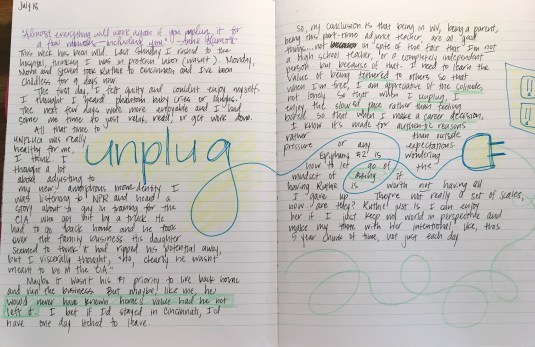
I always write beside my students, so my notebook is generally peppered with quickwrites or “write into the days” from NWP.

img_1056

These are often the roughest drafts of posts that land on TTT, like this page, which morphed into this post.  For my students, quickwrites are often seed prompts that lead to longer compositions.  Just as often, though, they remain untouched:  an essential part of building fluency and stamina and the identity of a writer with many starts and stops.

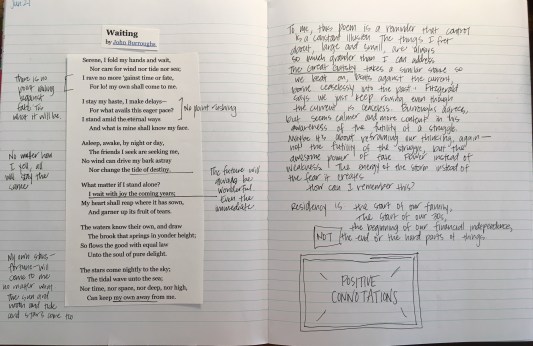
My notebook is also full of poetry that I write beside or around.

img_1058

I get my poems every day via email from the Writer’s Almanac.  In addition to just being inspiring and enjoyable to do, this active reading of poetry makes me more aware of wordplay, themes in literature and in my life, and a new perspective.

I also write in response to quotes from books, TED talks, poems, or anywhere.

img_1057

This helps me to unpack a quote that strikes me for its craft, content, or both–students, too.

Gluing in artifacts to write beside is also powerful for me.


These serve not just as reminders of who and what is important to me, but a lovely time capsule to show me what was happening in my life at the time when I return to look at my notebook in future years.

There are also things I’m attempting to make connections between, but perhaps never do…

img_1062

(This might go under “things I abandon.”)

Rants that should probably be left in the dark…

img_1065

(You can tell by my handwriting that I was ticked, here.)

Things I abandon

img_1064

Sometimes I mean to write a bit more, and never do, so I add some squiggles and doodles to fill up the white space.

It’s important to remind students that it’s okay to abandon pieces of writing…we abandon books, don’t we?

…and random doodles, drawings, and in-the-moment jots and notes.

The last spread of my notebook is always my what-to-read page…

img_1071

(I keep my lengthy read, currently reading, and TBR list on GoodReads, so this page functions more as a ThriftBooks shopping list.)

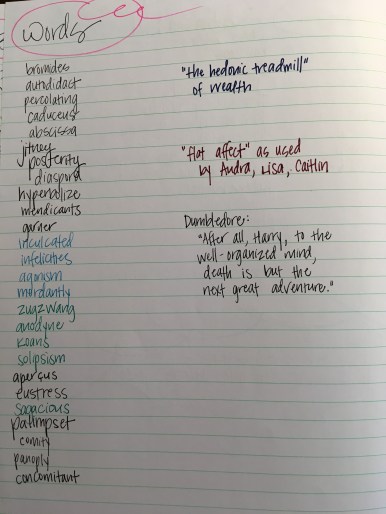
…and the very last page is always my list of words and phrases that strike me as unusual.

img_1072

I jot these as I find them in books, poetry, or conversation.  Sometimes I look up definitions of these words; sometimes I already know what they mean, but just like them.  I ask students to keep this page, and twice monthly we visit it and do something with our lists.


As you can see, there’s really no “order” to my notebook–no sections other than those crucial first and last pages–but that’s just what works for me.  I taught seniors most recently, and found that they didn’t require the structure of a multi-sectioned writer’s notebook, but when I worked with 8th graders, they most definitely needed a little guidance.

This is just a guide, an inspiration, and an invitation–to not judge me for my wonders about the woes of motherhood, my consternation about teaching topics, or my completely unhealthy obsession with expensive writing utensils (Precise V5 pens…thanks, Amy…and PaperMate Flair markers are my top picks).

Please use this to help you craft a vision for the possibilities notebooks afford in helping us build fluency, gain confidence, and take on the identity of WRITER, and feel free to reach out to any of us with questions or wonders you have about the magic of writer’s notebooks.

Share with us, please, what your notebook looks like on Twitter using #whatsinanotebook!

Shana Karnes teaches sophomore, junior, and senior preservice teachers at West Virginia University.  She finds joy in all things learning, love, and literature as she teaches, mothers, and sings her way through life.  Follow Shana on Twitter at @litreader or read more of her writing on the WVCTE Best Practices blog.