Category Archives: Shana Karnes

3 Mentor Text Mini-Lessons

I am the worst at successfully locating mentor texts when I need them (even though Amy gave me great advice on how to do so here), but I do far better at tripping over mentor texts in life and designing subsequent lessons around them.  Recently I found three mentor texts that inspired me to create mini-lessons in which my students could write beside their authors.  Their written products could be cultivated as stand-alone pieces, but because May means multigenre in my classroom, I’d envision these mini-lessons as possible genres for a longer MGP.
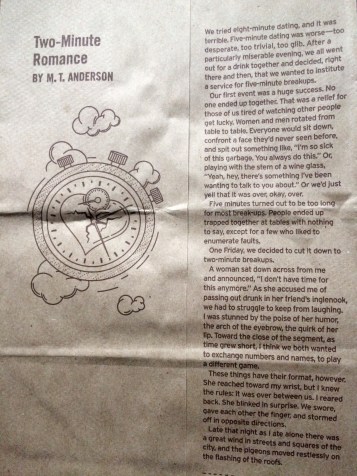
img_2531Mentor Text #1:  Microfiction on a Chipotle Bag

I love Chipotle for a variety of reasons (did you get your free burrito yesterday for Teacher Appreciation Week?), but one surprise I love encountering is whomever is published on my bag.  On my latest visit, I spied one of my favorite new authors on my heavenly-scented bag of burritos–MT Anderson.  This phenomenal author of Feed and Symphony for the City of the Dead is already a favorite in my classroom, so I know his work will go over well.

His story is a piece of microfiction, or a short short story, or flash fiction.  Whatever you call the genre, it’s a highly useful one for the multigenre research paper, which seeks to tell the story of its topic using a variety of genres.  This year, my students are focusing on their relationships to literature in their MGPs, and re-reading one of their favorite books from the year with an eye for telling the story of how they interacted with, learned from, and grew because of the text.

This piece of microfiction is, as a result, a great mentor text.  MT Anderson’s story leaps into the action without directly establishing setting, employs minimal but highly effective dialogue, and uses extremely precise diction.  These skills could easily be practiced during a quickwrite, which could then be revised into an MGP piece.
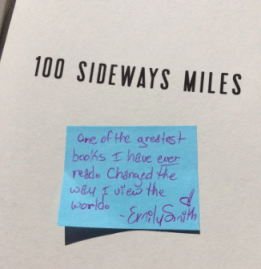
Screen Shot 2016-05-04 at 7.39.17 AMMentor Text #2:  Annotations in Books

Billy Collins’ great poem “Marginalia” has always been one of my favorites, and I thought it’d be a wonderful genre for this year’s MGP.  On a re-read, there’s plenty to say in the margins, plenty to preview on the inside cover, and plenty to exclaim about after the afterword.  For the project, I asked students to purchase their own copies of their favorite books they’d read this year so they could marginalia the heck out of them.

The creation of marginalia could be done, in part, in two separate class periods–one day for the preview note at the beginning, and one day for the review note at the end, with the remaining marginalia being written while the student was re-reading at home or during independent reading time.  Many of my students relish the idea of writing in books and enjoy encountering previous readers’ marginalia, so I know they’re excited to create a new text by adding to their favorite book.

img_2536While I’ve been wanting to have students try this genre for a while, I was inspired by two mentor texts I stumbled upon–a note left in Andrew Smith’s 100 Sideways Miles, and the notes my students wrote in a copy of Shel Silverstein’s The Giving Tree, which they presented to me as a gift for Baby Ruth.  (Yes, it made me sob, and it wasn’t just the postpartum hormones!)

Mentor Text #3:  Biography Picture Books

With the arrival of little Ruthie, I’ve found my taste in literature skewing to a decidedly younger set of titles.  One of my favorites is a beautiful, lyrical biography of Walt img_2535Whitman. As my students work to reflect on and engage with their favorite books, I want them thinking about the books’ authors as well–and writing about them, too.  This book is a wonderful mentor text for showing how an author came to be a writer.
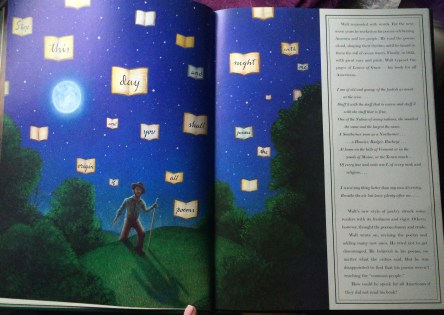
Walt Whitman, written by Barbara Kerley and illustrated by Brian Selznick, is a gorgeous text that tells the story of Walt Whitman’s upbringing and eventual discovery of his love for writing.  Kerley intersperses lines of his poetry into the story, and they’re paired with beautiful illustrations by Selznick.  My students could easily create short biographies focused on how their authors became interested in writing, then pair them with an illustration for a children’s book genre to add to their MGP.


What writing lessons have you designed after stumbling upon random mentor texts?  Please share!

Lessons from the Classroom

Last Monday, Amy posted an excellent mini-lesson about personal reading challenges.  This Monday, I can’t seem to think of any lessons other than the new ones I’ve been frantically learning for the past seven days.  Like how to function on no more than two hours of sleep at a time.  Or the dire importance of burping a child after a feeding.  Or how to swaddle the most jazzercise-obsessed infant ever.

img_2189My little Ruthie Karnes–our first child–arrived on the scene last Monday at 10:20 am, forever altering my life in the most wonderful of ways.  Somehow, my entire world (and worldview) has shifted to center around her.

When we came home from the hospital, one of the first things I caught myself talking to Ruth about was which book I’d read to her first.  I cooed this while holding her in her nursery, perusing her already-full bookshelf, but also thinking about perhaps just reading aloud one of my grown-up favorites.  Reading aloud, after all, is a daily part, and an important part, of the way I teach my seniors–why not use that same method with an infant?

It was only natural that I began to wonder what other pedagogical routines I might bring into my budding relationship with Ruth.  Over this past (hectic? insane? life-changing?) week, I’ve drawn from at least three non-negotiables from my teaching as I try to navigate my new role as a mother.

2000px-Zone_of_proximal_development.svgLesson one: hard work and fun are not mutually exclusive.  When learning is difficult, it’s incredibly engaging, provided we are capable of achieving the skill with guidance, effort, and practice.  I challenge my students regularly to take risks, attempt new skills, and make a habit of pushing themselves.  Staying in the zone of proximal development is easy when learning is individualized and students have choice about what, how, and why they engage with a lesson, as they do in a workshop classroom.

This norm of hard work isn’t rigid or meaningless, though–it’s often rather enjoyable.  My students and I are able to laugh together even while tackling a complex theme in literature, a difficult craft move in a piece of writing, or a long-term assignment.  Engagement in our work together, when it’s authentic, is rewarding in a deeply satisfying way.  I love seeing students’ pride in themselves when they complete a reflection and realize their growth.

It’s definitely been the same for me this week with motherhood–while the lessons I’m learning are tough (and sleep-depriving), it’s incredibly satisfying when I see Ruthie peacefully sleeping after a successful feeding, diaper change, and swaddle.

Lesson two:  I am a model for my learners in so many ways.  So much of a teacher’s efficacy comes from just loving our work and being ourselves.  Our passions, whether purposely modeled, like Catherine did with her reading life this year, or reluctantly modeled, like mine were when teaching multigenre last year, are what must guide our teaching.  If you ask my students to imitate me, they’ll yell (in a high-pitched voice I hope is drastically unlike my own), “I love you! I love books!”

It’s accurate.  I’m effusive.

But that works for me.  I model enthusiasm all the time–for making mistakes, for trying new things, for revision, for any kind of reading, for hard work.  I’m authentic because I have no choice but to be authentic with my students–I am a huge fangirl and I have embraced that.  My free nerdiness, constant vulnerability, and frequent showcasing of my mistakes in reading, writing, or thinking are necessary to allowing my students to feel comfortable doing those things too.

Now I’m learning that it’s the same with motherhood.  I’m effusive, but also fairly calm.  It takes a lot to ruffle me, and it’s already apparent that Ruth is that way too.  She’ll sleep through anything (except hunger) and will stare calmly at whoever is holding her for as long as she can without passing out.  I know that as she gets older and learns skills of communication and literacy, the way my husband and I model those things will be integral to her development of those skills, too.

Lesson three:  use your resources.  Teaching can be incredibly solitary.  It’s easy to forget to leave your classroom to interact with other adults, or to engage in professional development, or to seek help from other practitioners.  But it’s when we seek to learn from others that we achieve growth, whether through the modern PLC, self-selected learning, or just reading pedagogical texts.  There are so many resources available for the curious, motivated educator–so we don’t have to be lonely.

“With a room full of authors to help us, teaching writing doesn’t have to be so lonely.” -Katie Wood Ray

We all have room to grow, and seeking help from others is the easiest and most effective way to do that.  I know that I wouldn’t have made it through this week if it weren’t for my mom, who’s staying with me until I figure this whole parenting thing out.  I asked friends and family and even students alike for help with whatever I knew they were good at, whether it was simply getting heavy things out of cabinets or teaching me how to feed a baby in a way that worked for me.

IMG_2273The biggest lesson I’ve learned this week, though, is that much like any school year, it’s all worth it.  The hard work and tears and sleep deprivation and laughter and constant conferring and feedback and trying to find missing library books all adds up into something beautiful–a community of real readers and writers who will leave my classroom with (I hope) a love of literacy and all that entails.  And it’s the same for motherhood–when I see Baby Ruth and her sweet smile (I know it’s not real yet, but it’s still really cute), I somehow don’t care about all the chaos that my life has become.  I just know that I’ll keep trying to grow–as a teacher and a mom.
Mini-Lesson Monday: Reading Challenges

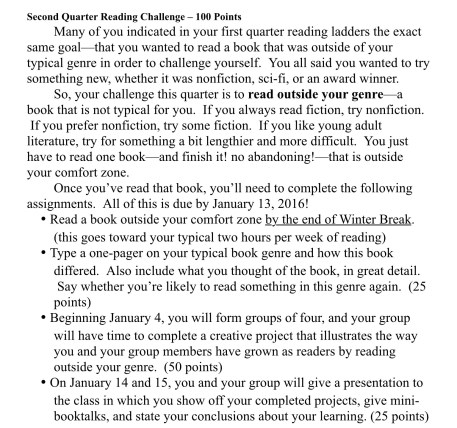
On Friday, I shared Jak’s reading challenge essay about Patricia McCormick’s Cut.  Today I want to share how I framed the assignment that led to his writing such a piece.

Objective:  Using the language of the Depth of Knowledge Levels, students will assess their current reading comfort zone, compare their reading of their challenge book to their typical reading experience, and analyze in writing both kinds of reading.

img_0342Lesson:  With their first quarter reading ladders on hand, I’ll ask students to reflect on their goals from that ladder with their tablemates.  I expect that each table will arrive at the consensus that they wanted to challenge themselves in terms of genre or text difficulty.

With that goal in mind, I’ll booktalk several titles and explain how they might serve as challenge books–Chris Lynch’s Inexcusable might challenge a reader in terms of its topic (rape); Anthony Doerr’s All the Light We Cannot See might challenge a reader in terms of its length, multiple points of view, or vocabulary; or Bill Bryson’s A Walk in the Woods might challenge a reader in terms of its genre (nonfiction).  I’ll continue to booktalk potential challenge books throughout the quarter.

For the remainder of today’s lesson, though, I’ll ask students to hone in on what they’d like to learn as a reader in order to achieve growth through their challenge books.  In writer’s notebooks, students will list the skills they’d like to acquire, using their tablemates to help them brainstorm.  We’ll develop a shared list on the board to help give further inspiration, and students will try to find a book that might offer many of those skills (vocabulary acquisition, a new genre, organization, etc.) through booktalks, their own searches, or recommendations of friends.

Follow-Up:  Once students have selected their challenge book and completed it, they will complete three follow-up activities (listed on the handout).  Students will write a one-pager describing their reading of the text, work with a group to reflect on their growth as readers, and then present their learning, mini-booktalks, and a creative project that represents both.

How do you summatively assess your students’ reading growth?

Reading Challenges for Growth, Connection, and Reflection

My students complete a reading ladder at the end of each quarter, during which they reflect on their reading from that nine weeks, write about the texts they read, and set goals for the following quarter.  When I read first quarter’s reading ladders, almost every student said one of their goals was to challenge themselves either with a book in a new genre or a more difficult length/writing style/topic.

So, I challenged them formally during second quarter to read a book outside their comfort zone, then write an essay that showed me that process.  I love Jak’s essay about his chosen challenge book–Cut by Patricia McCormick.  While this text is short and not full of especially difficult vocabulary, it challenged him because of its topic–self-harm and depression.  His essay is full of voice, text evidence, and text-to-self connections.  It’s a strong piece of writing that helped Jak reflect on his reading of this book, and is just one of many authentic alternatives to a traditional method of reading assessment.


img_1999

“A Challenging Cut” by Jak McMillen

Ready, Tropics? 1, 2, 3! LET’S GET TROPI—actually, let’s get dark for a moment. Let’s talk about Patricia McCormick’s Cut, a challenging and rough look into the mind of a depressed teen named Callie. Cue synopsis mode! To get into this mindset, Callie cuts herself. Never too deep, never enough to die, but just enough to feel the pain. Because she cuts, she’s been placed in Sea Pines, a treatment facility where everyone has a problem in one way or another. The only problem with Callie here is that she doesn’t speak, and for the most part refuses to throughout the book. Okay, synopsis mode over.

Now, Karnes, I’m assuming you have grown tired of the banter and have asked, “Well, how does this challenge you?” I’ll answer that shortly. In my essay earlier typed this year Of Mice and Misery, I cited one particular moment of my life that still affects me to this day, that of which being my father’s unfortunate passing. Now, my shell opens up more through this essay to share some of the past that I hold back.

Throughout my schooling years, I’ve found myself growing more and more tired of everyday tasks, even so far as just waking up and dressing myself. I could even use yesterday as an example: I had already felt like nothing more than dust the night before, which carried over to the next day. After coming back from MTEC the feeling was still there and unexplained, just as Callie’s feelings through the first parts of Cut. For me this is a culmination of years upon years of dark and harrowing thoughts of self-harm, and unfortunately at some points, even thoughts of suicide. Over the years of therapy some of these thoughts are still here. Now… I know that you probably didn’t want, nor did you need, to read that information, but I had to be relatable somehow, right?

41jIgmsYB+LAfter breaking her silence to her therapist, in their time between pages 122-125, Callie exposes her scars and tells what she uses. At one point in this segment, she says “Guess I’ll never wear a strapless ball gown,” from which I related in my own thoughts as feeling like I would never be good enough. Callie’s thoughts—as well as my own, but not in the book of course—were at most unexplained until later in the text. Cut took a vast amount of effort to read, and for this I praise McCormick for putting the amount of effort she did into writing this title.
When I read this title, it hit very close to home, and still does. I guess that’s why it’s such a challenge for me to read. Also, for the love of all that is holy, please do not take this as a cry for help or a sob story. I’ve moved on mostly and do not need any more sympathy than I’ve already received. Do know that it is much appreciated though! In closing I would like to say something Callie said once: “I may not want to get rid of my scars. They tell a story.”


How do you encourage your students to make personal connections to their reading?

#3TTWorkshop — Assessing Student Work in a Workshop Classroom

What does assessment look like in a workshop classroom?  #3TTWorkshop Meme

Amy:  Interestingly, I just saw a tweet by @triciabarvia yesterday that said “Growth, when ss do something better than they did before (as a result of assignment/lesson, that’s success.” In away that’s really what assessment should be, right? We should be noting growth and improvement, and celebrating successes. I think we forget this sometimes, especially in regard to what we view as assessments and students call grades. Too often we overlook the learning and focus on the 78 or the C+. (That is all most of my students focus on.)

Assessment in my classroom drives my students crazy. I think they feel like I am that elusive balloon they cannot pin down and pop. Poor darlings. I refuse to give in to the grades routine. I want to see improvement. I want to see them take the skill I know I’ve taught and then apply it — better yet, go beyond and do something clever with it. So to answer the question, “What does assessment look like?” is kind of tricky. I think too often teachers spend time assessing student work in ways that is not meaningful. We can waste a lot of time.

But if we’d plan a little differently and make assessment a natural and moving part of our learning journey, we would save time scoring work and enjoy talking to our students more. At least that is always my goal.

In my classroom, assessment takes the shape of written work:  play in notebooks or on notecards, exit slip quickwrites, and sticky note conferences, plus, of course, major writing tasks with formal and informal conferences and oral and written feedback. Assessment also shapes itself into lots of student self-evaluation: “Look at the instructions, the model, the expectations, did you meet them, why or why not?”

If I didn’t have to take grades I wouldn’t, but I assess everything all the time.

Shana:  I go back and forth when it comes to how I value process vs. product vs. what Tom Romano always called “good faith effort.”  There are students who have mastered skills important for reading and writing, but who haven’t fully committed in terms of being vulnerable and trying to advance their skills.  Then there are those students who explore powerful themes and show amazing growth in their abilities, but still can’t spell or use commas to save their lives.

Because I wrestle so frequently with this dilemma, I end up grading not on where each student is at in relationship to our academic content standards, nor on where each student is at in relation to their peers, but rather how far they’ve come since the start of the unit/school year/week.  And I do this by doing what Kelly Gallagher does– “a lot of fake grades.”  🙂

Amy: Me, too!

How do you design assessments?

Shana:  I used a lot of scantrons my first year of teaching.  Those kinds of assessments were pretty easy to make, if time consuming–long, multiple-choice tasks that were topped off by a few essays.  After a year or two of fighting with the scantron machine and my conscience when I noticed that oftentimes a kid’s essay was much stronger than his multiple choice section (or vice versa), I threw tests out the window.  I haven’t given a test in five years.

Now, I focus on designing assessments that are as unique as the units we work through.  A unit of study revolving around the exploration of complex themes cannot be assessed, well enough, in my opinion, using a multiple choice test.  So instead of trying to gauge a student’s interaction with Macbeth that way, I use Socratic Seminars.  Or projects.  Or reflections.  Or presentations.

Amy:  Yeah, I tossed out the multiple choice tests at the same time I introduced choice-independent reading. Even the shorter texts we read together as a class are worthy of much more than a scan tran. Harkness discussions and writing about our thinking allow students room to stretch a bit and show us what they really know.

I design assessments by thinking through my end game. Of course, teaching AP Lang means I must prepare my students for that exam each spring. I know my students have to write convincing arguments, synthesize sources into their arguments, deconstruction other writer’s arguments, and read critically — sometimes some pretty old texts. To design assessments means to start there and then work backwards into the instruction.

For example, I know my students must be able to synthesize sources into their arguments. So I may decide on a couple assessments — say a Socratic Seminar where students discuss three related texts. They must come to the discussion armed with questions, annotated texts, and join the conversation. Then, I may challenge students to find three more texts related somehow to the first three. Now, we move into writing an argument in which they must synthesize at least three of the texts. That essay becomes another important assessment because all along the way I’ve taught mini-lessons:  academic research via databases, proper citation, embedding quotes, transitions between paragraphs, interesting leads, combining sentences, etc.

Everything I teach as a mini-lessons gets a matching mini-assessment somewhere along the line to learning. By the time I read those synthesis essays I have a pretty good idea of which of my students understands and can apply each of those skills. I’ve conferred with them and retaught as necessary, and when I read that final paper I rarely have any surprises.

I think maybe one of the reasons I love a workshop pedagogy so much is because of the grading. It is just not the same as it was when I taught in a traditional model — it is better!


Do you have topic ideas you would like us to discuss? Please leave your requests here.


Choice as the Keystone in Secondary English Classes

In a readers and writers workshop, everything comes back to choice.

Have you seen the movie You’ve Got Mail?  If so, you’ll recall the scene where Tom Hanks is giving Meg Ryan business advice.  “The Godfather is the answer to any question. ‘What should I pack for summer vacation?’ ‘Leave the gun, take the cannoli.’ ‘What day is it?’ ‘Maunday, Tuesday, Thursday, Wednesday.'”

It’s the same with choice.  “How will I know they’re reading if I haven’t read the book?”  They’ll be engaged, authentically, because they’ve chosen their books.  “How will I get them to want to revise their writing?”  They’ll want to strengthen the writing about topics and in genres they’ve chosen.  “How can I assess them if they’re all reading different books?”  You offer choice in ways for students to show their mastery–reflections, conferences, blogs, and more.

Choice is the keystone.img_1957

We have written about choice here and here and here.  It crops up again and again in our writing, thinking, and talking.

And we’re excited to talk more about choice with you all this Saturday, April 2, during The Educator Collaborative’s annual Gathering.  This amazing, free, inspiring day is the perfect way to spend a spring Saturday, as it will leave you energized, rejuvenated, and brimming with ideas.  It’s the modern PLC at its best, and the perfect way to help you finish the school year strong.

Tune in at 1:00 EST as we discuss choice as the keystone in English instruction.  We’ll share:

  • Research to support choice in literacy education
  • Strategies for teaching independent vs. small group vs. whole-class novels
  • Why conferring is at the heart of workshop
  • Writer’s workshop non-negotiables and the use of skills learned from independent reading

Please let us know in the comments, via Twitter (@amyrass or @litreader), or on our Facebook page what questions you have about choice as the keystone in secondary English classes.  We’ll be happy to answer them Saturday, and we can’t wait to see you there!

Poetic Mini-Lessons from Real-Life Mentors

img_1792

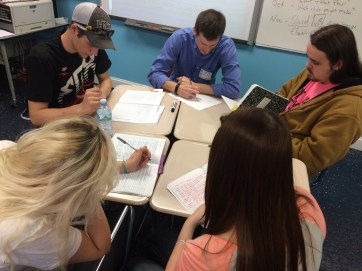
Fiction writer Emily works with Tyler, Logan, and Willy to discuss a poem.

If your town is a university town, like mine is, there are guaranteed to be some amazing writing mentors right under your nose.  Have you taken advantage of them?

Our university’s MFA program offers courses in writing poetry, fiction, and nonfiction, and I was lucky enough to connect with these fine folks through the Bolton Writing Workshops, which were a fantastic challenge for me to participate in.  And my students were lucky enough that several of the program’s MFA students were willing to come into our classroom and write beside them.

Our writers came to visit one of my least-poetically-inclined classes, bearing many mentor texts, three poem prompts, and two revision exercises.  They wrote beside my students and their seriousness inspired earnest effort from my kiddoes–I was so impressed.  Rarely have I seen fourth period so calm, engaged, or thoughtful.  Their method consisted of three steps–read, write, revise.

img_1791

Nonfiction writer Whit works with Dylan, Scott, Mariana, and Hailey to analyze a poem.

Read poetry.  The Bolton writers brought over 20 poems for my students to study.  A pro read the poem aloud, my students following along on their own copies at their desks.  We absorbed the language, the tone, the emotions of the poem.  The Bolton poets asked questions like:

  • “Why is the poem called this?”
  • “Do you believe this speaker?”
  • “Did you like this poem?  Why?”
  • “How many characters do we see in this poem?”
  • “What do we think of this (image, line)?”

Their language was important to me, as it created a community of writers by using the word “we,” focused on responsiveness to the poems rather than the extraction of meaning, and encouraged a variety of responses.  My students engaged with this kind of talk fully–I loved the quiet murmurings I heard as teens worked to construct meaning and understand these poems.

We read closely a variety of poems that did what we wanted to try–prose poems like “Instructions on How to Cry” by Julio Cortazar, or free verse like “The Instruction Manual” by John Ashbery, for a poem about instructions on how to do something.  Then we wrote.

img_1876

Logan’s poem about how to hunt

Write poetry.  Next came the writing–very low stakes, line-by-line, three times.  We wrote a poem where each line corresponded to a month in the year, one from the point of view of an animal, and one list of instructions on how to do something we felt expert at.

In poems with eight to twelve lines, my students wrote about hunting, death, school, love, welding, graduation, trust, and a wide variety of other topics.  Each poetic prompt allowed for a student to write about whatever was meaningful to him or her.  I loved the lovely images they produced, no matter the topics–like Logan’s “soft brass shells” in his hunting poem.

We wrote three drafts, then revised.

img_1888

Dylan’s poem about how to weld

Revise, revise, revise.  The revision process, like the writing process, was low stakes.  The Bolton writers advised my students to:

  • “Cross out your two worst lines.”
  • “Repeat your best image or line somewhere else in the poem.”
  • “Circle a line you love so we can share it.”
  • “Think about where you might add some alliteration.”

Language was celebrated, no matter how fancy or plain.  Dylan’s use of similes, metaphors, and alliteration in his poem about welding received lots of snaps.  I believe he felt comfortable sharing it because of the authentic atmosphere the professional writers created–he knew he’d be taken seriously, and his words were met with thoughtful  responses from both the Bolton poets and his fellow students.

The two-day workshop was a fantastic reminder of how simple it is to celebrate poetry in any classroom, within any timeframe, as part of any unit.  Simply read beautiful poetry, try your hand at a few drafts, then revise as much as you need to.  I loved participating in this workshop and watching my students blossom, acting and thinking and talking like serious poets.

Have you brought any writers into your classroom or school?  Please share how it went in the comments!

Books That Gave Me The Feels

I’m a big fan of all kinds of reading–sweep-me-away books, books that are dense and time-consuming, mysteries that puzzle me when I’m trying to fall asleep, books that break my heart, and more.

I think the teenage version of that whole entire category is “the feels.”

Books that are powerful, that grip us and force us to grapple with them, are what “the feels” are all about.  This is what I hope my students read for the rest of their days–far beyond the measly month or so they have left of high school.  I’m heartened by Emma’s recommendation list below–her blend of mystery, YA, and nonfiction that just rips at her heartstrings–because I know she’s already discovering books that give her the feels, and I hope she’ll continue doing so beyond our classroom.

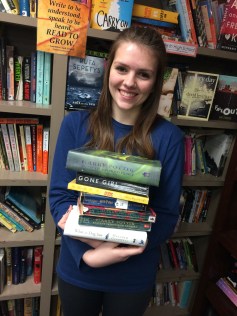
img_1549-1Emma’s Top 10 List: Books That Gave Me The Feels
  1. Stolen by Lucy Christopher – 

This book is crazy good. It has the most twisted and unexpected plot line in the history of books. With kidnappers then romance it is just freaky good. It would keep basically any reader captivated. A mixture of romance and just plain old creepiness.

  1. Gone Girl by Gillian Flynn –

I love weird creepy things and this book is exactly that. It is an amazing mystery with a heart dropping twist that left me feeling sick to my stomach. If you are a disturbed human being like myself, this is a must read.

  1. 13 Reasons Why by Jay Asher –

The overall idea of this book is sort of hard to wrap your head around. Suicide is a sensitive subject and this book makes it very real, almost as if you are living through the events. It is an interesting way of telling the story.

  1.  The Hunger Games by Suzanne Collins –

Though cliché, this series is very good, and perfect for my list because it pulls out a lot of emotions. All the action and loss and real world situations that are incorporated make it a very good read.

  1. If I Stay by Gayle Forman –

very emotional book that weighs life and death. It is an interesting way of telling a romance story while keeping the reader on their toes the whole time for fear that it might end forever.51clOkezoKL._SX329_BO1,204,203,200_

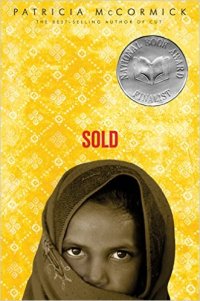
  1. Sold by Patricia McCormick –

More than anything this book is written beautifully, but the story is also very touching. The real life of a poor girl who gets put in situations out of her control is truly touching. It is a very easy read but very worth is because it is so touching.

  1. The Lovely Bones by Alice Sebold –

This book is good because it is told from the point of view of Susie, a girl who was murdered. It’s a cool way of an outsider point of view to the family who is struggling with their daughter’s death.

  1. The Fault in Our Stars by John Green –

On the more romantic side of my feels, this book ripped my heart out, along with every female heart in America. Illnesses are no joke and this book displayed the worst of circumstances, losing the one you love. It was a difficult book to read without crying.300x300

  1. Mere Christianity by C.S. Lewis –

On the complete opposite spectrum of any book genre. This book gives my Spiritual feels a tug. This isn’t a story with mystery or romance, it is just real life, telling you straight up how it is and I don’t know about you, but I’m a mess and when that is brought to my attention, the emotions start flowing. Plus, C.S. Lewis is a beast.

  1. 50 Shades of Grey by E.L. James 

I’ll start by apologizing for adding this book to my list but I don’t read many books so I don’t really have a choice. But hey, if awkwardness doesn’t give you the feels, what does? I can say with certainty that this novel will make you feel some type of way. Whether it’s good or bad, that’s up to you to decide.

“Plus, C.S. Lewis is a beast.” Don’t you just love that?!

What books give you and your students the feels?  Share in the comments!

YA Fiction That’s Funny and Full of Voice

After millions of snow days, my student teacher, Mike, and I are finally wrapping up our Siddhartha self-reflection unit and jumping into a new writing unit I’m really excited about–comedy!  We’ll study satire, sketch comedy, stand-up, commentary, and monologues for mentor texts, then work with our students to craft strong comedy writings that exemplify the skills of pacing, payoff, “punch-up,” and one other skill that I think is the most important:

Voice.

Writing voice, for me, is where humor, sarcasm, and personality come alive in a piece of writing.  “Voice,” Tom Romano writes, “is the writer’s presence on the page.”  Voice is the most elusive quality of writing to teach, I think, because it’s not really quantifiable and cannot be duplicated or imitated.  Each writer must craft his own authentic voice.

img_1738

Brainstorming the bare bones of a comedy unit

While discussing the very bare bones of our comedy unit, we brainstormed mentor texts, seed prompts, and writing skills.  After we hammered those out, Mike wondered about which books to booktalk for the unit.  “Nonfiction comedy is easy,” he said.  “Bossypants, Yes Please, Confederacy of Dunces.  But I’m not sure what to booktalk for fiction.”

“But YA fiction is so hilarious!” I exclaimed.  I started rattling off narrators who cracked me up.  Their writing voices were the perfect mentor texts for our students, who’d be focusing on crafting a humorous writing voice over the course of the unit.

“Looks like I know what I’ll be brushing up on for my weekend reading,” Mike remarked.  So here, in part, is a list of what I recommended to him–YA fiction that’s funny and full of voice.

The Absolutely True Diary of a Part-Time Indian by Sherman Alexie — This novel, paired with illustrations by the narrator, is loosely based on Alexie’s own upbringing somewhere between two identities–his poor Indian self who lives on the rez, and his striving-to-succeed “white” self who attends a better school up the road.  It’s infused with Alexie’s signature wry humor even against a pretty dark plot backdrop.

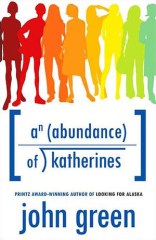
49750An Abundance of Katherines by John Green — This is, to me, the funniest of Green’s novels, although all of his narrators are pretty hilarious.  Colin Singleton has dated 19 girls named Katherine, and has been dumped by all of them.  If that’s not funny enough as it is, Colin is trying to write a mathematical formula for relationships and likes to find anagrams in random places.
The Disreputable History of Frankie Landau-Banks by e. lockhart — For me, Frankie is the female version of James Dean in Rebel Without a Cause.  Determined to subvert the male-dominated traditions at her private school, Frankie gets into all kinds of mischief, and I loved her headstrong voice.

American Born Chinese by Gene Luen Yang — This excellent graphic novel pairs multiple storylines, all of which are made hilarious primarily through dialogue and stylistic choices in Yang’s illustrations.  From antagonists so dumb they’re funny to Yang’s monkey alter ego, this is a humorous look at growing up different in America.

Anna and the French Kiss by Stephanie Perkins — I identified so much with the quirky narrator of this novel.  Forced to change schools right before her senior year, Anna is self-deprecating, sarcastic, and delightfully bewildered when she moves to the International School of Paris.  There’s also a great cast of hilarious supporting characters here.

Dumplin’ by Julie Murphy — I just loved Willowdean, the narrator of this terrific, important novel.  Most of her snide comments are made through internal monologues, but her interactions with her mom through dialogue are also quite funny, too.  Like Part-Time Indian, there are some heavier themes, but all in all I smiled throughout most of this book.

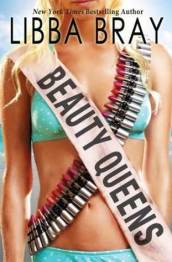
9464733Beauty Queens by Libba Bray — An all-girls’ Lord of the Flies, this book was fantastic for a variety of reasons.  The colorful cast of alternating narrators means there’s someone every reader can identify with, the interactions between those characters are often ridiculous and hysterical, and interwoven with it all is a series of broadcasts from a corrupt third party who are so evil it’s funny.
Noggin by John Corey Whaley — I finally read this book after it was stolen from my library countless times, and it’s hilarious from page one.  The story of a boy whose head is transplanted onto another teen’s body after he dies of cancer, Travis’ tale is at turns heartbreaking and hilarious as he tries to navigate the world five years after he last left it.  A fantastic series of supporting characters elevated the humor in this book for me, too.

Me and Earl and the Dying Girl by Jesse Andrews — For me, this was a more realistic version of The Fault in Our Stars.  I found Greg’s writing voice engaging and entertaining right away, and it made me read this book in one sitting.  His frequent addresses to the reader combined with his hilarious interactions with his friend Earl made Greg a favorite narrator of mine, and makes me eager for Jesse Andrews to write some more books!

Winger by Andrew Smith — All of Andrew Smith’s writings are hilarious at times, but for me Winger was the funniest.  Ryan Dean West is a scrappy fifteen-year-old making his way through freshman year at a private school, and his escapades with his rugby teammates, his crush, and his teachers made for a lot of laughs–up until I completely broke down in sobs for the last 30 pages or so of the book.  Still, Ryan Dean’s voice was so great that I couldn’t wait to devour this book’s sequel, Stand-Off.

What are some of the best-voiced YA books you’ve read that have cracked you up?  Please share in the comments!

Mini-Lesson Monday: Storyboarding to Organize Writing

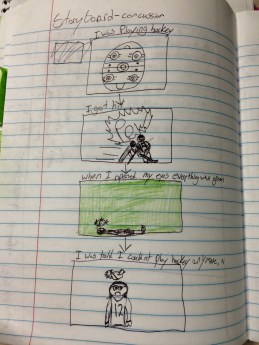
For me, narrative is central to all reading and writing.  I can find story anywhere–poetry, nonfiction, even a science report–so it’s no surprise that I teach about storyboarding a lot, both in the context of reading and writing instruction.  My students storyboard what’s happening in their independent reading novels, map out what they’ll present about through storyboards, and organize their writing using them too.

Objective:  Using the language of the Depth of Knowledge Levels, students will organize the plot structure of their own narratives; create a map of their story structure, and differentiate between pacing speeds in scenes mapped out.  Or, from the Common Core, students will use a variety of techniques to sequence events so that they build on one another to create a coherent whole and build toward a particular tone and outcome.

img_1530-1

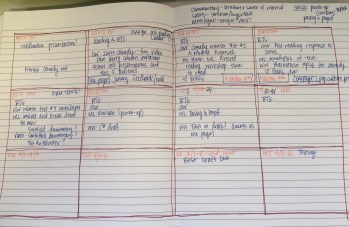
Mitchell’s narrative storyboard is reminiscent of lessons from Tom Newkirk’s Boys & Literacy class

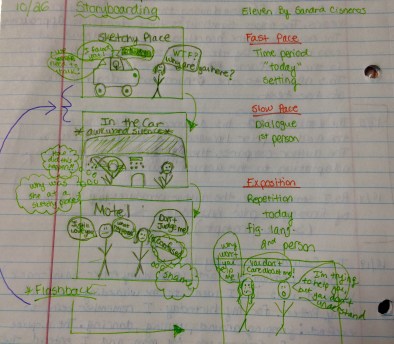
Lesson:  Prior to this lesson, students will already have selected a narrative topic and talked it out, at least generally, with their peers.  They will be ready to create a start-to-finish storyboard for the structure of their narrative.  We will also have studied “Eleven” by Sandra Cisneros to review pacing, and how to slow down and speed up scenes.

I’ll begin by modeling on the whiteboard for students.  “So, in my narrative, I want to tell the story of this pregnancy.  I want it to be kind of funny, so I’m going to focus most of my scenes on the funny parts–my husband’s and parents’ reactions when I told them, and my own reaction to figuring it out.

“So where should I begin my narrative, do you think?” I ask.

“Probably with suspecting you were pregnant,” a student chimes in.

“Yep.”  I draw a box on the board, and draw stick-figure me at my desk at school, question marks over my head, pondering whether I could be pregnant.

“Then where do I go?”

“Finding out you are for sure,” another kid says.

img_1531-1

Carleen’s narrative storyboard shows her addition of a flashback after partner conferencing.

“Yep.”  I draw another box next to my first one, using a directional arrow to connect them.  We go on in this vein until my storyboard is nearly complete, adding a flashback to previous disappointing pregnancy test results, and swapping the location of a scene.  Then I turn the students loose to draw their own storyboards in their notebooks.

Follow-Up:  After students have drawn their completed storyboards, I’ll ask them to find a partner to tell their story.  Often, this is where hiccups and gaps in the narrative structure are revealed–this second-draft talk.  Students will make revisions to their storyboards, and during workshop time we’ll begin writing actual scenes out in prose format.

In our next mini-lesson, we’ll choose which scenes to slow down and which to speed up, and work on various techniques to control pace.

How do you use storyboarding in your classroom?  Do you have any resources for storyboarding digitally?  Please share in the comments.