Category Archives: Writers

What Will You Read Next?

I’m always on the lookout for ways to keep moving my readers forward. To stave off the lethargy that unrelenting mid-forties temperatures and 17 weeks of gray skies (winter makes me hyperbolic) can leave in a classroom. The novelty of a new year, with its resolutions and fresh semester, has succumb to the bleak midwinter pall of third quarter and we need something that says, “If that groundhog claims six more weeks of winter (rat-face that he is), we’re going to need a plan…and a good book or two.”

Well, thank goodness I have an unhealthy addiction to Twitter (Ummm…Cornelius Minor just started following me last night. I’m going to need to step up my game. Significantly).  Years ago, it was Pinterest, but that was back when I had time to scroll and save ‘Best Brunch Recipes to Feed a Hangry Crowd’ and ’19 Ways to Burn Booty Fat’ (not to say I couldn’t still use both).

My scrolling these days, however, is far more literary in focus and professional in nature (19 Ways to Burn Booty Fat for Educators – Conferring as Cardio). Seriously though, Twitter has led me to countless quick write topics, mentor text ideas, blogs to follow, inspirational quotes, professional development opportunities, booklists, laughs, collegial exchanges, and pedagogical articles to stretch my practice. #TrachersWin, #LoveToLearn, #StrongThumbs, #TwitterScrollingSavesLives.

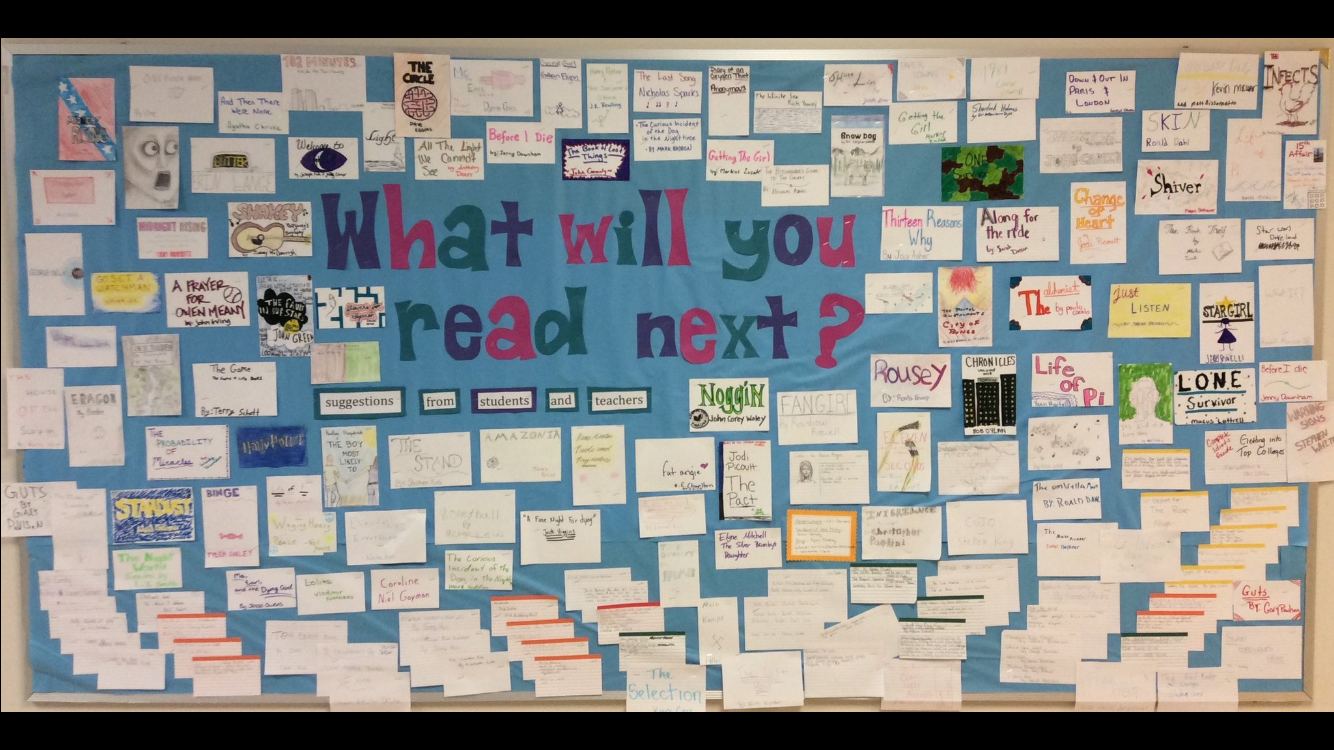
A few days back, Penny Kittle posted this photo:

I quickly screenshotted the image to replicate in my room. This visual reminder of where we’re headed (another book and/or a swing toward spring) will provide the push forward we need. Get it on the wall!

My students needed something to set their sights on, so I asked them to take a look at their ‘I Want to Read List’ and choose what their next reading would be. This wouldn’t just be a goal to finish our current texts, but would also give us something to look forward to.

I encouraged students to take this as an opportunity to challenge themselves outside what they have been consistently reading, either in complexity or genre, and select a book they were excited to get their hands on.

Each student then took an index card, on which went the name of the book, the author, and the date they plan to start this next text.


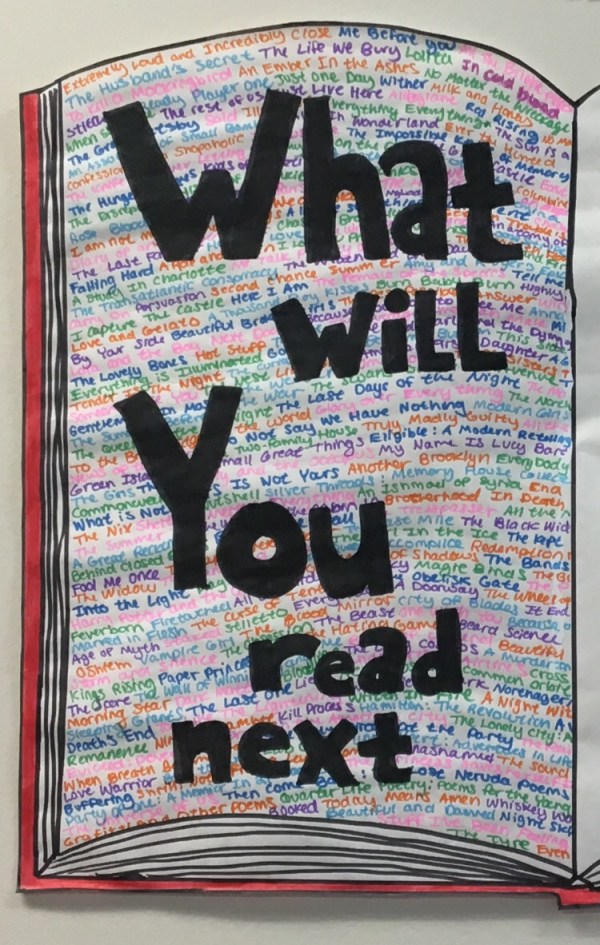
My aide, an artistic genius, drew the book that would be the center our our display (It even has dozens of book titles written on the first page – I LOVE it, Hailey!) and started arranging the ‘Next Text’ cards around it. The whole back wall of my classroom is going to be a sea of texts we can look forward to.

I’m loving my current read (Shout Out: #3TTTBookClub – Jodi Picoult’s Small Great Things), but I too will be adding a card: In Cold Blood by Truman Capote.

(A freak and serious arrest of my artistic development in the second grade prevents me from sharing my card with you. Please imagine it’s simplistic beauty and that might help me create something wall worthy)


Let’s Get Excited About Where We Are Heading! What Will You Read Next? Please leave your text choices in the comments below. Happy Friday. 


Lisa Dennis spends her school days teaching AP Language and Honors/Pre-AP Sophomores, while also leading the fearless English department at Franklin High School, just outside Milwaukee, Wisconsin where she lives with her husband Nick, daughter Ellie, and beagle Scout.  She is a firm believer that a youthful spirit, a kind heart, a big smile, and a good book can ease most of life’s more troublesome quarrels. Follow Lisa on Twitter @LDennibaum.

AP English and Choice Reading

Last week Lisa inspired me with a post she called Books Can’t Be Bullied. Her last line:

“Let’s produce millions of resilient readers, hungry for truth, who will open books and listen, because a book is always ready to talk, and frankly, we could all stand to listen a lot more than we do.”

Then, a friend and colleague of mine wrote a post on her blog about the importance of choice in her AP Literature class, a topic near and dear to my own AP English heart. (I’ve written about choice in AP and how I feel about AP test scores quite a lot.)

And I knew I would share Amber’s testament to readers-writers workshop in AP English. She builds resilient readers, hungry for the truth, who open books and listen.

In this world of fake news and clickbait sharing, we might all want to evaluate how we can provide more opportunities for our students, at every level, to take more ownership of their learning and grow as resilient readers who are hungry for the truth.

Let’s stop saying choice does not work in AP English. It does. And it’s the students’ voices that prove it the most.

Here’s an excerpt from Amber’s post. I especially love the student comments:

. . .

I am currently in my fifth year of teaching AP Lit., and I feel confident that the feedback I have received supports the idea that choice and Advanced Placement courses are not mutually exclusive; in fact, choice might just be essential to our students’ future as readers. Not only have my AP scores supported this (I taught the class of 2013 using full-class novels which were chosen based on how many times they were referenced on the AP exam as well as the desire to cover all of the major literary eras, and my AP scores have increased, and have remained above national averages, since I began to offer students some choice in which texts they read), but my students have also provided positive feedback about how the ability to choose what they read has provided them with more incentive to thoroughly read and explore their texts.

I should probably note that the reason I felt compelled to write this post is because recently, I heard several well-meaning, experienced teachers express genuine concern that the classics “are not being taught anymore” and that “we should make students read them because if we don’t, they won’t ever choose to read them on their own.” Yes, that’s right – I clearly heard the words “make them read…” – because yeah, that works.

Here are a few snippets from students:

  • “Being able to pick our own book to read made the class even better, because we got to choose something to read that would fit our own styles instead of being forced to read something we may not like.” –Tiffany
  • “The book I enjoyed the most…are all the ones I chose to read. I had been wanting to read 1984 for a while and I got the chance. It was so interesting to me because my favorite books to read are dystopias. I liked The Picture of Dorian Gray because it’s different form what I’m used to reading. I like the fact that it was controversial. The Nightingale just had me feeling all kinds of emotions. It was hard to put it down because it was full of suspense. Although I loved 1984, Animal Farm was not for me. I was excited to read it, but it let me down. I don’t think it was the book itself, just the fact that it was assigned with a lot of work. Also, that we had assigned chapters every week, so I couldn’t read it and enjoy it at my own pace.” -Isela
  • “By you giving us freedom, we’ve been able to produce more creative ideas and products. You have definitely helped me prepare just a little bit more for college. Thank you!” –Kara
  • “I suppose I should designate Beowulf as my least favorite book that I had been assigned to read in the duration of my high school years.  I did not despise it entirely; it simply was not very appealing.  In addition, I never completed it.  With only a handful of chapters left, it is one of the few books I have not at least forced myself to finish.  Thus, it will always be a sore spot on my conscious. For my final remarks (at least my final mandated remarks, but I am not making any promises), I would like to state that I prioritized this class over my others even though from the grading perspective this made the least amount of sense.  I honestly felt the need to learn and not just merely make last minute memorizations.”  –Allison
  • “The book I liked best that I read for the class was Les Miserables because I liked it the best and because it was so long I cracked and got the audio book, and I enjoyed having the book read to me as I followed along even though it was a 12 1/2 hour audiobook. My all time least favorite book from my high school Englishes was Bless Me Ultima. It was plainly a boring book and the more I tried to read it the less I was interested in it. I didn’t even end up reading it, honestly. I just sat in class and listened to everyone else’s discussions and from that I got the general gist of the story and such.” –Clancy

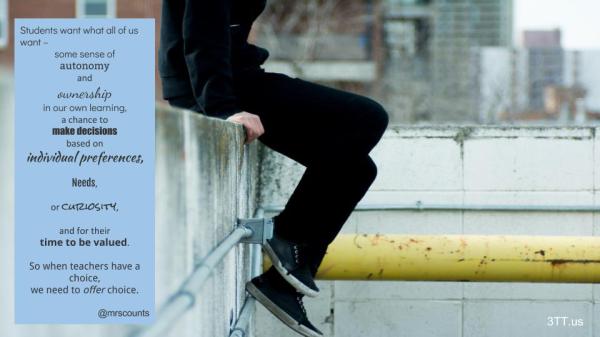
countsquote

Read Amber’s full post Choosing Readers Over Texts with the whole of her students comments. You’ll get it.

What are you thinking? Please let me know in the comments.

Amy Rasmussen lives in north Texas and teaches AP English Language and English 3 to the Fighting Farmers at Lewisville High School. She adheres to the words of Emerson: “We aim above the mark to hit the mark,” and Jesus Christ: “Love one another.” Imagine a world if we all love more than we think we can. Follow Amy on Twitter @amyrass.


Books Can’t Be Bullied

Books: “They don’t get tired and give in, they don’t rearrange their words to soothe their reader’s ego or get a better position on the shelf, and they can’t be bullied”  – Josh Corman for Book Riot.

I’m not going to get political here. I promise.

I’m quite frankly exhausted by, though no less involved in, politics these past few weeks, but when I saw this quote, I knew I needed to explore it. It does (fair warning) come from a pretty politically charged piece that you can seek out and read, if you like, but I first saw this quote completely out of context and feel that it’s a powerful statement in and of itself.

The push and pull of it intrigues me.

I first pictured a book: proud, immovable, and cool. Spine bent ever so slightly, tantalizing a reader with the ideas inside, like the love interest in a dark romance who reads Goethe in tiny coffee shops and spells color with a “u”:

I’ve got what you need, but I’m in charge here. We go at my pace. Turn my pages to see where I will lead you. You aren’t the first and you won’t be the last. 

Aloof in the face of need, careful not to promise too much. If you come to this book looking for fulfillment, it won’t permit you to find it. Too easy. It’s not about you. It’s about the message.

I can also see this book as a soldier on the front lines, battling to retain pride in its themes. Beat down by two star Amazon reviews, milk spilled across its pages, and the misrepresentation of translation, reprinting, and censorship. Not desperate, but insistent:

See me. See what I really am. What I have to offer. I am not what you purport me to be. I am not what others say I am. Think. Judge for yourself. 

But what does any of this mean for our classrooms?

For my students, It means we are going to write about it. I want to know what they think. What identity this quote suggests books have, and thereby what role in our lives? What impact?

See, in an age that not so subtly suggests that books are made better by individual interpretation, I would argue we sometimes give ourselves too much credit.

I might go so far as to suggest that we need books to be a bit immovable these days.

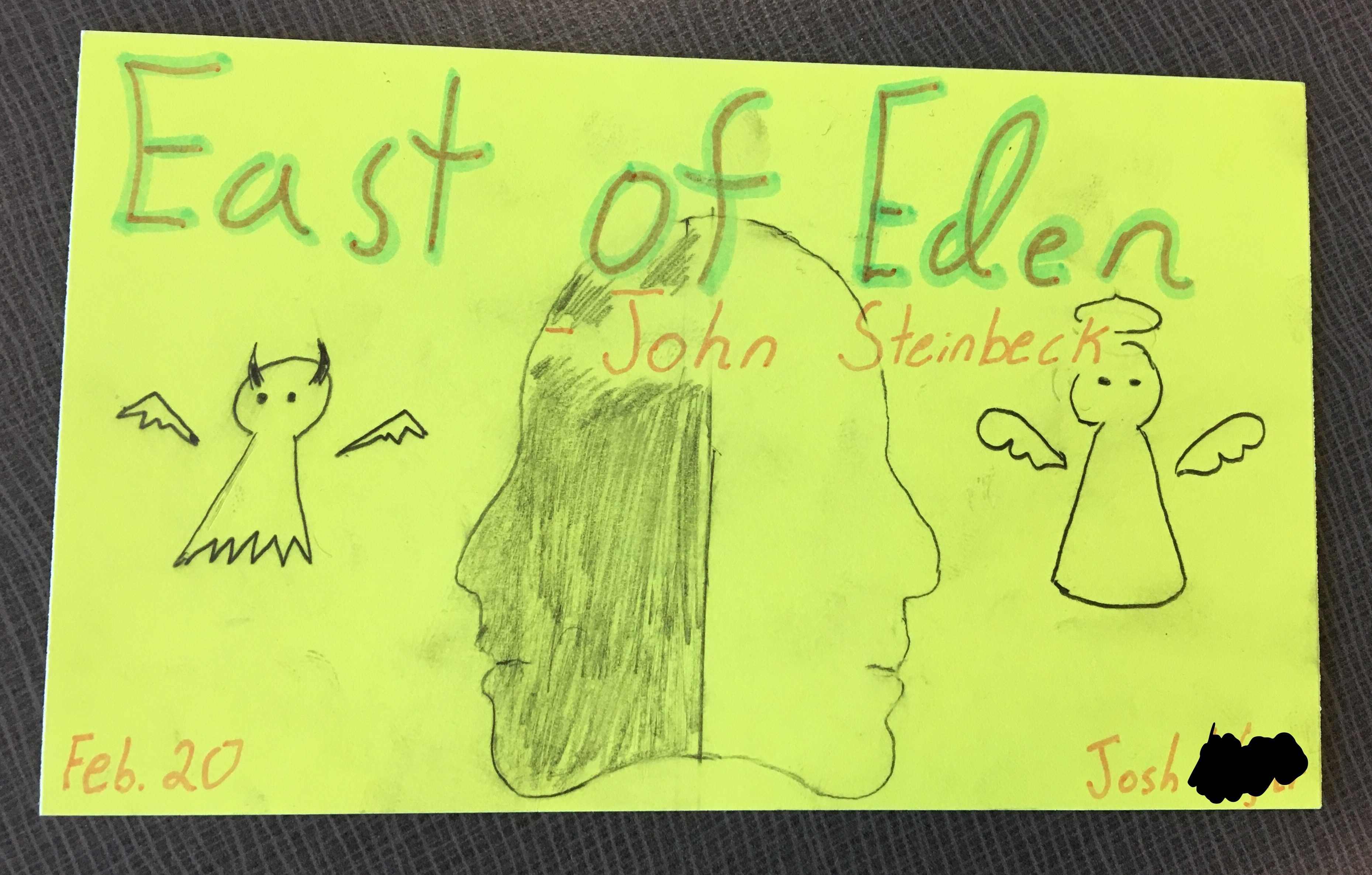
It’s not all about us. What we like. What we need. What we get out of an experience.  Of course, authors need to make money to keep writing books, but on the back of my copy of East of Eden, Steinbeck is casually smoking a cigarette and weaving a tale of good and evil. Is there really so much room for interpretation there? Should there be?

Yes, we, and our students, benefit immensely from challenging conventional thought and learning to build meaning from difficult texts through personal connection, but at the end of that journey, the book remains. The nuance may be up for debate, but the message, perhaps not.

Books offer us a place to see that which does not grow old. The words are pressed between the pages, meaning what they did when they were published. It is we who change and must work to balance how perception influences theme.

Tweets scroll past in soundbites on the screen. Facebook spins and updates with a thousand new ideas with every pull of a thumb. Books remain what they always have been. They cannot be bullied to change with the times. They are timeless, and as such, essential to our survival in the era of eight second attention spans.

So as we bring ourselves to a text, we must be willing to meet it halfway.

It’s not about you, or not only about you.  It’s about the two of us. Book and reader. We can only succeed if we work at this together. 

What better lesson for these times, political or no, than to meet in the middle and align our unchangeable past with the possibilities that carefully crafted ideas can suggest for our future? A book, afterall, still needs a reader.

Let’s produce millions of resilient readers, hungry for truth, who will open books and listen, because a book is always ready to talk, and frankly, we could all stand to listen a lot more than we do.

I’d love to hear your reflection on the quote. Please feel free to join the discussion below in the comments. 

Lisa Dennis spends her school days teaching AP Language and Honors/Pre-AP Sophomores, while also leading the fearless English department at Franklin High School, just outside Milwaukee, Wisconsin where she lives with her husband Nick, daughter Ellie, and beagle Scout. She is a firm believer that a youthful spirit, a kind heart, a big smile, and a good book can ease most of life’s more troublesome quarrels. Follow Lisa on Twitter @LDennibaum.


How to Make 28 Teens Feel Special Immediately and Simultaneously: Or How I Manage Conference Notes

One of the most difficult parts of setting up a workshop was figuring out how to use and organize notes.  Those videos that show elementary school teachers walking around at leisure, seeming to write a paragraph on each child?  Not even possible, not even under the best circumstances.

img_20170110_165650101-1

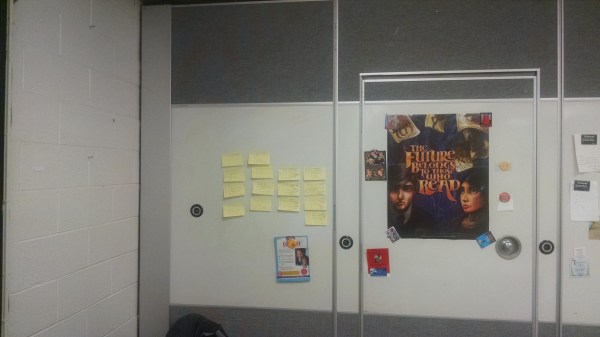
Wall space can also be temporary storage for conference notes and for giving you a “status of the class” picture of student progress.

What follows is a step-by-step guide to How I Workshop.

  • Figure out what you, as a teacher, are out to accomplish.  Are you trying to do a quick check in with each student, or are you going to do extensive work with 2-3 kids?  You need both kinds of conferring styles, I’d argue, but you also know which mode you are using, when, and why.
  • Write down 1-2 words in conference, add notes later if you need to.  When I sweep and chat to each student, as I did today, I’ll scribble in a few more notes after class if I need to.  
  • Notice patterns.  I like using my post-it notes to “snapshot” where students as a whole are and where I need to teach something the following day, especially if I find myself repeating myself over and over again in conferences.
  • Diagnose and select students for extended follow up.  If I notice that a student is working on an issue that involves more conversation, I’ll prioritize them for the next day.
  • Save and document information.  I can pop these post-it notes into a plan book.

How do you manage your conference notes?

Amy Estersohn is a middle school English teacher in New York.  She never met a Post-It Note she didn’t like. 


Light Bulb Moments: Igniting Students Interest in Their Own Learning

What is it you love about teaching? I have a few favorites.

More than anything I love to see the light bulb moments. You know what I mean — you see them, too. The thinking becomes almost visible like a thought bubble above a student’s head, then the thought spins a cartwheel, lands on both feet, and ignites some insightful murmur.

“Ohhh, I get it,” sighs the student.

I long for these moments.

I get them with my students, sure, but lately it’s teachers who have warmed my heart as they’ve come to embrace the philosophies of readers-writers workshop.

In December, I facilitated a workshop training in a district in my home state of TX. A little while later, I exchanged some messages with Candice Thibodeaux, an English department manager and English III teacher in Clear Creek ISD who attended that training. I asked if I could share her comments (although I am late in doing so) because I think they may speak to many of our readers who are new to implementing the moves of workshop in their classrooms.

Candice:  I wanted to say once again that it was a pleasure to meet you. I think why it was so easy to hear your message is because there was no doubt you understood where we were because you are in the same trenches we are each day. I was already convinced that I wanted to move my department to the workshop method, but you cleared up some fuzzies and gave me a lot of confidence. I feel like I am in the infancy stages of implementing it, but you have me so excited. I am worried I may not implement my thematic idea well, but I am going to jump in and take note of what works and what doesn’t. I feel it has the possibility to ignite the students interest in their own learning.

Me:  Your ideas for the thematic units are fantastic, and I think you will be so pleased with the responses you get from your students. And once your teachers see the kind of engagement and work your students produce, they will be more apt to want to join in the thinking and planning for workshop. Remember to be patient with yourself. There are just a few things that really matter: choice, time to read and time to write, lots of talk around books and writing, talking to kids one on one about all of it. I know we focus on the standards a lot in Texas, but really, good reading and writing requires skills that are reciprocal — and practice is what matters most.

Candice:  Thanks so much for the response! I am so anxious to get back to school because I

candiceclassroom

Ready for student talk. Candice’s new classroom set up invites collaboration.

did a whole lot over the break that will be so much fun to put into action. I changed my room so we can do group work easier. I cataloged all of my classroom library so students can check out online. I bought more books (which hubby was thrilled about and a little blown away as he helped me catalog almost 1,000 books, lol) and I created a quick PD for my teachers tomorrow based on my time with you and the reading I have done. I am very excited to see if I can light a fire with my teachers. My department is on board but for the most part is still very unsure what it all looks like.

Candice:  The themes I picked [for my units] are war, race relations, technology, self image, and a catch all of society issues (depression, teen pregnancy, drug use, crime, violence). I expect to get a lot of discussion, reading, and writing out of all that; plus, students will do their own video PSA and print ad. I am very excited and have written letters to parents reminding them about free choice reading and telling them about thematic units, and encouraging them to discuss what their child is reading/writing/thinking. So we shall see….

Oh, yes, you shall see! You’ll see more reading, more writing, more engagement, and tons of learning — for students and for you as their teacher.
That’s another thing I love about teaching:  I learn with my students. We share our thinking as readers and writers in my workshop classroom. I am not the sage on the stage, nor the keeper of the knowledge. We all are. We are all discovering the world through the texts we read, and writing about our world through the texts we write.
Last week Jessica wrote Readers-Writers Workshop: But, Does It Work? and Lisa wrote Looking to the Future: Students as Changemakers. Both address the needs of the students who sit in our classrooms every single day.
Candice is like them, and her light bulb moments moved me at that workshop training back in December. She is like many other teachers who know her students need more. And I cannot wait to hear how her thematic units go as she shares her love of all things literacy with her students. (Hey, Candice, are you ready to write that guest post yet?)
lisadennisquote

photo by Jayden Yoon

If you have ideas for articles, poems, videos, or more Candice might be able to pair with other texts in her units, please add your ideas in the comments. (Oh, there’s an idea for some pretty cool collaborative text sets. I’m gonna have to think about that.)


Amy Rasmussen lives in north Texas and teaches AP English Language and English 3 to the Fighting Farmers at Lewisville High School. She adheres to the words of Emerson: “We aim above the mark to hit the mark,” and Jesus Christ: “Love one another.” Imagine a world if we all love more than we think we can. Follow Amy on Twitter @amyrass.


Down and Dirty Diction

My AP Language and Composition students have been waist deep, nay, armpit deep in literary analysis these past few weeks. Of the three types of essays my AP’ers will write, this is always the one that gives them the most trouble. Students are asked to read a piece of prose and then write an essay in which they analyze how the rhetorical strategies the author uses help to achieve his/her purpose.

Though students are familiar with literary analysis, they are often most familiar with analysis that gets at the “what” as opposed to the “how.” I explain to them that deep literary analysis involves what the author is trying to achieve with the writing, as opposed to only what the content itself suggests.

Once we get into it, students often have a lot to say, but lack the developed analysis skills to artfully communicate what they’re seeing. We work to expand and deepen the analysis with specifics.

Early in our study of analysis, we utilize two key acronyms to hone our craft study. DIDLS (which makes everyone giggle) and SOAPS.

c41e726a-d680-42af-8ee2-2b620a58134e

Amelia provides suggestions to a peer on diction analysis of an AP practice essay

Students can use analysis of Subject, Occasion, Audience, Purpose, and Speaker to provide context to their essays and justify the purpose sandwiched in the middle of this acronym. Then, in terms of which rhetorical strategies we can analyze that achieve that purpose, we jump into Diction, Imagery, Details, Language (as in figurative), and Syntax. Our discussions focus on adding the elements together to comment on, for example, how diction contributes to imagery, pathos is built through details, or how various elements create an overall tone for the piece.

Of all the DIDLS (mmwahahahah) components, however, diction is the one that students struggle with year after year. Case in point, a claim about diction submitted on a post-it note after our first look (without direction from me) at diction:

The author uses diction to achieve his purpose.
Ok…You’ve zeroed in on one element. Good. But you are telling me the author uses words. I’m not sure that’s exactly the specificity the AP readers are looking for.

To combat (or encourage, if you are feeling friendlier) such insight, I’ve developed several components to diction study.

  1. Detail with students what their options are. They need to be specific in relating how the diction is used, so we start with something basic like fill in the blank.

    The author uses __________ diction in order to ____________. 

  2. Then, they need the tools to fill in that first blank. I provide a list of terms that could be used to describe diction. We define a few they are curious about, discuss some they are already familiar with, and then choose several to brainstorm around.

    Nostalgic might be used when the author wants to fondly remember the past. 
    Patriotic would be found in political speeches or Fourth of July gatherings. 

  3. I then have students practice focusing their own writing using these words. During quick writes, students choose a specific type of diction and purpose, then set off to match the two in a quick piece on a topic of their choosing.

    Technical diction to write about a process for downloading an app. 
    Curt diction to decline an invitation to prom with a jerkface.

  4.  Next up, my students are going to be analyzing some actual AP prompts specifically for diction and for homework, locating an editorial they can analyze for the same purpose. We’ll be doing quick 1 minute speeches that consist of analysis of the editorials purpose and specific words used to achieve it.

Other practice comes from analysis of diction in their independent novels, some work with Nancy Dean’s Voice Lessons on diction, and quick table discussions around taking famous lines with specific diction and changing that diction to completely change the connotation or meaning of the selection.

It was the laziest of times, it was the craziest of times. (A modern diction twist to reflect senioritis in the classroom).

4a5d56bd-793a-4db7-9f20-ea3d5972ba37

Amanda provides feedback to a peer on her AP Analysis practice 

All in all, students are swimming in words and I love it.

It’s how this happens: 

The author uses diction to achieve his purpose.
Ok…you are telling me the author uses words…
The author uses colloquial diction to achieve his purpose.
Better…the specificity of the diction gets you closer, but why use that type of diction?
The author uses colloquial diction to talk with his son about sex.
Interesting. Why would the author want to do that? 
The author of this passage, a father who wants to connect with his teenage son, uses colloquial diction to try and ease the awkward nature of a conversation about sex. Not surprisingly, this attempt to be super hip backfires when his son realizes this false “cool” is not at all hip, let alone effective.
Boom!

How do you help students explore an author’s use of diction? Please share some ideas in the comments below! 


Lisa Dennis spends her school days teaching AP Language and Honors/Pre-AP Sophomores, while also leading the fearless English department at Franklin High School, just outside Milwaukee, Wisconsin where she lives with her husband Nick, daughter Ellie, and beagle Scout.  She is a firm believer that a youthful spirit, a kind heart, a big smile, and a good book can ease most of life’s more troublesome quarrels. Follow Lisa on Twitter @LDennibaum.


Readers-Writers Workshop: But, Does It Work? by Jessica Paxson

1444217.pngThere are many things that are frustrating about teaching in general, and teaching SENIORS.  They are almost adults who think they are already adults, and say they want to be treated as such, but show that they want to be treated like a child for just a little while longer.

Me too, guys.  Adulting is HARD.

This makes for quite a few venting sessions during our PLC time.  A few days ago, a fellow teacher was venting about our Shakespeare unit.  She and another colleague noticed that the feedback from walkthroughs seemed to be nudging us more toward skill teaching rather than teaching whole works, especially in Shakespeare.  She then began to vent about college readiness.  They will HAVE TO read whole works in college.  If they’ve never read anything cover to cover, they will never survive in college!

Obviously I began to feel my Reading/Writing Workshop senses going off.  They’re much like Spidey Senses, but possibly even more dangerous.  These topics are often thin ice with teachers, and if you stomp too firmly into the conversation, you’ll break right through and be left to freeze on your own in the frigid pool of, WHAT DO YOU MEAN YOU DON’T WANT TO TEACH SHAKESPEARE?  In an effort to be heard and not misunderstood, I gingerly began to ask questions.

  • But will they need to have read THESE works, specifically?
  • Do you think non-liberal arts majors will encounter an entire work of Shakespeare during their time in college?
  • Do you think what they need to know is the stories of Shakespeare, or how to parse difficult language in general?

Then, finally, quietly, with the shaky hands I often get when I’m about to make something dear to me vulnerable to scrutiny, I asked: Have you ever read Book Love by Penny Kittle?

I’m surprised how many issues have come up this year during PLC to which the best solution would be, emphatically, give them choice on what they read; write more than you can grade; give them choice on what they can write; start where they are and gradually encourage more challenge and nuance.

I thought it would be helpful to write about some of the most Frequently Asked Questions I’ve received about RWW, even with less than a year under my belt of these practices.  Here they are, in no particular order:

  • How do you make sure your students are reading challenging books?
  • How do you test their knowledge?
  • What if they lose your books?
  • What do you mean, use mentor texts?  Are you talking about your Creative Writing class?
  • How do you grade if they all do different stuff?
  • Why are you making this so hard on yourself?

I have to tell you, I don’t know a definitive answer to all these questions.  By no stretch of the imagination have I perfected Reading/Writing Workshop.  (If you have, I’d love to borrow your brain for a day or five.)  

What I do know, is that it works.  

Don’t other things work, too?  Maybe, but it depends on your goal.  If the goal is for students to know facts about the plot of a handful of works, and know how to fill in a graphic organizer, sure.  


Now, if only I could figure out how to answer questions on the spot, we might be in business!

Jessica Paxson is an English IV and Creative Writing teacher in Arlington, TX. She also attempts to grapple with life and all of its complexities and hilarities over at www.jessicajordana.com. Follow her on Twitter or Instagram @jessjordana.

Looking to the Future: Students as Changemakers

As teachers, we have a unique opportunity, and I would say responsibility, to see our students not only as the beautiful (challenging, curious, and occasionally perplexing) people they are, but also as the adults we want them to be: consumers of information, thoughtful citizens, empathetic neighbors, considerate collaborators, creative problem solvers, and kindhearted souls.

Specifically as English teachers and workshop practitioners, we lay a foundation for these futures with classrooms rooted in a sincere passion for reading, writing, speaking, and listening. We advocate for our students through literacy, because their futures depend on a capacity to actively engage with the human condition.

P. David Pearson,  founding editor of the Handbook of Reading Research and professor of Language and Literacy and Human Development at the Graduate School of Education at the University of California, Berkeley, said that “a teacher’s job is always to bridge from the known to the new.” We work each day with students whose experiences, beliefs, passions, and preferences vary as widely as our own, but together we take what is fixed and challenge it to stretch, bend, and grow.

In the process, we end up with countless stories of students falling back in love with reading, challenging their opinions through talk with fellow classmates, digging into their writing to push past self imposed limits of where words and expression can take them. I shared a quote from Barbara Kingsolver with my students the other day, specifically for diction analysis, but probably more importantly for talk:

“Art is the antidote that can call us back from the edge of numbness, restoring the ability to feel for another.”

We discussed the far reaching definition of “art” (including literature and composition) and the suggestion in this line, art not only speaks to us, but heals us and build empathy within us. Several students throughout the day noted the need for this type of beauty in our current politically turbulent times.

“Congress should have a book club,” one student suggested.
“The whole country needs a book club,” another chimed in.
“Yeah, make them talk about feelings and stuff like Mrs. Dennis does.”
“Well,” I smiled slowly, “if they used our small group discussion rubrics for assessment, they would have to provide text evidence for their opinions, politely disagree with other members of the group and support their contrasting ideas with more evidence when necessary, and work to show leadership skills by actively engaging all members of the group. Sounds like a good place to start for all of us.”

See, even high school students know that art can be the mirror we need to lift up in order to carefully consider our actions and how those actions impact others and the community at large.

It is with this in mind that I share a few brief stories to further inspire your commitment to and passion for the work we do. Students that internalize the power of words, communication, and concentrated energy for making the world a better place become living mentor texts that we desperately need in order to motivate current students to keep pushing, keep questioning, and keep believing in their own capacity to make a difference.


Sam Kraemer was my student twice, and was the type of kid you’d like to fill your whole classroom with: thoughtful, inquisitive, charming, hard-working, funny, and smart. Having made the decision to be a newscaster in the sixth grade, Sam now finds himself as the weekend anchor for the 5:30 and 10:00 o’clock news at NewsCenter 1 in Rapid City, South Dakota, a position he was promoted to after less than a year on the job as a reporter. sam-2

Sam recently came back to school to visit and, of course I could believe the confident young man standing before me, but what struck me was the depth of understanding he already had about the role he is playing in this world. Having asked him where this passion for reporting came from, he said firmly, “the storytelling.”

samHe knows that his reporting efforts can show “the American people what is actually going on” and  that “the world is a better place when facts are clearly established and people have the right to think for themselves. I guess I just enjoy my role in presenting info & stories for people to use in that thinking process.”

How often do we all preach about the importance of clear and careful thought? And here is a young man, in an age when journalists have become a group too often mistrusted and maligned, whose believe in the power of educating the opinions of others, makes my heart swell.

Sam goes on: “A lot of people don’t have time to follow government closely, pay attention to how things happening nationally or internationally affect them, or even know about crime/incidents just down the street for them. Through ample & clear communication, I can be that trustworthy source of information. I can present the facts — not with opinion, but with context — for the viewer to consume and formulate an opinion on.”

What more could we want from our kids than for them to realize that their role in the future matters? That writing and storytelling and communication that ensues matters.

 As Sam concludes, “I know I can share relevant information that either gets people thinking or even spurs action. And that right there is how I try to make the world a better place.” (Shared with me like all of the convictions that truly make a difference in the world, via Facebook message at 3:15 a.m. Classic).

Here is one of Sam’s recent broadcasts. A piece, where as he says, that presenting both sides of an issue with national implications,  “let [his viewers] decide whose argument had more merit.” Fair and balanced news reporting? Sign me up.


Sarah Matuszak graduated from Franklin in 2012 and to say she was passionate doesn’t do her soaring spirit justice. A deep thinker with a kind heart, Sarah finds herself as a paramedic in North Dakota and recently took her “constant obsessive preoccupation with sarahthe world’s bleeding” to Standing Rock. Having worked with the United States Army, firefighting, and in law enforcement, Sarah says that “being a paramedic comes close to what sets my soul on fire, but I’ve found that activism is where I belong. I use all the skills I’ve learned from those aforementioned fields, and apply them to activism.”

Now, just as we’ve all encouraged our students to do, Sarah has taken her passion to print with an article for The Huffington Post detailing her position on and work at Standing Rock.

When she published her piece, “December 5th Is Not the End Of Standing Rock,”  Sarah posted it to Facebook and tagged me. Years ago, right before she took the AP Language test, I gave Sarah a note of encouragement, telling her that I not only knew she had no reason to be nervous for the test, I also knew I would see her writing in the New Yorker someday. Little did I know, she would keep the note all these years and dedicate her first published piece to me.

sarah-3

sarah-2

To say that Sarah is invested in the betterment of our planet, would be to shortchange the depth of her character and the depth of her commitment to humanity. Sarah was destined to take her educated opinions and make the world think about them long before she ever walked into my classroom, but the encouragement she received along the way, meant something. And just as she says, “firsthand experience makes it real,” seeing the potential of our students makes their dreams that much more real too.


Austin Bohn spent some time with me in the classroom last year. He inspired several of my students to challenge themselves, specifically Bennett Dirksmeyer. I wrote about it in a post about students inspiring students. Both young men credit our shared class IMG_0123experiences, and the books and essays they’ve read as a result, with teaching them how to think. Bennett, I’ll be writing about again in a few years when he becomes the first President of the United States to listen more than he talks, but Austin is already putting his passions to good use through writing.

His two published pieces appear on Medium, an app designed for “readers on the go.” Both selections, “New popularity for unpopular opinions…and new a responsibility for the unpopular” and “Dissonance of the Day: Is Twitterspeak Orwell’s Newspeak?” use Austin’s charismatic voice and probing curiosity to challenge readers’ thinking. In fact, I just went back and reread his piece about Twitterspeak and his insights from last January on Orwell’s 1984 are feeling eerily familiar as the novel is once again a bestseller in our age of alternative facts and fake news.


Our students listen.
Our students internalize our enthusiasm.
Our students have big dreams, and we can give them mirrors in the form of books, time to write, and safe places to develop and share their ideas, that allow them to see themselves more clearly.

If we’re lucky, they turn those mirrors around and hold them up to the world, so we can see each other more clearly too.


How do you encourage your students to be changemakers? Share some stories in the comments below of students and former students who are out there making a difference! 


Lisa Dennis spends her school days teaching AP Language and Honors/Pre-AP Sophomores, while also leading the fearless English department at Franklin High School, just outside Milwaukee, Wisconsin where she lives with her husband Nick, daughter Ellie, and beagle Scout.  She is a firm believer that a youthful spirit, a kind heart, a big smile, and a good book can ease most of life’s more troublesome quarrels. Follow Lisa on Twitter @LDennibaum.
Mini-Lesson: The Simultaneity of Instants by Jessica Paxson

I am an anti-bandwagon jumper.  I tend to think if everyone is flocking toward something, I’m likely too cool for it.  I attribute that to my father, and I’ve discussed it before, but that’s beside the point.  

18143977.jpgThis year, as I made the venture to RWW, I knew I would need to read lots of buzz-worthy books, simply for the purpose of recommending.  Needless to say, I have slowly been broken down from my rigid ways. It’s because of this anti-bandwagon mentality that I am so late to the Anthony Doerr party, particularly in respect to All the Light We Cannot See.  

I decided to tackle this novel over Christmas break because of how many people had recommended it to me.  I was reluctant, but of course, Doerr drew me in with his utterly gorgeous descriptions of difficult cultural situations, the relationships between characters, and the flawless knitting together of a nonlinear storyline.  

So.  I’m a fan.  Likely at least two years after everyone else, but better late than never, right?

I was specifically intrigued by one of the chapters near to the end, entitled, “The Simultaneity of Instants.”  This chapter reminds me a little bit of the montages that occur at the end of a movie or a season finale in which all characters come together for a final appearance.  The only difference with this chapter is that they did not come together in the same place, but simply in the same moment.  I thought this would be a great way to coach my students through describing an important moment with a bird’s eye view.  

Objective: Students will describe an important moment in their life by also providing a glimpse into that same moment for other “characters” in their story.

Mentor Text

Lesson: First, students will begin by writing about a specific moment that they remember vividly.  You could draw from many different forms of pre-writing for writing about memories, but a few of my favorites are Writing Territories and Blueprinting.  After students decide on a moment that was important to them, we will do a quick draft for about 10 minutes.  

Next, students will begin to brainstorm about what other people might have been up to at that very moment.  The key here is for students not to get hung up on what actually happened, but to simply imagine that moment in time from a broader scope.  

Finally, after brainstorming simultaneous instants, it’s time to weave them together.  This is the moment in which Doerr’s writing as a mentor text will be unequivocally valuable.  Students will ask, “Well, how do I know which moment to put where?”  And I’ll say, “What does the mentor text do?”  And on and on until we have pieces of writing of which the students never imagined they would be capable.

I hope to do this along with my students, and I’m particularly imagining a Simultaneity of Instants starting with the Presidential Inauguration, or Obama’s farewell wave, or something to that effect.  I may already be blubbering as I brainstorm.  

Follow Up:

I teach Seniors and Creative Writers.  While my CWers will work on this concept soon, I may save this for my Seniors until their end of year MGPs (anyone want to help me plan?).  I think an imaginary Simultaneity of Instants as they walk across the stage.  This will end up resembling an end-of-an-era-montage, and I can’t wait to see what they come up with!

Jessica Paxson is an English IV and Creative Writing teacher in Arlington, TX. She also attempts to grapple with life and all of its complexities and hilarities over at www.jessicajordana.com. Follow her on Twitter or Instagram @jessjordana.

Clickbate Goes to College: Challenging Readers Daily

With my daughter Ellie fast approaching the age of four (when did that happen?), we watch a fair amount of Sesame Street these days and we are working on letter sounds (“N, nah, Narwhal” makes me smile every time), so at our house, C is for cookie. However in my classroom, with the start of the new semester, I’ve been telling my students that C is for Challenge.

Choice has been at the forefront for most of the year so far, and while it’s a workshop non-negotiable I have personally seen the power of, we need to step up the challenge portion of our programming.

For some, this means simply getting through a text. Yes, workshop breeds excitement around reading and an increase in the number of students consuming books is sure to follow, but there are always holdouts (Shana has a list of books to hook those holdouts, so have at it). I have several holdouts this year. Some are too busy, some are too easily distracted, and some are too downright stubborn. As a result, their reading has stalled.

Other students are entrenched:
Dystopian novels or bust.
Jodi Picoult or nothing.
Nicholas Sparks is the only one who can speak to my soul.
John Green is my God. 
I’m allergic to nonfiction.
This book has more than 300 pages…so, yeah…that’s a no.

Now, don’t get me wrong. These kids are reading, but even though my book talks are riveting (I’m sure) and full of variety, and we explore countless texts together through mini lessons, and, and, and…they are still reading only what they know already. For this group, and for all, I’m going to try Amy’s Personal Reading Challenge. 

However, if you are anything like me, sometimes the long game is…long. To maintain momentum for all, I am constantly on the lookout for pieces that will both interest and challenge each and every day. Sometimes the successes need to be a bit more bite sized. Thought provoking essays and articles, as opposed to entire novels.

al-daily

Enter: Arts and Letters Daily.

My AP Literature colleague Kevin Nettesheim shared this resource with me a few weeks back and I love it, love him, love it all.

Much like Amy’s post about using The Skimm as an easy way for kids to stay informed about major current events (and as she puts it, to just be smarter), Arts and Letters Daily is a one stop shop for pieces from, as the website states, the “Chronicles of Higher Education.” Started in New Zealand in 1998 by  Denis Dutton (university philosopher…sounds like a thought provoking post), the website was created as a place for people to go for a “daily for a dose of intellectual stimulation.”

al-daily-2

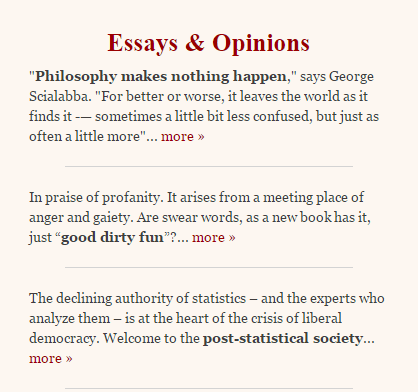
A quick glance across the homepage, proves to be a feast for the intellectually curious (or those we hope will be). Articles, reviews, and essays from all over the web are organized by Articles of Note, New Books, and Essays & Opinions.

al-daily-3

Beneath each of those three headings is an extensive collection of recently published works, each summed up in about 20 words meant to pique your interest:

  • Fake news is not a new phenomenon. Indeed, fake news is older than real news. As facts recede, the power of concocted stories will only grow
  • What’s to blame for the death of the Western artistic tradition and the beginning of something entirely new? The dangerous idea of creative genius
  • How did Wallace Stevens, who lived an excruciatingly mundane and superficial life, write some of the most inventive poetry of the 20th century?
  • Science’s biggest dilemma isn’t funding, replicability, or lack of public respect. It’s language. Science has an English problem, and that means a lot of lost knowledge
  • The power of “yuck!” and “ew!”. Disgust, which comes from our evolutionary fear of germs, goes a surprisingly long way toward explaining our manners, morals, and religion

As for research opportunities, just glance down the lefthand side of the page. Links to:

  • 26 world newspapers
  • 16 television news websites
  • 107 major magazines
  • 52 book reviews
  • 54 links to other collections of content specific media, blogs, and ideaspaces

So far this year, I have used ALDaily in several ways:

  • Quick Write response – I asked my AP students to spend a few minutes searching the site for an article that intrigued them. I gave them several minutes to read the piece, reflect on it in their notebooks, talk at their tables about what they found, and then share out some of the interesting topics. We ended up talking briefly about procrastination, Arthur Miller, stem cell controversies, and Freud.
  • One Pager – Students needed to chose an article from ALDaily, read it, select a quote that struck them, and write about their expanded thinking related to the selection.
  • Article of the Week – I’m not as faithful to this practice as the name would indicate, or as Kelly Gallagher would likely advocate, but we do study information texts and practice skills involving main idea and word choice analysis, summary skills, and bias identification. My most recent article of study was with my sophomores. We read and discussed “Shame on You,” a piece with a hook that asked “What would Plato tweet?” We discussed the perceived freedom and catharsis of social media against the dangers it poses to honest reflection and conformity.
  • Beefing up my own quippy wit – This week, I’ve already talked with various groups of kids about science, poetry, an obscure language of the Amazon, and Emily Dickinson. I’ve also been able to share with kids that I am practicing what I preach : “Spend some of your time reading what matters. What matters to you and what matters to those around you.” 

The motto at Arts and Letters Daily is “Veritas odit moras.”
It means “Truth hates delay.”

Challenge your readers without delay, every day.

Arts and Letters Daily can be found at aldaily.com

Have you used Arts and Letters Daily? How might you use a collection of intriguing works to challenge your readers? Please comment below.


Lisa Dennis spends her school days teaching AP Language and Honors/Pre-AP Sophomores, while also leading the fearless English department at Franklin High School, just outside Milwaukee, Wisconsin where she lives with her husband Nick, daughter Ellie, and beagle Scout.  She is a firm believer that a youthful spirit, a kind heart, a big smile, and a good book can ease most of life’s more troublesome quarrels. Follow Lisa on Twitter @LDennibaum.