Category Archives: Writers

Promoting Community in the Workshop Classroom–and Out!

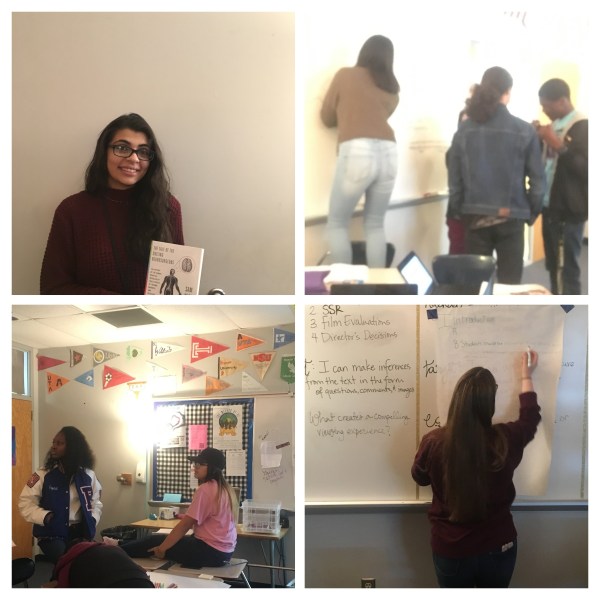
IMG_6878-COLLAGEThere were about two weeks of school when we came back that I wondered if I was doing something wrong.  It seemed like I had WAY too much time on my hands, and I wasn’t quite sure if I was just forgetting about responsibilities, and therefore shirking them in some way, or if I actually was managing my time better.

(Scoffs) Of course, it wasn’t the latter.  I simply FORGOT that I was in grad school.  This past week, as grad school classes started up again, I thought, “Ohhhh yeahhhh, that’s what was missing.”

I have questioned my life choices many times throughout this graduate student plus full-time (and then some) teacher season.  However, it is increasingly amazing to me the fact that teaching is more a study in behavioral psychology than it really is in any content.  The questions we ask ourselves are never just, What should I teach next?  Rather, they are loaded questions like, What can I teach next that will engage students, help them reach their potential, and provide a learning experience that will last beyond my classroom?

For this reason, my current class–focusing on social and emotional components of learning–is rocking my world.  The ore I read, the more I realize that it is my job not only to encourage healthy social and emotional characteristics in individual students, but also with each other.

So as my students are gain their reading strides this year, I’m pushing them to talk to each other about it more than ever before.  Here are some way I’m promoting community in my classroom, even among different class periods.

The Reader Hall of Fame:  This was my colleague’s idea, so I cannot take credit at all.  She started taking pictures of her students with their first finished book, and then she adds a small strip of paper with each new title they finish.  It looks AWESOME, and it really allows a constant brag-on-the-students feel to the classroom.  Students love coming in and seeing the new developments of their friends, the titles they’re reading, and the PAGE COUNT.  Yes.  They compare page counts like nobody’s business.

Book Clubs: This semester I am doing my first round of book clubs with my AP group.  Last semester, the students begged for book clubs.  They wanted to be able to read with their friends, which I think is a totally worthy desire that I do not mind milking for all it’s worth.  My goal is to come up with discussion questions along with the students that will promote discussion about life and the world, as well as education (our thematic topic for this unit).

Whole Class Reading Challenge:  Daniel Pink is haunting me in my sleep for this one–re: extrinsic motivation is not sustainable.  I know. However, when it comes to high school seniors, you sometimes have to pull out all the stops.  I follow Brian Kelley on Twitter (@briank) and he so graciously shared this reading challenge bingo with me.  I told my seniors each time they complete seven squares as a class–each square completed by a new student–they could bring to class.  When we complete three cycles, they can have a movie day.  I’m a sucker.  Feel free to troll me on Twitter.

Red Thread Notebooks, Technology Style:  This semester, my colleague and I are trying to get our seniors communicating across class periods, and even between our two classes.  In order to do this, we are going to take Shana’s Red Thread Notebooks, and take them to FlipGrid and possible Canvas discussion boards.  I hope to have different boards for big topics like LOVE, DEATH, FAITH, FREEDOM, on FlipGrid and allow time in class for students to respond to those boards and each other, referencing their current reading.

#bookstagram:  I love this hashtag on Instagram, and it provides a great way to connect to students in their own world.  I want to show a few photos from the hashtag to students in support of my book talks, and then offer an opportunity for students to #bookstagram their own book, or search the hashtag for their next read.

“Why I Read” Wall:  I’m a sentimental freak when it comes to second semester seniors.  They roll their eyes constantly as I say, “Do you REMEMBER when you said you would never read?!  Look at you now!”  Last week, tears streamed down my face–single ones, thank you–as I told them I believed in them and I’m so glad they’re here.  Beyond the sentimentality simply being my personality, it is also a teaching tactic that requires teenagers to reflect.  This is a skill I never thought would be so difficult to teach, but it is!  I want students to think of reasons why they read, and create a little notecard to hang in the hallway.  We could even steal their pictures from the Reader Hall of Fame and put them out there.  This would provide an amazing message for all the students who come into my classroom’s corner of the world that reading is more than just assignment.

And that’s the dream right there, folks.

So how do you promote community across classrooms through reading?


Jessica Paxson teaches English IV, AP Lang, and Creative Writing in Arlington, TX.  She runs on coffee and exaggeration, a deadly combination at 7 in the morning. Her students frequently describe her as “an annoyingly cheerful person who thinks all her students can change the world.”  Yep, pretty much. 

Trigger Warning – Whole Class Novels

Ideas don’t sneak up on me. They hit me from just beyond my peripheral vision like a swift backhand to the kneecap. I can’t possibly go on as I had been only moments before. The ideas explode onto my consciousness, and then my to-do list, and then leap onto my calendar, and then to most of my waking moments until I actually do something about them, or surgically remove them somehow from my obsessive brain.

Translation: I had been happily proceeding about my merry workshop way with the start of the second semester, until this weekend when I met Kate Roberts from The Educator Collaborative via her recent blog post “The Healthy Skeptic.”

And now I can’t stop thinking about whole class novels. Or the brilliance of Kate Roberts. Or whole class novels. Or nostalgically gazing in the rearview mirror of my career at some whole class novels.

However, it would be disingenuous of me to paint my work with whole class novels, even The Scarlet Letter, with rose-colored glasses (Sorry. Hester has enough to deal with. I shouldn’t try to make this punny). Self-reflection and engaging students in honest dialogue, often reveals that my students, like most students, were experts in the art of fake reading. We were experiencing texts together, in many cases for far too many weeks at a stretch, but few were reading.

So while the merit of the texts in and of themselves might be harder to shake, it was easy to admit that the value to my students was relatively low in comparison to the amount of time we took, form writing we constructed, and smiling/nodding (on a good day) that was had.

I wasn’t teaching the readers, that’s for certain. And if students aren’t reading, I’m not really teaching reading either. We’re unnaturally drawing out the process for avid readers at best, turning young people off to or supporting preexisting negative feelings about reading at worst, and going through the motions far more often than our nation’s tenuous relationship with literacy can afford.

Yesterday, I found myself in a nearby district sitting around a huge conference table with two administrators, one reading specialist, and a dozen or so high school English teachers. I had been asked to come in and talk about Franklin’s experiences with high school workshop as this department weighs their options in moving forward with balanced literacy, daily practice, and all the options to start parting ways with traditional, and explore the unknown. This group of educators had incredible questions, a healthy amount of skepticism I think, and most importantly, a sincere desire to do right by their students.

We talked a lot about the nonnegotiables of workshop, considerations when structuring daily lessons, the difference between engagement and compliance, fake reading, assessment, classroom libraries, and the notion that teaching students to be English teachers leaves far too many students on the sidelines, nodding along or possibly disengaging from reading once and for all.

Mostly we talked about control. How hard it is to let go. How necessary it is to work to balance the power in your classroom. How creating a “reading love fest” as one cross-armed gentleman yesterday suggested, really is the best way I have found to get kids seriously, joyously, consistently reading. Is it a personal savior for every single kid? Sadly, no. Does it solve some problems and create countless more, absolutely. But here is the bottom line in my book: Letting go of some control to hand it over responsibly to the students whose education we are entrusted to support is one giant step toward getting our students to value that education that so many take for granted, can’t afford to really embrace, or think they don’t need for one societal reason or another.

Letting go of some control and embracing the very specific needs of the students can come in many forms. Right now, I’m thinking about how it might impact the selection of a whole class novel.

booklove

This needs to look different and it must be intentional in every class, and my estimation of what my students need is only going to take me so far. Selection of a whole class text must serve the purposes of addressing the specific needs of the students in front of me.

My ninth grade teachers know, from speaking directly with their students, that most read, but don’t necessarily challenge themselves. Additionally, many have had longer texts read to them (excellent!) but have rarely finished a longer piece independently (not good!). In this case, the team feels that starting the year with a pointedly chosen whole class text is needed to really help students see what they can be looking for, thinking toward, and discovering when they read on their own. Many simply don’t have that skill developed deeply enough yet, to really do the type of critical thinking we’re asking them to do. And if that’s the case, the changes that their skills will develop independently are markedly lessened.

At the upper levels, I now have students who have been working in the workshop for over a year. As evidenced by students with books across campus, there is more reading happening now than in years past. However, the push toward challenge is spotty and in some cases, the real depth of understanding when challenge is pursued seems even spottier. In this case, our AP Language classes are considering using Between the World and Me by Ta-Nehisi Coates to not only tackle some recent unrest in our own school community but to work carefully together to analyze author craft across the main ideas of this dynamic text.

The key is to choose with purpose. To invite student input into that choice. To spend a reasonable amount of time working with the text (3-4 weeks is a general recommendation based on my recent experience and the advice of those far more seasoned than I). To have student-centered goals in mind. To celebrate the text without covering every inch of it, and possibly killing the book AND a student’s hope of becoming a reader in the process.

Our students deserve what our careful analysis of their needs would suggest we best use our limited class time for. The unifying study of a text can be just such an activity. Your professionalism, the unique make-up of your classroom, and the social events/factors that should drive national discourse – these are some of the most important factors in selecting any curriculum; however, the goal should always be the same. We want our students to value the power that comes with better understanding the human experience. Powerful books can take us there. Let’s read them together.


Lisa Dennis teaches English and leads a department of incredible English educators at Franklin High School near Milwaukee. Her personal mission statement is a work in progress but needs to involve equal parts readers, writers, thinkers, believers, and dreamers. Follow Lisa on Twitter @LDennibaum. 

TCTELA 2018: Professional Learning in Style on the Isle

I like to think I know about teaching.  Then I go hang out with hundreds of brilliant educators and I realize how much I have to learn.

(I hope Helen and Megan see what I did there)

Teachers

I just got home from the TCTELA Conference.  The 30 minute ride north on I-45 allowed me a brief opportunity to reflect on this weekend and think about the experiences that I encountered and the people I had the pleasure of meeting.

Collaborative Conversations:

Spending time in different sessions with different people from our District rejuvenated me. I enjoyed sitting with Adam Glasgow and taking in a presentation on curriculum development from two teachers from our district: Helen Becker and Megan Thompson.  I loved hearing them speak the workshop language.  It’s nice to take in a lunch with teachers from other schools in our district and really get to know them. There were also impromptu twitter education sessions and conversations about snacks.

Mary Margaret

Super Star Speakers:

Alfred Tatum is brilliant.  His presentation was first thing in the morning on Friday and was a perfect start to the conference.  His ideas about texts belonging to all students perfectly echo the words of Atwell, Kittle, and Gallagher.  Here is a video of Dr. Tatum talking about self-selected reading.

Pernille Ripp is inspiring and passionate.  She is one of the most ardent speakers I’ve ever heard and when she said, “Our fidelity should be to the students, not the programs. See the children and hear their voices,” I knew I had a new teacher-crush (Sorry Kelly Gallagher).

Donalyn Miller made me continue to think about my role in the classroom and as an advocate for literacy.

Chris Lehman closed out the conference this morning and his ideas about close reading should be standard practice for all of our reading teachers.

Chris Lehman

Looks like I’ll be spending money on more teacher books soon.

Harvey Panel:

Diane Miller of U of H Downtown set up this panel of amazing educators.  Unfortunately, our time slot worked against us and more people sat on the stage than in the crowd.  In that aspect, it kind of reminded me of the JV soccer game the night before.  That wasn’t really the point though.  The point was that these educators shared their uplifting stories and shared some of their emotional baggage.  It’s important to give a voice to those who are thinking and acting outside the box to help kids.

Call to Action:

Get involved.  Connect with innovative people on social media!!!  NCTE is in Houston this year.  Meet up with us!!!! If you are a Texan, Join us at TCTELA next year in San Antonio!!!

Charles Moore’s students sometimes revolt when he tells them to quiet down and all they want to talk about is their writing.  He can’t wait for the weather to warm up so that he can enjoy craw fish and his pool and maybe even devour craw fish while in the pool.  You can find his frequent thought bursts and his passive aggressive treatment of trolls by checking out @ctcoach on twitter.  His poorly executed instapoem collection can be seen @mooreliteracy1 on Instagram.

3 Ways to Utilize Audio and Visual Recording with our Readers and Writers

There is much debate regarding the use of digital technology in the classroom. For teachers, cell phones and other technology are both frustrating helpful when it comes to student use. They have the potential to be distracting and disruptive, as we all know, but tech is useful when it comes to some classroom activities, such as keeping a next reads list, or looking up word gaps. I love the idea of using them for the powers of good, so recently, I tried asking my students to use their mobile phones just for the purpose of recording, and to try to ignore the notifications that might come across as they used them.

I’m always looking for new strategies to help the readers and writers in my classroom, and in the past few weeks I’ve tried a couple of different applications. Using cell phones and iPads is simple, and it meets one of the simple rules I am trying to follow when it comes to working with students: meet them where they are.

Recently, while my grade nine students were in the thick of drafting informational essays, I asked them to read their essays aloud, and listen to the flow, the choppiness, the parts that sound great, and the parts that “just don’t sound right.” While I’ve asked students to read their own work aloud before, this time I asked them to record themselves, and then after, to listen to their voices while reading, keeping a pencil in their hands, pausing the audio and editing and revising as they go.

My students were reluctant at first, but once they got over the initial awkwardness of listening to their own voices, they indicated that it was a simple and useful strategy for revision. It’s one that can be used in other classes, and doesn’t require any other tools or even other people for help.

Another strategy we employed using recording technology was focused on the use of video recording. Before my students had started writing informational essays, we studied informational texts, using the Nonfiction Notice and Note signposts, along with the Book Head Heart strategy found in the works of Kylene Beers and Robert Probst.

IMG_4387

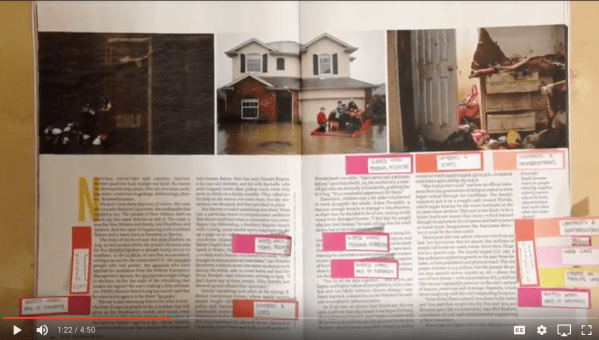
When students learn reading strategies and skills, it’s important to be able to see just where they are in the learning process, but it takes time to thoroughly check in with each and every one of them. So with this unit, our ninth grade English teacher team decided that it would be great if students could demonstrate their learning through a think-aloud. Doing this in class would take a lot of one-on-one time, so we asked students to demonstrate their thinking and reading skills on their own, and to use the video recording capabilities on their iPads and cell phones.

videothinkaloud

A screen shot from a video-think-aloud

Because we, as teachers, had modeled the think-aloud strategy in our classes many times, students knew exactly what we meant, and were able to demonstrate their understanding of the strategies and skills necessary when reading magazine articles. They annotated, exposed their initial confusion, shared their process of finding understanding, and demonstrated a multi-draft reading of the articles they had chosen. It was a successful method of assessment, and I plan to utilize it again. Students had a chance to showcase their thinking and understanding, and it wasn’t a one-off opportunity. They had the chance to try multiple takes with their recordings, so the pressure was off and they could easily share their thinking.

Our most current rationale for the utilization of video in class is with our new short novel unit, in which we formed book clubs. We are squeezing in a shared text at the beginning of second semester with Of Mice and Men. While all of my students are reading the same text, they are split up into groups of three and four so they can form their book clubs. One of the summative assessments with this unit is a small group discussion that they will record. They will need to demonstrate some academic, sustained, literary discussion in their videos, and are practicing in class, leading up to the recorded discussion. I’ll be able to have five small-group discussions going on at the same time in my class, which means precious class time isn’t frittered away with transition times between discussions, for example. Students will be thinking, reading, and discussing, and I’ll be able to watch the video later, when the pressure is off, and I can truly assess the conversation. I’ll try to remove the guess-work because I can slow down the speaking and listening assessment portion of it all.

annotation OMAM

One student has heavily annotated in preparation for the recorded small group discussion.

These are just a few ways to allow students to use the simple technology that is available to them. Kids know how to make movies and to splice audio, so there is little need to instruct regarding the technical details. They can use the audio and video to showcase their skills.

It’s also a timesaver as far as the classroom goes, and it takes some of the stress off of students who have test anxiety or who struggle when it comes to on-demand assessments.

While it’s not a student-recording, I will share one last recent use of video in class. I played the video in this NPR article about a murmuration of starlings as an inspiration for a quick write this week. I played it without sound, and hit replay several times. My students were fascinated and wrote some fun responses. One was even moved to write music: img_5972.jpg

I love how my students are constantly surprising and impressing me. They are unexpected and wonderful.

I’d love to hear more about how teachers and students are using laptops and cell phones for the power of good in the comments below!

Julie has been teaching secondary language arts for nineteen years, spending the first fifteen in rural Central Oregon, and the last four in Amman, Jordan. She’s thrilled to report that she and her family will be moving across the agua to Managua, Nicaragua next year, where a new adventure will begin.

Follow her on twitter @SwinehartJulie

Follow her blog https://adventuresinhighschoolworkshop.wordpress.com/

A Reading Conference with Tom Romano

I am fortunate to be on friendly-emailing terms with the great Tom Romano, from whom I’ve learned much about good writing instruction, multigenre, and student voice.

So when I received an email from him the other day, asking for book recommendations, I laughed aloud. My most excellent writing mentor, asking me what to read next?

img_6004

I admit, I balked a little at first. This was like having Tiger Woods ask you what golf club to try next. But then, I fell back on my tried-and-true reading conference strategies, which I’ve used countless times over the years with reluctant and prolific readers alike.

As with any student, I had much of what I needed in order to give a good recommendation between the request itself and my background knowledge of Romano. When students need help finding something to read, we’ll often meet at the bookshelf. As they stare blankly at the wall of books, one of the first questions I ask is:

“What are you in the mood to read?”

Often, students can give me a feeling–something fun, lighthearted, serious, or challenging–or a genre–romance, nonfiction, adventure. It’s even better when they can give me specific titles that relate to their preferences. I usually glean these titles by asking:

“What’s the last book you read that you loved?”

In his request, Romano gave me all the information I needed–he wanted something literary, something like The Nightingale (which I’d read after Lisa recommended it to me), Atonement, or All the Light We Cannot See. He’d also answered another question I usually ask readers:

“What’s your reading plan?”

Knowing where a student will be reading this book–at work in short spurts, at home in long stretches, or on a crowded bus on the way to an athletic event–impacts my recommendation as well. Here, Romano told me he’d be reading for long, uninterrupted stretches of time in airports, so I knew I could suggest something all-consuming.

So, I stuck with my usual formula:

I recommended three titles.

img_6005.jpg

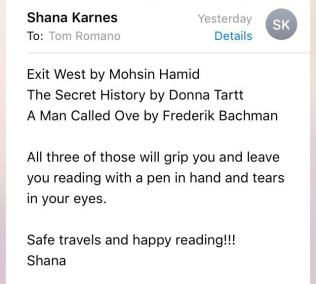
Exit West is a title I’ve heard a great deal about and would love to read, but haven’t gotten to yet; The Secret History is an amazing hidden gem by Pulitzer Prize-winning author Donna Tartt that I read about 15 years ago; and A Man Called Ove is a new viral title that made me sob hard over Girl Scout cookies and coffee as I finished reading it. My three recommendations usually consist of something old, something new, and something I haven’t read yet.

I wrapped up my pitch as I always do, with a clincher:

A promise of what the book will do for the reader.

A week went by, and last night at 11 pm, I received another email from Romano:

img_6006.jpg

“Loved Ove.”

A successful end to a successful reading conference, if you ask me…but of course, like any other conversation about books, I couldn’t let it end there. I just had to throw in one more recommendation, which I always do for my students when they return a book:

“If you liked that book, you should try ______________.”

This quick exchange of emails, like so many off-the-cuff conversations we have with students, was packed full of powerful data about a reader’s interests and abilities; a teacher’s knowledge of texts and titles, and most importantly, the transaction between the two parties–a shared endeavor to find a just-right book at just the right time.

All our words are imbued with purpose and power when we are discussing literacy. Reading conferences don’t need to be formal, sit-down conversations all the time. They have just as much weight when they’re held standing at the bookshelf, passing in the hallway, or from afar via email. This reading conference with Tom Romano reminds me: never take any of our talk about books for granted.


Do you have a what-to-read conference “formula?” What other titles might you recommend to Tom and me? Please share in the comments!

Shana Karnes is eagerly awaiting the end of flu season so she can go back to work without worrying about her two tiny daughters getting sick…again. When her family is actually healthy, she teaches preservice educators at West Virginia University, goes for long runs while listening to even longer audiobooks, and tweets about reading, writing, and school at @litreader.

Collaboration 4 Ways

The Classroom

It had been a great week in the classroom: we had shared our stories, written in our notebooks, and analyzed Queen’s awesome “Bohemian Rhapsody” (if that’s not a “fun on a bun” way to dive into rhetorical analysis, I’m not sure what is!). But despite my best intentions, I had not faithfully modeled engagement with writing mini lessons (ML’s) and folded in collaboration the way I intended. Okay, or much at all. You know how it goes . . . you nibble some off this end and things slide a little at the other end.

So, I found myself without time–as I so often do (Help Pacing Gods and Goddesses! Help me learn to be less thorough already!)–and wondered if/how I could efficiently address the 4 ways writers can collaborate. My colleague and I believe writers collaborate with mentor texts, people (teachers via ML’s and conferences and peers), materials, and themselves. How could I satisfy this need, this craving to model these fundamental skills in a totally wholesome way without cramming it down their throats?

Thus, Collaboration 4 Ways was born. Reminiscent of Steak ‘N Shakes’ Chili 5 Ways, I quickly figured out how to model what I wanted to do by synthesizing the 4 collaboration skills into a one-plated ML, focusing on the 6 Word Memoir, which is our lead into application essay writing for our seniors.

  1. I modeled collaborating with a mentor text, using an online sample off NPR’s site, taking note of what worked. I annotated interesting arrangement of words, varied syntax, clever pairings of language and visual, and more. Then I thought aloud regarding what I ought to “throw into the mix”–measuring out words that helped to build meaning.
  2. I modeled collaborating with the teacher; and, pulling the picture of my sweet and silly Ingrid as a unicorn, used the ML strategy of writing about what the picture encapsulated in 17 words or fewer. Ideas first; concision later.
  3. I modeled collaborating with materials (AND my students): gathering small thumb drive size sticky notes, I wrote each word and
    IMG_1142 (1)

    Here’s what I mixed up–with student collaboration–on the doc cam. The whole sticky notes reflect student suggestions and “drafts.” Note to self: they do sell thumb sized sticky notes . . .

  4. piece of punctuation on one and with student help, moved the words around and changed/added punctuation to truly model that sentences are made of moveable parts and that punctuation DOES matter (what taste it adds, darn it!).
  5. Finally, I modeled collaborating with myself, thinking aloud and reflecting to create my final piece. Does this arrangement of words build meaning? Does it build power? Should I revise the punctuation? Etc.

And, I did this all in 10-15 minutes (what I had originally allotted each day to teach each one of those separately).

Discovery:

Served early in the course, this lesson acted as a catalyst for many of my students. Some use the 6 word memoir approach to generate topics or meanings of topics; some manipulate syntax via sticky notes for their purposes; some spend more time talking through ideas; some realize then and there the value of a mentor text.

As for me, I discovered that maybe, just maybe, I needed to shift my thinking. Because it will shift my students’ approach. ML time has been about modeling what to do and getting help from my students, too, discussing and processing. To me, the ML steps have seemed a recipe for success–a thorough list of ingredients and instructions to follow as they work at isolating and problem-solving a certain challenge in their writing. With someone modeling it all for them. Collaboration 4 Ways allowed me to model possibilities . . . instead of the way, one way with an intended outcome.  Serving up Collaboration 4 Ways reminded me that students need to see what’s possible. And how even a seasoned cook needs to test and try.

Truth: Possibilities precede problem-solving.

Giants whose shoulders I stood on:

Many a giant supported me on this one  . . .

  • My Directors of Teaching and Learning who reminded us before school began that we have more freedom than we are using. And, what opportunity really means.
  • Angela Stockman’s Make Writing 5 Teaching Strategies That Turn Writer’s Workshop Into a Maker Space for inspiring me to experiment more with making writing.
  • My colleagues for holding me to the fire with how I ML because sometimes there’s not much mini about it.
  • Three Teachers Talk Mini Lesson Mondays!

Kristin Jeschke, in addition to enjoying Chili 5 Ways during late night study sessions back in college (too many years ago to mention here), appreciates constraints, good talk, and post it notes (lots of them, in all sizes) when writing. Follow Kristin on Twitter @kajeschke. 

Assessment Graffitti – Guest Post by Margaret Lopez

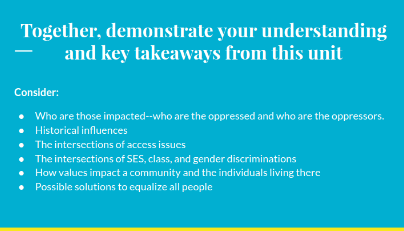
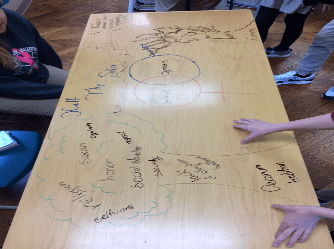
After a largely discussion and low stakes writing-based unit on Social Justice with three texts (Half the Sky, Hillbilly Elegy, and Ghettoside), I was contemplating a final activity to assess their understanding.  I wanted evidence of their thinking.  I wanted my students to show me, in any format, they “got” the unit–that they understood what injustices exist in the world, how they’re connected to privilege and access, and what solutions are necessary to equalize the playing field.  

But I didn’t want to have another seminar.

I didn’t want to give them time to write.

I didn’t want to read another article.

And, full disclosure, I certainly didn’t want cumbersome grading as we are in the final stretch and up to our necks in their year-long inquiry project.

I wanted something new, something we hadn’t done all year.  So, I decided to let my students do something forbidden–I equipped them with Expo markers and let them draw on the furniture.

Disclaimer:  I checked before to see that Expo markers washed off my classroom tables with a little elbow grease and Clorox wipes.  Please do so before!

I simply gave my students these instructions:

Lopez

Then, I stepped aside.  Students had about 30 minutes to complete their visual and were immediately engaged (likely because they were drawing on school property).  

Lopez2

Dev and Lisa collaborating on a cause and effect analysis of Appalachia according to Hillbilly Elegy. 

As they were collaborating, students were discussing the issues we had examined throughout the weeks, Students talked about the values of the oppressors compared with those who are oppressed, and how those intersect with community values.  Students connected historical roots with the current issues discussed in their books, structures of power and privilege that exist, and what solutions should be invested in.  Their purposeful talk around the assessment proved they had read deeply, thought critically, and synthesized multiple issues.

The products were great–original and insightful.  Students gained more listening to their peers explain their group’s visual at the end of class because the conversation was extended and connected, again synthesizing ideas between the texts and our world.

Lopez3

A live tree and dead tree representing opportunity and access for males versus females in Half the Sky.

Lopez4

Graham explains his group’s problem-solution web for the violent community discussed in Ghettoside. 

Lopez5

Emma explains the culture of have and have-nots that exist in other countries between males and females, emphasizing the barriers to equality.

While I ushered students out of the classroom, I heard the ultimate combination of compliments:

  • I feel like that actually assessed my thinking.
  • This unit was great, you should do it next year.
  • That was fun!

Mission accomplished.


Maggie Lopez has six years of teaching experience at large public high schools in Louisville, Houston, and now Chicago.  A graduate of Miami University, she had the pleasure of learning from the workshop masters and is on a continual quest to challenge, inspire, and learn from her hilariously compassionate juniors and seniors. 


Screen Shot 2017-05-01 at 8.44.22 PM

Care to join the conversation? We’d love to add your voice! Please email guest post ideas to Lisadennibaum@gmail.com.

What do colors have to do with teachers writing? Today, a lot.

When I read You Don’t Have to Say You Love Me by Sherman Alexie, I knew I’d found mentor gold. Infused with stirring poetry, this memoir tells the story of Alexie’s less than ideal relationship with his mother and how he grieves the loss of her, what was, and what could have been.

I reached for this book Monday as I began a session of PD. On a whim, I flipped the pages and landed on the poem, “Ode to Gray,” thinking it may spark some kind of response in my audience. It’s simple enough. And lovely.

Ode to Gray

This isn’t the complete poem. I just wanted you to get the idea. There’s one more stanza. Really, get this book.

After I read the the poem aloud, I asked listening teachers to write in response.

“Think of a color, and write about that. Write your own poem, or a paragraph. Doesn’t matter. Just write about your color.”

After writing five minutes, which is rarely long enough, I asked these writers to read over their words and do a bit of revision, challenging them to add an appositive phrase somewhere in their writing. This is a directive I often use with students:  We write. We read our work. We revise, often with a singular purpose that ties to a specific skill or craft move.

I walked the room, peeking over shoulders, listening to conversations — and noticed about a third of the group didn’t write a thing. Funny how some teachers are so much like some students, huh?

Maybe they didn’t get the simple task. I guess that makes sense if they’ve never been asked to write like this. I do not think that’s the case though. I heard one too many sigh and saw one too many eye roll to know I wasn’t the first presenter to ask this group to think and write.

It didn’t matter. We cannot make people eat. We can keep inviting them to the table.

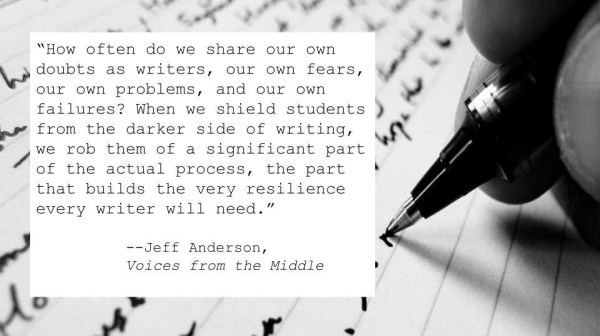
Writing teachers should be willing to write.

Accountability in RWWorkshop

Some teachers in that session wrote a lot — and they wrote beautifully. Adam showed me his piece about the color black. I should have asked for a copy. All I remember is the line “Little black lies.” It’s a great line.

Of all I wrote, one line holds a bit of promise:  “Orange, the color of sunsets, why are you so lonely?”

And then there’s Mary. She took that little quickwrite and turned it into something tender, touching, real. She published it on Facebook and said I could share it here:

An Ode to Red
Workshopping With Amy Rasmussen
1.15.18
Red is the fire of your cheeks as you demand to be heard in the morning before school, on a day I was supposed to get to sleep in late. Red is the fire of mine as I scream back, frustrated, unsure of how to solve this trembling toddler enigma. You want red grapes, I gave you purple. In your mind, they are not the same.
“What’s your favorite color, Mommy?” you ask. You expect an answer.
“Purple,” I say, knowing the question that comes next. We do this daily dance, aware of each other’s rhythm.
“And what else?” you ask.
“And orange.”
“That’s good, Mommy. Mine’s red. Red and blue. I love red and blue.”
Red is the sucker, no, the second sucker you negotiate for after getting your hair cut. Just one of the many tricks/bribes that I’ve learned along this short parenting trip we’re on together. Sticky, stained red lips, sticky, stained red teeth and sticky, stained red fingers.
“Go wash your hands before you hug me!” I yell as we walk in the house. “5, 4, 3, 2, 1…”
Red is the color of the bath water after you dump the entire bottle of finger paint into the tub.
“Bubble bath!” you shriek excitedly, giggling, red steaks strung along the sides of the just-washed tub.
Red is my heart each time I leave, and each time I return. Red is the love. All of the love, engulfing me in flames.


I see red a bit differently today.

Thank you, Mary. My kids are grown, and now I get to watch them practice parenting. It’s hard and noble work, and you will feel every color of emotion — sometimes all on the same day and sometimes more than once. But it’s that “love. All the love” that turn these emotions into rainbows. And sometimes just writing about them helps us see every moment just a bit more clearly. Thank you.

In an article by Tim Gillespie, published on the National Writing Project website, he sums up what I believe and have experienced myself as a teacher writer.

Accountability in RWWorkshop (1)

Here’s the thing, you teachers who refused to even try:  It doesn’t matter if you think you can write. Just write.

What does matter is that our students see us working at it. Just like we must be readers in order to help our students find the “just right” book, we must be writers if we want to know the struggle our students face when writing.

We learn when we are vulnerable. We learn when we practice.

So I am challenging myself as much as I am challenging you:  Write beside your students more. Let them see your thoughts, your mistakes, your struggles. Ask them for feedback.

If I truly want a community, where we all work to grow as readers and writers, I need to do more to get us there.

Amy Rasmussen began writing in journals at age 8. In addition to this blog, she now writes in notebooks and on sticky notes. A lot of sticky notes. She also tries to write the assignments she gives her students. She wishes she would have had teachers who wrote with her, but she does not remember one K-12 teacher ever doing so. Follow Amy on Twitter @amyrass and @3TeachersTalk

What’s the right way to book club?

I belong to a lot of book clubs.  Probably too many, if I’m being perfectly honest.  This book club habit, though, allows me view a range of activities that can be considered “book club” and has opened up the way I teach book clubs in my classroom.

Book clubs are valuable experiences in and of themselves and there is no one right way to “book club.”   Book clubs enrich the lives of readers and allow students to see a thought about a book go somewhere new with a friend.

We’ve all had those moments where we think, “Sure, I could run this unit as a book club, but how do I know the students are really reading?”  As much as it pains me to write … we know the students aren’t reading regularly and consistently anyway.  Penny Kittle’s Book Love gives a detailed account of the various deceptions and misdirections that high school students regularly go through when they “fake read” assigned classics for English class.  The concern is most certainly worth raising, but we also shouldn’t assume we already have a perfect solution.

And book clubs are not a perfect solution, either.  They are messy, they take time, and sometimes the teaching we do in a book club unit is more the teaching of life and human relationships than of actual content and reading strategies.  But to hear students arguing the role of fate in one’s life?  To see a gaggle of girls attempt to stymie me with a version of The Trolley Problem that they developed based on a book club conversation?  To see students become obsessed with the Berlin Wall because of a book club?  To listen in on how students work out interpersonal conflicts when they think an adult isn’t listening?

I’m telling you, it’s all worth it.

While there are no right ways to book club, here are some things that have worked for me:

  • Give generous choice in partner selection.  I maintain final say over groups, but I encourage students to indicate the classmates they want to work with on a survey.  A colleague encouraged me to add a space for students to include a student that they haven’t worked with yet but would like to work with in order to encourage students to branch away from just indicating friends.  If students look forward to talking to their conversation partners, I find they are more likely to read and more likely to have better conversations about the book.
  • Steer students towards books they might not otherwise pick up.  One of the hidden beauties of book clubs is that I can steer groups towards books they might not otherwise pick up.  Groups of students are more likely to branch out of genre or try an author they hadn’t heard of before if they have a group to do it with.  I use this opportunity to introduce racially diverse authors and authors whose works are set in other countries.  It delights me to overhear students discuss the role of Choctaw culture in the magical realist tale How I Became a Ghost or mull over the levels of privilege in Piecing Me Together.
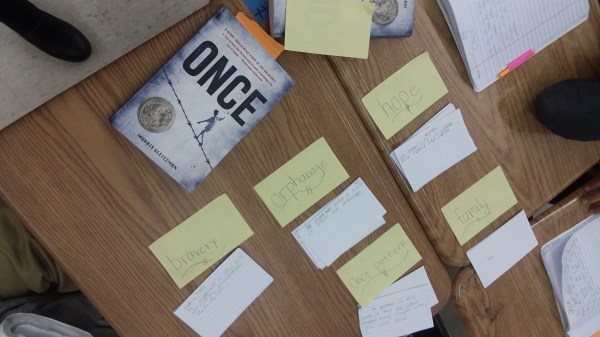
  • Provide activities to get conversation going and flowing.  One of my favorite activities from this past unit was having each student write down five significant events from the story, one event on each index card.  Then, in book club groups, students sorted their cards into piles and labeled their piles.  If you look at this picture, you’ll see that some of the piles from this student group are about setting (“orphanage”), others are about themes (“bravery,” “hope,” and “family”) and another is an observation about craft. This activity allows students to notice their noticings and realize they are not alone in their thoughts.
AmEOnceimage

Once by Morris Gleitzman is the first of an incredible series. Bonus to a book club choice!

If your school has a traditional canon-based curriculum in place, there are areas where I would see book clubs falling flat.  I would not assign Hamlet or Macbeth in book clubs.  (I might, however, think about assigning excerpts to small groups after some whole class teaching.)  I might instead start book clubs in a lower-stakes medium.  Maybe your book club reads poetry.  Maybe your club members are obsessed with the Dallas Cowboys and each member finds an article on the Cowboys to bring to the meeting.  Or maybe your book club loves superhero comics, and you read the new Superman comics together.

Wherever you are and whatever grade you teach, I encourage you to give book clubs a go.

What about you?  What are some of your favorite book club rules and routines? Or what are your book club roadblocks?


Amy Estersohn is a seventh grade English teacher in New York and is a halfway decent trivia team member.  She collects her book and graphic novel reviews at teachingtransition.wordpress.com


Sit Down Next to a Child

The closing of a semester is a stressful time.

Exams are looming for both students and teachers, papers are stacking up behind, on, and under my desk, and I’m certain that my desire to crawl headfirst into a hole (with a book?) isn’t a positive indicator of mental stability.

It’s also usually the time of year (one time at least) that I look back and wonder:

Did I guide them toward appropriate challenge?
Did we study enough mentors to shine a light on the path of reading like a writer?
Did I book talk a variety of books wide enough to hook readers at all interest levels?
Are these students better scholars and citizens for walking into my room every other day for the past four and a half months?
Will they remember any of what we did, thought, explored together?

Did I do enough?
Was our classroom experience together ENOUGH for these kids? 

Often, I fear the answer is no.

With half the year gone, I sense a blur behind me and a haze in front of me, and here I sit wondering how I can do more without killing myself in the effort, because despite all the hopeful posts of great tips and tricks and successful tidbits to help kids become better readers, writers, thinkers, citizens…I don’t feel the warm satisfaction of someone who knows it’s been enough.

  • Several students are in danger of failing.
  • My struggle with manageable methods to hold students accountable for their work/thinking hangs over my planning, and reflection, and lack of free time.
  • There is a persist voice in the back of my brain that tells me there just aren’t enough days in the school year, hours in the day, or minutes in the history of the universe to meet the diverse needs of my students, the administrative demands of documenting student progress, or the expectations I have of myself to provide the timely feedback to students that will most benefit their authentic learning.

And then…

I sat down next to Leila.

enough

A quiet, but determined student, Leila and I have sometimes struggled during the year to let her insights shine. From anxiety to a difficult home situation, there have been tears after a graded discussion when Leila couldn’t bring herself to speak, writer’s conferences where the draft was so muddled with tangents that the heart of her message was lost, and plenty of weeks when reading goals were nowhere near met, because life and the chaos it could bring her got in the way.

But we’ve grown together. Slowly.

Leila is the type of student that packs up methodically after last period. Sometimes she has a question. Sometimes I can tell she just wants to softly say goodbye without the bustle of 27 other students in the room. Sometimes she’ll shyly ask if I’ve read her draft yet or how she did in discussion that day.

She wants to connect.

And often, we do – chatting for a few minutes before she needs to catch the bus.

But shame on me, there are times I feel rushed – hurrying to a meeting, wanting to sit down and get to a stack of papers, resisting the urge to pack up and run screaming from the building after a day of craziness (not often, but sometimes).

Yesterday, however, I got the end of semester reminder that I needed. Leila asked if she could talk to me about a personal problem. Family struggles were weighing heavily on her slight shoulders, and could I listen for a few minutes because she needed to “talk to an adult I really trust”?

I put down the stack of books I was distractedly organizing and looked Leila straight in the eye. She smiled weakly and I came out from behind my desk to sit right down next to her.

Her struggles are the struggles of countless students: split family, terrible treatment by a parent, a struggling single mother, a student who wants to succeed from a deep need to exist as something positive in a world that has shown her far too much negativity in her 16 short years.

And as I listened to Leila struggle through and very carefully chose my words to let her know I really heard and appreciated her, a buried spark was re-lit. The soft glow inside when you feel truly connected to another human in this vast expanse of brisk passings, hurried exchanges, and impersonal interactions.

It had been exactly six school days since I had had a meaningful sit down with a student. In the name of providing time to “do work,” I had not conferred with kids, talked up a book, or written a word with them. They were working. I was working. We were coexisting and it felt…cold.

A few weeks back, I had a big, fat, slam a door fight with my husband.

It had been a few days (weeks?) during which we had let the hectic schedule of daily life hollow out a growing gulf between us. From the depleted shells we can all become after a day at work, to the endurance needed to weather the willful meltdowns of our spirited daughter, to the dog who needs to be walked despite windchills below zero, to the painful universal truth illustrated by conversations centered around, “I don’t know, what do you want for dinner?”, we were operating in triage mode almost each and every minute.

As a result, we were successfully coexisting, forging ahead, making steady progress, and maintaining stasis. We were not, however, connecting or particularly enjoying the experience.It wasn’t until we sat down next to each other and took the time to engage in meaningful conversation, that we fully realized how empty the very “full” days had been.

Such is the way of it with our students. Not the dinner conversations and toddler meltdowns, obviously, but the need to reconnect…or work to sustain the connections we’ve forged before too much stress, distraction, work time, or any sort of “other” gets in the way and makes it awkward.

So as this first semester comes to an end, I am trying to avoid the nagging questions of whether or not I have been, done, or provided enough in class so far this year.

When you become the trusted adult to any child who needs you, you have not only done enough, you are enough. 

img_9050-1

Sending anyone and everyone that needs it, a virtual hug today. Whether you find yourself at the end of the semester, or jumping headfirst into the new term, your work is important and valued.

Each and every time you sit down next to a child, it’s an opportunity. How blessed we are to have it.

So take a seat. You deserve it and your kids need it.


Lisa Dennis teaches English and leads a department of incredible English educators at Franklin High School near Milwaukee. Her new semester will start with State of the Union conferences for each student to reflect on the semester passed, set goals for the upcoming term, and connect. Follow Lisa on Twitter @LDennibaum.