Category Archives: Writers

A Workshop Approach to Whole-Class Novels: A Return

Three Teachers TalkJoin us for a summer series revisiting our top posts from this school year, and please “turn and talk” with us in the comments section each week!

This 2017 post by Amy Estersohn details one answer to the age-old workshop question: how to balance choice and whole-class novels.


I spent my President’s Day-Week vacation (the one that New York teachers and students get- yes, a whole week off for President’s Day!) scrapping my whole-class unit on The Outsiders and rebuilding it to reflect the values of a reader’s workshop.  First, I had to define my values:

read and write in english class

  • Choice in what we read and what we read “for” (information, entertainment, character chemistry, therapy, etc.)
  • Diversity in opinions, experiences, and interpretations
  • Engagement in ideas.  I always like to tell students that you don’t need to read to think, but a book can make you think something you haven’t thought about yet

I also had to define my teacher non-negotiables:

  • Reading for ideas. Students will be able to read a scene from a book and connect it to an idea
  • Tracking how that idea changes over time.  Students will be able to see how ideas unfold and develop over the course of a story, either by using a chronological progression to explain how an idea unfolds (At the beginning of the story… in the middle….at the end) or a more conceptual approach (At first I thought…. Then I realized….)

Here’s how a typical lesson on a typical day looks like in this unit:

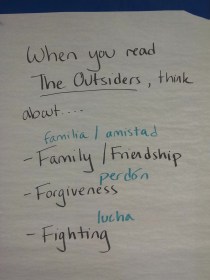
  1. A visual reminder of what we’re reading for when we’re reading The Outsiders
  2. A mini-lecture on the chapter.  After I summarize the chapter, I choose a passage and my readers help me write an entry.  I make sure my passages reflect “small moments” of the book instead of the plot-heavy moments of the story to show how careful reading leads to intellectual rewards.
  3. A group “crowdsourced” journal entry on my chosen passage. This requires a lot of fast, on-the-spot teacher thinking, as I will call on one student to begin the entry and another student to provide a follow-up sentence.  I like the idea of composing a paragraph in real time under real demands, because it allows me to ask the questions that writers should be asking when they write, like “What more can I say here?” and “Do I have any evidence to explain this idea?”  Later on, I post each class’s journal entry for other students to see and appreciate.  I emphasize that four different classes will have four different readings of the same scene.
  4. Time for individual journal entries on one of our four major ideas.  I invite students to post-it note possible scenes to write about as they read, through I don’t require it and I don’t encourage students to annotate as they read, either.  (Incidentally, my low-stakes approach to post-its has resulted in more student requests for more post-its than I ever thought possible.)  Most students have a scene or two that they want to take ownership of in their own notebooks.  Some students will continue the conversation we had as a whole class in their own notebooks, taking the scene I chose and adding something new to it.
  5. Time to share our thinking at the end of class.
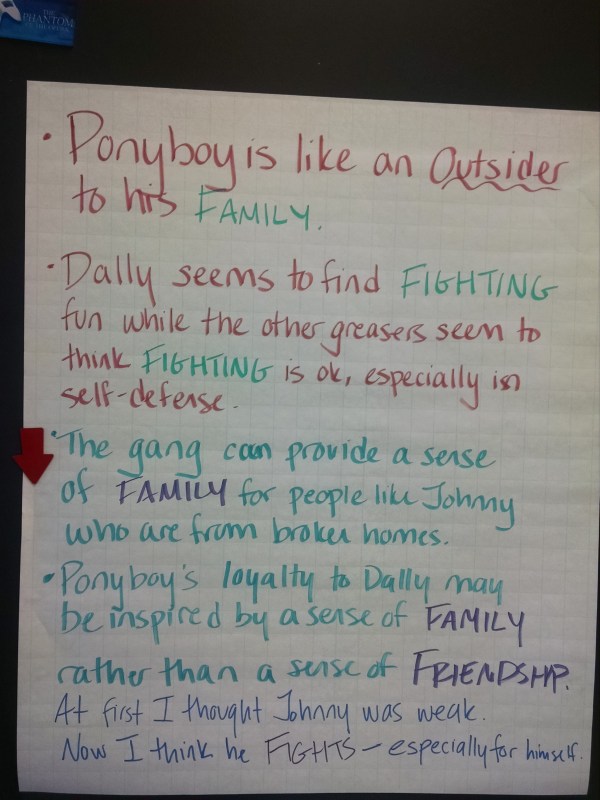
I also post and tracking some of the “greatest hits” ideas, ideas that I know will inspire strong thesis statements once readers finish the book.  By the time students prepare to write an essay, they will have a menu of student-generated thesis statements along with their own thinking about the book to reflect on.
IMG_20170303_075827356

Adapting this teaching to other books.

I was thinking about how I might teach other works using the same approach.  Here’s one thing I’ll say to high school teachers in particular: if you try this, you’ll find yourself making careful decisions about what you really want students to know and what you will let them figure out on their own.   It means letting some “juice” of the book drop and appreciating that you won’t have time to discuss the importance of every reference with every student.

For example, if I were teaching The Great Gatsby, I think I would let readers encounter and interpret the Valley of Ashes and Dr. T.J. Eckleburg on their own.  I would want to instead focus on Nick’s first description of Gatsby as a quasi-Moses figure and the fact that he dropped out of St. Olaf College — small details that lead to powerful and enduring interpretations and ideas.

Some suggested ideas and topics for popular high school books:

The Adventures of Huckleberry Finn

  • Civilization
  • Friendship
  • Trust
  • #ownvoices (if you aren’t familiar with this twitter hashtag, look it up!)

The Great Gatsby

  • Sin and Religious Iconography
  • Money

Macbeth

  • Greed
  • Lies/Lying
  • Power
  • Dreams/Reality

How are you using workshop methods and thinking to approach whole class novels?

Amy Estersohn is a middle school English teacher in New York.  When she was in middle school, her favorite authors were William Shakespeare and Meg Cabot.  Follow her on twitter @HMX_MSE

Q & A: How do you confer with readers without causing a distraction?

Questions Answered

Recently, I facilitated a readers-writers workshop training with a small team of brilliant teachers in Minneapolis. We shared an inspiring two days together, exploring and discussing how to shift instructional practices to allow for choice, challenge, and the authentic moves readers and writers make as they mature in their craft. In these trainings, I tend to talk a lot about conferring. I think it’s the linchpin that makes all the essential parts of a workshop pedagogy work. (It’s also the thing I still struggle with the most.) Towards the end of our time together, one young teacher said, “Have you tried everything? It sounds like you’ve tried everything.”

Pretty much.

At least it feels like it. I’ve pretty much tried anything and everything I think will help my students want to read and write — and want to improve as readers and writers. (I am still learning. Send me ideas!) And when it comes to conferring with my readers, I’ve tried a lot of things.

One thing I know for sure:  The expectations we set matter — a lot.

When I work with teachers, I get this question often:  How do you confer with readers without causing a distraction?

I don’t. I want to cause a distraction, especially for the one student I’m conferring with at that moment, perhaps for the couple of students sitting near enough to listen into our conversation, maybe for the student across the aisle who needs to know it’s not as scary as she may think to talk to a teacher about a book.

Besides — I may only distract a reader for a moment before I move on to the next reader. Right? And with a class of thirty students, it may take several days to loop back around to distract that reader again.

Sure, I could ask students to come to me — maybe at my desk or at the side of the room or just a step outside the door (I’ve tried all these locations), but scooting up in my rolling chair, or kneeling beside them, at their space seems much more authentic to me — less threatening, more inclusive. In my experience, our conversations are richer when my readers share their space with me.

I know it can be hard to concentrate and read when someone is talking, even in whispers, to someone else a couple of feet away. (I tried reading on a plane yesterday, but the couple next to me kept talking, talking, talking, and I finally took a nap.)

Expectations matter. If we build a culture of reading within our learning communities, where all students know we expect them to read during sacred reading time, and all students expect us to talk to them about their reading lives, every student will come to expect our conferences. It’s part of the overall workshop routine. It’s a huge part of what makes self-selected independent reading work on the daily.

The weight of the distraction just doesn’t come close to the impact of regular one-on-one conversations with our readers.


Note:  This post is a part of a series. It’s based primarily on the most frequent questions about readers-writers workshop asked at our workshop trainings. For more see here.

Amy Rasmussen lives, loves, and teaches in North Texas. She will be at a new-to-her high school in the fall — teaching seniors! This week she is in Chicago at a conference sponsored by The Poetry Foundation. So cool! If you have questions about Secondary Readers-Writers Workshop, shoot her an email amy@threeteacherstalk.com. While she doesn’t claim to be an expert, Amy’s been imperfectly practicing the routines of workshop for a long time. Maybe she can help.


To Flex or Not to Flex:  I’ve Been Thinking about Flexible Seating

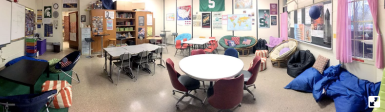
Being a new teacher at school this past year, I was the recipient of the “new English teacher classroom” that has been passed down for the last two years.  This classroom is located at the far end of the cafeteria, literally in the cafeteria, and came stacked with rows upon rows of forward facing desks, equally spaced in rows, all facing the front.  So industrial revolution-esqe. So not ideal for cultivating a welcoming environment where students to take ownership of their learning by interacting with one another to question and create meaning.

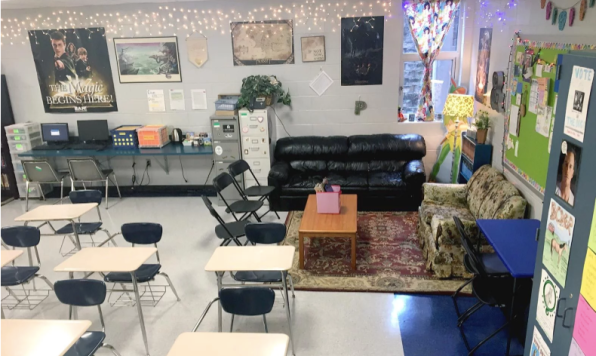
In the hopes of making my corner of the school more welcoming and conducive to English work, I slowly began to create flexible seating areas.  I built this up over the school year, finding more cozy chairs, lights, and touches of home to add, but I will confess: I don’t love my flexible seating classroom.


IMG_1500

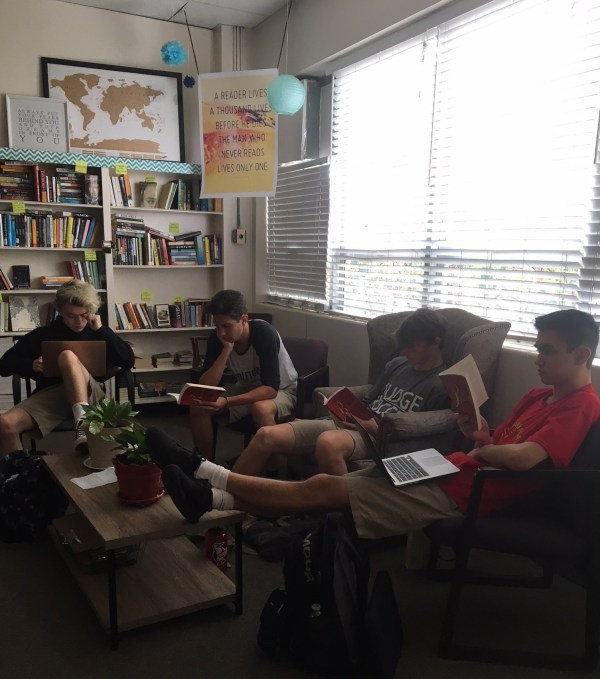
Isn’t this how we want all students to read in a Book Club?!


Let me explain, as there are pros and cons to everything.

Positives:

  1. Students are pretty chill and calm in class (also see Issues #1).  Students are relaxed because the lights aren’t blazing overhead and the furniture creates a homey vibe.  Students enjoy a break from sitting in the rigid desks that are too small for some or built for right-handed writers.  They also have more space for their books, laptops, and notebooks.
  2. Students can settle into our reading time.  I’m not sure about you, but I don’t read for pleasure at home in a rigid desk, sitting straight up.  I read on the couch settled to my gently snoring dog, or I read in an armchair with my slightly overweight dog, or I read propped up on pillows in my bed with my dog who sprawls out to cover half the space.  While I can’t bring Bounder to work (I wish!), I can create the transference of reading atmosphere from school to home.
  3. Students have a choice over where they sit depending on how they’re feeling or what type of work we are doing.  I had a few students who changed seats every day, and some who stuck with the same place. Sometimes a student would move to a new seat halfway through the class, usually to a desk or table after reading time.  This makes seating charts completely unnecessary and beside the point (woo!). Students also exercise soft skills, like compromise and problem solving, when they negotiate their daily seating choice.
  4. I can easily circulate around the room, accessing each student without having to disturb their neighbors in the tight rows of desks littered with backpacks.  Students also have access to one another.


Issues:

  1. Students are pretty chill and calm in class (also see Positives #1).  Sometimes the siren song of the plush armchair is too much to resist, and even my most engaged students are sucked into a nap.
  2. Students cannot see all of their peer’s faces at one time.  I didn’t realize how much it would annoy me, but I realized that to me, eye contact equals engagement.  Sometimes, this led to group conversations versus whole class conversations, as one side comment turned into a table chat.  While there is less of a “front of the room” as students are not all facing the same direction, this can be an impediment to the building community at times.
  3. While student seating is flexible, room configuration is not. I only have one projector and whiteboard, so there is a distinctive front of my room, which all the chairs have a vantage point of.  I have a collection of regular desks, two large tables with, a small table with chairs, and a living room set up with larger chairs and a coffee table. There isn’t much flexibility for reorganizing the shape of the classroom to support instruction, aside from group work.  Moving the furniture into an inner-outer circle is near impossible, especially given the four minutes between preps or short precious 40 minutes I spend with students.
  4. Creating these flexible spaces costs money out of my budget.  In total, I think I spent a little over $200. I debated–$200 in books for my classroom or $200 to buy old furniture.  I debated, that is a lot of book money, but figured options for seating would help me cultivate a welcoming, comfortable classroom environment.
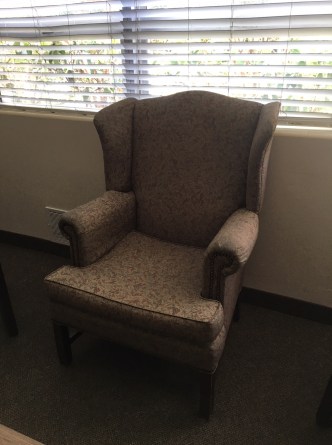
  5. Students are always jostling for the biggest, most plush chair, which I suppose cuts down on tardies, but also calls for a bit of regulation of the most coveted chair on campus by me.  This guy: 

IMG_1657

I learned a lot from this experiment and while room 104 has received a total facelift, there are some kinks to work out.  In the fall, I will set guidelines, not rules, to help form clear expectations for next year for how to navigate our space.  I will encourage students to select a new seat each week, so one group doesn’t always sit around the coffee table and students are mixing the voices they’re hearing.  I will also teach the importance of connection and looking at the speaker. Not doing so creates pods that are isolated versus cohesion as a full group.  I will continue to reserve the right to ask students to make a new or better choice in their seating, as well as use the sections of the classroom to a group and regroup as it best fits instruction.  I will also scour the local Goodwills for smaller tables and different chairs that are both more comfortable and flexible.

Aside from the lack of flexibility in the layout and money borrowed from my book budget, I believe creating a classroom with flexible seating was worth it for students. I adapted the “weird classroom in the cafeteria,” as one junior put it, into a space students feel welcome to breathe and relax a little during the day–there is something about being out of a desk and making a choice.  At the end of the day, if students are happy and like the setup, I can be satisfied with that.

Any flexible seating transition suggestions, guidelines, or ideas?  Please share them!


Maggie Lopez is enjoying summer vacation and hopes all of her teacher friends are doing the same.  You can find her on Twitter @meg_lopez0.


Book Talks, Choice Reading, and Fast Food Drive-Thrus: A Return

Three Teachers TalkJoin us for a summer series revisiting our top posts from this school year, and please “turn and talk” with us in the comments section each week!

This post from guest writer Amy Menzel struck a chord with readers in 2019. Amy writes here about ‘aha’ moments that strengthened her convictions about choice reading.


I can’t put my book down. I’m (finally) reading Extremely Loud and Incredibly Close and I am loving it. I book talked it a week ago and I’m 75 or so pages from finishing. I’m not sure why I didn’t read it before! I’ve book talked it before, so I assume I was so engrossed in another title that this one had to wait. Anyway, I’m already anticipating a serious book hangover upon finishing.

As I crawled into bed and turned on my reading light last night, I had two lightbulb moments. In addition to the obvious one, there was the realization that I am not rereading a book for the eleventy-seventh time this year. In fact, I haven’t reread an entire book for the past two years. Not that there’s anything wrong with that. But there may be something misguided about an English teacher focusing all her efforts on teaching the same few books year after year.

I spent nearly the first decade of my high school teaching career doing just that. I could still deliver a solid lesson on To Kill a MockingbirdFahrenheit 451The Great Gatsby, or The Kite Runner at a moment’s notice. Give me an hour or so to prep and I could review layers upon layers of annotations in my personal copies of each and make a solid lesson a good one. But I’ve been there and done that. Sure, I found new insight with each reread, but I don’t think enough to warrant the time it took. I’m not convinced my lessons got that much better from year to year, despite my thoughtful (and time-consuming) planning and preparation. And, really, that shouldn’t surprise me.

Writer Haruki Murakami once tweeted, “If you only read the books that everyone else is reading, you can only think what everyone else is thinking.” And, there I was, only reading the books that I had read, and only thinking what I had thought. I mean, I added related readings to ever-expanding text sets and used new pedagogical practices, but I was basically the academic equivalent of a Taco Bell drive-thru. It was all the same stuff just packaged differently.

That’s no way to live. It’s no way to grow.

amy 1

I see my job as an English teacher much differently now than I did as an eager newbie. I’m still eager, alright, but I also have this sense of urgency. Part of it is that I teach seniors now. And second semester Senior English is basically the pressure cooker of secondary education.* I have 90 days to help students identify as readers. Let me tell you, it’s not going to happen with a traditional approach. At best, a traditional approach might convince them that reading is “not that bad” as they grind their way through a couple assigned books (or the SparkNotes of a couple assigned books) that they may or may not find all that engaging. I’m striving for more than that.

I don’t have a lot of time with these young scholars and there’s no time to waste. It’s time they find books that intrigue them, inspire them, and challenge them. It’s time they find books they actually want and will read. And it’s really important that we shift to students finding their own texts. “Real world” readers don’t read because some lady named Mrs. Menzel tells them they should. They read because they find books that speak to them. Of course, I’m here to help. I book talk a new title every single day. I make it my job to play nerdy cupid and match the right title with the right reader. It all takes a lot of time. But not more time. I’ve simply reallocated my time. I don’t spend hours rereading the same books and turning last year’s burritos into this year’s enchiladas. Instead, I read. For real. I read a lot. I read books I want to read and books recommended by librarians and students. I read novels and nonfiction and graphic memoirs and collections of poetry. I read magazine and newspaper articles and blog posts and lyrics and scripts and transcripts. And I share what I read. And I ask students to share what they read. And we talk about it and we write about it.

amy 2my book board, featuring all the title’s I’ve book talked this year so far
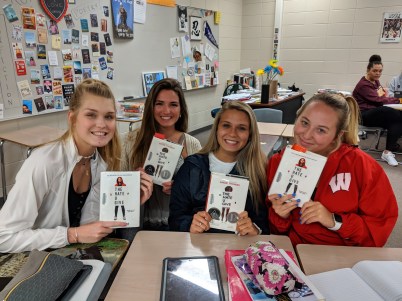
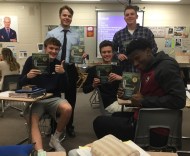
And I’m finally living a reading life I want my students to follow.

(And look at them follow!)

*I’m pretty certain this analogy checks out. It sounds good. Truth be told, I’m much more Taco Bell than I am pressure cooker kinda person in the nonliterary, culinary sense.


Amy Menzel finished Extremely Loud and Incredibly Close nearly seven books ago. She just got around to revising and submitting this guest post because teaching. She knows you understand. You might also understand why she’s contemplating spending $20 on this “SAVE THE WORD TACOS” t-shirt. She hopes you have a great end of year and a fantastic, restful summer filled with great reads.

Q & A: How do I know what mini-lessons to teach? #3TTWorkshop

Questions Answered

When I first started trying to implement readers-writers workshop, I was the master of the quickwrite and pretty much nothing else. It wasn’t until after a lot of volume writing that didn’t go far in helping students improve in style or structure that I knew my instruction was missing something. I had to teach into these quickwrites. Ohhh.

Over time, I’ve learned how to develop lesson plans that not only engage students in the non-negotiables of workshop instruction, but to actually feel confident that I am teaching the ELAR standards.

We all have standards, right? These might be Common Core —  or determined by whichever state we teach. Texas has their own standards (Of course, it does).

The beauty of workshop instruction is that we can practice independent reading and writing — and teach into students’ skills development independently. We just have to plan accordingly. . . and leave space, knowing we will do more on the fly.

Take a look at this —

Minlessons

So how do we know what mini-lessons to teach?

When planning, I start with my state standards. In Texas we have Student Expectations, SE’s. Each one of those can be a mini-lesson. I introduce the SE to students, model what it looks like in a text or task. We discuss, question, and practice it by applying it to our own independent reading or writing.

Then, I pay attention. Sometimes, based on formative assessment or conferring, I may need to teach the mini-lesson again to the whole class, or sometimes small student groups or specific individuals.

These are the mini-lessons I plan in advance. However– and this is a big however — just because I know I must “teach” the standards, does not mean readers and writers must “master” them. (Don’t even get me started on standardized testing.) When it comes to writing, especially, student writers may choose not to apply specific moves in their own writing. That’s the beauty of teaching writers instead of teaching to rubrics or a specific format (Ugh, five-paragraph essay). Real writers makes choices depending on their intent for meaning and their audience. I love how Linda Rief explains more about this here.

So what do responsive mini-lessons look like?

These are the pop ups — the ones I know I’ll need to teach on the fly — based on what I see in students’ learning and growth. Maybe students are struggling with strong thesis statements or putting punctuation in places that actually aid the meaning of their sentences. I respond to their needs, and I teach specific mini-lessons, using mentor texts, to help students see how language works to craft meaning.

There is no list of mini-lessons we may teach in any given year. Your students’ needs are different than mine, and probably different than the teacher next door. Lean in, listen, identify their needs as readers and writers, that’s the best way I know how to know what mini-lessons my students need me to teach them.


Amy Rasmussen has taught all levels of high school English, except AP Lit, which is still on her teaching bucket list. She lives in North Texas and will be at a new-to-her high school in the fall. Alas, all gap years must come to an end. Follow Amy on Twitter @amyrass — and if you have questions about Secondary Readers-Writers Workshop, shoot her an email amy@threeteacherstalk.com. While she doesn’t claim to be an expert, Amy’s been imperfectly practicing the routines of workshop for a long time. Maybe she can help.

Three Ways to Go Public with Your Reading Life

We all know that part of building a community of readers in our classrooms and in our schools requires modeling the behaviors and habits we are trying to promote.

The question for me, though, has been how? How do we model our reading lives at school when we do most of our reading at home, on vacation, or while in the waiting room during our own kids’ orthodontist appointments? Our students certainly don’t have access to those moments, so modeling a healthy reading life can be a challenge.

Of course, we do read at school sometimes. But school is busy, and while our students are reading we are submitting our attendance records, welcoming in the occasional tardy students, and conferring. It’s difficult to model the behavior we want to see in our students because of all of the tasks teachers do.

This past school year, our school tried three different easy strategies for sharing our reading lives and habits with our students. They aren’t revolutionary, new, or difficult, but they worked, and I think they are worth sharing.

  1. We put laminated signs on everyone’s classroom doors. Sticky notes and scraps of paper were used for posting our current titles, and students regularly noticed and commented on different titles throughout the year. 65535402_2081290802172377_7501378884630216704_n2. After finishing our books, we took the sticky notes and scraps of paper and posted them in the secondary office of our school. This is a place where students and teachers are in and out every day, and it was on a highly noticeable wall. This bulletin board was a great place to get “next reads” suggestions, and sparked conversation between students, teachers, and other staff. 65977219_652574388573414_1805783836705947648_n
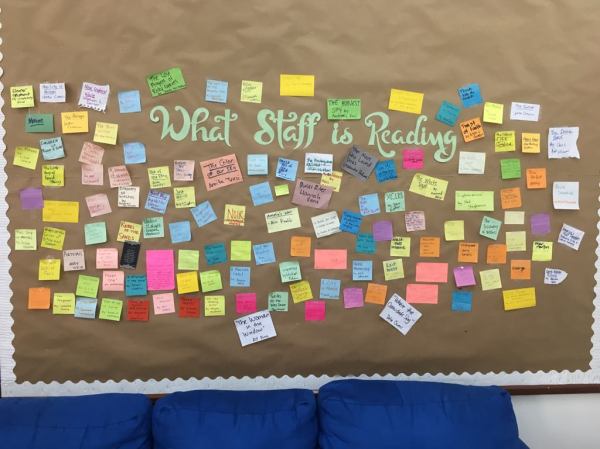
  1. Some teachers kept a list posted in their classrooms. I kept mine on my classroom door right next to my current reads sign so that when I changed out the titles, I could easily add it to my list.

One of the benefits of going public with our reading lives like this is it has motivated me to read through many of the books in my classroom library and in our school library. As I read through my classroom library, I got to know the books better, and I was more deliberate about book talks and about recommending titles to individual students.

While posting titles isn’t exactly the same as modeling the reading behaviors and habits we are trying to instill in our students, it’s close. It’s a visual reminder to our students that we read. It’s a way to show students that we aren’t asking them to do anything we aren’t willing to do ourselves, and it’s a great conversation starter when it comes to building next reads lists and encouraging independent reading habits.

Next year I will use these same strategies, and in addition I might try to get my students involved in the same type of board — a “What are the students reading?” bulletin board in our classroom where students can share titles and recommendations with each other.

How do you model a healthy reading life to your students? I’d love to learn about more strategies and ideas!

Julie has been teaching secondary language arts for twenty years, spending the first fifteen in rural Central Oregon,  four in Amman, Jordan, and the most recent school year in Managua, Nicaragua. 

Follow her on twitter @SwinehartJulie

Binge Learning: New Episodes Available Now –Guest Post by Karry Dornak

Summer me, 1995: No cable. Has four local channels: 6, 10, 25, and 44. Watches classic TV shows (The Addams Family, The Beverly Hillbillies) because it’s either that or soap operas. Also sits patiently through commercials.

Summer me, 2019: Highly annoyed that I can’t binge The Handmaid’s Tale because Hulu only releases new episodes weekly. Too impatient to sit through sixty-second ads; considers paying double the amount for the ad-free subscription.

Screen Shot 2019-06-13 at 1.58.44 PM

Wait, how did I go from watching thirty-year-old sitcom reruns complete with low-budget commercials for personal injury attorneys to feeling entitled to an entire season of a just-released show with absolutely no ads (and why are they no longer called commercials)?

Because on-demand access to content is a given in today’s world. Except, sometimes, in classrooms.

So I’ve been thinking, how can we make the content in our classrooms (the lessons, the skills, the texts, even the assessments) less Summer ‘95 and more Summer ‘19?

  1. We have to be okay with handing control and ownership of learning over to our students. Teachers are no longer the keepers of knowledge like they were in 1995. What if we thought of our lessons as “episodes” and our units as “series?” Could we release an entire season at once to allow our students to “binge” and work through the material faster than if we release one lesson at a time? Check out Kelly Gallagher’s blog post on building volume in your classes. Even though he and I approach the topic differently, I think we share the same goal.
  2. What if we could create a simple algorithm (check out how the Netflix algorithm works here) to personalize learning for our students? I’m thinking it would need to be two parts: an interest/genre survey plus an ongoing standards-based assessment checklist. The genre survey would ensure that I am equipped to recommend texts based on a student’s interests, and the current standards-based assessments would help create specific and personalized learning paths for each student to follow with their text.
  3. How can we remove “ads” from our learning experiences? In other words, interruptions to the real learning? These may be masquerading as “activities” that seem fun and purposeful to us, but the students may just be wanting to fast-forward through them to get it over with.

The bottom line is, we have to remember how our students are used to accessing content and information. It may not be how we grew up, but we do share some of their same expectations for instantaneity and personalization. While we may not have all of the answers for how to make this happen in our classrooms, I think it would be fun to try.

The results just might surprise us.

Karry Dornak is waiting: for next week’s episode, for the third book in the Scythe trilogy, for education as a whole to catch up to the 21st century. She would love to hear your ideas about making this a reality! Connect with her on Twitter @karrydornak.

What Secondary Teachers Can Learn From Elementary Teachers: A Return

Three Teachers TalkJoin us for a summer series revisiting our top posts from this school year, and please “turn and talk” with us in the comments section each week!

Angela’s post from 2018 is full of takeaways the secondary readership can glean from elementary practitioners. 


I sat outside my son’s first grade classroom helping students practice handwriting skills one day when a lightning bolt hit me.

Kids were in and out of the room, going to reading group, using the restroom as needed. When I finished with a student, they’d quietly walk in, tap the next person on the shoulder, and out they’d walk. As a high school teacher, I was enthralled by the bustle.

When I went into the classroom to touch base with the teacher, I continued to look around in amazement. Kids were everywhere. More importantly, they were working with purpose and focus. Some kids were lying on bean bag chairs reading. Others around a kidney table with the teacher. Another cluster of kids were sitting at their desks, working on bookmaking, tongues hanging out in determination. It felt like magic.

Screen Shot 2018-10-18 at 5.36.07 PM

I know it’s not magic, though. The teacher had made deliberate choices to nurture this environment. To be honest, though, it took me a moment to be open to this aha moment. At first, it felt like chaos. But when I took a step back, I realized that this wasn’t chaos I was seeing. It was productivity. It dawned on me that my high school classroom rarely had this kind of energy. I wondered, if these seven-year-olds could be taught how to work like this, could I create opportunities for older kids to do the same?

Some of my takeaways from spending time in elementary classrooms:

Classroom Set-up

Rocking chairs. Flip charts. Book bins. Cozy Rugs. Desks in clusters (rather than rows which Tom Murray recently referred to as “the cemetery effect”).

Elementary classrooms feel different. There’s an energy, a flow. The room often hums. When I’m in my colleague’s elementary classrooms, I’m struck by how different they look from my classroom setup. It’s not just the posters on the wall, or the rugs on the floor. It’s that the room feels like it belongs to students. Books students care about are on the shelves. The rooms are a welcoming space, which leads to students engaging with the content differently. They’re not just receptacles; rather, they see themselves as much a part of the space as the teacher. And everything in the space has a purpose.

I’ve been loving the ways that teachers are incorporating flexible seating and I think that even if you haven’t won a grant or launched a Donors Choose campaign, there’s a way to get creative about the space. I know I sometimes worry that kids will talk too much, or goof off. I remind myself, though, that when students are engaged in workshop practice, then I’m coaching them into independence. And if I can easily move around the room, I can cut off much of that behavior.

To read more about how we might set up our rooms, check out Kristine Mraz and Christine Herz’s book Kids First From Day One.


Routines

I notice that in elementary school, teachers spend a lot of time explicitly teaching routines for how to utilize the spaces. They build on what’s happened in year’s past, reminding students that they come ready with a whole skill set. They focus on those rituals as much as they focus on the content, especially in the beginning.

Sometimes, we teachers of older kids fall into a deficit thinking trap. I sometimes hear teachers say, “My students can’t do that [insert collaborative/independent work here].” I wonder, though. When they were seven and eight they were doing that work. How might we channel some of that muscle memory from their early learning years?

What would happen if we teach our older students explicit routines for work time. Teaching them explicitly what the room should look like and sound like when they are independently working. And of course, we know that older kids are different. Reinforcing the routines reground them.

Conferring

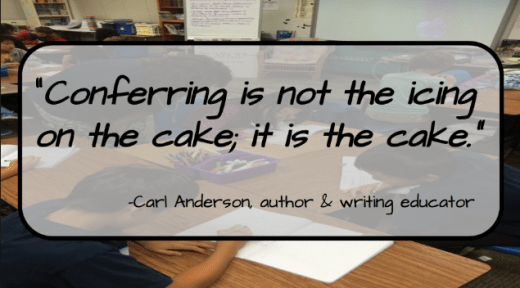
We know that conferring is one of the most powerful tools in our teacher tool box. Carl Anderson reminds me to ask kids, “how’s it going?” Kelly Gallagher & Penny Kittle show me how powerful conferencing is in their work. An effective conference can be the most impactful thing we do all day.

I also know that this is really really hard to do. Not only because of time constraints, but also because when I’m conferring, other students feel like it’s free time. Suddenly there’s whispering and laughing. While I’m chatting at my desk with a student during a conference, I often find myself saying, “Hey, everyone get back to work,” disrupting both my conference and the students who might have actually been working.

Screen Shot 2018-10-18 at 5.50.04 PM

What if instead I channeled the elementary teachers I know? I notice when I’m in their classrooms that their conferencing happens right where kids are sitting. They crouch next to students, leaning in, having whispered conversations.

This kind of conferring cuts down on transition time. Students aren’t walking across the room. Instead, they’re able to turn right back to their work and apply what they’ve talked about. And the teacher doesn’t have to wait on kids to gather materials and walk to the desk. Those minutes are precious, and I notice that when the teacher is where the work happens, more conferences can take place.

Small Group Instruction

Conferring isn’t the only way to have those smaller settings with students. Sometimes I forget that it’s not an either/or — we either work whole group instruction or 1:1 conferring. After having the same conversation three times in 1:1 conferences, I realized I needed to be more efficient with my time.

When I’m in an elementary classroom, I’m reminded of the power of small group instruction. I thought back to the way I saw my son’s teacher gather five students around her desk to teach them all the same skill. While the rest of the class was working independently, she was able to re-teach or extend the learning. I noticed too that she was able to target their needs in specific ways.

Whether it’s at a kidney table, or clustered around my teacher desk, I wonder if I could have students come to me in smaller groups.

Don’t get me wrong, I know that secondary students are different from elementary kids. They’re louder, bigger, and sometimes have checked out of school by the time they get to us. I try to remember, though, that they’re still kids. And when what I have been doing isn’t working with them, then I wonder if maybe it’s time to try something different. I think back to the students they once were, and I wonder if channeling some of those structures from their elementary days might make our days feel a little more magical.

Angela Faulhaber is a literacy coach in the Cincinnati area. She’s currently reading Greeting From Witness Protection by Jake Burt, based on the recommendation of her 11-year-old daughter. She’s also trying to figure out how it’s mid-October when it feels like school just started. 

Q & A: How do I do this on my own without other colleagues teaching this way? #3TTWorkshop

Questions Answered (1)

Believe me when I say I understand. Completely. I think many other teachers who took off the old shoes of making all the choices in their English classes and tiptoed, stomped, or danced into workshop instruction understand, too. Sometimes we are the only one hearing the music.

This was me most of the time.

Of course, working with colleagues in highly functioning PLC’s is advantageous. If we’re lucky, we’ve been in a few grade level teams, or even full departments with colleagues who embrace the choice and challenge readers-writers workshop offers and collaborate well. Other times we have to stick with our knowledge of what works best for growing readers and writers and make our own instructional choices, based on what we know is best for the students relying us in our own classrooms. It’s always our own students who matter most.

So how do I do workshop on my own without other colleagues teaching this way?

Here’s the advice I got when I asked a similar question to someone with a whole lot more experience than me in all things authentic reading and writing instruction:   Nod your head a lot, and then close your door.

That’s pretty much what I did for the first eight years when I was figuring out how to manage a classroom library, give students choice in the books they read, hold them accountable in some way for their reading, get them writing more (and better), using mentor texts, conferring semi-regularly, and trying not to lose my mind when I’d go to team meetings and hear “I’m teaching ________ (insert title from the canon) and making students do study questions, along with these specific annotations. Do you want a copy of my test over the book?” Thanks by no thanks.

We teach readers, not books. And maybe it’s just me, but when I hear teachers say “I make my students do ____”, I kind of cringe. Study questions, annotations for all (done with a teacher’s specific rules for notes instead of the reader’s own rules), and tests over books:  Sandpaper on teeth.

When I shifted my instruction to include choice, student engagement soared. I was converted, and I hungered for more ways to fully move into workshop instruction. But at the time, I was the only convert on my campus. I was lonely there.

However, I had company outside my school. Everyone who determines to make this shift does. You may just have to find it.

First off, there’s this blog. I started it with two brilliant teachers, Heather and Molly, I met at a summer institute of the North Star of TX National Writing Project, a site of National Writing Project. We wanted a place to write about how we applied our learning from our institute with our students, and we wanted a space that helped us stay connected. I was teaching at a Title I high school in a district just north of Dallas; Molly had just moved to a high school with a focus on project-based learning in Longview; Heather taught middle school in a district east of Ft. Worth. (If you know north TX, you know we spanned a distance geographically.) I tell you this history for a few reasons:

The National Writing Project advocates for authentic writing instruction, and it is one of the best networks of educators, willing to collaborate and share, I know. If you can link to a site near you, you will never do this work alone.

Three Teachers Talk has grown as my learning about workshop instruction has. Heather and Molly moved in exciting career directions different than mine, and at times this blog has really been one teacher talking as I tried to figure things out. (Note: Writing helps us figure things out.) Then, when I attended the University of New Hampshire Literacy Institute and took a two week class taught by Penny Kittle, and learned with Shana, Erica, and Emily, a similar blog-writing collaboration happened.

We started writing regular posts here called Our Compass Shifts because we were all working to shift our thinking about instruction and apply the learning from Penny’s class with our own readers and writers. Our teaching souls clicked. The Modern PLC. Emily and Erica wrote with us for awhile, but like Heather and Molly they moved on to other good things. We remain friends, but Shana — Shana remains as Diana exclaims of Anne in Anne of Green Gables, my “bossom friend. A bosom friend—an intimate friend, you know—a really kindred spirit to whom I can confide my innermost soul.”

To continue improving, growing, striving to do right by our students, I think we all need at least one bossom friend. I’ve got two in Shana and Lisa, two of the other admins on this blog. (Angela, you’re up-and-coming.)

I had to find them though. I couldn’t keep my classroom door shut and not step in to learning opportunities that helped me grow. Growing takes action.

So how do I do workshop on my own without other colleagues teaching this way?

Seek out connections with others who are making workshop work. All of the contributors on this blog have been where you are. Read their posts. Leave comments. Ask questions. Email me directly if you can’t find answers amy@threeteacherstalk.com. Like everyone else in the teaching world, I’m busy, but I will do my best to help. (And your questions may turn into blog posts. That’s how I met the amazing Lisa Dennis.)

Join a network of passionate educators on Twitter. There’s chats for you. #TeachWrite #DistruptTexts #buildyourstack #3TTworkshop #titletalk #NerdyBookClub #APLitchat #teachlivingpoets all come to mind. So many teachers moving the work of choice and challenge — and equity — forward. If you are new to Twitter and don’t know who to follow, follow us @3TeachersTalk; then, check out who we follow — educators like you.

Read books by those who’ve built a movement, and join in on discussions. Some of our favorite teacher-writers are active on Twitter, and they share brilliant ideas regularly. Thomas Newkirk, Tom Romano, Penny Kittle, Kelly Gallagher, Linda Rief, Cornelius Minor to name a few.

Also, Shana put together a fabulous resource page here. It’s not exhaustive, but it’s a good start.

I know joining chats, reading books, and connecting online does not replace collaboration on a campus, but it does work to help us grow in our practice.

Just like my daughter has online friends who are in the #houseplantclub, and my sister has online friends who play Pokemon Go, teachers — eager to make workshop work for their students — can find the support they need to make this ever-important pedagogy of engaging students as they grow in their identity as readers and writers work.

Press on, my friends, we are here for you.

Amy Rasmussen calls herself a literacy evangelist –among other things. Wife to a lovely man, and blessed to be the mother of six and grandmother of seven (five of which are boys), she loves to read and teach and share ideas that just might make the world a little brighter — for everyone! Follow her @amyrass — and join the conversation around workshop instruction on the Three Teachers Talk Facebook page. Go here see other Q & A posts about Secondary Readers-Writers Workshop.

I’ve Been Thinking…About Heroes (Or What I’ve Learned from Eighth Graders This Year) Guest Post by Elizabeth Oosterheert

Theater1

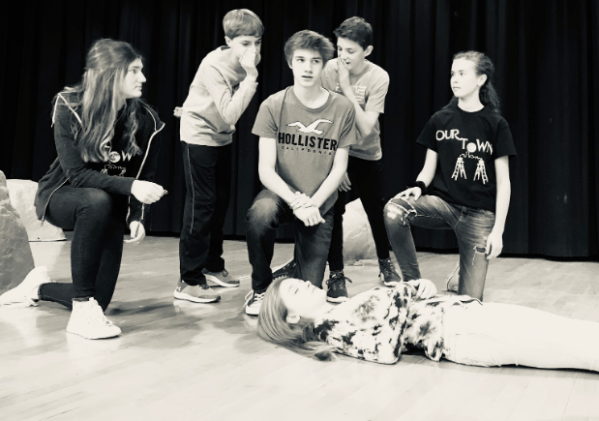
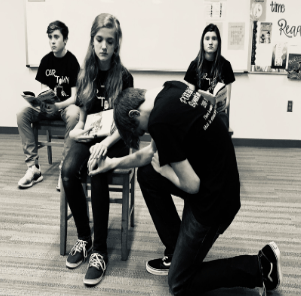
Eighth Grade Theatre Troupe members rehearse a scene from Peter Pan

Every great story has a beginning, middle, and end, not necessarily in that order.

We are all great stories…Phil Kaye

As the first days of June open like flowers, I’m thinking about the courage, complexity, and vulnerability of the eighth graders I taught this year…and all that I learned as we wrote together, and spent time on stage.

My students suffered. They experienced everything from abuse, to the death of a parent and coach, to Stage IV cancer. It was heartrending. And it was glorious, because they used tragedy to craft some of the most beautiful, honest writing I’ve ever read from middle school students, and their wounds gave them authenticity on stage, as many of them joined my theatre troupe.

What were our favorite mentor texts?

TheaterIn  writing workshop, my students’ favorite things to compose were Spoken Word poetry and film analysis. When I asked students what their favorite mentor text was at the end of the year, most of them chose “Tony Steinberg: Brave Seventh Grade Viking Warrior” by Taylor Mali.

In a poem that Mali says took him three years to write, he recounts what it was like to lose a seventh grade student to cancer, and also incorporates some of his best teaching memories.

Mali masterfully employs the metaphor of the Viking ship,  their belief in Valhalla, and the importance of dying valiantly in battle.

Students selected a captivating line or  image from the poem, and wrote from that. Not surprisingly, in a year when cancer was impacting so many of my students’ families, this poem resonated with them.

Following is an excerpt from a co-authored poem written by Trevan and Hayden, after listening to and writing beside the “Tony Steinberg” mentor text:

We’ve seen cancer take more than hair.

We’ve seen it take joy,  peace, and life.

Cancer has stolen our coach’s joy,

and torn the heart of his son like a gift ripped away from a child.

Cancer

/kansər/

A disease caused by an uncontrolled division of abnormal cells in a part of the body sometimes causing death.

Cancer can be battled, beaten like a knight in shining armor overcoming an army.

We watched it advance…


The Outsiders DallasIn addition to being inspired by Spoken Word poets, particularly Taylor Mali and Phil Kaye, my students enjoyed the autonomy of writing about memorable characters when we studied book and  film analysis. Our favorite mentor text for character study was “Katniss Everdeen is my Hero” by Sabaa Tahir, published in the New York Times.

In using this mentor text, students had the opportunity to borrow many excellent craft moves, such as the way that Tahir opened her commentary by explaining how she first “met” Katniss Everdeen.

Writing in front of my students, I imitated this craft move by sharing my first encounter with Dallas Winston, the toughest member of Pony’s gang, in S.E. Hinton’s The Outsiders.

Dallas Winston and I met on a summer’s day in 2002.

Countless colleagues had urged me to read The Outsiders, yet for some reason the book and I had never crossed paths. At the time, I wondered how a story written so many years ago could still resonate with teenagers. Days away from the birth of my first child, I decided to embrace stillness long enough to give the gold-dusted pages a try, reasoning that my advanced pregnancy made everything other than reading–from tying my shoes to my habit of  swimming a mile every morning–a challenge.

Resting beneath the branches of an ancient pine tree in my front yard, with only a few persistent sparrows for company, I read the book in one afternoon, ignoring everything but the words on the pages as the characters’ lives entranced me as deeply as any magic spell.

Of all the characters in Pony’s gang, it was Dallas Winston who hooked me from his first appearance. Dallas is a character of contradictions, claiming a stone cold heart,  yet lending his gun to two desperate boys and helping to shelter them in Windrixville. Scorning love, but ultimately dying for it. Dallas’ character stayed with me long after I read Pony’s last words about him. I wondered about the tough but broken hearted boy who died under a streetlight with an unloaded gun and Two Bit’s jet handled switchblade.. To some, he died a nameless hoodlum, but Pony knew the truth.  Dallas died young, reckless, and gallant, a true gentleman in a blood soaked jacket who got what he wanted.

So I could write much more about the  eighth grade heroes I taught this year. Like Dallas, they are gallant. They have broken hearts that are healing as they leave eighth grade and look forward to their high school chapters. They’ve reminded me that one is never too young to harness the healing power of the written word.

Elizabeth Oosterheert is a middle school language arts teacher and theatre troupe director at Pella Christian Grade School in Pella, Iowa. She loves writing, and sharing the stage with seventh and eighth graders. Her favorite stories are Peter Pan, The Outsiders, & Our Town. You can find her on Twitter @oosterheerte.