Have you ever attended professional development that reached into your soul and stirred things up so thoroughly, so deliciously, so deliriously, that you knew your teaching would never be the same?
I hope so. If not, consider packing your bags for #NCTE18 – Houston next fall. Or book some inspirational PD for your district. Or simply follow any of the heavy hitters on Twitter. Professional development is everywhere because sometimes all it takes is a few words to send you down the path of beautifully rich, and possibly practice changing, reflection.
Our students deserve teachers who see the classroom as an opportunity. Teachers who see them as deserving of unending work to help create the best opportunities for their learning. Teachers who see each day as an opportunity to build up readers and writers, as the most important work to be done in education.
The voices below, that I was lucky enough to drink in at #NCTE17 this year, speak of opportunity in every endeavor: The day to day, the conversations we have with kids, the responsibility we have to see beyond test scores, and things we can do to stay true to what we believe as educators.
Dave Stuart Jr. – Doing more isn’t doing better. Refocus your practice with a personal Everest/Mission Statement.
Mr. Stuart’s session focused on how to teach English and still have a life. Sounds lovely, doesn’t it? I’m still working on it, personally, but anyway, this sentiment stemmed from the idea that we often spend a lot of time doing things that don’t align with our true beliefs about what’s important in our classrooms. His suggestion to craft and publically post in your classroom a mission statement really hit home with me. I need to boil down my practice to stay focused on what is most important in my classroom, and a visual reminder will help me filter my stressors through what I’ve claimed is most crucial to the daily movements in our experience as a class. Often, what stresses me out most, for example, is returning emails. While important, I’m certain it wouldn’t be included in my mission statement for my classroom. Therefore, I need to set some limits to when and where I allow this work to take away from the work that will move my students forward as readers and writers. My Everest statement, so named because it’s really evident what the goal of climbing Everest is, will bring me back to readers, writers, and critical thinkers who use both their heads and hearts to guide not only our work but their lives. Work in progress.
Kylene Beers – If we raise test scores but fail to raise compassionate people, we have failed.
I thought the crowd in the theatre might come out of their seats at this suggestion. If there’s one thing anyone who has ever been acquainted with education understands, it’s failure, and we avoid it at all costs whenever possible. I’ve let this sentiment guide my 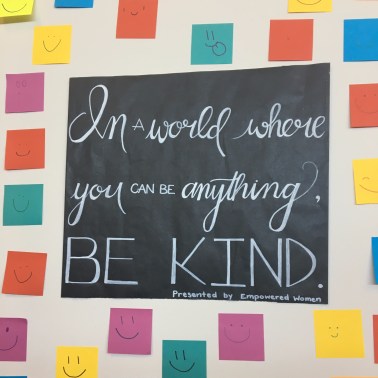 work this week specifically as it’s Kindness Week here at Franklin High School. Student need does not end (or perhaps more importantly begin) with the test scores they generate throughout their time with us, but if I can influence their capacity to better care for and understand one another, I’ve really made a difference.
Linda Reif – End in the middle of a sentence. It makes getting into the thinking again much easier.
I often have my students end their quick writes by suggesting that they should take a moment and wrap up their thoughts. I’d never considered the subtle shift of having them stop mid-thought as an encouragement to go back and finish, expand, explore, and keep at those thoughts. A quick write is inherently incomplete in terms of the time given and the depth of process used, so why suggest to students that their work should be wrapped with a nice little bow? I head back to my writing often. It’s where some of my best work grows – from the hazy suggestions I started with, to the revisited and revised thinking. Ask students to come back to their work more often. They might be surprised at what comes of it.
Kelly Gallagher – Reflected on Nancie Atwell’s quote about American schools having an aversion to pleasure.
This suggestion made me laugh out loud. How painfully true, yes? How often have I struggled to let go of the control in my classroom? How often have I feared that exploratory writing would be at the expense of preparation for the work my students would do after they left me? How often have I worried that it would be a “waste of time”  to extend a discussion or let students read just a bit longer? Far too often. As a colleague of mine famously suggested years ago, “Big Bird can’t come to class every day,” but pleasure doesn’t have to be a throwback to elementary playground free-for-alls. It can be simple. It can be personalized. But it must also be considered a worthy goal of any daily lesson planning. What opportunity for joy, satisfaction, or pleasure am I organizing for my students today? If the answer is nothing, then I wouldn’t want to be in my room either.
Tom Romano – There is language inside of you…Be fearless in heading down the page with it.
Tom said this casually before we did some quick writing in his session on multigenre writing. While I filled two pages with notes on how to incorporate a multigenre project into my classroom, this simple sentiment really stuck with me. I’ve used it several times with my students since then because I love how it rephrases the idea that we have to outwrite our inner critic. This phrasing suggests that we are already full of valuable ideas! We need simply to give ourselves permission to let them out onto the page.
What seemingly simple sentiments have changed your teaching for the better? Please share in the comments below.
Lisa Dennis teaches English and leads a department of incredible English educators at Franklin High School near Milwaukee. Her personal mission statement is a work in progress but needs to involve equal parts readers, writers, thinkers, believers, and dreamers. Follow Lisa on Twitter @LDennibaum.


 So, when we flew home on Sunday night, I got to bed at about 11:30 pm. Up at 5:00 am, Franklin had school through a half day on Wednesday. I then hosted Thanksgiving for 11 people on Thursday, managed a Black Friday marathon shop with my daughter Ellie (She’s four and up at 6 am anyway – might as well take advantage), cut down a Christmas tree on Saturday, and tried to be a teacher again on Sunday in order to tackle 70ish AP Language responses and plan for the coming week. Next week (I am so excited), we fly to Arizona to visit family for a long weekend.


 Just typing that feels like malpractice. I had an open heart and and open mind, but past practice and a limited knowledge of varying philosophies afforded me a narrow scope of imagination on the subject. My mind heard choice, voice, student talk, and for the most part, I believed I was already “doing all that.”


 Humankind. Throughout this conversation, Harari and Brand explore the idea that life is built on fictional stories that create our nonfiction existence, and if deeply examined provide the cooperative construction for all of civilization as we know it.



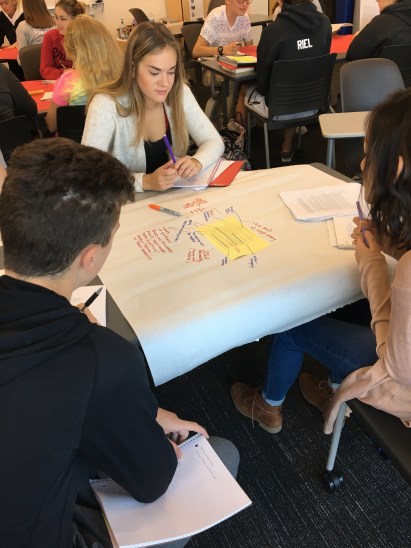 5? 78? Does flexible seating come in bunk style these days?), and an endless array of inquisitive minds, needs, and beliefs.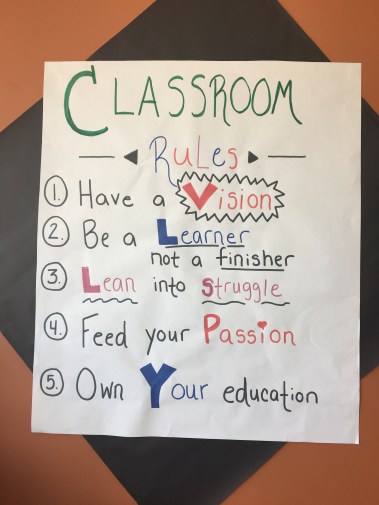
 .
. 



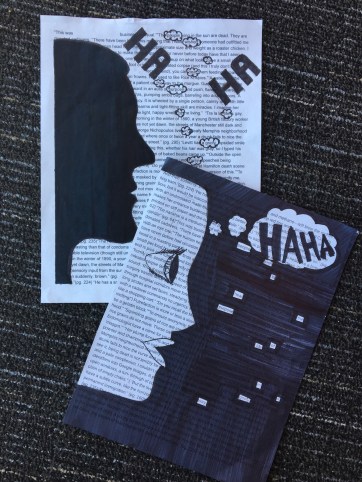 provide appropriate text evidence of the basic terminology of analysis: syntax, imagery, diction, figurative language, and detail. We wanted students to use their left and their right brains. We wanted to students to work together to solve a problem.



 throughout the summer.


 How then does it all seem to come crashing down so quickly? Where does that raw enthusiasm for “the new” become wide-eyed, survival-mode, toss-me-a-life-jacket exhaustion?
 Three Teachers Talk