Category Archives: Amy Rasmussen

Are you noticing what matters?

I learned a valuable lesson when my children were young. I do not remember the speaker who said it, nor do I remember much of anything else he said. I do know that two words changed me as a parent.

Notice them.

Notice your child when he enters a room. Acknowledge him with a hello, a question, a compliment. Non-threatening. Kind. Seems rather simple, doesn’t it? I remember thinking: “Sure, I can do that. no big deal.”

Oh, but it is — a very big deal. It’s a big deal to the child who grows in confidence, knowing we are intently aware of him as a person — an individual who matters when he walks in the room.

While i’ve been thinking and writing about conferring with students, I’ve done a lot of thinking about what it means to notice, really notice, the students in my charge. Do I take the time to speak to every student individually? What about my body language — am I open and approachable? How about eye contact — am I making it?

Last week I collected my students’ writer’s notebooks. Marked with a sticky note for me to read and scrawled on the back of one student’s writing territories was an entry that gave me pause and broke my heart. It said something like: “I remember asking my grandma about why my mother left. All she would say was that my mom said she could always have other children.”

Just that morning I’d been short with this student for not completing yet another assignment. I bit out a plea to get the work done without once considering why she’d not done it. I made it about the assignment instead of about my learner. Sadly, I do this often and have to continually remind myself of what matters.

Noticing the girl with the dark brooding eyes matters.

And once again I vow to be better than I’ve been.

from BrainPickings.org


[student writing used with permission]

©Amy Rasmussen, 2011 – 2015

Part I. Blogging with My Writers and You Can, too.

“Mrs. Rasmussen, can we write on our blogs more than just for assignments for class?”

After we set up our personal blogs, I received a similar message from several of my students. Of course, I replied, “Yes.” (Inside I yelled “YAY!!” and danced around the room a few times.)

Students want to write other than when I assign it. Wow.

And we are off…

I doubt anyone would argue that digital writing is important. Most of our students do it anyway:  texting, tweeting, commenting on YouTube videos. We might as well help them do it well.

We might as well help them share their ideas, opinions, stories, and arguments in a way that allows them to show their learning — and build their credibility as citizen scholars. That’s what I want for my students anyway. I want them to know that their voices matter. Their writing matters.

They have to have an audience other than me to truly understand that. That’s why I blog with my students.

Every year I ask student to personalize an online writing space. I’ve blogged with students when we had to reserve the writing lab. I’ve blogged with students when I had 12 computers we shared in my classroom. Another year I had an ipad cart with 30 devices. Now I’m at a 1:1 ipad school. It is easier, but it is not necessary.

If you want students to blog, you can find a way to make it work. I urge you to not let the lack of technology prevent you from at least doing something with digital writing.

Every year I try something new to help students take ownership of their blogging.  I’ve learned a few things about setting up blogs and getting students to write on them.

blogwordle

Here’s my blogging basics in a nutshell:

  • Build a case for blogging. I read “Blogging is the New Persuasive Essay” a few years back, and it helped me wrap my head around the how and why blogging works for the 21C student. I’ve even used this text as a reading piece with my students. They read, determine the author’s argument, and then have to defend, challenge, or qualify it. I can see pretty easily if a student is climbing on my blogging training willingly.


  • Conduct a little inventory of the blogsospere. Simply ask students to type “most popular blogs” into Google. Then ask them to do a bit of light reading. They might find “Top 15 Most Popular Blogs,” and they might recognize a few. They might find “The Top 10 Top Earning Bloggers in the World,” and you might see some jaws hit the floor. They might find “The 10 Most Inspirational Bloggers in the World,” and if we give them time to explore and read and think and play with the idea of become a blogger, we might get lucky, and our students might think: Hey, I can do this. This could be me!


  • Choose a platform. I’ve use Edublogs and WordPress in the past, and this year I am using Blogger because in my new district all students have google accounts. I’ve had no trouble learning blogger. It’s a Google product, so I figure if I cannot figure something out — or if kids can’t — we “Google it.” There’s a handy chart in this article that compares different blogging platforms used in education. You can decide for yourself which will work best for you and your students.


  • Take the time to get everyone set up. In year’s past I’ve expected students to know more than they do about using technology. Not every student is confident on a computer. Texting, yes. Applications, not so much. This year we took it slow. I created my own Blogger account and then modeled creating a new blog step-by-step in front of each of my six classes. I talked them through every step of their set up. Then I shared these instructions in writing, which include how they will be assessed for creating their blogs and their first blog post.


  • Show off students’ initial work. Besides asking students to follow each other, I think it is important to project their blogs and let everyone see what the class has created. Many students decide to change titles or themes or add different gadgets after they see the work of their peers. Here’s a few of my students’ blogs:  Jessica Ortiz, Mary SassamanDianna Sosa, Beatriz Vargas, Allie Tate.  (I do have male students; however, I have many more young women this year than young men. I just haven’t managed to follow all my writers’ blogs yet.)


Watch for Part 2 soon. I’ll write about how my students and I decide what we’ll blog about and what those choices look like in our AP English Language class.

Please share your questions about student blogging in the comments section. I’ll do my best to answer.


©Amy Rasmussen, 2011 – 2015

A Writing Workshop Lesson: Inspirational Speech

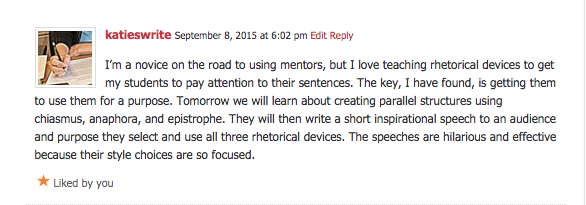
Last week I posted a mini-lesson about using student sentences as models for writing. Katie Bills-Tenney left this Screen Shot 2015-09-13 at 6.12.39 PMcomment. And I asked if she would write a post about her lesson.

She did even better:  she wrote on her own blog, complete with a lesson outline and student writing.

I love what she does here — and what her students do here, too.

Thank you for letting us see inside your classroom Katie.

Follow Katie at @Katieswrite

Mini-lesson Monday: Student Writing as Our Mentors for Sentences

I read Learning by Teaching by Donald Murray this summer, and I finally understand the importance of using student writing as the main text in my writing class. While I’ve believed students can learn from

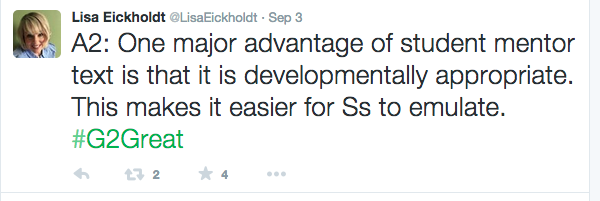
I lurked on this chat. Many positive examples of learning from student writing.

I lurked on this chat. Many positive examples of learning from student writing.

reading one another’s work, and I’ve often asked them to read and give feedback — on drafts and published pieces — I’ve never thought to actually use the text to teach a concept. I don’t know why. I supposed I’ve always relied on mentor texts by The Pros for that.

I am changing my tune. Here’s a bit of a lesson that worked better than I could have imagined.

Objectives:  Using the language of the Depth of Knowledge levels, students will write about their lives, and share their writing. They will recognize a wide variety of sentence structures. They will identify patterns, devices, and/or figurative language and discuss its effectiveness in creating meaning. They will revise their writing, formulate their own sentences, and apply their understanding to future writing assignments.

Lesson: Project the image, and ask students to write in their writer’s notebooks one sentence that answers the question. Remind them about what they know about various sentence structures and how punctuation works within a sentence.

“We can pack a sentence with a lot of information if we punctuate it correctly. Pay attention and see how you do. You can write any sentence, but try to not write a simple one.”

Give students about five minutes to write.

Next, ask for a couple of volunteers who are willing to write their sentences on the board. Be sure they understand that there is no judgment.

“We just want to talk about sentences.”

While two or three students write their sentences on the board, ask the other students in the class to read their sentences to each other.

one sentence

One at a time, read the student sentences on the board. Ask:  “What do you notice?”

Ethan sentenceTalk through the various comments students make, noting parallels, punctuation, clauses, word choice, etc.

Watch for teaching points. Ethan’s sentence on the left gave us a lot to talk about:  parallelism, use of semi-colons, colons, …

Next, ask students to return to their notebooks. “How can you make your sentence better?”

Allow time for revision (and time permitting, more sharing.)

Why this lesson works, especially for a writing lesson at the beginning of the year:  It’s just a sentence!

And sometimes we get a bonus gift like this one my class got from Edward:Edward C sentence

“I am the guy who picks people up when I, myself, am down; I am the guy who cares so much over things so little; I am the missing piece to a puzzle that has been forgotten; I am now by a sad and quiet shell of my former self; I am Edward Campos.”

The class hushed. All eyes turned to Edward.

“Wow,” I said, “Thank you for sharing this writing today. You’ve made yourself vulnerable, and we value that.

“First of all, we need to know that you are okay. Will you explain a little more what you mean here?”

Edward explained that he used to be fun and outgoing. He felt strong and powerful. Then at the end of last year and over the summer he learned his friends weren’t really his friends so much. Now, he feels alone and like he’s not the person he used to be.

“Hey, everyone, how many of you have ever felt like Edward?

“Look around, my friend, do you see all those hands? Everyone here has been where you are. We understand. You have new friends here.”

Two girls at Edward’s table leaned forward and touched his arm. “We’ll be your friends,” they said smiling.

And he smiled back.

Of course, because I am me — and I never leave a teaching moment untapped — we talked about the structure of Edward’s sentence. And we talked about the word choice:  “Why ‘forgotten’ instead of ‘lost’?”

When we watch for teaching moments in student writing, we will find them. Every single time.

Follow up:  In class the next day we did some free-writing in our notebooks in response to the spoken word poem “Hands” by Sarah Kay. Before we wrote I reminded students to pay attention to their sentences. Then instead of sharing the whole of what we wrote with the class, we only shared our favorite sentence. I consider this valuable formative assessment.

Now, I will hold students accountable for crafting their sentences with care in their upcoming writing assignment.

“The words of the world want to make sentences,” said Gaston Bachelard. I say, “We have to help them.”

Please share your best tips on getting students to pay attention to their sentences.


©Amy Rasmussen, 2011 – 2015


#FridayReads I Want All My Students to Experience This Kind of Reading

I’m always a bit nervous about how to introduce the volume of reading we will do in my AP Language class. Although students have heard that AP is “hard,” they don’t really know what that means until they start to see some of the texts they must read, understand, unpack, and analyze.

The biggest problem with all this reading:  most 16-year-olds are not readers. At least not when they come to me. (They do change.) Somewhere along their educational journey, the love of reading has gone by the wayside. Most tell me in our very first conference that they used to love to read. Few can tell with any specificity why they stopped. (I have my own theories.)

I’m constantly thinking of ways to help my readers fall in love again. If students are not reading, they are not growing as readers. It’s pretty simple logic.

And frankly, I want to live in a community of people who read. My current students will live on my street, work in the shops I patron, send their kids to my new grandson’s school. I want to be surrounded by families who enjoy literate lives because their lives will rub shoulders with mine.

Literature could change the world if we let it — if more people read it.

If we encourage what Louise Rosenblatt calls a sense of emotion, an aesthetic experience, in our young people, more of them would read. Rosenblatt explains how our readers need transactional experiences with the books they read:

“The transaction involving a reader and a printed text … can be viewed as an event occurring at a particular time in a particular environment at a particular moment in the life history of the reader. The transaction will involve not only the past experience but also the present state and present interests or preoccupations of the reader.” It’s like the letters on the page come to life, and the meaning of the words dance into the reader’s mind and heart. She has an experience with the text that remains long after she closes the book.

I want all of my students to experience this kind of reading.

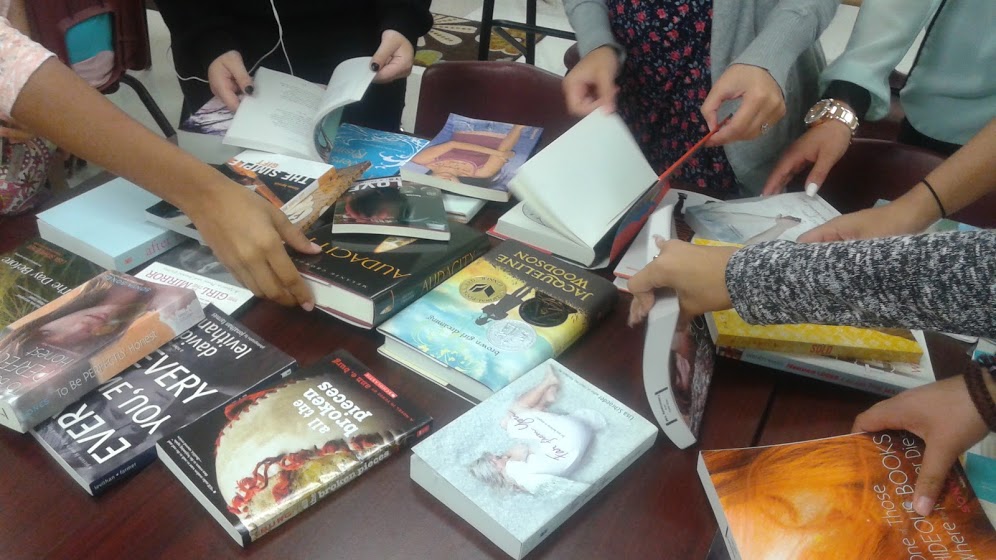
novels in verse 1So the first week of school I opened packages. Thanks to Donors Choose I had package after package arrive at my classroom. Each packaged filled with brand new novels for my brand new students. Most of them novels in verse — a powerful gateway back into reading with next to no stress. Few words on the page, and engaging story, vivid word choice, and a storyline brimming with emotion.

I book talked Chasing Brooklyn. It found a home in eager hands, as did To Be Perfectly Honest, The Crossover, Like Water on Stone,  My Book of Life by Angel, and many more.

If you’d like to build your Poetry shelf, or just add novels in verse to your classroom library, here’s a sampling of the books sweet donors gifted our classroom with this fall:

Like Water on Stone

The girl in the Mirror: A Novel

Audacity

Two Girls Staring at the Ceiling

The Red Pencil

The Vigilante Poets of Selwyn Academy

Perfect

October Mourning: A Song for Matthew Shepard

To Be Perfectly Honest: A Novel Based on an Untrue Story

What My Mother Doesn’t Know

The Simple Gift

The Secret of Me: A Novel in Verse

The Crossover

One of Those Hideous Books Where the Mother Dies

Every You, Every Me

Brown Girl Dreaming

I Heart You, You Haunt Me

Sold

Heaven Looks a Lot Like the Mall

Love, Ghosts, and Facial Hair

All the Broken Pieces

Geography of a Girl

Who Killed Mr. Chippendale?

(Note:  Shana’s the expert on building a classroom library by getting donations. Read about how she does it here. She’s got more ideas than just Donor’s Choose for books.)

Share your ideas on helping students have personal and meaningful experiences while reading…

©Amy Rasmussen, 2011 – 2015

What is it About Being Mean?

In the past three days I’ve heard two different stories from teachers who are already in high-stress because of encounters with co-workers. What?!

School started just this past Monday. Four days and we’re already mean?

What is is about some people who think they can speak their minds at the expense of being polite, kind, civil even? Isn’t teaching hard enough without having to deal with negative ninnies and downright mean people?

My mother always told me:  “It is the people who are the hardest to love who need it the most.” I believe this is true. Hurt, anger, and fear often manifest as aggressive, catty, spiteful behavior. “A root’s always poking holes in the cellar door.” I get that.

Many teachers who embrace the workshop model do so alone. They are the only teachers on their campuses who’ve “swallowed the Kool aid” and become “too idealistic for [their] own good.”

“You’re not going to have any better success with those kids that anyone else.”

I’ve heard my fair share, and I am fairly certain I’ve heard only a drop of a giant bucket of behind-my-back critiques. So it goes.

“You’re nasty and you’re loud,
you’re mean enough for two,
If I could be a cloud,
I’d rain all day on you.”
Jack Prelutsky

Today I am wondering:  How do we deal with colleagues who are mean, or bossy, or just plain rude? How do we smile with sincerity and stand steadfast in the face of criticism and disdain?

Please join the conversation. What do you do?

I’m Teaching Writing to the Whole 5th Grade — Now What?!

I received this note in a Facebook message:  I had big changes in my classroom assignment this year… moved from 2nd grade to 5th… turns out… after getting there I got the assignment of teaching writing to the entire 5th grade…. not what I really signed up for…. I have not only NEVER formally taught writing (as a process) beyond complete sentences… and moving toward paragraphs…. but I never even had a class in in it in college….. any suggestions on where to start and where to go with it? I will have 4 units of 12 days each during the year with each of the 5th grade classes….. suggestions?

Say you had to analyze the tone, what adjective would you use? concerned? riled? desperate? beseeching?

Let’s look at the clues:  “big changes,” “turns out,” “entire,” “not what I really signed up for,” “NEVER,” and all those “…..”

I could write an entire post on why the kind of changes this teacher has had thrust upon her is so disrespectful to her as an educator, as a professional. But I won’t. I just needed to say that.

Of course, I answered, and I will offer support and help any way I can. You would, too.

Maybe others have similar experiences and are new at teaching writing. Here’s how I answered my friend:

Yes, I have suggestions! Haha. Tons of them. You know I teach AP Language and Composition, right? Just writeThat’s juniors in high school, but good writing is good writing. Your instruction with your 5th graders can look very similar to mine. (And I hope it will.)

Here’s the non-negotiables in my writing class:

Writer’s notebooks. I use the black composition notebooks. Students cover them, personalize them, and make them mean something other than just a notebook for school. We write in them every day as a way to explore our thinking. I might give a prompt, or read a poem, or watch a news clip…whatever, and then I ask students to think and respond. These quickwrites become places to mine for ideas for topics we might develop into more formal pieces. Writer’s notebooks are required and loved in writing classes where students have choice and autonomy, two important components of effective writing instruction.

Mentor Texts. Mentors are texts that look like the writing I want students to practice. For example, if we are writing narrative, I want students to read good narrative writing. If we are writing book reviews, we need to study the structure of book reviews, etc. The authors of these mentors become our “writing coaches.” We study the moves the writers make, and then we try to make those moves in our own writing. Students learn from good models. They do not learn from poor, fix-the-grammar-and-punctuation worksheets or anything of that ilk. Research on that is plentiful.

Choice. When students have choice in the topics they write about, they are more apt to take ownership and care about their writing. Just like you and me — we do not want told what books we have to read, TV shows we have to watch, or essays we must write that show we learned something from pd. Topics matter so much to the effort students will put into their writing. We have to let students choose what they want to spend their time focusing on. Sometimes we need to nudge them. Sometimes we need to help them narrow the topic. But they need to always have a choice if we want to really teach them anything about writing. Save the formal test-like prompts for practice after students learn how to mine for ideas and develop those ideas in writing they want to do. Test writing can serve as a genre in itself later.

Time. Schedule time within the school day for kids to write. Let them know you are there to help. When they write with us, 1) we know they are writing and not a friend or parent, 2) we see their process and know where the struggles are.

Conferences. Meet with writers throughout the writing process, beginning, middle, and end. Ask questions that provoke their thinking. Let them talk about their ideas. Avoid giving advice, rather validate the students’ ideas and speak to them as writers. (Focus on the writer and his needs over the writing and what it needs — avoid the red pen at all costs.)

Modeling. Write in front of your students. This is probably the most effective instructional tool you have. Students need to see the messiness of the writing process. They need to know it is hard — even for a teacher. I try to write every assignment I ask my students to write. I start writing in front of them and let them see my thinking, my errors, my revision, my re-organization, all of it. Too many student writers think they should be able to write well in a one shot in the dark deal. That’s why they refuse to revise. We have to show them that writing is difficult and confusing and time consuming. We have to give them opportunities to see the struggle, so we can convince them that the work is worth it when we’ve finally been able to say what we want and need to say in our writing.

Talking. “Writing floats on a sea of talk,” I heard Penny Kittle say. Talk with students about their ideas, their process, their everything concerning writing. Encourage them to talk with one another. Talk and Write. Read and Talk and Write. Talking works to stimulate thinking and provoke the pen to action.

Celebrating. Feedback matters, even at the sentence level. Invite students to share their writing. This can be a sentence or a complete piece. Celebrating good writing along the way is a more effective feedback tool than a grade at the end of publication. Whips Around the Room that invite all students to share a favorite sentence or passage, Author’s Chairs that invite students to read a best draft, Posting on Blogs and inviting students to read one another’s work and leave comments, are all ways to celebrate writing — and help students understand the importance of audience.
Some of my favorite RESOURCES:

National Writing Project — Resources page

Read Write Reflect — Katherine  Sokolowski’s blog — the reflective practices inside a 5th grade classroom

The Nerdy Book Club — a community of readers (and teachers of readers) — read about books, reading, writing, and more!

Two Writing Teachers blog — more tips on teaching young writers that you can digest in one sitting

Moving Writers blog — Rachel and Allison show they are the best mentor text finders on the planet

And of course, my own blog: Three Teachers Talk where we write about Readers and Writers Workshop

Lucy Calkins quoteBOOKS you will consider life savers:

In the Middle by Nancie Atwell

Read Write Teach by Linda Reif
Write Beside Them by Penny Kittle

And I haven’t read this one yet, but who doesn’t want to be unstoppable? The Unstoppable Writing Teacher by Colleen Cruz
I imagine you are overwhelmed. No, I cannot really imagine. I do know that you are smart though, and you love children and teaching. You will do a wonderful job inspiring students to write — that is half the battle.

The learning comes from doing. Get your students writing. The more they write the better they will write. I see it every year.

Best blessings,

Amy

Did I leave anything out? What advice do you have for this emerging writing teacher?

©Amy Rasmussen, 2011 – 2015

My Classes are Only 45 Minutes — How Do I Do Workshop?

It’s a movement, you know — this instructional practice called Readers and Writers Workshop. More and more educators are catching the vision and clarifying their focus as English educators. (There’s also a lot of nay-sayers, which I think means they are afraid. Let’s be patient with them.)

I received an email that asked a question that I wish I would have had answered for me years ago when I made the leap into choice reading and the workshop pedagogy. It’s important, so I knew it needed to be a post on this blog:

English I teacher asked:  I have a question for you about classroom routine. I felt I needed to ask someone who can answer with authority about this because there is significant resistance from teachers on my campus to the whole idea of workshop, especially from my department chair. For various reasons that I won’t bore you with, we need to do a “by the book” implementation. We will be under a lot of negative scrutiny no matter what we do, but things will go better if we are following some sort of precedent on certain details.

I’ve found specific information about block schedule and the frequency of in-class silent sustained reading, but I haven’t found anything for non-block schedules. We are non-block with 45 minute periods. I think I read on your blog that you used to use Workshop in a non-block schedule. When you did that, how often did you do the in-class reading?

I am glad you asked about non-block scheduling for workshop instruction. Yes, it is doable! I taught class periods of 50 minutes five times a week prior to moving to my current school. When I was first trying to figure it out, the best advice I got was from Penny Kittle. She told me:  “You choose to do this, which means you choose not to do that.” Here’s how I interpreted that:

If I have 50 minutes with my students each day. Every minute matters, so I must be intentional in the choices I make. 

I used to choose whole class novels and read at least part of the novels in class. I used to assign students guided questions to help their understanding of those novels. I used to give lists of vocabulary words and ask students to define, write sentences, create images. I used to give writing prompts and writing homework. I used to expect students to read and write outside of class without ever showing them the messiness, the thinking, the discovering of ideas and emotions and writer’s moves on the page. I used to make all the choices, and I expected my students to go along for the ride.

Some did. Many did not. It finally started to dig at me that many was so much greater than some.

I choose not to do any of those things now.

Now, my students and I choose to read books we find interesting, engaging, and important to our lives. We read, discuss, and write about how the ideas inside these books are windows to the world outside our own, and how they are mirrors into the joys, aches, and heartbreaks we see inside ourselves and within our families.

I wrote about 7 Moves in My Workshop Schedule a while ago. These moves are non-negotiable:  read, confer, talk, write, revise, share, mini-lesson. 

To make these workshop moves work, we must also include these tools as non-negiotables:  writer’s notebooks, mentor texts, high interest books.

As you begin to plan for your 50 minutes, think about this:  How can you ensure that all students read, write, listen, and speak in every class period? (These are best practices for English Language Learner’s, which in my experience means they are best practices for all students.)

You specifically asked about the frequency of in-class independent reading in a class period of 45 minutes.

Read every day. Every day. Every day.

If you want students to become voracious readers, time is the greatest gift you can give them. Students need to know that you trust reading as your ally. If you believe that through reading students will grow in fluency, stamina, vocabulary acquisition, comprehension… and empathy, which has been written about here Scientific American and here Psychology Today you must make it a priority. So how might this look in your classroom:

She asked for a book that would help her learn science and accomplish her reading goals. Students will challenge themselves if we let them.

She asked for a book that would help her learn science and accomplish her reading goals. Students will challenge themselves. Really, they will.

Read at the beginning of every class period — 10 minutes. You do not need a bell ringer or any other focusing task when students know that the expectation is to come in the room and get to reading. The first chapter in Steve Gardiner’s book Sustained Silent Reading offers some great information — and quotes Nancie Atwell on the importance of choice. Encourage and challenge students to read outside of school. Help them create goals, and them help them hold themselves accountable to reaching them.

Confer when students are reading. Make this a norm. Conferring moves readers workshop instruction forward. And students want and need us talking to them about their reading, about their thinking, and about their lives. One-on-one instruction happens here, and it is through this teacher move that belonging, identifying, coaching, challenging, and empowering happens.

When you create a classroom culture of reading, discipline begins to care for itself. It’s a matter of setting expectations and then being consistent with them. If I have a student who refuses to read, which happens at times, especially early in the year, I make sure she knows that she has that right, but she does not have the right to interfere with anyone else’s right to read. Sustained Silent Silence instead of Sustained Silent Reading gets boring after a while.

You’ve read, and you’ve conferred. Now, you make other choices about what to include in your instruction. These are ideas that work for my students:

Write about their reading. Now, I’m not advocating for dialectic journals or questions about plot and setting, but it is important that students become reflective about their reading. Find a balance here. We do not want reading to turn to work, and demanding that students write about their reading way too much may turn them off to reading.  Think about the books you and I read. How often do we have to write an essay about a novel we read?

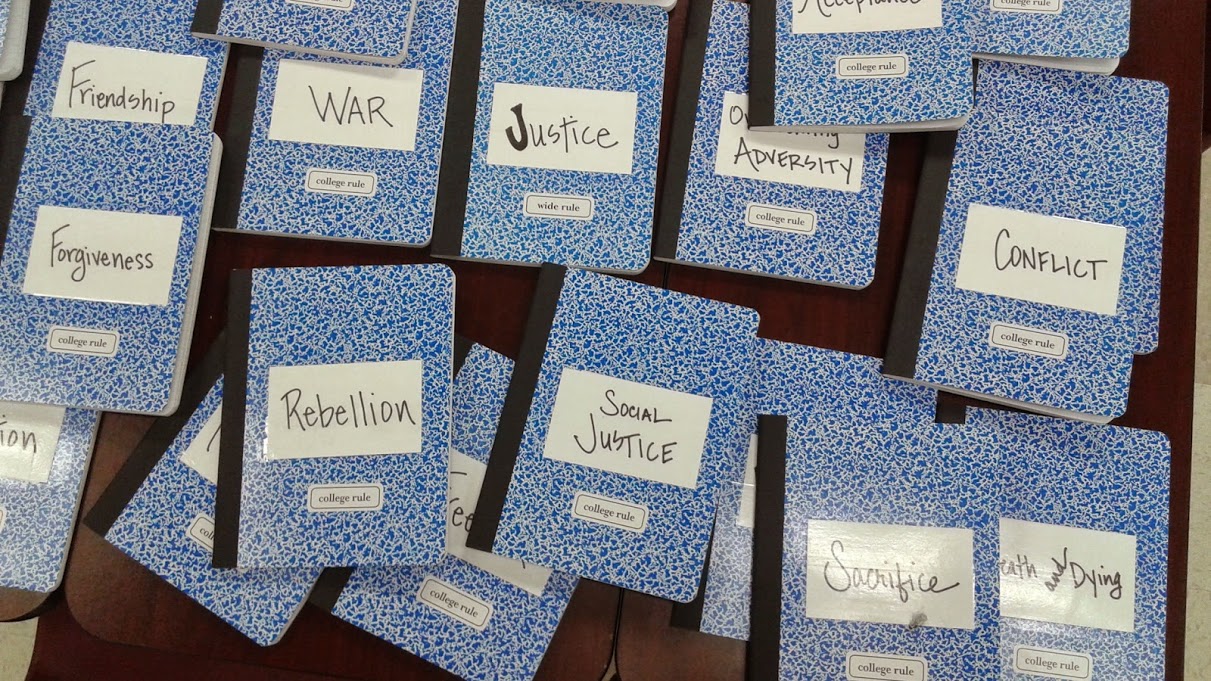
The topic notebooks in my classroom. We write in them about every three weeks. This is a fun way to share our thinking about our books.

Penny Kittle taught me about topic or “big idea” notebooks, and I’ve had a lot of success with these. (That link is to Penny’s Book Love handout, which has other great ideas for students to write about their reading.)

Teach skills in mini-lessons. I decide on mini-lessons based on two things: 1) my standards, 2) student needs based on what I learn in conferences.

Say I need to teach them about using the appeals in an argument, I may teach a mini lesson on logical appeal one day. Then I will ask students to do some flash research and find evidence of this appeal in either their independent reading, a news article, or an online text. We’ll share our findings and do a lot of talking — Why’d the writer use that appeal? How does it contribute to the argument? etc. Then, students will know I need to see them use that appeal in their own writing. We write (and confer) for the rest of the class period. Or, we share our writing in our writers’ groups.

Or, say I’ve conferred with half the class about their reading. I’ve found that half of those students are having trouble finding books with enough higher-level vocabulary to add to their personal dictionaries. I know I need to teach a mini-lesson on text complexity and what it means to challenge ourselves as readers. I may choose a few books with similar topics or themes and show my students a reading ladder:

Tears of a Tiger by Sharon Draper

Dopesick by Walter Dean Meyers

Homeboyz by Alan Sitomer

Tyrell by Coe Booth

The Absolute True Diary of a Part time Indian by Sherman Alexie

Letters to an Incarcerated Brother by Hill Harper

We’ll talk about why one book may be more complex than others. I might challenge students to read all of these titles and then tell me if I have the ladder right. (I may not, I haven’t read every one of these books, but I think I’m on the right track.) I’ll teach students about syntax and how that impacts text complexity as much, or more, than vocabulary. Then, I’ll challenge students to keep track of the complexity of the books they choose, not only by keeping their personal dictionaries up to date, but by adding codes to their reading lists. E – easy, C – comfortable, D – difficult. I show them my writer’s notebook and how this tracking helps me understand my reading habits.

Allow time to work. The greatest indicator that workshop works in my classroom is student engagement. When I allow students time to complete writing in class with me available to talk to and ask questions, they engage in the writing process more efficiently and effectively. I’ve let go of wanting a product, and now we enjoy the process of writing. We discover as we write. We revise because we know our writing improves as we revisit it. We share our writing because all voices in our classroom matter. The only way to accomplish these things is to build time to write right into the class schedule.

I wrote Choose to Become a Classroom of Writers a while ago. I still believe focusing on writing creates the smoothest transition to workshop instruction. Why? Because writers are readers first. Check out this post of 40 Inspiring Quotes about Reading from Writers. (Just a little proof.)

But that’s probably another post for another day.

Best blessings to you as you take off on this wonderful adventure with your students. Write any time: for support, for clarity, for whatever you might need. You’re blessing the lives of children. Our future –our society — needs educators like you.

Press forward (nay-saying department manager and all).

Warmly,

Amy

Dear reader, any advice you can offer our friend?

 ©Amy Rasmussen, 2011 – 2015

Talking about the First Day of School

I keep changing my mind. Students begin next Monday, and I cannot decide what we should do first.

In years past, I copied the syllabus and various other “need-to-knows,” and students sat with blank stares and asked a few meager questions as we read through them together.

“Let them know on day one how difficult AP English is,” a colleague advised me several years ago. “That’s what I do. I let them know what they are in for.”

Before I knew better, I thought that was a good idea. Be firm. Be serious. Let them know that an advanced English class would take a lot out of them. Leave ’em shaking in their Converse.

How dumb. Imagine attending a professional development session where the instructor put on this show. We’d laugh — or leave — wouldn’t we? (I would. My friends already know how difficult a time I have sitting still.)

Shouldn’t our first day of school be inviting?

Think about elementary school, how kind the teachers were, how much they wanted us to feel welcome and special, beginning on Day One. I remember Mrs. McBee (1st grade), Mrs. Nelson (2nd), Mrs. Smallwood (3rd), Miss Dallas (4th), Mrs. Holland (5th) — every one of them smiled and laughed and made me feel important on the first day of school. They set a precedent for every day to come.

I want to be that kind of warm.

One year I thought I had less chill. I prepared my room by piling high-interest books on each table, and after a brief introduction, I told students my plan to help them love reading. I explained my expectations for their reading lives. They chose a book and read for two minutes, chose another and read, chose another and read. They did this reading carousel for several rounds, and I asked them to choose their first independent reading book. They did. I thought Day One a success because 7/8 of students left with a book that day.

They also thought I was crazy. Distant. Cold. Unapproachable. They told me this much later.

I realized my mistake. If you look at that paragraph above, you’ll see it:  all those “I’s” and “they’s”. Everything my students did on the first day of school had to do with what I wanted for them. I did not invite them to think, to explore, to discover, to talk to me about how they learned, or how they need to be taught.

Shana refers to “the language of control prevalent in teaching narratives” in her post Just Let Them Write: Boys and Autonomy.

I eat the language of control for breakfast, and rely on it for power all the way to dinner time. How dumb.

If I want my students to feel welcome, invited, inspired, to want to engage in the complex learning in our classroom, I must create the atmosphere and culture that welcomes, invites, inspires, and engages the moment they walk in the door. And I think it starts with conversation.

The first day of school — I think we are just going to talk. conversation bubbles various

We’ll probably read a poem, or two, and talk.

In the introduction to Dawn Potter’s new book The Conversation: Learning to Be a Poet, she reminds us of the value of talk:

“[Conversation] combines so many different kinds of reactions — wonder, worry, curiosity, opinion, delight, memory — and all work to expand confidence, emotional connection, intellectual growth, and civil engagement.”

Isn’t that the kind of community we want for our students this year — one that builds and sustains confidence, emotional connection, intellectual growth, and civil engagement?

I do.

©Amy Rasmussen, 2011 – 2015

The Consciousness of the Child: Another Thought on Conferring

Much has been written about conferring with younger students, but in the current professional literature, I find little that addresses the needs I have in my secondary classroom. I know when I talk to my students in one on one conferences, they grow more as individuals who engage in reading and writing more critically. I believe that if teachers will talk to their students more, teaching them as individuals instead of the collective, students will respond in ways that delight and surprise us (and often surprise themselves as well).

Teenager with parent

Teenager with parent

The topic of conferring consumes my reading life of late, and I find myself reading Misreading Masculinity with this guiding question:  How does this relate to my study and work on talking to students about their thinking?

The following lines from Newkirk’s book relate directly to what I believe must be our first step in helping our teenage readers and writers develop the sense of self needed to engage meaningfully with the material and skills we need them to in high school English:

“…the ability to think beyond the “logic” of normal school performance in order to inhabit the “logic” of the student (Newkirk, 12).”

. . . The linguist Basil Bernstein elegantly points out the centrality of this ethnographic stance for teaching:

If the culture of the teacher is to be part of the consciousness of the child, then the culture of the child must first be in the consciousness of the teacher…We should start knowing that the social experience the child already possesses is valid, and that this social experience should be reflected back to him as being valid and significant. (1966, 120)

As a credo for education in a multicultural society, I don’t think we can do better than that (Newkirk, 13).

Educators must relate to students as individuals with a variety of interests, passions, backgrounds, and literary histories. We must try to think like they do if we are ever going to develop relationships that engage the teenager in reading and writing experiences that invite them to take on the qualities of readers and writers. Our goal should reach far beyond the idea of school. It must reach into a student’s future life.

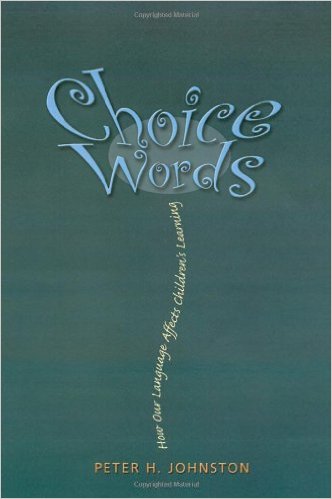
In the book Choice Words,  Peter Johnston discusses the importance of tapping into students’ literary Choice Wordshistories in order to give them a literary future. What experiences has the child had with reading and writing that have formed her belief about herself as a reader and a writer? We must learn of these experiences and then validate them if we ever expect to move our students from the starting places at which they come to us.

Regularly conferring with students is a vital part of getting into the “consciousness of the child.” However, many high school English teachers instruct their students as if they all experience the same culture and the same consciousness. No wonder groupthink is so prevalent in our communities and in our politics. It is a reflection of how students receive instruction. This whole class, one-size-fits-all, standardized teaching (not to mention the tests) is detrimental, not just to boys, but to all students who deserve to be instructed at an individual and personal level.

What are your thoughts?

©Amy Rasmussen, 2011 – 2015