Category Archives: Amy Rasmussen

#FridayReads: Required Reading “Our Students Want to Write”

Confession:  I buy a ton of pedagogy books. I rarely read them all the way through. I blame it on my blossoming OCD. I can only take in so many ideas before I run out of space in my head to hold them all long enough to use them.
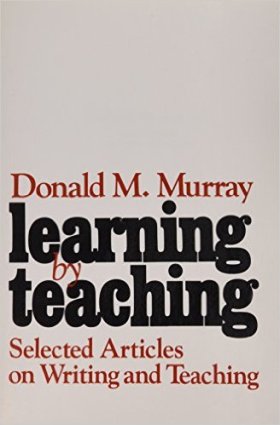
412bcpby4iol-_sx326_bo1204203200_That is not the case with this classic, suggested to me by my friend and mentor Penny Kittle, Learning by Teaching by Donald Murray.

I remember when Penny recommended it. She was in the DFW metroplex teaching a workshop, and I’d asked if we could meet up and talk about my writing. She graciously agreed, and we met at a Starbucks inside a Target. As always, Penny radiated positive energy. She told me about the work she was doing with Kelly Gallagher. I told her about my struggle trying to write a book, a book I am still trying to write.

I still cannot believe I had a writing conference — yet again — with Penny Kittle! (My first was during her class at The University of New Hampshire Literacy Institute the summer of 2013.)

At one point in our conversation, Penny paused and asked if I had read Don Murray’s book Learning by Teaching. I said no. At the time I hadn’t read any of his books, but I’d heard Penny talk about Murray with such affection, quoting him often. I knew this was a book I need to not just purchase, but one I needed to read. I’ve read and re-read and marked page after page.

Don Murray validates the moves I make in my workshop classroom, the moves I make

pageinMurraybook

My thinking while reading the essay “The Process of Writing” by Donald M. Murray


when planning instruction for my AP Language and Composition course. I have learned from those who learned from Murray, and his work reminds me again and again why teaching with student choice in mind works. Every time I feel like I fail, every time I get frustrated with the way an assignment flopped, or I didn’t reach a certain student what I’d hope to teach him, I turn back to this book of essays by Murray. (I did this recently after most of my students bombed an assignment, which was mostly my fault.)

Here’s an excerpt from Murray’s essay titled “Our Students Will Write –If We Let Them” published in North Carolin English Teacher, Fall, 1977. I probably break a copyright law by sharing, but I’ll risk it if it means freeing more writers. (See more about freeing writers in Penny Kittle’s piece “What We Learn When We Free Writers.”)

Our students want to write — but not what we want them to write.

Our students want to write of death and love and hate and fear and loyalty and disloyalty; they want to write the themes of literature in those forms — poetry, narrative, drama — which have survived the centuries. They want to write literature, and we assign them papers of literary analysis, comparison and contrast, argumentation based on subjects on which they are not informed and for which they have no concern.

We should see that their desire to write proves the vitality and importance of literature and literature-making in each generation, that language is central to the human experience, not just as a communications skill but as the best way to recall and understand experience. We tell our students the unexamined life is not worth living, yet we seldom allow those students to examine their lives firsthand through what is termed creative writing.

It is time that we, as a profession, not only support the reading of literature but the making of literature; that we encourage our students to write what they want to write and realize that what they want to write is more intellectually demanding, more linguistically challenging, more rhetorically difficult than the writing we usually require in the English class.

The biggest problem in the teaching of writing is ourselves. We do not encourage, allow, or respond to our students’ desire to write. We do not believe that our students can write anything worth reading, and they prove our prediction. Conditions will not improve until we realize that what we face is a teacher problem, not a student problem.

There are many important reasons to consider taking what is usually tolerated, at best, in the elective creative writing course and placing it at the center of the writing curriculum. Some of them are:

  • Writing about individual human experience motivates both the gifted and those we often consider disadvantaged. In fact, we may find that the disadvantaged aren’t in terms of experiences which can be explored through writing. Students who are not motivated by our lectures on the need for writing skills–they know the need does not exist in the lives they expect to live–still share the human hunger to record and examine experience. Students who are bored with papers of literary analysis or even incapable of writing such a paper at this state in their development may be able to write extraordinary papers based on first-person experience.
  • Students discover…that they have a voice, they have a way of looking at their own life through their own language. They discover and learn to respect their own individuality.
  • Through writing, the student increases his or her awareness of the world, and then works to order that awareness.
  • As students follow language towards meaning they extend and stretch their linguistic skills.
  • The experience-centered, doing nature of the writing curriculum will reach many students who are not comfortable with the analytical passive-receptive nature of the typical academic curriculum.
  • Creative writing gives students a new insight to literature. The study of literature is no longer entirely a spectator sport, but an activity which they can experience and appreciate.
  • The creative writing class may be the place where some students learn to read. Test results in many community colleges and other colleges of the second chance show that many students who test as not being able to read are also the best writers. They are able to read their own words and to perform the complex, evaluative techniques essential to revision. They learn to read by writing.
  • Students and teachers of creative writing rediscover the fun of writing. Art is, at the center, play, and perhaps that is the reason it is so little tolerated in the school. If it is fun can it be learning? Yes.
  • Finally, we should teach creative writing because it is more intellectually demanding than the study of literature or language as they are usually taught in the English class. This runs directly counter to the stereotype believe by most English teachers. IT is easier to complete a workbook on grammar, easier to tell the teacher what the teacher wants to know about a story than it is to use language to make meaning out of experience. The writing course is a thinking course, and it should be central to the curriculum in any school.

There is more. I believe Murray’s writing, like Penny’s books Write Beside Them and Book Love, should be required reading for every English teacher. I wish they would have been required reading in my education classes. For the first few years of my career, I struggled like many teachers I know with student engagement and learning while I taught literature instead of readers and writers. (Someday I’ll write about the Dickens I subjected my 9th graders to. It’s a sad sad tale of student, and teacher, woe.)

And someday I’ll finish this book I’m trying to write. I think Don Murray would want me to.

What books do you think should be required reading for all English teachers? I’d love to read your suggestion in the comments.


5 Things I Need to Remember When Teaching my Writers

I know we’ve been posting mini-lessons on Mondays on this blog for awhile now, but today marks the first day of my spring break, and since my students and I just finished a fairly complex writing task, this is a good time for reflection.

don-graves-quoteMy AP Language students wrote arguments as spoken-word poems, and then performed them in class. (Or if they produced their poems digitally, which was an option for publishing, they projected them.)


Our process included reading and studying several poems. We watched YouTube videos of spoken word poems by Shane Koyczan, Harry Baker, Marshal Davis Jones and more. We analyzed structure, craft, and theme. We pulled out lines we felt held the weight of the poem and wrote responses to them, hoping to find inspiration for our own writing. We reviewed the elements of argument. We discussed the claims the poets make and how they use evidence (or do not) to support these claims. We spent workshop time thinking, writing, and revising our poems. And my student teacher Zach and I spent hours talking to writers about their writing.

I’ll share some of the amazing poems my students produced in another post. For now, here are some things my students reminded me I need to do better so they can do better in our next round of writing:

  • Topics matter. If I want my students to produce well-written texts, they must select well-chosen topics. Too often my writers choose topics they might have a passion for, but they know little about. This leads to vague superficial writing.

I need to take more time on the front end of the writing process to make sure all of my writers choose a topic that they not only care about, but that is specific enough to the task at hand. One resource that will help as we choose topics for other writing tasks is this tutorial from University of Arizona Libraries. I need to remember to slow down on the front end and help students select narrow topics.

  • Clear feedback matters. For this writing project, I only left feedback once on student drafts. It was not enough. Or it might have been — if students had read it. (Please tell me I am not the only teacher with this issue:  Students ignoring feedback.)

The best feedback is not when I leave comments on Google docs like I did for this project, but when I talk to them face-to-face and answer their questions. Students need to see my response to the work they have done. They need to see if I like it. They often misread, or don’t read, my tone in written feedback. I must remember to give them a balance of both — and a lot of it all along the way.

  • Sometimes more explicit instruction matters. In more than one conference, when I asked students why I didn’t see application of the mini-lesson in their writing, they said: “Oh, I thought that was just a suggestion.” Well, yes. But what’s the point of a mini-lesson — designed to help students write better — if they refuse to at least try it?

I know that we must teach the writer and not the writing, but sometimes without a little push to make specific changes, my writers just do not improve. I need to remember that with some students I must be more explicit in my instruction.

  • Accountability throughout the process matters. I was out of the classroom several days when students had writing workshop time to work on their poems. (Someday I’ll tell you about the standards revision work I’ve done with the TEKS Review Committee in Austin this year.) Although my student teacher was there, and my substitute — a former teacher and a sub my students know well — too many of my students clearly wasted the time given them in class to write. They are teenagers after all:  give them an inch and they take a mile. And they are major procrastinators. I think they are finally understanding that good writing takes time, but many are still not taking the time to produce good writing.

I need to do a better job at holding them accountable for working during workshop time. More exit slips. More sharing a favorite line or passage they’ve written that day. More purposeful formative assessment and personal evaluation of their writing processes.

  • Conferring (more) matters. The two days students shared their poems were exciting. So many were fantastic. So many clearly showed their understanding of how to write an effective argument — and how to be clever and creative with poetic elements as they did so. But quite a few did not.

As Zach and I discussed each performance and each poem, matching the writing to our rubric and assigning a grade, we became clearly aware of which students we conferred with the most and which students we did not. One of us would say: “She did exactly what we discussed in our conference,” or “That was something he and I talked about in his conference.”

The students we conferred with the most not only fulfilled the requirements for the assignment the best, they produced the most creative and convincing argumentative and poetic writing. And they knew it. Their confidence as they performed their poems was evident, and they rocked the house with their beautiful and inspiring poetry.

Taking the time to confer with every student — whether they want to talk about their writing or not — must be a regular part of the writing workshop. Too often conferring becomes optional when I get too busy or spread myself too thin. I must remember to schedule conference time into the lesson plans and hold myself responsible for making them happen — not once but several times for each student.

How do you know when your writing workshop is working?  Please share your ideas in the comments.

From John Green to Jane Austen: Student Choice and Motivating Non-Readers

Anyone who knows me knows I talk a lot about moving readers and writers by offering choice in the classroom. Without a doubt, the more I study the research on reading acquisition, the more I confer with my students and try to write about it, the more I immerse myself so I can immerse my students in engaging YA and award-winning literature, the louder my voice gets.

I am a full fledged advocate of readers and writers workshop at the secondary level.

And I’m not backing down.

This semester I have a student teacher who hears it from me every second of every day. Almost.

My ultimate goal is to tattoo Zach’s brilliant young mind with everything I’ve learned about teaching the past ten years. Everything that sent me to and cemented my pedagogy in workshop. And I think choice seals the ink that may change his teaching career forever.

But this pedagogy is not easy. Just like in a traditional classroom, students put up their fists and sometimes fight dirty. Sometimes they want to be told what to read and what to write and how to think. Sometimes too often.

And that is when this job gets hard.

Lately, it has been hard, and Zach has seen my frustrations. But he is smart, and he sees through student b.s with laser-like charm, problem-solving as I vent and complain.

I should be more controlled I tell myself every morning. Careful-what-you-say-Ame. But I can’t help it — my job is my sleeve. If I didn’t care so much about my students, their lives, their futures, I’d call it a day and tell Zach to take charge and have fun.

But I want him to learn. I want him to last in this profession that eats ’em up and spits ’em out. So I’ll share.

I’ll share what I’ve learned and how I’ve learned it. I’ll encourage. I’ll prod. I’ll challenge.

He’s a keeper I can already tell.

How do I know? Well, I asked if he’d write a post for this blog about reading YA literature for the first time. What does Zach do?

Oh, he writes, but he starts his own blog and tells me today: “I’ve got this friend who’s student teaching over in Northwest ISD, and she’s started blogging, so maybe we’ll start this new-teacher blog thing….”

You can still see my smile.

Here’s Zach’s post about his first adventure into YA literature. You’ll read it, and then you’ll want to hire him.

Yeah, I know.

Choice Doesn’t Necessarily Mean Personal Connection: A reflection for a do-over


I have started this post four times, and I cannot think of a pithy way to begin. You know, some clever opening, some hook to get the reader’s attention — some startling statement.

My creativity got swallowed by analysis. Well, kind of.

I figure I must be doing something wrong because my students cannot analyze to save their lives. They can talk around a text and say absolutely nothing quiet well though.

So all afternoon and into the evening I’ve thought about thinking. I’ve thought about my students’ thinking.

And I’ve determined the problem: Many of my students are not doing it.

They sit and wait, looking around the room, waiting for someone else to speak up and do the thinking for them. It’s like a Mexican standoff, and something’s gotta give.

105997-clint-eastwood-mark-wahlberg-s-jkzn

Last week I listened to Dr. Margaret Hill talk about the importance of connections and how standards must include opportunities for students to make both efferent connections and aesthetic ones. The only way to truly learn is to make personal connections, Peg reminded me, citing Louis Rosenblatt’s Transactional Theory.

How can I provide more opportunities for students to connect to the learning?

Yesterday I read an article about mindfulness and how when it’s practiced in schools it is helping children’s well-being. Some experts say the practice of mindfulness is even an essential —  a way to reduce depression, extend focus, truly learn.

How can I help students get and stay in the present?

This morning I watched the TED Talk by Shonda Rhimes “The Year I Said Yes to Everything,” and how playing again has helped her find “the hum,” the thrill and joy in her life and in her life’s work.

How can I introduce more play into my classroom?

Today in class most of my students crashed into a brick wall of higher-thinking they could not go through, over, or around. Many didn’t even try. I came home from school worn out and weary.

Then I read this post by Tricia Ebarvia, and I stalked her blog until I read the post “Steps toward an Inquiry-based Classroom,” and a missing piece walked right into my puzzle.

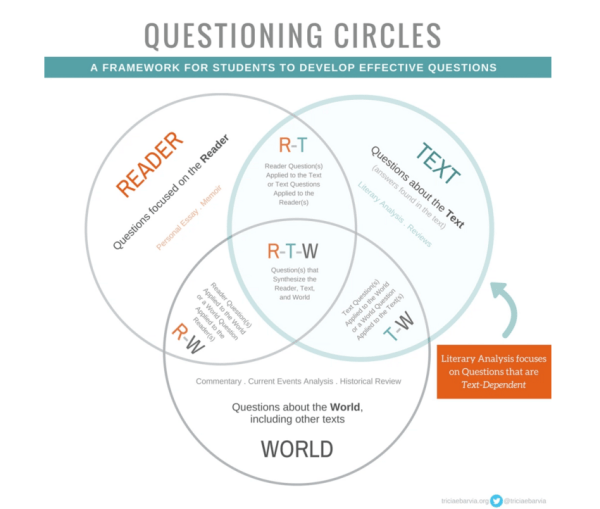
Tricia made me think about the on-going need for curiosity and student-generated questions. The ongoing need for purposeful and personal inquiry. She shared the chart below, citing the work of Christenbury and Kelly, NCTE, and Jeff Wilhem. And I got it.

Screen Shot 2016-02-18 at 7.18.15 PM

My students do not care enough about the books they’ve chosen to read. They do not care enough about the topics they’ve chosen to write about. I haven’t been paying enough attention, or I would have realized this sooner:  Choice does not necessarily mean personal connection.

I am glad I have time this year for do-overs.

It’s time to back up a few steps, so we can step into better opportunities for engagement, growth, and learning.

Maybe we’ll mediate.

Maybe we’ll play.

But we will certainly play with developing effective questions.

#3TTWorkshop: Asking Good Questions When Making the Move into Workshop

IMG_1279

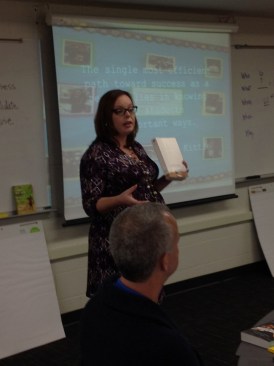
Book talks about NF like Columbine by Dave Cullen and talking about the writer’s research process capture many readers

Shana and I recently conducted a two-day professional development workshop in Franklin, WI — such inspiring teachers in Franklin!

Franklin administrators asked that we help their teachers move into a workshop pedagogy, which is, of course, a favorite topic at Three Teachers Talk. We shared the background of workshop, which stems from the work of Don Murray and Don Graves, and from the work of our mentor Penny Kittle, whose ears had to be ringing and ringing since we said her name a million times throughout those two days.

Franklin teachers caught the vision and the value of letting loose the reins and opening their hearts to choice reading and writing. They just needed to experience it themselves from the seats of their students.

The discussion covers five of the pressing questions teachers asked during our pd.

They:  Where are some great places where I can get resources for books and materials for my classroom library?

Us:  The good news for Franklin teachers is the buy-in from their insightful administrators who have reserved funds to begin building classroom libraries. Not all teachers who catch the vision for choice independent reading, and the need for engaging, well-curated classroom libraries, are so fortunate. We weren’t. But finding resources and is certainly possible. Shana wrote this great post awhile back about grants she’s been awarded and the many businesses that give funds to buy books. Amy’s had great success with Donor’s Choose, one of the options Shana mentions. Three grant projects funded there so far! Lewisville Education Foundation has also been a great resource for Amy’s students and the books they love. Be sure you check out the grants offered through your own EF.

Other resources besides books are important, too. We spent time watching and responding to spoken word poetry with our new friends, modeling quickwrites, and studying the craft moves of these poets. Some of our favorite spoken word poets are Shane Koyczan, Sarah Kay, Phil Kaye, Marshall Jones, and Amy’s new favorite Harry Baker. Search online, and you’ll find YouTube videos and posts with the texts.

Engaging non-fiction articles are an essential in workshop instruction. Mentor texts, craft studies, and pairings with literature all make for authentic engagement with thought-provoking non-fiction. Find interesting articles at NewsELA, Izzit.org, Essay5W, and The Learning Network at the NY TImes. And, of course, the excellent mentors curated by our friends at Moving Writers.

They:  How can I design units that foster inquiry-based outcomes for my students?

Us:  We lead teachers in a gallery walk activity where they explored ideas of what authenticity, modeling, dialogue, inquiry, and other workshop essentials look like from both a teacher and the students’ points of view. It was interesting for us to see the many iterations of inquiry these teachers listed and how closely they overlapped with authenticity. Yes, they should.

However, getting students curious about learning does not always happen instinctively — especially when they come to us hardened by years of sit ‘n git classroom instruction. We must provoke inquiry, pique imaginations, inspire curiosity.  Of course, the move to choice opens doors to many of these needs. Providing, introducing, and talking about highly engaging literature helps. But so does allowing students to decide how they want to read it and what they want to do with it to show they are learning from reading it.

Teachers have to let go of control. We have to trust that students want to learn. We have to stop doing all the hard thinking for them. What if we let them find the mentor texts that best suit their needs as writers? What if we give them chances to determine themes they want to study, and then let them take those themes into other genres and ideas?

Let’s invite students into authentic and on-going research, so we move far far away from the one-unit-one-major-research-paper. Shana’s multi-genre project and my students’ engaging in our multi-modal feature article unit are good examples of how we apply this thinking in our own classrooms.

They:  I write every day for my job, but I have never written a “persuasive essay” for my job. How do I design authentic instruction that mirrors what my students might have to write in the future?

Us:  Read like a writer. Look for mentors everywhere. And know your kids. 

We know, if the answer was really that easy, everyone would do it. Although we do believe every teacher could. One way we’ve found to incorporate authentic instruction is to conduct regular craft studies of a variety of texts. We read a lot, and we look for texts in which we can discuss with our students topics like structure, literary and rhetorical devices, tone, etc. We call this reading like writers.

Shana and I agree, we first learned the value of reading like writers from Katie Wood Ray in her book Wondrous Words. Here’s a great Pinterest board to get you started. Shana and I will post the craft studies we find and use with our students more often. You’ll find several we previously posted when you search the “craft study” category.

They:  How do we hold students truly accountable?

Us:  In a word, conferring. We must talk to our students often and with purpose. 

sticky conferences

Modeling Silent Reading Conferences

Amy remembers when she first started moving students into self-selected texts how her conferences revolved around the books students read. Eventually, she realized that if she wanted to truly move readers, she needed to talk more to the student — as a reader — than about the book she was reading. This is an important shift in mindset and practice.

If we only encourage students to talk about the plot, summarizing this or that, maybe describing the characters, we miss out on valuable opportunities to help the reader stretch and grow in the skills she needs to mature as an independent reader. Identity matters.

Teachers foster a love of reading not by focusing on the books but by focusing on the reader of those books and helping those students identify themselves as readers. If you need ideas on conferring, Amy and Jackie discussed conferring in this #3TTWorkshop post, Amy wrote about conferring in a crowded classroom here, and Shana wrote about a what to read conference here.

Another important thing to remember about accountability:  We can ask students to write about their independent reading. Shana and I both ask students to evaluate their reading lives — several times a year. We consider these summative assessments, and students provide thoughtful commentary on how they struggle, grow, and succeed as readers. Amy quotes many of her students’ evaluations here. They are honest and insightful.

img_0331

Speed dating with books increases student talk about books, which increases students reading good books

When we ask students to write about their reading, it must be a task they see as worthwhile — and one we see as a support to our ultimate goal:  developing life-long readers. Too often, we read about teachers who punitively assign tasks to “catch their students not reading.” If this is you, please stop.

They:  How do I create engagement not compliance due to grades?

Us:  Choice. Choice leads to engagement. Engagement leads to autonomy. Autonomy leads to independence. Independence is engagement.

Trust the process, and see for yourself.


Mini-lesson Monday: Taking on the Thesis Statement

Right now, my students and I are writing spoken-word poems. I’ve wanted to play with language this way for a long time now, but finally mustered the courage — and figured out a way to make this kind of poetry fit into my AP Language goals and the needs of my students as they prepare for the AP Lang exam.

While watching and listening to many spoken-word poems, I realized that most of them are an argument, filled with not only beautifully crafted language — devices galore — but they also show craft in the use of the appeals. With the help of my student teacher, Mr. Zachery Welch, we designed a unit that centers around the rhetoric in spoken-word poems. And we are all writing our own. (This is a challenge for me, but I absolutely believe the the importance of a teacher writing beside her students. Thanks, Penny Kittle, for teaching me that!)

The performance task for this unit reads:  Craft a spoken word poem that addresses a personal conflict and/or a social issue, include rhetorical techniques and literary and rhetorical devices to convince your audience of the need for positive change. Perform your poem for the class live, or create an automated slide show with visuals, or a video recording as a way to digitally perform your poem.

This lesson stems from our work  — and the need for students to include stronger thesis statements in all of their argumentative essays.

Objective:   Using the language of the depth of knowledge levels, students will identify powerful lines in a spoken-word poem that serve as position statements. They will discuss and then categorize these statements in order of importance as it pertains to the poet’s overall theme. Students will then formulate three powerful thesis statements of their own and revise their drafts to include these powerful thesis-like lines.

Lesson:  Watch and listen to “Paper People” by Harry Baker. Ask students to pay particular attention to the lines of the poem that hold the weight of the poet’s position. They must listen carefully because Baker’s poem is primarily crafted with the alliterative “p”. Give students a copy of the lyrics, and on the second listening, having them mark specific lines they think represent Baker’s position. Then, ask students to discuss the lines they marked with their small groups. As a class, determine the line that best serves as Baker’s thesis.

Next, instruct students to write three thesis statements for their own poems. They should discuss their thesis statements within their groups and help one another develop powerful statements that hold the weight of the meaning in their poems. Then, instruct students to revise their poems, including all three of their new strong lines.

Follow up:  Students continue to revise and strengthen the arguments within their spoken-word poems. They should also remember to write three powerful thesis statements in their argumentative essays and challenge themselves to use all three in their writing.

Mini-lesson Monday: Moving Past Identify

When my students and I talk about reading, we talk about writing.  If they pay attention to not just what the writer means in the words on the page, but how the writer crafts that meaning with words on the page, they move much quicker into the rhetorical analysis they must do on the AP Language exam in the spring.

But it is not easy. So many of my readers read below grade level. They struggle with fluency, so their reading is slow and laborious, and as a result, they miss out on much of the flow of the language that leads to constructing meaning as they read. If they cannot comprehend, how can they analyze craft?

They are pretty good at identifying devices and figurative language and the like though. They are pretty good at identifying structure. They’ve learned writers have different ways of approaching a topic, but they are not so good at discussing why. Why did the writer craft the text that way? What does that move do to further the writer’s message? What effect does it create? What is the tone?

So, this lesson came about as a way to help my students practice some critical thinking about how writers make choices with language — and as a bonus, introduce my readers to four new book titles.

Objective:  Using the language of the Depth of Knowledge levels, students will recognize a variety of structural and craft moves in fiction and non-fiction texts.  They will identify patterns and compare effectiveness through discussion. They will analyze the tone. They will summarize their discussion in their writers’ notebooks, and apply their understanding to future reading and writing assignments.

Lesson: Introduce three new titles as choices for independent reading by providing copies of the first few paragraphs of The Other Wes Moore, Nothing to Envy– Ordinary Lives in North Korea, and The Dog Stars. In small groups, giving each group one (or more of the passages depending on the time you want to take for the lesson) instruct students to read the passage and determine the structure and the craft moves the writer makes to begin the books. Ask:  Why do you think the writer chose to begin the book this way? What does that beginning do to capture the reader’s attention? Why might it be an effective way to do so? What is the tone of the passage? How do you know?

Help students recognize the effect of beginning a text with a passage of dialogue versus startling information versus first person narrative. What are the similarities? What are the differences? What structure do you find the most engaging? Why?

The Other Wes Moore by Wes Moore

Nothing to Envy, Ordinary Lives in North Korea by Barbara Demick

The Dog Stars by Peter Heller

Follow-up:  Students will apply their understanding to their independent reading books, and as homework will write a one-page response that analyzes the first few paragraphs of their books.

A Question about Equity

I have this idea stuck in my head, and it keeps spinning like the record player my sister broke when I was 11.

When we think about equity in an English class, what comes to mind?

I hope fairness, impartiality, “justice in the way people are treated,” says Webster.

But what does equity look like? What does it look like every day in an English class?

Too many days I spend too much time with my students who do not do the assignments than those who do. Is that equitable?

Too many days I find the time to talk to the talkative students about their lives outside of class, but I rarely take the time to talk to the quiet kids who have a gentle grace, pay attention, complete assignments. Is that equitable?

A week or so ago I conducted a training, and one of the teachers asked something like this:  “Do you still have students who do not read, or do not move forward, in your workshop pedagogy?”

Yes.

Will I keep encouraging, pushing, pulling, doing everything I — and my extensive network of workshop teachers –can possibly think of to help that student want to read and grow in her literacy skills?

Of course.

But let’s be real. I offer choice reading in my classroom. I offer choice of writing topics on every writing assignment (except timed writings when we specifically practice for the AP English exam.)

I’m going to have to allow the student choice when it comes to actually reading.

I can tell you this though:  More students read and grow and become avid readers than ever did when I chose all the books, all the prompts, all the everything.

And this brings me to the real question spinning in my head:  What does equity look like when it comes to instruction in an English class?

Choose one:

a. A teacher chooses six books for her students to read in a given school year, all books shining with literary merit. She teaches in a school where the majority of her students live in poverty. The children come from diverse homes where they face some struggles, but they seem eager to learn. She believes that since the more affluent school across town requires its students to read these six lofty books, she must require her students to read them. (Maybe her administrator even told her she has to teach these books– she’s just doing what she’s told.) This teacher wants her students to have the same rich literary experiences with these books she had in high school. She wants them to think about literature and analyze the language. She want them to grow in cultural literacy. All good goals. But probably, more than anything, she wants them to be on equal footing with the students across town. She wants them to have the same advantages and the same knowledge about the world’s great books.

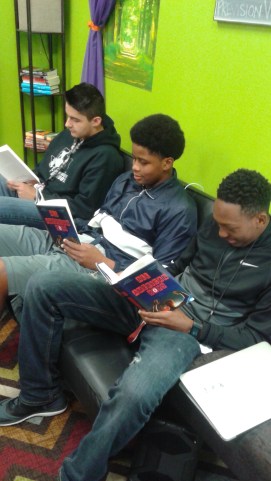
b. A teacher allows her students to self-select the books they read. She models the moves of a reader. She talks about rich literature, what makes a compelling story, hboys readingow characters and plot lines develop and how they mirror their lives. She challenges students to consume pages, develop stamina, and grow in fluency. She gives them opportunities to read more and read harder because she knows the value of reading in building confidence and competency. She introduces different genres, authors, themes. She surrounds them with shelves weighed down by high-interest books and gives them time to read in class. To this teacher, it is not about the book — or the six books of lofty literary merit — it is about the reader. Readers who read 12 books in a year instead of just six. This teacher knows if she makes a reader she can make a life.  And the skills gained through reading extensively transfer to their writing and permeate like energetic friends into the reading they must do in other classes.

I am going to go with b.

Equity is not in the books we require students to read in English classes. Equity is in the skills and the fluency and the stamina students need to read those books if they chooses to read them.

Too many students in high school read below grade level. The only way to help them read better is to read more. Six books (and I’ll question if he really reads them) is not enough. So much research helps us understand this. Donalyn Miller collected a lot of it for easy access here. And Penny Kittle cites scores of it in the bibliography of Book Love.

I met with a reader today. I asked her about the reading she did as a sophomore in her Pre-AP class. “Did you read last year?” I asked.

“Uh, no, not really,” she said. “I only read two books last year. But I only remember one.”

Two books.


And before you jump all over me, I know there is option c. Yes, we can have a mix of both, but I will hold my ground:  If we are not advancing readers and writers, we are doing it wrong.


Starting with Why

“People don’t buy WHAT you do, they buy WHY you do it” ~Simon Sinek, Start With Why

I first heard of Simon Sinek from my son Zachary. He came home from work one day excited to share a TED Talk he’d listened to during his break. I had not seen my youngest son so animated in months. Zach had big dreams, but he made some poor choices that led to him having to wait a while after high school to start making those dreams a reality. This young man needed some inspiration. Simon Sinek gave it to him.

At Zach’s request, I watched Sinek’s TED Talk “How Great Leaders Inspire Action,” and talked with my son about Sinek’s message:

“There are leaders and there are those who lead. Leaders hold a position of power or influence. Those who lead inspire us. Whether individuals or organizations, we follow those who lead not because we have to, but because we want to. We follow those who lead not for them, but for ourselves.”

Zachin Taiwan

Elder Zachary Rasmussen

Zach watched that TED Talk multiple times, and my husband pulled Sinek’s book from a shelf in our hallway. “You ought to read it,” he said.

“I want to be that kind of leader, the one who inspires,” Zach told me, and he began to make choices based on his drive to help people instead of what he thought he would get out of helping people. As I write this, Zach is in Taiwan. He gave up his cell phone and his friends and jumped into learning Mandarin Chinese. His 6’4” frame dons white shirts and ties everyday as he rides a bike through Taipei, serving a full-time two year Mormon mission.

My son found the WHY that Sinek inspires, and it changed the direction of his life.


Sinek’s book is about identifying why some leaders are able, not just to sell a product, but to create a movement. He explains his purpose: “to inspire others to do the things that inspire them so that together we may build the companies, the economy, and a world in which trust and loyalty are the norm and not the exception” (7).

That reads like a nice idea for educators, too, doesn’t it? I do not know a teacher who does not want “to inspire [students] to do the things that inspire them.” However, according to Sinek many in business go about it backwards. By extension, I argue that many in education do, too. We focus on the WHAT and the HOW– like making learning relevant, engaging our students, teaching them grit, focusing on achievement, calculating grades, teaching a specific book, giving them a quiz — instead of WHY we teach our students in the first place.

Sinek says, “All the inspiring leaders and companies, regardless of size or industry, think, act and communicate exactly alike. And it’s the complete opposite of everyone else.” They start with WHY. Instead of a focus on the WHAT they produce or sell, or HOW they produce or sell it, they focus on WHY they produce and sell it in the first place. Apple, for example, obviously sells computers. That is their WHAT, but their WHY is to challenge the status quo. It always has been. Stay with me here with Sinek’s explanation:

“A marketing message from Apple, if they were like everyone else, might sound like this:

We make great computers.

They’re beautifully designed, simple to use and user-friendly.

Wanna buy one?

When we rewrite the Apple example again, and rewrite the example in the order Apple actually communicates, this time the example starts with WHY:

Everything we do, we believe in challenging the status quo. We believe in thinking differently.

The way we challenge the status quo is by making our products beautifully designed, simple to use and user-friendly.

And we happen to make great computers. Wanna buy one?

Apple doesn’t simply reverse the order of information, their message starts with WHY, a purpose, cause, or belief that has nothing to do with WHAT they do” (40-41).

Now, let’s think about this as educators:  Most of the time, we think and talk about WHAT we do. “I teach English,” or “I teach high school,” or even “I teach kids.” Sometimes we talk about HOW we do it. “I teach readers and writers in workshop,” or “I advocate for choice independent reading,” or even “I teach To Kill a Mockingbird, ” or “I teach Hamlet.” These are different from WHY we teach and have nothing to do with what motivates us to greet our students each morning, armed with carefully crafted lesson plans, and a smile.

According to Sinek, when we focus on WHAT we do instead of WHY we do it, we are like most of the businesses and companies in the world that drive their work with manipulations and punitive rewards, which might work in the short-term, but do not breed loyalty and long term change. We see this in education all the time:  threats of in-school suspension and failing grades, mandatory tutorials, new test-prep programs, increased numbers of safety nets designed to keep students from failing, changes in grading policies, and more. “There are only two ways to influence human behavior: you can manipulate it or you can inspire it,” writes Sinek. Most decisions we make to motivate students are based on manipulation, and we fail to inspire long-term change. No wonder we see the same students in the same trouble year after year. When we define ourselves, or our schools, by WHAT we do, that’s all we will ever be able to do (45), and that is not enough “to inspire [students] to do the things that inspire them,” or to build a world where trust and loyalty are the norm. We need what Sinek calls “inside out thinking.” To inspire lasting change, we must start with WHY.

Let’s take that example of Apple from before and apply it to our schools. If we are like everyone else, we might talk about our school like this:

We teach high school.

Our school culture is spirited and sound. Our curriculum is rich. Our test scores are high.

Wanna come here?

When we rewrite the example again, and rewrite the example in the order an inspiring school leader actually communicates, this time the example starts with WHY:

Everything we do, we believe in challenging our students’ thinking. We believe in genuine and individual inquiry.

The way we challenge our students is by making our school safe and innovative, with passionate and knowledgeable teachers who are caring and compassionate, who cater to the needs of all students.

And we happen to graduate honorable and educated citizens. Wanna come here?

Does that example make you feel a little different?

As I read Sinek’s book, I kept imagining what his argument looked like when applied to education, but more specifically, I kept imagining what it would look like applied to me as a literacy leader in my classroom. The way I talked about teaching was like everyone else I knew; I focused on what I did as an educator instead of WHY I did it.

I taught AP English Language and Composition. I taught skills to pass a test. I taught students to love books and to like reading. I taught students to write.  Although I had changed my instruction from when I first began teaching, from whole class novel studies with little writing instruction, to readers and writers workshop with choice, modeling, and mentoring, I still struggled. I struggled until I turned my thinking inside out. I took that example Sinek uses to explain what makes Apple such an innovative force in the market and applied it to my belief about myself as an educator and how I make that belief happen in my classroom.

See how I start with WHY:

WHY:  Everything I do as a teacher, I believe in helping my students identify as citizens, scholars, and individuals whose voices matter. I believe our world is better when individuals understand their value, believe in their capacity to cause change, and take action to better the world around them.

HOW:  The way I challenge my students is by making my classroom safe and inquisitive for my individual learners, with instruction that centers on trust, esteem, equity, and autonomy. Through the rituals and routines in my workshop classroom, students gain a sense of belonging, identify themselves as readers and writers, develop their voices, advance in literacy skills, and take risks that have the potential to change their worlds and the world around them.

WHAT:  And I happen to teach English by modeling my reading life and writing life.

It works.

My readers and writers advance because they know we are in the business of learning about ourselves and our world — together.

Simon Sinek is right:  “[Students] don’t buy what we [teach], they buy why we [teach] it.”

My challenge for you:

Follow Sinek’s model like I have above, and write your WHY. Please share it in the comments.

Mini-lesson Monday: Thinking about Complexity

Many of my writers seem stuck in simple sentences. I think this has something to do with their reading fluency. When I ask them to read me a few lines out loud, they read in monotone with faltering phrases and seemingly little knowledge of the workings of punctuation. One of the best assessment tools I have for knowing what my readers need to help them become better writers is these few moments of one-on-one read alouds– them to me — in conferences. These conferences also remind me how closely my reading and writing instruction must be aligned. If my students cannot read well, I cannot really expect them to write well. (And it shows the huge variance of abilities in my AP Language classes.)

In an effort to move my readers and writers into more complexity, and to get them to start paying more attention to sentence structure in their independent reading, I know I must expect them to take action with what they learn. But I do not want to mandate anything I cannot keep up with, nor anything that will make students not want to read. So I decide to start a new challenge with our “quotes board” — the one that’s remained largely empty for most of this year.

Objective:  Using the language of the Depth of Knowledge Levels students will recognize and identify interesting and complex sentence structures; they will then copy the sentence into their writer’s notebooks and/or onto a notecard to use it as a mentor; then in their weekly blog posts, they will write and practice their craft, including at least one beautifully constructed sentence in their post. (If they choose to share their mentor sentence, they will pin it to our “quotes board” to display it for the week.)

Lesson:  First, I remind students that we’ve talked about sentence boundaries and sentence structure since the beginning of the year. I tell them that today we’re going to learn two different types of sentences:  periodic, and loose or cumulative, and look at how writers link details and ideas within sentences that create description and often rhythm.

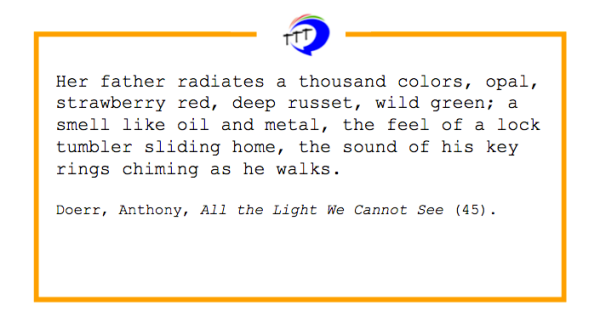
I say, “We are going to study sentences from the 2015 Pulitzer Prize Winner All the Light We Cannot See by Anthony Doerr. Doerr is our writing coach for the week. Let’s see what we can learn about writing more interesting sentences.”

I project the loose sentence, and we talk about where the independent clause lies within it. “How do all the details trailing off of the main idea make the sentence more interesting? What do you notice?”

loose sentence 1

After we’ve discussed the loose sentence, and I feel like students understand what makes it loose and how to identify this type of sentence, we move to the periodic sentence.

I project the following periodic sentence, and we talk about where the independent clause lies within it. “Why put the main idea of the sentence at the end?” I ask.

periodic sentence 1

We discuss why the author might have chosen to craft the sentence this way. “What does putting the main clause of the sentence at the end do for the meaning?” I ask.

Next, we study a few other beautifully crafted sentences I pulled from the novel. (There are so many!) Each time encouraging students to talk with one another to first identify the independent clause and then determine if the sentence is loose or periodic or an interesting combination. I remind them to discuss the meaning of the sentence and why the structure might matter.

We study.

beautiful sentence

and

beautiful sentence 2

And before we move into searching for loose and/or periodic sentences in our own independent reading books, I ask students to practice reading these four sentences aloud to one another.

“Pay attention to the rhythm of the sentence and what the punctuation does to create that rhythm,” I say. I give them a few moments to read sentences to one another at their tables. Low stakes. They know one another well, and there is no pressure. They help each other read, which is exactly what I want in my community of learners.

Follow up: I ask students to pay attention to the sentences in their independent reading books. “Watch for loose or periodic sentences,” I say, “and here’s the challenge:   When you find one, write it out on a notecard, and post it on the quotes board. Let’s see how many of these beautiful sentences we can collect this week.”

And remember to write at least one loose or periodic sentence in your blog post this week. Let’s work on crafting beautiful sentences like Doerr in our own works.