Category Archives: Twitter

6 Ways to Spend Your Snow Day

snow-day2So it’s your fifth snow day this winter…or your fifteenth.  Either way, you’ve done all of your spring cleaning, you can’t grade or lesson plan because you haven’t seen students for a week, and you’ve completely emptied your queues on Netflix and Hulu.  What’s a teacher to do?

1. Read a good book.  If you’re anything like the hundreds of English teachers I know, you love reading.  Use the time you’ve been cooped up to read something you’ve been wanting to but just haven’t had the time to start.  I haven’t stopped hearing about Jennifer Niven’s All the Bright Places, Atul Gawande’s Being Mortal, and Anthony Doerr’s All the Light We Cannot SeeI’ll think I’ll try to tackle the last two this week.

2. Write around a poem.  Penny Kittle shared once that she likes to tape poems into her notebook and write around them–it’s one way to move toward doing your own beautiful writing, she advised.  So, I signed up to receive the Poetry Foundation‘s daily poem via email, and when I read one I love, I print it and tape it into my writer’s notebook.  I’m amazed at the nuggets of written wisdom I arrive at after responding freely to a poem in writing.

3. Read a teaching book.  I’ve been wanting to finish Tom Romano’s Zigzag and Donalyn Miller’s Reading in the Wild for quite some time now, but with the day-to-day craze of the school year, it seems like the only time I find to read teaching books is over the summer.  This is the time of year, though, that I often need a little lift in my teaching spirit, so it’s always rewarding to explore some new thoughts from some of my old favorites.  Since I’m in the middle of a nonfiction book club and writing unit right now, I think I’ll settle down today with Georgia Heard’s Finding the Heart of Nonfiction.

4. Check out that dreaded State Test.  Dana Murphy at Two Writing Teachers reminded me that when our students are accustomed to writing in a choice-based, unit-driven workshop, they are not accustomed to writing to a prompt, and that while standardized tests do leave a bitter taste in our mouths, they are a reality our students must face.  If we want them to feel confident as writers in all environments, we must prepare them for all writing situations–especially the two or three standardized writing tests they may face each year.  Here in West Virginia, we’ve elected to go with SmarterBalanced as our Common Core-aligned assessment.  Today I’d like to spend some time looking at the writing portion of that test and brainstorming some lessons to help my students feel confident writing to those prompts.

5. Catch up with your tweeps. Twitter is a bottomless pit (seriously; you can get lost in it) of resources, ideas, and inspiration for teachers.  I could spend hours perusing the archives of #engchat, #titletalk, and #litlead, just to name a few.  I’d also love to look at the archives of some chats I missed recently–#mindsmadeforstories, for one.

6. Read incredible teacher blogs. I could browse the virtual thoughts of my colleagues forever!  We have so many brilliant and inspirational people in our profession, from the genius team at Nerdy Book Club to the marvelous ladies at Moving Writers; the steady wisdom of What’s Not Wrong to the joyful inspiration of the dirigible plum.  I’ve also been loving the thoughts of Hunting EnglishThe Reading Zone, and countless more…really.  I could never list all the great teacher blogs I’ve stumbled upon.  I feel so grateful to the many, many teacher-writers who have helped me fill my writer’s notebook with thoughts and ideas on dreary snow days like these.

What are your favorite ways to relieve the restlessness of several snow days?  Share in the comments!

Reading Resolutions

For the past few years, all of my reading has been for the purpose of research.  I read pedagogical teaching texts or young adult lit almost exclusively, and when I branched out from that, it was to read complex books that I thought I might use to challenge my students to use for craft examples in class.  I read only as a teacher, and not as a reader.  In 2015, I’m determined not to do that.

pc

Poet’s Corner

Ten days ago, I was in London, England.  Pretty much every moment of every day since then has been spent either reliving a magical moment there, or frantically trying to catch up with everything I fell behind on here in real life.

Much of that trip of a lifetime was spent flitting around different literary sights in London.  My husband and I had a beer at The Plough, the famed pub of Dickens, Woolf, and Darwin.  We visited Poet’s Corner in Westminster Abbey and saw graves of and memorials to my heroes Jane Austen, William Shakespeare, C.S. Lewis, and more.  We enjoyed a visit to the home of the most famous fictional character in England, Sherlock Holmes.  The Globe Theatre, The British Library, Southbank Book Market…we saw it all.  Awash in the history of English literature, my trip made me desperately want to revisit much of it.  I can’t think of the last time I read a classic for pleasure.  So, I made my first reading resolution for 2015: read my roots.  My degree is in literature, but I’ve missed out on a lot of its classics–probably because they were assigned as boring whole-class novels and I knew about SparkNotes, but I digress.

NYT-list---11---Cropped-761259So, I knew I wanted to read some classics for fun.  But I also wanted to make sure I read lighter, easier things too, for a different kind of escapist fun.  I got curious about bestsellers I’d never bothered exploring…Janet Evanovich. James Patterson. Sue Grafton.  I’ve never read any of their books, but millions of others have. So, that’s another resolution–read my age.  I’m a 27-year-old female lover of mysteries, and I’ve never cracked the spine of an Agatha Christie! So much of my reading life is focused on the 11th graders in my classroom, but I need to read my age, too.  I want to read what everyone is reading and talking about–all of the New York Times bestsellers, not just the Young Adult list.

FullSizeRender

Heaven in Outer Banks

My last resolution is to relax and read.  I recently read an article about a woman deciding not to participate in the GoodReads Reading Challenge because she felt like it stressed her out and diminished her intrinsic love of reading.  The comments were overwhelmingly negative and unsympathetic, but I found myself in complete agreement with her!  I was always “behind schedule” on the challenge, always feeling like I couldn’t take the time to read anything massive like The Goldfinch or pondering like The Poisonwood Bible or immersive like Will in the World.  Those books would take me way too long to read, and how was I supposed to find new things to booktalk for my students then?!  Well, I’m done with that.  I want to return to the days of my vacation in North Carolina last summer, where it rained for seven days straight and all I did was read.   It was the perfect beach vacation.

FullSizeRender (1)

My selfish to-read list

2015 is my year to stop feeling guilt, obligation, or stress about books.  Yes, reading saves lives, changes the world, and creates empowered, literate citizens, but that’s not why people read.  And that’s not why I try to get kids to become readers.  Reading is an exercise in imagination, in escape, in adventure.  It’s joy and pleasure and heartbreak.  It’s empathy and knowledge and understanding.  I’ve been so busy trying to teach that that I’ve forgotten it myself.  This year, my resolution is to remember that.  What’s yours?

Share your #readingresolutions and see others’ on Twitter.

Finding A Teaching Family Outside of School

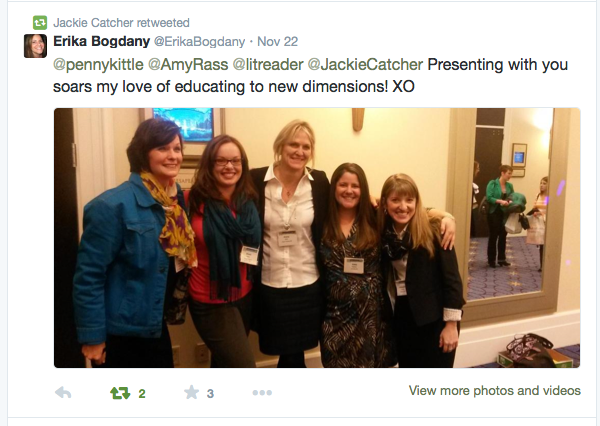
“It’s funny how my closest friends live states away,” Amy said to me as we crossed the convention center’s atrium during NCTE. I agreed; our group of four, Amy, Shana, Erika, and I, might live in different parts of the US, but we share a unique bond, one that has carried me through both the highs and lows of teaching.

Teaching is an anomaly: for being such a social career, it is also quite isolating. I learned this my first Screen Shot 2014-11-26 at 9.37.08 AMyear when I went from sharing a classroom during my yearlong internship to suddenly being by myself at the end of the hall. I found that while my colleagues and I would sit down for lunch everyday, we struggled to find common times to chat about our work or pedagogy outside of professional development days or staff meetings. Despite being within the same building, we’d oftentimes take to the Internet to discuss our plans and work with one another. Over the summer I would receive messages from Jenn about a fantastic new book we could incorporate into our academic English curriculum or recently I received a Pinterest pin from Kristina pointing out a fun way to teach sentence diversification.

Social media has changed the face of my professional learning network. While many of my teacher-friends are at my school, my core group doesn’t just involve those within my state anymore. I have discussed pedagogy with teachers in Canada, talked shop with friends in Washington D.C., and connected with educators across the country. Teaching is no longer the isolated occupation it once was. Over the past two years, these discussions have had a profound effect on my development as a teacher. Many teachers have helped to shape the workshop model within my classroom by being honest about their successes and struggles. My PLN has given me a place to geek out over reading, writing, and discussing literature. And ultimately, this passion online translates into my enthusiasm within the classroom.

With Thanksgiving right around the corner, I cannot be more thankful to my online peers as well as to Screen Shot 2014-11-26 at 9.33.43 AMthose teachers who I have met at conventions and in classes. I am grateful for the relationships I have garnered via social media and e-mail. No teacher should feel alone in this occupation—there are countless resources to uplift and inspire even the most isolated. After all, teaching is an occupation composed of charismatic, committed, and loving individuals who not only see the best in their students but also search for the best in each other.

Make Your New Year Revolutionary

It’s the end of New Year’s Day, and I am pondering resolutions. I should have probably already made some, but the end of 2013 took over my heart, and I am a little behind.

My husband’s grandmother passed away two days before my sweet mother. We attended two funerals in one weekend. Since we had to travel and plan services, I took the last seven days of the semester off, which means I missed reviews and final exams and calculating semester grades. I have a lot to do. And I’m having a hard time feeling like doing it.

But I will. And as I’m thinking about my resolutions I know I need to help my students set some, too.

So many need to read more, write more, do more. And I only have one more semester to help them learn.

So I am going to slow down, be more purposeful in my conversations with students, take more time for allowing them to talk, express, emote.

I am going to extend writing time, allow more hours to create and polish and publish–instead of rushing to meet the end of a grading period like I always seem to do.

I am going to keep filling my award-winning-books-only bookshelf and challenge advanced students to take on more advanced texts.

And finally, I am going to use Twitter more in the classroom: share links to student blog posts, reviews on Goodreads, book suggestions, author tags, and more. Try to model the sharing I do with my own PNL. Twitter made a huge difference in my class two years ago, but I haven’t taken the time to get it set up and going well in class this year. I need to change that.( I’m thinking about Instagram, too, but I’m still mulling around how to use it to promote more reading.)

On Monday I got two messages about resolutions from two of my daughters. Jenna said, “church was all about resolutions. They kept just calling them goals, but I always think a resolution should have a stubbornness to stop something or do something. You know, when people say things, resolutely? There’ something with staying power there. So, yeah, I’ve made some resolute goals for the New Year.”

And Kelly said, “I hope you all are making some New Year’s REVOLUTIONS! Not resolutions because that is lame…And revolutions are big. Make it a year to remember with me!

Next Tuesday my students and I will be back in the classroom. We will talk about being more resolute in revolution readour learning, more intentional as we learn together this spring. We’ll set some new goals.

And if I can figure out how to get students to do all this grading (the one thing that bugs me the most about teaching), well, that will be truly revolutionary.

Happy New Year, friends.

What are your New Year’s Revolutions?

Christmas Miracles

ocs

December has traditionally been my least favorite month of the school year.  Something about it bogged me down, without fail, every winter–the dark, sunless days…the mountains of papers to grade…the looming specter of exams–to write, administer, and grade.  I hated my job in December.  From old journals, I know that I was consistently unhappy in the twelfth month of the year, and I wanted to quit teaching every time it rolled around.

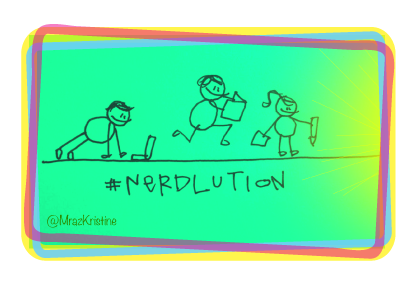
This December, though, things couldn’t be more different.  I am LOVING my job!!  Last week, I found myself completely caught up on grading–something that literally hasn’t happened yet this school year.  Somehow, I had plenty of time to plan great lessons, confer with students with no back-of-the-brain worries, AND reorganize my classroom library.  I was a productivity machine–and it didn’t stop at school.  At home, I found the energy to assemble Christmas cards, decorate my apartment, and make some holiday crafts.  As I type this, my fingers are still sticky with powdered sugar from the big batch of cookies I baked this morning.  What’s with the freakish perfection, you ask?  One little, made-up, three-week-old, hashtag of a word:  #nerdlution.

nerdlution-button-tiny-01

Teachers across the country made nerdy resolutions that would be kept for 50 days.  They could be anything–write every day, exercise, a more robust reading life.  A Thanksgiving day Twitter chat gave rise to that wonderful idea, which I hope will become an annual tradition.  Still riding my NCTE13 high, I resolved (nerdsolved? nerdluted?) to spread professional ideas about English teaching any way that I could, every day.

IMG_1036I started by leading an epic two-hour workshop for my English department.  We book-passed (a la Penny Kittle) the entire contents of my professional library, shared best practices in a “gift exchange” of ideas, and made our own heart books (a la Linda Rief) of things we wanted to try.  Afterward, Kristine, a 20-year veteran with a reputation for pessimism, approached me.  “I used to have your energy,” she said.  “I don’t know what happened, but I haven’t had it…for years.”  She teared up, then borrowed Blending Genre, Altering Voice by Tom Romano, a balm for her troubled teaching soul.  Other books from my NCTE haul were checked out, too–Georgia Heard’s brand new Finding the Heart of Nonfiction was battled over by two first-year teachers, Penny Kittle’s incredibly dog-eared and highlighted Book Love and Write Beside Them were taken by veterans, and Tom Newkirk’s well-loved Holding On To Good Ideas in a Time of Bad Ones was checked out by our department head, who has held his position since 1972 (I’ll let you do the math on that one).

I was elated, and my colleagues’ willingness to try new ideas didn’t stop there.  The next day, a friend came and talked through some ideas about having her students do mini multigenre projects on Greek gods.  Enthused, I told her I couldn’t wait to see the results.  The following morning, Kristine, the tired veteran who’d borrowed Tom Romano’s book, stopped me in the hall.  “I came to school every day this week with a new attitude.  I feel the spark again,” she told me.  I nearly cried after we went our separate ways.

IMG_1313The following week, it all seemed to be coming together–our entire English department was on board for trying something new, especially the workshop model.  They wanted to see it in action.  In five days, I was observed eight times by fellow teachers, and they saw my students doing amazing things.  With heads down and pens on paper, their extended narratives were growing to eight…twelve…twenty-six pages long.  They were BEAUTIFULLY written, and on an incredible variety of topics–hunting, car crashes, detectives, breakups, death.  One male student wrote a narrative about rape from a woman’s point of view after hearing me booktalk Speak.

IMG_1314As my colleagues listened in, my students conferred with me about their writing like the confident, thoughtful, reflective authors they are:  “I want it to read like a Rick Riordan story,” Kenneth told me.  “Do you think the pace is too slow?” Nora asked.  “I just need to zoom in a little more on this,” Tevin realized.  “I’ve resorted to writing in my vocab section because the rest of my notebook is full,” Adam admitted with a giggle.  I ended every class with a smile and a feeling of pride threatening to burst out of my chest.  My colleagues were stupefied.  “How are you getting them to read so much?  To write so much?  To work on this stuff in study halls and for homework?”  They were flabbergasted, but all I had to do was point them toward that professional bookshelf, full to bursting (but with more and more empty spaces!!) with the brainchildren of so many of my teaching heroes.

So, my #nerdlution, as well as this little workshop experiment that Emily, Erika, Amy, and I have been trying out, is going beautifully.  The two are combining to bring me the most peace I’ve felt during the holiday hustle and bustle in a long time–and that, for me, is a Christmas miracle.

Reflecting on Connections

ocsI’ve been thinking about connections. With Connected Educator Month coming to a close, many of you might be thinking about it, too. I’ve read chats and tweets about what it means to be connected, and I’ve thought a lot about what being connected has meant to me in learning how to be a better teacher.

My husband had me take the Six Human Needs test designed by Cloe Madanes a few years ago. According to Cloe’s research, we all have two needs that drive us and influence our decisions, behaviors, and actions. Of Significance, Certainty, Uncertainty, Contribution, Connection, Growth, my driving needs are growth and contribution. Learning this was not surprising, and it explains in part why I became an educator, and why I love to help other teachers grow in their practices.

While connection didn’t rise as one of my primary needs. It’s impossible to contribute and grow as a teacher with out connections. I have many.

photo @2003 Anselm Hook Flicker

photo @2003 Anselm Hook Flicker

I connect with my peers in the English department as we talk about the needs of our students, design lesson plans, and try to help students succeed. I connect with my colleagues in other content areas as we meet in faculty meetings, school activities, and crowded hallways.

Then I have my North Star of Texas Writing Project connections, the amazing educators that make up our Teacher Consultants. It’s because of them I am a confident presenter, researcher, writer, and workshop teacher.

Much of my confidence comes from the connections I’ve made on Twitter. Joining chats with my teacher heroes, receiving responses to questions, discussing issues with other professionals with similar challenges, all these connections help me improve the instruction in my room and the relationships with my students.

The relationships I made this past summer at the University of New Hampshire Literacy Institute changed my teacher soul forever. The connections made there gave me hope on more than one occasion. Emily, Erika, and Shana allow me to contribute and grow on a regular basis, and I am grateful for their insights and encouragement in my life. It can be difficult being the only teacher on my campus who believes in the power of a readers/writers workshop classroom. Support from these friends, even as far away as CA, WV, and Brooklyn, NY, comes at the most opportune and significant times. (Of course, the Words with Friends games help our camaraderie, too. What English teacher doesn’t want to beat another one at a word game? BK, join us!)

So today as I reflect on my week of blog posts, comments, and shared goals for students, I am thankful. Thankful for new connections, new friends, and even new challenges as I keep writing, keep sharing, keep trying to change the way I reach the students in my care.

Thanks to all of you, my connected educators.

I Might Be Ready. Thanks, PLN!

I got the idea from Jennifer Fountain @jennann516 to post the covers of the books I’ve read on the door of my Fountain book doorclassroom. See how awesome hers looks?

I’ll go to my classroom this week with a new color ink cartridge and start printing book covers. It might be expensive–my printer’s kind of a wimp, but I think the more we talk about books, display books, show off books, the more likely we are to get kids to read books.

So far this summer I’ve read nine books. I have a week to finish one more to reach my summer reading goal. It’s a good start on my book-lover’s door.

I have three teaching books I’m reading, too.  I have to read them slowly and mark the pages, so I can remember the things that made me want to read them in the first place. I will let my students know I read these books, and I’ll let them know I’m writing one. We will be readers and writers learning together. Every day.

Shana classroom libraryLast spring when school was letting out, with a little help from some National Honor Society students, I finally got around to sorting and categorizing my bookshelves. I have close to 2,000 books. My daughter made me cute labels that I’ll laminate and put on my shelves this week. My friend Shana Karnes @litreader finished her library in her brand new classroom, and she’s my inspiration. My walls aren’t quite so cheery, but I hope to make my bookshelves look as inviting. Who wouldn’t want to browse here?

I “listened” in on a Twitter conversation about getting rid of the teacher’s desk to make more room in the classroom. I think that was Ms. Fountain and Mini Rench @mindi_r who bounced around the ideas, and inspired me to move some furniture. I couldn’t quite boot my desk, but I did turn it around, and I moved a table, so my personal real estate shrunk four feet. I can now wander the room, weaving between my round student tables much easier, and if I want to stop and teach the whole group, I can do it from three distinct places: front, back, and right side. The left side is loaded with bookshelves, and I just got asked if I wanted a rocking chair that will have to go there. Yeah, maybe. (I’ll take pictures soon.)

This year, besides my personal goal to do better at conferring with students and holding them Kitras Glassaccountable for their writers’ notebooks, I aim to be at peace. This is hard for me; I hang onto stress like that kitten and the frayed rope. Thanks to Erika Bogdany @erikabogdany, I now have a Zen garden on the shelf by my desk. “It will work!” she promised me. At the urging of Emily Kim @booknerdkim I also have a Woodstock Tranquility Table Chime. But my Kitras Tree of Enchantment globe is my favorite. I saw it in a shop in Maine in July and knew it would help me keep my center.

My PLN (personal learning network) on Twitter is my best source of learning. Sometimes I join chats: #engchat, #rwworkshop, #titletalk are favorites. Most often I just read what people share–and it’s an amazing thing. I’ve favorited tweets all summer and now categorized them into folders in Drive. I’ve got mentor texts for narrative, informational, and persuasive writing. I’ve got infographics, Youtube videos, and TED talks to use as quick writes and/or discussion starters. And more. All first shared on Twitter by educators like me who want to do the best by their students.

I might be ready for the new school year, and it’s a big thanks to my personal learning coaches for helping me get there. This week is inservice, and I’m actually looking forward to it:  new principal and three out of four new assistant principals, 31 new staff at my large high school this fall–at the very least it has to be interesting.

I’ll slyly keep my Twitter feed open, and maybe I’ll score one or two more ideas before students show up in a week.

I’d love to know the best ideas you’ve learned this summer. Care to share?


50% of the Teachers Were Willing to Try

I underestimate people sometimes. For those who know me personally, this is no big surprise.

Today, a colleague and I taught (or attempted to teach) some of our peers how to use two (we believe) pretty simple technology apps. We kind of thought it would be easier than it turned out to be. Here’s what I learned:

1. Some teachers are not interested in learning–or even trying–to do anything with technology. It does not matter how much you testify to what has worked wonderfully well with your students. They do not care. They are not going to even pull out the cell phone and give it a try.

2. Some teachers are so impatient with their own devices that they will not even give you a chance to help them, or walk them through whatever application you want them to see. This frustration comes out as anger (and is often rude) against the person just trying to show them a tiny little thing.

3. Some teachers watch and listen, turn on, and try. They ask questions. They push buttons. They light up when they “get it.” They enjoy the experimenting and the experience of it all.

Quick quiz. Which of the three above do you think I want to work with every single day?

Self-evaluation. Which of the three above are you?

My friend JC Hamlin and I showed our peers Twitter and Vine today. We’ve both used Twitter with our students for awhile now; we both want to use Vine with our students this year.

Here’s a tidbit of our presentation:

Three Ways to Use Twitter in the classroom:

  • as communication within the walls of the class and beyond
  • as a backchannel (Shy students speak up when they can tweet their responses)
  • as a way to include the outer-circle in an inner-circle discussion

Why using Vine makes sense:

  • students love to make and share videos
  • most students have a Smart phone–or a classmate who has one
  • it’s fun

The assignment:  1. Create a Vine that introduces yourself to your students without showng your face. 2. Tweet it to us.

My Vine Introduction

50% of the teachers in the room successfully “played” with technology today. 50% of the teachers were willing to TRY.

I wonder how this translates into what the instruction looks like in their classrooms. Really, I wonder.

15 hours later:

Okay, so after thinking about this pretty much all day, I realized a few things:

1. I exaggerated. It wasn’t 50%. I’m amazed at how a few sure can feel like A LOT.

2. I must remember to be patient. At first I took a long time to learn tech things; I need to allow others time, too.

3. The experience, the emotions–positive and negative–are an fine parallel to what happens in class with my students.

So, the question I ask myself as I go into another year of teaching: What systems do I have in place, what communication skills, strategies, relationship-building tactics do I have in mind to deal with it. Better.

Writing Workshop: Assessment and Hope

Students should write more than teachers can ever grade. I heard this first from Kelly Gallagher, author of the book Readicide, a book, among others, that helped me frame my curriculum around Workshop. If I remember correctly, he said that his students write four times more than he grades. Really?

I pondered this for a long while, and I still struggle, but I think I have some of it figured out. I thought for a long time that my students would not write unless I graded what they wrote. Every assignment:  “Is this for a grade?” Every answer: “Yes, everything is for a grade.” The refrain got old.

Then I tried something new: I began writing with my students on the first day of school, and I had some kind of writing activity every single day. I don’t remember where I read it, but when I was researching the work of the reading writing workshop gurus a couple of years ago, I know I read:  if you struggle with time and have to choose between reading or writing, choose writing.

It’s the complete opposite of what I thought:  My students are struggling readers. How do I give up reading when I know they need it? I thought about it more and realized: If I teach writing well, students will be reading. And they will be reading a lot.

So let me explain how this works for me. Remember, I teach AP English Language and Composition (that’s the top 11th graders) and English I (that’s on-level freshmen)–two extremes.

Writing Every Day

There are many ways to get students to write every day. Of course, some ways will get them to take their writing more seriously than others. I find that when I give them an audience, students will put a lot more effort into what comes out their pens. Audience matters!

Topic Journals. Following the advice of Penny Kittle, author of Write Beside Them, I created “topic journals” that students write in once a week the first semester. I bought composition notebooks and printed labels, using various fonts, of the topics: love, conflict, man vs. man, man vs. self, man vs. nature, war, death, gender, hope, redemption, family, romance, hate, promise, temptation, evil, compromise, self-reliance, education, friendship, guilt, doubt, expectation, admiration, ambition, courage, power, patience, fate, temperance, desire, etc. I created 36 notebooks; one for each student in my largest class.

I introduced the topic journals to my AP students first. I set up the scenario:  “I will be teaching 9th grade. I need your help. Do you remember what it was like to be new to high school? nervous, anxious, a little bit obnoxious? I created these notebooks so you could write and give advice to my younger, less advanced students.”

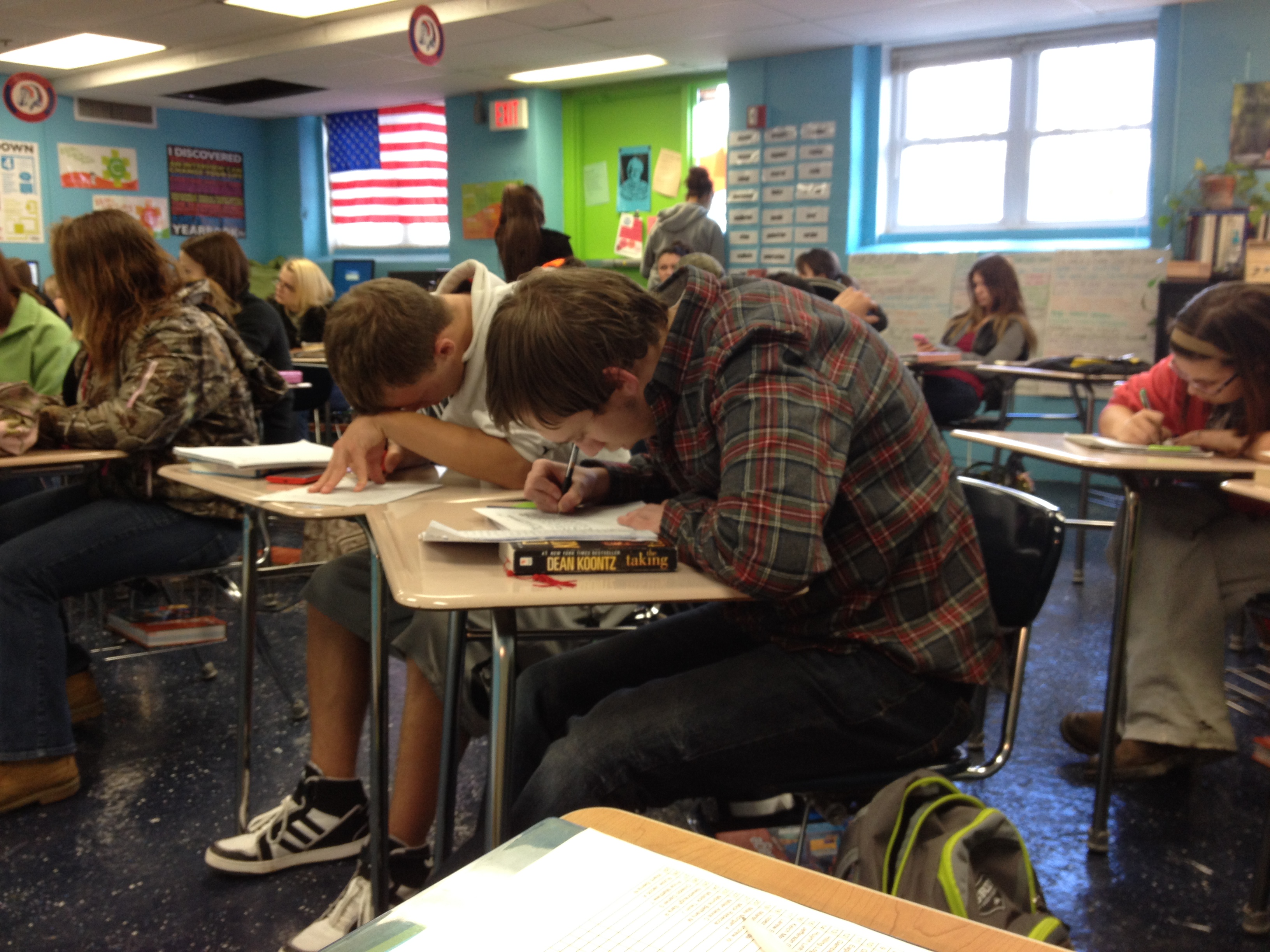
The first task was to turn to the first page in the journal and define the topic. Many looked up the terms in the dictionary or online. They wrote a quickwrite explaining what the topic meant. Then on the next page they wrote about anything they liked as long as their writing fit the topic. I had them sign their posts with their initials and the class period. I told them that they could choose their form (a letter, a narrative, an advice column) as long as they remembered that their audience was 9th graders, and whatever they wrote had to be school appropriate. “If you write about bombs or offing yourself or anyone else, you’re off to see the counselor or the police.” These are good kids, most of them in National Honor Society. They took my charge to help my younger students seriously. This exercise often worked as a lead into our critical reading or class discussion that day, and sometimes students chose a piece they’d started in a topic journal to continue exploring for a process piece.

You can imagine how I introduced the journals to my freshmen. I began by saying, “You know I teach AP English, right? That’s the college-level English class. Well, those students would like to offer you advice about high school, life, and whatever else you might have to deal with the next few years. They are going to write to you in these topic journals. Your job when you see these notebooks on the tables is to choose the one that “calls” to you. First, you will read the messages the older students wrote for you, and then you will respond. Remember to use your best writing.” I then set the timer and had students read and write for 10-15 minutes, depending on the lesson I planned that day. Sometimes I had students share out what they wrote; most often we tucked the notebooks away for another week.

Students constantly fought over a couple of the topics:  love, death, and evil were their favorites. I am certain that is telling (and it did help me when selecting titles for book talks.)

While students wrote in topic journals, I read what students had previously written in the notebooks kids did not select. I’d write a quick line or two in response to something in that notebook. I always used a bright orange or green pen, so students could tell I’d had my eyes in that journal. They knew I was reading them, but they never knew when or what entry. This helped hold them accountable for not only the content of what they were writing but also the mechanics of how they were writing it.

Assessment? Formative. Students have to think quickly and write about a topic on a timed test for the AP exam (11th grade) and STAAR (9th grade).

Blogs

At first I only set up a class blog, and I had students write in response to posts I put on the front page and in response to an article I put on an article of the week page (another Gallagher idea). It didn’t take me long to realize that students would write more and take more ownership of their craft if they created their own blogs. The first year I had students set up blogs I taught gifted and talented sophomores, and I was nervous. Nervous that something would happen:  they’d post inappropriate things, they’d do something to get themselves and me in trouble, they’d be accosted by trolls out to hurt children through internet contact. I chose Edublogs.org as the platform because I could be an administrator on the student blogs, and I had my kids use pseudonyms. This was overkill. Yes, I did have to change two things that year:  one student called his blog Mrs. Rasmussen. I told him my husband didn’t appreciate that much. Another kid used a picture of a bomb as his avatar. Not funny. All-in-all my students did great, and they wrote a lot more (and better) than they ever did for me on paper. I was a stickler for errors and created this cruel scoring guide that said something like: A=only one minor error, B=two minor error, C=three minor errors, F=four or more errors. Students that had never gotten a C in their lives were freaking out over F’s. “Sorry, kiddo, that’s a comma splice. That’s a run-on.” I had more opportunities to teach grammar mini-lessons than I ever had in my career. But see, these kids cared about their grades.

My 9th graders now–not so much. They care about a lot of things, but if I punish them for comma errors or the like, they shut down and stop writing. I learned to be much more careful. Now, I work on building relationships so they trust me to teach them how to fix the errors themselves. It takes a lot more time, but in the end, student writing improves, and students feel more confident in their abilities. I am still working on getting my 9th graders to be effective writers. So far, I have not accomplished that too well, as is evidence of their EOC scores this year.

This past year my AP English students posted on their blogs once a week. I told them that I would read as many of their posts as I could, but I would only grade about every three. I wouldn’t tell them which ones I’d be grading. I let students choose their topics, but since I had to teach them specific skills to master for the AP exam, I instilled parameters. They had to choose a news article that they found interesting, and then they had to formulate an argument that stemmed from that article. The deadline was 10 pm on Monday–every week. This assignment accomplished two of my objectives:  students will become familiar with the world around them, and students will create pieces that incorporate the skills that we learn in class. When I turned to social media to promote student blogs, I got even more ownership from my students.

Assessment? Formative or Summative. Students apply the skills they learned in class regarding grammar, structure, style, devices, etc. Scored using the AP Writing Rubric for the persuasive open-ended question.

Twitter in the Classroom

One of these days I will write a post about the many ways I used Twitter in class this year. For now, let me just tell you:  Twitter was the BEST thing I added to my arsenal of student engagement tools. Ever.

When I began asking students to tweet their blog url’s after they wrote on Mondays, I started leaving quick and easy feedback via Twitter. It was so easy! Kids would tweet their posts; I’d read them; re-tweet with a pithy comment. Within minutes of the first couple of tweet exchanges, students were posting and tweeting more. They were getting feedback from me, and they were giving feedback to one another. They began building a readership, and that’s what matters if students blog. Just because they are posting to the world wide web does not mean anyone is reading what they write. But, a readership, especially one that will leave comments, that’s a whole new story.

Assessment? Formative. Students share their writing and make comments about their peers’ writing. Critical thinking is involved because students only have 140 characters to express their views.

Student Choice. Sometimes.

In a perfect writing class, I am sure students get to choose what they write about every time. This does not work in an AP English class where I am trying to prepare students for that difficult exam. Once a week my students complete a timed writing where they respond to an AP prompt. The guidelines for AP clearly state that the essays are scored as drafts; minor errors are expected. My students must practice on-demand writing. There is no time for conferencing or for taking these essays through the writing process. Unless–we revisit. And sometimes we do. Students are allowed to re-assess per our district grading policy if they score below an 85. 85 is difficult for many of my students, so lots of them re-assess. To do so, students must come in and conference with me about their timed writing. I am usually able to pick out the trouble spots quite easily, and it’s through these brief conversations that I get the most improvement from student writing. Often, instead of conferencing with me, students will evaluate their essays with one another.

I show several student models of higher scoring essays and teach students how to read the AP Writing Rubric. Then, in round robin style, students assess their own essays and at least three of their peers. I remind students not to be “nice” to their friends and give a score that’s undeserved. This will not help anyone master the skills necessary for the AP exam. Rarely do students give themselves or their peers scores higher than I would.

My students also write process papers. For AP reading workshop students choose a book from my short list. After reading and discussing the books with their Book Clubs, students have to write an essay that argues some topic from the book. I model how to structure an essay. I model how to write an engaging introduction. I model how to imbed quotes and how to write direct and indirect citations. I model everything I want to see in this type of writing.

I allow several weeks in my agenda to take these papers through the writing process, and students do most of the work outside of class (not so with my 9th graders).

  • Day one students generate thesis statements, and we critique, re-write, and re-critique.
  • Day two students bring drafts that we read and evaluate in small groups. (I have to teach them that a draft is a finished piece that they are ready to get feedback on–not a quickwrite. So many students type up their rough draft and call in good. This makes me crazy! And I tell them that I will not read their first draft unless they come before or after school or during lunch. They must work on their craft before I will spend my time reading it.)
  • Day three students bring another draft that we read and evaluate again. Sometimes, depending on where my kids are in terms of producing a good piece, I will take these up and provide editing on the first page. Never more than the first page!
  • Day four students turn in their polished papers. I score them holistically on a rubric that aligns with the AP Writing one, or if it’s my 9th graders, I score them on the appropriate STAAR writing rubric.

My freshmen students need a much more hand holding, and we do a lot of writing on lined yellow paper. Most often, especially at the first of the year, they get to choose their own topics. However, I have to give them a lot more structure because on the new Texas state test. 9th graders have to write two essays (about 300 words each): a literary essay, which is an engaging story, and an expository essay, which explains their thinking about a given prompt. Students use the yellow paper to draft during class. I wander the room, answering questions and keeping kids on task. I also try to write an essay every time I ask students to do so. I use these essays as mentor texts in addition to mentor texts I find by professional authors.

Usually I begin class with some kind of mini-lesson if students are in the middle of drafting. I might show students a paragraph with a description that uses sensory imagery and instruct them to add some description in their own writing. Or, I might teach introductory clauses and have students revise a sentence to include one or two or three. This way I am able to get authentic instruction that my students need right there in the middle of their writing time. When I score these student papers, I specifically look for the skills I’ve explicitly taught. If I do it right, I will have read my students papers one or two times during their writing process, prior to them ever turning in their final draft.

Notice I said “if I do it right.” I rarely do it right. I am still learning to budget my time and get to every kid. I am still learning to get every kid to write. I am writing English I curriculum this summer, which I will use in the fall. I hope to get some of my challenges with my struggling students worked out as I focus more purposefully on the standards. I realized this year that while I am teaching writing as a process all the time, I am not necessarily targeting the standards that fit into the process. I am thinking about this a lot lately.

This is still my burning question:  how can I get kids who hate to read and write to participate in writing workshop so their writing improves and their voices are heard?

I am turning to the gurus as I research and think this summer. Jeff Anderson’s book 10 Things Every Writer Should Know has been an excellent start.

Twitter Schmitter – Recap

Thank you so much to all of you who attended our session. We had a lovely time! If you have any questions please don’t ever hesitate to meet us up in the Twittersphere!