Category Archives: Technology

6 Ways to Spend Your Snow Day

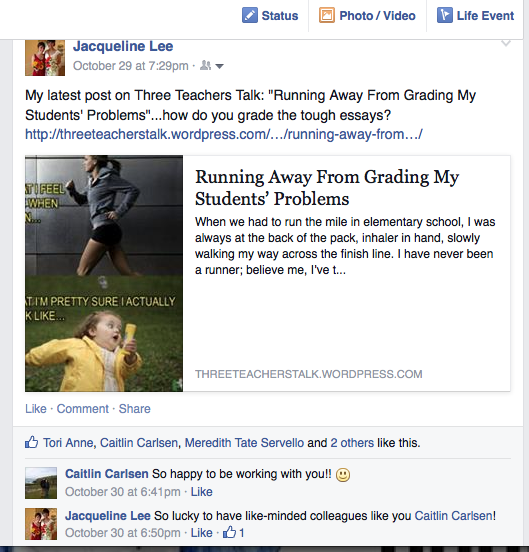
snow-day2So it’s your fifth snow day this winter…or your fifteenth.  Either way, you’ve done all of your spring cleaning, you can’t grade or lesson plan because you haven’t seen students for a week, and you’ve completely emptied your queues on Netflix and Hulu.  What’s a teacher to do?

1. Read a good book.  If you’re anything like the hundreds of English teachers I know, you love reading.  Use the time you’ve been cooped up to read something you’ve been wanting to but just haven’t had the time to start.  I haven’t stopped hearing about Jennifer Niven’s All the Bright Places, Atul Gawande’s Being Mortal, and Anthony Doerr’s All the Light We Cannot SeeI’ll think I’ll try to tackle the last two this week.

2. Write around a poem.  Penny Kittle shared once that she likes to tape poems into her notebook and write around them–it’s one way to move toward doing your own beautiful writing, she advised.  So, I signed up to receive the Poetry Foundation‘s daily poem via email, and when I read one I love, I print it and tape it into my writer’s notebook.  I’m amazed at the nuggets of written wisdom I arrive at after responding freely to a poem in writing.

3. Read a teaching book.  I’ve been wanting to finish Tom Romano’s Zigzag and Donalyn Miller’s Reading in the Wild for quite some time now, but with the day-to-day craze of the school year, it seems like the only time I find to read teaching books is over the summer.  This is the time of year, though, that I often need a little lift in my teaching spirit, so it’s always rewarding to explore some new thoughts from some of my old favorites.  Since I’m in the middle of a nonfiction book club and writing unit right now, I think I’ll settle down today with Georgia Heard’s Finding the Heart of Nonfiction.

4. Check out that dreaded State Test.  Dana Murphy at Two Writing Teachers reminded me that when our students are accustomed to writing in a choice-based, unit-driven workshop, they are not accustomed to writing to a prompt, and that while standardized tests do leave a bitter taste in our mouths, they are a reality our students must face.  If we want them to feel confident as writers in all environments, we must prepare them for all writing situations–especially the two or three standardized writing tests they may face each year.  Here in West Virginia, we’ve elected to go with SmarterBalanced as our Common Core-aligned assessment.  Today I’d like to spend some time looking at the writing portion of that test and brainstorming some lessons to help my students feel confident writing to those prompts.

5. Catch up with your tweeps. Twitter is a bottomless pit (seriously; you can get lost in it) of resources, ideas, and inspiration for teachers.  I could spend hours perusing the archives of #engchat, #titletalk, and #litlead, just to name a few.  I’d also love to look at the archives of some chats I missed recently–#mindsmadeforstories, for one.

6. Read incredible teacher blogs. I could browse the virtual thoughts of my colleagues forever!  We have so many brilliant and inspirational people in our profession, from the genius team at Nerdy Book Club to the marvelous ladies at Moving Writers; the steady wisdom of What’s Not Wrong to the joyful inspiration of the dirigible plum.  I’ve also been loving the thoughts of Hunting EnglishThe Reading Zone, and countless more…really.  I could never list all the great teacher blogs I’ve stumbled upon.  I feel so grateful to the many, many teacher-writers who have helped me fill my writer’s notebook with thoughts and ideas on dreary snow days like these.

What are your favorite ways to relieve the restlessness of several snow days?  Share in the comments!

Reading Resolutions

For the past few years, all of my reading has been for the purpose of research.  I read pedagogical teaching texts or young adult lit almost exclusively, and when I branched out from that, it was to read complex books that I thought I might use to challenge my students to use for craft examples in class.  I read only as a teacher, and not as a reader.  In 2015, I’m determined not to do that.

pc

Poet’s Corner

Ten days ago, I was in London, England.  Pretty much every moment of every day since then has been spent either reliving a magical moment there, or frantically trying to catch up with everything I fell behind on here in real life.

Much of that trip of a lifetime was spent flitting around different literary sights in London.  My husband and I had a beer at The Plough, the famed pub of Dickens, Woolf, and Darwin.  We visited Poet’s Corner in Westminster Abbey and saw graves of and memorials to my heroes Jane Austen, William Shakespeare, C.S. Lewis, and more.  We enjoyed a visit to the home of the most famous fictional character in England, Sherlock Holmes.  The Globe Theatre, The British Library, Southbank Book Market…we saw it all.  Awash in the history of English literature, my trip made me desperately want to revisit much of it.  I can’t think of the last time I read a classic for pleasure.  So, I made my first reading resolution for 2015: read my roots.  My degree is in literature, but I’ve missed out on a lot of its classics–probably because they were assigned as boring whole-class novels and I knew about SparkNotes, but I digress.

NYT-list---11---Cropped-761259So, I knew I wanted to read some classics for fun.  But I also wanted to make sure I read lighter, easier things too, for a different kind of escapist fun.  I got curious about bestsellers I’d never bothered exploring…Janet Evanovich. James Patterson. Sue Grafton.  I’ve never read any of their books, but millions of others have. So, that’s another resolution–read my age.  I’m a 27-year-old female lover of mysteries, and I’ve never cracked the spine of an Agatha Christie! So much of my reading life is focused on the 11th graders in my classroom, but I need to read my age, too.  I want to read what everyone is reading and talking about–all of the New York Times bestsellers, not just the Young Adult list.

FullSizeRender

Heaven in Outer Banks

My last resolution is to relax and read.  I recently read an article about a woman deciding not to participate in the GoodReads Reading Challenge because she felt like it stressed her out and diminished her intrinsic love of reading.  The comments were overwhelmingly negative and unsympathetic, but I found myself in complete agreement with her!  I was always “behind schedule” on the challenge, always feeling like I couldn’t take the time to read anything massive like The Goldfinch or pondering like The Poisonwood Bible or immersive like Will in the World.  Those books would take me way too long to read, and how was I supposed to find new things to booktalk for my students then?!  Well, I’m done with that.  I want to return to the days of my vacation in North Carolina last summer, where it rained for seven days straight and all I did was read.   It was the perfect beach vacation.

FullSizeRender (1)

My selfish to-read list

2015 is my year to stop feeling guilt, obligation, or stress about books.  Yes, reading saves lives, changes the world, and creates empowered, literate citizens, but that’s not why people read.  And that’s not why I try to get kids to become readers.  Reading is an exercise in imagination, in escape, in adventure.  It’s joy and pleasure and heartbreak.  It’s empathy and knowledge and understanding.  I’ve been so busy trying to teach that that I’ve forgotten it myself.  This year, my resolution is to remember that.  What’s yours?

Share your #readingresolutions and see others’ on Twitter.

Finding A Teaching Family Outside of School

“It’s funny how my closest friends live states away,” Amy said to me as we crossed the convention center’s atrium during NCTE. I agreed; our group of four, Amy, Shana, Erika, and I, might live in different parts of the US, but we share a unique bond, one that has carried me through both the highs and lows of teaching.

Teaching is an anomaly: for being such a social career, it is also quite isolating. I learned this my first Screen Shot 2014-11-26 at 9.37.08 AMyear when I went from sharing a classroom during my yearlong internship to suddenly being by myself at the end of the hall. I found that while my colleagues and I would sit down for lunch everyday, we struggled to find common times to chat about our work or pedagogy outside of professional development days or staff meetings. Despite being within the same building, we’d oftentimes take to the Internet to discuss our plans and work with one another. Over the summer I would receive messages from Jenn about a fantastic new book we could incorporate into our academic English curriculum or recently I received a Pinterest pin from Kristina pointing out a fun way to teach sentence diversification.

Social media has changed the face of my professional learning network. While many of my teacher-friends are at my school, my core group doesn’t just involve those within my state anymore. I have discussed pedagogy with teachers in Canada, talked shop with friends in Washington D.C., and connected with educators across the country. Teaching is no longer the isolated occupation it once was. Over the past two years, these discussions have had a profound effect on my development as a teacher. Many teachers have helped to shape the workshop model within my classroom by being honest about their successes and struggles. My PLN has given me a place to geek out over reading, writing, and discussing literature. And ultimately, this passion online translates into my enthusiasm within the classroom.

With Thanksgiving right around the corner, I cannot be more thankful to my online peers as well as to Screen Shot 2014-11-26 at 9.33.43 AMthose teachers who I have met at conventions and in classes. I am grateful for the relationships I have garnered via social media and e-mail. No teacher should feel alone in this occupation—there are countless resources to uplift and inspire even the most isolated. After all, teaching is an occupation composed of charismatic, committed, and loving individuals who not only see the best in their students but also search for the best in each other.

Ending Our Year with 60 Second Shakepeare

Sometimes we just need to celebrate. My sophomores just finished their Shakespeare projects, and a few of them are so fun!

Small groups chose one of Shakespeare’s plays. They read the graphic novel of it, read the summaries to be sure the graphic novel hadn’t left out any crucial information, read all the most familiar quotes from that play, and then had to get to work.

We watched examples of 60 Second Shakespeare found here. And we laughed and talked about our plays and the messages Shakespeare conveyed in them. We discussed topic vs. theme. (Mistaking the two is close to the top of my list of pet peeves.)

As a whole class we decided on the elements that we would need to include in our own 60 Second Shakespeare project. Students took ownership.

This is the guide they created that lead to their learning:

60 Second Shakespeare Project

I’m sharing a student project that surprised me. Two young women, both ESL,  who have struggled all year, made this four part set of GoAnimate.com movies for their project. Of course, five parts (Acts) would have been better, but still.

Twelfth Night

Part I

Part II

Part III

Part IV

Lest anyone think we didn’t give the Bard his due and read critically, analyzing symbols, word choice, and more, we did. We just did it with sonnets and speeches from a couple of his works.

All the Worlds a Stage argument essay ties the skills and the content for the unit together.

Thanks to students who were willing to take a risk with some Shakespeare, we’ve ended the year in Pre-AP English II with some laughs and deep learning. And they can for sure tell you why we read Shakespeare so many centuries after he wrote this great literature.

“It’s all about humanity and how we relate to one another,” said one student. He gets it!

P.S.  This one got presented late, but it’s too great not to share:  Hamlet

Tech Tip #487

Me being shown a new tech tool is actually pretty rare. In fact, I don’t know when the last time it has happened, but a fellow co-worker recently shared what appears to be a pretty cool presentation tool that I have never seen before.

Screen Shot 2014-03-24 at 1.49.58 PM


Powtoon, not to be confused with Paltoons – a comic creator, is touted as a newer and improved replacement to PowerPoint or Prezi. With a simplistic design and many easy to use templates students and teachers alike are sure to find Powtoon a fun tool for creating presentations.

Not that long ago, someone asked me about tool such as Haiku Deck that could also embed video and make a cool presentation. While I have yet to play with that feature it looks like it is simple enough to do as well.

Of course every one wants to know about cost and usage for children. Although there are paid options, there is also a free version that seems to provide some pretty descent access to the tools on the site. As far as any rules for student use, I scanned the terms of service and didn’t find any specific restrictions related to minors. But, as always, I would make sure to check for yourself.

Now, I do have to provide a disclaimer that I have not used this tool, as I just found out about it today, but I can guarantee you that my next presentation will be made Powtoon. I’ll let you know how it goes. — Hopefully you will try it out too!

Make Your New Year Revolutionary

It’s the end of New Year’s Day, and I am pondering resolutions. I should have probably already made some, but the end of 2013 took over my heart, and I am a little behind.

My husband’s grandmother passed away two days before my sweet mother. We attended two funerals in one weekend. Since we had to travel and plan services, I took the last seven days of the semester off, which means I missed reviews and final exams and calculating semester grades. I have a lot to do. And I’m having a hard time feeling like doing it.

But I will. And as I’m thinking about my resolutions I know I need to help my students set some, too.

So many need to read more, write more, do more. And I only have one more semester to help them learn.

So I am going to slow down, be more purposeful in my conversations with students, take more time for allowing them to talk, express, emote.

I am going to extend writing time, allow more hours to create and polish and publish–instead of rushing to meet the end of a grading period like I always seem to do.

I am going to keep filling my award-winning-books-only bookshelf and challenge advanced students to take on more advanced texts.

And finally, I am going to use Twitter more in the classroom: share links to student blog posts, reviews on Goodreads, book suggestions, author tags, and more. Try to model the sharing I do with my own PNL. Twitter made a huge difference in my class two years ago, but I haven’t taken the time to get it set up and going well in class this year. I need to change that.( I’m thinking about Instagram, too, but I’m still mulling around how to use it to promote more reading.)

On Monday I got two messages about resolutions from two of my daughters. Jenna said, “church was all about resolutions. They kept just calling them goals, but I always think a resolution should have a stubbornness to stop something or do something. You know, when people say things, resolutely? There’ something with staying power there. So, yeah, I’ve made some resolute goals for the New Year.”

And Kelly said, “I hope you all are making some New Year’s REVOLUTIONS! Not resolutions because that is lame…And revolutions are big. Make it a year to remember with me!

Next Tuesday my students and I will be back in the classroom. We will talk about being more resolute in revolution readour learning, more intentional as we learn together this spring. We’ll set some new goals.

And if I can figure out how to get students to do all this grading (the one thing that bugs me the most about teaching), well, that will be truly revolutionary.

Happy New Year, friends.

What are your New Year’s Revolutions?

Christmas Miracles

ocs

December has traditionally been my least favorite month of the school year.  Something about it bogged me down, without fail, every winter–the dark, sunless days…the mountains of papers to grade…the looming specter of exams–to write, administer, and grade.  I hated my job in December.  From old journals, I know that I was consistently unhappy in the twelfth month of the year, and I wanted to quit teaching every time it rolled around.

This December, though, things couldn’t be more different.  I am LOVING my job!!  Last week, I found myself completely caught up on grading–something that literally hasn’t happened yet this school year.  Somehow, I had plenty of time to plan great lessons, confer with students with no back-of-the-brain worries, AND reorganize my classroom library.  I was a productivity machine–and it didn’t stop at school.  At home, I found the energy to assemble Christmas cards, decorate my apartment, and make some holiday crafts.  As I type this, my fingers are still sticky with powdered sugar from the big batch of cookies I baked this morning.  What’s with the freakish perfection, you ask?  One little, made-up, three-week-old, hashtag of a word:  #nerdlution.

nerdlution-button-tiny-01

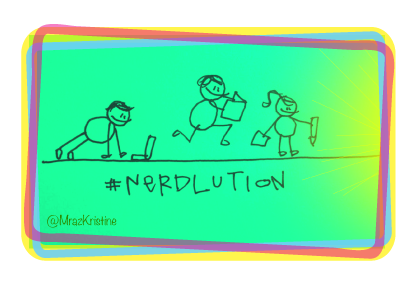
Teachers across the country made nerdy resolutions that would be kept for 50 days.  They could be anything–write every day, exercise, a more robust reading life.  A Thanksgiving day Twitter chat gave rise to that wonderful idea, which I hope will become an annual tradition.  Still riding my NCTE13 high, I resolved (nerdsolved? nerdluted?) to spread professional ideas about English teaching any way that I could, every day.

IMG_1036I started by leading an epic two-hour workshop for my English department.  We book-passed (a la Penny Kittle) the entire contents of my professional library, shared best practices in a “gift exchange” of ideas, and made our own heart books (a la Linda Rief) of things we wanted to try.  Afterward, Kristine, a 20-year veteran with a reputation for pessimism, approached me.  “I used to have your energy,” she said.  “I don’t know what happened, but I haven’t had it…for years.”  She teared up, then borrowed Blending Genre, Altering Voice by Tom Romano, a balm for her troubled teaching soul.  Other books from my NCTE haul were checked out, too–Georgia Heard’s brand new Finding the Heart of Nonfiction was battled over by two first-year teachers, Penny Kittle’s incredibly dog-eared and highlighted Book Love and Write Beside Them were taken by veterans, and Tom Newkirk’s well-loved Holding On To Good Ideas in a Time of Bad Ones was checked out by our department head, who has held his position since 1972 (I’ll let you do the math on that one).

I was elated, and my colleagues’ willingness to try new ideas didn’t stop there.  The next day, a friend came and talked through some ideas about having her students do mini multigenre projects on Greek gods.  Enthused, I told her I couldn’t wait to see the results.  The following morning, Kristine, the tired veteran who’d borrowed Tom Romano’s book, stopped me in the hall.  “I came to school every day this week with a new attitude.  I feel the spark again,” she told me.  I nearly cried after we went our separate ways.

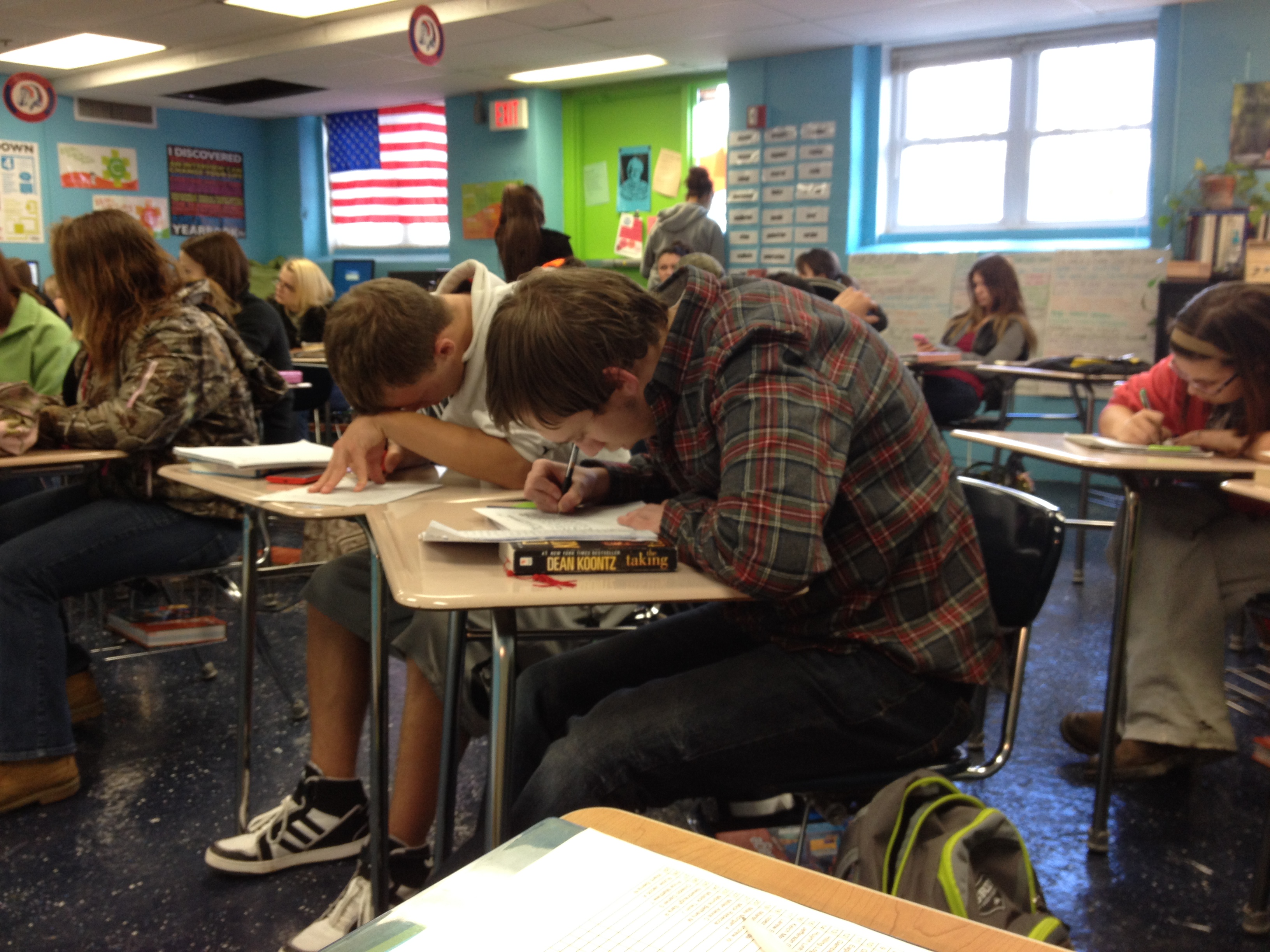
IMG_1313The following week, it all seemed to be coming together–our entire English department was on board for trying something new, especially the workshop model.  They wanted to see it in action.  In five days, I was observed eight times by fellow teachers, and they saw my students doing amazing things.  With heads down and pens on paper, their extended narratives were growing to eight…twelve…twenty-six pages long.  They were BEAUTIFULLY written, and on an incredible variety of topics–hunting, car crashes, detectives, breakups, death.  One male student wrote a narrative about rape from a woman’s point of view after hearing me booktalk Speak.

IMG_1314As my colleagues listened in, my students conferred with me about their writing like the confident, thoughtful, reflective authors they are:  “I want it to read like a Rick Riordan story,” Kenneth told me.  “Do you think the pace is too slow?” Nora asked.  “I just need to zoom in a little more on this,” Tevin realized.  “I’ve resorted to writing in my vocab section because the rest of my notebook is full,” Adam admitted with a giggle.  I ended every class with a smile and a feeling of pride threatening to burst out of my chest.  My colleagues were stupefied.  “How are you getting them to read so much?  To write so much?  To work on this stuff in study halls and for homework?”  They were flabbergasted, but all I had to do was point them toward that professional bookshelf, full to bursting (but with more and more empty spaces!!) with the brainchildren of so many of my teaching heroes.

So, my #nerdlution, as well as this little workshop experiment that Emily, Erika, Amy, and I have been trying out, is going beautifully.  The two are combining to bring me the most peace I’ve felt during the holiday hustle and bustle in a long time–and that, for me, is a Christmas miracle.

Gifted and Talented Teacher Leaps off Cliff of Faith and Experimentation

Guest post by Tess Mueggenborg

Make no mistake about it: I’m a classical canon gal.  Always have been, always will be.  And when I say “classical,” I also mean “really old” – few things written after 1650 hold much interest for me.  Favorite work of literature? Milton’s Paradise Lost.  Favorite time period of literature? Early Roman Empire (Ovid & Virgil).  Favorite English Lit class from my undergrad days? Greek Tragedy.

But as much as I love the canon – and I’ve had surprising success with teaching the canon in the past – I’m also a pragmatist.  I know that what I love isn’t always what’s best for my students, and their learning should take priority over my passions (I know … radical idea, right?).  I also acknowledge that the real world in which I live and work is far from my ideal.  Would I like to devote all of my class time to discussing Beowulf and Canterbury Tales?  Of course.  But can I realistically get my students to read and engage with these texts, and develop a passion for them?  Not likely.  Some, of course, will – and I’m happy to guide them on their own paths of classical literature studies.  But I bet (I hope) that those students will wind up as English Majors, and they’ll get their fill of such works in college.  I must work with the students I have, not the students I wish I had.  And the students I have are awesome: bright, curious, hungry for meaningful learning and wisdom.  So this classical pragmatist has started to break her own mold.  Here’s how …

I teach a class known as World Experience; it’s for Gifted and Talented sophomore students, and it combines AP World History with literature.  The history drives the course – it sets the pace, scope, and sequence for the year.  It’s then pretty easy to match up literature with the corresponding time periods.  leap off cliffAncient River Valley civilizations at the start of the year? We read Gilgamesh and Horus the Hawk.  Classical civilizations come next – that mean Antigone and a few selections from Metamorphoses.  Next up is the Medieval period … and this has always been a struggle.  I love Medieval lit, I can read Middle English, and I can wax poetic on the virtues and merits of The Song of Roland and Sir Gawain and the Green Night ad nauseum.  And while the students usually enjoy these stories, they don’t usually get much out of this unit in terms of literature.  They don’t learn much about author’s craft, they can’t do much literary analysis, and they become so frustrated with the archaic language of the text that most of them give up … and it takes me another six weeks to pull them back into literature.  So this year, I’ve scrapped all this, and leapt off a cliff of faith and experimentation.  The results have been pleasantly surprising.

Our district head of English Language Arts was kind enough to buy $600 of books for my classroom library.  I got to choose every one of them: all award-winners (or by award-winning authors), all world literature, all contemporary, all high-level.  No softballs in this classroom library – these are, after all, GT students.  Each student got to pick a book (this was a time-consuming and sometimes contentious process, but it certainly got every student interested in the books and invested in their choice).  Once a week, they’ve been blogging about their novel, based on someone generic questions posed by me.  Some of the questions are just opinion (Do you like this book so far? Why or why not?); some of the questions are analytical (Who is the main protagonist of your novel? What problems do they encounter in the course of the novel? How do you predict they will resolve these problems … or not?); some relate back to the history half of the course (In what ways does your novel relate to the history we’ve studied so far this year?).  Some responses have been good.  Some have been profound, moving, passionate, and elegant.  None have been outright bad, and none have been missing.  That’s right: NONE have been missing.  Every student has been reading and blogging.  Even the student who earned a grade of 9 (yes, a single-digit 9) for the first 9-weeks is reading and blogging about her novel.  I’m calling this experiment a success.

To be fair, I should say: this hasn’t been easy, and it hasn’t been without challenges.  But they’re good challenges, and not insurmountable.  Some students read their novels in a week – and then wanted to borrow another book.  YES!  Many students didn’t devote enough time to reading their novel, and they’ve fallen behind.  But they haven’t given up: they’re still reading.  I haven’t had any complaints of “this book is boring,” though I’ve had many complaints of “this book is so sad/depressing/pessimistic/disheartening.”  Which has led to some great discussions about the point of literature, analysis of tone, and some hefty doses of maturation (I’m pretty sure the girl who read The Kite Runner in a weekend has been inwardly weeping for two weeks now).

We’re wrapping up this unit, and thus this great experiment.  And I think it bears repeating: I’m calling this experiment a success.  Enough of a success that I’ll be spending this weekend revamping the next unit (which starts Monday) to include more student choice and incorporate more of these novels, though in a slightly different fashion.  Stay tuned.

Am I still a classical canon gal? Heck yes. Always have been, always will be.  But my students don’t need to be classical canon fans – they just need to be readers, eager to engage with the world and its complexities.  I think they’re well on their way.

“Professor” Tess Mueggenborg teaches English (and anything else with which her students need help) at RL Turner High School.  Her academic passions lie in comparative language and literature.  The Professor lives in Dallas with her husband, Jeff. Tess’ on Twitter @profmueggenborg

Reflecting on Connections

ocsI’ve been thinking about connections. With Connected Educator Month coming to a close, many of you might be thinking about it, too. I’ve read chats and tweets about what it means to be connected, and I’ve thought a lot about what being connected has meant to me in learning how to be a better teacher.

My husband had me take the Six Human Needs test designed by Cloe Madanes a few years ago. According to Cloe’s research, we all have two needs that drive us and influence our decisions, behaviors, and actions. Of Significance, Certainty, Uncertainty, Contribution, Connection, Growth, my driving needs are growth and contribution. Learning this was not surprising, and it explains in part why I became an educator, and why I love to help other teachers grow in their practices.

While connection didn’t rise as one of my primary needs. It’s impossible to contribute and grow as a teacher with out connections. I have many.

photo @2003 Anselm Hook Flicker

photo @2003 Anselm Hook Flicker

I connect with my peers in the English department as we talk about the needs of our students, design lesson plans, and try to help students succeed. I connect with my colleagues in other content areas as we meet in faculty meetings, school activities, and crowded hallways.

Then I have my North Star of Texas Writing Project connections, the amazing educators that make up our Teacher Consultants. It’s because of them I am a confident presenter, researcher, writer, and workshop teacher.

Much of my confidence comes from the connections I’ve made on Twitter. Joining chats with my teacher heroes, receiving responses to questions, discussing issues with other professionals with similar challenges, all these connections help me improve the instruction in my room and the relationships with my students.

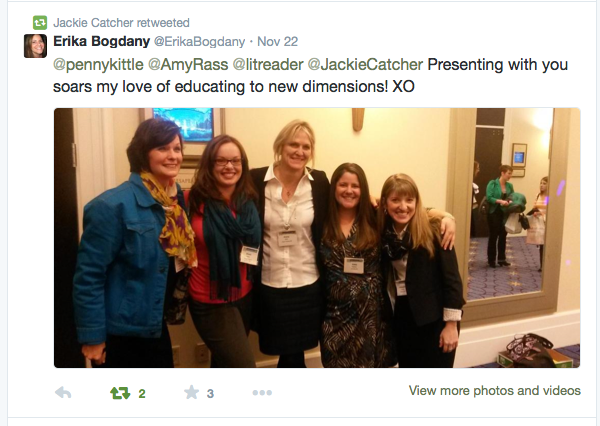
The relationships I made this past summer at the University of New Hampshire Literacy Institute changed my teacher soul forever. The connections made there gave me hope on more than one occasion. Emily, Erika, and Shana allow me to contribute and grow on a regular basis, and I am grateful for their insights and encouragement in my life. It can be difficult being the only teacher on my campus who believes in the power of a readers/writers workshop classroom. Support from these friends, even as far away as CA, WV, and Brooklyn, NY, comes at the most opportune and significant times. (Of course, the Words with Friends games help our camaraderie, too. What English teacher doesn’t want to beat another one at a word game? BK, join us!)

So today as I reflect on my week of blog posts, comments, and shared goals for students, I am thankful. Thankful for new connections, new friends, and even new challenges as I keep writing, keep sharing, keep trying to change the way I reach the students in my care.

Thanks to all of you, my connected educators.

Authenticity: Making it Real with Student Blogs

North Star of Texas Writing Project (NSTWP), in which I am a teacher consultant, asserts that authenticity is connecting student learning with significant audiences, tasks, and purposes.

image

Blogging with my students is one way in which I make that connection happen. Writing posts and commenting on the work of our peers has become an integral part of my readers/writers workshop classroom.

photo: Petras Kudaras

During the second week of school, once schedule changes calm down a bit, I introduced the idea of blogging to my students. This year I wrote a post on my class blog and imbedded an article that made them see that blogging can have value to their futures. You can see that here.

I’ve had students use Edublogs as their blog platform in the past, and I know some teachers have their students use Kidblogs. I decided to go with WordPress this year. I thought using the “real world” blog platform would be a good idea. You know, just in case some students loved the idea and kept writing long after they leave my classroom. Finally, eight weeks into the school year, I am glad I went this route, but the set-up, especially with my 9th graders took a lot longer than I’ve had to spend in the past. (Most of my students are not as tech savvy as many technology advocates would like to believe. For more on that read this post:  Digital Novices vs Digital Natives.)

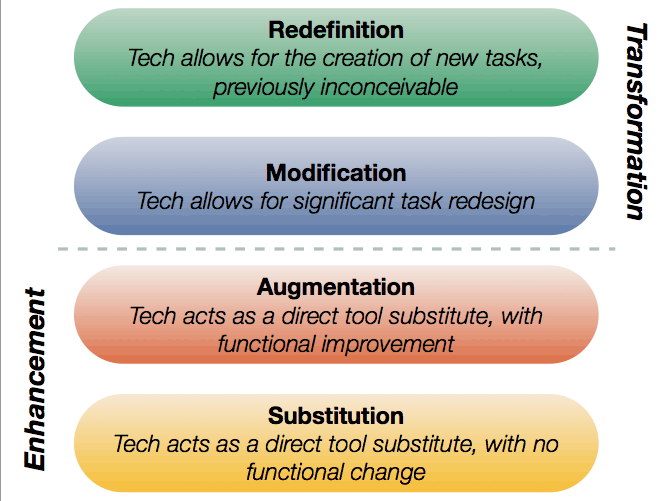
These are some ways I’m transforming my teaching by using student blogs this year (See this SAMR model for ideas on instructional transformation):

Timed Writing. I need students to be able to think quickly about a topic, organize their thoughts, and write effectively in a short period of time. Years ago I had students complete timed writings on paper with a pen, and I’d take the stack of essays home and laboriously grade them. By having students post to blogs, my classroom is getting close to being green. We do very little writing on paper anymore. I can read student posts with the swipe on my finger on my iPad, and I try to leave comments that inspire improvement in their writing. Sometimes I put the score from a rubric. Most times I say something I like about what students have written. They like that kind of feedback best, and it usually prompts some kind of improvement in their next post–something that rarely happened with the marks of my red pen.

For our first timed writing, students wrote about their reading lives. We spend 10 minutes at the beginning of each class period reading our self-selected books. I conference with each student, brief one-on-one chats. I learned more while reading student posts about their reading habits than I did in the prior eight weeks of school. I posted a reflection of my own reading life on my class blog with the actual assignment, and then students wrote on theirs. The response to our wide reading warmed my teacher heart. Read a few of these students’ posts, and you will see why: Helen–A Path Led by Wise Words; Gina–Lay Down the Bridges; Mian–A Passion for Books; Emilio–Reading Life

Our second timed writing, students wrote an argument in response to our in-class study of Ralph Waldo Emerson’s “The American Scholar.” Some student posts were thoughtful and wise; most were ineffective and needed major revisions. All students wrote and showed what they’d learned from their reading and our class discussions.

Persuasive Practice. The AP Lang exam and the 10th grade STAAR test both require students to be effective persuasive writers. I like this blogger’s post:  Blogging is the New Persuasive Essay. As I teach my students how to use persuasive techniques, I also want them learning about their world. They have to know “stuff” to build their credibility after all. So every Monday my students write a post that they base upon something they read in the news. They scan headlines until they find a topic that interests them. Then they pull an idea from the article, and then they write an argument based on that idea. So far, we haven’t delved too deeply in the art of persuasion; we’ve talked mostly about form and structure and a few rhetorical devices, but some of my students have taken ownership of this weekly recurring assignment. Here’s a few to give you an idea:  Kathryn–Words Hurt; Ashley–Recycled Look or Recycled Lives; Jason–Smoking is Safer? Impossible; Adrian–Chemical Mistakes

Published Polished Pieces. As we move through different genres of writing, I need my students to fully immerse themselves in the process of creating effective and moving texts. We started the year with a focus on narrative. I know, it’s not on the AP exam or the STAAR test anymore. But story is so important. It’s what connects us as humans, and it’s story that has helped create a classroom community where students are not afraid to take risks and throw their hearts out on the page. While a few student narratives are not as polished as I would have liked prior to publication (grades being due always seems to interfere with authenticity), if you read just these three, you’ll see why story is important. I can be a better teacher to these PreAP students because of what I know from these posts. Esmeralda–Memories; Mercedes–What Do You Think About Moving? Bryanna–Why Batman?

I remember learning from Kelly Gallagher that students should write more than I can ever grade. Well, of all things in my teaching life, I’ve finally figured that one out the best. I cannot read every post my students write, but I can read a lot, and I can give a lot of feedback in a way that is meaningful so that students respond. We just started reading and leaving feedback for one another. I can already tell that this will be more valuable than just me giving feedback. After we spent two class days reading one another’s narrative posts, I had students tell me on their own narrative evaluations:  “I knew I could do better after I read other people’s.” For an example of our student feedback, read the comments on this one: Amy–Forever a Bye. The instruction I gave students was 1) Be polite but honest, 2) Bless something you think the writer did well, 3) Press a moment that needs more detail or description, 3) Address an issue of concern in regard to style, grammar, etc. For our first time, I’m proud of these students for the feedback they gave their friend.

Engaging student writers is often more than half the battle. So many times they have the attitutde “What’s in it for me?” By allowing students to choose their topics, and allowing them to express their true and authentic voices, I get better participation, and I get better writing, and I get to know the hearts and minds of my students.

That is all I ever really want.

photo: Dee Bamford

#NCTE13  Writing Teachers (Re)Inventing Literacy Instruction by Following the North Star