Category Archives: Talk

3 Types of Talk to Boost Confidence and Community

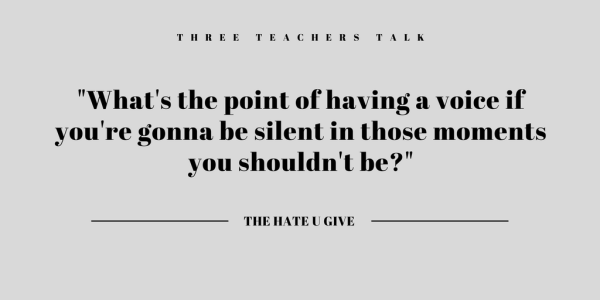
the hate u give

My first day of teaching was going to be great, because I WAS PREPARED.

I wrote a speech, long hand, about 5 pages.  It was going to communicate what students could expect from the class and what they should know about me.  It was going to INSPIRE them.  They would hang on my every word.

Forget all of the appalling things I just mentioned–you haven’t even heard the best part.

After I gave my approximate 35 minute speech, and students were drooling as a result of my awesomeness, we would have A DISCUSSION.

Drop the mic.  Best teacher ever.  My students will have a voice!

Needless to say, having never been in the classroom before, my first day was a shock.  Most students did not want to hear a single word I had to say, much less ABOUT MYSELF.  My voice was gone by the end of the day and I was in tears because I had no idea how to go back and do it for another round of classes the next day.

I had no idea discussions needed planning and structuring.  I thought they just HAPPENED.

Oh–sweet, naive, extremely troubled Baby Mrs. Paxson.

Almost two years later, we never have a discussion without some sort of structure.  The structure can be minor, or it can be massive.  It can simply be planning on my part, planning on the students’ parts, or it can be structure that I pull out of my back pocket to maximize of a discussion that materializes out of thin air.  It can mean a different configuration of desks, or a script to which students can refer if they get stuck.

When we teach literacy, we can’t just command students to “talk.” We have to give them tools and materials and practices so that they are building their houses of reading, writing, speaking, and listening on a solid foundation, rather than a shaky one (insert your chosen Three Little Pigs invocation here).

Here are a few of my favorite ways to structure talk in the classroom, that can really work for ANYTHING from talking about books, to talking about real world issues, to reviewing pieces of writing, to students encouraging each other in passions and endeavors.

AVID Strategy, 30 Second Expert:

I learned this strategy through AVID, and it is so stinking versatile, it kills me.  I’ve adapted it many times to fit what we need, but the underlying concept is in the script.  I used this last during our Life at 40 Unit in which students were exploring desired careers and imagining/researching a possible life path.  In order to get students thinking and talking about career paths, after we did a little bit of preliminary research and decision-making, I posted two sentence stems on the board.

I’m an expert about (desired career) because I found out that __________________________.

I will be an expert at (desired career) because I am (character trait), (character trait), and (character trait).

Now, after they fill out these sentence stems, here is where the magic happens.  Students are required to pair up and repeat this script to a partner.  Their partner must actively listen and repeat what this student said in their own words.

Here are some conversations I got to hear that day:

  • “I will be an expert at physical therapy because I look on the bright side of things and I don’t give up on people.”
  • “I will be an expert at cardiology because I have discovered that I can learn anything, and will work harder than anyone sitting next to me.” (Positive self talk, anyone?)
  • (Repeating back to their partner) “I think you will be a great teacher because every time I talk to you in class, I feel heard and understood.  You stated you were a good listener, and I have experienced that from you.”

This is just a small glimpse into the conversations that can happen with 30 second expert.  Students feel silly at first, and they joke A LOT with these scripts, but even so, if you change your thoughts you can change your world.  Sometimes changing thoughts means changing the way you talk about yourself to others.  This allows students to phrase things they’ve just learned or mastered in a way that helps them realize they have added to their learner toolbox.

Speed-Dating:  

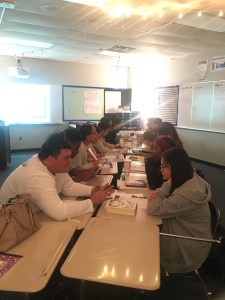
We are major speed daters over here at 3TT.  We speed date books ALL THE TIME.  I’ve also found that the speed dating format is golden for a lot of things such as when students bring in their own news articles for an assignment, giving post-it blessings, reviewing and revising writing, trying different mentor sentences and sharing, or really any situation in which you would like to allow students to have face-to-face time with many different ideas and possibilities.  You could also do 30 second expert in a speed-dating format!Structured Talk
 

Socratic Seminar:

I am by no means an expert on Socratic Seminar, but many different educators have different ways to get students talking about higher level questioning in a group setting.  B’s Book Love has some of my favorites.  In 822, we’ve tried fishbowl, whole class circle, passing stickies, and inner/outer circle with a live Twitter Chat.  They’re all great.  When my kids hear Socratic Seminar, they know I mean serious business, so this usually elicits slightly more academic talk.

Ultimately, structured talk promotes confidence and community in the classroom because it not only communicates high expectations, but it gives students the building blocks to reach those expectations and with skills they will carry into the real world!

How do you structure talk in your classroom?  Have you learned any tricks along the way?  Share them with us below!

Jessica Paxson is an English IV and Creative Writing teacher in Arlington, TX.  She usually takes on major life events all at once rather than bit by bit, such as starting graduate school, buying a house, going to Europe, and preparing for two new classes next year.  If you enjoy watching her make a fool of herself by being unbearably vulnerable, you can catch more of that over at www.jessicajordana.com. Follow her on Twitter or Instagram @jessjordana.


5 Ways to Avoid the Trap of Test Prep

The AP Language test is a month away. Only 14 school days (Spring Break, y’all. Woot!), which means 7 class periods with each of my AP classes between now and the big day.

This imparts in me equal parts excitement, dread, and crippling panic. I’m not sure what my problem is. I’m not the one taking the test, but my test anxiety runs high.

test 3

Now, Amy has written beautifully in the past about the test scores and how little they really mean. How AP and workshop can be beautiful partners.  I applaud her conviction. I need to learn from her resolve. Because all year, I can workshop and weave in test prep (in other words, my priorities are straight – I’m building readers and writers, not test takers), but when the test draws near, I start thinking in numbers. Always dangerous.

When this happens, I feel my brows furrow. I’m suddenly focused on the wrong thing.

I can FEEL it.

Experimenting with workshop during semester two of the 2014-2015 school, I very purposefully placed reading and writing experience above test prep. My scores went up. Last year, I was all in. Lots of student choice. More focus on why and how, instead of what. My scores went up.

Do students need practice with the multiple choice format? Yes.

Should they write several AP practice essays over the course of the year with self scoring, student sample analysis, peer and teacher feedback? Certainly.

Will students be prepared for the test if test prep is secondary to building authentic readers and writers all year. Unequivocally, yes.

Just a few days ago, Donalyn Miller beautifully stated that the best way to improve test scores naturally is to “provide access to books, encourage free choice, give children time to read, and actively support their reading development at school and home.” Her piece for the Nerdy Book Club furthered my determination to remain focused on my students as readers, not as test takers. This is what workshop does. Focuses on readers, writers, and the humans who are so much more than test scores.

Here are a few suggestions to keep focused on what really matters (in my humble opinion), even as AP tests draw nigh, and frankly, in the face of any “big” test.

1. Focus on Experience

I tell my students every year, that living life and being aware of humanity in general is the best argument preparation there is. So, when I saw Elizabeth Matheny‘s spring break Twitter challenge, I immediately asked if I could adopt the idea. Matheny provides her students with a hashtag to document their adventures and several suggestions of ways to really live it up over break as a way to not only build community, but provide inspiration for narratives her students will write in the coming weeks.

I’ve got some ideas brewing to have my students write their own author bios (like the quippy book jacket variety) after break to celebrate themselves as writers. Documenting new experiences may be just the thing to provide focused attention to new passions  and open eyes to the wider world.

My students will start Friday using #langbreak. Follow our adventures and feel free to add your own if you’ve been waiting all this time for break like we have!

2. Write from the Heart First

I used to have students write endless practice essays. Knowing the format seemed important to scoring well, so I had students write in class, take prompts home over the weekend for homework, and churn out essay after essay of (no offense former students) formulaic crap that I dreaded grading.

These days, I’ve embraced a new philosophy. My students need to write more, but practice essays aren’t the thing. Quick writes in class are the thing. Weekly one pagers building their fluency and skills of expression about quotes that stick with them from readings are the thing. Poems about community are the thing. Book reviews on texts that make them feel smart are the thing.

The thing is, students build their writing skills in writing what they care about. They can then apply that to the essay at hand, regardless of the essay type. I spend a small amount of time going through the specifics of the argument and analysis essays, and then we look at countless mentors, we read as writers, and we learn how to effectively break the “rules.” The College Board suggests that effective essays are built from developing a “personal style.” No mention of five paragraph essays to be found.

3. Talk

  • Speed date prompts for the sake of brainstorming (not more and more writing – do that elsewhere)
  • Discuss current events
  • Share insights on readings (assigned and independent) through the lens of analysis (or argument, or synthesis)
  • Reflect on multiple choice passages without the questions
  • Solicit feedback on writing and make connections to specific skills to move that writing forward

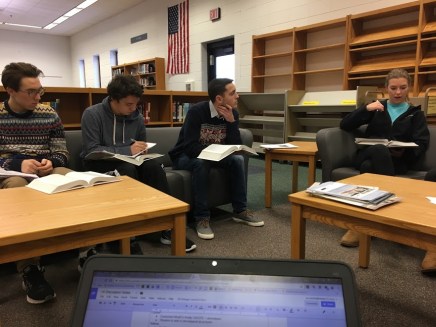
discussion

4. Review Your Reading Lives

At least one class period each year, right before the test, is reserved for a trip down memory lane. Students get into small groups and list common themes they have seen in argument prompts we’ve discussed over the course of the year (good vs. evil, power struggles, individuality, etc.). They then make lists of everything they’ve read, studied, reflected on that might be good evidence for arguments related to those ideas.

We fill posters upon posters of ideas to put around the room and remind ourselves how incredibly smart we all are. No one need fear “not knowing what to write.” Students have been preparing for this test since they learned to read, just by reading and living. Little review required.

5. Make Class Time Count

This is a “to each their own” example. Many classes do very little after the AP test. Students relate that they “worked really hard to get to the test” and the class periods up until the end of the year are free time as a reward.

I reward my students after the AP exam too. We have another book club (students are choosing this year from this extensive list of nonfiction titles, to which I just added the Pulitzer Prize winner Evicted) and they complete a multigenre project on an area of study we’ve not explicitly studied together (sports, politics, language, pop culture, etc.).

My class is about reading, writing, speaking, listening, and investigating life. That doesn’t stop because students took a three hour test.


Lisa Dennis teaches English and leads a department of incredible English educators at Franklin High School near Milwaukee. Her spring break will include finishing Sabaa Tahir’s A Torch Against the Night, spending time tiptoeing through the tulips with her daughter Ellie, and taking her own advice to live a little and try something new (curling, anyone?).  Follow Lisa on Twitter @LDennibaum and follow her students’ AP Spring Break adventures on Twitter #langbreak. 

Ask Your Students: What is Engagement?

Between the World and Me

A few weeks ago I ran into a brick wall with a project in my classroom.  I promised an update, but what I have for you is so much more.

I took Shana’s advice and asked my students, WHAT WILL ENGAGE YOU?!  However, as I thought about asking them that question, I found myself wondering if they would know what I meant.

All teachers aim for engagement, administrators search for engagement and attempt to quantify it, but how many students have been explicitly taught what it is we truly desire from them?

I set out to do just that last week.  I knew we would be working with three different concepts that I think are frequently muddled in the classroom.

Fun.  Compliance.  Engagement.

I also knew we needed a purpose/audience for the discussion, so I explained to the students that they would be assisting me in writing this blog post.

I never knew it would be necessary to define these words, but as I doled out a different word to each table group, I walked around to notice a lot of the same conversations happening at each table.

What would a fun classroom feel like?

It would feel like everyone doing what they want, being productive, and everyone would be happy.

What would a compliant classroom feel like?

A compliant classroom would feel how school is supposed to feel; come in, get your work done, leave. 

What would an engaged classroom feel like?

It would feel like students being able to choose their paths.  It would feel like happiness because the students would know the teacher and classmates cared about them.

These students have been taught to be compliant their entire educational career.  Sure, it is necessary to be compliant in terms of respect, but if you are ONLY EVER compliant, you’re being robbed of the best part of learning: Recognizing you can push your mind further than you ever imagined.

I want an engaged classroom.  You want an engaged classroom. Oprah wants an engaged classroom.  EVERYBODY WANTS AN ENGAGED CLASSROOM.

So if compliant and engaged classrooms both get work done, what’s the difference?

Engage: (v.) pledge or enter into a contract to do something; establish a meaningful connection with.

Did you catch that?

To engage means to commit and connect.  That doesn’t just change classrooms, it changes lives.

So why is it so hard? Commitment and connection don’t come through passivity or apathy, they require effort and exertion.  They require pushing past the point of comfort (for both students and teachers), and sitting in the pain–not because you want to, but because you committed to it.

As we discussed why a classroom should not be all fun, Andy had an enlightening thought.  He said, “I think the problem is, any time you take part in something, you’re sacrificing something else.  I think a lot of students are afraid to sacrifice their own comfort to make a connection with someone.  There’s always the risk, too, that you won’t connect, and then it’s like you lost twice.”

Sometimes I forget the amount of fear that exists in the classroom on a daily basis.  Commitment asks us to sacrifice the easy path.  Connection asks us to say goodbye to selfishness.  All of this has to take place before engaged learning can happen!

It takes a straight up ninja to pull that out of every student in every class period!

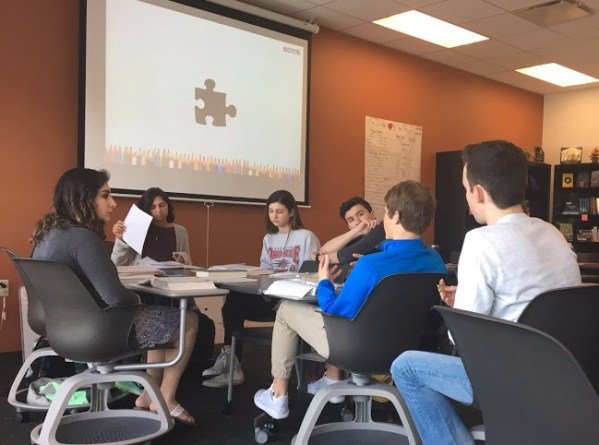
We ended this mini-unit with a Socratic Seminar.  I love me some good structured talk.

PTT5

2nd Period Preparing for Socratic Seminar/Live Tweeting

What is the purpose and direction of our learning?  How can we make our classroom a space of authentic dialogue and engagement? (Question credit goes to my emergency lesson-saver, Shana.)

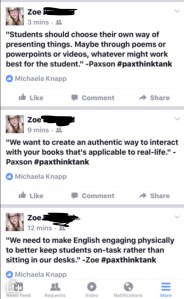
Zoe said she never liked English until she had choice.  She also said she wanted to do more talking about books in a way that connected with her classmates and what they were reading.

Dee said she enjoys higher level thinking.  What might happen if _____ happened to someone you know?  Would you handle things the way this character did?  What would you change? (Her suggested questions.)

4th period agreed they would like to deal with real world issues, and have choice in how they present their findings (poetry, video, podcast, etc.).

2nd period explained it should be about the learning, not about the grades, but it’s been that way for so long that they don’t know how else to operate.

Grady said, “School gives you a chance to do something great with your life, but you have to DO SOMETHING to be great.”

Shahin said, “Compliance is a downfall because you just follow orders and don’t think for yourself.  It makes it to where you will always need a boss, or you won’t know how to operate.”

PTT1PTT4

PTT2PTT6

Listening most often leads to learning, and I sure learned a LOT last week! Thanks for the ideas, #PaxThinkTank!!

Is your classroom one of compliance, engagement, fun, or a mixture?  How do you communicate with your students what you expect from them each day?

Jessica Paxson is an English IV and Creative Writing teacher in Arlington, TX.  She frequently feels as though someone made a mistake in allowing her to hold the futures of over 100 teenagers in her jittery, over-caffeinated hands for the past two years.  If you enjoy watching her make a fool of herself by being unbearably vulnerable, you can catch more of that over at www.jessicajordana.com. Follow her on Twitter or Instagram @jessjordana.


10 Things Worth Sharing Right Now

I love the little ripple of a thrill that runs through to my fingertips when I find something that I want to share with my students. That borderline codependent excitement that comes with wanting to share a book, an article, a statistic…immediately.

“They NEED to see this,” I think, fumbling around on my phone to figure out how and where to save it.

“They NEED to read this,” I say to my husband, as I make him pause his own life to listen to yet another passage of my latest read.

“They NEED to know about this,” I mutter, linking wildly to our syllabus (just another in a long line of moments where I’m grateful that life happens and we share it in class).

So today, I’m taking a page from one of my newest obsessions, the newsletter put together weekly by the brilliant, inspiring, and wildly creative, Austin Kleon. Each week, delivered to your inbox, arrives a list of “10 things [he thinks are] worth sharing.” Simple. Intriguing. Very, very useful in the classroom.

I’m honestly not sure how I stumbled on this one, but in the month since subscribing, I’ve used three of his images to inspire quick writes, and book talked (loosely) the newsletter itself, suggesting to students that they should subscribe in order to broaden their horizons to current happenings, inspiring visuals, and commentary on books, shows, and cultural phenomenon. In other words, link up to something that delivers items to keep you reading texts other than social media updates (“Made a sandwich guys…bet you’re all jelly. Get it? Jealous, but jelly instead.? God, I am such a genius”).

  1. Austin Kleon’s Weekly Newsletter
    Kleon reflects on a central image each week, along with linking to intriguing articles, a poem of the week, ear candy audio, eye candy visuals, and other noteworthy insights from across the vast expanse of the internet. If someone comes up to you and says, “Hey, did you see…?” chances are Kleon will have it linked on his list for the week.
  2. The Power of Exemplars
    A few weeks back, I was bemoaning to my fellow Three Teachers Ladies, how disappointed I was in a recent project my sophomores had completed. My vision for a poster that brilliantly illustrated their insights on their latest reading, was met with large sheets of paper with haphazard cutouts of text, crudely taped across the page, accompanied by printed book covers in black and white, and the occasional hurried pencil addition to the project (last minute insight for forgotten components). Needless to say, I was frustrated AND without any way to hold students accountable for the quality of the visual they submitted (not the central point, for sure, but a consideration certainly). Take pride in your product, and all that, had fallen short. In my irritation, I searched in vain for something in the Common Core that might suggest students consider carefully how they convey their ideas.

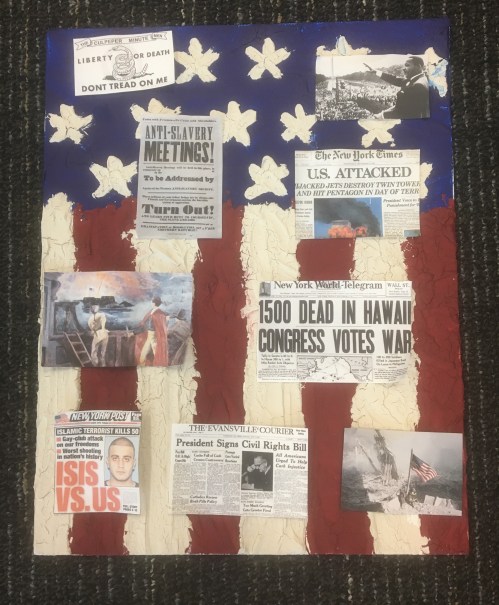
    Then, I took a deep breath. I realized I had what I needed, I just hadn’t used it. See below the power of exemplars. My AP students were completing their community visuals (which I wrote about last year in a reflection on the use of essential questions), and I had no rubric for this work either. However, the power of suggestion, in showing them some of the brilliant work from the year before, was more than enough. They knew the expectation, saw what I thought was praiseworthy when it comes to presenting their insights, and we enjoyed some brilliant symbolism in the presentation of these visuals. Amen.
    img_1163

  3. Musical Genius
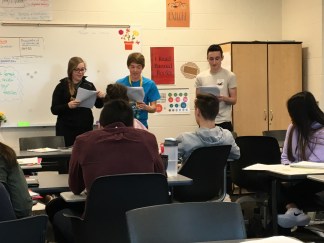
    One of my groups took a creative leap for their community unit visual and put together a musical. Franklin’s production of Joseph and the Amazing Technicolor Dreamcoat opened this past weekend. Several members of the cast in my first period class asked if they could complete the project in a slightly different way. Their project would still include analysis, present their ideas to the class, and involve audience feedback after the presentation, but…there would be singing.

    img_1092

    Francesca, Joe, and Parker

    Since I always joke with my kids about presenting their ideas through interpretative dance, this musical idea intrigued me. Their mini musical included several skits that detailed life within the community of a musical cast/crew. Watching students sing their way through a summative, I was reminded that my vision for a project is rarely as broad and brilliant as what students can come up with on their own. My exemplar pool had just expanded in verse.
    img_1095

  4. Bag o’ Books
    Remember to beg for books. Want to build that classroom library? Get down on your knees and remind your students of how good it feels to give back…to you.Maija recommend the book Dangerous Minds a few weeks back. When a fellow student was at the bookshelf looking for it the other day, I asked Maija if she’d be willing to bring it so, AJ could borrow it. I even turned on a sweet smile and said, “If you don’t need it anymore, I’d be happy to take it off your hands.”

    The book was outside my door the next day, in a bag with a sweet note and several other books. Score.

  5. Amy Poehler on Writing
    I’m training for a half marathon. Without audiobooks, I might not make it. Seriously. I need to get lost in a story to pound out the miles. So, when I started 10 miles on Sunday and realized my Overdrive audiobook had expired, I had to quick download something new. Ugh.Enter, Amy Poehler’s Yes, PleaseI smiled for nine miles (it takes awhile to download when you’re actively running down the street). Poehler’s voice is sincere, relatable, and funny as all get out. Easy to book talk.

    Here’s the golden ticket: The Preface. I heard it and knew I needed to play it for my students. Poehler writes with undeniable voice about writing. She says of her text and the writing process that she “had no business agreeing to write this book” and wrote it “ugly and in pieces,” because “everyone lies about writing…they lie about how easy it is or how hard it was.” She says, and students really related to the idea, that “writing is hard and boring and occasionally great, but usually not.” In reflection afterward, students also noted her use of stream of consciousness, aside, and self deprecating banter to tell her story, not just inform her audience about what the book would be about. Classes agreed that they could really get behind her idea that, “Great people do things before they are ready.” Amen, Ms. Poehler. Let’s all put pen to paper.

  6. langchat#17
    I recently started following the brilliant Elizabeth Matheny on Twitter. Her AP insights and resources have helped fuel my work recently and her AP Language slow chat last week was a great opportunity to have my kids practicing analysis with students across the country. I’m thinking of several things to extend this activity:
    – Have students organize a slow chat for peers
    – Get students to live tweet peer feedback during speeches or discussion
    – See #7 below
  7. Tweeting Authors
    I tweeted Angie Thomas to tell her that her book The Hate You Give is stunning and I’d be getting into the hands of as many students as possible.She liked my tweet.Fangirl moment.img_1024
    Have your students reach out to authors. They often reach back.
  8. Creativity Visual
    I love what this suggests to students about the power they possess.
    img_1157
  9. Get it to the Big (or small) Screen
    My students often buy into the idea that great books are made into (sometimes great) movies. The Underground Railroad is being made into a series with the director from Moonlight. Having just finished this intriguing read myself, I book talked the text this week and shared the movie plans.
  10. Quick Write – Psychopath
    This came across my Facebook feed the other day, and I tossed it on my PowerPoint. As is the way in educator, my students surprised in noticing it, and we ended up doing a quick, quick write about changing social norms. AP Language test prep comes in many , many forms.
    img_1122
    What would make your list of 10 things we need to see and share this week? Add your ideas in the comments below! 

Lisa Dennis teaches English and leads a department of English educating gods and goddesses at Franklin High School near Milwaukee. She loves lists, especially lists with links to beautiful thoughts and ideas. Follow Lisa on Twitter @LDennibaum 

disclosure


Can We Talk? The Silence is Killing Me.

Let me start by acknowledging the following : We all work hard.

Day in, day out, passionately, for hours outside the classroom, over breaks, through the night, in the summer, at the expense of our own health, sanity, and in some cases children, tirelessly, endlessly, hard.

We wrestle with accountability, making the right choices, bankrupting our personal finances, moving in new directions, providing substantive feedback, reinventing our curriculum, and capturing that often elusive “I’m making a difference” feeling.

And all of these opportunities, obstacles, maneuvers, struggles, negotiations, blessings…are well worth the effort. We know this to be true.

We grow. Students grow. The world brightens.

This week, however, a week of extra meetings, assigned readings, professional development planning, ACT Interim test data analysis, sophomore research papers and practice AP tests in all of my classes, has me feeling cranky, irritable, and disenchanted with the whole thing (and apparently listy, because I’ve got a lot of lists rolling here).

But it’s not all of these “bonuses” to my week that really have me in a funk. silence2

It’s the quiet.
The file in and file out of my classroom.
The silence of compliance.

My students have not been talking the past few class periods, and the absence of their ideas has me crankdified.

While it might seem nice to have a “break” to work while kids complete practice tests and independent study, it didn’t feel nice. It felt…empty.

It hit me last week during a discussion of Scott Brown’s “Facebook Friendonomics.”

We’re in a unit on community in AP Language and wrestling with the following:

What is the individual’s responsibility to the community? 

I had just read the piece aloud, asked students to respond to it in a quick write, and was now listening to a discussion on the author’s use of allusion. Brown suggests that the natural evolution of friendships is corrupted by social media.

The discussion was not initially brilliant. Students wrestled with some examples of allusion that meant nothing to them (the author details contacts in a Rolodex, quips about watching 90210, and references Garbage Pail Kids), so I suggested we try to update references, eliciting an enthusiastic walk (dance) down memory lane for my seventeen year olds, back to Pokemon cards and “Soulja Boy” (Ahhhh…2007).

As I listened to them reminisce about cultural touchstones in their lives, I had to smile.

“So, what is this author trying to tell us about community?” I asked.

Our discussion continued for another few minutes, encompassing author craft, the existence of Finsta (I am suddenly SO old), the unnatural qualities of social media “friends,” and the duality of both fake and fulfilling relationships through online communities. I sent my students back to their notebooks and they reflected a bit further on how discussion had expanded their understanding of the ways this piece answered our essential question.

And I…was happy. tree

I had listened, mostly. Invited a few students into the discussion who hadn’t shared. Pulled us back to the task at hand.

But I had let them talk. No agenda. No time limit. No right answers.

Now, I’m not here to suggest that having a discussion with your class is revolutionary. Obviously it’s not, but it occurred to me:

My individual responsibility to this community is to keep my students talking.

And while I’m on this soapbox (it’s not my preferred method of communication, thankfully, but I sort of like it up here), I’ll say it another way:

We need to listen. More.

Educators the world over, both seasoned and virginal, know, but all too often forget (so guilty myself), that the talk in our classrooms that is most vital to engagement, progression, retention, and overall enthusiasm for learning, is not our own.

Facilitated and guided by the teacher – yes.
Framed by objectives, teaching points, and standards – of course.
Aimed at gradual release – ideally.
Supplemented with our insights, passions, and ideas – I certainly hope so.

Talk to their small groups, talk to the class, talk to me, talk to their notebooks, talk about talk. It’s all talk that can promote discovery.

We need students talking, not just to check comprehension (flashback to the initiate, respond, evaluate cycle of classrooms I grew up in), but far more importantly, to develop their thinking.

My modeling and guided instruction is far more beneficial in the long run, as the goal of each is to get students involved in a way that has them taking the torch and forging ahead on their own.

That’s where the emptiness of this past week had come from. We weren’t involved in anything together, and I felt the absence of the interaction keenly.

With the testing behind us and the research papers waiting patiently for another hour (or seven hours, if my calculation for that stack is correct), I conferred with several students during reading time, to selfishly feel better myself. During our quick write, I sat down at a table with my kids and wrote, as opposed to staying at my desk. I started several writing conferences during workshop time with, “Tell me about…”

I’m not in any sort of denial that what I’ve written here is new or different in any way,  but I am certain that the reminder did me good. I hope it does for you too.

Let’s talk about talk in the comments below. I’m a good listener. 

Lisa Dennis teaches English and leads a department of English educating gods and goddesses at Franklin High School near Milwaukee. She loves to listen to the Decemberists, the call of redwing blackbirds, and audiobooks read with British accents. Follow Lisa on Twitter @LDennibaum 


Why I Returned to Hard-Copy Grading

tumblr_maccshmi241rvog5q.gifGrading, grading, grading.

Sigh.

As the kids say, I literally cannot even.

Where do I begin?

Grading, to me, is one of the necessary evils of education–along with mandatory monthly fire drills, whole-building staff meetings, and standardized tests.  I have disliked it for the duration of my teaching career, as I have disliked all of those things, but I still have not found a way to avoid it.

When I left the high school classroom last May, one of the things I was happiest to let go was grading.  (That and those damned fire drills.)

But I didn’t expect to come to loathe grading even more when I began teaching college students.

There were a few reasons I disliked grading in my new job:  first, I found that, by dint of the course designs I inherited, that the only “grades” given were at the very end of the semester.  This meant that what little formative feedback was built into the course wasn’t seen as valuable–by the students nor the other instructors I was working with.  I sat in meetings where a colleague complained about “having to do all that reading and write all those comments for nothing” (“nothing” being no grade).  I thought to myself, wow, you’re missing the whole point of formative feedback.

Another thing I loathed was that most everything was electronic.  Any assignment due was expected to be turned in via email/eCampus/Google Drive two days prior to the class meeting, and the instructor was to give feedback and a grade before class began on Friday.  This meant that the only feedback about a student’s work was always only given by the instructor, and that students never saw one another’s work.

So, as the semester moved along, I began to make some changes to the course design:  more formative feedback, more frequent turn-in checkpoints for large assignments, lots of ungraded, low-stakes drafting of ideas in class.  We all hobbled to the end, adjusting assignments and expectations as we went.

But over the winter break, as I reflected and gathered the many post-its of ideas I’d stuck here and there, seeking to refine our syllabus and clarify our goals, I thought of one major change I could make that would solve a lot of my problems with the course.

Return to paper.

img_7291Good, old-fashioned, print-it-out-and-bring-it-to-class-and-turn-it-in assignment submission.

This practice has had a few key benefits for me so far this semester.  First, I am seeing much more clarity of thought in my students’ talk in class–I suspect because they’re treating their weekly one-pagers as first drafts of their thinking, and then re-reading them, as evidenced by their frequent typo corrections or asides to me in the margins.

Second, the issue of opacity between students’ assignment submissions is gone.  Each class meeting, I try to build in a time to share our writing, whether by trading papers, using our papers as an artifact to support some talk, or asking students to comment on one another’s work.  I ask students to read not just for content, to glean multiple perspectives, but also to read for structure, to see how other writers think through the issues we’re grappling with.  As a result, I’ve seen a great deal of growth in how students structure their writing, as well as a transformation in the confidence of their writing voices as they engage with (and often question) the ideas in the texts we read.

Third, we’ve been reading Visible Learners this semester, which encourages the practice of documentation for the purpose of reflection.  By having concrete documentation of our thinking in the form of hard-copy papers, as well as hard-copy documentation of responsive thinking in the form of my comments or their peers’ in the margins, it is much easier to trace patterns and progress in our thinking.

Fourth, I’ve found that removing laptops or tablets from the equation when students share work actually improves the quality of their conversation.  I’ve been reading widely about how detrimental our devices can be to our talk, so I’ve made a conscious effort to reduce our screen time in class.  Fewer devices lead to more robust dialogue, which leads to better thinking and writing and time together overall.

Finally, my students are now accustomed to receiving frequent formative feedback and have come to expect and welcome it.  Initially, the students were a little wary when they saw my scribbles, assuming they were all corrections, but then were delighted when they actually read the feedback a peer or I had left.  Now, they hunger for the moments when a friend hands them back their paper with a handwritten note, or I return assignments the next class.

C4ErTFNVcAA9ku9 2

Switching to hard-copy grading has improved a great deal of my work with my students, and although I still haven’t come to love grading, I am enjoying it a lot more this semester.

Now to tackle that huge stack of one-pagers that’s been staring at me all morning…!

Shana Karnes lives in West Virginia and teaches sophomore, junior, and senior preservice teachers at West Virginia University.  She finds joy in all things learning, love, and literature as she teaches, mothers, and sings her way through life.  Follow Shana on Twitter at @litreader or join her for the Slice of Life Writing Challenge here.

FTC guideline affiliate links

8 Ways Listening Leads to Learning

not-listeningWe teachers often talk too much. Research on listening suggests that adults spend an average of 70% of their time engaged in some sort of communication; of this average, 45% is spent listening compared to 30% speaking, 16% reading and 9% writing. I would argue that this data does not represent teachers in the classroom. We tend to talk more than we listen.

I wonder how many of us have thought of teaching as communication.

Think about this definition of communication: “Two-way process of reaching mutual understanding, in which participants not only exchange information, news, and ideas and feelings but also create and share meaning. In general, communication is a means of connecting people or places.”

Now, think about how much richer our classroom environments could be if we planned, prepared, and presented our lessons through this lens of communication — with the goal of reaching mutual understanding, exchanging information, ideas and feelings, and creating and sharing meaning. To do so, we must listen more than we speak.

What about the time, we may ask, what about the content knowledge we must impart?

When we exchange our need to talk with our students’ vital need to have us listen, we

  1. transform our teaching by looking for ways to invite students into conversations
  2. better utilize the time we have with our students, meeting their needs in one-on-one and small group discussions
  3. deliver information in new ways, other than students listening to lectures or taking notes from slide presentations, or completing worksheets
  4. break down walls many adolescents have built against school and against authority — they know we see them as the unique individuals they are, and they respond
  5. provide opportunities for students to learn from one another so we may listen as they share with one another
  6. help students discover and take ownership of their needs, both personally and academically — talk often works as a lead into deeper thinking
  7. facilitate communication that leads students to take on the characteristics and behaviors of readers and writers — or in a biology class as scientists, or in a history class as historians.

Fostering room for more listening is the first move into creating a culture of conferring.

Does it make us vulnerable? Yes! and facing our vulnerability is where our growth as teachers takes root, taps into strategies that nurture our learners, and eventually blossoms into the instruction and learning experiences we want for all students.

How do you make room for listening in your classroom? Please share in the comments.

Amy Rasmussen lives in north Texas and teaches AP English Language and English 3 to the Fighting Farmers at Lewisville High School. She adheres to the words of Emerson: “We aim above the mark to hit the mark,” and Jesus Christ: “Love one another.” Imagine a world if we all love more than we think we can. Follow Amy on Twitter @amyrass.

Why Conferring Matters

Conferring is the interaction missing from many of our students lives.

Consider this:  the current generation thrives on one-on-one attention. They do not remember a time before social media, and many live much of their lives online via their smartphones. They turn to instantaneous interactions that have a direct impact on how they feel about themselves:  Snapchat, Vine, and Instagram over Facebook, which they are abandoning in droves because “it’s for old people.”

Our students crave immediate feedback. They seek personal communication — and they need it.

Think of the implications of this virtual-reality world on long-term relationships and problem-solving. We have already seen how it impacts our students in the classroom: short attention spans, skimming versus sustained reading to name a couple, not to mention the addiction to notifications.

Our students need to experience and understand the importance of eye contact, facial expressions, and body language, and how these physical features create non-verbal communication. They need to interpret and explicate tone.

The students in our classrooms today are different from Millenials. Anyone born after 1995 earns the new title of Generation Z, also called iGen, Centennials, Founders, and my favorite title: Gen Edgers.

As a whole, these students use technology as their primary source of communication — to validate, and to feel validated.

They also value genuine relationships, loyalty, and honesty and are increasingly more careful than the previous generation with the friendships they form online. They want to know their voices matter and that they are okay just being themselves instead of being the perfectly-phrased word count they must craft online.

Our students need opportunities to share thoughts, feelings, ideas, and knowledge in non-threatening situations through real face-to-face conversations.

Conferring opens opportunities to meet the needs of our students at the core of their longing.

When we invite students to talk and affective filters lower. Students relax. They respond.

When teachers confer with genuine interest in the well-being of the child, we grant students permission to be their genuine selves. Research on the brain shows that “positive comments and positive conversations cause a chemical “high,”” and with less pretense and stress, students experience more learning.

Conferring gives students the chance to share their stories; and besides creating trusting relationships, conferring allows us to meet them where they are and help them advance in knowledge and skills from there.

On-going regular conferences ensure that every student receives the one-on-one interaction and instruction they deserve. Peter Johnston reminds us that every student has a personal history that affects our ability to help them advance in their literacy skills.

Through conferring we learn the cultural and personal backgrounds that shape our learners, along with the experiences that shaped them in the past as readers. Both are important factors. By asking questions that invite students to recall their learning histories, we initiate future learning.

Conferring also sparks critical thinking, creativity, and curiosity.

No matter the teaching style — be it an English class where the teacher makes the choices about books and writing topics, or a workshop inspired classroom where students choose what they read and write, or even a classroom of another content area — when conferring becomes a norm, students proactively engage in learning, which results in more growth, independence, and mastery of content and concepts.

Our students learn to ask questions, ponder responses, and seek for interesting ways to show they are learning. Differentiation happens naturally.

Imagine the opportunities students may create and the innovative energy they will have in the future if they experience this kind of learning in their secondary schools.

The children in our classrooms are part of the fastest growing force in the workplace and the marketplace. Their influence is changing companies, marketing styles, and consumer habits.

This generation wants to make a difference in the world. They are pragmatic, self-aware, goal-oriented, and self-taught via YouTube. They’ve grown up “dealing with too much vs. too little information their entire lives.”

They will soon become our peers standing in voting lines, our colleagues standing near the copy machines, maybe even our bosses, or perhaps the officials that govern our cities and our states.

As adults we must provide each child with the education that prepares them for the future they are moving into.

We cannot keep teaching the way we have always taught with one-size-fits-all lesson plans and instructional models. We cannot keep making all the choices about books and reading or essay topics.

We must talk to our students one-on-one about what matters to them personally. Our future, and theirs, depends on it.

And for the teacher who worries about time, conferring provides a means of easy and accurate formative assessment, which saves valuable time spent grading:  time teachers may spend planning effective lessons or conferring with more students.

When done with fidelity, conferring improves the effectiveness of our teaching. I don’t know one teacher who doesn’t want that.

Please share your thoughts on conferring in the comments. What are your conferring routines?

Amy Rasmussen lives in north Texas and teaches AP English Language and English 3 to the Fighting Farmers at Lewisville High School. She adheres to the words of Emerson: “We aim above the mark to hit the mark,” and Jesus Christ: “Love one another.” Imagine a world if we were to all aim higher to love our fellow man. Follow Amy on Twitter @amyrass.

2 Ways to Prioritize Student Talk in the Classroom

Workshop affords so many opportunities to explore with the students in front of me as opposed to present a set curriculum to whomever happens to be seated in my classroom. It’s teaching through interaction, and in this case, it’s teaching straight from the kids themselves.

We see it in workshop all the time. Students given the tools to explore the world as readers and writers, and encouraged through personalized learning, quite often take their learning to places our old lesson plan books didn’t always accommodate.

One of the best opportunities for this classroom growth is having students do more and more of the talking. With the right modeling and specific expectations around that student talk, the classroom becomes a place students lead through inquiry, as opposed to follow through completion of teacher set tasks.

discussion-2

Morgan quotes Judy Brady’s “I Want a Wife” to analyze how the repetition supports the sarcastic tone and proves the point that since they do SO much, everyone should want a wife. LOL!

It happened yesterday morning, in fact. My AP students were participating in small group graded discussions. Just reading the last sentence makes me cringe (yes we use a rubric, no, the conversations don’t have to be formulaic as a result), but with choice in which readings from our unit they wanted to discuss and some guiding questions throughout the discussion, our conversation about gender and the implications of historical stereotypes on a modern world (their direction for the discussion, not mine) took an interesting turn.

“Mrs. Dennis…you’re smiling weird. What did I say?”

I stop furiously typing comments and look up. “I’m sorry?”

“You had a look. Did I say something wrong?”

“Sarah, you said nothing wrong,” I smile and glance around the table. Seven intrigued faces look back at me. “In the last few minutes this group has, largely unprompted, connected several essays through the lens of analysis, used terminology we’ve not discussed since September, Trinity uttered the words, ‘I don’t believe gender pronouns are even really necessary anymore,’ and then supported her opinion with specific text evidence, and several of you actually just murmured sentiments of excitement to shift the discussion to Judy Brady’s satirical 1971 piece ‘I Want a Wife.’ I’m smiling because I was just thinking about how I used to give short answer reading comprehension quizzes on these pieces.”

“Oh,” said Sarah, “This is way better.”

Yup.  This was a discussion they wanted to have. This was a discussion I wanted to hear. They took the lead, in fact one of our rubric bands demands that, and they came to the

discussion

Part of a small group discussing racial stereotyping colliding with gender stereotyping in the Brent Staples piece “Just Walk On By”

discussion prepared to drive conversation from the perspectives of authors like Brent Staples, Deborah Tannen, John and Abigail Adams, and Judith Ortiz. Perspectives that regard gender through stereotype, race, satire, narrative, an exchange of letters almost 250 years ago, and visual texts.

Did I just sit back and let them talk, free-for-all style? No. This conversation took practice, feedback, and correction over the past few months. Today, it took redirection on some occasions and additionally it took specific intervention for those students reluctant to participate. Additionally, had it been a lower-level class, I would have been a bit more actively involved to start. But as you well know, students at any level are capable of, and actually far more likely, to get actively involved if their efforts for comprehension are supported and their exploration of the text is encouraged. We work specifically on ways to communicate both agreement and polite disagreement, so students can help clarify the text as well as analyze it.

Like any solid workshop component, it involves careful teacher planning and modeling, but equal parts careful student leading as we gradually release them to own their own education. 

We assess students on their preparation for the discussion with visible notes and use of specific text to support their points and their leadership within the group. That leadership can be exhibited through meaningfully involving others to bring them into the discussion with a question, synthesizing ideas they have heard so far, and/or including insights from additional research on a particular topic to extend discussion beyond the reading.

I spend a whole class period for discussions, breaking the class into groups of 7-10 students so all voices have more opportunity to be heard. Students not in the discussion have specific work to complete, sometimes by the end of the hour. For feedback, I type comments and insights while the students are speaking, so I can quickly copy/paste them into the comment section of my feedback form (A Google form emailed directly to students with 2 Common Core based rubric bands as dropdown tabs so I can just click the score for each band, include specific typed feedback, and often get that feedback out to kids the same day).

Another opportunity for seriously impactful student talk, is handing over the daily book talk to the class.

One of the many benefits of this scenario is that I can tap into growing student enthusiasm about books and have my kids spread the book love directly with each other. Don’t get me wrong, my book talks are something to behold. Part forensics piece, part reader’s theater, and part screentest for the literary loony bin, I sell books much like I would envision the traveling vacuum salesmen of yore putting food on the table with a pitch of salvation not just for the home, but the soul. It’s not just going to clean your carpets, it’s going to change you life, Ma’am. Your life. 

But, let’s be real. Though I sprinkle my classroom with good will, good cheer, and good books, I’m not the best salesperson in the room. If you’re going to sell the vacuum with radial root cyclone technology (I Googled that), or the book with 389 scary looking pages on dystopian fantasy rooted in a chromed society, you need to know your audience. You need to relate to your audience. You need to be one with your audience.

There are plenty of reasons to get kids doing your book book talks, not the least of which is I can’t read fast enough these days to keep up with the need for the type of really passionate and informed book talks that come from having read the whole text (Books do sell themselves sometimes, just by reading the back cover and a page or two at the start, but I love to hook kids with a section from the middle to show the impact of the rising action or depth of character development).

book-talk

Priyanka book talking Stitches, a graphic novel by David Small, under the document camera.

  • Students trust one another’s opinions. Yes, often more than mine. I sell hard, but at the end of the day, I’m usually still the biggest book nerd in the room, and therefore I think I am occasionally regarded in much the same way  as the Dancing Grannies in a holiday parade: Enthusiastically adorkable, but a bit of an anomaly to be trusted only at a distance.
  • They find titles, authors, and series that aren’t yet on my radar. Despite my best efforts, I can’t read fast enough or comb enough best of lists to meet the recommendation needs of over 120 kids. But when the classroom experiences a new student perspective on reading each class, additional book talks at their tables after reading, speed dating with books,  and an invitation to help grow our classroom library with tax free, gluten free, guilt free donations of gently used books, everyone wins and the depth of our classroom repertoire grows.
  • Their enthusiasm is relatable and often focused on books that don’t speak to my own bibliophilic tendencies, but can ignite the reading sensibilities of their adolescent peers. For example, I took several YA Lit books home at the start of last summer. Two days in, I was already struggling with the voice. It grated on me (no offense scholars) after hearing it all day in person for 180 days. So when a student book talks The New Guy (and Other Senior Year Distractions) by Amy Spalding, and two sophomores in my class (who have struggled to meet reading goals week after week) add it to their “I Want to Read List”s, that’s another win, because we can’t push kids to deepen their reading if they aren’t reading. First hook them, then book them with more challenging pieces.
  • I offer up the option to produce their book talks digitally and for some students, this is what makes the entire experience meaningful. Students sell their books through book trailers, compilations of related imagery and voice over to meet the same requirements of a live book talk. I’ve had kids include clips of author interviews, live action fight scenes with voiced over dialogue directly from the text, and this year, I have a student who wants to read over the top of a mannequin challenge he plans to shoot to represent some of the major action in the text.

What results is growing book lists, renewed enthusiasm as students go back to books they’ve read and revisit their love for the text, and involving each and every single student as a valued reader in our classroom community.

We’d love to hear from you! What tips and tricks for student talk make their way into your daily workshop practice? Please comment below! 

What is Your Teaching Everest?

I’m standing on my desk.

It’s dangerous, but exhilarating, and I probably look like a loon, but I don’t care. (Please see my post where I embrace my dorkdom in an effort to really get to know my students and move on happily with passionate living and teaching.)

oh-captain

High heels kicked off, channeling the spirit of Mr. John Keating and brazen pigeons everywhere, I’m perched on the edge of my desk during prep, looking around the room to try and gain gain a different perspective.

Oh, Captain, my Captain…Somebody call security. She’s lost it.

No, no. I’m all right. (Well, you know – Relatively speaking. Dear colleagues, if you hear a thud, please investigate.)

So, what caused this poetic exploration of my abandoned classroom? I was thinking about a quote I heard at NCTE 2016:

What is your Everest this year as a teacher?

No, my desk isn’t my Everest. I’m not that far gone. But, per Shana’s inspiration to start with a question, I was thinking about what needs my attention the most right now. With 86 minutes to plan, grade, create, and locate necessary motivation to do all of the roomaforementioned tasks, what should I start with?
There’s certainly a lot to chose from: stacks of papers, countless books to read, share, and sort, a department in need of collaborative time to plan, students flying under the radar.

Everything in front of me is important. I need to grade the narratives my sophomores wrote, to put some ending punctuation on that adventure. When She Woke by Hillary Jordan is calling to me too. That book is Hester Prynne meets Offred meets futuristic criminal justice system that injects offenders with a skin altering virus based on their crimes – I need several extra hours in the day to read. Truth be told, I should have started this post sooner too. Procrastination and exhaustion mix into a delightful little cocktail called Crippled Motivation. Bartender, I’ll take another when you have a minute.  

In all seriousness though, I return to my question (Yes, I’m off my desk, Mom), because answering it means I can get something done. I’m weird that way. Could I pick up a stack of papers and just start? Of course. But I have to mentally work up to it, know my plan, have a reward of some sort (read five papers, read When She Woke for five minutes). This time, the question, the task, the implication is much bigger.

What’s most important right now? When I could do a thousand things, what needs to be done right now because it will mean the most?  I know the answer. And not only because I was just standing on my desk :

My Everest this year is feedback.

Consistent, responsive, quick feedback that first encourages, and then focuses in on promoting growth. Remember the old saying about catching more flies with honey than vinegar? That’s the stuff right there.

I want to move my students forward. We all do. But now, more than ever,  I believe the way to do it is through sincere investment in the original thoughts and explorations of my students. Personal connections that, yes, take some time, but build relationships that have helped me to better recommend texts, suggest style moves students may need to make in their more formal writing, and encourage additional critical thinking beyond the classroom.

I used to stress about “finding something good” to include in my comments to my students. And I hate to say this, but it’s downright hard in some instances, isn’t it?

I really like what you did with the title there. 
Interesting transitional choice. 
Wow. So many words in that sentence.
Nice…font selection.

But now,  I’m thinking about feedback in new ways and delivering it in new ways too. To reach my Everest, I’m going to have to get creative and intentional. So, here’s what I did this afternoon:

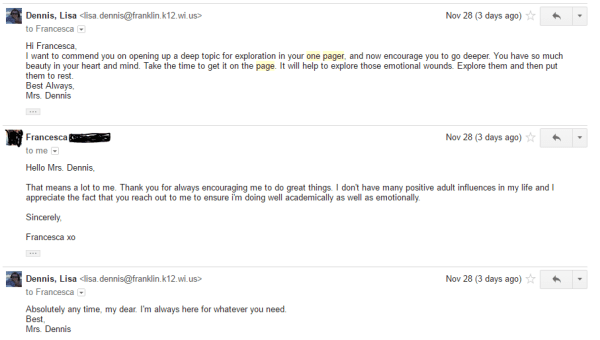
  • Read through a section of one pager submissions from my AP students. Check them in with the quick rubric for a formative score, and email five students per class with reactions. Not corrections, but reactions. Students are encouraged to explore in these writings and the best means of moving them forward in this case is to share additional insights, question, and encourage. I highlighted the students’ names in my gradebook to know I’ve contacted them and I’ll do the same with several more students next week. Writing feedback…check.

fran

  • I made a plan for conferring during reading later this week. Without a plan, it’s feeling random and I’m not doing it enough (the thousand things on my desk keep capturing my attention). So, I have a list. I know who I want to talk with based on quick writes students did today. They reflected on their progress toward their weekly reading goals and some students are struggling. Just by having them take a quick photo with their phones and email me the page, I got a literal snapshot of how each and every one of my students is doing with their independent reading, and I didn’t have to collect notebooks. Now, I’ve emailed a few students congratulations and made this plan. In the picture below, Alexis refers to her current read as “a beautiful romance of adventure.” Love! Reading feedback…check. 

    img_1012

  • Students will self-assess their latest practice AP argument essays. Feedback does not need to come from me to be beneficial. Using the AP rubric to help justify scores, students will take a sheet of paper, put a score and justification on the top, fold it over and hand it to the person next to them. Scoring will proceed in the same way around the table until everyone has his/her paper back. The table will then need to calibrate/norm and agree on a score. Self assessment and peer assessment…check
  • I am going to question and listen more. Long ago, I gave up on the idea that my imparting knowledge on others was the best way for them to learn. Everyone learns best when the are motivated to do so through personal connection to the work, interest in the material, and an understanding of how to improve. Workshop sets this up in a classroom, it’s now my job to remember to listen more and jump in less. During conferences, during book clubs, during discussion. Listen first, respond, encourage, and redirect/suggest later. This certainly doesn’t mean my presence in the room diminishes. It means I remember that my presence in the room is to guide my students, not steamroll them.

Gaining a new perspective feels like hitting the reset button to me. It provides clarity of mind and purpose. Skill development is my professional responsibility. Human development is my personal responsibility. They work hand in and hand and they are the Everest I will climb all year, every year, as I talk with, respond to, and gain insights alongside my students.

What is your teaching Everest this year? We’d love to hear from you! Please add your insights to the comments below!