Category Archives: Writers Workshop

AP English: Improving Our Rhetorical Analysis One Quickwrite at a Time

I’ve mentioned that I am working on finding a way to be more efficient in my writing workshop. I want to expose students to beautifully written language that we can study together, and maybe learn a little grammar, but I also want to use these pieces of text for quick writes. I know that the content (or at least my questioning) has to be compelling enough that students will have something that makes their fingers itch to pick up their pens.

When I read I find myself dog-earing pages and book-marking passages that have been crafted with many rhetorical devices and/or literary elements. By helping students recognize how these strategies, used deliberately by the authors, create meaning, my students’ rhetorical analysis timed writings are scoring higher than they have at this point of the semester in years past.

I love it when my ideas work.

This is the passage we will read and respond to this week:

From An Invisible Thread by Laura Schroff and Alex Tresniowski p4

And so, when Maurice spoke to me, I just kept going. Another thing to remember is that this was New York in the 1980s, a time when vagrants and panhandlers were as common a sight in the city as kids on bikes or moms with strollers. The nation was enjoying an economic boom, and on Wall Street new millionaires were minted every day. But the flip side was a widening gap between the rich and the poor, and nowhere was this more evident than on the streets of New York City. Whatever wealth was supposed to trickle down to the middle class did not come close to reaching the city’s poorest, most desperate people, and for many of them the only recourse was living on the streets. After a while you got used to the sight of them–hard, gaunt men and sad, haunted women, wearing rags, camped on corners, sleeping on grates, asking for change. It is tough to imagine anyone could see them and not feel deeply moved by their plight. Yet they were just so prevalent that most people made an almost subconscious decision to simply look the other way–to, basically, ignore them. The problem seemed so vast, so endemic, that stopping to help a single panhandler could feel all but pointless. And so we swept past them every day, great waves of us going on with our lives and accepting that there was nothing we could really do to help.

Write about a time when you encountered a homeless person or a beggar. How did you feel? What did you do?

I am still working on the questions. Sometimes I think it’s best to say, “Just respond.” Other times I think students need more direction.

What do you think?

Christmas Miracles

ocs

December has traditionally been my least favorite month of the school year.  Something about it bogged me down, without fail, every winter–the dark, sunless days…the mountains of papers to grade…the looming specter of exams–to write, administer, and grade.  I hated my job in December.  From old journals, I know that I was consistently unhappy in the twelfth month of the year, and I wanted to quit teaching every time it rolled around.

This December, though, things couldn’t be more different.  I am LOVING my job!!  Last week, I found myself completely caught up on grading–something that literally hasn’t happened yet this school year.  Somehow, I had plenty of time to plan great lessons, confer with students with no back-of-the-brain worries, AND reorganize my classroom library.  I was a productivity machine–and it didn’t stop at school.  At home, I found the energy to assemble Christmas cards, decorate my apartment, and make some holiday crafts.  As I type this, my fingers are still sticky with powdered sugar from the big batch of cookies I baked this morning.  What’s with the freakish perfection, you ask?  One little, made-up, three-week-old, hashtag of a word:  #nerdlution.

nerdlution-button-tiny-01

Teachers across the country made nerdy resolutions that would be kept for 50 days.  They could be anything–write every day, exercise, a more robust reading life.  A Thanksgiving day Twitter chat gave rise to that wonderful idea, which I hope will become an annual tradition.  Still riding my NCTE13 high, I resolved (nerdsolved? nerdluted?) to spread professional ideas about English teaching any way that I could, every day.

IMG_1036I started by leading an epic two-hour workshop for my English department.  We book-passed (a la Penny Kittle) the entire contents of my professional library, shared best practices in a “gift exchange” of ideas, and made our own heart books (a la Linda Rief) of things we wanted to try.  Afterward, Kristine, a 20-year veteran with a reputation for pessimism, approached me.  “I used to have your energy,” she said.  “I don’t know what happened, but I haven’t had it…for years.”  She teared up, then borrowed Blending Genre, Altering Voice by Tom Romano, a balm for her troubled teaching soul.  Other books from my NCTE haul were checked out, too–Georgia Heard’s brand new Finding the Heart of Nonfiction was battled over by two first-year teachers, Penny Kittle’s incredibly dog-eared and highlighted Book Love and Write Beside Them were taken by veterans, and Tom Newkirk’s well-loved Holding On To Good Ideas in a Time of Bad Ones was checked out by our department head, who has held his position since 1972 (I’ll let you do the math on that one).

I was elated, and my colleagues’ willingness to try new ideas didn’t stop there.  The next day, a friend came and talked through some ideas about having her students do mini multigenre projects on Greek gods.  Enthused, I told her I couldn’t wait to see the results.  The following morning, Kristine, the tired veteran who’d borrowed Tom Romano’s book, stopped me in the hall.  “I came to school every day this week with a new attitude.  I feel the spark again,” she told me.  I nearly cried after we went our separate ways.

IMG_1313The following week, it all seemed to be coming together–our entire English department was on board for trying something new, especially the workshop model.  They wanted to see it in action.  In five days, I was observed eight times by fellow teachers, and they saw my students doing amazing things.  With heads down and pens on paper, their extended narratives were growing to eight…twelve…twenty-six pages long.  They were BEAUTIFULLY written, and on an incredible variety of topics–hunting, car crashes, detectives, breakups, death.  One male student wrote a narrative about rape from a woman’s point of view after hearing me booktalk Speak.

IMG_1314As my colleagues listened in, my students conferred with me about their writing like the confident, thoughtful, reflective authors they are:  “I want it to read like a Rick Riordan story,” Kenneth told me.  “Do you think the pace is too slow?” Nora asked.  “I just need to zoom in a little more on this,” Tevin realized.  “I’ve resorted to writing in my vocab section because the rest of my notebook is full,” Adam admitted with a giggle.  I ended every class with a smile and a feeling of pride threatening to burst out of my chest.  My colleagues were stupefied.  “How are you getting them to read so much?  To write so much?  To work on this stuff in study halls and for homework?”  They were flabbergasted, but all I had to do was point them toward that professional bookshelf, full to bursting (but with more and more empty spaces!!) with the brainchildren of so many of my teaching heroes.

So, my #nerdlution, as well as this little workshop experiment that Emily, Erika, Amy, and I have been trying out, is going beautifully.  The two are combining to bring me the most peace I’ve felt during the holiday hustle and bustle in a long time–and that, for me, is a Christmas miracle.

Multi-purposing My Quickwrites

Photo Credit: Jennifer

At NCTE last week, Penny Kittle reminded me of the need to consistently share beautiful language with my students. If I ever want them to be able to read it, understand it, and use it in their own writing, I must make conscious choices about voicing that which is lovely. I do a fine job of this right until my students choose their own topics and begin their compositions. Then the room gets stale, and the feeling of “what a chore” begins.

No wonder. I stop sharing short texts and poems. I stop having students respond in their notebooks. I stop allowing them to share their thinking.

While in Boston, I stole a moment with Penny and asked her about my problem, and she simply said, “I keep sharing beautiful language every day.” I must do this, too.

I made a list in my notebook of the things I need to do better when I return to the classroom. Continuing to share poetry and short passages that students can respond to sits at the top of my list, but I want to try to multi-task this activity.

My students are in the process of writing a feature-length article. They chose topics and began drafting before the break. I want them to think about ways to make what they are writing pop into 3D on the page; I want them to see vivid verbs and colorful word choice, and all kinds of devices that they might include in their own writing. My goal is to use poems and passages from now on that will serve several purposes:

1) rhythms of beautiful language,

2) models for sentence structure,

3) examples of figurative language,

4) built-in book talks,

5) questions that aid student thinking about things that matter in their lives.

We will read, and we will respond. We will notice author’s craft as we craft ourselves.

I know, I know, I am slow on this boat. Good planning would make this possible with all my quick writes.  I get that. Thus far, I’ve been a bit disjointed because I struggle with doing it “all:” Independent reading time, quick writes, mini-lessons on craft, grammar, mechanics, student-to-student reading response, reading and writing conferences, book talks. . . I keep most plates spinning, but more and more are crashing lately. My #nerdulation is to do better. (Search that hashtag on Twitter if you don’t have a clue.)

Here’s the passage I will use today. I think it’s appropriate to read a beautiful passage about books since I got a ton of new ones at NCTE. My classroom library welcomes them, but it’s screaming “crowded.” I gotta get a new shelf.

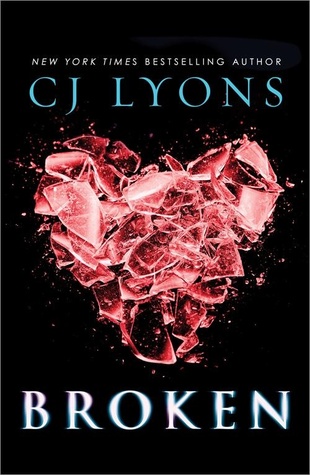
From Broken by C.J. Lyons: 

Kids fill the hall from wall to wall. Despite the unfamiliar press of bodies, I don’t panic. Instead, I let them steer me, like running with a herd of wild, untamed horses. At the end of the corridor, the herd separates into two, leaving me alone in front of a high glass wall.

The library.

Footsteps and lockers banging and voices colliding barrage me. Then I open the door, cross over, and step inside. I’m greeted not by silence, but instead by a hushed burble, relaxing, like the sound of a water fountain. I stand, enjoying the sensations, and take a breath.

School smells so much better than the hospital. And the library smells the best of all. To me, a good book is hot cocoa on a stormy winter day, sleet battering the window while you sit inside, nestled in a quilt.

A room filled with books?

I inhale deeply, a junkie taking her first hit. Sweet, musty paper. Ebony ink so crisp it threatens to rise off the pages and singe my nostrils. Glue and leather and cloth all mixed together in a menage a trois of decadence.

Another breath and I’m drunk with possibilities. Words and stories and people and places so far from here that Planet Earth is a mere dust mote dancing in my rearview mirror.

Hugging myself, containing my glee, I pivot, taking in books stacked two stories high, couches and chairs strategically positioned to catch the light from tall windows lining both sides of the corner, like the bridge of a battle cruiser, broad, high, supremely confident, and comforting. In here, I dare to imagine that I might just survive high school after all.

Respond in your notebook:  Describe a place where you find  peace or refuge?

How do you revision your instruction when you know something isn’t working?

Always an English Teacher: Have Red Pen Will Travel

So Heather and I are eating lunch at a Chili’s in the St. Louis Airport because hungry.*  We are on our way to NCTE in Boston, and we haven’t been together in person for a couple of months, so we are talking talking talking about English teaching, YA books, best practices, job interviews, transformation, old practices, new practices, motivating the masses, and, of course, writing our book.

Heather takes a bite of her hamburger and notices that the couple at the table next to us is composing some kind of letter on the man’s cell phone. She mutters, “They aren’t doing a very good job of it, maybe we should help.”

I hardly notice as I continue scribbling notes of our conversation in my writer’s notebook with my favorite green pen. Until. . .

He says:  “I am writing this letter to inform you that. . .”

She nods in agreement.

He says:  “Words can hardly express my feelings about . . .”

She nods in agreement.

He says:  “I will certainly miss meeting with you to hear about all of the progress that is taking place within the company and its growth.”

[Heather and I both reach for my RED pen.  j/k — but we really wanted to]

We pay our bill and leave the restaurant before we can see the lady nod her head in agreement.

Heather:  “Quick, before we teach them how to write.”

Amy:  “No kidding, talk about wordy.”

Heather:  “Talk about how NOT to pass the STAAR writing test.”

Amy:  “They exceeded 26 lines.”

Here’s the thing:  Those people were practicing real world writing. But did anyone ever teach them how to write?

Although we are not questioning the ability of their 10th grade writing teacher, we do have to question what they took away from their formal writing instruction. As educators we must think about practical skills and strategies that learners can internalize, similar to universal truths, so when they need those skills, be it reading, writing, thinking, etc., they will be able to recall and then apply them to real world tasks— like writing a resignation letter in an airport restaurant.

Three simple tips that would help our new friends:

1. Purpose should be carefully crafted within the context of the piece, not explicitly and immaturely stated in the first sentence.

2. Word choice, even when saying meaningless nothings, matters. If words can’t express feelings, what can?

3. Say it, and say it as concisely as possible.

*See English has a New Preposition, Because Internet

Acceleration — Is Your Model Worth It?

Let me state the obvious: There are certain students who do not like school. You know some of them. I know you do. Maybe you were even one yourself.

There are numerous reasons for this dislike, and sadly, some of the negative feelings have their claws in deep by the time these students get to high school. In my experience, most students who claim to hate school are struggling readers; therefore, their writing suffers, and they score low on most assignments–if they are willing to do them at all. These students just don’t feel smart — or capable.

Every day I make a concerted effort to reach them, to help them like learning, to encourage them to practice reading and writing. And sometimes I succeed.

But success comes hard when outside forces inflict unnecessary roughness.

Take tutorials for example. “Mandatory” tutorials in order to “prepare” for standardized testing. You know the kind.

The date for the re-take of the STAAR EOC looms, so schools go into panic mode. Students need extra support, and the state mandates we give it, so schools figure out how to provide this accelerated instruction. In my humble opinion, the mode of this instruction does nothing but give students who already struggle, already dislike school, another bucket of reasons to hate the whole deal.

Pass out reminders during regular classes:  students feel dumb for being singled out.

Call students from class early to escort them to tutorials:  teenage students get angry for being treated like young children.

Pull students our of class during the day and put them in a room with a teacher they do not know:  students feel angst for being forced to be yet another place they do not want to be with a teacher that doesn’t know their names. The lessons are a whole other story.

I’d say we’ve done our duty. Not.

When will we change the model of this “necessary” tutoring? When will we put the student first instead of never?

The same old same old tutorial sessions just do not work, and they probably do more harm than good– at least when done like the model I describe. It’s painful for students who struggle anyway. All we do when we go through the motions of acceleration is hurt the young people we claim to be helping.

Okay, probably not every program, but that’s my take on what I’ve seen this year.

And it makes me very sad.


For a new idea check out how North Star of Texas Writing Project, in partnership with innovative districts, is figuring it out. See  Finding True North: Accelerated Camps for Students at NorthStarofTexasWritingProject.org, celebrating students’ writing instead of disparaging the student writer.


How does your school handle acceleration?

The Unexpected Trio

Our Compass Shifts 2-1“Miss Bogdany, isn’t writing a narrative the same thing as writing a story?”

“Yes, it is.  However, we’re going to spend time exploring writer’s craft by infusing a few strategies.  We’re going to be in tune with our five senses; explore the power of short sentences; and work through personification all while sharing an important moment in our lives.  Ready to play?”

Over the course of the next two weeks, the playing had begun. My students were charged with the task of choosing a moment in their lives that has, and continues to, shape them as individuals.  As students took to their Writer’s Notebooks and scribbled words and ideas as they began to chronicle the very moment that guided their paths – struggle, strength, and empowerment; you could feel the intensity.

***

Since my time at UNHLIT13 this summer, I have been experimenting with ways in which to inspire my students’ writing.  While asking students to ‘play with’ their five senses, short sentences, and personification may seem like a tall order, or at the very least, completely random; I realized they were willing to try.  (I’m still not exactly sure why I grouped these three concepts together.  I’ll chalk it up to trusting a whim!) As each skill was introduced, it was partnered with Mentor Activities and/or Mentor Texts so students could see how other authors used these strategies.  Take a peek – Craft- Mentor Texts, Activities and Skills

I know giving students the time to think through what they’re thinking (I love this concept!) is vital to building their self trust, worth, and importance as writers.  So, I made sure to do just that.  I took each concept and taught it as a separate entity so students could narrow their focus to just one concept at a time.  We started with the five senses.

And yes, while the five senses have been part of their writing journeys for the last ten years, I was asking them to do it in a way that was elevated – full with adjectives and adverbs – so we could start with the fundamentals and work our way through.  A mentor activity involved pairing students together so they could collectively guide their readers on a vibrant, sensory tour of a destination.  Giving students access to this foundational, yet imperative, practice empowered them.  They made the leap from understanding the descriptive power of touring a destination to the descriptive power in bringing their own moments to life.  Here is an excerpt from one young woman’s journey:

I remember picking her up off them white sheets on the hospital bed and laid her on my white spaghetti strapped dress that was then covered in the blood that fell from baby N’s mouth.  I rocked her and rocked her until she got cold and stiff.  I held her hands.  Her little fingers got hard around my finger and I couldn’t even get my finger out of hers. 

I breathe deeply.  Saniyyah’s use of setting and color infuses wonderfully into the stark reality of what is happening.  You can’t help but to be invested, and then saddened, through this experience.

*

This summer, I also had the luxury of moving through Dave Cullen’s work (Columbine) with my ever- wonderful book group consisting of Amy, Emily and Lauren; and it could not have been a more exhilarating experience.  For the first time I was combing through a text, peering in with the scope of a writer not a reader.  This was formative in elevating my own view on literature and imperative for my students.

So, when we started studying Mastering the Short Sentence, I brought Columbine into our community and shared how beautifully (and masterfully) Cullen utilizes this technique.  (How could I not?!  It was where my own literacy scope shifted profoundly.)  The short sentences were highlighted prior so when students received their copies the ‘skill’ jumped out at them immediately upon first glanceWe took our time in debunking their individual power.

I also showcased some of my own writing with Day One Disaster? to show students where and how I played with this technique.  When I have writer’s craft questions, I secretly wish I had the opportunity to converse directly with the author who made the decisions, yet in most cases I’m left to my own analysis.  So sharing my efforts (albeit scary at times); affords students the opportunity to engage in dialogue around specific techniques, writing, and literacy as a whole.  Here’s an excerpt from a writer who is willing to take risks:

“I have a confession… I like you more than a friend and I think we will make a great couple”, he began to say. He stutters and chokes on his words. It was so cute to see him choke on those words.

My body starts to fill up with all sorts of amazing emotions. It’s unexplainable. I can’t think straight. He asks me what I think about him. My plan was to say I feel the same way.

Or, so I thought.

The next thing that comes out my mouth changed my whole life completely.

My heart and soul is working against each other like the U.S. vs. Vietnam. Blood and Crips.  A war against Heaven or Hell.

“I think I love you Sherwin”

Everything stopped. Everything except my heart.  Beating ever so loud at that. Boom, boom. Boom, boom.

The court case: Ife’s heart vs. Ife’s mind is finally over. My heart wins.

I’m Free.

Do we not all remember specific encounters with love?  Ife uses the power of short sentences to bring us into her piece; shares her inner-most thoughts with us, and affords us the opportunity to watch her play with mastering the use of short sentences.

*

If you haven’t had the chance to read I AM MALALA by Malala Yousafzai, make it a priority.  This piece is so beautifully written that I found myself rereading excerpts just to hear the words (and arrangement) over and over.  Beyond the craft, you can’t help but to take this young woman (and her journey) home with you, on your morning commute, to a coffee house on a rainy afternoon…or into your classroom to book talk and indulge in during independent reading.

I burst into class the day we started studying personification with MALALA and projected, “M’s, p’s and k’s were all enemies lying in wait.”, a line so eloquently phrased I read it three times over and each time students were awed that Malala chose to chronicle her father’s speech impediment so carefully, precise, and through the use of personification.  They couldn’t wait to try it out in their writing:

Cue me, seven or so years old standing on the flat of the plateau that was my grandfather’s land. A red hillside dirt road leads to a house, body made of wood and a roof of zinc. Being in front of it after all those decades of it being desolate, you almost felt as though the termites couldn’t eat away at it faster than the unfilled silence of children turned adults.

Kurt explores the use of personification while journeying his readers through this historic moment in his life.  “The body made of wood”…wow.


I am in awe (you can see why).  I am awed by students’ bravery, courage, and commitment to developing their moments and their crafts.  Who would have thought that the five senses, mastering short sentences, and personification would prove to be a beneficial trio?  While I was riding the wave of a whim, students were firmly grounded in their trust – trusting me to guide them and trusting themselves in taking risks.

What skills and techniques have you (accidentally!) combined to challenge and motivate students to push beyond their limits in writing?    

When a Student Tells You What to Teach: Sweet

I mentioned before that I gave a Pulitzer Prize winning novel to one of my AP English students recently. He gave it back to me three days later.


“Did you read it?” I asked.

“Well, I tried,” he said. “There’s just too much description. I couldn’t get into it.”

“What do you mean?” I asked.

“I don’t know exactly, but it’s the kind of book you should pull passages out of and teach with,” he said.

Okay, then.

I still haven’t read the novel Tinkers by Paul Harding, but I did take a look to see what Levi meant. (He’s a bright young man–taking both AP Lit and Lang his junior year.)

Just read the first page. You’ll see what I did.

Yes, I can teach some skills with this. It’s beautiful, and now I’m reading it– on the lookout for mentor slices that engage and inspire great reading and writing.

Screen Shot 2013-11-03 at 10.02.26 AM

Authenticity: Making it Real with Student Blogs

North Star of Texas Writing Project (NSTWP), in which I am a teacher consultant, asserts that authenticity is connecting student learning with significant audiences, tasks, and purposes.

image

Blogging with my students is one way in which I make that connection happen. Writing posts and commenting on the work of our peers has become an integral part of my readers/writers workshop classroom.

photo: Petras Kudaras

During the second week of school, once schedule changes calm down a bit, I introduced the idea of blogging to my students. This year I wrote a post on my class blog and imbedded an article that made them see that blogging can have value to their futures. You can see that here.

I’ve had students use Edublogs as their blog platform in the past, and I know some teachers have their students use Kidblogs. I decided to go with WordPress this year. I thought using the “real world” blog platform would be a good idea. You know, just in case some students loved the idea and kept writing long after they leave my classroom. Finally, eight weeks into the school year, I am glad I went this route, but the set-up, especially with my 9th graders took a lot longer than I’ve had to spend in the past. (Most of my students are not as tech savvy as many technology advocates would like to believe. For more on that read this post:  Digital Novices vs Digital Natives.)

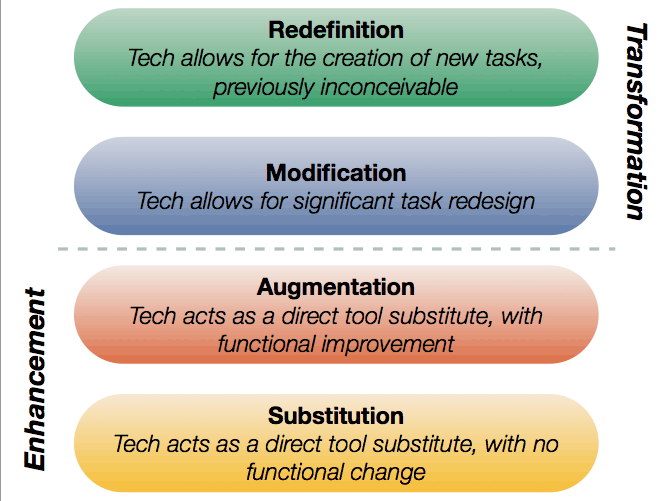
These are some ways I’m transforming my teaching by using student blogs this year (See this SAMR model for ideas on instructional transformation):

Timed Writing. I need students to be able to think quickly about a topic, organize their thoughts, and write effectively in a short period of time. Years ago I had students complete timed writings on paper with a pen, and I’d take the stack of essays home and laboriously grade them. By having students post to blogs, my classroom is getting close to being green. We do very little writing on paper anymore. I can read student posts with the swipe on my finger on my iPad, and I try to leave comments that inspire improvement in their writing. Sometimes I put the score from a rubric. Most times I say something I like about what students have written. They like that kind of feedback best, and it usually prompts some kind of improvement in their next post–something that rarely happened with the marks of my red pen.

For our first timed writing, students wrote about their reading lives. We spend 10 minutes at the beginning of each class period reading our self-selected books. I conference with each student, brief one-on-one chats. I learned more while reading student posts about their reading habits than I did in the prior eight weeks of school. I posted a reflection of my own reading life on my class blog with the actual assignment, and then students wrote on theirs. The response to our wide reading warmed my teacher heart. Read a few of these students’ posts, and you will see why: Helen–A Path Led by Wise Words; Gina–Lay Down the Bridges; Mian–A Passion for Books; Emilio–Reading Life

Our second timed writing, students wrote an argument in response to our in-class study of Ralph Waldo Emerson’s “The American Scholar.” Some student posts were thoughtful and wise; most were ineffective and needed major revisions. All students wrote and showed what they’d learned from their reading and our class discussions.

Persuasive Practice. The AP Lang exam and the 10th grade STAAR test both require students to be effective persuasive writers. I like this blogger’s post:  Blogging is the New Persuasive Essay. As I teach my students how to use persuasive techniques, I also want them learning about their world. They have to know “stuff” to build their credibility after all. So every Monday my students write a post that they base upon something they read in the news. They scan headlines until they find a topic that interests them. Then they pull an idea from the article, and then they write an argument based on that idea. So far, we haven’t delved too deeply in the art of persuasion; we’ve talked mostly about form and structure and a few rhetorical devices, but some of my students have taken ownership of this weekly recurring assignment. Here’s a few to give you an idea:  Kathryn–Words Hurt; Ashley–Recycled Look or Recycled Lives; Jason–Smoking is Safer? Impossible; Adrian–Chemical Mistakes

Published Polished Pieces. As we move through different genres of writing, I need my students to fully immerse themselves in the process of creating effective and moving texts. We started the year with a focus on narrative. I know, it’s not on the AP exam or the STAAR test anymore. But story is so important. It’s what connects us as humans, and it’s story that has helped create a classroom community where students are not afraid to take risks and throw their hearts out on the page. While a few student narratives are not as polished as I would have liked prior to publication (grades being due always seems to interfere with authenticity), if you read just these three, you’ll see why story is important. I can be a better teacher to these PreAP students because of what I know from these posts. Esmeralda–Memories; Mercedes–What Do You Think About Moving? Bryanna–Why Batman?

I remember learning from Kelly Gallagher that students should write more than I can ever grade. Well, of all things in my teaching life, I’ve finally figured that one out the best. I cannot read every post my students write, but I can read a lot, and I can give a lot of feedback in a way that is meaningful so that students respond. We just started reading and leaving feedback for one another. I can already tell that this will be more valuable than just me giving feedback. After we spent two class days reading one another’s narrative posts, I had students tell me on their own narrative evaluations:  “I knew I could do better after I read other people’s.” For an example of our student feedback, read the comments on this one: Amy–Forever a Bye. The instruction I gave students was 1) Be polite but honest, 2) Bless something you think the writer did well, 3) Press a moment that needs more detail or description, 3) Address an issue of concern in regard to style, grammar, etc. For our first time, I’m proud of these students for the feedback they gave their friend.

Engaging student writers is often more than half the battle. So many times they have the attitutde “What’s in it for me?” By allowing students to choose their topics, and allowing them to express their true and authentic voices, I get better participation, and I get better writing, and I get to know the hearts and minds of my students.

That is all I ever really want.

photo: Dee Bamford

#NCTE13  Writing Teachers (Re)Inventing Literacy Instruction by Following the North Star

Calling All Principals!

ocs    “I’m curious.  Tomorrow as you wake up and head out the door to start your day, you are faced with the reality that all educational institutions have been permanently shut down.  How does this impact your lives?  And, most importantly, what are you going to do about it?”  

As I set out to write this piece, I internally chuckle as I reminisce about the beginning of the school year.  Three weeks ago, if you had peered into room 382 to see what my Social Justice and Student Voice class was up to, you’d be welcomed by silence and quizzical looks replacing the vibrant and eager-to-learn sparkle in students’ eyes.  This off-the-cuff question became the catalyst for an unplanned three week project.  Here’s how: 

  1. I happened to be curious about something.
  2. Students couldn’t stop talking about it.
  3. All other plans were pushed aside. 
  4. Then, magic!

At that very moment, eleven principals were born.

From Dr. Collins to Principal Senat, students decided the only way to ensure that all human beings are given a fair shot at pursuing their dreams and goals is to reconstruct our educational system.  And they were very clear about this – the system needs to be customized to meet the needs of students far and wide.  Who better to do so then those most versed on the issue?  Vision, passion, and commitment ooze out of these change agents as they take to the process.  

As students have welcomed and emerged themselves in taking on this charge, there’s not much room for me in the process!  The way in which I sliver my way in is by providing guidance and options regarding organization.  Here’s what it looks like:

Write!  Just write!  There need not be any organization at first.  Students glanced at me through the corners of their eyes, caught each other’s eyes, glanced back, and repeated this eye game various times.  When they noticed I was not giving any further guidance they realized “she’s serious”.  And they tried it.

* Get dirty!  (Again, the eyes.)  When I explained that getting dirty means you can tell Principal Gordon “has been here” because he’s ruffled up his thoughts, he’s playing with his words, and he’s continuing to shift around his ideas…they liked the sound of others knowing “they had been there”.  Armed with highlighters, post-its, and colored pens.  Again, they tried.  

PP - self-edits

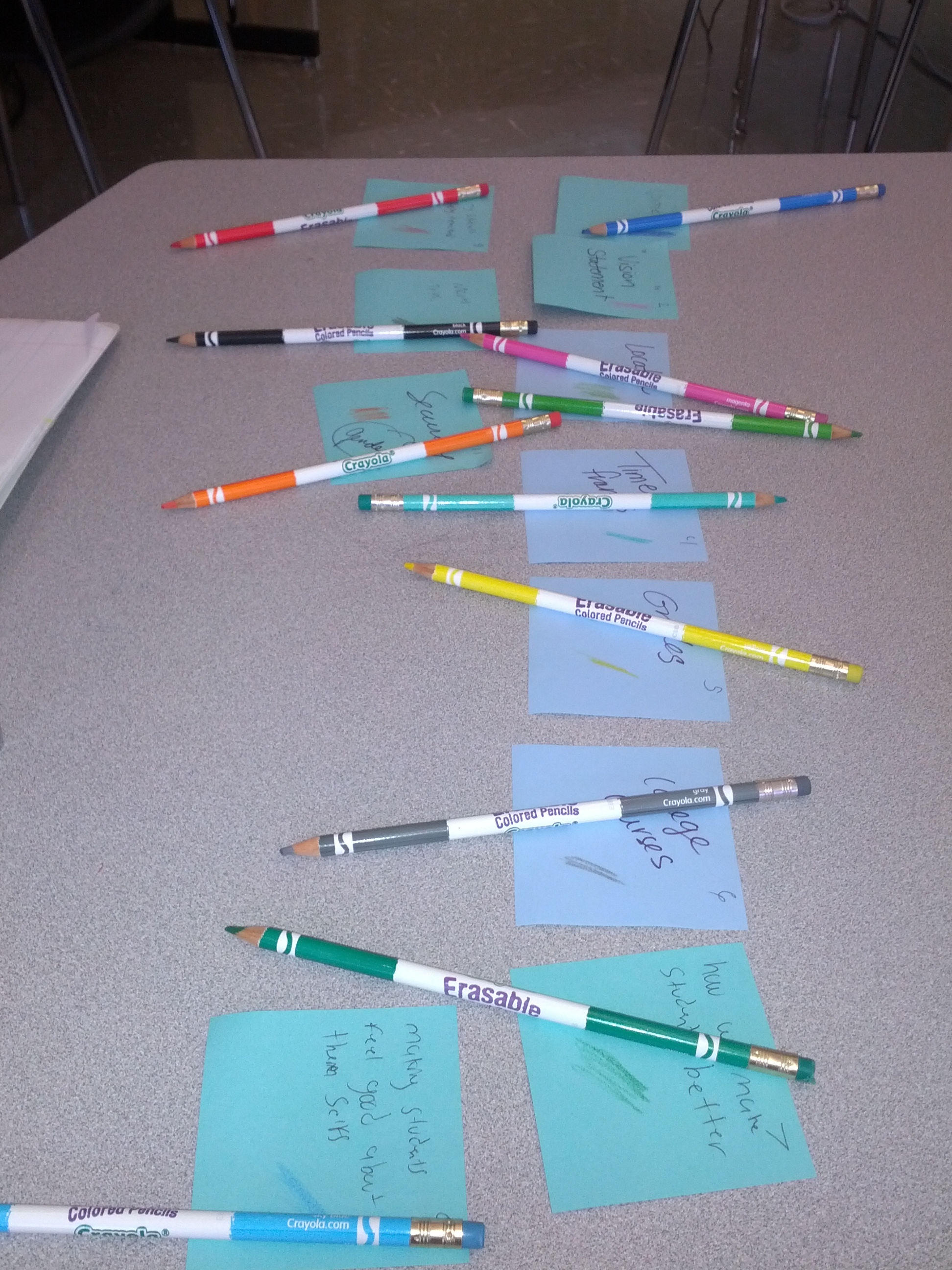
Now, let’s start to organize!   I know I know…it feels a little backward, but without students feeling as though they have to write in boxes, this process frees them.  They write first, organize next.  Yes, the key to the Writer’s Workshop! Write down the main topics in which you have decided to write about.  (See loose leaf)  Partner a topic with a color.  Each topic deserves its own post-it with the same color.

PP - color coded paper

*Once topics are color-coded and placed on post-its, now students have freedom to move their topics around! Literally.  Students have a holistic scope on all of the topics they have written about and now move post-its around in the order in which they want to introduce (and discuss) their topics.  

PP- color coded more pencils

 *Now, go into your paper using the color you indicated for each topic and underline wherever you find ideas about the topic!  Many times students enjoy seeing the same color throughout additional parts of the paper.  This visual guide helps them realize that their writing is (while sometimes scattered) valuable, and even though they (unintentionally) drop the topic into various parts of the paper, they have the power to locate it, restructure it, and reorganize it.  

*Would you like to take a look?  Students, when comfortable, reach out to other students to peer review their work.  This is a wonderful opportunity for students to talk practice, content, and work through ideas together.  I provide them with guidelines on how to productively, and respectfully, provide feedback.  (Pardon the red marker.  Students gravitate toward them!  Next up: using gentler colors for all revisions!)  

PP- peer edits

*When all of our drafting has landed in a comfortable place, we take to formalizing “Best Drafts”. (Thanks to Penny Kittle for this wonderful and inviting phrase students and I have comfortably adopted).  Each principal now makes themselves cozy in their “offices” and takes to their visual presentation.  Our principal and assistant principal will be in the audience when students present their projects next week.  Students have expressed some nerves, but little do these experts know we’re all here to borrow a few ideas from them!  

PP- Office


Eleven principals, three weeks of hard work, and one wildly proud educator makes for quite the beginning-of-the-year journey.  While finding the moments in which I can guide students along their writing paths, and support them individually in the way in which they succeed best; I can resort less to asking how to educate, and listen to what they are offering.  They are whispering to me through their vision.  These educational leaders have invited me to understand their views on what an educational system, derived on justice, looks like.  I am now the student.  

Could We Just Get Students to Read and Write in All Content Areas?

So one of the problems on my campus is the fact that students don’t read. Oh, I know some do, but by and large, the majority of our students are not readers. As a school we are struggling with this new problem of practice, trying to define “complex language.” We’ve spent hours with this already, and have yet to come to a consensus. In frustration last week, after discussing this for two and a half hours, my colleague wrote on the bottom of our PD group’s thinking sheet:  “Could we just get students to read and write in all content areas?”

Really. It could be that simple.

A few years ago, our campus began whole-school reading. Built into our daily schedule is a 30 minute Advisory time, where a good number of minutes could be used for independent reading– if only teachers would enforce it. Most students like to read when they are given their choice of the right books. But if teachers are not reader themselves, it’s no wonder they don’t care if their students read.

Mine do, but that’s not surprising. The students in my English classes read for 10 minutes at the beginning of every class. So, if their advisory teachers are mandating reading, my students should be reading at least 25 minutes during every school day. That’s not a lot, but it is something.

Of course, independent reading will not solve all our problems. Students need to think deeply about texts, not just increase their fluency, and non-readers will abandon a book rather than struggle through it. That’s why if we really want to get our students to develop complex language skills, we must get them to practice complex reading. This is the kind of reading teachers must do with their students. You know, modeling close reading, modeling thinking about a text? And I think English teachers who know how to do this need to be given the opportunity to teach math and science and choir and business teachers how to read closely with all students.

We can talk about complex language all day as a staff. We can define it and put the definition on the walls of our classrooms, but that won’t do a thing until all teachers in all content areas start reading complex texts with their students. (And maybe it’s too much to ask, but imagine the growth if every student wrote in every class every day, too.) Hey, friends in other content areas, I’m glad to show you how.


Does your school have a wide reading program or other reading initiatives that include reading and writing in all content areas?