Category Archives: Writers Workshop

Try It Tuesday: Red Thread Notebooks

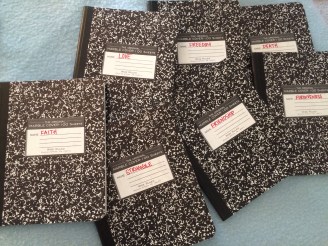
img_3173-1So much of a workshop philosophy centers on the assumption that reading and writing are forever intertwined.  Vocabulary, grammar, poetry–they’re all pieces of the puzzle that make up literacy and a passion for words, too.  It was with this in mind that I created Red Thread Notebooks.

The idea came from two places–one was Penny Kittle’s “big idea books” (found on page 8-9 of those handouts), which are reading response notebooks  centered around themes in literature.  The other was Tom Romano‘s “red thread” assignment, in which teachers had to write about which parts of our teaching philosophy would run through all of our teaching, like a red thread.

img_3177

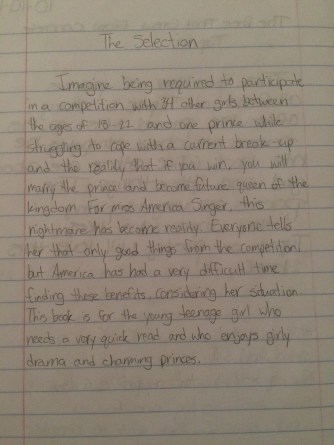
This student booktalks The Selection in the “STRUGGLE” notebook.

So, when composition notebooks are just a nickel in the summer, I buy 60 of them each year.  My students and I begin the year by brainstorming themes and topics that are important to us–love, cell phones, faith, music, family, video games, death, high school, forgiveness, four wheelers.  We label our notebooks and use them all year long.

There are a variety of ways I invite students to write in these notebooks:

  • Vocabulary practice: list related words, synonyms, word associations, etc. similar to the notebook title
  • Skill practice: write dialogue, revise sentence structure, practice figurative language, craft descriptive writing, about the notebook’s title
  • Book talks: write about how the book you’re currently reading might add to a conversation about the notebook’s title
  • Grammar instruction: revise a sentence, imitate a paragraph, tinker with style, while writing about the notebook title
  • Free writing: write your thoughts and musings on the notebook title
  • Poetry: find an existing poem, craft your own poem, or create a found poem about the notebook’s title
img_3179

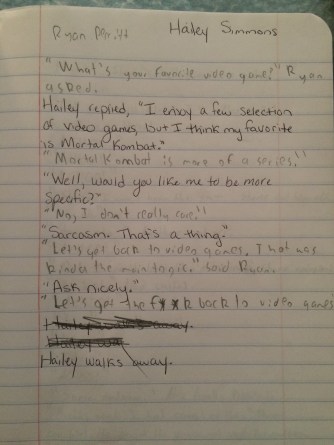
Hailey and Ryan practice dialogue in the “VIDEO GAMES” notebook after I teach a mini-lesson on its conventions.

Because these are shared notebooks, I ask students to refrain from using profanity in them or writing about any of their peers.  I don’t require names, but many students like to sign their writing.  Those are the only rules.

Once the notebooks have begun to fill up, students can refer to them to find book recommendations, writing topic ideas, or vocabulary words to add to their personal dictionaries.  They can also look for examples of skills practice, craft studies, or grammar lessons that we’ve done for additional guidance.  One year students even selected multigenre topics based on our red thread notebooks.

These notebooks are a lovely way to make permanent a yearlong conversation about literacy.  The topics change every year–Michael Jackson had his own notebook my first year of teaching, and this year Lebron James had one–but the opportunities to write, reflect, and make connections remain the same.

Do you think you’ll try Red Thread Notebooks next year?  Do you do something similar?  Please share in the comments!

Mini-lesson Monday: Poetic Literary Movements

This year was a balancing act. Bridging the old and the new. The curriculum I’m used to and the possibilities of workshop. Along with that came plenty of challenges, but also plenty of opportunities to improve on what I know by learning more about what my students can create with choice.

This lesson is from my American Literature class (sophomores) and occurred this past April when we were studying Realism. Students had conducted some research on what thematic and stylistic elements characterized the Realist movement in America and I turned to poetry to make the 19th Century ideas come to life.

Objective/s: Using the language of the Depth of Knowledge Levels, students will analyze their Realism research and examples of Realist poetry in order to synthesize characteristics of the time period with original ideas in the form of Realist inspired poetry.

Lesson: Students came to class with notes they took on American Realism. I had asked them to research the major authors of the time period, famous works, common themes and stylistic elements of writing from that time, and the historical events that led to a shift away from Romanticism.

We started by taking a look at Stephen Crane’s “I Saw a Man Pursuing the Horizon.”

I saw a man

I modeled for students my own analysis, suggesting the elements of Realism I saw in the poem. The clash of Romantic thought and Realist. The futility Realists saw in trying to escape reality. The simple construction of sentences and relatively plain diction.

We then talked about connections to these realist ideas today. “Many of us are Romantics,” I said, “I think I’m one. But I bet many of you are Realists too. What does that look like in your life?”

I asked students to jot down some ideas in their writer’s notebooks of everyday events that speak to these same themes…what some would call the ordinary struggles of life. As I walked around and took a look at the ideas my students were generating, several jumped out at me:

  • Watching someone get bullied and not knowing how to help
  • Dealing with the hand you’re dealt
  • Unavoidable accidents
  • The ‘you’ no one would suspect

Holy poetry material! I shared aloud several examples of ideas I saw from their notebooks and then shifted to have them look at one more example to solidify the simplicity (and power) of realist diction and images.

“Now, I am of the opinion that some of the best poetry is exceedingly simple. The raw, honest truth of life, just like some of the ideas I saw when I walked around and peeked into your notebooks. Let’s take a look at one more example of realist poetry – a modern example.” I showed students  “The End,” a poem (no author found) I discovered when searching for examples of Realism:


The End

It didn’t come with a bang

or a big explosion.

It didn’t come with an inevitable apocalypse

or an armageddon.

It didn’t come with collision

or a war.

It didn’t end with a dying sun

or a waking moon.

It didn’t end in breached dimensions

or shattered realities.

It didn’t end with entropy.

It came when Existence stopped dreaming

And fell into a deep sleep.


Students read the poem silently a few times and I asked them to write down the lines that they felt were especially impactful, powerful, and/or moving. I then read the poem out loud and we discussed our thoughts on the lines they wrote in their notebooks.

Next up was time to explore. Students took their knowledge of Realism, their explorations of realist topics, and our discussion on the power of simple construction with simple ideas and set to work on their own realist poems in their notebooks.

Follow up: After students had time to work on their poems, I had them share at their tables. Each table elected one student whose poem they thought was particularly pointed and either that student stood to read it or asked someone else at the table to read his/her work. We always talk about taking pride and ownership in our writing to build community. Sometimes this means letting someone’s enthusiasm over the work of his/her peers fuel an energetic reading of the work as well. Kids love to read the work of their peers and I can see in the faces of the authors a pride often unmatched when they read their own work.

A few class periods later, I asked them to find additional poems with Realist characteristics. We used these as mentor texts for small group discussion and to compare with our own work.
Do you sometimes have to bridge the gap between old school and workshop? How do you make the old seem new again? Please share in the comments below.

Try it Tuesday: 44 Songs for Quickwrites

My students and I start writing on the first day of school. Our first quickwrite might be in response to a video or a poem or a short passage. For the past few years, I’ve shown To This Day by Shane Koyczan. I pass out notecards and ask students to listen to the message and then either write their thoughts to the whole of the video, or perhaps to a line in it.

I learn a lot about my students on the first day of school.

Then, three or four times a week, we write in response to other videos, poems, or passages throughout the year. Sometimes we return to these quick writing pieces, choose topics, and take the writing into full processed works. (Shana shares how she leads students into this mining his mini-lesson.) Sometimes we stop at just sharing our thinking with our table mates. Sometimes we use our thinking a springboards into texts we read together or in book clubs.

Writing responses is one of the best thinking strategies I know for engaging students in writer’s workshop. (Actually, I think asking students to write responses in any content area is good for thinking — I wish math and science teachers gave students more opportunities to write. I’m sure they wish I did more with math and science, but somehow I don’t think that’s really apples for apples. Is it?)


As this year winds down, I think of a million things to ask my students that might help me

Screen Shot 2016-05-30 at 4.48.59 PM

Lovelyn’s suggestions for songs to inspire writing.

reach more readers and writers the following year. This week I asked them to give me ideas on the songs they listen to — songs that might work well to get students thinking and responding in their notebooks.

They sent me lots. Some sent me lists.

(Disclaimer:  I have not listening to all of these songs yet, but I did start watching the music videos. Some have lyrics that might work well, but videos that might not. Some are a little too much… others are just weird. Some would work if we think of thought-provoking questions to include with the lyrics/videos. Should’ve had kids come up with those, too.)

Here’s a list of songs my students suggest would make for good quickwrites:

“Alive” by Kehlani

“Clarity” by Zedd

“Bright” by Kehlani

“Halo” by Beyonce

“Someone Like You” by Adele

“Be Alright” by Kehlani

“Lean On” by Major Lazer & DJ Snake

“Shark” by Oh Wonder

“Lights” by Vexents

“Thinking Out Loud” by Ed Sheeren

“Imagine” by John Lennon

“Run Away” by Kanye West

“Brother” by Need to Breathe

“Love Yourself” by Justin Beiber

“7 Years” by Lukas Graham  (I found this one before my students mentioned it. I actually saved the title to this song in my notebook after I heard it on the radio. It’s a great song for thinking about Our Stories.)

“Stronger” by Kelly Clarkson

“Humble and Kind” by Tim McGraw (Another song I already love and am tickled that a student suggested it. This is a message I know we all hope our students internalize. Studying the humanities makes the world –and the classroom — a better place.)

“50 Ways to Say Goodbye” by Train

“Apple Tree” by Erykah Badu

“Ain’t No Rest for the Wicked” by Cage the Elephant

“The Light That Never Fades” by Andra Day

“Rise Up” by Andra Day

“Hall of Fame” by the Script

“Cornerstone” by Hillsong

“Don’t Stop Believing” by Journey (Ohhh, Journey. I remember you well. Another student suggestion that made me smile.)

“The Middle” by Jimmy Eat World

“Heroes” by David Bowie

“What Would You Do” by Bastille

“Youth” by Troye Sivan

“Locked Inside” by Janelle Monae

“I Don’t Want to Be” by Gavin DeGraw

“Became” by Atmosphere

“Battle Scars” by Lupe Fiasco

“Not the Only One” by Sam Smith

“The Moon – The Swell Season, It Will Rain” by Bruno Mars

“Talking to the Moon” by Bruno Mars

“See You Again” by Charlie Puth

“Only One” by Kanye West

“Beautiful” by Eminem

“Heaven” by Troye Sivan

“Lose It” by Oh Wonder

“Don’t Let Me Down” by The Chainsmokers

“Never Forget You” by Zara Larson

First” by Laura Daigle

What about you — do you have some great songs you use to inspire your writers? Please share in the comments.


Mini-lesson Monday: All Good Writing Begins with a Good Question

One of the hardest things I ask my students to do all year is choose their own topics. We start generating ideas on the first day of school. We watch video clips, read quotes and short passages, listen to poems, look at cartoons — and we write responses. We create various versions of writing territories in our writer’s notebooks. We have many ideas stored in our well-used notebooks by this time each year.

But with every writing task, students seems to always start the topic journey right back at square one, even when I remind them that they have a mine of ideas sitting in the pages of their composition books. I’ve decided that just like me they like the process of discovery.

My goal is to get them to move past topic discovery into writing discovery. Too often, students think they have to know what they want to say before they ever start writing. No wonder so many kids have a hard time approaching the blank page. (See NCTE’s 10 Myths of Learning to Write #4)

The last writing assignment my students complete each year is a multi-genre type piece wherein they show they’ve improved in the various writing modes we’ve practiced throughout the year. They have almost total choice in terms of what they write, and they have most of the choice in terms of the forms they write in.

I have just two mandatory suggestions (oxymoron intended):  one piece must be a Rogerian argument, and somewhere in their master piece, students must show they know how to use an academic database to find valid sources, and then they must use the sources in the correct context, and cite the sources correctly.

We look at a few mentor texts that use multiple genres within the same piece. Narrative, informative, persuasive — plus images and info-graphics, or other types of forms that present information, including videos and interviews. My favorite is the award-winning feature article, Snowfall: Avalanche at Tunnel Creek by John Branch.

Once students know their end-goal: the creation of their own multi-genre writing piece that shows off their writing journey for the year, they must choose a topic. Some will want to stick with a topic they’ve written about multiple times this year. Depending on the topic, and the student, I may be oaky with that.

This mini-lesson came about in an attempt to help students figure out a topic that they know enough about to ask questions but not so much about that they could answer all of them.

Objective:  Using the language of the Depth of Knowledge Levels, students will construct a list of things that make them wonder; they will formulate questions about a self-selected topic derived from their wonderings. They will then categorize the questions in sets that make sense. Finally, they will determine which questions may best be answered through a specific genre or form of writing.

Lesson:  I tell students that we are about to play in our notebooks. “Turn to a new page, and write a list of all the things you wonder about,” I say. They usually sit there writing nothing, so I get them started:  “I wonder if teens got paid to go to school if they would want to learn more.”

Most students start to write, but I keep wandering the room, stating things that make me wonder as students list their own wonderings in their notebooks.

“I wonder when the state of Texas will get wise to the lack of wisdom in state testing. I wonder why students choose to do their APUSH homework over AP English. I wonder if the Dallas Cowboys will ever win the Superbowl again.”

Once students have at least a half a page of wonderings, I ask them to talk with one another in their small groups. “Perhaps your peers will remind you of something else you wonder about. Add it to your list.”

“Okay, look at your list and zero in on one topic that you think you can find the answer to with a little bit of research. Now, let’s think all the way around this topic.”

I ask students which of my wonderings I should use as a model for their next step, and they tell me the one about the Cowboys. I write it on the board. “Okay, help me come up with questions that look at this from every perspective possible — like who has a stake in whether the Cowboys win the Superbowl again.”

When was the last time the Cowboys won the Superbowl?

Who led the Cowboys to the Superbowl in the past?

How many times have the Cowboys been in the Superbowl?

Is the Cowboys coach as good as the coaches in the past? Are the players as good as the players in the past?

What is different or the same about the NFL?

What do the Cowboys need to do to win more games?

Who would be a better quarterback than Tony Romo?

Does the current team consist of Superbowl quality players?

Which teams are in the way of the Cowboys going all the way again?

Some questions get silly — pretty sure the Dallas Cowboy Cheerleaders don’t matter all that much to the reality of getting to the Superbowl. Sorry, girls — but students get a hang of the idea. “Ask as many questions as you can think of. After you write a list of your own, ask your peers for help in writing others.”

Next, we need to put our questions in categories. I ask students to talk with one another and determine which of our questions about the Cowboys might go together. We decide we’ve got questions about 1. the history of winning the Superbowl, 2. similarities and differences in the game, the coach, the players, 3. current Cowboys, 4. the opponents.

We talk about what genres and forms might work to convey the best answers to our questions.

“Compare and contrast the differences. That’d be easy,” someone says.

“The history of the Cowboys’ past wins would be information, right?” another student says.

“What could be the topic of a persuasive piece?” I ask.

“The question about the ability of the current players. Easy.”

I tell students that they get the idea, and I charge them with reading through their questions and categorizing them into groups that seem to go together.

I remind them:  “All good writing begins with a good question.” And they’re off.

Follow up:  Students should use their questions and their categories to guide the choices they make as they write their end-of year multi-genre pieces. In conferences, I read through questions, helping students add to and clarify. I remind them that form helps determine meaning, so as they make choices, they need to think about the best way to share meaning with their intended audiences. Students will present their writing projects as their final exams.
Writing Myself Out of a Wreck

Note: This post was supposed to run this morning. Must not have clicked the right button last night. So, here’s my thinking of late. Better late than not at all. (I think that’s the mantra of many of my students.)

I have a confession:  I am pretty much a wreck.

I could blame it on my son who joined the Army and left for basic training the afternoon of Mother’s Day, or I could blame it on another son who called to say he’s marrying a girl he’s known a month and I’ve never met, or I could blame it on this Empty Nester thing that’s barely three days new and haunting me with shutting doors and creaking floors.

I could blame it on the AP Language exam my students take today.

It’s the same every year — well, not that son part, thank God — but definitely the wreck part.

Every year I wonder if I taught enough, had them write enough, gave enough feedback. I wonder if I helped them grow as critical thinkers and accomplished writers. I wonder if they will read the prompts correctly. I wonder if they’ll answer the questions. (I’d be happy with a thesis statement.) I wonder if they’ll remember we learned to read footnotes. I wonder if they’ll cite their sources. I wonder if they’ll write enough to show they are bright and honest and eager and loving young adults.

Oh, wait.

That’s right.

No matter how my students do on this high-stakes test, the important things — the things that matter to me, and should matter to the world — are the things that cannot be measured in 55 multiple choice questions and three essays.

I just needed to write myself into that reminder.

_________________________________________________________________

Today I read  Enjoy the Best Year Ever with a Mantra by Ruth Ayres and loved her Why I Write mantra. I took up the pen to write my own. It’s still a work in process, but I’m kinda likeing it, and I’m no longer a wreck.

Why I Write

I write to make myself feel better.

I write to discover what I want to say.

I write to hear my voice within the chaos.

I write to play with colorful words (and pens).

I write to show my students I am a writer — and because it’s hard.

I write to share my thinking, my hoping, my planning, my longings.

I write to be remembered and to be worth remembering.

I write to know I belong.

I write to advocate for literacy and learning and the lives of my kids.

I write to become a better reader (and I read to become a better writer).

I write to tell stories.

I write to walk the walk and talk the talk of my English teacher self.

I write because it is better than the spa.


Have a go at it. What is your mantra?


Try it Tuesday: Thesis Statement Dissection

Buttering someone up is an idiom that has long made me smile. Perhaps it is my deeply rooted devotion to butter (the dairy state doesn’t play…you can’t live here if you dislike butter) or the visual of someone taking a stick of butter and applying it like deodorant, but either way, I buttered up my students the other day and it worked deliciously.

Basically, I slathered it on like this:

  • Remind students of how awesome they are at writing thesis statements because they have been doing it for years.
  • Have students apply their reviewed knowledge of quality thesis statements to their own papers in order to double check their awesomeness at this skill.
  • Elevate them to the role of “expert” in the area of thesis writing in order to have them make suggestions to their peers about clarity and depth of their awesome thesis statements. 

Underlying all of this was my firm knowledge, butter in hand, that many of their thesis statements were currently far from awesome. However, this certainly wasn’t because my students lacked the skills to clearly convey their ideas, it was most likely because they had procrastinated in writing their drafts, checked out to the warmer temperatures and sunshine, or hadn’t taken the time to really carefully reflect on what they had written in favor of working on something for just about any other class.

So basically, the issues of every paper written by a high school student in May.

In order to encourage some honest reflection and move their work forward, I employed the following strategy:

1. First, I shared with students a thesis statement I wrote to accompany an informative paper I was writing along with them. We talked about the different elements present in my sample and how they matched up with what students knew of writing complex thesis statements. One area we worked through together was my struggle with a negatively connotated word that was pushing my informative thesis statement in the direction of argument. Having students help me change the word, demonstrated what I was going to ask them to do in small groups shortly. (Much praise here and reminders of how awesome they already are at writing thesis statements.)

IMG_0611

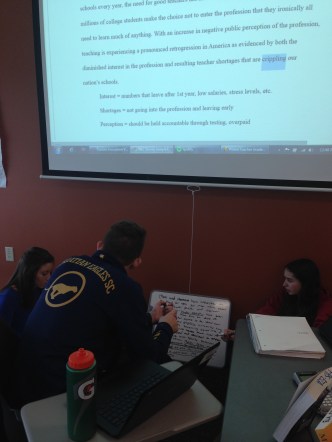
Students work on their thesis statements in small groups, under the projection of the sample paper I wrote along with them

2.  Next, we reviewed the non-negotiable elements of effective thesis statements. I asked students to highlight their inclusion of those elements and/or comment on their papers with what was missing so they could return and revise. We included that an informative thesis statement needed to present non-debatable facts, organization of those facts into a logical roadmap for the paper, and inclusion of a “so what?” element to clarify purpose for their audience on the specific elements of the topic the paper would cover.  At this point, we circled back to my thesis statement and looked one more time with theses specific elements in mind. (Again, more buttering up in the form of high praise to their identification skills and encouragement to now apply that thinking to their own work)

3. I then asked students to spend ten minutes or so, writing their thesis statements on our mini whiteboards, revising as they went. They were to write notes on the side to indicate areas they needed help on or questions they had about the effectiveness of their statements.

4. With markers in hand, students then gathered in small groups, “presented” their thesis statements to their group members by reading aloud and asking questions, and then worked collaboratively to strengthen their sentences. (Before they got to work, I reminded them of how highly qualified they all were to assist others and how as a classroom of writers, each student could provide insight to his/her peers on improving the work)

Honest conversations around the room included such statements as:

“I see what you mean. That part made sense in my head, but it needs to move over here.”

“I like it, but I’m still asking ‘so what?’ Like, what’s your point about stereotypes?”

And my personal favorite, “Dude. That thesis is awesome. Can I steal that idea to have a dependent clause first? My audience needs to think about historical examples of Congressional corruption before they can really understand how bad it’s gotten.”

Dude. Did you just reference syntactical choices to more appropriately orient your audience for your paper? Mic drop.


While students worked in small groups, I was able to conference with several members of the class one-on-one. In addition, I noted a few kids I would need to pull into a small group during the following class period to continue guiding their work on these statements.

With the messiest looking whiteboards I have seen in quite some time, students returned to their seats and kept working on both their thesis statements and the necessary adjustments to their papers to reflect their revisions.

I could have easily reviewed the parts of an effective thesis statement and walked around to take a look at what kids had already written. But by helping students see each other and themselves as resources, most of the class improved their clarity and complexity significantly and my involvement was minimal.

In a community of writers, everyone is a resource. Sometimes it just takes a little grease, er butter, to get the parts moving and the collaboration started.

What are your ideas for helping students see themselves as writing resources in the classroom? Please leave your comments below! And, Happy Teacher’s Day! 


Try it Tuesday: Thinking Outside the Bubble

Testing season is upon us. Heaven help us all.

ACT, SAT, AP – insert your high stakes, hive-inducing, pencil-sharpening acronym here.

As students sit down to demonstrate, in bubble form, their proficiency as scholars (and sometimes in their own estimation, as human beings), we as educational professionals hold our collective breath.

Have we balanced real world application of skills and test prep as we should?
Will students be able to develop their ideas in the limited time provided? 
Do they know the specific language necessary to decode the test? 
Will they demonstrate growth reflective of the hard work of both teacher and student? 
What will these scores mean for my daily practice? My salary? My job security? 

It can sometimes feel desperately difficult to maintain the freedom, choice, and empowerment that workshop affords in the face of district expectations for test performance. Afterall, students aren’t given choice when it comes to test prompts or format, or taking the test at all. However, at the end of the day, the skill focus of both readers and writers workshop speaks pointedly to preparing students for whatever they might encounter on such tests, as learner investment in choice materials in often much higher. So if we work to illustrate key skills in mini lessons and have students work with those concepts utilizing texts they are enthusiastic about, research would suggest a solid return on investment, both scholars and the tests used to measure their “proficiency.”

For example, Greene and Melton’s book  Test Talk: Integrating Test Preparation into Reading Workshop stresses that successful test takers must be smart readers.

Many test taking strategies are simply good reading strategies, so as we work to build student skills in close reading, we are also building their test-taking skills. In this way, test review isn’t an isolated unit, but rather a daily practice that teachers can refer students back to as test time approaches. And because better reading means better writing, the need to develop students as careful readers is paramount.

So while the beauty of workshop is choice, our world of standardized tests demands the development of specific reading and writing skills; however, those two worlds can have more in common than we might initially think.

To illustrate, I took my AP Language students through a prompt review that challenged them with timed writing, analysis of student samples, self-assessment of their work, peer-assessment of their work, and then collaboration to arrive at a final score.

Obviously, part of the written test is one’s ability to write an argument, but in the case of this synthesis prompt, if students aren’t careful readers of the materials provided, they struggle to effectively incorporate the evidence. This specific test prep went way beyond the test in terms of skill development and it went down like this:

  1. Students wrote an AP Language Synthesis essay in class. This required 15 minutes to look at sources and 40 minutes to write an argument essay utilizing those sources to support their claims. AP Synthesis essays ask students to write an argument and incorporate at least three of the provided sources. Students must quickly read through the source material to locate information they want to use in support of their claims and then plan, organize, and write their essay.
  2. The following class period, we looked at student samples and the AP scoring guide from the College Board website. This gave students an idea of what the prompt looked like in action and the actual scores those students received. I divided the class into groups, had each group look at one sample essay and its score. They then had to justify how AP scorers came up with that score. We shared as a class that lower essays lacked organization and analysis, middle scoring essays were adequate in all areas but could be improved with more specifics and developed analysis of included source material, and the top scoring essays blend style and content in a mature fashion.
  3. Students then pulled out a clean sheet of paper and self-assessed using the provided rubric by giving themselves a score and justifying it.
  4. Here’s where I tried something new. Students folded over the top of their assessments and handed their synthesis essays and the reflection (without their score visible) to the person next to them. Peers read through the essay, scored it, and wrote several suggestions for improvement. We went around our tables of four until each student had his or her essay back.
  5. We then unfurled their feedback and engaged in collaborative discussion. I asked students to talk about what they saw in each other’s essays and to arrive at a final score. I recorded this in the gradebook as their formative score for the exercise. Anyone that was dissatisfied with what the table decided, could come and share their concern with me, which I am pleased to report, did not happen.
  6. Students stapled their feedback form to the essay with a final score on top, along with their thoughts on the exercise.

In the end, students said it was hugely helpful to compare their work to that of others and in doing so, realize what they could do to improve their own responses on the actual test.

Eva said she found the activity, “Really, really helpful. It’s good to get perspective and to be able to reflect from that feedback. 10/10 :)”

Sam suggested that it was helpful because he finds it “hard to critique” his own work. Having published student samples from AP and peer samples from his group, he was able to compare and contrast against concrete scored examples and try his hand at assigning a score on his own, with his tablemates to help justify that score at the end.

And Daaman said she, “enjoyed this activity as we were able to see others’ interpretations of the prompt and also see ways we can improve.”

I’m glad they feel more prepared for the test, but beyond that I am most impressed that in just two class periods they demonstrated skills in both reading and writing, analysis, synthesis, reflection, and collaboration. By analyzing student samples as mentors and applying that knowledge to their own work, students walked away with several examples of what to do, what not to do, and where to take their writing for the next argument we write. No bubbles or number two pencils required.

How do you bring workshop and standardized testing together? Please leave your ideas and comments below! 

Poetic Rhetoric — Spoken Word Poems in AP Lang

For a long while now, I’ve wanted to write spoken word poems with my students.

I use Sarah Kay’s “Hands” at the beginning of the year to start students thinking about their lives and the important moments that shape them. We draw hands in our notebooks and fill them with words that represent our memories. Like many of you, I first did this myself with Penny Kittle, and now I draw a hand in every notebook as one of the first pieces I write in it.

I use Shane Koyczan’s “To This Day” and ask students to write a response to it. Sometimes they tell me things that break my heart. Like the fall on the first day of school when two different girls in two different classes wrote about the abuse they experienced from their fathers at home.

These and other poems students find interesting and inspiring, and while they’ve always worked as never-fail quick writes, I wanted to challenge students to use all the skills we’ve focused on this year to write their own poetry. My student teacher, Zach, and I finally figured out how.

And students wrote some powerful poems with some perfectly poetic language.

We called the assignment:  Poetic Rhetoric. what-matters-most-in-life-are-quotes-and-stuff-that-tell-you-what-life-is-really-about_motto

The initial task read like this:  Craft a spoken word poem that addresses a personal conflict and/or a social issue, include rhetorical techniques and literary and rhetorical devices to convince your audience of the need for positive change. Perform your poem for the class live, or create an automated slide show with visuals, or a video recording as a way to digital.

Every day for a week we shared a different spoken word poem. Sometimes we wrote responses as a way to mine for our own ideas for topics. Sometimes we studied the lyrics, closely reading and analyzing structure, tone, and literary devices. We encouraged students to use the work of these poets as their mentors:  “Remember, we learn to write when we study good writing.”

We listened to “Paper People” by Harry Baker, and we talked about theme and sentences that hold the most weight, ones that might be his position statement.

We listened to “Education” by Aadil Malik, and we talked about evidence and examples that support the main idea.

We listened to “Touchscreen” by Marshall Davis Jones, and we talked about repetition, puns, and other literary devices that make language clever and meaningful.

We analyzed the structure of “To This Day,” and we talked about how Koyczan moves from self, to another, to another, to everyone as a way to finally get to his moving plea “to get a better mirror.”

Zach taught mini-lessons, reminding students how to use personification, puns, allusions, and fresh figurative language. We gave students time to write in class, and time to talk with one another, and time to talk with us about their process and their product.

We provided resources on how to write performance poetry like this and this and this.

And students wrote beautiful and meaningful arguments.

Most students performed their poems live in class. (I did allow for a teleprompter since I am the worst at memorizing myself.) We have a slam poetry night coming up on our campus in April. I hope many of my student will perform their poetry again there.

Here are the lyrics to some of the ones I personally enjoyed. I wish I had video of the performances. You’ll have to trust me — they were awesome.

Nefertiti Franklin:  WelcomeToStereotypesAA

Jennifer Melendez:  Find Your Charge, which includes an evaluation of her writing process

Kennedy Jenkins: Use Your Mind

Fabian Gutierrez: ADPoem

And here is an example of one of the poems published digitally. I love her language.

Jessica Ortiz:  People Love to Talk

Reminders to self for when I do this writing unit another year:

A. Take more time with topic selection. As with any writing, if students choose topics that are too broad, or they do not know enough about, the writing is harder to revise.

B. Meet with students more often. Conferring is essential to helping students find what they want to say. Too many students procrastinate and then think they can produce quality writing at the last minute. I must remember to confer at the beginning, the middle, and the end of the writing process. Schedule time for this.

C. Allow time for students to provide one another more targeted feedback. Although they met in small groups and talked about their writing, they did not use their time as effectively as they could have. If I will be more purposeful in modeling what a helpful feedback group looks like, students will be able to help one another more.

I love teaching students to write. I’m not sure there’s a better gift than reading their published work and seeing that they understand the power of their voices. Sometimes they blow my socks off with the force of their wisdom. I love it when they get it.

Have you used spoken word poetry in your writing class? How? What are your favorite poems?

#FridayReads: Required Reading “Our Students Want to Write”

Confession:  I buy a ton of pedagogy books. I rarely read them all the way through. I blame it on my blossoming OCD. I can only take in so many ideas before I run out of space in my head to hold them all long enough to use them.

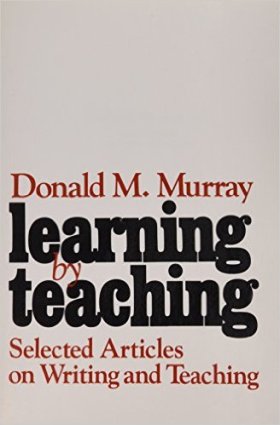
412bcpby4iol-_sx326_bo1204203200_That is not the case with this classic, suggested to me by my friend and mentor Penny Kittle, Learning by Teaching by Donald Murray.

I remember when Penny recommended it. She was in the DFW metroplex teaching a workshop, and I’d asked if we could meet up and talk about my writing. She graciously agreed, and we met at a Starbucks inside a Target. As always, Penny radiated positive energy. She told me about the work she was doing with Kelly Gallagher. I told her about my struggle trying to write a book, a book I am still trying to write.

I still cannot believe I had a writing conference — yet again — with Penny Kittle! (My first was during her class at The University of New Hampshire Literacy Institute the summer of 2013.)

At one point in our conversation, Penny paused and asked if I had read Don Murray’s book Learning by Teaching. I said no. At the time I hadn’t read any of his books, but I’d heard Penny talk about Murray with such affection, quoting him often. I knew this was a book I need to not just purchase, but one I needed to read. I’ve read and re-read and marked page after page.

Don Murray validates the moves I make in my workshop classroom, the moves I make

pageinMurraybook

My thinking while reading the essay “The Process of Writing” by Donald M. Murray


when planning instruction for my AP Language and Composition course. I have learned from those who learned from Murray, and his work reminds me again and again why teaching with student choice in mind works. Every time I feel like I fail, every time I get frustrated with the way an assignment flopped, or I didn’t reach a certain student what I’d hope to teach him, I turn back to this book of essays by Murray. (I did this recently after most of my students bombed an assignment, which was mostly my fault.)

Here’s an excerpt from Murray’s essay titled “Our Students Will Write –If We Let Them” published in North Carolin English Teacher, Fall, 1977. I probably break a copyright law by sharing, but I’ll risk it if it means freeing more writers. (See more about freeing writers in Penny Kittle’s piece “What We Learn When We Free Writers.”)

Our students want to write — but not what we want them to write.

Our students want to write of death and love and hate and fear and loyalty and disloyalty; they want to write the themes of literature in those forms — poetry, narrative, drama — which have survived the centuries. They want to write literature, and we assign them papers of literary analysis, comparison and contrast, argumentation based on subjects on which they are not informed and for which they have no concern.

We should see that their desire to write proves the vitality and importance of literature and literature-making in each generation, that language is central to the human experience, not just as a communications skill but as the best way to recall and understand experience. We tell our students the unexamined life is not worth living, yet we seldom allow those students to examine their lives firsthand through what is termed creative writing.

It is time that we, as a profession, not only support the reading of literature but the making of literature; that we encourage our students to write what they want to write and realize that what they want to write is more intellectually demanding, more linguistically challenging, more rhetorically difficult than the writing we usually require in the English class.

The biggest problem in the teaching of writing is ourselves. We do not encourage, allow, or respond to our students’ desire to write. We do not believe that our students can write anything worth reading, and they prove our prediction. Conditions will not improve until we realize that what we face is a teacher problem, not a student problem.

There are many important reasons to consider taking what is usually tolerated, at best, in the elective creative writing course and placing it at the center of the writing curriculum. Some of them are:

  • Writing about individual human experience motivates both the gifted and those we often consider disadvantaged. In fact, we may find that the disadvantaged aren’t in terms of experiences which can be explored through writing. Students who are not motivated by our lectures on the need for writing skills–they know the need does not exist in the lives they expect to live–still share the human hunger to record and examine experience. Students who are bored with papers of literary analysis or even incapable of writing such a paper at this state in their development may be able to write extraordinary papers based on first-person experience.
  • Students discover…that they have a voice, they have a way of looking at their own life through their own language. They discover and learn to respect their own individuality.
  • Through writing, the student increases his or her awareness of the world, and then works to order that awareness.
  • As students follow language towards meaning they extend and stretch their linguistic skills.
  • The experience-centered, doing nature of the writing curriculum will reach many students who are not comfortable with the analytical passive-receptive nature of the typical academic curriculum.
  • Creative writing gives students a new insight to literature. The study of literature is no longer entirely a spectator sport, but an activity which they can experience and appreciate.
  • The creative writing class may be the place where some students learn to read. Test results in many community colleges and other colleges of the second chance show that many students who test as not being able to read are also the best writers. They are able to read their own words and to perform the complex, evaluative techniques essential to revision. They learn to read by writing.
  • Students and teachers of creative writing rediscover the fun of writing. Art is, at the center, play, and perhaps that is the reason it is so little tolerated in the school. If it is fun can it be learning? Yes.
  • Finally, we should teach creative writing because it is more intellectually demanding than the study of literature or language as they are usually taught in the English class. This runs directly counter to the stereotype believe by most English teachers. IT is easier to complete a workbook on grammar, easier to tell the teacher what the teacher wants to know about a story than it is to use language to make meaning out of experience. The writing course is a thinking course, and it should be central to the curriculum in any school.

There is more. I believe Murray’s writing, like Penny’s books Write Beside Them and Book Love, should be required reading for every English teacher. I wish they would have been required reading in my education classes. For the first few years of my career, I struggled like many teachers I know with student engagement and learning while I taught literature instead of readers and writers. (Someday I’ll write about the Dickens I subjected my 9th graders to. It’s a sad sad tale of student, and teacher, woe.)

And someday I’ll finish this book I’m trying to write. I think Don Murray would want me to.

What books do you think should be required reading for all English teachers? I’d love to read your suggestion in the comments.


Mini-Lessons are in the Students Before You by Colleen Kiley

“You have all the tools you need to plan minilessons in the students before you. The secret is to be willing to flail around together through the murky mystery of how to get to the heart of story.”     -Penny Kittle, Write Beside Them, 2008

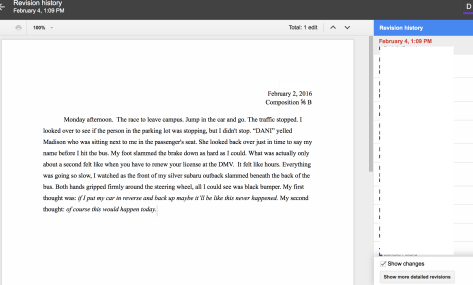
guest post iconA few weeks ago, in preparation for a unit on personal narrative, I was rereading (for at least the 4th time) a chapter from Penny Kittle’s Write Beside Them. Upon rereading these words, I immediately thought of my student Dani. Just yesterday she’d stayed after class to revise a piece of writing. The assignment, to write a snapshot moment, was the first formal writing piece of the semester (an idea I also gleaned from Kittle), and she was determined to get it just right.

Dani was writing about a semi-traumatic, semi-humorous event from a few months prior when, rushing to leave school, she rear ended a school bus. Dani was struggling with her beginning.

“What comes to mind first when you think of that day?” I’d ask a few days earlier.

“All I could see was yellow.”

“That’s perfect!” I was excited for her to begin this piece and just wanted her to get words on the page. “Start there, and then go back in time to show us the events leading up to hitting the bus.”

But today, after rewriting and reworking and just re-everything, we both realized the beginning wasn’t working.

“Okay,” I told her, “so scratch that first sentence and let’s find a new way to begin this.” I thought she’d be hesitant to delete something she spent a lot of time thinking about; many of my students are and I understand. Sometimes it takes days of my gentle prodding for them to get words on a page. And after so much work, they certainly cannot imagine deleting those precious words. But Dani loved it, and felt relief from deleting something that clearly wasn’t working. We spent another hour on the piece. I continued to make suggestions about totally deleting sections or being more specific with the details of the actual event, reminding her she was writing a snapshot, not an entire narrative.

“I’m worried there will be nothing left.”

I assured her that by keeping only the most important details, the ones that evoked the senses and allowed the reader to feel the intensity of the moment, she’d have a stronger piece than if she included every minute detail leading up to the actual event. And then she went back to work, eagerly adjusting and rewriting.

The type of revision Dani was engaged in felt authentic; she could see the piece improving in front of her and I could see she was pleased with the results. I wanted to infuse this into my other twenty-two students, so I asked if she’d walk the class through her revision process.


The next day Dani used the “See Revision History” tool in Google Docs to show the class how she revised her snapshot moment.

It wasn’t easy for her to talk through the process, though, and I was surprised at how often I had to remind her what decisions she’d made while revising. I asked her to tell the class why she’d deleted a section or rewrote another, and this proved to be a challenge. Dani is a very outspoken student, so I thought it would be easy for her. Then I recalled Kittle’s words: flail, murky, mystery. Right. It wasn’t easy for Dani to describe the process because she was just learning it and it’s not a simple process with easy to follow steps.

And isn’t that the lesson of revision? It’s murky and mysterious and you’re going to spend A LOT of time flailing around, as Dani had done. I’m hoping that’s what my students realized as Dani showed the evolution (again, the Google Docs Revision History tool was so helpful in this lesson) of her piece.

From these drafts we see so much about the revision process.

pic1 

We see that sentences must be deleted or rewritten.

pic2

We see that sometimes you have to rewrite the beginning many, many times.

pic3

We see that you have to rearrange paragraphs. Or delete paragraphs. Or save paragraphs at the bottom, in case you want them later.

We see that you have to do a lot of thinking.

pic4

And then we see a final snapshot that gives us all the details and emotions of the event, and leaves us wanting to know the rest of the story. Dani may continue this story and develop it into a longer narrative in our next unit, or she may start with a new topic and leave this be. Either way, Dani, and hopefully the class, learned what it truly means to revise, and I learned the power of using my students as mentors in the writing workshop.

Colleen Kiley teaches high school English in Bristol, Vermont, a rural town nestled in the foothills of the Green Mountains. She is passionate about connecting each student to the right book and was a 2015 Book Love Foundation grant winner. Inspired by the wonderful teachers at Three Teachers Talk and Moving Writers, she is continually trying to improve her approach to the writer’s workshop. You can reach her on Twitter at @ckiley4.