Category Archives: Writers Workshop

3 Ways to Utilize Audio and Visual Recording with our Readers and Writers

There is much debate regarding the use of digital technology in the classroom. For teachers, cell phones and other technology are both frustrating helpful when it comes to student use. They have the potential to be distracting and disruptive, as we all know, but tech is useful when it comes to some classroom activities, such as keeping a next reads list, or looking up word gaps. I love the idea of using them for the powers of good, so recently, I tried asking my students to use their mobile phones just for the purpose of recording, and to try to ignore the notifications that might come across as they used them.

I’m always looking for new strategies to help the readers and writers in my classroom, and in the past few weeks I’ve tried a couple of different applications. Using cell phones and iPads is simple, and it meets one of the simple rules I am trying to follow when it comes to working with students: meet them where they are.

Recently, while my grade nine students were in the thick of drafting informational essays, I asked them to read their essays aloud, and listen to the flow, the choppiness, the parts that sound great, and the parts that “just don’t sound right.” While I’ve asked students to read their own work aloud before, this time I asked them to record themselves, and then after, to listen to their voices while reading, keeping a pencil in their hands, pausing the audio and editing and revising as they go.

My students were reluctant at first, but once they got over the initial awkwardness of listening to their own voices, they indicated that it was a simple and useful strategy for revision. It’s one that can be used in other classes, and doesn’t require any other tools or even other people for help.

Another strategy we employed using recording technology was focused on the use of video recording. Before my students had started writing informational essays, we studied informational texts, using the Nonfiction Notice and Note signposts, along with the Book Head Heart strategy found in the works of Kylene Beers and Robert Probst.

IMG_4387

When students learn reading strategies and skills, it’s important to be able to see just where they are in the learning process, but it takes time to thoroughly check in with each and every one of them. So with this unit, our ninth grade English teacher team decided that it would be great if students could demonstrate their learning through a think-aloud. Doing this in class would take a lot of one-on-one time, so we asked students to demonstrate their thinking and reading skills on their own, and to use the video recording capabilities on their iPads and cell phones.
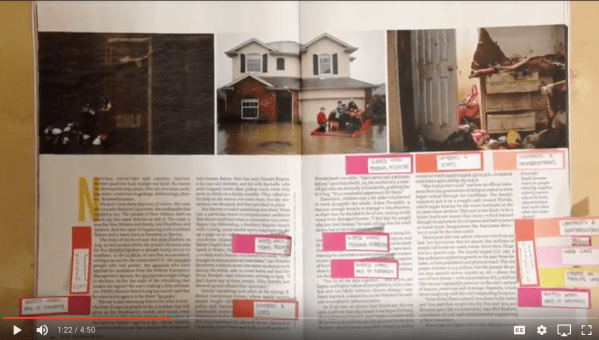
videothinkaloud

A screen shot from a video-think-aloud

Because we, as teachers, had modeled the think-aloud strategy in our classes many times, students knew exactly what we meant, and were able to demonstrate their understanding of the strategies and skills necessary when reading magazine articles. They annotated, exposed their initial confusion, shared their process of finding understanding, and demonstrated a multi-draft reading of the articles they had chosen. It was a successful method of assessment, and I plan to utilize it again. Students had a chance to showcase their thinking and understanding, and it wasn’t a one-off opportunity. They had the chance to try multiple takes with their recordings, so the pressure was off and they could easily share their thinking.

Our most current rationale for the utilization of video in class is with our new short novel unit, in which we formed book clubs. We are squeezing in a shared text at the beginning of second semester with Of Mice and Men. While all of my students are reading the same text, they are split up into groups of three and four so they can form their book clubs. One of the summative assessments with this unit is a small group discussion that they will record. They will need to demonstrate some academic, sustained, literary discussion in their videos, and are practicing in class, leading up to the recorded discussion. I’ll be able to have five small-group discussions going on at the same time in my class, which means precious class time isn’t frittered away with transition times between discussions, for example. Students will be thinking, reading, and discussing, and I’ll be able to watch the video later, when the pressure is off, and I can truly assess the conversation. I’ll try to remove the guess-work because I can slow down the speaking and listening assessment portion of it all.

annotation OMAM

One student has heavily annotated in preparation for the recorded small group discussion.

These are just a few ways to allow students to use the simple technology that is available to them. Kids know how to make movies and to splice audio, so there is little need to instruct regarding the technical details. They can use the audio and video to showcase their skills.

It’s also a timesaver as far as the classroom goes, and it takes some of the stress off of students who have test anxiety or who struggle when it comes to on-demand assessments.

While it’s not a student-recording, I will share one last recent use of video in class. I played the video in this NPR article about a murmuration of starlings as an inspiration for a quick write this week. I played it without sound, and hit replay several times. My students were fascinated and wrote some fun responses. One was even moved to write music: img_5972.jpg

I love how my students are constantly surprising and impressing me. They are unexpected and wonderful.

I’d love to hear more about how teachers and students are using laptops and cell phones for the power of good in the comments below!

Julie has been teaching secondary language arts for nineteen years, spending the first fifteen in rural Central Oregon, and the last four in Amman, Jordan. She’s thrilled to report that she and her family will be moving across the agua to Managua, Nicaragua next year, where a new adventure will begin.

Follow her on twitter @SwinehartJulie

Follow her blog https://adventuresinhighschoolworkshop.wordpress.com/

Collaboration 4 Ways

The Classroom

It had been a great week in the classroom: we had shared our stories, written in our notebooks, and analyzed Queen’s awesome “Bohemian Rhapsody” (if that’s not a “fun on a bun” way to dive into rhetorical analysis, I’m not sure what is!). But despite my best intentions, I had not faithfully modeled engagement with writing mini lessons (ML’s) and folded in collaboration the way I intended. Okay, or much at all. You know how it goes . . . you nibble some off this end and things slide a little at the other end.

So, I found myself without time–as I so often do (Help Pacing Gods and Goddesses! Help me learn to be less thorough already!)–and wondered if/how I could efficiently address the 4 ways writers can collaborate. My colleague and I believe writers collaborate with mentor texts, people (teachers via ML’s and conferences and peers), materials, and themselves. How could I satisfy this need, this craving to model these fundamental skills in a totally wholesome way without cramming it down their throats?

Thus, Collaboration 4 Ways was born. Reminiscent of Steak ‘N Shakes’ Chili 5 Ways, I quickly figured out how to model what I wanted to do by synthesizing the 4 collaboration skills into a one-plated ML, focusing on the 6 Word Memoir, which is our lead into application essay writing for our seniors.

  1. I modeled collaborating with a mentor text, using an online sample off NPR’s site, taking note of what worked. I annotated interesting arrangement of words, varied syntax, clever pairings of language and visual, and more. Then I thought aloud regarding what I ought to “throw into the mix”–measuring out words that helped to build meaning.
  2. I modeled collaborating with the teacher; and, pulling the picture of my sweet and silly Ingrid as a unicorn, used the ML strategy of writing about what the picture encapsulated in 17 words or fewer. Ideas first; concision later.
  3. I modeled collaborating with materials (AND my students): gathering small thumb drive size sticky notes, I wrote each word and
    IMG_1142 (1)

    Here’s what I mixed up–with student collaboration–on the doc cam. The whole sticky notes reflect student suggestions and “drafts.” Note to self: they do sell thumb sized sticky notes . . .

  4. piece of punctuation on one and with student help, moved the words around and changed/added punctuation to truly model that sentences are made of moveable parts and that punctuation DOES matter (what taste it adds, darn it!).
  5. Finally, I modeled collaborating with myself, thinking aloud and reflecting to create my final piece. Does this arrangement of words build meaning? Does it build power? Should I revise the punctuation? Etc.

And, I did this all in 10-15 minutes (what I had originally allotted each day to teach each one of those separately).

Discovery:

Served early in the course, this lesson acted as a catalyst for many of my students. Some use the 6 word memoir approach to generate topics or meanings of topics; some manipulate syntax via sticky notes for their purposes; some spend more time talking through ideas; some realize then and there the value of a mentor text.

As for me, I discovered that maybe, just maybe, I needed to shift my thinking. Because it will shift my students’ approach. ML time has been about modeling what to do and getting help from my students, too, discussing and processing. To me, the ML steps have seemed a recipe for success–a thorough list of ingredients and instructions to follow as they work at isolating and problem-solving a certain challenge in their writing. With someone modeling it all for them. Collaboration 4 Ways allowed me to model possibilities . . . instead of the way, one way with an intended outcome.  Serving up Collaboration 4 Ways reminded me that students need to see what’s possible. And how even a seasoned cook needs to test and try.

Truth: Possibilities precede problem-solving.

Giants whose shoulders I stood on:

Many a giant supported me on this one  . . .

  • My Directors of Teaching and Learning who reminded us before school began that we have more freedom than we are using. And, what opportunity really means.
  • Angela Stockman’s Make Writing 5 Teaching Strategies That Turn Writer’s Workshop Into a Maker Space for inspiring me to experiment more with making writing.
  • My colleagues for holding me to the fire with how I ML because sometimes there’s not much mini about it.
  • Three Teachers Talk Mini Lesson Mondays!

Kristin Jeschke, in addition to enjoying Chili 5 Ways during late night study sessions back in college (too many years ago to mention here), appreciates constraints, good talk, and post it notes (lots of them, in all sizes) when writing. Follow Kristin on Twitter @kajeschke. 

What do colors have to do with teachers writing? Today, a lot.

When I read You Don’t Have to Say You Love Me by Sherman Alexie, I knew I’d found mentor gold. Infused with stirring poetry, this memoir tells the story of Alexie’s less than ideal relationship with his mother and how he grieves the loss of her, what was, and what could have been.

I reached for this book Monday as I began a session of PD. On a whim, I flipped the pages and landed on the poem, “Ode to Gray,” thinking it may spark some kind of response in my audience. It’s simple enough. And lovely.

Ode to Gray

This isn’t the complete poem. I just wanted you to get the idea. There’s one more stanza. Really, get this book.

After I read the the poem aloud, I asked listening teachers to write in response.

“Think of a color, and write about that. Write your own poem, or a paragraph. Doesn’t matter. Just write about your color.”

After writing five minutes, which is rarely long enough, I asked these writers to read over their words and do a bit of revision, challenging them to add an appositive phrase somewhere in their writing. This is a directive I often use with students:  We write. We read our work. We revise, often with a singular purpose that ties to a specific skill or craft move.

I walked the room, peeking over shoulders, listening to conversations — and noticed about a third of the group didn’t write a thing. Funny how some teachers are so much like some students, huh?

Maybe they didn’t get the simple task. I guess that makes sense if they’ve never been asked to write like this. I do not think that’s the case though. I heard one too many sigh and saw one too many eye roll to know I wasn’t the first presenter to ask this group to think and write.

It didn’t matter. We cannot make people eat. We can keep inviting them to the table.

Writing teachers should be willing to write.

Accountability in RWWorkshop

Some teachers in that session wrote a lot — and they wrote beautifully. Adam showed me his piece about the color black. I should have asked for a copy. All I remember is the line “Little black lies.” It’s a great line.

Of all I wrote, one line holds a bit of promise:  “Orange, the color of sunsets, why are you so lonely?”

And then there’s Mary. She took that little quickwrite and turned it into something tender, touching, real. She published it on Facebook and said I could share it here:

An Ode to Red
Workshopping With Amy Rasmussen
1.15.18
Red is the fire of your cheeks as you demand to be heard in the morning before school, on a day I was supposed to get to sleep in late. Red is the fire of mine as I scream back, frustrated, unsure of how to solve this trembling toddler enigma. You want red grapes, I gave you purple. In your mind, they are not the same.
“What’s your favorite color, Mommy?” you ask. You expect an answer.
“Purple,” I say, knowing the question that comes next. We do this daily dance, aware of each other’s rhythm.
“And what else?” you ask.
“And orange.”
“That’s good, Mommy. Mine’s red. Red and blue. I love red and blue.”
Red is the sucker, no, the second sucker you negotiate for after getting your hair cut. Just one of the many tricks/bribes that I’ve learned along this short parenting trip we’re on together. Sticky, stained red lips, sticky, stained red teeth and sticky, stained red fingers.
“Go wash your hands before you hug me!” I yell as we walk in the house. “5, 4, 3, 2, 1…”
Red is the color of the bath water after you dump the entire bottle of finger paint into the tub.
“Bubble bath!” you shriek excitedly, giggling, red steaks strung along the sides of the just-washed tub.
Red is my heart each time I leave, and each time I return. Red is the love. All of the love, engulfing me in flames.


I see red a bit differently today.

Thank you, Mary. My kids are grown, and now I get to watch them practice parenting. It’s hard and noble work, and you will feel every color of emotion — sometimes all on the same day and sometimes more than once. But it’s that “love. All the love” that turn these emotions into rainbows. And sometimes just writing about them helps us see every moment just a bit more clearly. Thank you.

In an article by Tim Gillespie, published on the National Writing Project website, he sums up what I believe and have experienced myself as a teacher writer.

Accountability in RWWorkshop (1)

Here’s the thing, you teachers who refused to even try:  It doesn’t matter if you think you can write. Just write.

What does matter is that our students see us working at it. Just like we must be readers in order to help our students find the “just right” book, we must be writers if we want to know the struggle our students face when writing.

We learn when we are vulnerable. We learn when we practice.

So I am challenging myself as much as I am challenging you:  Write beside your students more. Let them see your thoughts, your mistakes, your struggles. Ask them for feedback.

If I truly want a community, where we all work to grow as readers and writers, I need to do more to get us there.

Amy Rasmussen began writing in journals at age 8. In addition to this blog, she now writes in notebooks and on sticky notes. A lot of sticky notes. She also tries to write the assignments she gives her students. She wishes she would have had teachers who wrote with her, but she does not remember one K-12 teacher ever doing so. Follow Amy on Twitter @amyrass and @3TeachersTalk

A Little Learning with Big Outcomes

Last week was tough. If you teach in TX, you probably know what I mean.

December means STAAR/EOC testing, and while I teach readers and writers in 11th and 12th grade English classes at a large senior high school, many of my students carry the label of “re-tester.” (It’s an ugly label; isn’t it?)

All week students who have yet to successfully pass all five exams required to graduate filed into testing rooms to try again. This meant many disruptions for students not testing.

All week the English hall, along with other rooms, became the testing center. Classes displaced. Students out of comfort zones. Just a bit of chaos.

We know how well this works for learning.

In an effort to get my students settled in, back in our classroom and back in our routine

Julian shares his haiku

Julian sharing his haiku

of workshop, we played with words.

Testing disrupted our writing project, a series of letters in a variety of forms with a variety of tones, all related to a self-selected thematic link. We needed a revision workshop, but my seniors were not having it. With just 10.5 days until winter break, plus 8.5 until the end of term, many are already playing XBox and watching Netflix in their heads. (Me, too, but at least I’m fighting it.)

Since we read our choice books at the beginning of every class period, and I work daily to hold students who have not read a book on their own throughout high school accountable, I am constantly trying something new.  Today the new turned pretty cool.

We wrote book reviews in the form of haiku.

The tremendous thinking about word choice — well, it was kind of magical. (If only students would always think about word choice with such care.) Here’s a sampling of our book review poetry:

A book can contain

many life lessons that we

can use in our lives.

~Cesar Perez

The Playbook by Kwame Alexander

Are her thoughts her own

or does the tightening coil

control her whole being?

~Maria Cruz

Turtles all the Way Down by John Green

my life was stolen

but after 18 years I

got to hug my mom

~Grace Foust

A Stolen Life by Jaycee Dugard

being arrested

for helping his ex-girlfriend

Being black is hard.

~Di’Myrius Owens

Dear Martin by Nic Stone

her eyes captured me

I lost myself in her heart

Owned me from the start

~Axel Ibarra

The Oxygen Thief by Anonymous

Looking for a path

Twisted and in need of help

How do I escape?

~Jesse Borjas

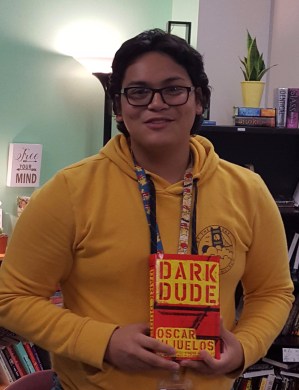
Dark Dude  by Oscar Hijuelos

Running for freedom

Garret escapes boot camp

Fear, risk run with him

~Cris Velasquez

Boot Camp by Todd Strasser

Black lives do matter.

Police brutality sucks.

assume all black steal

~Alondra Rosales

All American Boys by Jason Reynolds & Brendan Kiely

The first hand account

No excuses for mistakes

Kill Osama Bin

~McKenzie Bowie

No Easy Day by Mark Owen

This simple activity led to a complex discussion about the power of words and why we need to revise our writing in order to craft with purpose. We discussed adding figurative language, creating imagery, using complex sentences. I taught how to write appositive phrases, a grammar move my students did not know.

And as students moved into their writing groups, they talked about their plans for revision. Teaching writers does not get much better than that.

When our students take on the identify of writers, they talk like writers, and they write with purpose — choosing words and phrases and making moves like real writers do.

Side note:  Some of my students produces haikus that revealed needs in their reading lives. For example, one student wrote that Fahrenheit 451 was set in WWII, and another showed confusion in the change of point of view in All American Boys. Their book review haikus gave me an action plan for reading conferences. Bonus!

Amy Rasmussen teaches senior English and AP English Lang & Comp in North TX. She loves to get her students talking about the things that matter to them. She also loves to get them talking about the things that matter to us all:  books and words and poetry and writing and serving people everywhere. Follow her @amyrass and @3TeachersTalk.

#NCTE17 – A Story I’m Thankful For

Like Amy, my NCTE experience this year was a blur of the most magnificent proportions. I was able to share the experience with an amazing group of colleagues, survived flying on standby in a peculiar route from Milwaukee to Detroit to St. Louis, and wrapped up my planning about 72 minutes before 3TT spoke to a wonderfully supportive and inquisitive audience on Friday.

I have 7 pages of notes, in 5 colors, saw so many English Gods and Goddesses speak I lost count, sat down three inches from Cornelius Minor to plan a forthcoming 3TT Twitter chat (Ekkkk! Fangirl moment), got to room for three nights with my bestie like college roommates watching Hallmark Christmas movies, secured over two dozen books for students in the exhibit hall, spent time with my amazing co-bloggers from Three Teachers Talk, and deliciously foreshadowed Thanksgiving with a calzone of turkey, cranberries, pecans, stuffing, mashed potatoes, and gravy dipping sauce.

thanks1So, when we flew home on Sunday night, I got to bed at about 11:30 pm. Up at 5:00 am, Franklin had school through a half day on Wednesday. I then hosted Thanksgiving for 11 people on Thursday, managed a Black Friday marathon shop with my daughter Ellie (She’s four and up at 6 am anyway – might as well take advantage), cut down a Christmas tree on Saturday, and tried to be a teacher again on Sunday in order to tackle 70ish AP Language responses and plan for the coming week. Next week (I am so excited), we fly to Arizona to visit family for a long weekend.

thanks2

Spoiler Alert: I ended up at the chiropractor this past Tuesday. She said she was surprised I could turn my neck at all. “Do you encounter a lot of stress on a daily basis?” she asked. I almost choked and laughed in her face.

Needless to say, my notes from NCTE have waited patiently for me.

NCTE last year was such an incredible experience, I came back to my district and raved about the opportunities our department could reap if a group was able to go and fan out across the convention to sample the wealth of presentations that take place. I am so lucky to teach with such amazing English teachers and even luckier to get to travel with them to this event.

We plan to debrief with administration and our department in a few weeks. I promise to share some of the information and inspiration they gathered. We attended sessions from Writing MultiGenre Papers, to Having a Life as an English Teacher, to Arab Voices in the Classroom, to Using Self Assessment with Students, to “let’s listen to Linda Rief, Penny Kittle, Kylene Beers, and Robert Probst all from the same stage and try not to faint with the fatigue of trying to write down all of their brilliance.”

So, until I find a few minutes to sift through those notes and take in the depth of learning we all did, I humbly share with you the slides from my portion of the Three Teachers Talk presentation on reclaiming our voices as teachers and students through narrative writing.

In it, you will find:

  • Some embarrassing personal photos I used to open our presentation with an illustration of  my own story and how it illustrates the power of narrative to define me: who I am, what I do, and why that might be.
  • Supporting information on how narrative defines the human experience. 
  • Explanation of the Visual Biography assignment I used to have students tell their own stories to start the year.
  • A quick write to get students thinking and telling their stories “outside the box” with a reading from Hillary Jordan’s When She Woke. 
  • A final plea to see the value of student story in narrative writing as a way to know students, value their humanity, and give narrative a proper place next to argument and expository writing in our classrooms.

Amy wished us a happy December in her post earlier this week and shared her slides as well. We hope that December really does come soon. Tomorrow, maybe?  May it bring a few moments to breathe and reflect. When we do, we will be sure to shower you with all the #NCTE17 insights you could ask for.


Lisa Dennis teaches English and leads a department of incredible English educators at Franklin High School near Milwaukee. Last year her NCTE notebook pen of choice was the PaperMate Flair, this year she highly recommends the PaperMate Ink Joy pens.  Follow Lisa on Twitter @LDennibaum 

#NCTE17 — So Much to Remember, So Much to Do

Confession:  I do not have the energy to write this post.

NCTEStLouisI had an amazing learning experience at NCTE in St. Louis. I met Twitter friends for the first time face-to-face. I got to present with my amazing and faithful blogging buddies — and Tom Newkirk! I loaded my shoulder bag with loads of new books for my classroom library complements of the book vendors in the exhibit hall. I talked with some fascinating educators and attended fantastic sessions — all tattooed my heart with meaningful messages. I saw Linda Rief talk about her heart books and Nancie Atwell, Kelly Gallagher, and Penny Kittle advocate for choice reading and more talk and more diverse books and more time to read and write with students. I attended CEL and presented with my newfound friend, Sarah Zerwin, who is writing a book on going gradeless, my newest quest. I did not sleep much. Does anyone sleep much at NCTE?

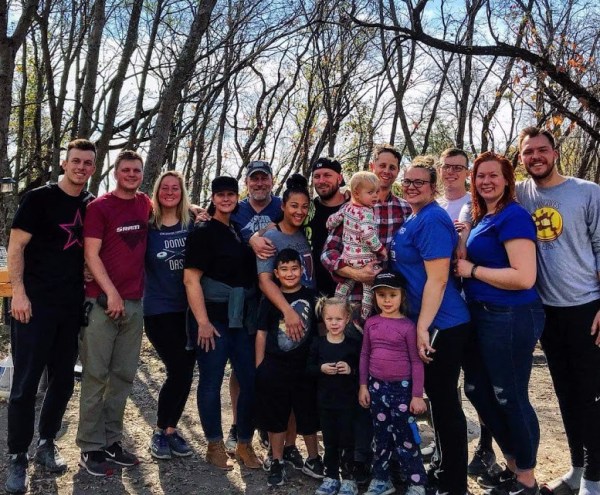
You’d think that after a week-long break I’d have caught up. Not so. Remember how I wrote about my family coming for Thanksgiving? They did. We laughed and ate and camped and ate.

And. It. Was. Awesome.

JennaRyanKellyDevin

My newly weds. Two daughters and two new son-in-laws.

HyrumMeZach2017

Hyrum, my soldier, and his twin, Zach

campingThanksgiving2017

On the 3rd day of camping, we are a motley crew but somehow still smiling.

But I am tired.

Yesterday I returned to school like I assume most every teacher in America did. The stack of papers needing grading shouted at me as I flipped on the lights. 111 emails flash danced in my inbox. One plant gave up its withered ghost, and four of my bookcases must have wrestled with the devil. Before the first bell, I sat at a table and breathed. Amazing what a few deep breaths will do.

So, yes, I have a lot to remember about NCTE. My notebook begs to be revisited, and when I get a minute or two, I will write a post that showcases the best of my learning at this inspiring convention.  In the meantime, since I did not preview my part of our presentation at NCTE like my writing partners did, I include it here. Most of my notes are in the slides, so maybe my message will make a little sense without my commentary. At least I hope so. Personally, I think our 3TT presentation was awesome! I learned so much from our journey into doing more with narrative. If you were not there, I wish you could’ve been!

Happy almost December, my friends. May your days be merry and bright right on up to the December holidays. Maybe then we will get some sleep.


Amy Rasmussen teaches senior English and AP Language at a large and spirit-filled high school just north of Dallas. She is the mother of six adult children and grandmother to five. She loves to read and write and share her love of reading and writing with anyone who will listen. She also loves to sleep and believes that good pillows make the best of friends. Follow Amy @amyrass and @3TeachersTalk.

Students Who Write by Ear by Amy Estersohn– an #NCTE17 Preview

The following is a sample of what I’ll be presenting with Three Teachers Talk at #NCTE17, session C.26, Friday at 12:30, room 274.

Tom Newkirk’s book, Minds Made for Stories, encouraged me to think about students as natural storytellers.

So I dug through their writers’ notebooks to see storytelling in action. During my dig, I wasn’t looking for detail or dialogue or finished pieces.  I wasn’t reading for apostrophes or paragraphing or numbered and dated pages, either.  I instead wanted to know where writers were already practicing storytelling, and what tools and strategies they were already using.

One the ways I noticed that student writers tell stories is that they listen to their inner ear.  This emerged when I read half-baked, quarter-finished crime stories where a student could hear a bought cop addressing a group of criminals.  I noticed it when I heard a writer list the annoying sayings her mother used.  I noticed it again when writers took on a Ken Burns-ish important-sounding narrative voice to discuss an important world issue.

Some students can really hear when they write.

So the first thing I did was I turned that observation back to the students: did you notice how you hear the character in this section?  That observation then became an expectation.  In your writing, you should be able to hear your character or narrator speaking.  When you revise, ask yourself if you still hear your characters or your narrators.  If you don’t, mark the text for a future revision.

There are also ways that writers can practice hearing stories.  The easiest way is just to choose a good piece to read out loud to the class.  For middle school, I’d recommend the first few pages of a Kate DiCamillo’s Because of Winn Dixie or Jason Reynolds’ Ghost.   For high school, I’d probably choose a text like Laurie Halse Anderson’s Speak or A.S. King’s Glory O’Brien’s History of the Future.  You can read the book in your voice or cue up the audiobook, and ask students to discuss what they noticed and then practice some imitations.

You can also invite students to imitate characters they already know.   It’s always fun to try to imitate a sibling’s voice or a young child’s voice.  I invited students to imitate boastful and outrageous LaVar Ball, a parent of an NBA player, after I provided examples of what he has said.  Students embraced the opportunity to play around with LaVar’s voice in their writers’ notebooks.

AmEstudent notebook

Another idea would be to collect some of the voices of nonfiction: this includes Deborah Heiligman’s Vincent and Theo, Candace Fleming’s Giant Squid, some Mary Roach, and whatever nearby textbook or magazine is in sight.  Work backward: what do these voices sound like?  Whom do I imagine is telling me this story?

I could even see students doing multimedia work with voice by tape recording themselves.

I’m going to assume for a moment that teaching voice is probably not new to you.  But what might be new is teaching voice and playing with voice as an element of storytelling instead of housing it within a certain genre or a certain unit.

Will you be at #NCTE17?

Sarah Raises Hand

I hope to see you there!


Amy Estersohn is a middle school English teacher in New York.  She writes book reviews at teachingtransition.wordpress.com and is deeeeeelighted to serve on the CYBILS book award committee for middle grade fiction.  


3 Sparks to Shift Thinking and Practice

What gives you pause as an educator? Not politically speaking. Not shake your head and think of simpler times speaking. Not even “Yes, death is the narrator in The Book Thief. You’re on which page?!” speaking.

I’m talking about the changemaker moments. The moments that make you stop in this crazy profession, take a breath, and think about how you do what you do, why you do it that way, how you got to where you are, and how to move forward in the best interest of kids.

You know. A Tuesday, for example.

If you frequent Three Teachers Talk, chances are you’re quite familiar with the benefits of reflective practice. You’re already on the lookout for motivation and inspiration to move your professional work forward. You’re interested in change. You’re not afraid to wear stripes with polka dots.

Three Teachers Talk

But often, the moments that change us the most are the ones that sneak up on us. We don’t go looking for them, but there they are, in the blink of an eye, demanding, “So, now what are you going to do?”

I started this workshop journey over two years ago. And while I’m sad to say that the move wasn’t so much motivated as mandated,  I was ready for a challenge and always in pursuit of positive change. Or, so I thought.

When I found Three Teachers Talk, I had naively come looking for a way to ‘deal with endless annotations to assess assigned reading’ in the workshop model. Yikes. wisdomJust typing that feels like malpractice. I had an open heart and and open mind, but past practice and a limited knowledge of varying philosophies afforded me a narrow scope of imagination on the subject. My mind heard choice, voice, student talk, and for the most part, I believed I was already “doing all that.”

And to some extent, I was.

But, in many cases is was how I was doing it that kept me in control and my students in a cycle of compliant work completion vs. curious exploration as readers and writers. I’m happy to say that I’m growing, but like most things in my life, I have plenty of growing left to do.

So, because I work best with snippets of inspiration, the kind that I can digest, reflect on, and work to put into practice without feeling paralyzed by the scope of change before me, here are three shifts in my thinking and practice this week, and where they came from, where they took me (or took me back to), and the great minds that inspired them:

  1. Shana got me thinking hard earlier this week. Her post “What Will You Teach Into?”, stirred so many feelings that had been resting heavy on my heart the past few months. The world we live in, raise children in, guide students through, and try to navigate ourselves (because really, who among us can consistently stomach everything that’s been crashing down upon the nightly news lately?), is no longer just frightening, it’s often demoralizing.

    In response, Shana wrote, “This week and every week, I hope teachers are having difficult conversations with our students. I hope we are not shying away from the ease of ignoring our nation’s pain in favor of teaching about comma splices or symbolism or character development. I hope our time with students is deliberately geared toward talk about these incredibly complex, nuanced topics.”

    In an nation so politically polarized, it may seem uniquely difficult to have these conversations, but it’s precisely for this reason that the conversations are all the more important. Our students need to see, and in some cases learn, what civil discourse looks like.

    Our classrooms are certainly not the place to promote our own political opinions, but they must be a place to explore nuanced topics with students. My step this week was to have students look at the statement Senator Chris Murphy made after the mass shooting in Sutherland Springs, Texas this weekend. We’d recently talked about the debate over guns in our country, sadly after the previous mass shooting in Las Vegas just a few weeks before, with Kelly Gallagher’s article of the week that presented opinions on both sides of this debate, and Senator Murphy’s statement brought us back to this discussion with an exploration of not only the topic, but writer’s craft, bias, and argument.

    Students quickly latched on to word choice (“That word, ‘slaughter,’ it’s heartbreaking.”), the use of context, and possible bias from a senator from the Democratic party. What mattered the most in the course of our 15 or so minute exploration, was that we devoted the time to do it at all. Students referenced the article of the week pieces we had read previously and marveled at the fact that we were having to talk about this. Again. So…we focused on “again” and students vented some of their fears and frustrations about what this all means for their daily lives.

    We didn’t change policy. We didn’t write to legislators. We didn’t protest. We talked. We talked carefully and candidly. It was the best spent 15 minutes of the week so far.

    These conversations are not easy. They shouldn’t be. But they must happen. Reading Shana’s piece reminded me that the time is now. Have a conversation, let students write, invite them to read, today.

  2. Students in our AP Language classes have been writing one pagers weekly since the first few weeks of school. With 76 students, the feedback on these pieces has been relatively minimal. I had been thinking the task of providing consistent feedback on this writing was well beyond my capacity, so I filed this work away as the writing students need to do, even when it’s not assessed.

    However, as I sat scrolling through the weekly work on Monday, it struck me that I had my feet in two worlds. Students still receive a formative grade for this work. Often, when I fail to record consistent scores, their work falters. So, I take a look, put a formative score in the gradebook and try to email five students from each class with feedback each week, which happens…sometimes.

    Noble, I guess, but straight up stupid on my part too.

    It’s disingenuous to record a score to make students compliant in writing these explorations of their independent reading, when growing as writers (which requires more consistent feedback!) is the goal.

    So, I’m getting out from behind my desk and moving those feet, previously in the two worlds of old school and real school, to more purposefully make moves as a workshop teacher.

    On Monday, I recorded reflections on the one pagers for my fourth period class. Just for five students. During reading time, I went to briefly speak with these students about what they had reflected on in their one pager. Since they write these pieces from the books they are currently reading, we just had more to guide the conference. I asked a follow-up question from the one pager and students talked about their writing process in relation to the book in their hands. Heart. Warmed. Goals. Clarified.

  3. Lastly, and probably most impactful, was a reminder from Carol Jago that I nearly scrolled past on Twitter. I’m so glad I didn’t. It’s catapulted my thinking back to a place I’ve known, but sometimes forget. It’s sparked some wonderful conversation with my dear friend Alejandra. It’s made an immediate impact on the feedback I’m giving:

    carol
    There are huge implications here. Enough for a whole separate post. But, I will say this – My shift here had less to do with philosophical agreement, because I’m already there, and everything to do with mindset. It was a simple reminder to encourage and instruct more, and correct less.

    My pledge to my students this week was a return to the type of feedback that has everything to do with their next paper. If I do my job and confer with students during the writing process, in an effort to improve the current work, my focus can and should remain on the writer and his/her next paper when I give summative feedback.

The power of wonder moves us forward. The curiosity that surrounds our work is not only necessary to foster in students, but critical to keep our own work fresh, functional, and full of meaning for everyone in the classroom.

What has sparked moves in your thinking or practice this week? Please comment below and share the love through snippet PD. 


Lisa Dennis teaches English and leads a department of incredible English educators at Franklin High School near Milwaukee. Her desire to grow as an educator is only inhibited by the number of classes she can conceivably afford to take, the number of times her daughter wants to re-watch Mary Poppins, and the number of hours in the day. Follow Lisa on Twitter @LDennibaum 


News You Can Use

I find most of what’s reported on the news today to be either deeply disturbing, horribly demoralizing, or downright exhausting. It almost feels like the past few months have been less of an end to summer/start of fall and more of an obstacle course of the absurd, obscene, and disappointing.

However, in the unending quest to inform our future electorate, we forge on. Articles of the week, hot topic debates, impassioned student speeches on the criminality of injustice, and an endless stream of quick writes to vent some of the hot, hurt feelings.  Then there are the daily discussions on the struggles we face, the struggles of those we need to know more about, and the struggles to balance it all when sometimes we just want things to feel whatever definition of “better” might help us through.

In the face of all of this, here is a recent success I had that championed choice and voice (coupled with a bit of creative reflection) around some of the news that might get overlooked in the whirlwind of our current news cycle.

News You Can Use

  1. Students selected an article from several that I had re-tweeted in recent weeks with our class hashtag –#fhslanglife. Topics varied widely and I simply went through and briefly highlighted the focus of each article in an effort to pique interest. Here are a few I included. Student response was awesome. We could have easily talked about these articles for the full 86 minute class period:

Are my students reading pieces on the economy, info-graphics, and authors (even authors they love) on their own? Not often. Are they talking with gusto about the relativity of these pieces, sharing insights on author craft, and talking about topics that impact them in the here and now when they are offered up as choice? You bet.

  1. Then, inspired by the Three Teachers Talk Twitter chat earlier this week with Tom Newkirk (#3ttchat), I stole a quick idea (the very foundation of Twitter chats,yes?). I love the quick and dirty nature of professional educators hurling greatness at one another in rapid succession and a maximum of 140 characters. For this week, I was immediately able to implement the single line, or as I told my students, “THAT line. You know the one” craft analysis. Based on the awesome insights of my fellow chatmates, I asked my students to do their reading and zero in on THE sentence that made the piece.

  2. Students read for 10-15 minutes, jotting down reflections and searching for “the one.” Once they were finished, I challenged them to respond in their notebooks in a creative approach they didn’t usually use. A dialogue, letter, poem, etc.

  3. After sitting silently for roughly 30 minutes, I had students get up and connect with someone from the other side of the room. Get the blood flowing a bit. They were to connect with someone who read the same piece and debrief. Ideas flew around the room.

  4. We then came together to share and here is a sampling of what I heard throughout the day:

  • From Ward’s piece on raising her son, Kaitlin pulled out: ” I hope I love him enough in the time I have with him, that while he can be a child, I give him the gifts of a childhood: that I bake chocolate chip cookies and whisper stories to him at bedtime and let him jump in muddy puddles after heavy rains, so he can know what it is to burst with joy. “
  • The info-graphics brought Nhan’s attention to: “We can trace the US story through stereotypes.”
  • After looking over the maps detailing climate change, Karan wrote a dialogue between President Trump and an environmentalist.
  • Several students brought up questions about college vs. career after reading about the jobs of their future.
  • Jerry Khang (who told me to publish his last name so you all know who he is even before he’s famous) read the John Green piece and wrote the following poem in about 4 minutes flat:

Books are a closer look into a person’s soul. 
We find ourselves deteriorating, gloomy, and so dull. 
But when we are able to read, to relate, to medicate our minds, 
We’re temporarily fixated on happiness in a short burst of time. 


When we provide students with relevant, yet challenging reading material, choice, time to write, time to think, and time to talk, 30 seemingly innocent minutes reading an article and writing about it can be beautifully rich, engaging, and rewarding.

And beautiful is something I think we could all desperately use right now.

Lisa Dennis teaches English and leads a department of incredible English educators at Franklin High School near Milwaukee. Her social media scrolling is driven largely by searching for class related articles and pumpkin soup recipes. Follow Lisa on Twitter @LDennibaum 

Please, Add Your Questions about Narrative– #3TTchat tonight 8ET/7CT

Last week I asked my students the same question I often ask teachers when I facilitate professional development workshops:  What do students today need?

My students talked in their table groups and then shared their ideas. Most said in one way or another:  We need to feel validated and to share our voices.

I don’t know of a better way to accomplish both then by infusing narrative into every aspect of my teaching.

Tonight is our inaugural #3TTchat with our guest Tom Newkirk, author of Minds Made for Stories and the new book Embarrassment: And the Emotional Underlife of Learning (among others).

Screen Shot 2017-10-23 at 6.02.59 AM

If you are a regular reader of this blog, you’ve certainly noticed we’ve focused on narrative, specifically Newkirk’s books, lately. I wrote about how teaching itself embraces the drama of story and later shared some of the quotes that resonated enough to change the way I talk about writing with my students — and the way I teach it. Lisa shared her beautiful argument Narrative Writing: Giving Voice to the Stories that Matter Most.

We are shoulders deep into planning our session for NCTE:  Reclaiming Narrative and Amplifying our Voices:  Using Story to Invite Fearless Inquiry and Intellectual Challenge for Our Students and Ourselves. (We present Friday at 12:30. We hope you will come!)

If you haven’t had a chance to read Tom’s books, we hope you will still join us as we chat with him on Twitter. And if you have some time between now and then, or any time really, perhaps you’ll find value in this Heinemann podcast with Tom about Embarrassment and how it is the “true enemy of learning,” or a sample chapter of Minds Made for Stories. You’ll see why we at Three Teachers Talk have made such a fuss.

In preparation for our chat tonight — and for our presentation at NCTE, we’d love for you to ask some questions about infusing narrative into our teaching practices, or just share with us some of your favorite ideas or best experiences with students and narrative reading or writing. We’d love to include you in the conversation tonight and in St. Louis at #NCTE17.

While you’re thinking:  This is the quick write my students and I will write today: What’s your story?