Category Archives: Readers Workshop

Books Can’t Be Bullied

Books: “They don’t get tired and give in, they don’t rearrange their words to soothe their reader’s ego or get a better position on the shelf, and they can’t be bullied”  – Josh Corman for Book Riot.

I’m not going to get political here. I promise.

I’m quite frankly exhausted by, though no less involved in, politics these past few weeks, but when I saw this quote, I knew I needed to explore it. It does (fair warning) come from a pretty politically charged piece that you can seek out and read, if you like, but I first saw this quote completely out of context and feel that it’s a powerful statement in and of itself.

The push and pull of it intrigues me.

I first pictured a book: proud, immovable, and cool. Spine bent ever so slightly, tantalizing a reader with the ideas inside, like the love interest in a dark romance who reads Goethe in tiny coffee shops and spells color with a “u”:

I’ve got what you need, but I’m in charge here. We go at my pace. Turn my pages to see where I will lead you. You aren’t the first and you won’t be the last. 

Aloof in the face of need, careful not to promise too much. If you come to this book looking for fulfillment, it won’t permit you to find it. Too easy. It’s not about you. It’s about the message.

I can also see this book as a soldier on the front lines, battling to retain pride in its themes. Beat down by two star Amazon reviews, milk spilled across its pages, and the misrepresentation of translation, reprinting, and censorship. Not desperate, but insistent:

See me. See what I really am. What I have to offer. I am not what you purport me to be. I am not what others say I am. Think. Judge for yourself. 

But what does any of this mean for our classrooms?

For my students, It means we are going to write about it. I want to know what they think. What identity this quote suggests books have, and thereby what role in our lives? What impact?

See, in an age that not so subtly suggests that books are made better by individual interpretation, I would argue we sometimes give ourselves too much credit.

I might go so far as to suggest that we need books to be a bit immovable these days.

It’s not all about us. What we like. What we need. What we get out of an experience.  Of course, authors need to make money to keep writing books, but on the back of my copy of East of Eden, Steinbeck is casually smoking a cigarette and weaving a tale of good and evil. Is there really so much room for interpretation there? Should there be?

Yes, we, and our students, benefit immensely from challenging conventional thought and learning to build meaning from difficult texts through personal connection, but at the end of that journey, the book remains. The nuance may be up for debate, but the message, perhaps not.

Books offer us a place to see that which does not grow old. The words are pressed between the pages, meaning what they did when they were published. It is we who change and must work to balance how perception influences theme.

Tweets scroll past in soundbites on the screen. Facebook spins and updates with a thousand new ideas with every pull of a thumb. Books remain what they always have been. They cannot be bullied to change with the times. They are timeless, and as such, essential to our survival in the era of eight second attention spans.

So as we bring ourselves to a text, we must be willing to meet it halfway.

It’s not about you, or not only about you.  It’s about the two of us. Book and reader. We can only succeed if we work at this together. 

What better lesson for these times, political or no, than to meet in the middle and align our unchangeable past with the possibilities that carefully crafted ideas can suggest for our future? A book, afterall, still needs a reader.

Let’s produce millions of resilient readers, hungry for truth, who will open books and listen, because a book is always ready to talk, and frankly, we could all stand to listen a lot more than we do.

I’d love to hear your reflection on the quote. Please feel free to join the discussion below in the comments. 

Lisa Dennis spends her school days teaching AP Language and Honors/Pre-AP Sophomores, while also leading the fearless English department at Franklin High School, just outside Milwaukee, Wisconsin where she lives with her husband Nick, daughter Ellie, and beagle Scout. She is a firm believer that a youthful spirit, a kind heart, a big smile, and a good book can ease most of life’s more troublesome quarrels. Follow Lisa on Twitter @LDennibaum.


Mini-Lesson: The Simultaneity of Instants by Jessica Paxson

I am an anti-bandwagon jumper.  I tend to think if everyone is flocking toward something, I’m likely too cool for it.  I attribute that to my father, and I’ve discussed it before, but that’s beside the point.  

18143977.jpgThis year, as I made the venture to RWW, I knew I would need to read lots of buzz-worthy books, simply for the purpose of recommending.  Needless to say, I have slowly been broken down from my rigid ways. It’s because of this anti-bandwagon mentality that I am so late to the Anthony Doerr party, particularly in respect to All the Light We Cannot See.  

I decided to tackle this novel over Christmas break because of how many people had recommended it to me.  I was reluctant, but of course, Doerr drew me in with his utterly gorgeous descriptions of difficult cultural situations, the relationships between characters, and the flawless knitting together of a nonlinear storyline.  

So.  I’m a fan.  Likely at least two years after everyone else, but better late than never, right?

I was specifically intrigued by one of the chapters near to the end, entitled, “The Simultaneity of Instants.”  This chapter reminds me a little bit of the montages that occur at the end of a movie or a season finale in which all characters come together for a final appearance.  The only difference with this chapter is that they did not come together in the same place, but simply in the same moment.  I thought this would be a great way to coach my students through describing an important moment with a bird’s eye view.  

Objective: Students will describe an important moment in their life by also providing a glimpse into that same moment for other “characters” in their story.

Mentor Text

Lesson: First, students will begin by writing about a specific moment that they remember vividly.  You could draw from many different forms of pre-writing for writing about memories, but a few of my favorites are Writing Territories and Blueprinting.  After students decide on a moment that was important to them, we will do a quick draft for about 10 minutes.  

Next, students will begin to brainstorm about what other people might have been up to at that very moment.  The key here is for students not to get hung up on what actually happened, but to simply imagine that moment in time from a broader scope.  

Finally, after brainstorming simultaneous instants, it’s time to weave them together.  This is the moment in which Doerr’s writing as a mentor text will be unequivocally valuable.  Students will ask, “Well, how do I know which moment to put where?”  And I’ll say, “What does the mentor text do?”  And on and on until we have pieces of writing of which the students never imagined they would be capable.

I hope to do this along with my students, and I’m particularly imagining a Simultaneity of Instants starting with the Presidential Inauguration, or Obama’s farewell wave, or something to that effect.  I may already be blubbering as I brainstorm.  

Follow Up:

I teach Seniors and Creative Writers.  While my CWers will work on this concept soon, I may save this for my Seniors until their end of year MGPs (anyone want to help me plan?).  I think an imaginary Simultaneity of Instants as they walk across the stage.  This will end up resembling an end-of-an-era-montage, and I can’t wait to see what they come up with!

Jessica Paxson is an English IV and Creative Writing teacher in Arlington, TX. She also attempts to grapple with life and all of its complexities and hilarities over at www.jessicajordana.com. Follow her on Twitter or Instagram @jessjordana.

On In Defense of Read Alouds. Please, do.

At the end of a post I wrote last August called “My Classes are Only 45 Minutes — How Do I Do Workshop?” a reader named Andy left this comment:  I am at kind of a roadblock mentally and could use a push…I teach 8th grade reading in a building that still has both “reading” and “language” classes. While I am slowly transitioning to more of a workshop approach, I am still getting stuck on a few things. For our second semester, we have always read a whole class novel, but I would love to get away from that. Have any of you done read-alouds in your classes? I am beginning to think that maybe a better option would be to have students vote on a novel with a certain theme and do a read aloud and work on certain aspects of reading. My one concern that I can hear being brought up by administration is making sure I have enough assessments and grades…

First of all, I love that Andy asks this question and recognizes his need for “a push” as he wants to do more to engage his students than just another whole class novel. Not that whole class novels are necessarily bad, but those of us who have seen what choice can do in our students’ reading lives know:   if we only choose whole class novels, we lose valuable time developing readers. Giving students a choice as to a book to read aloud might just be a good idea.

I heard Steven Layne, author of In Defense of Read Alouds speak at the Illinois Reading Council Conference this past fall. He quoted the research and the position statements from scholars of various grade levels on the benefits of read alouds:

  • Positive attitudes are fostered towards books.
  • Imagination is exercised.
  • Background knowledge is built.
  • Reading skills are improved and reinforced.
  • A model of prosody and fluency is provided.
  • Reading independence is promoted.
  • Interests in genres are broadened.
  • Cultural sensitivity is increased.
  • Listening skills are improved.
  • Exposure to a variety of text types is provided.
  • Reading maturity develops.
  • Reading happens.

Based on these statements, Andy, what do you have to lose?

stephenlaynequote

I offer a few suggestions though:  HOW you read aloud to children is as important as WHAT you read aloud. Layne suggests five key elements the teacher-reader must employ as he conveys an awareness of phrasing and word color:  diction, volume, pace, tone, and pitch.

To read aloud effectively, as to engage all listeners, the reader must be a performer.

Of course, what you read aloud matters, too. Offering students several choices and letting them vote is one way to foster trust in your classroom community. Students want to know we value their opinions. I’ve found with my AP English students, when I provide several choices for their Book Clubs, many students will choose to read the books not selected for their independent reading.

I would also suggest that you offer a choice of books that are not too long. I learned a few years ago when I read aloud with my 10th graders that even when they choose the book, attention spans are short. A full-length novel read aloud can cause the same negatives that a whole class novel study can. For this reason, I think it’s important to consider your main objective first and then plan backwards.

If I were doing a read aloud with those same 10th graders this spring, I would plan differently than I did before.

  1. I’d select several books with the same theme I want to build a unit around, and I’d plan to introduce the books by reading aloud from each of them.
  2. I’d think about the goals I can accomplish as we focus on the theme, and I’d think of several summative-type assessments in which students can choose to show they’ve accomplished these goals. Or I’d think about how I might invite students to create their own major assessments.
  3. I’d think about the skills my students need to master, and I’d pair mini-lessons with the ones I know will emerge through the reading. (These can serve as formative assessments.)
  4. I’d think about how I will get my students to apply these skills to their independent reading books, which could all be centered on the same theme (if I planned that well enough). (These can also serve as formative assessments.)

One of my goals with my AP students this spring is to do more read alouds. I’ve learned this fall that many of my students do not understand the different forms and structures stories can take. We are going to use children’s books to help with our understanding. The book Writers ARE Readers by Lester Laminack and Reba M. Wadsworth offers several suggestions on titles that will work with students of all grade levels.

So while I will not be reading aloud a whole novel, I will be performing read alouds and thinking through 1-4 above as I plan this unit.

Best wishes to you, Andy, as you read aloud with your students. I believe this poem by Steven Layne is an important reminder to all of us who work with children:

Read to them
Before the time is gone and stillness fills the room again.
Read to them.

What if it were meant to be that you were the one, the only one,
who could unlock the doors and share the magic with them?
What if others had been daunted by scheduling demands,
district objectives, or one hundred other obstacles?

Read to them
Be confident Charlotte has been able to teach them about friendship,
and Horton about self-worth:
Be sure the Skin Horse has been able to deliver his message.

Read to them
Let them meet Tigger, Homer Price, Aslan, and Corduroy;
Take them to Oz, Prydain, and Camazotz;
Show them a Truffula Tree.

Read to them
Laugh with them at Soup and Rob,
and cry with them when the Queen of Terabithia is forever lost;

Allow the Meeker Family to turn loyalty, injustice, and war
into something much more than a vocabulary lesson.

What if you were the one, the only one, with the chance to do it?
What if this is the critical year for even one child?

Read to them
Before the time, before the chance, is gone.

– Steven L. Layne, from The Reading Teacher Vol 48, No. 2 October 1994

Do any of you have other suggestions for Andy about how he might structure and/or craft assessments for his read aloud? Please leave your ideas in the comments.

Amy Rasmussen lives in north Texas and teaches AP English Language and English 3 to the Fighting Farmers at Lewisville High School. She adheres to the words of Emerson: “We aim above the mark to hit the mark,” and Jesus Christ: “Love one another.” Imagine a world if we all love more than we think we can. Follow Amy on Twitter @amyrass.


disclosure

Join the #3TTBookClub

We’ve probably all seen a ton of posts about the “best” books of 2016, and our To Read Next lists and wish lists and carts in numerous online book shops have grown like crazy. Thankfully, I have some grant money just itching to be spent on new books for my classroom library. Here’s a list all in one place, if you want to take a look. Thanks @shawnacopola!

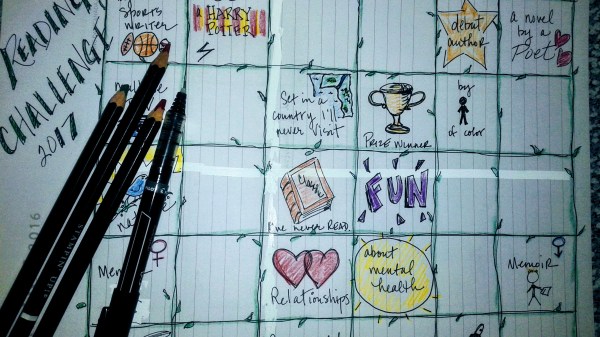
We’ve also probably set reading goals for ourselves. I played in my new planner, setting some goals that I will share with my students when I ask them to create their new challenges.

20170101_200237

If you are looking for a way to spice up your reading in 2017, consider this:

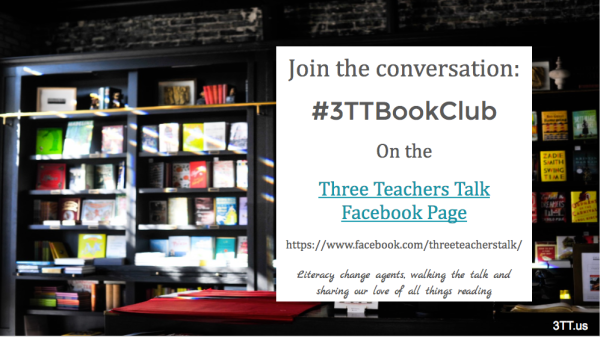
Join the #3TTBookClub on the Three Teachers Talk Facebook page.

Why #3TTBookClub?

In the introduction to her book Reading in the Wild, Donalyn Miller writes: “I want my students to enjoy reading and find it meaningful when they are in my class, but I also want them to understand why reading matters to their lives. A reading workshop classroom provides a temporary scaffold, but eventually students must have self-efficacy and the tools they need to go it alone. The goal of all reading instruction is independence. If students remain depends on teachers to remove all obstacles that prevent them from reading, they won’t become independent readers.”

How do we help our students become independent readers if we are not independent readers ourselves?

I am often surprised at how many English teachers I meet who admit to not reading. I wrote a bit about that in a post last year, and I extend the same invitation:  Are you walking the talk in your content? (The invitation to guest post on this blog stands as well. Every teacher’s voice matters. Your voice matters.)

How will #3TTBookClub work?

We batted this one about a bit, but it didn’t take long to decide that even when it comes to book clubs, choice matters. Each month Shana, Lisa, and I will choose a book. We will introduce our books on the Three Teachers Talk Facebook page and invite other readers to read along with us. Read one of the books, two of them, or all three (My personal goal, but, you know…time… and all that feedback to leave on all those papers.)

We will share ideas on how we might book talk certain books with our students, share insights from pedagogy books we read, share ways we might use excerpts to teach craft, and just overall share our deep and abiding book love.

What have you got to lose?

We hope you will join us in #3TTBookClub in 2017 — and please, use the #3TTBookClub hashtag and invite your friends. See you on the Three Teachers Talk Facebook page.

3ttbookclub


Follow Three Teachers Talk on Twitter @3TeachersTalk, on Instagram at 3TT.us, Pinterest at Three Teachers Talk, and Facebook @ThreeTeachersTalk. Oh, and remember to subscribe to the TTT blog, so you never miss a post.

Amy Rasmussen lives in north Texas and teaches AP English Language and English 3 to the Fighting Farmers at Lewisville High School. She adheres to the words of Emerson: “We aim above the mark to hit the mark,” and Jesus Christ: “Love one another.” Imagine a world if we all love more than we think we can. Follow Amy on Twitter @amyrass.

ftc-guideline-%22affiliate-links%22


Finding New Books: A Lesson from Rachel the Book Bandit

I have a lot of awesome students this year.

A LOT.

img_6200One of my preservice teachers is the hilarious Rachel, who, when she stopped by Allen Hall to turn in her writer’s notebook for the semester, was carrying a copy of Chimamanda Ngozi Adichie’s excellent book Americanah.

“Ooooh,” I said.  “That’s a great book.”

“It is, so far,” Rachel agreed.  “I’m only about 40 pages in.”

“Is it for one of your classes?” I asked.

Rachel laughed a little and said no.  “It’s on the African American Literature syllabus, though.”

Well, that was exciting to me for two reasons.  One was that the African American literature class was going beyond Ralph Ellison and Richard Wright and Zora Neale Hurston into the realms of contemporary.  And the other was that clearly, Rachel had been talking to others about books.

I love me some contagious book love!

“Do you have a friend taking the class?” I inquired.

imagesRachel looked sheepish.  “Well, you see,” she explained, “at the beginning of the semester I always go around to all the different English classes and just stay for the first class so I can get a copy of their syllabus.  Then I put all the titles in my Amazon cart and my mom sends me a few books every month!!”

She was gleeful, and I was giddy.  Rachel was…a book bandit!

“Wow,” I said, impressed.  “So you discover all kinds of new titles this way.”

“Yeah,” she agreed.  “I don’t have time to take every single English elective offered, but I need to know a lot of titles if I’m going to be a good English teacher.  So I do this instead.”

I was so impressed that Rachel had discovered, and independently read, award-winning literature this way.

And, I was even more impressed that Rachel knew that to be a successful teacher of readers, you have to know lots of titles so you can match the right kid to the right book at the right time.

Now that winter break is approaching, I’m looking for some new books to read.  So I took a cue from Rachel and discovered the following amazing titles on the syllabi (found through the online university bookstore) for various English courses at our university.

Popular American Culture, ENGL 258:

  1. Do Androids Dream of Electric Sheep? by Philip K. Dick
  2. Fledgling by Octavia Butler
  3. I am Legend by Richard Matheson
  4. The Walking Dead, Vol. 1: Days Gone By by Robert Kirkman

Sexual Diversity in Literature, ENGL 288:

  1. Rubyfruit Jungle by Rita Mae Brown
  2. Fun Home: A Family Tragicomic by Allison Bechdel

Fiction for Adolescents, ENGL 405:  (this one was a gold mine!!)

  1. The Book Thief by Markus Zusak
  2. Fallen Angels by Walter Dean Myers
  3. The Absolutely True Diary of a Part-Time Indian by Sherman Alexie
  4. The Crossover by Kwame Alexander [I bought this, read it one sitting, and cried in public while finishing it]
  5. Simon vs. the Homo Sapiens Agenda by Becky Albertalli
  6. Brown Girl Dreaming by Jacqueline Woodson
  7. Bone Gap by Laura Ruby
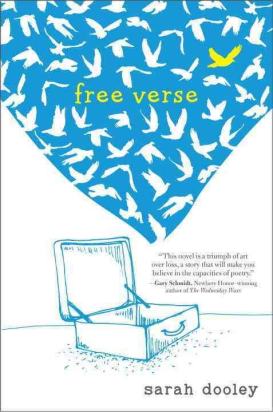
  8. Free Verse by Sarah Dooley [I bought this one ASAP; it’s set in a West Virginia coal mining town]
  9. We Are the Ants by Shaun David Hutchinson

Multiethnic American Literature, ENGL 255:

  1. The Namesake by Jhumpa Lahiri
  2. American Born Chinese by Gene Luen Yang
  3. Everything I Never Told You by Cynthia Ng
  4. Underground Railroad by Colson Whitehead
  5. Make Your Home Among Strangers by Jennine Capo Crucet

Thanks to Rachel for inspiring me with a way to find all of these great new titles!  I hope you’ll find some great new titles this way, too.  Please share them with us in the comments so we can all enjoy!

2 Ways to Prioritize Student Talk in the Classroom

Workshop affords so many opportunities to explore with the students in front of me as opposed to present a set curriculum to whomever happens to be seated in my classroom. It’s teaching through interaction, and in this case, it’s teaching straight from the kids themselves.

We see it in workshop all the time. Students given the tools to explore the world as readers and writers, and encouraged through personalized learning, quite often take their learning to places our old lesson plan books didn’t always accommodate.

One of the best opportunities for this classroom growth is having students do more and more of the talking. With the right modeling and specific expectations around that student talk, the classroom becomes a place students lead through inquiry, as opposed to follow through completion of teacher set tasks.

discussion-2

Morgan quotes Judy Brady’s “I Want a Wife” to analyze how the repetition supports the sarcastic tone and proves the point that since they do SO much, everyone should want a wife. LOL!

It happened yesterday morning, in fact. My AP students were participating in small group graded discussions. Just reading the last sentence makes me cringe (yes we use a rubric, no, the conversations don’t have to be formulaic as a result), but with choice in which readings from our unit they wanted to discuss and some guiding questions throughout the discussion, our conversation about gender and the implications of historical stereotypes on a modern world (their direction for the discussion, not mine) took an interesting turn.

“Mrs. Dennis…you’re smiling weird. What did I say?”

I stop furiously typing comments and look up. “I’m sorry?”

“You had a look. Did I say something wrong?”

“Sarah, you said nothing wrong,” I smile and glance around the table. Seven intrigued faces look back at me. “In the last few minutes this group has, largely unprompted, connected several essays through the lens of analysis, used terminology we’ve not discussed since September, Trinity uttered the words, ‘I don’t believe gender pronouns are even really necessary anymore,’ and then supported her opinion with specific text evidence, and several of you actually just murmured sentiments of excitement to shift the discussion to Judy Brady’s satirical 1971 piece ‘I Want a Wife.’ I’m smiling because I was just thinking about how I used to give short answer reading comprehension quizzes on these pieces.”

“Oh,” said Sarah, “This is way better.”

Yup.  This was a discussion they wanted to have. This was a discussion I wanted to hear. They took the lead, in fact one of our rubric bands demands that, and they came to the

discussion

Part of a small group discussing racial stereotyping colliding with gender stereotyping in the Brent Staples piece “Just Walk On By”

discussion prepared to drive conversation from the perspectives of authors like Brent Staples, Deborah Tannen, John and Abigail Adams, and Judith Ortiz. Perspectives that regard gender through stereotype, race, satire, narrative, an exchange of letters almost 250 years ago, and visual texts.

Did I just sit back and let them talk, free-for-all style? No. This conversation took practice, feedback, and correction over the past few months. Today, it took redirection on some occasions and additionally it took specific intervention for those students reluctant to participate. Additionally, had it been a lower-level class, I would have been a bit more actively involved to start. But as you well know, students at any level are capable of, and actually far more likely, to get actively involved if their efforts for comprehension are supported and their exploration of the text is encouraged. We work specifically on ways to communicate both agreement and polite disagreement, so students can help clarify the text as well as analyze it.

Like any solid workshop component, it involves careful teacher planning and modeling, but equal parts careful student leading as we gradually release them to own their own education. 

We assess students on their preparation for the discussion with visible notes and use of specific text to support their points and their leadership within the group. That leadership can be exhibited through meaningfully involving others to bring them into the discussion with a question, synthesizing ideas they have heard so far, and/or including insights from additional research on a particular topic to extend discussion beyond the reading.

I spend a whole class period for discussions, breaking the class into groups of 7-10 students so all voices have more opportunity to be heard. Students not in the discussion have specific work to complete, sometimes by the end of the hour. For feedback, I type comments and insights while the students are speaking, so I can quickly copy/paste them into the comment section of my feedback form (A Google form emailed directly to students with 2 Common Core based rubric bands as dropdown tabs so I can just click the score for each band, include specific typed feedback, and often get that feedback out to kids the same day).

Another opportunity for seriously impactful student talk, is handing over the daily book talk to the class.

One of the many benefits of this scenario is that I can tap into growing student enthusiasm about books and have my kids spread the book love directly with each other. Don’t get me wrong, my book talks are something to behold. Part forensics piece, part reader’s theater, and part screentest for the literary loony bin, I sell books much like I would envision the traveling vacuum salesmen of yore putting food on the table with a pitch of salvation not just for the home, but the soul. It’s not just going to clean your carpets, it’s going to change you life, Ma’am. Your life. 

But, let’s be real. Though I sprinkle my classroom with good will, good cheer, and good books, I’m not the best salesperson in the room. If you’re going to sell the vacuum with radial root cyclone technology (I Googled that), or the book with 389 scary looking pages on dystopian fantasy rooted in a chromed society, you need to know your audience. You need to relate to your audience. You need to be one with your audience.

There are plenty of reasons to get kids doing your book book talks, not the least of which is I can’t read fast enough these days to keep up with the need for the type of really passionate and informed book talks that come from having read the whole text (Books do sell themselves sometimes, just by reading the back cover and a page or two at the start, but I love to hook kids with a section from the middle to show the impact of the rising action or depth of character development).

book-talk

Priyanka book talking Stitches, a graphic novel by David Small, under the document camera.

  • Students trust one another’s opinions. Yes, often more than mine. I sell hard, but at the end of the day, I’m usually still the biggest book nerd in the room, and therefore I think I am occasionally regarded in much the same way  as the Dancing Grannies in a holiday parade: Enthusiastically adorkable, but a bit of an anomaly to be trusted only at a distance.
  • They find titles, authors, and series that aren’t yet on my radar. Despite my best efforts, I can’t read fast enough or comb enough best of lists to meet the recommendation needs of over 120 kids. But when the classroom experiences a new student perspective on reading each class, additional book talks at their tables after reading, speed dating with books,  and an invitation to help grow our classroom library with tax free, gluten free, guilt free donations of gently used books, everyone wins and the depth of our classroom repertoire grows.
  • Their enthusiasm is relatable and often focused on books that don’t speak to my own bibliophilic tendencies, but can ignite the reading sensibilities of their adolescent peers. For example, I took several YA Lit books home at the start of last summer. Two days in, I was already struggling with the voice. It grated on me (no offense scholars) after hearing it all day in person for 180 days. So when a student book talks The New Guy (and Other Senior Year Distractions) by Amy Spalding, and two sophomores in my class (who have struggled to meet reading goals week after week) add it to their “I Want to Read List”s, that’s another win, because we can’t push kids to deepen their reading if they aren’t reading. First hook them, then book them with more challenging pieces.
  • I offer up the option to produce their book talks digitally and for some students, this is what makes the entire experience meaningful. Students sell their books through book trailers, compilations of related imagery and voice over to meet the same requirements of a live book talk. I’ve had kids include clips of author interviews, live action fight scenes with voiced over dialogue directly from the text, and this year, I have a student who wants to read over the top of a mannequin challenge he plans to shoot to represent some of the major action in the text.

What results is growing book lists, renewed enthusiasm as students go back to books they’ve read and revisit their love for the text, and involving each and every single student as a valued reader in our classroom community.

We’d love to hear from you! What tips and tricks for student talk make their way into your daily workshop practice? Please comment below! 

#3TTWorkshop –Right Now Literacy

My 11th grade curriculum overview begins:  Unit I of English III invites students to explore multi-genre texts that reflect diverse perspectives through reading and writing. Students evaluate the credibility of different viewpoints and consider how the ideas of others strengthen their own voice.

I set out to design lessons that met these guidelines. I began introducing a variety of contemporary texts in a variety of forms — all about high interest, high profile topics. Good idea, I thought, for a never-an-empty-seat diverse class of sixteen year olds.

My plans quickly met resistance right there in the classroom, and I faced the terrifying conclusion:  My students are too biased to recognize bias, too emotionally attached to their own viewpoints, so they are blinded to the viewpoints of others.

Reminds me of a few of my “friends” on Facebook, a few of the people I follow on Twitter, a lot of the stories on pretty much any type of social media.

This fall as I’ve designed lessons, it’s been one puzzle piece after another as I’ve worked to meet the needs of all of my students in the limited amount of time they are with me. (Accelerated block means I have them only one semester.)

Then, the presidential election happened. The doublespeak, the false news, the protestors, the name calling, the ramifications, the incivility…on every side.

Obviously, my students are not the only ones who suffer from a suffocating bias that makes them blind.

And I am bothered. I know many of you are bothered, too.

So as educators, what do we do about it?

I wrote about this idea of Right Now Literacy in a post as I reflected on NCTE. I would love for the educators I trust most to help me think and expand this idea in a once a month post. The first Wednesday of each month, I’ll first get the ideas rolling and then ask questions to Shana and Lisa, and then we’ll run a post centered around my on-going investigation of right now literacy.

We invite you to join this conversation by voicing your own thinking in the comments. Here goes:

Amy:  We all attended some great sessions at NCTE, and we’ve all written posts with some of our reflections. One session that we attended together (thanks for saving me a seat) shines as a highlight for me:  The panel discussion called Expert to Expert: The Joy and Power of Reading with Kylene Beers, Pam Allyn, Ernest Morrell, and Kwame Alexander. (Lisa, I know you cried at least once. I would’ve slipped you a tissue if I had one.)

What was your biggest takeaway from that session?

Lisa: My biggest takeaway is that I should bring Kleenex to NCTE sessions. Rookie mistake. I had no idea how powerful this learning would be!

I wrote yesterday about Kwame Alexander’s insights that we must “be the manufacturers and purveyors of hope,” and that we must “help students become more human.” These ideas have propelled quite a bit of writing and reflecting in recent days as I reexamine my daily practice through the lens of developing my students as people as well as learners.

Early in my career, I was just getting my footing. I taught the way I had been taught and the way my collaborating teachers were teaching. It was pretty traditional. But about a decade ago, our department really started changing. More choice, more authentic assessments, more student voice. I learned to talk with my students instead of at them. Alexander’s quotes above reiterate this to me. Hope for the future flourishes when people take ownership of resolving problems with well reasoned and fair solutions. In this case, allowing students to take ownership of much of their learning fosters hope for their futures as critical thinkers and skilled communicators.

In that same vein, I’ve examined the resources I have made available to kids, because as Kylene Beers said in the same session, “If you don’t have kids falling in love with reading, take a look at the books in your room.”  All of these ideas together remind me that I need to consistently refine my role in the classroom to see learning through the eyes of my diverse students and their unique experiences. While my ideas, plans, and suggestions might guide our daily practice, it’s the students that fuel the inquiry and it’s their discoveries that we expand on to emulate in writing, debate as a class, and guide future reading selections.

Shana:  Pam Allyn is right up there with Penny Kittle and Tom Romano in terms of people who have impacted my teaching life profoundly.  She is brilliant and brave and I fell madly in love with her and her work at NCTE last year, when I sat next to her mother to listen to a similar session.  We got to turn and talk to our neighbors about a variety of topics, and at the time, I was pregnant with my daughter.  I’ll never forget Pam’s mother telling me about the books she’d read to Pam as a young child, and I think of that every time I read to Ruthie–look what a literary giant was borne of a simple indoctrination into a love of reading.

But, I digress.  Pam referred to the fact that the day she spoke was the anniversary of the Gettysburg address, a “hopeful story on a ground of despair.”  She mentioned this in the context of saying that “we’ve been enculturated to allow injustice to occur, especially in education.  We have to say when something isn’t working.

For me, that rang true.  I can’t sit back and listen to people discuss practices of blatant readicide, assuming someone else will speak up–they have been enculturated not to.  Instead of viewing this as a battle, though, I think standing up for what’s right is an act of hope.  As Kwame said, “Teachers, librarians, and parents are purveyors and manufacturers of hope.  We have to offer literature to kids to help them find, raise, and share their voices.”  That’s what I want literature to do for kids, and I have to speak up about it.

Amy:  When Ernest Morrell answered Kylene’s question about the kind of literature we should be reading now with the comment: “We are in a new classic movement in English Language Arts. It’s a need for right now literature.” I thought of a million reasons why a workshop pedagogy fits the immediate need of students today. It wasn’t seconds before my brain connected so many dots made bold by the election:  What we really need is Right Now Literacy, not just literature.

Here’s some of the thoughts percolating in my notebook (They may even work as chapter headings).

  • Story as an Equalizer — How do we give voice to every student’s story?
  • Audience Participation — How do we truly give voice if we are the only listener?
  • Communication as Compromise — How do we move speaking and listening skills to the forefront of instruction?
  • Reading as Literacy Presencing — How do we provide opportunities and encourage students to see themselves in the books they read?
  • Reading as a Bridge — How do we provide opportunities and encourage students to view multiple perspectives?
  • Critical Lenses — How do we teach bias, fallacies, multiple viewpoints, how to validate of sources, including a focus on digital literacy?
  • Design Thinking — How do we shift learning to designing? This is what employers want.

How do you define Right Now Literacy? What would you add or take away?

Shana:  Amy, you are so great at conceptualizing books as mirrors, windows, or doors.  I was thinking about this and realized that while I’ve heard those terms thrown around a lot at NCTE, I don’t know where they originated.  After some googling I discovered the work of Dr. Rudine Sims Bishop, who pioneered the idea of taking these terms from architecture and applying them to the reading of literature.  Here are her words:

Books are sometimes windows, offering views of worlds that may be real or imagined, familiar or strange. These windows are also sliding glass doors, and readers have only to walk through in imagination to become part of whatever world has been created and recreated by the author. When lighting conditions are just right, however, a window can also be a mirror. Literature transforms human experience and reflects it back to us, and in that reflection we can see our own lives and experiences as part of the larger human experience. Reading, then, becomes a means of self-affirmation, and readers often seek their mirrors in books.

So, those concepts to me are central to what Right Now Literacy is:  in an era of homophily and a lack of cultural responsiveness, we need to teach kids how to see not just literature as windows, doors, or mirrors, but also the stories of other people’s lives.  I’ll draw on the Tom Newkirk lovefest when Tom’s editor read aloud the first line of his book, Minds Made for Stories:  “Our theories are really disguised autobiographies, often rooted in childhood.”  She advised us to get curious about the stories that lead people to their stances and belief.  I don’t think kids know how to do this, and for me it’s a big part of Right Now Literacy.

Lisa: I love what Shana shared about literature reflecting the “larger human experience,” and how we seek ourselves in books. In addition to these ideas, I think what Amy referred to as “suffocating bias” is at the top of my Right Now Literacy Focus.

Literacy instruction can be daunting enough when goal is to help students gain the necessary skills to first comprehend, then analyze, and evaluate what they read. This is, of course, in addition to the self-affirmation piece Sims references. But now, it’s become downright demoralizing that teaching literacy must not only mean standing guard against bias, but evaluating sources of “news” for outright lies.  

But while it’s difficult to stomach that teaching these additional skills has to be a part of Right Now Literacy, and that we need articles like NPR’s “Fake or Real? How to Self-Check the News and Get the Facts,” this is necessary work in our modern world. Students need to be able to sift through the information around them, tossing out the misleading and sometimes incendiary “news,” if we are to hope that they can synthesize the perspectives and get back to the enlightening work of finding that self-affirmation referenced above.


rmmibfe4czy-jeremy-thomas

photo by Jeremy Thomas   Longmont, United States

Amy:  Thanks for sharing your thoughts here, Lisa and Shana. Dear Readers, I hope you will join the conversation, too. What are your thoughts on a Right Now Literacy?

Three Good “Ninja” Books About Children of Alcoholic Parents by Amy Estersohn

downloadI’m always on the lookout for ninja books – the kinds of books that address tough issues directly, but are also swift and subtle in how they go about doing it.  These are books that have middle school-appropriate characters, plot points, and pacing with some high school-ish themes.  See also: author Kerry O’Malley Cerra’s #mggetsreal campaign.

Without further ado… here are three terrific ninja books about children of alcoholic parents:

Shug by Jenny Han

Shug (nickname for Sugar) is stuck between being a child and being a teen, and she’s in the unfortunate situation of having a huge-o crush on her male best friend, Mark.  While Shug is primarily an optimistic if awkward tween relationship novel, astute readers will pick up on Shug’s mother’s social withdrawal and her tendency to rely on wine to solve problems.  This novel reminds us that chemical dependency can affect anybody without regard to class or gender.

The Seventh Most Important Thing by Shelley Pearsall

This book is about a boy named Arthur Owens who throws a brick at an old man’s head, nearly killing an old man. Whenever I booktalk this book, there’s always a reader who says, “Surely it was an accident that Arthur threw the brick.”

To which I smile and say, “No, Arthur really meant to throw that brick.”

The Seventh Most Important Thing just might be my favorite book ever, if I really had to choose a favorite book.  It’s a book that transformed me; it’s also transformed some of the readers I’ve worked with, readers who have never felt compelled by any particular text until THIS ONE.  (Note that this book isn’t some magic cure-all, as some of my readers find it a little too character-driven and not cliffhangery enough.  But still.  This book.)  

I won’t give too much else away here, but I will say that Arthur’s father did his best to be a good dad to his children despite a struggle with alcohol.

This Side of Home by Renée Watson

Watson has written a book I can only describe as a gentrification romance.  Twins Maya (named after Maya Angelou) and Nikki (named after Nikki Giovanni) are watching their Northeast Portland neighborhood change before their eyes.  It’s becoming more white, the stores are changing, and their neighbor and best friend Essence’s landlord has started remodeling the bathroom and kitchen … before raising the rent on their apartment.   Maya wants to go to Spelman with Essence, while Essence isn’t sure she’ll be able to leave Portland and her alcoholic mother, who constantly needs her help.

Each of these three books gives a different lens into how different characters may cope with an alcoholic parent, and each of these titles could appeal to younger and older teens.

Amy Estersohn is a middle school English teacher in Westchester County, NY.   She also reviews comic books for http://www.noflyingnotights.com.   Follow her on Twitter at @HMX_MSE.

Thanks for the Great Read #FridayReads

I think it was a “thank you,” of sorts.

My associate principal, the ever-smiling, ever-supportive, Anita Sundstrom, had asked at the end of last school year to borrow some books to read over the summer.

I sent her home with Kristin Hannah’s The Nightingale (and I swear to the heavens and Nicholas Nickleby that Ms. Hannah isn’t paying me to write about her book. Though I may have mentioned how it made me weepy here, and how I broke the law to read it here,  and how the lovely Erin Doucette – who is so very lovely that she helped me with the title of this post at 7:31 a.m.- and I book talked it for the whole school here).

Only a few days later, I received a text from Anita. Something about reading until two in the morning and then not being able to fall asleep for fear of Nazis.

As I said…I think it was a thank you.

She couldn’t put the book down and immediately wanted another recommendation.

Translation: A book captured a reader and fueled a desire to keep reading.
Further Translation: The deepest desire of each and every English teacher fulfilled.

However, it wasn’t until I went to book talk The Nightingale for my current students a few weeks back, that I noticed the Post-it stuck to the inside cover of the book: “Thanks for the great read. – Anita” 

It made me smile. And want to pass on the book love.

So, when I did the book talk, I shared the brief reading story above and showed that Post-it to my students. I joked that Mrs. Sundstrom’s note added street cred to the book. After all, she’s a former science teacher.

Translation: The book has a wider appeal than just a tearful (though sincerely passionate) English teacher.
Further Translation: I now had an idea to help “sell” more books.

Next to the book return bin in my classroom, I placed a stack of Post-its and a few pens. I introduced the idea that we could all help each other better understand the books in our library and their appeal by leaving each other notes in the text. 

These quick little reviews could reach out to readers in search of a book. Those souls searching for a little connection to the readers that have gone before them. Swaying back and forth in front of the bookshelves. Staring. Now, they would have the recommendation of fellow readers right there in the book. The book that would already be in their hands.

Sometimes those Post-it notes can recommend a book I’ve not yet book talked. Sometimes those notes can recommend a book before I can get over to the shelves and help a student select a text. Sometimes those notes lend cred to book when a cover/title/description doesn’t do it justice.

img_6682img_6680

img_6683

So…
Read a book.
Love it.
Leave your name and your thoughts on a sticky note.img_6677

Simple, right?

Helpful too.

Now I tease kids that their old school Post-it note reviews might find their way to Mrs. Sundstrom’s office, which is better than finding themselves in Mrs. Sundstrom’s office.

My hope is that the inside covers of my books end up looking like our writer’s notebooks: colorful, messy, informative, creative, and full of inspirational, deep thoughts.

So, thank a peer, thank a friend, thank a reader, thank a book. #FridayReads and then pass it on.

How do you capture students’ thoughts on books they love? Please share your ideas in the comments below! 

Mini-Lesson Monday: Do Teens Read Seriously Anymore?

It’s the end of our nine weeks. Well, kinda. I have one class of English 3 students that are at midterm since they are on accelerated block, and I’ve got two classes of AP English Lang who I share with AVID every other day in a year-long class, so they are at about the 4.5 weeks mark. Talk about crazy trying to keep the pacing straight and everyone moving.

One thing I know:  All my readers need to revisit the goals they set for themselves the first week of school. We’re going to start with independent reading. I’ve seen a little too much of this lately:

joshandtajhnotreading

Taken after exams when I suggested students use the time to read.

and not enough of this:

juniorboysreading.jpg

Daily routine: 15 minutes of independent reading

I set the standard high and ask my students to read three hours a week. This is difficult for busy teenagers who are not used to reading (and if we are honest, many are not used to completing any type of homework).

We will read this article this week “Do Teens Read Seriously Anymore?” and create our personal reading challenge cards. But before we do, I want to get students thinking about themselves as readers and what reading can, and should, mean to them and what they hope to accomplish in their lives.

Objective:  Interpret a quote on the importance of reading and connect it to my own reading life; construct a plan to help me meet my reading goals.

Lesson:  Students will select up two literacy/reading quotes and glue them into their writer’s notebooks. They will then think about their reading habits over the past several weeks of school and write a response to the quotes that connects their reading experiences (or not) and begin constructing a plan on what they can do differently in the upcoming weeks to either continue to grow as readers, or start to.

Follow-up: Later in the week we will also read “The Insane Work Ethic of Mark Cuban, Jeff Bezos, and 15 Other Powerful Leaders” and write a synthesis-type response using the two articles and their personal goals for reading.

Please share in the comments your ideas for getting and keeping students developing their reading lives.