Category Archives: Pedagogy

A Call for Real Opportunities to Learn — Not More Test Prep

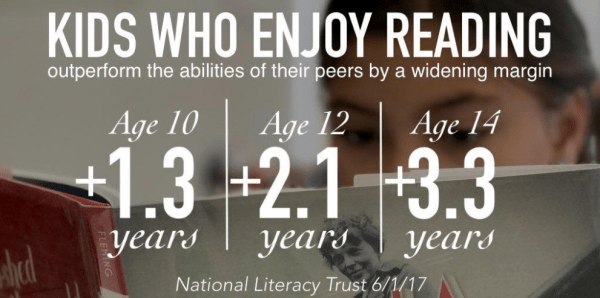
Natl Literacy Trust Survey 2016

Of course, this data caught my eye.

My friend Gary Anderson posted it on Facebook with this link to the National Literacy Trust Findings from their Annual Literacy Survey 2016: Celebrating Reading for Enjoyment.

I had just spent the day working with teachers in Clear Creek ISD as they launched their two week STAAR Academy, a series of summer school-like classes designed to immerse students in authentic reading and writing — not the typical mode of tutorials often offered in the hope of helping students pass their state mandated English exams.

Billy Eastman, Clear Creek ISD High School ELA and World Languages Coordinator, is a visionary who believes in his teachers and in the students they serve. He knows that when students choose books they want to read, experience learning in an environment that validates their personal lives and learning journeys, and are given space and instruction that allows them to write about the topics that matter to them, students grow. They grow in confidence, and they grow in ability.

Thirty-five teachers met with me in a two hour institute this morning. We read and talked and wrote and talked. We built a community of teacher-readers and writers. We engaged in learning — all with a central goal:  How can we create a space for all students to advance as readers and writers?

Then, teachers planned. In teams they designed lessons intent on engaging students as real readers and writers — not just students reading and writing for a test.

After lunch, teachers facilitated similar community building activities with the roughly 250 students attending the academy.

With generous funding by his district, Mr. Eastman was able to provide books, lots of new high-interest YA literature, in which students could choose a book they want to read. This is the first step in “celebrating reading for enjoyment” and all the benefits that come with it.

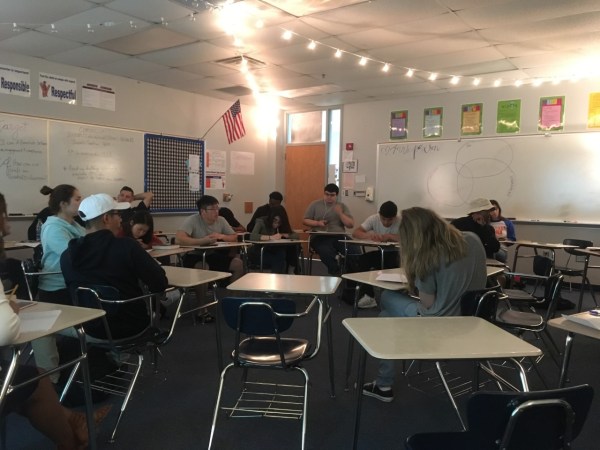
As I visited the 12 classrooms this afternoon, I witnessed students writing and talking about their reading lives.

“I like stories okay,” one boy said, “but I don’t like to read.”

“I’m not really into reading,” said another.

“Reading isn’t my thing,” another boy said.

I asked one young man if he liked to read, and he told me: “Yes, I read a lot.” He had just selected Scythe, the new book by Neil Shusterman, and I could tell he was eager to get started reading it. He’d already read Unwind and quickly told me how much he enjoyed that series. The other three students in this boy’s small group were less enthusiastic about reading anything, but they were willing to try. One chose Still Life with Tornado by A.S. King, another Boy 21 by Matthew Quick, and the other Out of Darkness by Ashley Hope Perez.

As I observed every classroom this afternoon, I noticed a few things:

  • The ratio of boys to girls in most every classroom was at least 4 to 1.
  • Boys want to read books that look “tough.” The cover has to captivate them.
  • Girls will choose books with male protagonists more often than boys will choose books with female protagonists.
  • Few students choose historical fiction — they seem drawn to realistic fiction and dystopian.
  • Many students chose books teachers might deem too difficult for them. (One of the most popular book choices offered today was All the Light We Cannot See, which won the Pulitzer Prize in 2015.)

For the next nine weekdays, students will read their chosen books and spend time engaged in their community of learners. They will practice the moves of real readers and writers as teachers practice the routines of readers-writers workshop and read and write beside their students. Besides the obvious benefit for students, teachers will engage in the kind of professional development that truly matters, the kind that gives hands-on experience with students as they practice the art and craft of teaching.

I am excited for the outcome. I am excited that teachers are excited. I am honored to be a part of Mr. Eastman’s vision for his district.

So what does this have to do with the National Literacy Trusts’ Annual Survey? A lot.

As I read through the report this evening, I found nothing startling or surprising. Of course, there are advantages to reading for enjoyment.

But then I shifted my thinking and began questioning the why and the what. Why does the data say what it does? Why are their gaps in enjoyment between boys and girls? Why are their gaps between age groups? What is happening in schools that might be causing these gaps? What is happening in students’ lives that might be causing these gaps? What can change if we approach reading and writing instruction differently? What should change?

I challenge you to read the report and ask yourself similar questions. Then, I challenge you to take the next step:  follow Billy Eastman’s lead. Whatever your sphere of influence, how can you allow a space for reading for enjoyment? And if you haven’t done so yet: How can you change the model of instruction in your classroom, in your school, or in your district so all students have the chance to become real readers and writers who enjoy what they read and write?

Don’t all students deserve similar opportunities to learn — not more test prep?

Amy Rasmussen lives in north Texas and teaches AP English Language and English 4 (new prep in the fall). She loves talking books, daughters’ weddings (two this year), and grandbabies. She also loves facilitating PD for other teachers making the move into a workshop pedagogy because it keeps her focused on her own improvement. Amy adheres to the words of Emerson: “We aim above the mark to hit the mark,” and Jesus: “Love one another.” Imagine a world if we all aim higher. Follow Amy on Twitter @amyrass. And she’d love it if you follow this blog!

Thinking Differently to Do More Thinking

I think most teachers would agree, no matter our content, our number one goal is to help students develop as critical thinkers. And in a world where technology rules much of their lives, impatience governs their actions, and emotions overcrowd the adolescent brain, this can be daunting.

We must keep trying.

Every day we see see headlines spouting fake news, and more and more we see headlines shouting “This news is fake.” We see sites on how to spot fake news, and analyze fake news. We have access to lessons on fake news — Google “lessons on fake news, and you’ll find 5,250,000 resources. We even see the hashtag #fakenews (a fabulous lesson on paradox btw).

A few months ago I read this article at Forbes. Then clicked through and read this one at BuzzFeed. I shared them with my students. We had an interesting discussion, but one comment left me thinking:  “So, basically, everyone’s making stuff up. How are we supposed to believe anything?”

If we are not helping our students find answers to this question, we are doing a disservice to our students — and by extension a disservice to ourselves. What kind of world will we grow old in if we do not help the students in our classrooms today, determine fact from fiction, identify bias, value diversity of thought, be open to new ideas, support their opinions, and seek to understand before passing judgment?

First, we have to be willing to step outside our comfort zones and seek to understand other perspectives. (If you haven’t seen Outside Your Bubble, it’s an interesting starting place.)

Plato

Next, we must school ourselves on rhetoric. And then, we must weave it more overtly into all aspects of our instruction.

As English teachers, we have a prime opportunity:  let go of the nine weeks novel study where we focus on characters, conflict, plot, and theme. Bring in speeches and essays and news articles that invite discussion about the use of language. At the very least balance the study of both.

A few weeks ago a group of teachers from a neighboring district visited my classroom. They observed as my students and I read two blog posts about the Fearless Girl and the Raging Bull statues: Seriously, the guy has a point, and an opposing view, No, the Wall St. Bull Sculptor Doesn’t Have a Point. The discussion was rich. The thinking was richer.

At the end of the class, I chatted with these teachers. We talked about the routines in my workshop classroom, the book talks I conducted, the way I transitioned from one thing to the next. Then, the conversation turned to novels. One teacher asked how long I spend on novels. I don’t. I responded. My students read novels in book clubs where they facilitate the discussion. They talk of plot and themes and author’s craft. They bring meaning to the text, based on their experiences reading the books. (I am not opposed to novels. I am opposed to spending too much time on them.)

I hesitate to challenge anyone on what they do in their classrooms. I do not know their students. I do not know their routines or their motivations, the goals they hope to accomplish as they instruct their students, or the limitations put on them by mandated curriculum.

I do challenge the idea that studying a novel for “a long time” like this teacher told me, is a valuable use of the limited time we have with our students. Our students’ need to navigate the language of their world is too great to spend week after week with a book “they really like” that “I read to them.” We must put the focus on the needs of the reader and not the book.

What our students need right now — what our country needs right now — is critical thinking around a wide variety of texts. We need a focus on how language works to persuade and to manipulate and to cause outrage. Really, that’s our best, and maybe, our only hope.

As we go into summer (I’ve got three days left), I hope we will think about how we might shift our thinking about the needs of our learners. As we read by the pool, vacation with family, attend conferences and trainings, work our part-time jobs, I hope we will think about language and how it can either make or break the communication that is so vital to a society, a society that will thrive on diversity, respect individuality, and foster empathy and productivity.

Teacher friends, that is our job. And I think it’s our duty.

Amy Rasmussen lives in north Texas and teaches AP English Language and English 3. She loves talking books, daughters’ weddings (two this year), and grandbabies. Facilitating PD for other teachers making the move into a workshop pedagogy keeps her focused on her own learning. Amy adheres to the words of Emerson: “We aim above the mark to hit the mark,” and Jesus: “Love one another.” Imagine a world if we all aim higher. Follow Amy on Twitter @amyrass.

5 Lessons from Public Teaching

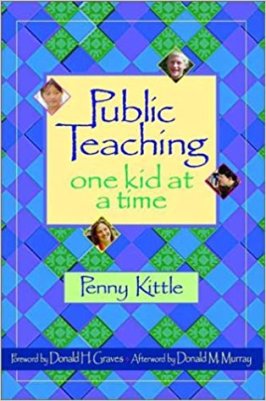
51A2WRYQAZL._SX312_BO1,204,203,200_.jpgThis week I tackled a title that’s long been on my to-read list:  Public Teaching: One Kid at a Time by Penny Kittle.  Published in 2003, it’s Penny’s first book, and has a foreword by Don Graves and an afterword by Don Murray.

(Yeesh…no pressure for when the rest of us thinking about writing our first books, right?!)

I loved this book, a collection of short essays plus an interview with Penny at the end.  It was readable, honest, and spectacularly well-written, as everything by Penny is.  I smiled as I read every page–except for the pages where I was crying.  Even in those essays I found myself impressed by the cleverness of Penny’s craft, both in her teaching and writing.

I bookmarked lots of pages and quotes to share with my preservice teachers this fall, but here are five lessons I took away from the reading that I believe are relevant to teachers of all content areas.


No one is perfect.

Penny begins her book with several amusing essays on mishaps from murderous crickets to accidentally-transparent skirts.  She eases us into the notion that even she, the great Penny Kittle, has had some missteps in her career, then launches into a few gut-wrenching essays on what she reflects on as her more weighty teaching failures:  a student we never say the right thing to, one we lose patience with, one we never teach to love learning or reading or writing.

We all have memories of those students, and Penny honors this with her writing.  I loved these vulnerable, humble essays that remind me we all ride a rollercoaster of success when it comes to our teaching.

Classroom management is a myth.

Penny tells the story of a novice teacher, struggling to manage her classroom, making wrong turn after wrong turn as a battle with her students escalates.  She has this to offer:

“Classroom management is really about the management of the heart and soul of your students.  The only ‘technique’ that works is a full-hearted human response to their lives, and to the conditions of school.  In some schools students sit in rows and listen, then rush to their next class, to sit and listen even more.  Try to understand the conditions in your particular school and view the entire day through their eyes. … You aren’t bad.  Your students are children, preoccupied with myriad distractions.  It is a natural state.  School is often the unnatural one.”

This advice was so much better, for me, than the age-old wisdom I got from mentors when I first began teaching and a lesson would crash and burn:  “don’t take it personally.”  I did take it personally, and still do, when I lose a class’s attention or a lesson falls flat.  When I learned the lesson Penny teaches here–“You must teach the students, not the content.  I want every student in my class to know that he or she is more important than what I am teaching”–I had far fewer of those flat moments and many more roundly satisfying ones.

Novice teachers need mentors, not critics.

We’ve all heard the statistics that half our teachers will leave the profession within three years.  As Penny says, “teaching, like marriage, is best when you make it past the courtship.”  The first few years are hard, and what makes them easier is exactly what improves my marriage:  talk.  As a young teacher simultaneously full of ambition and anxiety, I became more even-keeled when I found mentors.  I talked with them, they empathized, they advised.  I felt more prepared for my work, but I also felt less alone when I found a group of peers to encourage and support me.  “We have to mentor new teachers, listen to them, and I guess, hold hands once in a while,” Penny remarks.

Less is more.

“Somehow we decided that four short stories is better than one rewritten four times, and it’s a huge mistake.”

Penny’s assertion about the way many teachers conceive of writing is so true to my own learning experience, and as a result, my own early teaching experience.  I’ve been interested in the idea of simplifying my instruction for a while, and of course, Penny helped me see more clearly how to do it–with revision.

“I needed to have them linger longer over less,” she says, then backs it up with stories about an entire day’s work spent on fragments, the slow process of discovery learning, the work and power of weeks of revision on one genre of writing.  We have to jettison some things if we really want students learning, to keep it simple, to remember that less is more.

Teachers need to write.

By joining a writer’s group of teachers at her school, writing an essay for the local paper with her students, and carving out the time from motherhood to write, Penny learned to be a much better teacher by writing.  Her peer and student readers, as well as her editors, taught her to “be positive.  Encouragement works; criticism hurts.  Be careful with words.”

It’s hard to learn this lesson if you’re not a writer yourself, and Penny shows us her journey to becoming one throughout her essays.  She describes the early days of her writing group this way:

“Their criticism stung.  I didn’t like it.  You have to be careful when you’re correcting someone’s work.  I don’t think I was careful enough with my students all those years before.  It was so easy to just tell them what wasn’t working and think that was helping.  In writers’ group I learned quickly that compliments showed me what I could do and gave me confidence, criticism confirmed my fears and left me frustrated.  When I confidently approached a piece to revise it, I was playful.  When I went back to one in frustration, I usually made it worse.”

We become better teachers when we do what we’re asking our students to do–it’s only then that we can really know what we’re asking of them.  I highly recommend reading Public Teaching, doing some writing (how about with us?), and reflecting on your teaching by doing both.

43ccacd3aa51c2341980e1e34e34cba6.jpgAs we near the end of the school year, I hope you can find truth in one of Penny’s final statements:  “In my experience, it isn’t the stress that’s left the greatest mark, it is the joy.”

Shana Karnes teaches sophomore, junior, and senior preservice teachers at West Virginia University.  She finds joy in all things learning, love, and literature as she teaches, mothers, and sings her way through life.  Follow Shana on Twitter at @litreader.

Learning from One Another – Professional Development is Everywhere

As high school cliques go, I was never a part of the “cool kids” group. I loitered around the exterior, occasionally granted access to view what went on behind the curtain, but knowing people who know people didn’t really make much of a difference in terms of obtaining a season pass to all things elite.

I was a somewhat lovable dork, voted most compassionate of my high school class (please read this amazing post about being nice vs. being kind, because I was far too nice in high school), content to spend time laughing with my band geek friends and the ever flexible crowd made up of people who really tried not to care what went on at the “totally awesome” parties thrown by people too important to acknowledge the existence of 92% of their graduating class.

Now, in retrospect, I was saved from many things:  painful experiences that would have blown my sheltered innocence far before I could handle it, drama related to pecking order and perceived slights over social class, Gatsby-esque flaps fueled by alcohol and beautiful shirts.

These days, in the professional world, having a collaborative group that functions supportively, creatively, cohesively, also has many benefits reminiscent of those true friends from years past who helped get me through, helped raise me up, helped make me better. The teachers in my department are simply amazing, and I am lucky to have a season pass to be a part of their cool.

Across the profession, some of us meet weekly (or more often) in PLC meetings. Some of us meet in spare moments after school, chance encounters in the hallway, and Google hangout planning sessions. Some of us befriend the teacher next door and talk shop at all hours. It’s about growing as professionals, even when it’s sometimes just about what we’re all “doing tomorrow.”

pd1

However, growing as a professional, these days, can also mean connections that are far from the traditional and learning that comes from very surprising places. In these trying professional times, to be a teacher requires hits of rejuvenation whenever and wherever we can get them.

Take, for example, Shana’s post from last week on her professional development enthusiasm and the message she shared with 3TT. I listened to her message and hurriedly wrote down two ideas I wanted to try right away.

That is the magic of connecting with other professionals: learning (or reviewing) what can bring back (or sustain) the spark that every classroom teacher needs in order to weather the slings and arrows of our craft.

Those sessions where you fill up page after page of quotes, insights, lesson ideas, tips, and tricks. Where you are the cool kid, not because you’ve adjusted who you are in any way, but because you have built up who you are and what you do.

Over the course of this year, I have come to see professional development as something that is happening every surprising moment, from all possible angles. pd2

Below, some reminders (that I myself needed this year) of how empowering learning is. If we forget about, resist, or otherwise close ourselves off to new ideas, review of what works, or even the very basics of our craft (Let me hear you : teachers must be readers and writers or we are in the business of false advertising) what unfortunate hypocrisy we make of what we purport to do each and every day.

Embracing PD Opportunities Based on Your Needs

Whether it’s to pursue an advanced degree, get continuing education credits, fulfill a district initiative, or to explore a topic of interest, professional development can be hugely invigorating to daily practice (It can also be a flop and/or downright insulting, but that’s for another post).

For example, I am typing this blog post today, because I was in need. I needed support to help make the move to workshop and to lead my department through that move. I Google searched “readers and writers workshop,” started reading the 3TT blog, emailed Amy to ask her a million questions, and then insisted to my district that 3TT needed to come for professional development in Franklin. It was some of the most authentic PD I’ve received in fourteen years of teaching.

photo2

Sometimes, it can feel like professional development gets overwhelming. We have professional development opportunities at staff meetings, during mandatory extra hours outside of the school day, and in order to fulfill countless professional expectations of record keeping, curriculum development, and reflection.

However, through professional development organized by and for teachers, we learn from those who know best and know now because they are in the trenches. Seek out professional development for yourself that speaks to the needs you feel need to be met in your classroom.

Creating a PLC with Students 

Sheridan lingered after class yesterday. She’s actually the inspiration for this entire post.

Shyly, she asked if it would be alright to share an article with me. “I ran across this article yesterday while I was looking for something else and it intrigued me so much that I read it.”

With a smile on my face I said, “What were you looking for?”

She laughed, “I don’t even know. I never found it! But I think you’ll like this, so I’ll send it to you.”

What arrived was a link to a Washington Post article from a few years back. Alexis Wiggins, the daughter of Grant Wiggins (of Understanding By Design fame), is also an educator and had shadowed a student for several days. Her takeaways in this article about what students experience every day hit home with me in a big way.
Not because her insights were new or because they would change everything I do on a daily basis, but for two reasons.

The ideas were a reminder of a perspective that often falls away in the face of daily routine and that reminder was shared with me by a student of my own.

Sheridan in no way was looking to make me feel bad, but she did exactly what I tell my kids that reading, sharing, and reflecting should do : remind us of what we need to make a priority each day.

Wiggins research on students needing to feel valued, engaged, and physically and mentally present isn’t new to me, but the article was the best kind of professional development: Kid centered, kid inspired, immediately applicable to my classroom.

Look for, solicit, or otherwise beg students to share with you what is making them think. Direct them to places like Austin Kleon’s newsletter or Arts and Letters Daily, so they can study new and unique ideas, talk about those insights in class, connect them to current learning, and expand your repertoire of resources, insights, and enthusiasm.


Hanging with the Cool Kids

Expanding our definitions of professional develop can also be hugely beneficial.

You’re doing it already, you know. Reading this blog. Reading other blogs, following educational news, getting active in political topics that weigh on our schools, our kids, and our jobs.

Go even further:

  • Follow the English rockstars on social media– Kittle, Gallagher, Newkirk, Morrell, Miller, Anderson, just to name a few.
  • Like the Facebook pages of authors your students love – I’ve had Angie Thomas and Matthew Quick like posts my students and I wrote just in the past few weeks.
  • Tag big names in your posts – Opening your insights or questions up to a wider pd3audience.
  • Jump on Twitter chats –  You don’t ever even need to comment, if you don’t want to. You can just read, click on links to other great articles/insights/lessons, and remain anonymous. You can watch a chat as it’s happening, or follow a hashtag back to a conversation that’s already happened and read through what was said. Here is a link to scheduled Twitter chats that educators might find value in.

Keep learning intentionally.

Not only will you open yourself to an even wider world of resources, insights, opinions, and discussion, but sometimes, you’ll hear personally from these teaching megastars, and let this fangirl tell you, that discipleship can take you all the way back to that thrilling peek behind the curtain of the cool kids.

What professional development opportunities have you found most beneficial to your career? Whether it be attendance at a national conference or stalking a Twitter chat, we’d love to have you join the conversation in the comments below! 


Lisa Dennis teaches English and leads a department of incredible English educators at Franklin High School near Milwaukee. Her favorite pens for note taking during professional development are Paper Mate Flair pens in a variety of colors. Follow Lisa on Twitter @LDennibaum 

Learning from Other Teachers

5054c4145eaf8a4c41c3bbd1d1954cdd.jpgI have so much hope for our profession, our students, and our society.
In a pretty pessimistic world, want to know why I’m so optimistic?

Because I believe in our future teachers.  After an entire school year of working with preservice educators, I have seen so much energy, excitement, and engagement from every single one of my students.  Every challenge that comes their way–whether in the form of an assignment, a tough reading, or grappling with a seemingly unsolvable education issue–only reaffirms their desire to help their students.  They just careso much.

A fantastic conference I attended last week was a wonderful reminder of all of that hope I have for teachers and teaching and learners and learning.  We’re here because of love–love for who and what and how we teach.  Yesterday, I shared my learning from the morning sessions of that conference, and today I’d like to share the ideas, quotes, and joy I heard in my afternoon sessions.

Session Three:  On Teaching Writing & Knowing Our Students

This amazing session was led by three preservice teachers who interned in high school ELA classrooms in our community.  Each of them spoke about their struggles and successes with so much passion that I was left feeling proud to be a teacher by the end of their talks.

Idea:  Audio Recording Peer Feedback–I absolutely loved Katie N.’s idea of having students record their feedback to peers.  After a semester of struggling to get her students to view themselves and one another of being capable and worthy of giving authentic, valuable feedback, she hit upon the idea of having students read one another’s papers ahead of time, prepare some comments, and then record a few minutes of thoughts, responses, suggestions, and connections.  I can’t wait to have my students try this idea!

Quote:  “When I conferenced with my students, so many of them really surprised me!!”  Danielle focused on looking for patterns in her students’ extracurricular involvement and how it might connect to their engagement, motivation, and success in schools.  She had lots of preconceived notions about how her athletes, club members, or student body leaders might act in the classroom, and many of them were wrong.  She loved the experience of being surprised by her students when she took the time to confer with each of them multiple times.

Just Joy:  Katie P. was interested in taking a whole class novel study far beyond the book.  While reading A Separate Peace with her students, she encouraged her students to read the novel through a critical literacy lens, identify social issues they could connect to their own school community, and then take action to improve the state of those issues.  As a result of her teaching, the students in her class created a club focused on improving mental health by participating in mindfulness activities like meditation, yoga, and deep breathing.

As she spoke about this new awareness of mental health issues in a school that had been plagued by student suicides, Katie teared up–as did many of us in the room listening to her speak.  I was so impressed and inspired by the power this young teacher realized she had to change a school community.

Session Four: On Evaluating Ourselves

In this session, led by a mix of teachers and school leaders, speakers presented on ways in which they looked at their own teaching, their whole classroom, or their entire school community; identified a problem; and then attempted to fix their issue.  Many of their inquiries resulted in some amazingly ambitious goals–one principal wanted to find a way to improve her students’ poor attendance, which was often caused by factors stemming from a community plagued by poverty; a group of teachers formed a committee to implement more responsive, sensitive discipline into their elementary school; and an academic coach shared ways she’d aggressively procured free technology into her school for teachers and students to use to improve learning.

I loved all these school leaders’ ideas, but I found one presenter’s approach to strengthening pedagogy incredibly effective and easy to implement.  Josh Karr, a high school math teacher, simply emailed his colleagues and invited them to form an informal PLC to evaluate themselves.

Idea:  Record Your Teaching–Josh invited his whole faculty, via email, to video record one of their lessons, watch it alone, and then bring a small clip to share with a partner in their mini-PLC after school.  Thirteen teachers agreed to participate, and showed up, quite nervously, with their recordings.  They paired up, regardless of content area or grade level, and worked together to analyze their videos, give and get feedback, and talk through some questions they had.  I loved this super easy, low-stakes idea to self- and peer-evaluate our teaching in such a welcoming way.

Quote:  “We laughed at how many teachers didn’t even have students in their videos.”  Josh told a funny story about how several of the teachers’ video cameras had only been pointed at the teachers themselves, and how they didn’t realize this narrow-minded view until they started talking with colleagues.  It was a real revelation for many of these teachers to realize that, wow, their worldview wasn’t very student-centered.  I was so uplifted by hearing Josh speak about how this simple activity prompted these teachers to stop looking at themselves for evidence of good teaching, and to begin looking at their students instead.

Just Joy:  Josh talked about what an inspiring thing it was to be part of this tiny community of teachers within his school, which included teachers from all content areas, and even the band director.  He gave me such hope when he shared how the teachers’ video recordings had evolved over the weeks to include more students, more difficult class periods, and more and more vulnerable learning.

I loved hearing how teachers of all levels of experience and expertise were willing to open themselves up to their colleagues for the sake of improving their students’ learning opportunities.  It’s a hard thing, in this profession, to invite criticism of our teaching when our  work can sometimes be thankless.  I can’t wait to try this idea with my students and colleagues alike.


Check out Part I of this post from yesterday, and then please leave us a comment:  what strategies, ideas, or frames of mind might you try out in your classroom?  Will you share some fantastic lessons you’ve gleaned from good conferences in the comments?

Shana Karnes lives in West Virginia and teaches sophomore, junior, and senior preservice teachers at West Virginia University.  She finds joy in all things learning, love, and literature as she teaches, mothers, and sings her way through life.  Follow Shana on Twitter at @litreader.

Getting Invigorated by Good PD

11863319_864585353577385_5354103936493098384_n.jpg

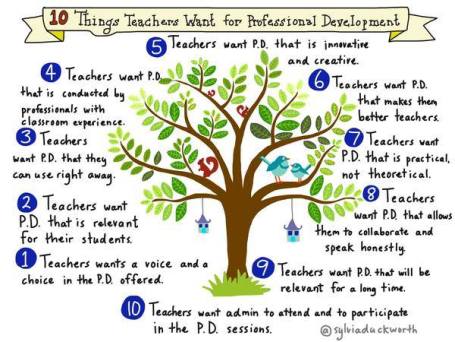
I love this accurate graphic about PD by Sylvia Duckworth.

Last Friday, I was fortunate enough to attend some of the best professional development I’ve been to in a while–and it was free!

At the end of the day, I left my 3TT friends a seven-minute WhatsApp message of out-of-breath enthusiasm, describing my day’s learning.  That’s how you know it’s been a good day.

The conference I attended is held annually to celebrate our Masters’ students’ impending graduation and entry into the field of teaching.  The all-day event features presentations by both preservice and practicing teachers, academic coaches, and principals.

Before the conference, speakers are invited to conduct an inquiry into one aspect of their practice, then present on their methods, findings, and insights.  I attended four absolutely wonderful sessions, and filled up six pages in my notebook with ideas and quotes and just joy–and I’d love to share them with you all.  Today I’ll share ideas gleaned from my morning session, and tomorrow I’ll share what I learned from the afternoon portion of events.

Session One:  On Independent Reading

In my head, I called this session “What you do after you’ve read Book Love,” because it was full of amazing ideas that I’m certain would be Penny Kittle-approved.  One presenter, Andy Patrick (@MrPatrickELA), absolutely blew my mind with the ways he’s clearly innovated independent reading.

Idea:  Reverse Reading Rates–Andy explained that when students chose a challenge book, they took a new reading rate and then used their findings to determine how long it would take them to finish the book.  The students could set a completion goal, Andy could touch on this goal in his conferences with them, and when the book was finished, students reflected on their reading process.  Since I’ve struggled with reading rates and accountability, I just loved this idea.

Quote:  “I never let them off the hook” when they tell me they don’t like reading.  Andy followed this fantastic one-liner up with his philosophy that they just weren’t reading the right books, and it was his job to help his students find them.

Just Joy:  I left this session absolutely impassioned thanks to Andy’s flurry of ideas.  He tossed out strategies like using quotes about the joy of reading as quickwrite prompts, his determination to get colleagues on board with teaching reading across the curriculum, and how great teachers of reading cannot excel unless they are real readers themselves.  YAAAAAAAASSSSSSS was the prevailing word in my notebook after that session!

Session Two:  Strategies for Reading, Writing, and Grammar

After leaving the first session, I had no idea how any other speakers could top that.  Luckily, I was just as inspired by three preservice teachers who’d done their internships in middle school ELA classrooms, and who shared their optimism for our profession in the form of their research.

Idea:  Say Something Journals–Sierra shared that many of her seventh graders weren’t engaged in reading independently or as a whole class, and she wanted a way to spark their interest in their texts.  She created journals, simply folded out of notebook paper, in which students could practice recording their internal reactions to something while reading during class.  When they were reading shared texts, she had students trade journals and giggle about the similarities and differences in their reactions.  The journals culminated in getting the reader to “say something” about the “something” they believed the writer was trying to “say.”  I loved Sierra’s emphasis on the transactional nature of reading, rather than a linear interpretation of a book’s message.

Quote:  “Why don’t they just capitalize their i’s?!” said Tori, who struggled with getting her 8th graders to use grammatical conventions in their writing, even after conferences and practice sessions in which students proved they knew what they were supposed to be doing.  Tori’s presentation was characterized by her sheer love of grammar and her bewilderment about why the heck kids could study mentor texts, send flawless text messages, and yet still refuse to obey the conventions of standard English.

One student’s response?  “Well, I just think capital I’s aren’t very cute.”

Just Joy:  Charity brought sophistication and high expectations to her 8th graders by teaching them about what critical literacy is and then working with them to practice it when reading nonfiction texts.  She focused on helping students develop discussion skills to practice thinking, reading, writing, and speaking within a critical literacy framework, all while reading place-based texts they helped her select.

I think my jaw was on the ground throughout the whole of this brilliant young teacher’s presentation–I want my daughter in her classroom someday, I kept thinking to myself.  What a treat to end my morning by feeling so hopeful about the new talent entering our profession!

Stay tuned for Part II of this post tomorrow, and please share with us in the comments–what have you learned from strong PD sessions you’ve attended?

Shana Karnes lives in West Virginia and teaches sophomore, junior, and senior preservice teachers at West Virginia University.  She finds joy in all things learning, love, and literature as she teaches, mothers, and sings her way through life.  Follow Shana on Twitter at @litreader.


Two Take-Aways from Mentoring my Student Teacher

Next week I get my students back. For 12 weeks I’ve had Joseph as a student teacher, and I’ve come to really miss my kids. It’s an exciting time.

I am hoping I get my writing mojo back, too. I’ve struggled with topics to write about since I haven’t been working with my students day to day. One of my favorite parts about being a reflective practitioner is my itching need to think about, write, and share my experiences in the classroom. Thanks for reading this writing.

This is the fourth student teacher I’ve mentored. It is the first time I’ve given up control. Maybe it’s because I’ve learned how. Maybe it’s because Joseph is just that awesome at stepping into the role of teacher. It’s probably Joseph. I have learned a lot from Joseph over the past several weeks, and I’ve learned a lot about my teaching practice as I have become the observer.

In every aspect of my practice, I have become more purposeful. When I return to my classroom next week, I will be sharper, more intentional in my planning and instruction, and how I interact with my students day to day.

Here’s two top take aways — and why I think every teacher, especially teachers who practice a workshop pedagogy — should offer to mentor a preservice teacher eager to enter our discipline and our profession:

Perception changes everything. My first conversation with Joseph was in the fall. He spent several weeks during the semester observing my classes two days a week. After his first visit he said something like this:  “That was unlike any English class I’ve ever been in. I was always bored in English. I didn’t know a class could look like this.”

Don’t most new teachers step into their roles and teach the way they were taught?

I did. I assigned writing with prompts and due dates instead of teaching writing with mentors and modeling. I pulled out the textbook, assigned a lead weight book to every student, used the suggested lesson ideas and the questions for guided discussion and the activities in each chapter. I chose every novel for the whole class, torturing children with booklets of questions to “aid their understanding” or dialectical journals to “write their thinking” for the complex texts I chose. The students I taught year one certainly still dream about Dickens, and quizzes about characters and setting and plot. I was a nightmare.

Joseph conferring

Conferring with readers during independent reading time.

New teachers have to believe there is a better way. I know some university education programs prepare students for choice and workshop. (Shana was blessed at the University of Miami with the likes of Tom Romano for a professor.) But many programs do not come close to preparing students for the realities of teaching, much less the research-based practices of readers-writers workshop.

Experienced workshop teachers can change that one student teacher at a time.

Research-based Practices in Reading and Writing Instruction. Even more than usual, I’ve turned to research to back up and refine my thinking. I’ve studied Lou LaBrant thanks to Dr. Paul Thomas and his blog. I’ve read more blogs by thoughtful educators like Tricia Ebaria and books by teacher leaders who inspire great ideas — favorite faithfuls like Penny Kittle’s Book Love and Write Beside Them, and I have re-read conference notes and remembered the why and the how of this pedagogy called readers-writers workshop.

I’ve been able to support my thinking with research, and I’ve learned through my reading the importance of validating that research. Research is important to the choices I make in my classroom.

My confidence grows as I read the work of people who are smarter than me and usually more experienced. I nod along, making notes in the margins, get giddy when I think “I do that.” And as my confidence grows, I am more apt to take risks. When I take risks, my students are more likely to take risks. Risks are exciting in a writing class where we celebrate the process over the product. We go on the journey of discovery together.

Sharing this research with Joseph is like a backpack of confidence. Depending on where he lands as a teacher, and the input and control of administration, he may need it to back up his workshop approach to teaching readers and writers. Knowing Joseph will begin his career with evidence-based practices may take away some of the other frightening struggles of first year teaching. I hope so.

I look forward to seeing Joseph step into a classroom of his own. His students will be lucky ones.

What advice can you give Joseph as he steps into his career in English education? Please share in the comments.

Amy Rasmussen lives in north Texas and teaches AP English Language and English 3 to the Fighting Farmers at Lewisville High School. She also facilitates professional development for other teachers making the move into a workshop pedagogy. She adheres to the words of Emerson: “We aim above the mark to hit the mark,” and Jesus Christ: “Love one another.” Imagine a world if we all love more than we think we can. Follow Amy on Twitter @amyrass.

A Lot of Dancing, Please — Guest Post by Billy Eastman

My beautiful and vivacious and pernicious six-year-old daughter frequents a Kindergarten class. She pretends her way through life these days; it’s a problem. But, a problem I refuse to address. Because, one day, that problem with vault her to success in something.

Violet uses a wheelchair. She doesn’t use it all the time. Most of the time, she traverses time and space with arm crutches — but at school, she uses her wheelchair so she doesn’t become fatigued from chasing other small people around.

The other day, an adult at Violet’s school admitted something to me:  she caused Violet to school hallwaytip over in her wheelchair in the hallway (Don’t worry, no daughters were harmed in the making of this short narrative). Really, Violet wasn’t hurt, but the big person was distraught.
I thanked her. For tipping my daughter’s wheelchair over in the hallway. You see, they were dancing. An educator was dancing with Violet in her wheelchair. They were spinning and twirling and tipping and falling. I prefer that.

So, this is what we should prefer in our classrooms as well:  possibilities, no limitations, risk and reward, fear and excitement, falling down, getting up and saying “I’m OK, and some dancing (at least on the page). A lot of dancing, please.

Random undiscernibly identifiable adult:  please continue to dance with Violet in the hallways.

Teachers:  dancing is better than walking in straight lines with bubbles in your mouth.

And, this clearly applies to reading, writing, and thinking—which is what I was writing about this whole time.

Billy Eastman is a curriculum coordinator for English Language Arts and World Languages and Culture in League City, TX. He enjoys talking with folks and finding ways to make smart ideas happen. Follow Billy on Twitter @thebillyeastman


Ask Your Students: What is Engagement?

Between the World and Me

A few weeks ago I ran into a brick wall with a project in my classroom.  I promised an update, but what I have for you is so much more.

I took Shana’s advice and asked my students, WHAT WILL ENGAGE YOU?!  However, as I thought about asking them that question, I found myself wondering if they would know what I meant.

All teachers aim for engagement, administrators search for engagement and attempt to quantify it, but how many students have been explicitly taught what it is we truly desire from them?

I set out to do just that last week.  I knew we would be working with three different concepts that I think are frequently muddled in the classroom.

Fun.  Compliance.  Engagement.

I also knew we needed a purpose/audience for the discussion, so I explained to the students that they would be assisting me in writing this blog post.

I never knew it would be necessary to define these words, but as I doled out a different word to each table group, I walked around to notice a lot of the same conversations happening at each table.

What would a fun classroom feel like?

It would feel like everyone doing what they want, being productive, and everyone would be happy.

What would a compliant classroom feel like?

A compliant classroom would feel how school is supposed to feel; come in, get your work done, leave. 

What would an engaged classroom feel like?

It would feel like students being able to choose their paths.  It would feel like happiness because the students would know the teacher and classmates cared about them.

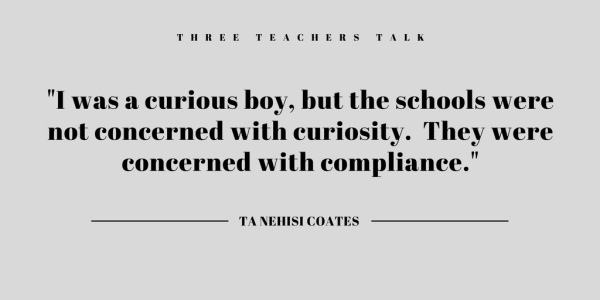
These students have been taught to be compliant their entire educational career.  Sure, it is necessary to be compliant in terms of respect, but if you are ONLY EVER compliant, you’re being robbed of the best part of learning: Recognizing you can push your mind further than you ever imagined.

I want an engaged classroom.  You want an engaged classroom. Oprah wants an engaged classroom.  EVERYBODY WANTS AN ENGAGED CLASSROOM.

So if compliant and engaged classrooms both get work done, what’s the difference?

Engage: (v.) pledge or enter into a contract to do something; establish a meaningful connection with.

Did you catch that?

To engage means to commit and connect.  That doesn’t just change classrooms, it changes lives.

So why is it so hard? Commitment and connection don’t come through passivity or apathy, they require effort and exertion.  They require pushing past the point of comfort (for both students and teachers), and sitting in the pain–not because you want to, but because you committed to it.

As we discussed why a classroom should not be all fun, Andy had an enlightening thought.  He said, “I think the problem is, any time you take part in something, you’re sacrificing something else.  I think a lot of students are afraid to sacrifice their own comfort to make a connection with someone.  There’s always the risk, too, that you won’t connect, and then it’s like you lost twice.”

Sometimes I forget the amount of fear that exists in the classroom on a daily basis.  Commitment asks us to sacrifice the easy path.  Connection asks us to say goodbye to selfishness.  All of this has to take place before engaged learning can happen!

It takes a straight up ninja to pull that out of every student in every class period!

We ended this mini-unit with a Socratic Seminar.  I love me some good structured talk.

PTT5

2nd Period Preparing for Socratic Seminar/Live Tweeting

What is the purpose and direction of our learning?  How can we make our classroom a space of authentic dialogue and engagement? (Question credit goes to my emergency lesson-saver, Shana.)

Zoe said she never liked English until she had choice.  She also said she wanted to do more talking about books in a way that connected with her classmates and what they were reading.

Dee said she enjoys higher level thinking.  What might happen if _____ happened to someone you know?  Would you handle things the way this character did?  What would you change? (Her suggested questions.)

4th period agreed they would like to deal with real world issues, and have choice in how they present their findings (poetry, video, podcast, etc.).

2nd period explained it should be about the learning, not about the grades, but it’s been that way for so long that they don’t know how else to operate.

Grady said, “School gives you a chance to do something great with your life, but you have to DO SOMETHING to be great.”

Shahin said, “Compliance is a downfall because you just follow orders and don’t think for yourself.  It makes it to where you will always need a boss, or you won’t know how to operate.”

PTT1PTT4

PTT2PTT6

Listening most often leads to learning, and I sure learned a LOT last week! Thanks for the ideas, #PaxThinkTank!!

Is your classroom one of compliance, engagement, fun, or a mixture?  How do you communicate with your students what you expect from them each day?

Jessica Paxson is an English IV and Creative Writing teacher in Arlington, TX.  She frequently feels as though someone made a mistake in allowing her to hold the futures of over 100 teenagers in her jittery, over-caffeinated hands for the past two years.  If you enjoy watching her make a fool of herself by being unbearably vulnerable, you can catch more of that over at www.jessicajordana.com. Follow her on Twitter or Instagram @jessjordana.


What We Teach vs. How We Teach

We all struggle constantly to find balance in our classroom.  The demands of our students, our workplaces, our curricula, our standards, our colleagues, and ourselves are all but impossible to manage.

Generally, as a teacher, when I struggled with that balancing act, it looked something like this:

tumblr_ncvodo1Fg91saf2tdo1_500.gif

Yeah.  It wasn’t pretty.

Although I’ll probably never manage the perfect balance, I think I’ve edged a little closer to some sort of evenness through the process of tweaking, refining, revising, and rethinking how and what I teach.

I primarily do this by considering all things through the lens, first, of who I teach.

But I don’t think it’s enough to just say, hey, I know my students really well through lots of conferring and they know my expectations really well through lots of modeling and boom! learning occurs!

I think it’s really important to consider how and what we teach, too.

As a new teacher, I spent AGES pondering what I’d teach.  I was manic about designing thematic units, creating a complicated web I’d fill in before I introduced each central text, whether read or written.  I’d make sure I had some contemporary stuff and some old stuff, some poetry and some music, some fiction and some nonfiction.

My units were full of variety, that was for sure, but they all centered on classic books and pretty classic compositions, too–The Catcher in the Rye, a literary analysis; A Separate Peace, an argument essay.  I didn’t understand why students weren’t engaging with what I was teaching.  I mean, it was awesome!

Then I happened upon Alfie Kohn’s excellent article in Education Week, It’s Not What We Teach, It’s What They Learn.  I felt a little stupid, as I often do when I read Kohn’s matter-of-fact words–I picture him saying, duh, Shana. What you’re teaching doesn’t matter. You have to change how you teach it.

So, I threw myself into a focus on my methods.  How were students supposed to thrive if everything we did was so high-stakes?  How were they supposed to feel any agency or empowerment if they didn’t have as much choice as I did in their curriculum?

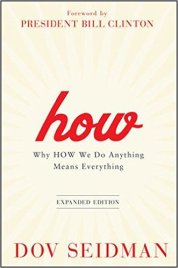
41v68aRP5UL._SX329_BO1,204,203,200_.jpgI did a lot of reading about the importance of how we do things.  Penny Kittle mentioned Dov Seidman’s How at NCTE, and I jotted the title down, thinking it was one my husband would enjoy.  I bought it for him, but ended up devouring it myself.  Thomas Friedmann applied Seidman’s principles to the economy; why couldn’t I apply it to teaching, too?

That was when I committed to full-on workshop teaching, and that was the year I experimentally abandoned teaching whole-class novels, too.  I liked a lot of the changes I saw in my students, but with my focus on how I was teaching, I felt that my curriculum began to weaken.  Units felt disjointed since I wasn’t spending as much time obsessing about what to teach.  Something intangible felt lacking.

I had to move back toward strengthening my curriculum, while maintaining the benefits of an added focus on my methods, in a new kind of classroom.

I realized that I needed to combine all three of those things to get closer to achieving a good balance:  knowing who I taught, thoughtfully considering how I taught, and carefully selecting what I taught.

It wasn’t enough to teach with a pedagogy of engagement if what I was teaching didn’t match who I was teaching.  Similarly, it wasn’t enough to design layered, high-interest units of study that featured reading and writing and talk and practice and joy if the things we read and wrote and talked about and practiced didn’t match what my students cared about.

With every lesson and unit I design, I struggle to find the sweet spot that balances who and what and how I teach.  Like all teaching, it will always be a great deal of work to find that balance–but being aware of the necessity of all three of those factors has without a doubt improved my practice.

Shana Karnes lives in West Virginia and teaches sophomore, junior, and senior preservice teachers at West Virginia University.  She finds joy in all things learning, love, and literature as she teaches, mothers, and sings her way through life.  Follow Shana on Twitter at @litreader or join her for the Slice of Life Writing Challenge here.