Category Archives: Pedagogy

Formative Assessment Works!!!

For those of you who haven’t taught Seniors, trust me on this:  Formative assessment during the second semester is challenging.

If you’ve taught seniors, then you might understand where I’m coming from:  Sometimes it’s hard to tell if they aren’t grasping a concept, or they are just too tired of school to have the energy to engage.

I hurts my heart to even consider that my precious learners are worried about bigger issues than Comparative Literary Analysis essays or finding examples of bias in their self-selected texts.  Prom looms five days away and graduation seven weeks after that.  They work, they compete in extra curriculars, they deal with the adults and peers in their lives.  I forget, sometimes, that their plates are filled with important thoughts.  I remind myself I’m not doing their stress levels any favors by point out that we still have important work to do before June 2nd.

Last Monday we reviewed an excerpt from Niel Schusterman’s Thunderhead as a mentor text for practicing literary analysis through all the lenses that should be crystal clear to these literate learners.  I needed to assess their understanding and thinking so that I could make decisions about the instruction leading up to the summative assessment.  That’s the point of formative assessment; to “form” a plan for instruction.

I read the short selection with them, and asked them if they would, please, mark their thinking on this first lap through the text.  They should, as they’ve done many times before, underline or highlight what they noticed about the words the author chose through the lenses of diction, bias, author’s purpose…literally anything they noticed within the realm of literary analysis. It’s the last nine weeks of their public education career. They should be able to look at a text through a variety of lenses.

Some of them made some marks on the page while others wrote notes next to highlighted lines or words.  Others, though, marked nothing.  [Alarms wiggle and stir in my head. Something’s not right.]

I asked them to share within their groups what they noticed.  Muted whispers of ethos, tone, and metaphor struggled out of some groups, but again, most said very little.  Very few connections were being made. For them and for me, the picture was as clear as mud. This, by itself, is important formative assessment. This wasn’t working. [Def Con 55- Full tilt klaxons at maximum volume!]

Yet, I refuse to blame them.  I fully believe that it is solely on me, the teacher, to facilitate engagement with the text.  Somehow I need to do a better job inviting them to take all those useful tools out of their tool belts and dissect this very meaningful text.

New England Patriots at Washington Redskins 08/28/09

I bear a striking resemblance to Tom Brady.  Photo by Keith Allison

In football parlance, I needed to call an audible in the middle of the game. What I had hoped they would do; they won’t or can’t.  It’s time for me to jump in and scaffold this concept to a place where they can see the connections they can make and I can assess their thinking.  I’m not going to put them in a position to fail on the summative assessment if I know they aren’t ready for it.

In a whole class mode, I read over the text, mark what I notice and verbalize my analysis.

Now I ask them to talk about what they notice.  There it is…an increase in discussion, an inflation in dialogue. The alarm volume turns down a notch, but it doesn’t turn off.

I wrap the class period up with an invitation to write about what moves the author is making and as they do I confer with a few students who seem completely flabbergasted.  The bell tolls, signaling an end to their literary torture session.


Thus was the source of my salvation:

book

I only saunter.

Jumping into this book reminded me of a few important tenets of writing instruction that I let myself forget:

  1. Give them choice- I was allowing no choice in the subject of their analysis.  I know better than to restrict their reading and writing experiences and I let my, and their, end of the year exhaustion affect my decision making.
  2. Show them, not tell them, what you want to assess.  I wasn’t showing them examples of literary analysis and again, I know better.  I was expecting, wrongly, that Senior English students would confidently engage in literary analysis and move forward with their thinking in a way that shows me they can write a response in essay form.

After school, I tore up my lessons plans for the next four days and re-wrote them to reflect what I SHOULD do to support my students in this exploration.

On page 5 of their amazing new book Marchetti and O’Dell introduce a mentor text written by Joe Fassler from The Atlantic.  His recurring series “By Heart” is a collection of responses from a diverse group of thinkers and writers and is an amazing resource.  A simple Google search returned a link to this series of essays. I scanned the list of the titles and discovered an article from September titled, “What Writers Can Learn From Goodnight Moon.”   In it, Celeste Ng describes her feelings of the children’s book and how it “informs” her writing.

Perfecto!!!

This checked so many of the boxes of what I was looking for in a mentor text.  And…I get to read a children’s book to “big” kids.  I know enough about my students to know they will love this.

Also, I used Marchetti and O’Dell’s five part descriptions of literary analysis on pages 11 and 12 to create a glue-in anchor chart for their readers’/writers’ notebooks that helped to clarify what exactly we should look for when reading and writing literary analysis.

Confidence restored! Disaster averted… kind of.

We Ng’s reflection and discussed how this was a perfect example of literary analysis.  They asked questions, we laughed about Goodnight Moon.  I saw their confidence grow and I knew we were back on track and ready to move toward our essay.

Thursday, we started the drafts and I hope to see many of them tomorrow.

Being responsive and intentional is a crucial part of the workshop pedagogy.  I can’t stress enough how this one piece can make our break my teaching.  My lesson planning skills have finally reached the point where I plan for and anticipate opportunities to change up what we are doing to match what the students need. This was an opportunity for which I hadn’t planned, but we made the adjustment and made it work.

Sometimes, that’s how it goes.

Let me know in the comments below when you’ve had to make big changes on the fly to support your students’ learning. I know I can’t be the only one.

Charles Moore is neck deep in Children of Blood and Bone.  He’s spending the day taking his daughter to school and then having lunch with her.  It might be the best day of his life.  His summer TBR list is growing uncontrollably; feel free to add to it in the comments.

An Intervention Change Up and a Plug for Summer Learning

brady-cook-314868-unsplash

Photo by Brady Cook on Unsplash

I bet I am more ready for summer than you. No, really. I am SO ready.

It’s not that I don’t like my job. It’s not that I am not having tons of great learning experiences with my students — they are doing beautiful things. It’s not that all things testing come crushing in this time of year (TELPAS, STAAR, AP) and make me daydream of working at a spa folding towels. It’s really none of that. It’s not even that I need a vacation — although I do. Did we already have Spring Break? (Oh, yeah, we did.)

It’s this:  Last summer I had one of the most amazing, awe-inspiring experiences of my teaching life. And I get a do over this summer.

Last summer I got to work with a powerhouse group of ELAR teachers in Clear Creek ISD with my friend and collaborator, Billy Eastman. I met Coach Moore who now writes on this blog and many other true blue educators dedicated to doing the work of workshop instruction and determined to do right by their readers and writers.

I could go on and on and on. But I won’t because Billy and I already did.

We wrote about our planning and implementation of that summer learning in this article “An Intervention Change Up: Investing in Teacher Expertise to Transform Student Learning,” recently published in English Journal.

I hope you’ll read it. Think about the intervention routines on your campus. Are they good for all students? Will they increase confidence in the hearts and minds of your readers and writers? Will they help students gain skills — or reinforce their lack of them?

And what about teachers? What’s in that work for you?

I’d love to know your thoughts. And if we can help, please let us know that, too.

Amy Rasmussen teaches English IV and AP English Language and Composition at a large senior high school in North TX. She is grateful to the North Star of TX Writing Project and Penny Kittle for showing her the benefits of choice and challenge; otherwise, she would probably still be dragging students through Dickens’ novels and pulling her hair our over plagiarized essays. Thank God she learned a better way. Follow Amy @amyrass and @3TeachersTalk. And please join the Three Teachers Talk Facebook page if you haven’t already. Join the conversation and share the good news of your workshop classroom.

Standing, spellbound, among Giants…

So that’s that. I’m almost exactly two years in.

I jumped head first into workshop practice at the start of the fourth grading quarter of the 2016-2017 school year. This was about the same time I asked to try my hand at sponsoring our Student Council on top of coaching football in the fall and soccer in the spring.

I learned I’m a glutton for punishment.

Two years of workshop practice elapsed and I still quake at my lack of knowledge and experience.

I’m still a novice; yet I’m motivated now more than ever before.

Thinking about starting the journey? Look here.  Also, check out this amazing post! This blog contains a wealth of knowledge and when it was introduced to me two years ago, I was smitten.

I think we can all agree that Workshop is both exhilarating and terrifying. It’s kind of like standing in front of one of the largest living organisms on the planet.

Recently, I traveled across California on a site seeing adventure that shared some symbolism with my workshop journey.

As my family and I wound upward in elevation through a mountain forest ten days ago, we started noticing giants. They stood out from the other bits of foliage not just in their massive size, but also in their presence. The sensations reminded me of the amazing teachers I’ve met. Have you ever noticed how some teachers have almost an aura about them? I feel it every day before school, between classes, at meetings or even just walking down the hall.

tree3

Standing among those behemoths was exhilarating. I’m a big guy and these ancient giants made me feel like a tiny speck, a flea at their feet. I’ve never felt so insignificant, small, or helpless. If you haven’t stood next to one, you can’t possibly understand the deep sense of awe, unless you know truly transcendent teachers, as I do.

The same feelings that massive trees evoke pour out of my mind as I reflect on my journey with workshop; which I do often.

Maybe you are like me and sometimes feel overwhelmed by the complicated and time consuming process of delivering workshop style instruction day in and day out.

Many of my peers tell me how much they love this pedagogy, but also remark how much preparation is necessary to be true to what the students need most. They are so right!!!

Despite the struggle.  Despite the time and stress…in me:

bane

So the following ideas are what work best for me:

  1. Engage the professionals around you – I learn more from the professionals around me than I do from anywhere else. Our impromptu hallway discussions are invigorating and refreshing.  Teachers learn best from teachers.

  2. Engage the professionals in your professional library – There exists an avalanche of information for us to access.  Of course Kittle, Gallagher, Romano, Newkirk, Anderson, Atwell and so many others should be studied and reviewed yearly.  There are many new and notable books that I’ve experienced just this year:

  3. Engage the professionals on social media- For so long I was afraid of social media and its potential impact on my professional life.  I felt it was for the kids and better left alone.  Boy was I wrong.  Social media leverages collaboration in a way that nothing else has ever done.  Twitter chats are so much fun to follow, much less participate in.  Check this out.

  4. Engage in reflecting on your own work- Take time to write about your experience.  I’ve found writing about this journey to be cathartic and energizing.  Its more than writing though, its recording my place in this movement.  We are changing the world by advocating for literacy to emerge in the forefront of education.

Charles Moore is currently neck deep in Fates and Furies and is engrossed finding more books for his library. 

Creating Community One Story at a Time

My son started Grade 6 this year at a brand new school. This was a nerve-wracking shift for us as he had been attending his previous school since preschool. His fears were largely centered around finding new friends and fitting in, but as a teacher/parent my fears centered more around the learning environment and if his new teacher would conduct the class in a way that fostered inquiry and creativity.

After the first few weeks of school, it became clear that this teacher had a different style of teaching than the ones at my son’s previous school and  I fretted that he wasn’t learning enough and that he was going to be bored with this new style of instruction. In one of my particular moments of panic and after just finishing a lengthy text to rant to a teacher friend of mine about my fears in regards to the way my son was learning, my wise sage of a friend responded with a simple response – yeah, but how much do you really remember what you learned in Grade 6 content wise anyways? What you should really be asking yourself is what type of classroom community is being fostered.

Just that one simple question quelled the storm of concerns and made me reflect. What was my son’s new classroom community like? So, when he came home from school each day, I stopped listening for what he learned and focused more on the tidbits he shared with me about how he is learning. Once I started listening for the how, I realized the gift that his new teacher was sharing with him was the gift of story. I soon saw that my son who so often answered questions of “what did you do at school today?” with a shrug and an “I don’t remember” was now answering the question by sharing the stories he learned.  You see, his new teacher has created a classroom steeped in story and story is a powerful community builder. Every day he tells the students stories of his life, stories of the past, and stories of his hopes for the future. He also surrounds the students with stories with a huge classroom library that the students are free to access at any time. Most importantly, however, is the culture he has created by one simple habit- everyday he reads aloud to his Grade 6 class. I soon began to realize that my son was excited to tell me the stories that were being read to him and his classmates and recounted them with a verve and detail he has never had before when talking about school. Will my son remember the content of his Grade 6 Social Studies lessons? Maybe not, but he will remember the power of those stories being read aloud to him and what they made him feel.

In her blog and in her book Passionate Readers: The Art of Reaching and Engaging Every Child, Pernille Ripp discusses the importance of reading aloud to our students and the importance of providing joyful reading experiences. When we read aloud to our students, we model our own enjoyment of reading, tap into the inherent human love of story, and provide a joyful reading experience for our students. Why then do we stop reading aloud to our students as they get older? This was the question that came to mind when I thought about my own teaching practice. Do I read aloud to my students? In reflection, I realized I do read the practice sample reading paragraphs to prepare for the Provincial Exams to my Honours English 11 class and I occasionally read out samples of strong essays, but this would hardly count as joyful reading. I quickly realized that I had fallen into the mindset of the senior English teacher – the one that does not see reading aloud to her senior English students as a valuable use of time.

For more detail on techniques to bring read alouds alive in your senior classes, please read Amy’s post on the topic.

Once this realization hit, I went straight to my senior English department colleagues and started to brainstorm ways that we can bring the joy of storytelling into our senior classes and these are the first steps we took.

Besides integrating daily reading time to each class, we also focused on how we can bring storytelling into their lives. Our school is a K-12 school and our senior students are fortunate enough to have many connections with the junior students. One program we have is a Kindergarten/Grade 12 buddy program where our Kindergarten students and our Grade 12 students meet once a month. Right away, I knew this was a perfect opportunity to allow my Grade 12 students to share stories. Prior to our next buddy meeting, I took the Grade 12 students down to the library and set them free in the picture book section with one simple task – find a story to read to your buddy. Off they went and magic quickly happened. As they were searching the shelves, stories started to present themselves to them. They found their favorite picture books they read as a child or ones that were tied to special reading memories. These were the books they choose to share with their buddies – the stories of their childhood. As they read the stories to their buddies the pride and the joy of sharing stories was evident.

IMG_0458

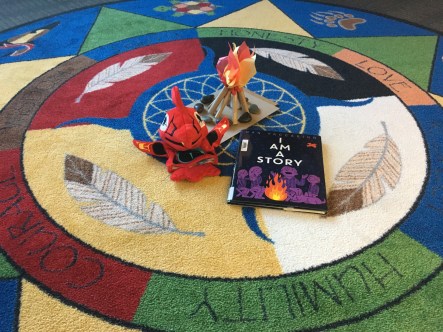
Before starting our living library, I read my Honours English 11 students the amazing picture book I Am A Story by Dan Yaccarino to get them in the story telling mood. We also made little campfires to tell the stories around to further create the atmosphere of sharing stories around a campfire. Some of my Grade 11 students were a little shy to tell their stories, so they enlisted the help of our school library puppet collection.

Another storytelling initiative I took on was having my Honours English 11 students create a living library for the Grade 3 and 5 students at our school. A living library is where students become living books with a story to tell. The Grade 3 and 5 students circulate around the library and “check out” an Honours 11 student and listen to the story the Grade 11 has prepared to tell. The purpose of the living library is not to ask questions or to engage in conversation with your audience, but simply to share your story. My Honours students have recently been studying how authors create voice in their writing and what better way to study voice than to create story using our own voices. When I first proposed the idea to my Honours students, I presented it as an exciting opportunity in storytelling and I was met with less than enthusiastic groans. They wanted to know if they really had to do this (the answer being yes, I want you to try) and “are we being marked on this” (the answer being no, but it will help you develop voice in your storytelling). Despite their reservations, they all actually showed up on the living library day and ended up having a blast. Upon reflecting on the experience afterwards, my students talked about how they had to change their stories to suit the different audiences that were listening to them. In some cases it was because they had an older or a younger audience, but in many cases it was because of the way the audience was reacting to the story. At the end of the experience, all of the Grade 11 Honours English students could agree on one thing – they loved telling their stories and they wished they could do this every class.

While running a living library every class is not really possible, this experience reminded me how I need to weave story into my daily classes more because story is a powerful tool. By reading aloud to my senior students, by giving them opportunites to read aloud, by sharing my stories, and by allowing them to share theirs I can help foster a class community that is steeped in the joy of story and storytelling.


Pam McMartin teaches Senior English, is the English Department Head, and the Senior School Teacher Librarian at a school in Tsawwassen, British Columbia Canada. When not trying to balance her many teaching roles, she loves sharing stories with her students, her son, her dogs, or anyone who will listen. She tweets at @psmcmartin.


To the Woods: The Importance of Stopping to Reflect While on the Journey

In a recent twitter chat for AP Literature teachers hosted by Talks with Teachers Brian Sztabnik, he opened the chat with a prompt: identify a poem befitting of the weather conditions. Robert Frost’s “Stopping by the Woods on a Snowy Evening.” Too on the nose, my husband would say. Yet for me–given weather conditions and classroom conditions–it felt natural, not as a text to teach but as a text to prompt the kind of introspection I needed. As a teacher, I am at a stopping point, a midway point in the year where I gain new students (I teach on the block schedule). I have miles to go before I sleep (#Englishteacherlife). But before I try to fulfill those promises to my new students, I need to go to the dark places, to the woods of my mind. And stop. Stop moving from one thing to the next. My teacher life desperately needs this stillness. In the woods of my mind, I can truly reflect and determine how to keep moving forward on the miles ahead, discovering the ways I can uphold my responsibilities to my students and to myself.

As I paused, visiting my own woods, I reflected and wondered yet again: do my students have enough opportunities to go their dark places, their woods? I don’t mean social-emotional dark places. Instead, I mean the darkness and woods of their learning journey as writers where they must ponder thickets and brambles and branches–the very things that trip them and rip them up as writers. No, they don’t. As a teacher who regularly pushes students to reflect because of its impact on self-regulation skills, this year I’ve gotten buried under new content and new approaches. It seems I’ve let my commitment to reflection on not just product but also process get covered up by the deep snow of other stuff. Yes, my students reflected at the end of each essay, but what were my students missing by not pausing for more profound reflection in the midst of their journeys? What chances to directly impact their writing processes did I miss?

My students’ end-of-the-term portfolios, where they presented artifacts and reflected on their writing process journey, certainly carried me deeper into the woods–theirs and mine–and I learned about what we missed.

Screen Shot 2018-02-04 at 9.43.03 PM

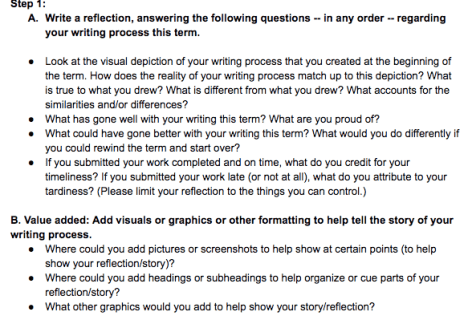
These are the end-of-the-term reflection questions with which we asked students to engage.

Students not only narrated how their writing processes changed and what went well with their writing but also what could have gone better and what they would do differently if they could rewind and start over. Their reflections were lovely, dark, and deep. Here are a few samples.

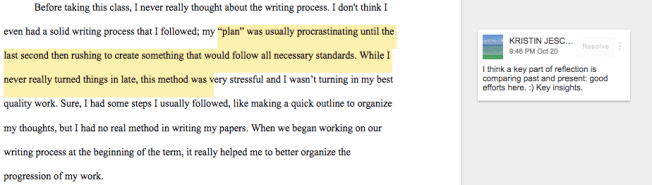
Student A’s reflections: 

Screen Shot 2018-02-04 at 9.47.05 PM

Screen Shot 2018-02-11 at 9.19.13 PM

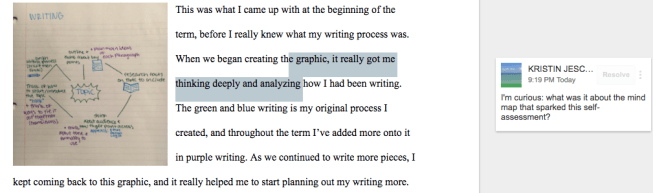
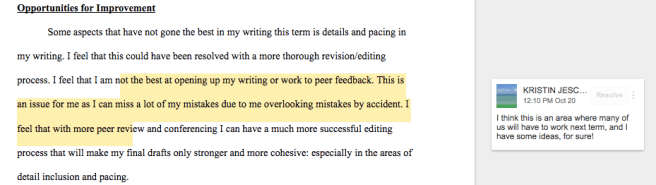
Student B’s reflections:

Screen Shot 2018-02-11 at 7.33.43 AM

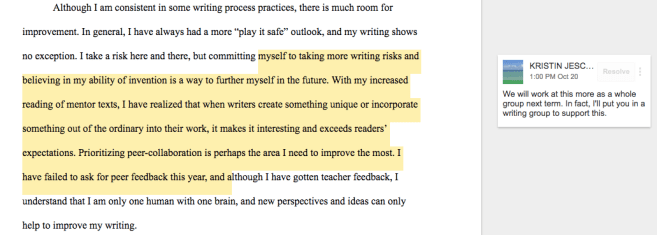
Student C’s reflections:Screen Shot 2018-02-04 at 9.59.26 PM

As I re-read their end of Term 1 reflections and then later really paused to consider their Term 2 reflections, I recognized why I need to force those pauses in the midst of the journey more often. Yes, many of my students, like Student A, pondered their processes overall and showed improvement in self-regulation. But, Students B and C are far more indicative of missed visits to the woods. I could have mentored Student B more to take calculated risks throughout the process, and both Students B and C could have benefitted from more coaching regarding peer collaboration. There are, it seems, so many more opportunities for learning if I create the conditions for true pauses during the process. Sharon Pianko’s “Reflection: A Critical Component of the Composing Process” from 1979 (when researching the relationship between composing and reflection was new) speaks to this:

It is reflection which stimulates the growth of consciousness in students about the numerous mental and linguistic strategies they command and about the many lexical, syntactical, and organizational choices they make–many of which occur simultaneously–during the act of composing. The ability to reflect on what is being written seems to be the essence of the difference between the able and not so able writers from their initial writing experience onward.

I have a responsibility to help my students become “able” writers. And, now I’m all too full of eagerness to move, bells of expectation ringing, full of purpose toward that responsibility.

This term my colleague and I intend to schedule deep reflection time–true pauses to reflect on process not product–on a regular basis. We must prioritize this. Sure, at first, my new students might think it strange to stop. And to stop where we do. They might even think it’s a mistake. But I know better now. I’m inviting them to the woods, empowering them first to reflect and then to find their way onward, ably, through the snow.

For resources on reflection, check out two of my recent “go-to’s”:

Angela Stockman’s Blog Post “Ten Reflective Questions to Ask at the End of Class”: I appreciate question 7: it’s all about the journey. Allison Marchetti and Rebekah O’Dell’s Writing with Mentors: their checkpoint questions provide a systematic approach to the kind of reflection we’re after.


Kristin Jeschke teaches College Prep English (senior English) and AP Language and Composition at Waukee High School in Waukee, Iowa. She doesn’t mind the snow, enjoys the woods, appreciates the poetry of Robert Frost, prizes reflection, and loves her students. Follow her @kajeschke.

So You Don’t Think Workshop Works? 5 Reasons You are Wrong

It doesn’t take much to fire me up.

Last month, I sat listening to Pernille Ripp speak at the TCTELA Conference in Galveston, TX. I’d just spent an hour walking along the beach and thinking about the presentation I would give in an hour. I’d subtitled it “Reimagining Literacy Through Secondary Readers-Writers Workshop.”

Pernille spoke as if our minds were fused. Her passion was my passion. Her beliefs were my beliefs. I haven’t read her books, but I quickly put them in my online cart.

She said some things I needed to remember to say, so I opened up my laptop and fell into an argument. A colleague had sent an email with a link to a neighboring high school’s online news article about my district’s new ELA curriculum, a curriculum that invites choice and challenge and allows teachers the freedom to plan instruction based on the individual needs of her students. It aligns with our state standards, which align with College and Career Readiness Standards. It does not require any specific texts be taught, but it does offer suggestions. Therein lies the rub.

While the student writers wrote a fine piece for high school journalists, they highlighted some erroneous conclusions about choice reading and the instructional rigor that it offers. They also seemed to side with those uninformed to the research and practical application of the workshop method of instruction. Those who just don’t get it.

I had a bit more moxie when I presented that day.

If you’ve heard me speak, or read this blog for any length of time, you know I’ve been on this journey a long while. Workshop instruction is not easy. And giving up control is only a slice of the hard part. But with talking, training, continual reading of research-based practices, and reflexive moves as a teacher, it works. It works to help students identify as readers and writers, and it works to prepare them for the work of college and the careers that will come after it.

In my presentation, I shared the why of workshop and needed more time to share the how. Later, it struck me:  The how can only happen when we fully understand the why, and the why only becomes clear when we are open to understanding it.

And there are probably a lot of teachers who are working hard to make choice work who need a lot more support and training to make it as successful as they know it can be.

A few days later, my colleague forwarded me her rebuttal to the students’ news article and asked for my feedback. I did not have anything to add to her remarks. They spoke to the need of fidelity to a choice model, specifically to the advantages of independent reading, and the importance of teachers being active celebrators of books and talking to students about their reading. But I did have a few thoughts related to a lot of other things regarding the subtext of the initial attack on our new curriculum. (Of course, I did.)

On SSR and Independent Reading. There is a difference, although the two are often misused synonymously. Both prove beneficial to students readers. SSR is usually choice without parameters and little accountability, except for celebrating books and teachers conferring with students about their reading lives in an attempt to get and keep them reading. Independent reading is a much more structured approach to choice. 

With independent reading, we teach using our books to study the strategies for becoming better readers and writers. We might suggest parameters like reading certain genres or books with specific themes. We might have students go into their books and find examples of characterization, how the writers move the plot forward, descriptions of setting, etc. — basically, we teach in mini-lesson format all the skills we might otherwise teach with whole class novels. Few teachers I know new to the idea of choice know this difference between SSR and the more complex approach to choice with Independent Reading. In my AP Language class, I do a combination of both.

On Research. The research is immense on the importance of experiential reading. I am sure you are familiar with Louise Rosenblatt’s work on Transactional Theory. Many other edu-researchers today build upon it, most recently Jeffrey Wilhelm, Kylene Beers, Bob Probst, and Penny Kittle. Today few high school English teachers I meet outside this blog circle understand this research. They teach the way they were taught, and many came to be English teachers because they love literature, not because they believe their job is to teach students to become readers and writers.

If we were to ask:  What is the theory that guides your practice? They would not be able to answer. I always refer to the research of Richard Allington and often quote an article he wrote with Rachel Gabrielle, Every Child Every Day. All students need the six things they mention, yet high school teachers often discount this research claiming:  That’s only for elementary. Of course, this is not true.

On Reading. Most teachers know the majority of their students do not read the required texts, and to hold students “accountable,” they give quizzes with questions “that cannot be found in Sparknotes or other online sources.” I have heard so many teachers say this! Instead of working to include students in the decisions important to their reading lives, they use punitive methods, disguised as grades, to turn students away from reading and into cheaters. Sure, there are some students who will read assigned texts, but if teachers would be vulnerable enough to actually ask their kids, so many would tell the truth:  they do not read. So not only do teachers enable dishonest behavior, they do not move their students as readers.

The only way to become a reader is to read. The same holds true for writing. If teachers give students choice in topic, form, etc, students are less likely to plagiarize, especially if the writing is done in the classroom with the teacher present to confer and coach students through the writing process. Plus, most teachers who rely on the whole class novel do not have time for authentic writing instruction. It just takes too long to work through whole class novels. Students write analytical essays over books again and again — the form of writing they are least likely to write in their careers and even in college, unless they become English majors (and if you didn’t know, the numbers of English majors continues to fall.)

On Engagement. Research shows that when students are engaged, they are more apt to learn. Many teachers confuse engagement and compliance. Many young people, especially those in schools and in classes where grades are the focus, are compliant. And we’ve trained students to reach for the grade instead of diving deep into the learning. In my experience with these students, they want to know how to make the A. They take few risks, and they get frustrated when I intentionally keep things ambiguous so they have to struggle with the learning. I get quite a lot of push back, which of course, ties in to growth mindset, another area rich in research. The systems we’ve created with grades and sit-and-get education have stagnated curiosity and the drive to learn for the sake of learning.

On Rigor. As Penny Kittle said, “It’s not rigor if they are not reading it.” Somehow, and I am guilty of this in the past, we think that complex texts equate to rigorous instruction. This simply is not true. The rigor is in what we have students DO with the text. How they think. How they interact. How they work through the process of learning.

I recently read Jeff Wilhelm’s article on interpretive complexity. He states:  “Interpretive complexity, or what the reader is doing with the text, should be the focus of our teaching. We don’t teach texts! We teach specific human beings—our students—to engage with texts.” For any teacher who wants the control of only “teaching” required texts, I have to ask:  So how are you teaching the “specific human beings” sitting in your class? Doesn’t specific imply some level of individuality?

Most teachers I know claim to hate the system of standardized tests, yet when we make all the choices in our classrooms, we are standardizing our instruction. This reeks of hypocrisy. On the contrary, instructional methods that involve choice invite students to own their learning. We talk so much of student-centered learning, yet when we hold hard to the harness, few students ever get the chance to take the reigns. If we are confident in our content, and we identify as readers and writers ourselves, we are more able to step out of the way and facilitate deeper learning that meets the needs of each individual.

I could probably go on, but those are the main reasons my ire is up at the moment. In all honesty, I know most teachers work hard, but some just do not want to change. They want to keep doing the same thing they’ve always done because it is safer. If they stick with the classics, parents probably won’t push back, and students will go with the flow —especially if they have never experienced anything other than the way English has always been taught.

If we want to reach and teach each child sitting in our classrooms each day, isn’t it about time we take a hard look at what methods we use and ask some serious questions? Are we limiting our students’ growth or fostering more of it? Do we hang on to control or hand it to our students? Does the research support or counter our methods?

Our students deserve the best education we can give them. Why put limitations on their learning?

Amy Rasmussen teaches English IV and AP English Language and Composition at a large senior high school in North TX. She is grateful to the North Star of TX Writing Project and Penny Kittle for showing her the benefits of choice and challenge; otherwise, she would probably still be dragging students through Dickens’ novels and pulling her hair our over plagiarized essays. Thank God she learned a better way. Follow Amy @amyrass and @3TeachersTalk. And please join the Three Teachers Talk Facebook page if you haven’t already. Join the conversation and share the good news of your workshop classroom.

Research in These Times

We all love those days when everything goes perfectly.  I’m not talking about getting your grading done and entered, sending all the emails you meant to send, or making sure you’ve made the requisite parent contacts.

I’m talking about days where your lesson planning paid off and the students engaged in a meaningful learning opportunity. Think about those days where the kids work bell to bell and it feels like all you did was confer with as many writers as possible (Amy wrote about the importance of conferences here). I’m slowing building toward a place where this happens more and more and it’s both exciting and rewarding.

Teacher Book Talk:

Maja Wilson’s book,  Reimagining Writing Assessment: From Scales to Stories, is introducing me the ideas of John Dewey, someone who’s thinking I need to know more about. Its also a well-written book with some amazing insight.

When talking about Dewey’s phrase, “growth in the right direction,” Maja suggests, “I have to be transparent about my primary aim: the healthy and sustainable growth of young writers within an inclusive and equal democracy.”

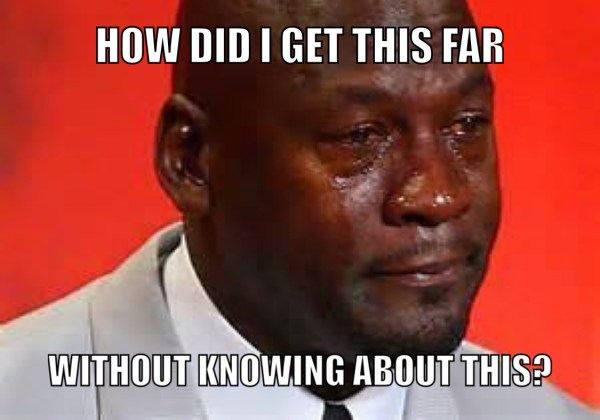
meme

….Um, wow.


Growing young writers….within an inclusive and equal…democracy.

 Lesson Talk:

Our English IV classes are investigating research through several modes this year.  We’ve read, talked about, and written: Letters to the Editor, Op Eds, Infographics, and now we are looking at TED Talks.

I wanted this exploration to be as pure to the workshop pedagogy as possible.  Instead of giving them an anchor chart or watching a TED Talk as a whole class, I asked them what they already knew about the medium and invited them to create a list of traits they looked for when consuming media.  Each class period was slightly different in what appealed to them and what they wanted to see in a TED Talk. Of course I guided them through this process of discovery, but one way I formatively assess them is by noticing what they already know and planning my lessons around filling in the blanks or extending their experience.

We laid the ground work of noticing by accessing our schema and I set them loose to seek out TED talks that appealed to their thinking.  The students engaged themselves in media that appealed to them.  They wrote about what they saw in their self-selected TED Talks that engaged the media as learners. I gave up control and gave them choice.

Of course, our forward looking thoughts aren’t just towards making us more savvy consumers of digital media.  Our thoughts should guide us toward being savvy producers of media as well.

 Growing young writers….within an inclusive and equal…democracy.

By late February, the seniors at my campus will produce a research project.  The fun part is that they will have choice in how they publish it.

I think the choices that we made as teachers are facilitating the, “sustainable growth of young writers within an inclusive and equal democracy.”  I’m proud of this work.  I’m also thankful for the teachers I have the pleasure of working with every single day.

How have others set free their students to explore their place in our democracy? What are other modes within which we can explore the research process?  Please share your successes; they are powerful.

Charles Moore has now totally lost control over his book spending habits. So much so that the cashiers at Barnes and Nobles don’t even ask for his teacher discount card and Amazon chose his house for their newest headquarters.  He loves the sound of a classroom full of readers and he likes to imagine word counts ticking higher as they hover above the students’ heads during reading time. His sometimes humourous musing can be viewed on his twitter page @ctcoach and his embarrasing short form poetry and, eventually, book recommendations are on instagram @mooreliteracy1

Who Else Have I Been Failing?

Among the countless ideas borrowed from the inimitable Penny Kittle are quarterly reading reflections (although by the time I got around to it with my sophomores, they wrote quarter(ish) reading reflections). I offered students a collection of reflective questions, generated from Penny’s work:

  • What has worked well for you so far in your independent reading?
  • What was challenging for you?
  • What might be helpful to overcome those challenges?
  • What reading goals will you set for next quarter/semester?

I love this work for the way it asks students to focus on themselves as readers, not just as students earning a grade. It also informs my plans, especially for students who are still meandering through workshop: fake readers and serial abandoners and the like. Much of what I found was unsurprising:

Students can be hard on themselves …

At home I read fairly inconsistently and met the goal of 2 hours a week infrequently. Looking back at this that is pretty pathetic; I did the math and figured out that reading that reasonable amount every week for me is the same as if I were to read just one minute for every waking hour.   — Robert P.

… and on their authors.

I have to say that Big Little Man was the most challenging because its story was quite confusing to me  … I had to piece events in order and figure out if it was a flashback or not. This confusing puzzle kept me up nights. I understand that he is adapting to the American life as a Filipino Man, but please explain it in order from Day 1.   — Dylan L.

Learning happened …

Even though I read only 2 books this quarter I feel that my habits are disappearing and that I’m becoming a better reader with each book. I feel that I am reading a lot faster and not stumbling on lines as much as I did all my life.  — Jacob V.

… and choice is emphatically good …

I’M NOT READING THE BOOK BECAUSE I HAVE TO. I’M READING THE BOOK BECAUSE I ENJOY IT AND WANT TO. [emphasis NOT added]        — Maluboo D.

… except when it’s not. 

Because I no longer have a criteria for choosing books, I no longer feel the desire to choose a book.   — Darielle W.

KeepCalmReadOn

Growing up in Delaware, Darielle had always chosen books by authors of color, “not because of their past, but because of their color, sadly. Although my past relates a lot more to an author of Caucasian, and privileged descent.” When she moved to Chicago seven years ago, her experience — and her understanding of her own identity — became more complicated. Reading books by African American authors became a way for her to “learn to be more like the people who looked like me … to appear more black, to fit in with them so that I could rid myself of the title ‘the whitest black girl I know.’ To understand how I am really seen by others.” Darielle’s book choices became even more fraught when she developed a relationship with a white boy.

I began to feel as if I was no longer black enough to read about these things. I’d suddenly felt guilty and unworthy of reading anything that had to do with the African American experience … which is very unfortunate because [these] books are all I’ve read or wanted to read since I moved here 7 years ago.

For all her reading life, Darielle had been trying to find a mirror. Amy Rasmussen deconstructs this reading metaphor in this post. Don’t we all search for mirrors in books, especially as young readers? What we read is about who we are. What others observe us reading tells them about who we are.

I thought about my past conversations with Darielle and realized how I had been failing her. Every time I asked her if she was still reading How It Went Down. Every time I asked her why it was hard for her to remember to bring her independent reading to class. Every time I playfully called her “the book sampler.”

Who else have I been failing? What is really behind the avoidance behavior of my other “fake readers” and “serial abandoners”? The answer, I see now, is far more complicated than finding the right book for them. The answer is about who they are, how they see themselves, and how they fear others will see them. 

In our RWW classrooms, students “get to” choose what they read. Shana examines the complexity of choice in this post. For some (read: many?) students, this freedom is heavy. What we choose to read sends a message about who we (think we) are. And what we choose not to read, or what we cannot decide to read, sends another message loud and clear. And now I’m listening. 


Kathleen Maguire teaches Sophomore English, Senior Advanced Writing, and AP Language & Composition in Evanston, a suburb just north of Chicago. When she’s not grading papers or reading books to recommend to students, she tries to keep up with her yoga and her 10-year-old son, Jude (not in that order). She tweets at @maguireteach.

Trigger Warning – Whole Class Novels

Ideas don’t sneak up on me. They hit me from just beyond my peripheral vision like a swift backhand to the kneecap. I can’t possibly go on as I had been only moments before. The ideas explode onto my consciousness, and then my to-do list, and then leap onto my calendar, and then to most of my waking moments until I actually do something about them, or surgically remove them somehow from my obsessive brain.

Translation: I had been happily proceeding about my merry workshop way with the start of the second semester, until this weekend when I met Kate Roberts from The Educator Collaborative via her recent blog post “The Healthy Skeptic.”

And now I can’t stop thinking about whole class novels. Or the brilliance of Kate Roberts. Or whole class novels. Or nostalgically gazing in the rearview mirror of my career at some whole class novels.

However, it would be disingenuous of me to paint my work with whole class novels, even The Scarlet Letter, with rose-colored glasses (Sorry. Hester has enough to deal with. I shouldn’t try to make this punny). Self-reflection and engaging students in honest dialogue, often reveals that my students, like most students, were experts in the art of fake reading. We were experiencing texts together, in many cases for far too many weeks at a stretch, but few were reading.

So while the merit of the texts in and of themselves might be harder to shake, it was easy to admit that the value to my students was relatively low in comparison to the amount of time we took, form writing we constructed, and smiling/nodding (on a good day) that was had.

I wasn’t teaching the readers, that’s for certain. And if students aren’t reading, I’m not really teaching reading either. We’re unnaturally drawing out the process for avid readers at best, turning young people off to or supporting preexisting negative feelings about reading at worst, and going through the motions far more often than our nation’s tenuous relationship with literacy can afford.

Yesterday, I found myself in a nearby district sitting around a huge conference table with two administrators, one reading specialist, and a dozen or so high school English teachers. I had been asked to come in and talk about Franklin’s experiences with high school workshop as this department weighs their options in moving forward with balanced literacy, daily practice, and all the options to start parting ways with traditional, and explore the unknown. This group of educators had incredible questions, a healthy amount of skepticism I think, and most importantly, a sincere desire to do right by their students.

We talked a lot about the nonnegotiables of workshop, considerations when structuring daily lessons, the difference between engagement and compliance, fake reading, assessment, classroom libraries, and the notion that teaching students to be English teachers leaves far too many students on the sidelines, nodding along or possibly disengaging from reading once and for all.

Mostly we talked about control. How hard it is to let go. How necessary it is to work to balance the power in your classroom. How creating a “reading love fest” as one cross-armed gentleman yesterday suggested, really is the best way I have found to get kids seriously, joyously, consistently reading. Is it a personal savior for every single kid? Sadly, no. Does it solve some problems and create countless more, absolutely. But here is the bottom line in my book: Letting go of some control to hand it over responsibly to the students whose education we are entrusted to support is one giant step toward getting our students to value that education that so many take for granted, can’t afford to really embrace, or think they don’t need for one societal reason or another.

Letting go of some control and embracing the very specific needs of the students can come in many forms. Right now, I’m thinking about how it might impact the selection of a whole class novel.

booklove

This needs to look different and it must be intentional in every class, and my estimation of what my students need is only going to take me so far. Selection of a whole class text must serve the purposes of addressing the specific needs of the students in front of me.

My ninth grade teachers know, from speaking directly with their students, that most read, but don’t necessarily challenge themselves. Additionally, many have had longer texts read to them (excellent!) but have rarely finished a longer piece independently (not good!). In this case, the team feels that starting the year with a pointedly chosen whole class text is needed to really help students see what they can be looking for, thinking toward, and discovering when they read on their own. Many simply don’t have that skill developed deeply enough yet, to really do the type of critical thinking we’re asking them to do. And if that’s the case, the changes that their skills will develop independently are markedly lessened.

At the upper levels, I now have students who have been working in the workshop for over a year. As evidenced by students with books across campus, there is more reading happening now than in years past. However, the push toward challenge is spotty and in some cases, the real depth of understanding when challenge is pursued seems even spottier. In this case, our AP Language classes are considering using Between the World and Me by Ta-Nehisi Coates to not only tackle some recent unrest in our own school community but to work carefully together to analyze author craft across the main ideas of this dynamic text.

The key is to choose with purpose. To invite student input into that choice. To spend a reasonable amount of time working with the text (3-4 weeks is a general recommendation based on my recent experience and the advice of those far more seasoned than I). To have student-centered goals in mind. To celebrate the text without covering every inch of it, and possibly killing the book AND a student’s hope of becoming a reader in the process.

Our students deserve what our careful analysis of their needs would suggest we best use our limited class time for. The unifying study of a text can be just such an activity. Your professionalism, the unique make-up of your classroom, and the social events/factors that should drive national discourse – these are some of the most important factors in selecting any curriculum; however, the goal should always be the same. We want our students to value the power that comes with better understanding the human experience. Powerful books can take us there. Let’s read them together.


Lisa Dennis teaches English and leads a department of incredible English educators at Franklin High School near Milwaukee. Her personal mission statement is a work in progress but needs to involve equal parts readers, writers, thinkers, believers, and dreamers. Follow Lisa on Twitter @LDennibaum. 

The Power of Self-Reflection

For the last 9 years, I have been living proof that dreams come true. Once I decided to become an educator, all I would do is picture my ideal classroom, inspiring kids and motivating them to learn. For any new teacher, the excitement to begin our futures is so powerful; I wanted to bottle that up and keep it forever. However, the first year was all about survival. I devoted every waking moment to my job because that’s what I always thought “good teachers do.” I was like the Energizer Bunny; I never stopped planning, grading, copying, (did I mention grading?), etc. It wasn’t until 3 years in that I realized that teaching was different than what I thought it would be. I still loved everything about being in the classroom (okay, maybe not the paperwork), but I still felt that something was missing.

unnamed - Edited

I poured through a plethora of professional books and signed up for every type of professional development out there. While I was (and still am) appreciative for the feedback from colleagues and leaders in my district, I couldn’t get that image out of my head – the one where my hypothetical students were smiling, learning, and coming back to tell me all of the lessons they learned in my classroom. I was convinced those “lessons” in my dream classroom had nothing to do with participial phrases or thesis statements. Desperate to fulfill my vision, I did something I had never done formally before. I began to reflect on my own performance as a teacher.

Some things that came to mind were;

What do I want students to gain from being in my class?

How can I connect with every student?

Was I doing enough to ensure my students felt safe to take academic risks in my classroom?

Would I want to be a student in my class?

Am I the kind of teacher I would want for my own children?

As the years went on, I continued to ask myself those questions constantly. I saw a difference once I was open to growing and changing to fit the needs of my students. The connections I had with my students strengthened, as did the confidence I had in my classroom and willingness to accept constructive feedback from my colleagues and administrators. However, my teaching assignment changed, and now, I was up against high school students a.k.a teenagers.face

Quickly, I learned that my motivational “talks” and individual conversations with kids were not enough to keep their attention and frankly, I was doing all of the work. That also meant I was doing all of the learning, and I was NOT okay with that. I remembered seeing something on Twitter about “Growth Mindset,” so I decided to give it a whirl. I put together a fun presentation, had my students reflect on their mindsets and even create motivational posters for my classroom. They became involved in their learning in a way that I had never experienced or expected.

IMG_7360

This picture is of a bulletin board in my classroom. We choose the best ones as a class at the beginning of school and refer to them throughout the year.

I knew this wasn’t something I would only do at the beginning of the year. Shifting a mindset is a continuous process; It can be difficult, frustrating, and make you question every single choice you make. For most adolescents, this is something they don’t do, or don’t know HOW to do.  This year, I have had a tough time lighting a fire in my students the first semester. No matter what I did, I felt as if my students were just going through the motions. I took our “Growth Mindset” further by having them check their own progress. I created a simple 5 question survey that would help me target the real issues my students were up against

Survey

As we talked through these reflection questions as a class, I reminded them that self progress is not limited to English class. They were free to reflect on whatever they felt they needed to improve on.

The questions weren’t rocket science, but they were the questions I wanted to ask each and every student. After all, they were questions I ask myself all the time! That is when it hit me. How many chances do I give my kids to be involved in their own learning? Shouldn’t they have a voice, a chance to explore and identify what causes them to be successful or not? Shouldn’t they have a place to figure these things out in a safe environment, free from judgement, rather than for them to be left to fend for themselves? Shouldn’t I be the one to model this openly for them?

One of the reasons I became a teacher was because I fully believe that what we do in the classroom transcends far beyond the mere 187 days we spend together. It is my purpose. Yes, I am passionate about learning, about reading and writing, etc., but my #1 priority will always be on valuing who my students are. Being able to show them that their progress (or lack of) is controlled by the choices they make, and that I truly care about the people they are becoming helps clear the way for them to take ownership of their learning. Once they see that their needs matter to me and they are encouraged to share them, they become open to change. They begin to see their obstacles as opportunities for growth.

Shana Karnes recently wrote about the power of conversation. She expressed that,

“Speaking and listening are much more than just standards for us to cover – they are the tools our students need to change themselves and the world for the better.”

I wholeheartedly agree. However, this doesn’t only apply to students. As educators, we should be the ones to model our own growth mindsets. Our students need to know that these conversations aren’t just one-sided; they have a voice, and how they choose to use it will help define who they are. We just have to give them a chance to do that. More importantly, we are the ones who need to be willing to listen.

What are some ways you encourage growth mindsets and reflection in your classroom?

Quote

Gena Mendoza is a proud wife, mom of two little princesses, and teacher of high school English. Her students are well educated in the fine art of disinfecting their hands when they enter her classroom and appreciate her aversion to fluorescent lighting. She is an excellent re-tweeter and is currently working on her goal of reading 50 books by the end of the school year! Find her on Twitter and Instagram at @mrs_mendoza3.