Category Archives: Pedagogy

7 Moves in My Workshop Schedule

Quite often teachers ask me what the daily schedule looks like in my workshop classroom.

This is a hard one. I think mainly because it is not about the schedule as much as it is about the routines, or manners, we start putting into place at the beginning of the school year.

I’ve had a lot of adapting to do this year. Moving to a new school and adjusting my lessons to fit 85 minute class periods where I see my students twice a week for sure and every other Friday — sometimes. This is quite a change from 50 minute class periods where I saw my students five days a week.

Our normal routines  — and these are non-negotiables that make workshop work — consist of reading, conferring with readers, talking about books, writing in our notebooks, revising in our notebooks, sharing a bit of our writing, and learning or reinforcing a skill, then….it all depends on our workshop task. That’s why writing about my daily schedule is hard.

Here’s the best I can do without going into a long explanation — that has to wait for my book (Penny keeps telling me that my book will never get written if I keep writing on this blog, and I know she is right. Only so much time.)

READ — 10 to 15 minutes. This is sacred and silent reading time. Students choose books that interest them. I CONFER with my readers, always with a specific focus, depending on my reader.

TALK about books. Sometimes I do a book talk, reading a few pages of the book, or holding a book interview like Erika does. Sometimes a student does a book talk, if I’ve talked to her first and know she’s passionate about the book she’s just read. Sometimes I ask my students to just talk about the books they are reading. Shana wrote about the Value of Talk, and I agree completely: “Talk is one of the most valuable tools at work in my classroom.”

WRITE in our writer’s notebooks. Everyday we need to have our students thinking on paper. When I forget, or think we do not have time, to open our notebooks and write — in response to a poem, or a video, or a story, or about the book students are reading, or about whatever — I regret it. Discussions are richer when we write first. Discoveries are more insightful when we write first. Writing is better when we write, just thinking about our ideas, first.

Then, something I learned from Penny Kittle, we always read what we wrote and REVISE. Penny modeled revising with a different color, and I ask my writers to do the same. I simply say, “Read over what you just wrote. How can you make your writing better? Maybe add a phrase or two that develops your thinking more. Maybe change a word or two that adds a punch. Maybe you can remove some words and make your thinking more concise. Where can you add figurative language or a list or an interesting style move?” (When I check writer’s notebooks, I always look for evidence of revision. We work on establishing the habit of revision, daily.)

SHARE some of our thinking. Sometimes we pair up and read our writing to a shoulder partners. Sometimes I ask for volunteers to share out their writing. Sometimes I randomly call on someone (and I usually allow them to opt out at least once if they are uncomfortable reading aloud). Sharing is an important part of our community, and from the first day of school we work on establishing a safe and respectful environment where we can all grow as readers and writers.

Learn or reinforce a skill via MINI-LESSON. (If I introduce something totally new, like one of the AP English Language exam prompts, obviously the mini-lesson will not be so mini. On these days, the mini-lesson time and the workshop time allotment swap places. Sometimes I need the focused direct instruction time because it saves time in the long run.)

Our routines usually take about 35 to 45 minutes. That leaves us about half the class period to hold a workshop. This might be a readers workshop if we are practicing close reading or if we are preparing for a Harkness discussion. This might be a writers workshop if we are composing a piece of writing or studying the moves of a favorite author.

Of course, if we are writing, I change my hat and confer with my writers.

I would love to know the workshop routines you establish with your readers and writers. Please share in the comments.

©Amy Rasmussen, 2011 – 2015


Yes, I’ll Share my Reading List

Awhile back I wrote Aim Higher™: A Case for Choice Reading and a Whole Lot More in AP English. I am pretty sure I thanked everyone individually for the comments. If not, thank you for helping me think through this pedagogy even more. One reader asked for my reading list, and I’ve been derelict in posting that. I am sorry.

Since my classroom instruction centers on helping students identify themselves as readers and writers, I being Readers and Writers Workshop on the first day of school. We read and workshop a short piece — sometimes my AP English Language syllabus one-pager. We write and usually do a short revision workshop. Students learn quickly that writing requires revision.

In years past I’ve even provided each students with a writer’s notebook — just so we could get started taking ownership of it on the very first day. (That was the year composition books were 10 cents. I haven’t seen them so low since.)

I give students the following list of books and tell them that at each quarter they will be responsible for getting their hands on one of the titles. They may purchase the book, borrow it from a library, download it to their device, or in extreme circumstances, check out one of the few copies of each title I keep in my room.

We are a classroom of readers, so reading is the only option.

Note:  I didn’t facilitate four book clubs this year. We only had time for three, and we never got to the first list of books below. It took me a long while to learn how to fit my instruction into the schedule at my new school:  a 90 minute period where I see my students every other day and then every other Friday. I lost some time figuring it out.

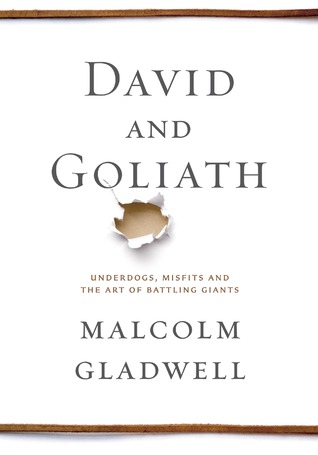
Next year, I am going to put this list first, and we will analyze author’s craft as we learn about argument. I’m also thinking of only introducing Gladwell’s books. I’ll add David and Goliath:  Underdogs, Misfits, and the Art of Battling Giants, and maybe What the Dog Saw: And Other Adventures after I read it this summer. That way students will still have choice as to which book they select, but all students will be reading books by the same author. This should work well as we study the moves of one writer, something I waited way to late to do this year.

Book Club One:

Outliers, the Story of Success by Malcolm Gladwell

Blink, the Power of Thinking Without Thinking by Malcolm Gladwell

The Tipping Point, How Little Things Can Make a Big Difference by Malcolm Gladwell

Freakonomics by Steven D Levitt and Stephen J Dubner

Quiet:  the Power of Introverts by Susan Cain


Book Club Two:

Extremely Loud and Incredibly Close by Jonathan Safron Foer

The Glass Castle, Jeanette Walls (non-fiction)

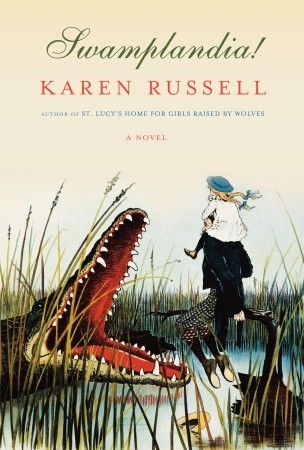
Swamplandia by Karen Russell

The Curious Incident of the Dog in the Night Time by Mark Haddon

Girlchild by Tupelo Hassman


Book Club Three:

The Namesake by Jhumpa Lahiri

Little Bee by Chris Cleeve

Sarah’s Key by Tatiana de Rosnay

The Kite Runner by Khaled Hosseini

A Thousand Splendid Suns by Klaled Hosseini


Book Club Four:

The Yellow Birds by Kevin Powers

Room by Emma Donoghue

Where Men Win Glory by Jon Krakauer (non-fiction)

The Bell Jar by Sylvia Plath

The Things They Carried by Tim O’Brien

Billy Lynn’s Long Half-time Walk by Ben Fountain

I am always reading some piece of compelling literature, always on the look out for the next book to add to these book club lists. My students did not enjoy The Bell Jar, although many students chose to read it, and no one chose to read The Things They Carried, even though I made as big a deal out of it as all the other titles. I just added Swamplandia this year, and then I forgot to talk about it, so it is still not vetted with students.

If you have any suggestions for compelling, complex, rich literature that engages adolescent readers, please share your titles in the comments. Thank you.


©Amy Rasmussen, 2011 – 2015

An Invitation: Are You Walking the Talk in Your Content?

Now, that is the way to walk the talk.

knowyourphrase.com

knowyourphrase.com

I attended a Vocal Majority concert Saturday. This is one awesome men’s chorus. When the emcee introduced a quartet, I sat up a bit. There, singing with The Essentials was the choir director from my high school. Wow, what a voice.

As he sang, I kept thinking: There is a teacher who walks the walk. His presence on the stage, singing first in a group, then in a quartet, and later even as a soloist, shows that he knows exactly what his students must do — and feel — when they engage in activities and performances in the LHS choir.

Credibility is huge.

I think about this as I talk with other English teachers. I should stop being surprised when I learn that they do not read — “unless it’s a book I’m about to teach, of course.”

I’ve heard that more than once.

Perhaps even a bigger concern than not reading:  many English teachers are not writers.

The thing that has helped me be a better writing instructor — not attending conferences or classes, not reading pedagogy books — the single most thing that’s improved my ability to teach writing:  Becoming a writer myself.

I understand the struggle to think of ideas, the headache of revision, the joy of finally getting something right. My students need to know that I know what all of this feels like.

Like my colleague the choir teacher, I try to walk the walk of my content. I am an individual intent on improving my literacy skills, just like I want my students to be. I talk about my reading life, and I share my writing life with my students, regularly.

I think they trust me more because they know I read as much as I ask them to read. I write as much as I ask them to write, and every major assignment I give to them I write myself (plus this blog and a book I’ve been working on for awhile now.) I even write blog posts about improving my writing: 5 Ways to Meet Your Writing Goals.

It is not hard to have credibility. But it does take commitment.

The Best Writing Teachers are Writers Themselves.

A couple of weeks ago, i joined in a #litlead chat. The topic turned to teacher-bloggers and why and how to become one. A few participants in that discussion spoke out and said they were nervous about starting their own blogs, but they know it is a good idea. I’m sure their reasons for wanting to blog are varied, but there are three possible truths:

Teachers who blog are more likely to 1) reflect on their practices, 2) seek out new ideas for topics to write about, 3) show their students that they practice the craft of writing — like they hope their students will do.

I offered to let those nervous about blogging to wade it a little and publish a piece here at Three Teachers Talk. One stipulation: You have to be an advocate for readers and writers workshop. (That is the main topic of this blog after all.)

So think about it:  Do you walk the talk and walk the walk? Do your students see you as an adult with passion for your content outside the classroom walls?

Would you like to write a guest post? Send me an email with your idea, and I’ll respond and set up a date. (amyprasmussen@yahoo.com)

I’d like to help you walk a better walk.

©Amy Rasmussen, 2011 – 2015

On Annotations and Assessment in Readers Workshop

If you’ve read this blog for a while, you know that I advocate for self-selected reading in all English classes. My students read stacks of books each year that they choose for themselves, and they read four titles for in-class book clubs that they select from my short stack of complex (mostly) contemporary titles.

The question I get the most from teachers who do not practice this choice pedagogy is “How do you know your students are reading?”

My initial response is usually:  “I ask them.”

But if you practice readers and writers workshop in your classroom, you know that it takes a bit more than that to know that students are developing as critical readers.

We do still have to teach.

Shana wrote a post recently about the value of talk in her workshop classroom, and I was intrigued by one of the comments:

I think we should consider what would be the best balance between between teacher and student talk. As the literacy expert in the classroom, I think the reading/language arts teacher’s voice needs to be heard often. While we all can be our own teachers, we will probably learn more with the wise guidance of a teacher.” 

But, of course.

Balance is key. So is authenticity.

These two ideals drive the choices I make in my workshop classroom.

My new friend, Lisa, sent me a question that got me thinking about both as I composed a response. I share her question here and how I replied to this dedicated teacher who is moving herself as she moves her readers.

Question:  Do you assess any annotations the students do with their reading? I’ve included a rubric we have been using to give students some feedback on their annotation of fiction. Their annotations in the text, and thereby their discussions about the texts, has greatly improved!! However, providing feedback on their annotations takes FOREVER. Just curious how you handle any sort of assessment related to students reading their chosen texts.” 

Response: Initially, when I read your question about annotations, I thought of these two questions:

1) Why do you need to leave feedback on the annotations in their books?

2) You said your discussions on the texts have improved. Are those discussions not enough of an assessment on their annotations?

Then I read your rubric, and it got me thinking.

I love the simplicity of the rubric, and I can see how students would notice more and be able to contribute to discussions more thoroughly and completely if they mark their books accordingly; however, I always use caution when it comes to interrupting a student’s reading flow — you know, reading for the sake of enjoyment.

In my own reading life, I rarely mark up a piece of fiction, unless it is for my own book club and I want to remember a significant passage that I loved, or didn’t understand, or a moment in the text that shocked or saddened me so much that I want to bring up in the discussion.

When I have my students engage in book clubs or self-selected reading, I want them to have authentic experiences and discussions about their books. (I quote Louise Rosenblatt on experiential reading at the end of this post.) That hope for authenticity is what drives what I have students do while they read.

And it is hard, and I have to trust that students notice the nuances and the complexities in the language and all the important literary aspects of their books. Sometimes they just don’t.  Sometimes they need to focus just on comprehension. I have to be okay with that.

Here’s how I try to facilitate learning:

1. Model my reading. I show students the books I’ve read for my book clubs and the kinds of passages I’ve marked so I can remember them for discussion. I encourage my students to mark their books in similar ways. Some will, and others never will. Some show me that they can think about their books without ever marking them. I have to let them learn the habits of readers that work for each of them individually, and I have to trust that they will.

This goes for writing, too. Every major writing task I ask my students to do, I do it first. I show them my process and later my product. For my ESL students, this is the single most effective strategy I do. I’ve asked them, and they’ve told me. I know that if this modeling helps my students who struggle with language, I know it helps all of my students.

2. Teach mini-lessons. Say I want students to focus on literary devices. I show them a variety of “beautiful sentences” from various texts; 51 Of The Most Beautiful Sentences In Literature was a perfect resource for this. I pulled several of these pretty slides and put them on a presentation in Drive. I projected them in the front of the room, and students and I talked through what we noticed in these sentences.

We discussed the craft in the sentence and why the author might have made the moves he or she did. This focus on the writing in a text often leads to greater critical reading of a text just as critical reading should lead to better writing.

Next, I asked students to go into their books and look for beautiful sentences. I gave them each a note card, and they had to find two sentences — one for each side of the card — where they could tell where the author did something interesting with language. I instructed them to write the sentence and the page number at the top, and then they were to identify the device/s, interpret the meaning of the sentence, and analyze the meaning, based on what they’d read in the book and what they believed the author was doing there as it related to the meaning as a whole.

What does this assess? A lot.

  • I know immediately if students know how to identify literary and rhetorical devices.
  • I know if students understand what they are reading, especially if the activity is during book clubs, and I’ve read all the titles in which students choose.
  • I know if students can analyze the author’s use of the device versus just summarizing the meaning of the sentence.
  • I know if students are reading their books. They are not going to choose a sentence on page 195, if they haven not read that far. They will not know how to tie their analysis into overall meaning

(The sentences I used for this mini-lesson lead to book talks, too, and I had one girl come in the next day with a copy of Anna Karenina that she’d bought for herself. Hooyah!)

Mini-lessons like this can be done over and over again — perhaps with a different skills focus each time, and the more students see that we are going to ask them to go into their books to focus on a skills, the more likely they are to start marking significant sentences and passages as they read. It becomes a natural move on the reader’s part instead of a mandate by the teacher.

3. Teach Notice & Note signposts. If you are not familiar with Notice & Note, Kyleen Beers and Bob Probst researched the patterns in story arcs and crafted six signposts around the moments in the text that appear the most often in a vast number of fictional pieces — short stories and novels. Students at all levels can apply the signposts as they learn to ask themselves questions as they read. In my experience, their understanding of theme improves dramatically.  If you Google Notice & Note signposts, or join the Facebook group, you’ll find many teachers who share their resources.

My students and I learn the signposts with short stories, and then throughout the year, we practice applying them to our full-length novels. Best thing I’ve done to help students analyze theme, which is SO HARD for some of them. I don’t quite understand why, but it is singularly the thing my students year after year struggle with the most.

For assessment, again, I do a lot with note cards. Quick, short writing snapshots where students can talk to me about what they know. I can grade these easily and leave feedback in the form of questions to direct students to look deeper, or closer, or whatever. I usually score these with check plus, check, or check minus and leave feedback in the form of one thing the student did well and one thing that might need improvement.

4. Write reader’s response. I have 35 composition notebooks that I labeled with thematic topics. I learned this strategy from Penny Kittle (Here’s a handout from 2013 that has a list of topics for notebooks in it.) I morphed her idea with Notice & Note, and it works well for reader’s response, another piece in holding students accountable for their reading and assessing their acquisition of skills.

At the beginning of the year, when composition notebooks are .50, I buy 35, and I label them with a variety of topics like Penny has on her list, plus some. I glue a handout of the signposts inside each one. Then, every once in a while, I’ll pull the notebooks out and set a handful on each table.

Students know to find a notebook that they can tie the thematic elements of their independent reading book to. We write for about 10- 20 minutes, depending on how in-depth I want students to go with their thinking, and then they share out what they wrote with their table mates. (This works as book talks, too, because students hear about what their friends are reading.) I wander the room and listen in. This is formative assessment. If a student has written about theme, shown that he is reading and understands how the book relates to that thematic topic, I know he is learning. Of course, the reverse is also true. I use check marks for grades of this kind of assessment, too.

Now, having told you all of this, I am not saying to ditch your rubric. I am just always trying to figure out how to put more of the responsibly for the learning (and the work) on the students, and probably most important to my sanity — the need to cut my grading time.

Regarding your rubric, I wonder:

A. How can you ask students to practice annotations with short stories?Then when you go to leave feedback on what they have marked, zero in on one or two slices of the rubric — never the whole thing. And be sure your feedback is something that will resonate. All too often students do not care about what we write, they only want to see their grade. I saw this great reminder in a tweet today:  “Put comments on my paper that begin conversations, not end them.”

B. Instead of trying to leave feedback on every students’ annotations for their whole books, how can you ask students to apply what they have learned from annotating?

For example, choose a slice of the rubric. Give students a half sheet of paper (or a notecard) and have them synthesize their annotations into a paragraph or two that answers a question. Something like :  Think about the things you’ve annotated about the characters in your book, how have the behaviors of the protagonist advanced the plot in the story?  Explain how any single or series of choices by the protagonist has surprised, unsettled, or shocked you.

C. How can you use the rubric to guide your conferences?Instead of checking their annotations, ask students to use their annotations as they talk with you about their books.

For example, choose a slice of the rubric. In a one-on-one conference, or in a small group conference if students are reading the same book, ask:  In regard to your annotations about literary elements, what have you noticed about how the author uses them? How do these elements help the author craft the story? Talk to me about some passages or sentences in the book that you’ve been particularly moved by.

You will know if students are paying attention as they read., and you’ll know so much more because your assessment shoots over the annotation itself and gets to the thinking behind why we want students to annotate in the first place.

Lisa and I would love to know your thoughts on annotations and assessment? Please leave a comment


©Amy Rasmussen, 2011 – 2015

Today We Draw

A Five Day Checklist:

Chancellor visit. (Check!)

Superintendent visit. (Check!)

A posse of outside principals observing. (Check!)

Our CBO (community based organization) pulled out = no counseling…or any other services…for students.  Teachers are now ALL of that. (Continual check!)

End of the Cycle (think semester) and the accompanied wildness. (Checking…all week long!)

*THIS WEEK.  Yes, in one week.  And, it’s Wednesday only.

 —–

The above is an email I composed to Amy, Jackie, and Shana in one of our most recent communications. In response, Amy wrote:  You’ve got the world on your shoulders this week, E!  And, it wasn’t until I was greeted with this affirmation that I realized it most definitely felt that way.  I was too busy moving through it to take a moment’s pause and acknowledge the intensity of it all.   The. Weight. Of. The. World.

It got me thinking.  If I felt this way, I couldn’t imagine how students were feeling as they were the reason for all of the visits.  They were the ones ‘on display’.  I just kept it business as usual with our Readers Writers Workshop flow; rigorous expectations, Writer’s Notebooks being utilized, Independent Reading occurring, questions being raised; chuckles here and there.  Yet, it felt off.  As I looked around the room, it occurred to me that students have taken on the weight of the world too.

They’ve been trying to articulate their thoughts wrapped around their chosen literature when the Chancellor asked them about their favorite books.  They’ve tried to be loyal to our collective work and answer the Superintendent’s question about rubrics (aside from the thought provoking work they’ve been creating) knowing that we are currently exploring with our pens and ideas sans a rubric.  They have tried to find comfort in their movement over the last six months, but these pressures have made them second guess themselves.  And the reason I know?  They’ve told me.

Yet, their resilience astounds me.  So, I dug deep.

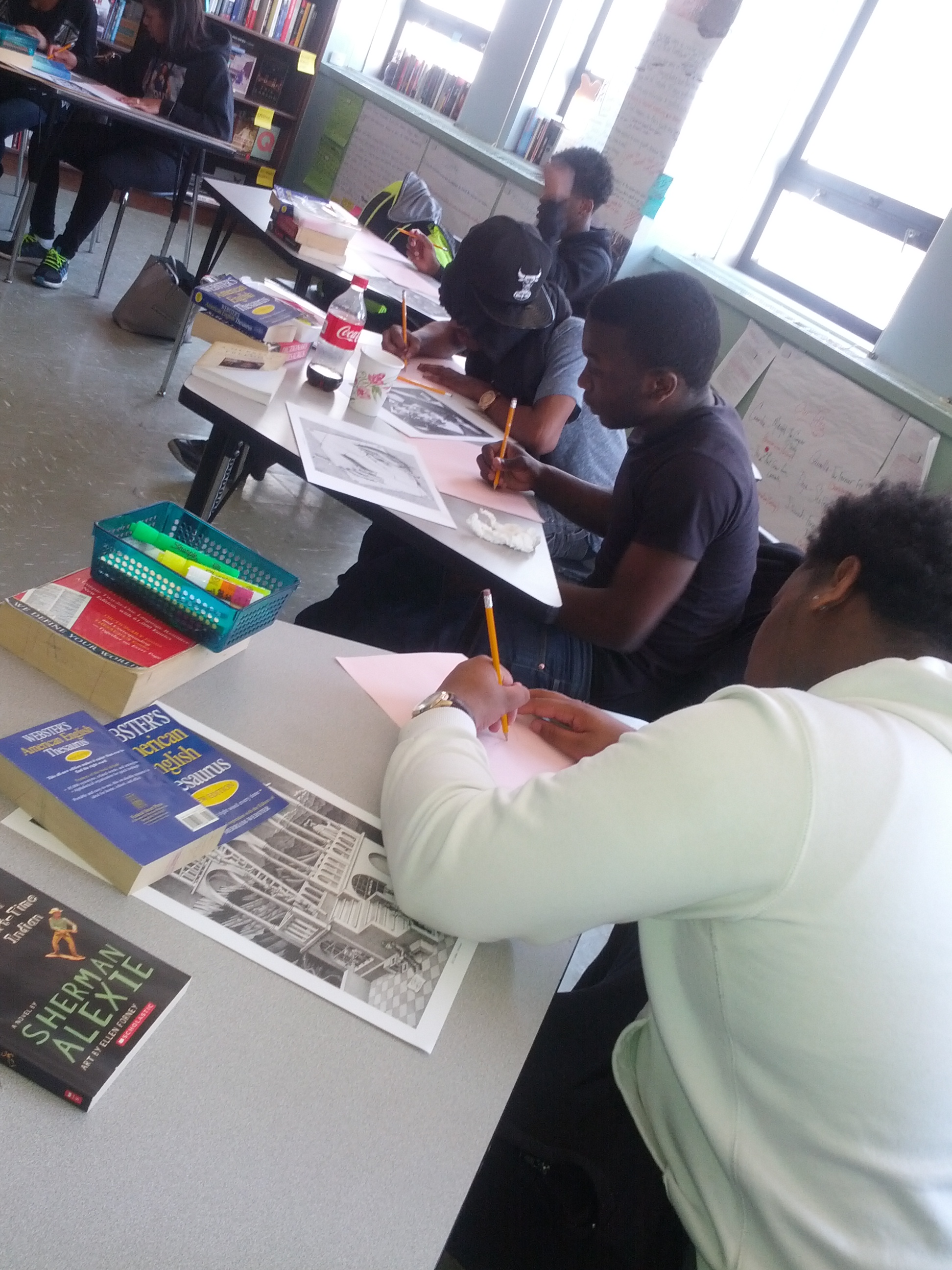
We needed a collective breath.  With all of the tension and uncertainty swirling about Room 382, we needed a class period full of calming zen.  I channelled my extraordinary experience at #UNHLIT13, as I was guided by Penny Kittle in sketching an already created piece of art.  Aside from my internal voices loudly telling me that there was no way I was going to be successful at this; I tried.  And regardless of how my sketch came out I knew the most important lesson is that I didn’t give up.

Calmly, yet intensely, sketching.

Calmly, yet intensely, sketching.

So, today we draw.

The weight lifted immediately and you could feel the energetic life seeping back into 382.  Students were riddled with questions: Wait.  We’re just going to draw today?  You mean, no writing?  We can do that?!  

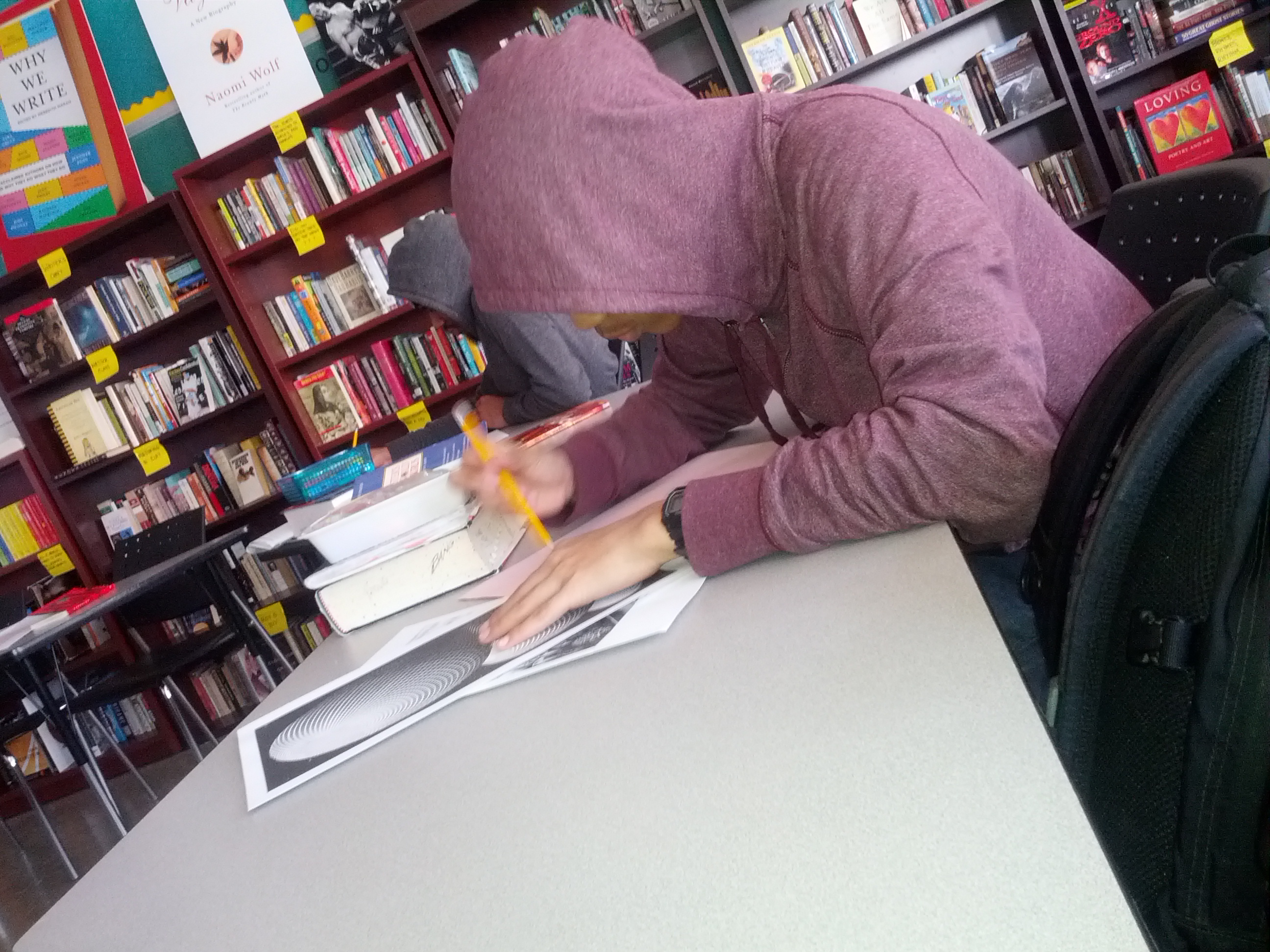
And, while some questions made me laugh and others prompted me to reflect, students were back.  So, everyone grabbed their newly sharpened pencils, chose the drawing that spoke to them most, and got to it.  I mean, really got to it.

Hoodies up.  Concentration in full effect.

Hoodies up. Concentration in full effect.


It was important for me to voice my intention: Folks as we partake in this together, I need you to know that I am wildly uncomfortable with all things drawing!  For the last six months I have asked you to find strength and courage in reading and writing that has challenged you to the core.  Today, I do the same.  (Deep breath)  Here I go…

While students zoned in, I followed their lead.  I sketched under the document camera so students could watch me struggle…and I mean struggle.  Yet, while drawing/sketching isn’t my forte, I needed students to watch me play with a level of discomfort they are not used to observing.  Students engaged in non-literacy conversation (as Shana brilliantly suggests here) while honing in on their focus.  Students approached me to lend their expertise on how to curve lines or align measurements or see the artist’s sketch with a different perspective.  It was exhilarating being the student!

Some of our masterpieces!  My attempt at creating a balcony.

Some of our masterpieces! My attempt at creating a balcony.

All said and done, here’s what I know.  The RWW is about so much more than always reading and writing; it allows the space to explore, mess up, build community, redefine rigor, and just enjoy.  On this given day, the latter is my favorite.

How do you find ways to calm the tension within your learning environment using the Readers Writers Workshop model?


They Taught Me the Lesson Here: It’s About Time

Please tell me I am not the only one in a rush. Every spring I feel this pressure to teach more, do more, assign more. I know part of it is the AP exam date creeping closer and closer. I know my students are still not ready.

We still struggle with rhetorical analysis. Most students are getting better at recognizing devices in the texts of others, but when they try to analyze the effect? Well, the light bulb is still quite dim. And I have to practically beg to get students to add a device or two in their own writing. So many are afraid to take risks or to explore with words and sentences.

As a way to help students play with language, I turned to POETRY. (Yes, even in my primarily non-fiction AP Language class.)

We read Meg Kearney’s “Creed” poem together, and we talked through the moves she makes to craft it.

Students noticed the sound devices, the contradictions, the little story, the concrete details. They did a fine job of noticing.

But we have to do much more than notice. And that’s the hard part.

I found this “Creed” assignment by a Mrs. Rothbard online, which fit my hopes for my students exactly, and I asked students to read and study the poem themselves and then mirror the moves of our poet.

I still cannot believe how difficult this was for some of my students. Some simplified the assignment and just wrote their own lovely poems. Others made beautiful lists of their personal beliefs — but that was not the assignment. Others modeled Kearney’s first few lines and then rambled on about angst-filled beliefs that the student writers didn’t even care about when they read them to the class. (Note to self: Revision workshop must last much longer next year.)

But, some…some student writers took ownership of their own craft and composed lovely poems, modeled after our writing coach and poet Meg Kearney.

Here’s the links to JerashiaGuillermoNaWoon, Doreen, Josh, and Sydney-Marie‘s blogs where they posted their poems. They’d love it if you’d read them and maybe leave a comment (actually, they will probably die because they think publishing to the WWW makes them anonymous–so much scarier to read their poems aloud in class, which is a topic of another post I need to write.)

I learned some valuable things as a result of this writing task, and I am glad that my students talked to me about what worked and didn’t work for them. I am glad I took the time last week to let them talk.

The comment that will guide our learning the rest of the year came from a table in the back when one of my quiet ones said:

“Could we slow down? We need more time to write with you in the room to help us.”

Yes, I know that.

If I want to truly help my students grow as critical readers and writers, I must devote the time to letting them think, draft, read, write, revise, re-do, share, and all of this again and again with me in the room as their coach, their mentor, and their cheerleader.

My students need to talk to me and to their peers like I talk to my husband and my collaborators when I am writing.

I thought I had this down by now. But what I think is enough time is obviously not what my students think is enough time, so I’ll listen, and starting today.

Class time will be different.

©Amy Rasmussen, 2011 – 2015

The Value of Talk

Talk is one of the most powerful tools at work in my classroom.  Now, I’m talking about talknot discussion, sharing, peer editing, Socratic seminars, think-pair-share, or any other structured form of communication that might occur.  The simple act of letting our students just talk is invaluable, and we must create spaces in our curriculum for it to take place.  Here are three ways I encourage talk in my classroom.

Conferences – Reading and writing conferences aren’t just about assessment.  They’re also a valuable time for teachers and students to just talk to one another, getting to know each other as the humans that we are.  Creating a space for talk breaks down the teacher-student barrier, humanizes both parties, and by and large erases discipline problems in my classroom.  I begin every conference with a simple, “How are you today?”, and after genuinely listening for the child’s answer, direct the conference from there.  Some conferences, we don’t talk about books or writing–we just talk, because the student needs to.

IMG_6441

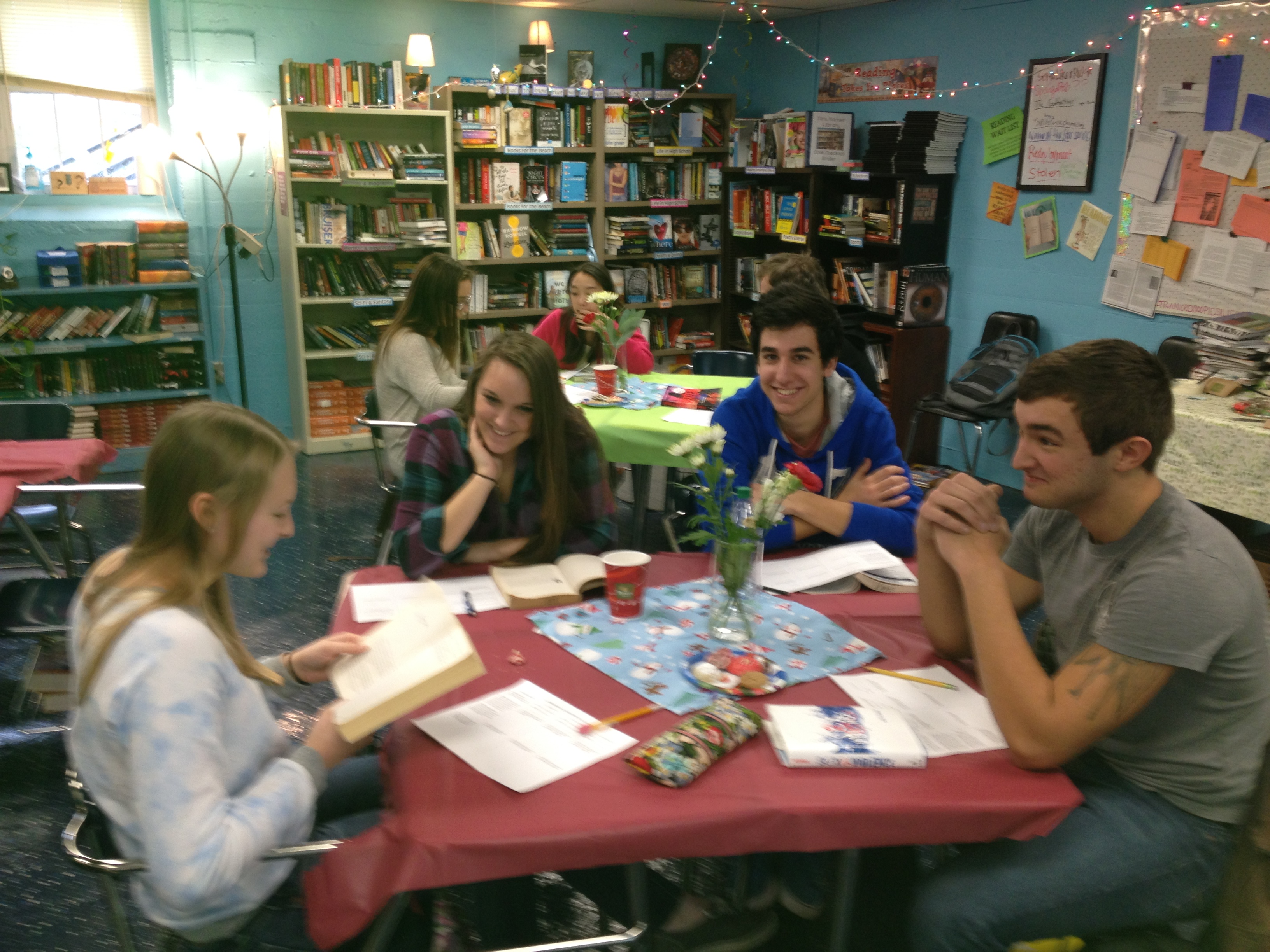
Students chat during the ‘Book Bistro’

Book Clubs – Not every book club meeting requires structure or an agenda to be valuable.  During this most recent unit, I simply asked students to keep the conversation going for 20 straight minutes.  They sometimes had to cast about for topics, but they always found something to discuss–mostly their books, but often text-to-text/self/world connections they’d made, which spun off into generalized, real-life conversations between kids who wouldn’t ordinarily find themselves chatting.  After finishing book clubs, Ana wrote, “I loved our book clubs because I felt like I got to know everyone better.”  She wrote other things about how she grew as a reader and writer…but she LOVED the unit because of the TALK that happened.

Root of the Writing Process – My journalism students consistently talk out their ideas at the very beginning of the writing process.  They chat in groups, usually starting with, “so what should I write about?”  It takes a few minutes, but enlightenment inevitably follows–the other day, Shay threw a few silly ideas out for Kenleigh about bathroom graffiti, but then they got serious about that as a story idea.  “You could call your piece ‘Signs from the Stalls,'” Shay said.  “AHHHH, that’s a great idea!!” Kenleigh enthused.  What kids like to talk about is often what they’d like to write about, and they need to talk to get to the heart of those topic ideas.

Talk builds community.  Talk is the tool that made my former student Emily say, “I felt like by the end of the year, everyone in the class became my best friend, including you.”

How do you see talk improving your classroom and its community?  What spaces do you create for talk in your classes?

Guest Post: Changing the Reading Culture in Our School One Book at a Time

Both Penny Kittle and Kelly Gallagher have transformed my thinking as a high school literacy coach.  As a former elementary school teacher, I had always used reading/writing workshop, literature circles, and choice in my classroom.  When I transitioned to being a reading specialist/literacy coach in a high school, I really struggled with the whole class novel approach.  It didn’t work for me with the little ones and I saw more and more of my students struggle with it at the high school level.  Attending workshops offered by Gallagher and Kittle, along with reading everything they have written has given me the reassurance and the research that this approach CAN work in a high school.  Here is what has happened at my high school in just six months:


More and more teachers are trying it…

It all starts with one teacher and the support of a department chair.  Last spring after sharing what I learned at Penny Kittle’s Book Love workshop, one teacher decided to drop everything he has been doing in English and take on the “Book Love” approach.  He had so much success getting students to actually read books and improve their writing that two other teachers decided to jump in second term and teach English through choice and mentor texts.  The results were astounding. Word spread at lunch and in our PLCs – students were engaged and excited to come to English class.  Then at the beginning of term three, we had four more teachers jump in.  I am not sure if it was the “positive peer pressure” or hearing about students’ engagement, but little by little teachers have been asking about how to structure their classes in a way to make this work.


Teachers are reading more and talking about books…

At times during lunch teachers used to vent about the struggles they had motivating students to complete the reading from the previous evening, or how students bombed the reading check, but now the conversations are about books. We are talking about what we are reading, what our students are reading, what mentor texts we are using, and what changes we see in our classrooms.

Thanks to one teacher’s organization and determination, staff members are swapping rooms once a week and book-talking to students that they don’t teach.  The other day the principal’s secretary came in to our freshman class and book talked The DaVinci Code.  After she left, I saw that several students had added that book to their to-read list.

None of this would even be possible if our teachers weren’t willing to read new books.  Teachers are setting their own reading goals, keeping to-read lists, creating book trailers, etc.  For the past two years we have had “I am Reading” posters outside of our classroom doors, but this is the first year teachers are updating their posters more often and students are noticing the books.


Our library is busier than ever before…

We have a beautiful library that has a lot of books that just didn’t get checked out.  This year that has changed.  Last year from August until the end of February, only 4821 books were checked out and 63 books were placed on hold.  This year in the same time period 7333 books have been checked out and 137 books were placed on hold.  That is over 2500 more books being checked out and 74 more books being asked to be held.  Why the change?  Student choice!

Students now come to the library with a purpose.  They have a to-read list (some that are pages long) and if all the books they want are checked out, they can give us a good idea of what they want to read next.  As one of our English teachers told me, “They are thoughtful about what they are looking for if they go to the library.”  He doesn’t worry anymore about students going up to the library trying to “leave class” or “waste time.” Another teacher shared how his students “know their favorite authors and/or recognize titles that have been book-talked.”  They are talking to each other about books and recommending new titles to each other.  They are even checking out 2-3 books at a time.

Our library staff is also trying hard to find ways to get books in our students hands.  Our librarian has shared ARCs with classes and spends time in the classrooms promoting tons of books – the new ones and some of the oldies but goodies that haven’t been checked out in a while. The staff has started creating competitions each month to encourage students to read (Abe Lincoln Award voting, March Madness book bracket challenge, etc) new books.  The library is no longer just a place for students to come and get homework done.


Students are reading….

They really are reading and not just the “YA” books that naysayers worry about.  Prior to taking this approach, students came into classes either as students who read all the time (1-2), students who only read assigned books, students who fake read assigned books, and students who didn’t even try fake reading the assigned books.  As one teacher pointed out to me, “As soon as choice became an option, reading, for the vast majority of the students, became fun again!”  They began forming a reading habit that had been lost so long ago.

The issue is no longer trying to get students to read anything. They are reading more consistently than ever before.   Instead of dealing with them reading zero pages in a week, teachers are finding ways to increase student stamina from 50 to 150 pages in a week. That in itself is a huge success.  Students come to class early and start reading their books.  They can even be found reading as they walk down the halls. One boy almost knocked over an upperclassman in his attempt to finish the chapter of his book.  Once a week I co-teach in a freshman English class.  Of those twenty-one students, I think only two students have finished three books.  The rest have read an average of six books in nine weeks (snow days and all). Instead of worrying how to encourage our students to read common texts and pass the reading checks, the challenge is having enough books that interest all of our readers.

Our students ARE challenging themselves – reading more, picking nonfiction, moving up the reading ladder, and trying new genres based on what others have recommended to them. I had one boy in my homeroom start with Hatchet by Gary Paulsen in January and stretched and read Escape From Camp 14 by Blaine Harden for book two.  It was definitely challenging for him, but he didn’t give up on it and was so proud when he finished it.  Other teachers are finding the same thing – students are willingly picking up books from Fitzgerald or Vonnegut, or Hemingway and are able to have real conversations about these books from their perspectives. Students are talking about books with each other AND coming up to teachers and discussing books with them. Because of the location of my office (the library), I tend to do book talks quite often when kids come upstairs and are looking for something new to read.  One of my favorite memories from this winter was a girl who had seen my Goodreads list and made her to-read list off of some of my favorites.  After she finished To All the Boys I’ve Loved Before by Jenny Han, she asked her teacher if she could come find me and talk with me about it.  She had loved it so much and wanted to thank me for introducing her to that book.These students aren’t afraid of looking smart or nerdy – they are proud.


The culture is changing…

Students are now immersed in books wherever they turn.  Between our March Madness Book Bracket challenge, I am Reading posters, Classroom Reading Trees, the Health class independent reading project, random teacher book-talks, etc. students are reading more than ever before.

Melissa Sethna @msethna23 is a high school literacy coach in Mundelein, IL. She has always had a passion for books, technology, and working with adults. In her free time, she loves to read.  She’s a strong believer in book choice and sharing her joy of literature with her family and students. She says, “I wouldn’t be the teacher I am today without my reading heroes: Penny Kittle, Kelly Gallagher, Kylene Beers, Bob Probst, and Donalyn Miller — who inspire me to take risks, and I try to encourage others to do the same.”

The Modern PLC

Sometimes things stay with you. In December I got this message:

I have been working with three teachers this fall who have transformed their classrooms (all ranging from freshman level to AP Lit and AP Lang) from the traditional class to a readers/writers workshop approach.  Your blog posts always show up in my email box at the exact right time when they are in need of inspiration to keep going and figure out what to do in their classes.  They realized very quickly how fast they were able to get through “old curriculum” when they dropped the class novel approach and were then scrambling to find new and exciting mentor texts, books to share, and additional writing ideas. Their students have read thousands of pages and enormous amounts of books which never happened in their classes before.  Students were writing them thank you letters for inspiring them to become true readers and writers.  Penny Kittle’s books got them started on this path, but your real life teacher posts have helped them validate what they are doing.  So… thank you and keep those posts coming.  They are making a difference in our classrooms.

I could write a book about the value in that feedback (Probably will). Feedback should make writers want to write more. That is exactly what Melissa Sethna’s kind words did for me and my friends here at TTT.

Her simple thanks also made us want to follow her work, support her even more, watch how she helps other teachers. We’ve become colleagues with a united purpose. We’ve become friends.

And that is the beauty of the modern PLC.

A literacy specialist in Mundelein, IL sends a thank you to a teacher/blogger in Lewisville, TX, which makes the teacher/blogger want to become a better teacher so she becomes a better writer so she writes more inspiring and instructional blog posts for other teachers and so on.

Teachers supporting one another as we do our best to do right by the children that we teach. As ELA teachers the best way we know how to do that is through balanced literacy practices in readers and writers workshop.

That’s the foundation for the Three Teachers Talk blog, which started as three friends committing to stay in touch by sharing our work through our writing. We are four teachers now — writing, sharing, and growing. And participating in a Professional Learning Community that’s been redefined, refocused, and restructured by connected educators around the globe who are just like us.

Thank you, readers, for being part of the best PLC on the planet.


Note: Melissa Sethna posts as a guest blogger here tomorrow. Her work inspires us.

©Amy Rasmussen, 2011 – 2015

Five Steps to Fostering Balanced Literacy in Your American Lit Class

How does your district handle classes that are very content specific? For example, I teach Honors/Pre-AP American Literature. This is a sophomore (with accelerated freshmen course) that has a pretty traditional literary movement focus, which includes several of the classics (The Scarlet Letter, Huck Finn, Of Mice and Men, The Great Gatsby, The Things They Carried). And while I feel I have made great strides over the years in terms of student driven lessons, focus on discussion and annotation, skill vs. content based assessment, the one area I continue to struggle with as I look to workshop is how to facilitate the choice. 

This post is Part II of my response to those questions I received via email. See Part I here: Choose to Become a Classroom of Writers

I’ve thought about your query about your “content specific” American literature class a lot, and I keep getting stuck on one question:  Does the class have to revolve around full-length American novels?

I ask this for a couple of reasons. First, in my experience, many 11th grade teachers, in Texas at least, think that they have to teach English III as a survey of American literature; however, the  curriculum standards (Texas Essential Knowledge and Skills or TEKS) do not mandate that. Yes, there is a standard that requires students read American literature, plus another that says American drama, but there are 11 other reading standards (plus Fig.19, which is a whole other story) and at least that many writing standards.

All of these standards are classified as either readiness (they will be tested on state exams) or supporting (they may be tested). The standards mandating American literature are supporting — meaning perhaps that they might not carry as much weight as readiness. Yet many teachers design their whole year’s worth of reading around one American novel or play after another, at times ignoring all the other reading standards that state that students should read a variety of other texts — fiction and non-fiction. Seems to me that if we do a mash up of all the reading standards we’d come up with one overarching goal:  Create readers. All adults should take note

How can we create readers if students are not reading? More and more research proves this is so.

Many of the junior level teachers here teach the American literature survey because that is the way it has traditionally been done — prior to the changes in the standards, almost 10 years ago, and our new state tests, three. Most have not learned how to do anything differently — like facilitating readers and writers workshop.

So, I wonder about the standards that drive your class. Are they like the TX ones that require some American lit, or is the class designed by your campus and/or district to be one focused on a survey of American Lit?

If it’s the first, give yourself permission to let some of those whole class novels go. You can step right into allowing more student choice. You can select short texts to read together, conduct book clubs where students still get choice but with your parameters. Imagine the possibilities for short stories and passages where you can teach the same skills you focus on when you teach those full-length novels.

If it’s the second, I wonder what you can do to change the course design. Would your administration be atticus finchokay with you taking a more balanced literacy approach and only reading some of those whole-class texts? You will have more time for writing, and you’ll have a better chance of moving students as readers because odds are you’ve got many students who are not reading those books. We’ve all been there.

If you haven’t read the English Journal article Not Reading: The 800 Lb Mockingbird in the Classroom, it is a fantastic piece that reiterates the problems of students faking their way through their reading.

Another great article is this one by Tim Pruzinsky, an IB teacher at an international school in Thailand. IB mandates specific texts, but Tim still manages to get all of his students reading novels of their choice.

Here are some ideas that might help as you continue to transition your instruction. The moves you’ve already made are probably much harder than these:

Five Steps to Creating Balanced Literacy in your American Literature Class (in no particular order):

1. Intentionally decide which of your current novels are nonnegotiable. Which book do the majority of your students read? Which book adds the most to your reading community in terms of discussions that build relationships? Which book are you able to teach the most skills that students can apply to their own independent reading? Keep that novel (or a couple of novels) as your whole class texts.

2. Decide to read fewer whole class novels and increase your reading of shorter whole class texts. How can you teach some of the skills you normally do with novels with short stories, poems, and a variety of non-fiction pieces?

3. Decide what type of writing will benefit your students most. Choose mentor texts that relate thematically to the novel/s you let go. You can still have the rich discussions surrounding a text and teach annotation skills without mandating another whole class reading assignments.

4. Select a short stack of books and facilitate Book Clubs. Students choose a book from the list to read and discuss with their peers in small groups. Visit each group and briefly join the discussion to hold students accountable for their group time. You might conduct Book Clubs 2-4 times a year to allow for choice with parameters and to ensure that all students reach for books that meet your ideal of complexity.

5. Decide to promote reading in your classroom and take no excuses from students. Talk about books and reading daily. Devote 10-15 minutes of self-selected reading time at the beginning of every class period. Confer with students about their reading regularly. Read a lot, so you are able to match students with books that they will want to read.


Anyone have other ideas to help make the move to more balanced literacy? Please leave a comment.

©Amy Rasmussen, 2011 – 2015