Category Archives: Readers Writers Workshop

How We Built our First 3 Weeks of Workshop

Picture1

Look at Sarah’s room!

A classroom built around flexible seating is amazing for kids building their literacy.  Comfy chairs, tall stools, and bean bags take a student out of a “classroom” mindset and into a creative work space that encourages ideas to flow across boundaries that might have been impermeable with rows and rows of sterile desks.

It works just as well for teachers building a workshop from thin air. You can imagine how comfortable that tan couch felt on the last Friday morning before the start of school.

Sitting in that room for this much anticipated planning session felt as comfortable as if I’d been there for a decade.  Five teachers with a singular focus gathered their resources and experience to put together a plan that was student focused and built on the foundation of workshop.   I got to know this group well at the Literacy Institute but I’m still trying to learn the full extent of their individual and collective power.

It is important, on our team, to be intentional and explicit with our lesson design.  The kids should know exactly what we are doing and why we are doing it.  They should recognize the moves their teachers make and take comfort that those moves were selected specifically for them. There is no reason to keep the “why” and the “how” a secret.

On this team, we typically build lessons with an eye towards a learning focus that starts with something like: I want you to know that readers/writers ….. do something. (Thanks Amy, Billy, and the Lit Institute.)

For the first three weeks, though, we talked about using: I want you to know that members of a Reader/Writer Workshop….do…one of the six pillars.  You get it.

Our curriculum documents, designed by teachers, contain a section devoted to the six routines of workshop instruction and the following are the routines around which we built lessons:

The Reader’s/Writer’s Notebook

Lesson Focus: I want you to know that members of this Reader’s/Writer’s workshop use a notebook to explore thier literacy.

Our “notebooks” look very different teacher-to-teacher.  Some of our classes will use traditional composition notebooks and some will use Microsoft OneNote in our explorations.  Either way, the point of having a safe and personal place to plan, draft, revise, reflect, etc. remains consistent across our classes.  Its not enough for us to ask the kids to have a notebook, they need to know the importance of having it.  Some of the kids struggled with following my set-up instructions because they were intentionally vague.

Student: “Mr. Moore, what categories do you want us to use to track our reading this year?”

Me: “That’s up to you.  Its your notebook.”

Self-Selected Independent Reading:

Lesson Focus: I want you to know that members of this Reader’s/Writer’s workshop take ownership of their reading and writing experiences.

I remember back to last year, and how much the kids struggled genuinely connecting to a book. Maybe it was the hurricane sitting out in the Gulf or that they really only had one year of workshop leading up to their senior year.  What ever it was, we worked hard to take ownership of our reading, so much so that I wrote about it here and here. (Looking back at those words is like seeing the words of a different writer, but I digress…)

Mentor Texts:

Lesson Focus: I want you to know that members of this Reader’s/Writer’s workshop use mentor texts to guide their learning.

We use mentor texts to teach kids how to read and write like a writer. The students need to know that we looking at the writing of others with specific intentions in mind. Its important to delineate the separate lenses of craft and content and constantly reinforce the importance and interconnection of both.

We planned for ways to write beside them.  When I write in front of my students it invites them to connect to a writer from their community.  This connection is between a student and a person that shakes their hand every day and smiles when they make eye contact. That’s an incredibly deep connection and one that I’ll leverage every chance I get.

Mini-Lessons:

Lesson Focus: I want you to know that members of this Reader’s/Writer’s workshop look at specific skills that we want to learn and then apply those skills to their reading and writing.

The skills we choose to highlight are intentional and our students need to understand that they aren’t chosen at random.  Not only that, but we aren’t going to spend more than a few minutes in our mini-lessons before we move back into reading and writing, with an emphasis on those specific skills.

Collaboration:

Lesson Focus: I want you to know that members of this Reader’s/Writer’s workshop listen to others share and provide feedback that supports their growth.

I can’t teach all 30 of them all the time and maintain any level of effectiveness.  We have to build a supportive community that  allows me to widen the feedback cycle from one, typically confident student, to 30 who are confident to share with their confidants. They need to know that the days of me asking a question and calling on one person for the answer are far behind us.  We practice the routine over and over. Ask a question, discuss in group.  Ask a question, practice their thinking through written response. Rinse/Repeat.

Oh, and they have to be trained not to shoot up their hands or shout out an answer when they are asked to notice something.  Instead, they will learn to sit in the silence and let their thinking wash over them in waves. Or maybe the metaphor is to peel back the layers of their thinking like an onion. Whichever you prefer.

Conferring:

Lesson Focus: I want you to know that members of this Reader’s/Writer’s workshop take advantage of opportunities to talk one-on-one with the expert in the room.

The importance of regular one-on-one conferences can not be understated. I’m not just “checking-in” on them while they read and write.  I’m digging into their thinking for places I can provide support.  We will explain to our students how important it is for them to be honest and open when we confer.  They can’t hold back due to nervousness or fear. Like Jerry Maquire said, “Help me, help you!!!” with that typically creepy look on his face.


Based on our planning sessions, impromptu secret meetings, and the genuine happiness in which we approach each other, I know this year will be my best ever and it is because of the work this team will do together to move our freshman class forward in their literacy.

Now, in all seriousness, lets cross our fingers and hope nature and fate don’t hit us with the same intensity as last year.  We all need time to heal a little more.  Let’s do it together.

Charles Moore had a quiet Friday night and went to all four of his son’s soccer games this weekend.  He passed El Deafo by Cece Miller back and forth with his daughter this weekend.  He put more than two thousand words to the page this weekend between his grad classes and this blog post; a new record.  He can’t wait to get back into the classroom Monday morning and learn alongside the students.  And he wishes you the same happiness he’s enjoying right now. Visit him on twitter or instagram.


Poetry Matters (and not just in April)

Screen Shot 2018-08-23 at 5.10.47 PMPoetry is alive. It surrounds us, breathing life into our Instagram feeds, popping up as videos on Facebook, nestling into our daily lives. If you follow the conversation on Twitter around #teachlivingpoets you’ve likely been introduced to poems from writers like Sarah Kay, Clint Smith, and Rupi Kaur. According to a study released from the National Endowment for the Arts, 28 million adults said they read poetry last year — a 5% increase from just four years ago. According to the market research firm The NPD Group, poetry book sales are one of the fastest growing categories in publishing. Library shelves are full of novels in verse — Jason Reynolds’ Long Way Down, Elizabeth Acevedo’s Poet X are two of my recent favorites. Poetry is not just alive; indeed, it is thriving.

Too often, though, poetry in our curriculum continues to be relegated to a unit during National Poetry Month in April, after state-testing has passed and teachers feel like we can have “fun.” We must expand the space poetry occupies in our classrooms. In fact, Nancie Atwell, in her introductory letter in Lessons That Change Writers, explains that she uses poetry as one of the first units of her year, because “my students showed me that no genre can match poetry in teaching about the writer’s craft.”

Here are some of my favorite ways to use poetry in the writing workshop throughout the year:

“Rambling Autobiography” by Linda Rief

In the pantheon of “getting-to-know-you” poems, Linda Rief’s poem “Rambling Screen Shot 2018-08-23 at 4.56.03 PM.pngAutobiography” is one of my favorites. Students are captivated (and sometimes surprised) by how Rief jumps from idea to idea, creating rhythm and flow. They like that it doesn’t have to all “make sense.” Some of our best writing all year comes from this piece. Sometimes we write the poems towards the middle of the year. Sometimes we go back and write from a sentence. Sometimes we go back and mine the poem for other writing ideas. After writing from their own perspective, students could later try to write from someone else’s perspective. (note: please create space for students to write about themselves first! It builds confidence, fluency, and buy-in.)

You can find “Rambling Autobiography” along with other quickwrite possibilities in Linda’s latest book The Quickwrite Handbook (a quick google search turns up lots of poems written by students using Linda’s as a model).

“The Truth About Why I Love Potatoes” by Mekeel McBride

Reading like a writer, as Shana wrote about yesterday, is a powerful part of the work of a writer. Poems give us wonderful touchstones for being able to do this.

One of my favorite poems to share with students as we examine author’s craft is “The Truth About Why I Love Potatoes” by Mekeel McBride. I was first introduced to this poem when teaching with Tom Romano (he wrote about it how he uses it in his book Fearless Writing).

After drafting their own poems, I often invite students to gather research about their topic and add a layer of information to the piece. It’s great practice for weaving research among your own words. I also love how Amy Ludwig VanDerwater reminds us that poems reside within the world of informational writing.

“Possibilities” by Wislawa Szymborksa

Ever since I first saw Beth Rimer, co-director at the Ohio Writing Project, share this poem with teachers a few years ago, I’ve been amazed at how effectively it can be used as a launch pad for argument writing. We examine the way each line flows together, but also stands alone. Imagine having students create a list of things they prefer, then going back and revisiting for the claims that live in their lives. We can then infuse that writing with research, or even practice adding hyperlinked citations as evidence for a line. There are so many possibilities (groan…pun!).

So here are a few ways you might add poetry to your classroom. Maybe you already use these — we’d love to hear about it. Or we’d love to know about all the other ways we know you’re using poetry. Share your ideas (be sure to tag @threeteacherstalk). Together we can fill our rooms with poetry all year long.

Angela Faulhaber lives in Loveland, Ohio and is gearing up for another year of literacy coaching and teaching pre-service educators at Miami University. A version of this post appeared in the Ohio Journal of English Language Arts Summer/Fall 2018 issue in the Editor’s Note, where Angela has just finished up as editor. 


We Can All Be Writers

Penny Kittle absolutely ruined reading for me five years ago.

You heard me. Destroyed it.

In the summer of 2013, at the University of New Hampshire Literacy Institutes, Penny taught me how to read like a writer. Our class studied short poems and discussed the deliberation of the author’s diction with a sense of wonder rather than through the lens of “what does this symbol mean?”. We read whole books in book clubs and gave a presentation about our texts on simply its craft. We wrote process papers at the end of the class that told the story of how we’d written our final essays.

Something about this made me absolutely unable to mindlessly read anythinganymore. Online articles, advertisements, tweets, and even beach-appropriate fiction just screamed CRAFT ANALYSIS!!!! at me. I couldn’t really relax and let go while reading anymore–instead, I was hypersensitive to the words I read, thinking constantly about what the author had lived, and done, to write such a work.

The total immersion in craft study of those two weeks has stayed with me, five years later. In every book I read, I have a new appreciation for the work of the writer–the work of writing.

writer.jpg

The craft of language, the power of literacy, is everywhere.

And seeing writing everywhere helped transform me from a lifelong reader into something more: a writer.

I start my day with the awesome Twitter crew at #5amwritersclub. Many participants are teachers, writing before they begin the day with their students, and many others are parents, writing before they begin the day with their children. I identify with both groups and love the sense of identity that comes from writing beside my tribe.

I feel the same way about writing in online communities like this blog. Every time a Three Teachers Talk post appears in my inbox, I think about not just what the post says, but also what my fellow teachers were thinking and doing as they wrote. I have watched Amy’s and Lisa’s thinking grow over time, since I’ve had the privilege of reading their writing. When Amy wrote about beating the dread, and when Lisa wrote about settling into summer, I read beyond the “I agree” part of my teacher brain. I thought about those women, both moms, cramming in some writing after their (grand)kids’ bedtimes, or in the early morning hours before school, or on their too-packed planning periods.

This is, in part, what helped me shape my identity as a writer. I saw my peers, my friends, my teaching neighbors writing. I saw their process, their thinking, their methods translate into writing. It showed me what was possible: that I, too, was a writer.

Our students need to see this.

As we kick off this school year, we need to make not only our own writing processes visible–from initial thinking, to drafting, to tinkering, to publishing–but our students’ processes visible, too. Students who see one another write understand that it’s not a one-track process; writing can look different from one kid to the next, and from one school year to the next. The possibilities are endless.

We can all be writers. We should all be writers. Viewing the world so differently has no doubt made my brain more tired, but it has made my life so much more rich.

Believing that I could become a writer took time, a shift in my mindset, and lots of work…but it transformed my identity and introduced me to a whole community of writers I wouldn’t have met otherwise, and for that, I am forever grateful. I can only hope that my students someday can feel this sense of gratitude to the writers–both the teachers and students whose words they read, and the published poets and authors whose craft we study to get better–that I feel for every writer, every human, that I know.

Please leave a comment and let us know how you plan to make the writing process more visible for your students this year, so you might all become writers!

Shana Karnes is a mom of two, an avid reader and writer, and someone whose life has been immeasurably bettered by literacy and all it entails. She is grateful to be part of the Three Teachers Talk community, and loves equally her NWP@WVU and WVCTE (where a version of this post appeared earlier) peers and pals. Connect with Shana on Twitter at @litreader. 

Taking a Chance with Mentor Texts

I was both relieved and inspired by Amy’s post on ways to “avoid the dread” and make the opening day or days of our reading-writing workshop classes feel less like just like everything else, forms and lists of rules and the reinforcement of the dread of yet another school year filled with being told exactly what to do and how to do it. I loved her idea about author bios, and my teaching partners and I plan to use it along with another mentor text idea I stole from Allison Marchetti at the blog Moving Writers: James Gulliver Hancock’s Artists, Writers, Thinkers, Dreamers: Portraits of Fifty Famous Folks & All Their Weird Stuff. This  mentor text worked really well last year with both sophomores and seniors. I only wish I had done more with it, so I plan to do so this year, which is actually less than a week away!

As teachers of reading-writing workshop and followers of this blog, we are so fortunate to have the benefit of so many tried-out mentor texts to use with our students. Our own colleagues are of course our best and most trusted source for anything we need from the most philosophical to the most concrete. So, thank you for everything this blog has provided for me to be constantly reflecting and improving on my practice to provide the richest possible experience for my students.

But in the second part of this short-ish post, I’d like to present a handful of mentor texts that are not yet tried-and-true but hold (I think) some potential for reaching our writers who have their own very personal reasons for their reluctance as writers.

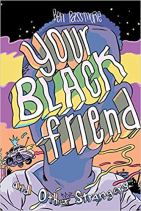
Your_Black_Friend_coverA collection of Ben Passmore’s online comics has been published late this summer as Your Black Friend & Other StrangersYou can read one of the NYT reviews here — I read the book myself and was blown away. Race and equity is a critical element of our curriculum and professional development. Ben Passmore’s work, I think/hope, can be useful for opening a cross-racial dialogue in a way that is accessible for its down to earth portrayal of what cross-racial friendship looks like from the perspective of a person of color.
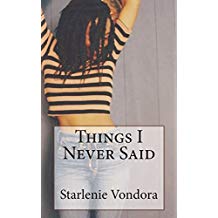
For this next one, Things I Never Said by Starlenie Vondora, I owe thanks to my Things I Never Saidcolleagues Mariana and Abdel: the same day I read Mariana’s review on GoodReads, lo and behold, Abdel had a copy of it just sitting in his classroom waiting for a reader. Disclaimer: This book is heavy, heavy stuff. I curated a few of the more neutral poems that might have potential as quick-write prompts or mentor texts. But I love the overall concept of putting down on paper “things I never said,” and I think teenagers might, too.

And so, we begin again. A friend of mine who recently left teaching was speaking wistfully about the cyclical nature of what we do, about the freshness of each new school year. It’s so true. Despite last year just about slaying me every day, I might be just about ready for this one. Aren’t we all? So let’s savor these early days, which for me will be the about the first five, just before it sets in that that I’m already behind, that there is never enough time and far too much to do. And we’re back to it, coming back and trying again every day. With a little help from mentors and friends.

Five Ideas that Beat the Dread

A few years ago I stopped reviewing class rules and smacking down my syllabus on the first day of school. I had been doing some research on chronic stress (mostly my own) and read extensively about the fight, flight, freeze response. One description glared at me and gave me pause:  “You have a sense of dread.”

I remembered what I had been taught as a first year teacher:  Set yourself up as the authority figure. Be kind but firm. Establish norms quickly so students know what you will and will not tolerate in your classroom.

Then, almost in the same breathe, I was told:  Develop relationships. Learn students’ names. Let them help develop class rules.

And I muddled through doing a combination of both the best I knew how. Those first few days of my first few years were rocky to say the least. And in hindsight, it’s clear:  there was dread. Lots of dread.

So when I read up on the fight, flight, and freeze response, I realized a big part of my problem:  With my seemingly simple attempt at outlining classroom expectations and detailing how ‘my class would run, chemicals danced a jig in students’ brains: fight, flight, or freeze. Now, I know my syllabus is not on the scale of major life trauma most often associated with this fff response theory, but many of my juniors and seniors didn’t want to be in school anyway. Why was I compounding it?

I learned a better way.

Wait.

Let every other teacher lay down the law. Lay out their plans. Run through the rules.

On the first day of school — maybe even the first five days of school — just write. And talk. Let students drive the discussion. Let them ask questions. Give them a chance to be seen and heard and welcomed.

“Community before curriculum” Angela wrote in her last post, and I love her thinking there. I also think we can merge the two on the first day of school and lay a firm foundation for thinking and talking every day thereafter. We can jump start community and begin our curriculum as we put pen to the page and write.

Here’s my top five sources that beg a response and invite students to write on the first day of school (or at least the first week or so):

  1. To This Day by Shane Koyczan.

Give every student a notecard and ask them to watch and listen and then respond to the poem as a whole or to a line they particularly like or relate to. (I’ve learned some pretty heavy stuff from students over the years. So many of them can relate to the themes in this poem.)

  1. How poetry can help kids turn a fear of literature into love by Jason Reynolds on PBS.

Give every student a sticky note and ask them to think about their reading lives. Then after they listen to Mr. Reynolds talk about reading, ask students to rate themselves. Are they readers eager for the pit bulls or for the puppies? Why? (I quickly find who my readers are and with whom I need to take on the challenge of helping them want to read.) Then for a little more of a challenge, on the flip side of the sticky, ask them to describe in poetic form their feelings about poetry. (You’ll learn even more.)

  1. Possibilities by Wislawa Szymborska. Or the version here where Amanda Palmer reads the poem.

Give every student a copy of the poem. Then read the poem aloud and ask students to write their own list of possibilities. Their list can be straightforward, funny, or interesting things they want the class to know. (I wrote about how I used this poem to practice imitation a couple of years ago. It’s a great lesson and a great poem to revisit.)

  1. Three poems:

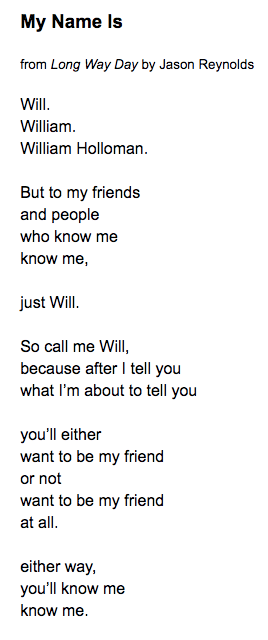
“My Name Is,” an excerpt from Jason Reynolds’ book Long Way Down. (If you haven’t read this book, oh, my goodness. It’s amazing!)

My Name Is by Jason Reynolds

“Instructions” by Rudy Francisco.

Instructions by Rudy Francisco

“Like You” by Roque Dalton, translated by Jack Hirschman

Give students copies of all three poems and a notecard or piece of paper. Read them aloud. Ask students to read them again and then to write a response. They can respond to just one of the poems, a line from a poem, or anything the poems make them think or feel. There is no right or wrong. Just write your thinking. (This is always an interesting response, and it tells me a lot about how to help my students. Many of them will begin to write an analysis of one of the poems — or all three. Others understand that I am asking for a different kind of thinking, one that leads them into ideas for their own poems, stories, or essays.)

  1. Author Bios!

Give students access to books that have clever, witty, or interesting author bios. YA authors like Julie Murphy, Jeff Zentner, Chris Crutcher, Libba Bray, and Gina Damico are great ones, but there are many with a bit of quirk that will draw students in and spark their interest in reading these author’s books. Ask students to explore the author bios and then make a list of the books they think they’d like to explore this semester. Have them write the author’s names on sticky notes for you to put in your conferring notes.

If you want to take this author bio idea further — (this is my favorite):

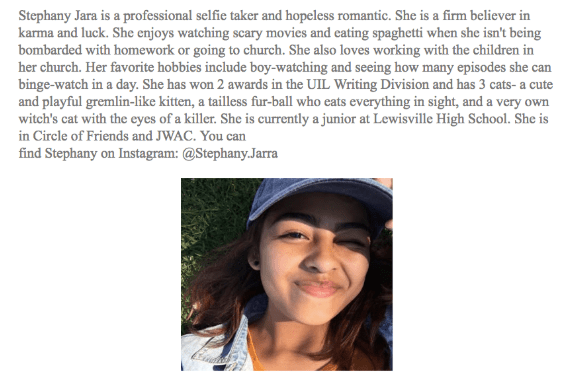
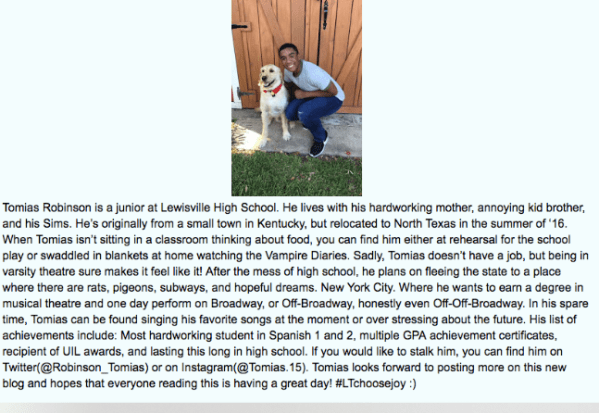
Read several professional author bios aloud. Ask students what information is shared and make a T-chart that lists the what on the left, e.g., name, personal hobbies, awards won, where the author lives, who the author lives with, etc. Then, ask students to describe how this information is shared and add these craft moves to the right. This is the how. For example, short and sometimes incomplete sentences, lists, 3rd person, the author’s name is first, witty word choice, etc. Finally, ask students to write their own author bio while you write yours as a model. Encourage them to try to craft their bio to include ideas from both the what and the how side of the T-chart. Below are two of my students’ bios from this past year.

Stephany author bio

Tomias author bio

(The author bio idea is Lisa’s baby, and she wrote about it here after I wrote about it here. It’s still the best idea I have ever heard to begin students on their journey into developing their identities as readers and as writers. I’ve used this idea in a model lesson for every workshop I’ve facilitated this summer, so if you were there, feel free to share the author bio you wrote this summer in the comments. My newest one is below.)

I wish you happy reading and writing with your students this year. Please share your go to ideas for inviting students to write and build your community.


Amy Rasmussen loves books, pretending to garden, adolescents, and coconut cream pie — not necessarily in that order. She lives in North Texas with her dashing husband of 33 years, their twin-terror Shelties Mac and Des, and a not so loving love bird named Colonel Brandon. Amy spent the summer leading professional development in several districts across Texas and has grown especially fond of the Houston area. If only she could move… Follow her on Twitter @amyrass — and if you are not already, please follow this blog.

3 Ways This Year Will be the Best Ever!!!

Can you feel it coming?  Do you smell new books and old desks?  Are you imagining the sounds of students shouldering their way through the halls and into your classroom like bees through long un-mown grass? (I’m a huge Oscar Wilde fanboy!)

Are you ready to hear a deep breath or quiet giggle interrupt a totally silent self-selected reading segment? Are you ready to mop up tears in buckets and heal emotional wounds with book bandages?

If not, you better get ready.  You may be starting school today, or maybe next week.  It doesn’t matter; time to get your mind right.

I’m ready to launch from the best summer of my life into the best teaching year of my life.  Happiness breeds happiness.

So here are three thoughts I have that will help me be the best teacher I’ve ever been.

  1. Book Talk like my teaching life depends on it…because it does.

If the number one tool in my belt is my classroom library, my number two is my ability to “sell” books.  We all know that we need to be able to sell books both informally and formally.

Informally, we confer with readers and talk about books with individual kids (and adults!) who are in the market for their next reading relationship.  This is the easy back and forth that comes with being a reader and contributing to a literacy rich classroom culture.

The formal moments, in my mind, are those points in time you carve out to stand in front of your class, or some group, and give them the hard sell on a book you’ve decided was worthy of their attention.

To me, these two different bookish scenarios require different thought processes and the latter is example is the one to which I plead my case.

Obviously we have to consider “how” we present the key information that we think will engender interest in deserving books.

But also, we have a massive burden to present books that offer a cultural variety of information that will allow our readers the “windows, mirrors, and doors” that Rudine Sims Bishop wrote about all the way back in 1990.

I took a step forward on the Sunday of the ILA conference and chose to attend a session featuring LGBTQ writers and their books.

Over and over, the panelists describe the point in their lives when they first encountered a character in whom they saw themselves.  Ashley Herring Blake, a primary grade teacher and middle grade writer from Tennessee talked about how she was 32 when it happened to her.  We have to be more pro-active when it comes to offering students windows, mirrors and doors.  Book talks are an opportunity in which we can’t afford to play it safe.

2. Love the kids like their learning lives depend on it…because it does.

I said it before: I will be 100% this year in telling my classes I love them before sending them out the door each period.  I’ve already been practicing with the Student Council kids that I hung out with at Fish Camp.  It was our first time to work together and as the day ended, I told them too. You never get a second chance to make a first impression.

But I’m not just going to say it to their backs as they sprint out of the room.  I’m going to say it to their faces as they enter and I’m going to write it on their papers.  Reading and writing culture revolves around love: of texts, but more importantly the readers and writers.

3. Empower the students to read and write in a massive volume like our world depends on it…because it does.

We know how important volume is in a student’s growth.  We have to let them read and write more than we can ever think about grading.

Also, we have to give them room to read and write in ways that let them explore their place in the world. Anything less than this, and I’ve failed. I will not fail.

Charles Moore will, for the first time in many years, teach Freshman English this year. His bleeding heart required him to volunteer to sponsor Student Council at this new school. You can follow his antics on twitter at @ctcoach


Independent Reading and Accountability: a Paradox

The paradox persists, every year. Here are some basic principles of my sophomore RWW course last year with independent reading:

  • Students were allowed complete choice in their independent reading.
  • Part of their writer’s notebooks were connected to their independent reading: Writer’s Craft and vocabulary
  • Students kept their own track of page progress.
  • I conferenced as much as teacherly possible.

Like many teachers I know, I tend to dwell on what didn’t work. So, here it is:

  • A few students chose to not read or to fake read, all year.
  • As a result, these same students either did not complete or faked their notebooks.
  • It’s not hard to keep track of zero.
  • Conferences became predictable: repeated proclamations of non-readerhood followed by a polite acceptance of yet another suggestion for a book, which would yet again be not- or fake-read.

Struggling yet again with this issue as we plan for next year, my colleagues and I find ourselves in the waters between the unstable shore of no grades and the concrete ledge of grading, that deep roiling vortex between theory and practice. In this post, Shana cites Pernille Ripp and Janice Pilgreen and translates some of their basic principles into a RWW model. We all believe in these principles and are committed to exercising them every day in our classrooms. Regarding practice, at the end of our most recent meeting we had been focusing on this one: a lack of graded formative assessment and an emphasis on summative assessments for learning, not of learning.” We even got down to the tools we might use to do so: Padlet, Flipgrid, video book trailers, even good old-fashioned book reviews and “live” book talks. We even discussed scaffolding these summative assessments to support growth toward the formal speech that is a requirement for fourth quarter.

Yay. Right?

Still, won’t there still be students who remain entrenched in — even empowered by — their non-reader status?

Last year, I had students who were able to earn a B- in the course while never reading a single word. They participated in the writing process. They faked their way through the reading-based components of their writer’s notebook. They even wrote about their non-reading in their “quarterly reading reflection.” This consequence of the grading policies of the course is not enough for me to revert to grading independent reading, but I can’t help but be preoccupied by it.

bbbSo, readers, I’ll leave you with these question: Is it realistic to expect 100% participation in independent reading? Must we accept that there will inevitably be non- and fake-readers among us? And if so, is success for the majority — when it includes those students who may not have succeeded with assigned reading — enough?

ILA 2018 Conference Run-down!!! (and an epiphany!)

Am I the only person who feels super awkward meeting new people?

So I’m standing in the “New to ILA!!!” section of the Austin Convention Center early Saturday morning.  Several well spoken women and men address the throng of newbies and supply us with important information about the conference.  Remarks concluded and we are encouraged to visit with those around us, meet new people, and hang out.

I’m there by myself waiting for Gretchen Meyer, my fellow literacy advocate, to arrive. She shared this conference experience with me and I couldn’t ask for a better guide.

IMG_4479

Can you imagine a more awkwardly handsome face?

So I’m scanning the crowd looking for familiar faces, assuming there won’t be one.  I’m an award winning people-watcher and for those of you who aren’t, teachers can be incredibly fun to observe.  Anyways, Marcie, an incredibly nice women with a bright smile introduced herself to me and we talked about the conference and how excited we were to listen to the speakers at the General Meeting that was to begin shortly.

Both of us, my new ILA friend and I, massively underestimated the level of brilliance that was about to wash over me.  I listened to Adan Gonzalez talk about his success in the face of poverty and bigotry and how he works to fight those demons today.  Nadia Lopez blew the crowd away with the statement, “I opened a school to close a prison.”  So…um…wow.  If that wasn’t enough, we got to experience the passion of Cornelius Minor and his charge to consider, “How can we not stand for our children…when the traumas of the world weigh them down in our classrooms?”

I had to pinch myself.  Was the rest of the conference going to be this amazing? (It was.) Was this euphoria and uplifting feeling of being re-energized going to fade as I left this hall and moved on to the other presentations? (It didn’t.) Was I ever going to see my new friend, Marcie, again? (I did, on the big screen, at the end of the general meeting.)

Marcie

Meet Marcie Post, the Executive Director of the ILA.

Even now, back in League City, I can’t stop reflecting on the lessons I soaked in at ILA.  Maybe the biggest realization I came to, and there were many, wasn’t about books or kids or literacy.  This realization encompassed all those ideas, but was really about me.

I realized that above all else, I’m a “culture” guy.

I’ve identified myself by so many labels over the years: Football guy, Coach that can teach, Book Lover, Literacy Advocate, Student First Teacher… all those things. But, when its all said and done, after 16 years in the classroom, culture means everything to me. The culture in my classroom is, obviously, important. Just as important, perhaps, and, for the most part out of my control, is the culture of the people around me.  I want to be around teachers that are happy people.  I want to feel like we are all in this together and that the kids will be the big winners in this world.

I think this seed might have been planted by this blog post by Lauren Ambeau, an intermediate school principal in my school district that posts on her own blog. Or it might reach all the way back to my first two principals, Marlene Skiba and Deanna Daws; two women that made me feel confident and valued in my teaching role.

I think, also, the people I learned from at my most recent, and longest, stay had a lot to do with it.  I have the honor of presenting with the brilliant Jenna Zucha next week and this woman took time out of her summer, twice actually, to visit with me about our upcoming opportunity to present about writing to the leaders and stake-holders of our district.  She guest posted on this blog back in May.  What’s funny about our second meeting, is that one of my best friends happened to be at the very same Starbucks. He’s a genius, and famous.  You might have heard of him… Ashton Kutcher thinks he’s cool.

bro

This summer’s Literacy Institute, our own sort of ILA, comes to mind as well.  Billy Eastman and Amy Rasmussen build a culture of respect, trust, and love that I try to recreate in my classroom.  The huge win came from spending three weeks with the beautiful souls whose teaching team I’m so looking forward to joining.   We laughed enough to get stares from the other groups and cried buckets on the last day as we bared our souls through our writing.  Sarah Roy guest posted about that process just two weeks ago and then Austin Darrow guest posted for Amy the next day!!!  Amanda Penny is one of the most fun loving people I’ve ever met. Looks like the culture I’m joining at my new place is strong, and, having gotten the opportunity to interact with the instructional leaders there, I know this is by design.

Kylene Beers, Sunday afternoon, said, “Our democracy requires that we hold onto our own literacy and not turn it over to a few pundits on this network or that one.”  This statement reminded me that I posted about this very same idea back in February.  Thus I’m reminded further that this blog, this digital workshop, is a culturally supportive space for teachers like me.

There is so much more to write about.  I plan to sprinkle those tidbits through my posts this year.

Understand this: I’ll fight for culture.  I’ll seek out good people and happy teachers for the rest of my teaching career.  The kids deserve it.

Charles Moore has his pool looking as clear as crystal.  He’s done a horrible job being a reader this summer. His kids spend most nights sleeping in a blanket fort in the boy’s room (thick as thieves, those two.)  He’s looking forward to sharing the experience of discovering a new school with the incoming 9th graders at Clear Creek High School.

I Survived: Subbing the Last Three Weeks of School (with 140 freshmen)!

I am a literacy coach. That means I spend my days supporting teachers: teaching mini-lessons, co-planning, developing (hopefully) high-quality PD. I adore my job, though sometimes a little voice niggles in the back of my mind, a voice leftover from my classroom days, the teacher voice that’s always a little skeptical of anyone who’s not currently in a classroom:

Do these ideas (still) really work?

Yeah, but you’re not in a classroom anymore…

This sounds great … but what about kids who [insert reality here].

When a long-term sub position opened up for the last three weeks of school, teaching freshman English in a district where I had been coaching, I jumped. I was excited, energized, eager to get in there. Sure, I’d be spending my days with 140 freshman. For the last 21 days of school. I got this. I felt like I could get some answers for that niggling voice.

Plus, I can do anything for three weeks, right?

The first day was hard. Like, haaaaarrrrrdddd. I texted my husband, a 20-year veteran high school math teacher.

8:45 am

IMG_1675

10:15 am

IMG_1673 2

2:45 pm

IMG_1674 2

It was so good for me to be back with students, to spend even just three weeks in the shoes of a teacher. I think it’s something folks who support teachers should carve time out for on a regular basis.

Day two was much better (read: I instituted seating charts — rookie mistake! And used my “deep voice” as needed.). We spent the last days of the school year immersed in a writing unit using writing workshop principles to structure our time. (We studied multigenre writing, which you can read more about here and here and here.)

One of the best parts of those three weeks was that I left affirmed in the work we do as writing workshop teachers. While I was reminded how challenging teaching is, it also confirmed how powerful it is when we carve space for students to explore their thinking. Students grew as writers in those three weeks. It didn’t happen by magic, though. There are intentional choices that workshop teachers make along the way.

Belief 1: Community (before curriculum)

Many of us are great at building communities within our classrooms. We start the year with narrative writing, or getting to know you writing, poems about our lives. We fill the space with student writing and take time to really get to know our students. We all have fresh notebooks and sharpened pencils.

How many of us, though, have been guilty of still having those early products hanging up at Thanksgiving break? If you’re like me, by the time January rolls around, the idea of community building is a distant memory as you begin to feel the pressure of testing season roll around.

It doesn’t have to be that way. In workshop, community is the catalyst for success, and building that community is never finished. In my time with students, I was reminded that before I can move into teaching the curriculum, I need to make sure that students feel safe and seen. We do that in lots of ways. Our favorite was using quickwrites (check out Linda Rief’s new book The Quickwrite Handbook) to launch workshop time. Then we’d share, sometimes with partners, sometimes whole group, sometimes just a line from our own writing. I noticed a community growing (in some cases one had already been in place, but in other classes not). From there, kids were more willing to take risks.

They wrote about brave and honest topics. One student wrote about his childhood spent playing in the woods. Another girl wrote about coming out and how she felt like nobody believed her. Other students wrote about church camp, horse camp, and The Office. Some kids designed google sites, others published in booklet form. They were brave because they felt like they were part of a community of writers and they had something to say.

Belief 2: Choice is crucial

We know from our own experiences how powerful it can be to make choices as writers, especially beyond choosing a topic. Writers make choices about all kinds of things — length, genre, tone, craft, font. We know, though, that often giving kids choice leaves them feeling paralyzed, crippled with self-doubt (or lack of motivation). I remembered that kids need to be taught how to make choices.

I started small. I was amazed at how powerful it was to let them choose how to store their pesky phones. They resisted turning them into me, but had no argument when I let them charge them at a makeshift charging station. I noticed too that when I let kids decide where to sit, even if just on the floor by the window, they were more willing to dig into the writing.

This led us to be able to have discussions about their most often asked questions, like how long? am I done? is that what you wanted? It’s tempting to just give them the checklist, to create a template and let them fill in the blanks (I’ve done it, okay? It was awful for all of us!). Instead, though, we worked towards empowerment so students could make choices that made their writing their own.

Belief 3: Teacher is the heart

If students are the life blood of a writing workshop classroom, then the teacher is the heart, pumping, motivating, breathing life into the space. That’s not to say we’re at the center, of course. But we are busy making sure we do our share so that all the other systems can keep working.

I noticed that when I wrote right in front of kids, they leaned in. They referenced my writing. I noticed that when I conferenced with them, they were more willing to share later. I noticed that when I asked them questions, they would think about their responses. Conversely, I noticed when I sat at my desk and tried to get caught up on grading or emails, well, they tuned out too. I set the tempo.

Writers need us in the background, nudging, nurturing (sometimes nagging). They need our steadiness.

Caveat

This is not to say that every kid dug in. There were several who chose to spend the last three weeks with their heads down. A few showed up every single day yet still ended the year with a staggering 25%. Writing workshop isn’t magical, after all. We invite students, show them the possibilities. They choose what to do next. But every day, we invite them. I’d say to one student, “I’m happy to see you today.” To another I might whisper, “you’re always invited to the writing table.” Out of the 15 or so kids across the day who refused to work, I was thrilled when one of them, Will, finally decided it was easier to write than to sit there every day. I’ll take it.

Conclusion

I am energized after my three weeks with students (6 weeks of summer has helped with that). I’m more committed than ever to the principles of writing workshop and to supporting teachers as we carve out space in our curriculum for students to grow as writers. I know that my time was short, but look at all they accomplished in just three weeks! If we can make this happen in just 1/12 of a school year, think of all we can do throughout a year!

Angela Faulhaber is a literacy coach in the Cincinnati area. She’s currently trying to get through the stack of books she hoped to read this summer, while also squeezing in pool days with her three kids, and maybe a nap or two before school starts. 


Assigned Reading Works as well as Assigned Flossing

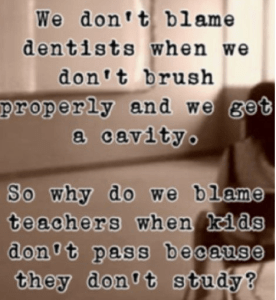
Every few months, I notice a meme recirculate with some variation of “Judging teachers on their students’ test scores makes as much sense as judging farmers on their crops without accounting for drought, freezes, or disease.” Still reflecting on my students’ lackluster AP scores as I sat down in the dentist’s chair this morning, I considered this meme. Then, like most teachers I know, I still wracked my brain trying to figure out what I could do differently to help my students score higher on that exam. As I mused, and chastised myself for taking their scores harder than I should, I endeavored to distract myself a bit by trying to remember the other meme out there that connected the professions of dentistry and teaching based on clients’ results. Ultimately, I looked it up when I got home, and it reads: “We don’t blame dentists when we don’t brush properly and we get a cavity. So why do we blame teachers when kids don’t pass because they don’t study?” Or read enough prior to twelfth grade, I thought.

Screen Shot 2018-07-24 at 1.57.38 PMMy cleaning ensued – painfully, I might add, as my technician was unnecessarily rough, and I wanted to ask her if she remembered that a person was attached to those teeth, but I found it too difficult to ask such questions with someone’s hands in my mouth. I waited for the post-cleaning check-up with the dentist, knowing the only question I had for him was about the dark staining I’ve been experiencing lately despite my careful brushing and (sometimes) flossing regimen.
During the 3 minutes he spent with me (I see why he earns the big bucks compared to me, I thought cynically) he responded to my question with one of his own.

“Do you drink a lot of tea?”

“Well, I guess so. I gave up soft drinks a couple of years ago, and tea became my go-to beverage.”

“Well then, that’s why your teeth are stained. You should expect that if you drink tea. It’s the worst thing you can do to stain your teeth. It’s worse than drinking coffee for stains.”

I didn’t hear the rest of what he said because it devolved into chastisement. I didn’t Screen Shot 2018-07-24 at 1.55.01 PMexpect him to congratulate me on the steps I’d taken for my overall health in giving up on sodas, and I didn’t expect him to have sympathy for how hard that habit must have been to break, and I didn’t even expect him to think logically about how much less acid was wearing away at my enamel now that I don’t drink soft drinks, but I also didn’t expect to feel as though I had done something so very wrong.

That’s when my English teacher brain went back to thinking about what we do (or fail to do) for our students. I thought about how many students have been made to feel “less than” when they want to read a YA book instead of a classic text. Just as my dentist was so set on his vision of how I should live solely focused on the effects on my teeth that he forgot about the person attached to them, how many well-meaning English teachers are so hyper-focused on their well-chosen texts that they forget about their students’ needs? How many forget or do not understand what can be gained with YA or self-selected books?

Screen Shot 2018-07-24 at 1.58.46 PMMy teeth will continue to stain, I guess. I’ll brush with baking soda once a week to combat that. But I’ve gained better health and energy. I’ve lost the migraines I used to get when I drank colas all the time. And if we allow our students to read what they want and need to read, they might lose content knowledge of some of the classics that we read (or fake-read) in high school, but they will gain an authentic love of reading. They will find connections with characters in their books. They will connect with each other as they enthusiastically discuss their books. They will feel empowered and in control of their lives as readers. Their reading levels will improve. And yes, the test scores will follow.

Prescribing all the texts our students read, even when doing so comes from a place of good intentions, works as well as prescribing flossing. Everyone does that at least twice a day, right?

Amber Counts teaches AP English Literature & Composition and Academic Decathlon at Lewisville High School. She believes in the power of choice and promotes thinking at every opportunity. She is married to her high school sweetheart and knows love is what makes the world go around. Someday she will write her story. Follow Amber @mrscounts.