Category Archives: Readers Writers Workshop

Finding a Book to Crawl Into

I’m feeling a bit chaotic lately. The holidays are fast approaching on the personal front, but seemingly retreating on the professional front (we have how many days left until break?!). My reunion tour with freshmen requires more planning and more patience than I fear I have capacity for. My only child status is rearing its ugly head as my Dad prepares to have surgery today for that emperor of all maladies, and my mind is flying to all sorts of outcomes I can’t imagine dealing with right now. Additionally, I’ve decided that with no time and little energy, I’m going to commit myself to the madness that is Orange Theory Fitness and complete workouts that leave my aging limbs in such agony I’m walking down the stairs sideways. I needed the elderly assistance bar in the restroom the other day, friends. It’s been quite a season.

Needless to say, I need some solace (and a full body heating pad). No surprise, I’ve found it recently in books. Here are a few texts that have me feeling beautifully nostalgic, contemplative, and remembering the joy of learning as I try and hold it together on the outside, but not so secretly disappear into books.


Anne Lamott’s Bird by Bird, Some Instructions on Writing and Life, an accessible text on turning your writing ambitions into a practice that will bring both joy and fulfillment, has me laughing out loud, recommitting to my own writing life (her recommendation to 3tt5remember the power of short writing assignments make it all seem so…doable!), and finding pearl after pearl to share with my students about moving their own writing forward, specifically memoir.

For example, I can picture several of my students benefiting from Lamott’s advice to remember that perfectionism, both in writing and in life,  “is based on the obsessive belief that if you run carefully enough, hitting each stepping-stone just right, you won’t have to die. The truth is that you will die anyway and that a lot of people who aren’t even looking at their feet are going to do a whole lot better than you, and have a lot more fun while they’re doing it.” Sometimes we all have such struggles letting go, we can’t even get started. We must be willing to release not only the formulas, structures, and sentence starters of writing, but also give ourselves permission to write in a way that brings us joy and releases pain without judgement from inner critics that can crush our work before it begins.

I also can’t let go of what Lamott suggests in being brave enough to write about those experiences that carry weight in our lives. Those memories that crush us beneath the wheels of remembering and try to halt all progress we can make toward a path of personal growth. Far too many of our students have such experiences, and writing about them can help some to process and release.

With a nod to the fears and reluctance that students in her own classes have when it comes to writing about what really matters to them, Lamont suggests that we:

Remember that you own what happened to you. If your childhood was less than ideal, you may have been raised thinking that if you told the truth about what really went on in your family, a long bony white finger would emerge from a cloud and point to you, while a chilling voice thundered, “We *told* you not to tell.” But that was then. Just put down on paper everything you can remember now about your parents and siblings and relatives and neighbors, and we will deal with libel later on. (Lamott)

Lamott is witty, clever, and real. I plan to pull some sections from this book as mentors for both style and content. This text is a “warm, generous and hilarious guide through the writer’s world and its treacherous swamps,” said the Los Angeles Times. I could not agree more.


My love of Anne Shirley was actually born through Canadian actress, Megan Follows. 3tt3The 1985 mini series on the trials and triumphs of fiery tempered Anne was a favorite of my grandmother, and we watched her two tape VHS version together until it literary broke.

Fast forward to today (I couldn’t help myself) when at NCTE in Houston a few weeks back, I found a copy of Sarah McCoy’s recent publication Marilla of Green Gables. I love a good backstory, so to see McCoy’s ideas around how the sometimes prickly Marilla Cuthbert came to be, made me smile. The text takes it’s liberties, and expands on some character traits that reach a bit from who these classic characters were in my mind, but overall it was a nostalgically tender read that took me back to a story I’ve loved since I was a girl. Having found a few Anne fans in my own classes, this is a great text to recommend.


Ruth Sepetys Salt to the Sea had me researching the World War II civilian tragedy of the Wilhelm Gustloff and sharing with my students the power of stories we don’t often hear, because history is too often told only by the voices of the winners.

The Tattooist of Auschwitz by Heather Morris has become an audiobook I can’t hit pause on.

Sold on a Monday by Kristina McMorris is where I’m heading next.

Which books are you escaping into these days? Please share in the comments below! 


Lisa Dennis spends her school days teaching AP Language and English 9, while also leading the fearless English department at Franklin High School, just outside Milwaukee, Wisconsin where she lives with her husband Nick, daughter Ellie, and beagle Scout.  She is a firm believer that a youthful spirit, a kind heart, a big smile, and a good book can ease most of life’s more troublesome quarrels. Follow Lisa on Twitter @LDennibaum.

3TT Talks Gifts: Besides BOOKS, what supplies make your workshops work?

“I think the greatest gift that anybody can give anybody else. . .As a matter of fact, the only unique gift that anybody can give is his or her honest self.”  Mr. Rogers

Teachers give of themselves uniquely all the time. We know this. We live this.

We plan, teach, reflect, carry tote bags of papers home to grade at night and on the weekends. Okay, that doesn’t sound too unique. It sounds like every other English teacher we know.

But — you are unique, and we know you give of yourself uniquely to your unique students. Daily. And since this is a time of year we often get a chance to pause, give thanks, recharge, and give and receive gifts, it seems like a good time to share some of our 3TT favorite things — just in case you need some ideas on gifts for colleagues or ways to spend that stack of gift cards coming your way. (Sometimes it happens.) And just so you know, if you buy through our link, we will get a little something.

I asked Three Teachers’ Talk contributors questions about their favorites. (I already posted a gift list for favorite YA books.) Maybe some of these workshop necessities are already your favorite, too. Maybe they’ll serve as good gift suggestions.

What type of notebook do you purchase for yourself? Any particular size, shape, brand?


Zequenz Classic 360 Softbound Journal

Mead Composition Notebooks

Paipur Notebook, softbound, 9.75″ x 7.25″

Moleskin Classic

Exceed Dotted Classic Notebook

Rocketbook Everlast Reusable Notebook

a regular spiral


What type of pen do you choose to write with most often?


What classroom supplies can you not live without?


Do you have any go-to games or activities you use with your readers/writers?

Bring Your Own Book. My juniors love this!


Taylor Mali’s Metaphor Dice

Story Cubes

The Autobiography Box

Quicktionary:  A Game of Lighting-fast Wordplay

Crazy Aaron’s Thinking Putty (I have this in lots of different colors. Great for fidgeters or serious thinking time.)

Beginnings and Endings

Regarding leads, or “introductions,” my usual advice to students as they draft is NOT to start with the beginning. Many have difficulty doing so, but it’s ok — our revision process always includes a reconsideration of the lead and, by turn, the conclusion, so that the two are stylistically and thematically connected. I’ve turned to many mentors for showing students how it’s done. For the purposes of most readers of this blog, Beyond Literary Analysis by Allison Marchetti and Rebekah O’Dell offers practical and student-friendly approaches to leads & conclusions for analytical writing. I used these lessons with my sophomores, who are writing media reviews.

Today, though, I want to offer an approach to beginnings and endings in writing that I used in my Advanced Writing class — specifically for short-story writing — but I like it because I think it is highly adaptable for writing experiences in many genres and at many levels.

I borrowed the content from articles in The Writer’s Notebook II: Craft Essays from Tin HouseAfter students had a draft of their short story (many of which were sans endings), I presented the content from articles by Ann Hood and Elissa Schappell about beginnings and endings, respectively. In these essays, these two writers examine beginnings and endings in the short story genre and present their findings to readers — who, given this publication, are also writers. Here’s the slide we discussed in class about “Beginnings:”

3TT_beginnings and endings - Google Sl_ - https___docs.google.com_presentatio

Many of these beginnings I’m sure you will recognize, and so did several students! For our purposes, I asked students to experiment with three alternate beginnings that were different than the way their story opened in their drafts. Students then shared their options at their writing tables to determine which worked best.

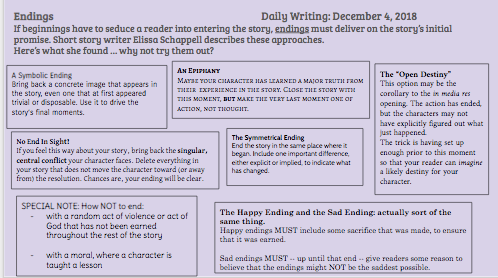
The “Endings” slide was a bit less specific in that it did not cite word-for-word examples. Still, as many (read: most) students hadn’t written any ending at all to their short story drafts, they found the suggestions useful. In a move that is contradictory to true workshop form, I required students to identify one of these approaches to the beginnings and endings of their short stories. And in keeping with the best paradoxes, these limitations have allowed their sense of choice to flourish rather than flounder among too many possibilities. (Mariana knows about my unapologetic “taking the ‘creative’ out of ‘creative writing’ approach this year). But in a school system that seldom allows choice, for many (read: most) students, I have found that “choice among several options” is more productive than choice that is infinite. And I’m more than ok with that.

3TT_beginnings and endings 2- Google Sl_ - https___docs.google.com_presentatio

So, I hope you find this framework useful.  You can find the Google Slides document here, if you would like to use my clumsy boxes and improve upon it for your own use. (I hope I did the sharing settings correctly — if you cannot access, let me know).  If I had it to do over again — which I will, because I plan to use this approach regularly — I might combine it with Marchetti and O’Dell’s sticky-note activity, in which students write several different beginnings and endings on sticky notes and stick them at the beginning and end of a printed essay. Then they can try out a few options next to each other, which even further reinforces the construction of a piece of writing as a series of conscious choices on the part of the writer.

3TT Talks Gifts: What books will you give this season?

If you know me, you know I live by lists. I make them. I collect them. Sometimes I even stick to them. I raised seven children, you know. I had to keep track of who needed to go here, there, and everywhere and who needed what and what and what just to survive and thrive in our robust and rowdy family. Christmas shopping, often on a bone of a budget, gave me hives.

Gift-giving has never been my strong suit. Perhaps my practicality, and my history of stretching dimes into dollars, gets in the way of thoughtfulness. (Not even kidding, my kids got socks and underwear wrapped in cute paper. To their credit, they never complained–at least not to me.) I know it is possible to be both practical and thoughtful, but I am still working on that balance.

So what does any of that have to do with a blog about teaching readers and writers? Not a lot — except, I asked my fellow writers to help me craft a list for literacy teachers. Maybe you’ll find something to gift yourself, a colleague, a friend, or a perfect stranger. (I like the idea of gift-wrapping a book and giving it to one of the Salvation Army bell-ringing volunteers and saying, “This is for you.”)

Part 1 of this literacy teachers’ list is below. I’ll post about professional books, and favorite writer’s notebooks, pens, and other clever things for literacy lovers over the next few days.

BOOKS. What are the top titles students love in your classroom library right now? (Remember, we work with a range of readers from middle grades to AP Lit. There’s old and new, non-fiction, YA, and just some really good recommendations here, in no particular order, that would make great gifts for any reader or want-to-be reader or you-want-them-to-be a reader in your life. )

The Poet X by Elizabeth Acevedo
Long Way Down Track Series (Ghost, Patina, Sunny, Lu) by Jason Reynolds
Ready Player One by Ernest Cline
The Hate You Give  by Angie Thomas
American Street by Ibi Zoboi
Graphic novels (Ghosts, Smile, Babysitters… by Raina Telgemeier
Love that Dog/Hate that Cat/Moo by Sharon Creech
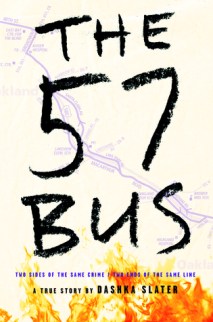
The 57 Bus:  A True Story of Two Teens and a Crime that Changed Their Lives by Dashka Slater
Love, Hate, and Other Filters by Samira Ahmed

331553252034261734647324

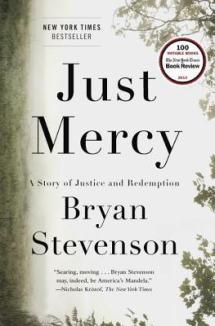
Just Mercy  by Bryan Stevenson & the version adapted for YA
Lies My Teacher Told Me by James W. Loewen
The Handmaid’s Tale by Margaret Atwood & the graphic novel version by Nan A. Talise
The Last Black Unicorn by Tiffany Haddish
The Nightingale by Kristin Hannah
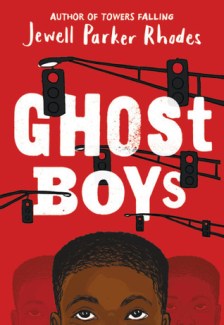
Ghost Boys By Jewell Parker Rhodes
The CrossoverBooked & Rebound by Kwame Alexander
Children of Blood and Bone by Tomi Adeyemi
The Greatest Stories Never Told:  100 Tales from History to Astonish, Bewilder, and Stupefy by Rick Beyer

249749963497431033830437

An Ember in the Ashes by Sabaa Tahir & the whole trilogy
Looking for AlaskaTurtles All the Way Down by John Green
My Bloody Life: The Making of a Latin King by Reymundo Sanchez
Twisted by Laurie Halse Anderson
Dear Martin by Nic Stone
The Marrow Thieves by Cherie Dimaline

NOTE: Get this book free with a donation to Book Love Foundation

We Should Hang Out Sometime:  Embarrassingly, a True Story & Love and First Sight by Josh Sundquist
I am Not Your Perfect Mexican Daughter by Erika L. Sanchez
Because I was a Girl:  Trues Stories for Girls of All Ages by Melissa de la Cruz

346493482901039534608062

Between the World and Me by Ta-Nehisi Coates
The Martian by Andy Weir
1984 by George Orwell
The Lovely Bones by Alice Sebold
The Road by Cormac McCarthy
#NotYourPrincess: Voices of Native American Women by Charleyboy (editor)
All the Broken Pieces by Ann E. Burg
The Astonishing Color of After by Emily X.R. Pan
Far from the Tree by Robin Benway

For more book-gifting ideas, check out the Goodreads Choice Awards for 2018; 15 Life-Changing Middle-grade Books; and here’s the School Library Journal list of best children and YA audiobooks of 2018.

A New Approach to “Teaching the Novel”

I am still reeling from #NCTE18! The conference was exactly what I needed to refuel my passion for teaching. In the spirit of transparency, before the conference, I wasn’t sure I was going to make it through this year. The teacher burnout was REAL. All of the excitement from the beginning of the school year, the new ideas, the drive–gone. Disappeared. The Whole Class Novel Struggle was real and rapidly approaching, and to be honest, I just wanted to get through it. Going to the conference felt like my last shred of hope and boy, did it NOT disappoint!

Throughout the conference, I had the opportunity to confer with my colleagues, share with new acquaintances (who turned into friends), and hear from the icons like Kelly Gallagher, Penny Kittle, and Cornelius Minor, who reassured me that I CAN do this–it is going to take a mindset shift.

Coming back to the classroom affirmed that the struggle I was having was due to forcing pasted image 0old habits and conventional ways of teaching on a group of students that would resist anything and everything I tried. In Houston, among the plethora of books I purchased was Kelly Gallagher and  Penny Kittle’s 180 Days.  I was inspired in their approaches and philosophies because they mirrored my own. In addition, the pressure to conform was lifted, and I finally felt compelled to exercise my professional and creative judgement.

The first thing I decided to transform is our novel unit. Following the strategies and “why” of 180 Days helped put it all in perspective. Here is my “plan” of action:

  • Booktalks – I am giving them daily and plan on having students take over. We are going to our school library every other week where our fabulous librarian will help with getting amazing titles into my students’ hands.
  • Time – Students will have class time to read. This is a big one because I like to control everything, so this will be a huge moment of release on my part. Wish me luck!
  • Reading Conferences – I have committed to 4 conferences for this grading cycle. Some will be informal, some will be based on a survey, but ultimately, we are going to TALK about what we are reading.
  • Quick Writes – I am giving students 5-10 minutes everyday to write.Then, we will TALK about what we are writing.
  • “Shared Reading Experience” – This is how I framed reading To Kill a Mockingbird with my students. I also mentioned that we would not (gasp!) read that book cover to cover. Rather, we will use it as a shared reading experience. In addition, their assessments will be based on our shared reading experience. I promised that I would not be assigning reading quizzes or other activities like that. Rather, our unit will focus on skills and discussion.

Most of my students seem open to it. I shared my vulnerability with them and let them know that this is something I would be willing to try. We have already had our first reading conference and I was surprised at how many students checked out books from our classroom and school libraries the first week! This is something I fully plan to continue beyond a simple “unit.” The biggest take away for me is that I KNOW this is what is best for students, and I am willing to advocate and try new approaches in order to foster a love of reading. #readandresist

What suggestions, feedback, comments do you have about the “novel unit”? I would love to hear other ways you are changing the way to teach novels in the classroom. 

Gena Mendoza teaches High School English in San Antonio, Texas. Her most salient identities include female, Chicana, feminist, mother, wife, educator, dog mom, and self-proclaimed advocate for social justice and equality. In between managing her career and grad school, she enjoys making paper flowers and spending quality time with her family. She invites you to connect with her on Twitter at @Mrs_Mendoza3


Conferring and My Wish for a Time Machine

I am as guilty as the next guy. When I first started teaching, I didn’t have any idea how to get students to read more, write more, do more in my English class. I didn’t even know I would have to work so hard. Although I was in the middle of raising my own teenagers (and they all turned out great), I had no idea how to inspire other people’s teens to give books a long enough look to want to read them or to take the time needed to write something they would want others to want to read. I was all about my content, my lesson plans, my choices, my control. I did most of the talking. I did very little listening.

I remember the first day of my first year teaching. Students sat in assigned seats, alphabetically by last name. I asked each student, seat by seat, row by row, to tell everyone their name and one thing they hoped to learn in their freshman English class. I have no idea what they said — except for one.

“My name is Susie, and I hate white people.”

I am a white woman.

I might have felt stunned, hurt, appalled. I do remember thinking, “The audacity!” and shouldering an internal huff. I tried not to let these words sink me before I ever got afloat, and for the most part, I think I succeeded. Susie and I learned to work together that year, and she did fine in my class.

But my idea of success is much different than it was back then:  I no longer think fine is ever good enough.

I think about those young people from my first few years of teaching, and if time machines were a real thing, I’d set the dial to 2008. I would do things differently because I am different. I know better. I learned to be better.

1200-330446-relationship-quotes-and-sayings

Last week I facilitated a day-long training on implementing the routines of readers-writers workshop in secondary classrooms — a shift in pedagogy so students sit at the center and learn through authentic reading and writing practices. These teachers are eager, and their district leadership is providing support to make this happen. Yet they struggle.

In table-group conversations, two topics came up again and again:  Our students lack discipline. We need more tips on conferring.

What’s obvious to me now, that wasn’t back when I first started teaching, is a clear connection between the two. Students need to be heard. Now, I am not saying that implementing a workshop pedagogy will fix all disruptive behaviors, but I do believe these behaviors are often evidence of a lack of conferring. Students need to be seen and heard. (See more on why here.)

We talk a lot about creating a positive culture in schools and cultivating learning communities where relationships thrive. These take intention, effort, and time. In ELAR classes, these take intentionally designing instruction that utilizes every square meter as we practice authentic literacy skills with authentic texts and model the effort it takes to build our identities as readers and writers. To do all of this well, we must meet our students where they are in their learning, or in their apathy, or their attitudes, or whatever we want to call it. Conferring, those one-on-one little talks with kids, is where we do it.

As with anything that deals with humans, it has to start with listening. Listening jumpstarts relationships. Relationships build community. Community shapes culture.

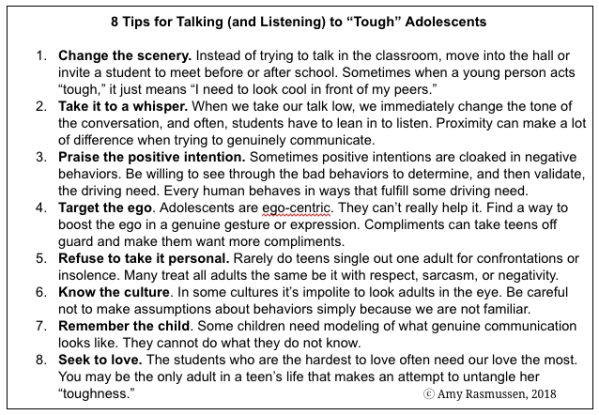
8 Tips for Talking to Adolescents

If I could relive day one of my first year teaching and my interaction with Susie, I’d make sure she knew I heard her. I’d pull up a chair at the beginning of our next class, and I’d listen. That would be the start of Susie doing more than just fine in her freshman English class. I am pretty sure of it.


Amy Rasmussen loves her life in North TX. She’s currently reading We Got This by Cornelius Minor, Embarrassment by Thomas Newkirk, and Braving the Wilderness by Brene Brown. She may be a completely different person come 2019. Find her on Twitter @amyrass

Whole Class Struggle (Novel)

img_4955

I could tell something was wrong.  I stood up from my seat like somehow that fruitless movement would clarify the mystery.  I could see my son, across the arena, furiously working the controller, yelling something to his team mates, feeling the frustration rise in him.

Three months, hundreds of hours, dozens of late nights, early Saturday morning stops at Shipley’s and his one chance to truly measure himself against the best robot drivers in the state, overwhelmingly high school students, the non-human factor reared its ugly head.

Later, as he told my wife and me the story and filled us in on the narrative, I realized how important this whole process had been. In the moment, when all that effort and energy drifted away, Colton (11 years old) reached back to the lessons he’d learned about keeping his cool from his robotics mentors, the thirty-two other students in that program, and the experiences along the way.

The interesting part for me was that, instead of being disappointing or feeling like he let his team down, he glowed with the confidence that he did all he could do to make the best of that situation and scored several hundred points with a broken robot.  This is the type of lesson I hope he learns from experiences like this one.

He knew, no matter the circumstance, that his peers and coaches would be there for him and that knowledge empowered his confidence, filled his spirit, and kept him grounded in the moment, grinding for the team.

img_4947This is the type of lesson we can teach when we bring whole class novels into our classrooms.  The “shared experience” of reading a text is a phrase that I’ve heard from and seen written by the smartest people I know.  It’s the same lesson that my son and his peers experienced with their robotics team this year.

Our students will need these lessons and, certainly, we can teach them through targeted mentor texts and the skills we ask them to explore.  At some point, though, a somewhat more difficult, shared, experience might be effective.

This is a lesson you can’t possibly learn in a “worksheet” class; one filled with blanks, multiple choices, and compliance.

That’s the idea that I started our whole class novel unit with last week.  The team I have the pleasure of learning from this year knows it all too well.  They know to start with the end in mind.  They showed me the importance of planning for “the struggle.”

I used to know how to “teach a novel” and every time I tried in the past, I failed. This failure, as I’ve learned, was due to me teaching the “novel” and not teaching kids. This team of teachers is showing me how to take those lessons students learn from being on teams, and move that into my classroom.

I’m still growing. And most importantly, so are my students.

It will be hard, on them, and on me.  We will all need preparedness and grit, but the growth goal is paramount.

Teachers, I want you to know how important your work is.  You hold the future in your hands.  Please listen to the brilliant teachers around you. Let yourself be the student and then take those lessons back to your classroom.

Charles Moore is excited to continue his work with freshmen, although their excitement might be harder to quantify.  He loves watching his son compete against his own inner expectations and he loves watching his daughter dance (compete) against her own inner expectations.  He hopes to his students can learn to dance and judge themselves against their own expectations.  He hopes those expectations are high, because his students are beautiful and brilliant.

Question Storming with Students

analysis blackboard board bubble

Photo by Pixabay on Pexels.com

Eighty percent of my teaching load is in the role of senior school teacher librarian and much of this aspect of my job is spent working on research skills with our middle years and graduation years students. One of the hardest tasks students face when starting with research is knowing where to start. Often times students will start with a topic that is significantly too broad and they lack the skills to narrow down their search focus, which leads to a frustrated student proclaiming they can’t find anything at all on their topic.

One technique I have used with my students to help them narrow their focus in their research and to guide them through the search process is a technique called question storming. Question storming is a technique I discovered in the educator section of The Right Question Institute website and I have used it with success in research lessons with Grade 6s all the way up to my Grade 10-12 AP students. Question storming is similar to brain storming, but instead of generating ideas or statements that come to mind, students are asked to generate questions. The following are the steps I take to guide my class through the question storming process.

Step One: I model the process of question storming by walking through the process with them. I love to use images as prompts to generate questions as I find students really become engaged with the images the more they ask questions about it. After I briefly explain what a question storm is, I project a thought provoking image on the screen. With my most recent question storming practice with my AP Capstone class, I used the viral image of the Palestinian protester in Gaza.

Step Two: After projecting the image, I ask students to generate as many questions as possible about the image. In my initial modelling with my students, I have them call the questions out and I record them on the board. I also remind my students that at this stage we are not trying to answer the questions and we are not judging the questions, we  are simply trying to generate as many questions as possible. The first questions generated are often rather surface level, things like why is the man holding a flag or where is he, but after the first few questions, I am always surprised at the depth that starts to emerge in the questions.

Step Three: After a few minutes of generating questions, we stop and review the difference between a closed question (one that can be answered simply) and an open question (one that is complex and has multiple possible perspectives) and we go through the list of generated questions and label each as being either an open question or a closed question. At this stage we talk about how it is the open questions we want to explore in our research, but the closed questions often help us in our research, as well because they help us explore what basic information we need to understand about the topic before we can delve into exploring the open ended questions.

Step Four: Once we have labelled our questions as being closed or open, we then select the one open question we want to explore as our main topic. Some of the open ended questions my students generated about the Palestinian protester photo included: To what extent are the Palestinian protests in Gaza affecting the conflict? How has the media coverage of the conflict in Gaza affected the conflict? To what extent has the media coverage of the conflict in Gaza affected the level of aid provided by other countries?

At this stage, students have a significantly more focused starting point for their research and have narrowed their focus with their open-ended questions. As well, they can use their close ended questions to help provide search terms to help narrow their research down even more.

When students start research or an inquiry with a powerful question they find the research process to be easier and more meaningful and question storming is a technique that helps make the challenge of coming up with the right question easier.

For some more practical teaching strategies, check out Shana’s post on some strategies she learned from the pre-service teachers she works with.

Pam McMartin is a Senior School Teacher Librarian, Senior English teacher and English department head at an independent school in Tsawwassen, British Columbia Canada. When she is not wading through storms of questions with her students, she is braving the perpetual winter stormy weather outside that comes with living in the Pacific Northwest. You can follow Pam on twitter @psmcmartin. 


Reading without Words

Too often, the purpose of reading in school is about grammar, vocabulary acquisition, organization, structure, mechanics, conventions, punctuation, figurative language, imagery, etc, etc, etc . . . There’s always a standard, a clear purpose, a takeaway for students when they read . . . but that doesn’t always have to be the case.

There is another important purpose for reading.

Reading is about stories, about discovering and creating our own identities, about realizing that others share in the same struggles as us. Reading is about being human, and being able to touch something on a page that tells our human experience when we are unable to find the words to tell it ourselves.

Reading is about stories, about discovering and creating our own identities, about realizing that others share in the same struggles as us. Reading is about being human, and being able to touch something that can tell our human experience when we are unable to find the words to tell it ourselves. 

Some of our students haven’t discovered this yet, and the reason is often because of the accessibility and relevance of books. We’ve all struggled with finding texts that are age and level appropriate for some of our students — readers who struggle don’t want to read what they deem to be “baby books” for a variety of reasons that are fair and legitimate. They need books that they can read and books that they want to read.

Recently I’ve discovered that there are some beautiful, poignant, relevant illustrated books that are decidedly not perceived as baby books, and which take a lot of thinking and reading in order to understand. But they are wordless, or at least almost wordless.

While I’m not giving up on teaching words and all of their beauty, I also know that wordless stories have a place in my classroom.

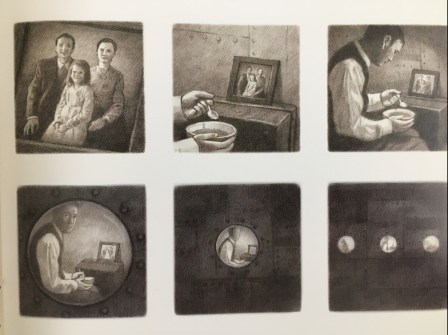
The book I’ve recently fallen in love with is The Arrival by Shaun Tan. It’s a wordless graphic novel, and it tells the story of a person who leaves his family behind in order to create a better life for them all. arrival cover

It’s the kind of story all sorts of people can relate to: Character endures separation, loneliness, and heartache because of hope, optimism, and desperation.

It’s beautifully complex and requires some attention to detail, some hard thinking, and some rereading in order to really understand and analyze it.

I’ve book talked it to several of my classes, and I’ve gotten some puzzled looks when students try to understand how a book can be both complex and wordless.

They struggle to understand how they could find fiction signposts, discover characterization, etc, in a wordless book, that is, until they get the book in their hands.

Students who don’t always have easy access to complex texts have found success with finding the Beers/Probst Notice and Note Fiction Signposts in this complex and detailed story.

IMG_2042

For example, this Again and Again signpost is an easy one to spot – the main character carries a picture of his family as he travels from his home country to his new land, and the photo pops up in many of the frames. It’s significant because students realize quickly that this man’s family is the most important thing to him, which is why he carries the photo everywhere.

Both boys and girls have read this book, and I’ve overheard conversations about what it might be about as they wonder and struggle through their thinking. This is the kind of talk I love to hear.

This morning, I discovered four boys reading choice books on a bench: one was reading this wordless graphic novel, another was reading one of the Harry Potter books for the first time, another was reading The Crossover, a novel written in verse, and the last one was reading a humorous graphic novel. All different forms of books, but all legitimate books that “count.”

The point is, all of these students had texts that were accessible to them. They were curious about their own reading, and were enjoying their books. Their brains were engaged, they were talking to each other about what they were reading, and most importantly, they were fostering a community of reading as well as their own healthy reading lives.

Graphic novels, with or without words, can be excellent bridges between teacher, student, and healthy reading habits. Students can learn valuable reading skills and strategies with all kinds of books – even the “extreme” examples that don’t have words. It’s not a place where I want my students to “live” — but I don’t want my students to “live” in any one genre or form anyway. They should build skills, stretch their brains and habits, find familiar and easier books, and then stretch some more. The wordless book have a place in their learning, and will always have a place in my secondary language arts classroom.

A few wordless/nearly wordless books that are complex and relevant to secondary students:

  • The Arrival by Shaun Tan
  • The Marvels by David Selznick
  • Unspoken by Henry Cole

One final idea: It’s a bit like teaching reading strategies with the Pixar short films. My grade sevens practiced finding fiction signposts in the short film Partly Cloudy last week, and they were able to point out signposts even though the movie does not have dialogue.

Studying and reading wordless books and silent films can build confidence and skills in our readers who struggle with more complex texts, and while we can’t ignore their decoding skills, we can also allow them to grapple with the complexities of stories that are developmentally appropriate for their growing identities as readers and human beings.


Julie has been teaching secondary language arts for twenty years, spending the first fifteen in rural Central Oregon, and the last four in Amman, Jordan. She’s thrilled to report that she and her family have moved across the world to Managua, Nicaragua this year, where a new adventure has begun.

Follow her on twitter @SwinehartJulie

The Teacher, the Story-teller, the Writer: Guest Post by Milree Latimer

Screen Shot 2017-05-01 at 8.44.22 PM

by author-educator Milree Latimer

Teaching might be the greatest of the arts since the medium is the human mind and spirit.

John Steinbeck

To write fiction, one needs a whole series of inspirations about people in an actual environment, and then a whole lot of work on the basis of those inspirations.

Aldous Huxley

Some days when I reflect upon my years as teacher, then as an elementary school principal, a high school vice- principal, and a professor of education–I see a thread. As William Stafford writes in his poem The Way It Is “There’s a thread you follow. It goes among/things that change. But it doesn’t change…/While you hold it you can’t get lost…/You never let go of the thread.”

There has been a thread throughout my teaching days, one that has manifested itself in my life now as a writer and published author. It’s been there all the time. A long gaze back reveals how I have grounded myself, the children and the teachers with whom I’ve worked, in the flow of story. There is a natural quality in the life of teaching that feeds the story-teller.

The narratives and chronicles of the educator’s life fed my yearning to write.

•••••

“Come, tell me your stories.” I said. The children in my kindergarten class and I gathered on the carpet. We told stories to one another: made-up tales of adventure, show-and tell chronicles of the life of a five year old, once-upon-a-time boldness.  It was 1963.

“Whenever I’m asked what advice I have for young writers, I always say that the first thing is to read, and to read a lot. The second thing is to write. And the third thing, which I think is absolutely vital, is to tell stories and listen closely to the stories you’re being told.”

~John Green

••••

“Let’s find a story together, draw it, write it, tell it.” I said.  I set my over-sized journal on the classroom easel. One by one they talked about what their story might be that morning – there’d been a snowstorm, white drifts were accumulating at the windows. Together we thought aloud. “A weather report for school announcements!”  They wrote, they drew, they told their stories. It was 1967. It was first grade.

••••

“You had the ball in your hands, Mark with few seconds on the clock–Tell us what that was like” I said.  It was 1974. Mark was an eighth grader.

“Anyone who is going to be a writer knows enough at 15 to write several novels.”
~May Sarton

••••

“Tell me what you hope for. Tell me what happens in your classroom that astonishes you. Tell me how you came to this, to be a teacher. Begin your educator’s biography this morning, write the last chapter when you retire.” A class of soon-to-be teachers at a Faculty of Education. September 1990.

•••••

The Graduate class was entitled “Reflective Practice.” The assignment: “What do you do; why do you do it the way you do; what do you hope for? A philosophical and personal portrait.”

A student’s response moved me. He wrote from a deep place within himself.  His was a narrative revealing his journey, his was a reflective piece of writing that inspired.

What truly set the path to my personal exploration was a question asked of me in one of my first courses taken at the Master’s level. When asked ‘who are you,’ my immediate response was ‘a wandering soul searching for answers.’ That answer came from somewhere deep inside…. I realize that there are many aspects of my life that I need to connect…I have to reflect on what it is that I actually do and the reasons surrounding that. (Tyrone Perreira, June 2004)

••••41n7v0p5fxl

Four characters in my novel THOSE WE LEFT BEHIND, are a composite of graduate education students with whom I worked from 1996 till 2004.

I held the images of those students as I wrote the story of Casey MacMillan, Professor of Education. The conversations that wove throughout the chapters represented some I may have had with my Master of Education students.

Casey gave air and space to her words. She believed that spoken thoughts and responses needed time to establish their own significance rather than being run over by too-hasty support or worse, ill-considered questions.

 As the author of Casey’s story, I discovered my experiences engendered a quality of truth within the story.

Professor Casey, the main protagonist taught about love, loss and the human condition. Even though she locked away her emotions within her life, her teaching bore a wisdom that connected her with her students.

When I wrote Casey’s story there was a direct line between myself as teacher and myself as author. A conversation between Professor MacMillan and her doctoral student Rob exemplifies this link:

Rob opened his briefcase reached in and pulled out a manuscript–his thesis. Her hope for all her advisees and her grad students was that they discover their own energy of possibility.

“Here’s what I really want you to see.” Rob said. He leaned forward and slid a page across the smooth mahogany table.

When she finished reading the page, she placed it on the table slowly, carefully–Resting her chin on her hand she began: “It’s a radical approach to tell your own story as your thesis. Saying that, it’s not impossible…difficult yes. (P. 99 Those We Left Behind)

••••

“Capturing shards of memory, writing specific scenes, I began to discover…” (Floyd Skoot, 2008).

There is a thread that I hold. Writing is my inner life moving me into the open a passage to the page where I am exploring, imagining, and remembering. I connect to my experiences, I hold the thread, I never let go.

Writing is a coming home. Like Toko-pa Turner (2017), I remember myself home.

Resources:

Skoot, Floyd, (2017). The Wink of the Zenith. The Shaping of a Writer’s Life. University of Nebraska Press.

Turner, Toko-pa, ( 2017). Belonging. Remembering Ourselves Home.

Her Own Room Press. Salt Spring Island, British Columbia.

Milree Latimer is a writer who spent most of her life as an educator and professor. She has an undergraduate degree from McMaster University, a Masters of Education from The Ontario Institute For Studies In Education, and a Doctoral degree in Education from Penn State University. An expat Canadian, she lives among the mountains in the Pacific Northwest of the United States with her husband Jerry and their three cats. She is currently at work on her next novel.