Category Archives: Readers Writers Workshop

A Life Full of Revision

I saw one in early August this year, winging its way over our Fine Line Buckthorns, past our Red Maple tree, through our verdant yard. Transfixed, I hoped it would land on one of our scarlet day lilies just like the first time I beheld one (back when I held Ingrid and held Jonas’ hand). But this Tiger Swallowtail–golden-winged and delicate–floated away, on its own journey of transformation. And while I once marveled at its beauty with my children, this year I marveled at the metamorphosis the butterfly endured in order to take flight. 

Even as that caterpillar egg (where, if you look closely, the caterpillar inside is visible) becomes a caterpillar; even as that caterpillar decimates leaves and sheds its skin several times to grow; even as that caterpillar forms a chrysalis and, as it begins its transformation, actually digests itself, using highly organized groups of cells to redirect its creation; even as there is seemingly destruction–something new emerges. And, after all this, the butterfly must hang upside down to allow its wings to harden before it takes flight. A butterfly in its colorful splendor is the culmination of a life full of revision.

Maya Angelou once noted that “We delight in the beauty of the of the butterfly, but rarely admit the changes it has gone through to achieve that beauty.” She’s right, of course. We reduce the complexity of the transformation in the same ways many of our students reduce the complexity of revision in writing. The beautiful butterfly doesn’t exist without significant change just as beautiful writing doesn’t suddenly and artfully emerge. So many of our students need to learn that once an idea is born into the world, this idea can and will transform–many times!–given the right conditions. This learning can transform the possibilities they see for themselves as writers, possibilities often limited by the misconception that some people are good writers while others are not. 

So, what do we do as teachers? How do we provide the right conditions, the ones that nurture (to help grow, develop, or succeed) destruction that leads to transformation? And, how can we help them look inside their work to see the special parts that hold the potential for splendor?

  1. The pitch: Have students pitch their ideas for writing projects to one another (Liz Prather’s Project Based Writing is an excellent resource for this). This lets ideas live, born into the world by sharing with peers, providing time and space for growth and development. And, sometimes, necessary destruction. 
  2. Feedback: Share this video with students about the nature of offering and receiving feedback. This may transform their understanding of the power of their responses to one another. 
  3. Modeling and practicing revision: Consistent practice in small ways in notebooks allows students to internalize the ways to direct their revision. Ask them to add, delete, rearrange, or substitute in their writing. Kelly Gallagher and Penny Kittle speak to the importance of this, especially with writing that is generative. More importantly, as teachers, we can and should model this, making it visible how and why we transform our writing. 
  4. Showing: Use the work of other students, snagging Google History screenshots to make visible the kinds of revision that occurs. Discuss these together. Show them our own, too. This is like looking inside the chrysalis! Whoa!
  5. Conferring: The questions we ask and the micro lessons we offer during this time can both trigger transformation and call attention to the parts already bright with meaning. Celebrating with students where a move works may prove a catalyst for more revision. 
  6. Destruction: Encourage students to print drafts and cut them apart. All the parts may be there, but they may need to be rearranged or to be developed further. 
  7. Letting students create their own analogy: Engage students in creating their own analogies about revision. They create meaning while we glimpse their thinking.
  8. Managing their creative process: This video from Tiffany Shlain helps writers think about their own processes. One of the most important aspects it focuses on is time. Writers need time to hang upside down with their ideas before they take flight. 

Of course, the limitation of comparing the nature of revision to metamorphosis is that it likens writing to a cycle. But writing is and must be recursive for our writers to successfully transform their writing. When our writers embrace this, then we can stand back with wonder and appreciation and watch them take flight.

Kristin Jeschke is an Instructional Coach for Waukee High School in Waukee, Iowa (where she spent time prior as an English teacher). She’s standing back, watching her colleagues write in their writer’s notebooks, wondering about the potential in each. What ideas will take flight? Follow her on Twitter @kajeschke. 

How Healthy is Your Practice?

It seems like self-care, wellness, mindfulness, and balance are all the buzz these days. Yet, too often, I see self-care employed as a marketing technique or a rationalization tool: buy this face mask! Do some mindfulness coloring! Treat yo’self to that $6 latte! Schedule a 6-night, 7-day spa retreat in Switzerland! IT’S FOR SELF-CARE!!

Yeah, no.

I admit, I bought into the hype a little bit and splurged at Target a few weeks ago in the “self-care” beauty section. But when I struggled mightily to successfully peel off the peel-off face mask that was supposed to “refresh” me, I didn’t feel refreshed. I just felt like a moron when I looked at my patchy, half-green face in the mirror. Instead of feeling satisfied, I felt, “wow, I can’t even PEEL OFF A FACE MASK.”

Not helpful, y’all.

Instead of having a teaching-life balance that somehow makes me think a peel-off face mask will help me feel less stressed (but instead makes me feel like a Halloween makeup artist), I need to have a teaching-life balance that is rejuvenative all on its own.

As a teacher, it’s a constant struggle not to get to the point in a school day where I don’t feel overwhelmed. When I think about the orientation courses in my inbox, the IEP feedback forms sitting in a folder on my desk, the messy disaster that is my classroom library, the toppling stack of writer’s notebooks students submit for feedback every other Friday…I don’t feel the need for some little moments of self-care. I feel the anxious, grasping need for escape to that spa in Switzerland, except I never really want to return from the spa to my real life.

We cannot let ourselves get to this point.

As teachers, we have to cultivate a practice that is more responsible, more sustainable, more respectful to the fact that we are HUMANS, and that we should feel ABLE to do our jobs, to do the work of teaching because we love it, and not because we’re suffering from some teacher-as-martyr delusions of grandeur and existential suffering.

A tweet about this very feeling from Dulce-Marie Flecha stuck with me–so much so that I still remember it, word for word, nearly five months later:

This sentiment struck me, forcefully, in mid-April: when tests were looming and assemblies were rampant and the science fair kept interrupting my carefully-crafted multigenre lesson schedule. I was so stressed out by the daily practice of teaching middle schoolers, on top of having two kids under the age of three and a life in general, that I really felt I could not do the work of teaching. I knew I had to make a lasting change that was more sustainable than trying to survive on coffee and weekend laundry marathons and naps.

Tami Forman writes in Forbes that self-care is actually kind of boring: it’s boundaries, it’s saying no to things we know we shouldn’t take on, it’s turning off the TV so we can actually get some sleep. It’s the little things, the simple habits that make our lives manageable.

Image result for onward elena aguilar
I’m reading Onward this year with a group of colleagues, which offers guidance for how to know yourself and your limits as an educator, so you can design a sustainable teaching practice more successfully.

And as an English teacher, it’s crafting a curriculum, a classroom, and a culture at school that don’t require me to give feedback on every single paper, to grade every single page a student reads, to be on every committee or lead every after-school activity.

We have to do what we can, the best we can.

If you’re spending too much time stressing out about your inadequacies as a teacher, consider how you might revise your teaching practice to be more sustainable, more balanced, more enjoyable. It’s more than just throwing that stack of papers you meant to grade in the recycling bin: it’s thinking carefully about how you might shift the cognitive load in your classroom toward student self-assessment, conferences, and peer feedback rather than just being all on you. It’s something that’s beneficial for teachers and students alike.

Ask yourself: how healthy is my teaching practice? And let us know in the comments how you’ve made shifts to keep your work and life in balance, so you have time to read all the latest and greatest YA, doodle in your own writer’s notebook, and daydream poetry.

Shana Karnes lives and works in Wisconsin alongside many smart, thoughtful, inspiring English teachers via the Greater Madison Writing Project. She enjoys reading, writing, and poem-ing in any spare time she gets when she’s not with her two baby girls and hardworking husband. Connect with Shana on Twitter at @litreader.

New Learning Territories and a Growth Mindset

I’ve mentioned before that I have two new “preps” to which I’m slowly adjusting. I’ve had a tendency to shoulder forward into new experiences with mixed results.  HulkSometimes enthusiasm and energy carry me through the learning part at the beginning. Other times, I’ve made mistakes caused by my straight-line approach that could have been avoided. Perhaps I’ve trended more towards the Hulk, when a more intentional, Bruce Banner style might have served me better.

Patience, I’ve learned in my old age, is truly a virtue.

Moving into the realm of an advanced class that focuses on rhetoric is a challenge all to itself. Couple that with a move to sophomore English where students have different literacy needs than the freshman I worked with last year, and I’ve gotten myself into a situation that demands open-mindedness, near constant reflection, and growth.

While these classes appear to diverge completely in content, I would argue that they have something important in common: an environment where workshop works.  In one class we learn about building narrative, in the other we explore the rhetorical situation. For me, success lies in the “invitation.” I can’t drag them towards a greater understanding of reading and writing anymore than I can make my daughter move faster when we are headed out the door in a hurry.

Examining the structure of a Rhetorical Precis recently, I took the risk of holding back the “notes” and letting the students tell me what they thought the elements of an effective rhetorical precis might be.  I had MY notes, of course, but the students built the anchor chart that we use. Unsurprisingly, each of the three classes noticed elements that the other classes didn’t, providing me valuable data and helping me understand the learners even better.

As I shared my writing with them, I had to be vulnerable. When they asked me about my writing decisions, I needed to have answers. This held true across both levels.

Our sophomores learned about creating effective characters, and it was their search through the mentor texts that informed their understanding, and those elements found their way into the writing.

We read self-selected books and utilize reader’s/writer’s notebooks in all my classes. They may diverge in content, but the importance in those connections remains paramount.

Conferring with readers and writers dominates the time before and after mini-lessons.  The effectiveness of one-on-one instruction doesn’t change because one student might read or write better than another.

One size does not fit all, and I know that teachers deserve autonomy.  The autonomy afforded me empowers our workshop to work in two totally different environments with totally different sets of students.  Their needs, however, are the same. They need to move forward in their literacy; be better tomorrow than they were today. The skills are different, but that’s where my work comes in.

This journey can not be survived alone.

I’ve learned, in a few short weeks, that the only path to success this year runs through a few very specific places: the office of our instructional coach, the room of my department head (from whom I’m learning how to teach rhetoric), and the room in which our sophomore team gathers as we plan our units and our lessons. It’s going to take a village to raise this learner.

I remain steadfastly committed to a workshop that centers on readers and writers, and the first five weeks of this school year have only strengthened that resolve.

Many of our readers at 3 Teachers Talk have brilliant ideas, and I hope to learn from our writers and our readers.  If you want to collaborate, email me at mooreliteracy1@gmail.com.


Charles Moore loves watching his son play football for the first time ever.  He loves to read, write, and learn along side readers and writers. Check out his twitter at @ctcoach.  If you headed to ILA, come see us at 11 on Saturday October 12th for our presentation on novels in verse. Our clothing will coordinate… I promise.

Your Students Deserve a Reflective Teacher – 10 Reflective Questions to Guide Each Day

Back in the day (before teaching, marriaging, and parenting), I loved the Indie Rock flavored reflection of an afternoon spent at the coffee shop. Pen, journal, and intellectually stimulating text at the ready, I’d dream away the hours in self reflective bliss. Fueled by sips of chai and youthfulness, I’d take the time to try and grow through the art of reflecting on the great mysteries of life as viewed by a college student. It was probably 2002.

Fast forward to 2019. I now reflect on life in the car on the way to and from work, in the shower, while my daughter flips across the floor at gymnastics class, and in the 37 seconds it takes me to fall asleep each night (if I haven’t already passed out from exhaustion on the couch).

There are thoughts of how I could have better handled my daughter’s overtired meltdown. There are moments of longing for my Dad, who I lost in March, and reflection helps to sustain me in my grief. Professionally, there are the moments when I ask students to write about their chosen texts, talk over with an elbow partner how they felt their latest speaking opportunity went, and consider how their experiences in school have helped (or hindered) their journey to this moment in their learning. Reflection happens in our lives intentionally and involuntarily all the time, though personally it happens now in much shorter snippets.

Back as a recent college graduate, with that twenty three year old glow, I floundered in the daily chaos and reveled in the fresh newness of the profession. This led to reflection on my teaching for a few moments each and every day in my journal. Nothing extensive, just a few lines about what really impacted me that day and what I wanted to do better.

That’s the beauty of reflection – its forward thinking, endlessly hopeful, blissfully enthusiastic bedfellow is goal setting. We grow forward when we look back. If we take the time.

In the ebb and flow of life as an educator, however, I’ve not kept up this practice over the years…which is a shame. Of course, there are endless reflective practices that we take on and use purposefully as educators every day, without having to write down a word, but in the quest to continually refine my practice, I consider reminders to reflect to be a hugely valuable add to my day to day. This type of professional reflection can help us overcome debilitating challenges, foster relationships, and reduce stress.

With the start of a new school year, the impulse to look forward is far stronger for me than to look back, but my dear colleague Anita Sundstrom, who has a blackbelt in reflective practice and who often knows what I need before I have a chance to figure it out, shared an article with me this week that got me thinking…and thinking and thinking.

Consider taking the time for yourself, at great benefit to your professional satisfaction, positive impact, and accumulated stress level, to read this piece from Wabisabi Learning, “10 Reflective Questions for Teachers to Use Everyday.”

I’ve created a set of notecards with one of the ten questions on each. I’m going try to flip through them once a day, select one at random, and just think, because what I value enough to take the time to do today, can make all the difference for both today and tomorrow.

How do you use reflection to positively impact your professional outlook? Your students? Yourself? Leave a comment below and share your beautiful mind with us!

Lisa Dennis spends her school days teaching AP Language and English 9, while also leading the fearless English department at Franklin High School, just outside Milwaukee, Wisconsin where she lives with her husband Nick, daughter Ellie, and beagle Scout.  She now tries to live life based on the last pieces of advice her dad gave her – Be kind. Read good books. Feed the birds. Follow Lisa on Twitter @LDennibaum

Hamilton or Burr?

If I hooked you with the Hamilton reference, YAY! But…there’s about four paragraphs before we get there, so here’s Weird Al performing a Hamilton medley.

We all know how important feedback is. And we all also know how much feedback we’re both getting and giving to students during every interaction: that sigh from the corner of the room, the eye roll at particularly bad puns, the way “That’s interesting” can be both a positive and negative for a student who volunteers in a class discussion, and the slump back into the seat as they try to figure out which one. We’re inundated in feedback, both coming to us and leaving us. Not to mention all the grading and conferencing and the feedback that comes with each of those. 

It’s a lot. 

So, to help make that feedback more focused for me and more reflective for my students, I ask them to complete a weekly feedback every Friday. Essentially, they answer the same three questions every week: what were your positives this week, what would you like more opportunities with, is there anything else I need to know. I particularly like the last question as it creates a place for students to show me a little of themselves as people and academics. 

My favorite response this week:  “In terms of my opinions, I am an Aaron Burr. (Don’t let them know what you’re against or what you’re for). I’d like to be at least a little bit more of a Hamilton, and I foresee your class providing an excellent opportunity for that growth.” 

Besides the Hamilton reference, I love the blunt honesty in this remark; she may already be more of a Hamilton than she knows. We often talk about current events and politics in our AP Lang class; of course, that could be uncomfortable for some for a variety of reasons. AP is at its core an argument class, so students are constantly asked to assume positions and defend them – sometimes with more zest and fervor than others. 

I appreciated the reminder that this practice/habit of argumentation can be scary or intimidating for some students or that they might not want to wade into the difficult or uncomfortable conversations in front of their peers, or right after that chem test, or in a place where their ideas may not stay inside the walls of the classroom or when they’re using the space to figure out what they actually think and why they think that way. So while this particular student might want to work to be a Hamilton – I’m betting I have a lot of Burrs sitting in my classroom. 

So what to do about it? 

I think it might be time to bring in an old favorite: Margaret Wheatley’s Willing to be Disturbed. Ultimately, a student’s comfort level with discussion and argumentation are directly related to classroom culture and that’s on me and my students to create. Maybe we can come to a place where we realize, as Wheatley says, “There is no need for us to be joined at the head. We are joined by our human hearts.” 

close up photo of book pages

Sarah Morris teaches AP English Language & Composition, AP Seminar,  and Film as Literature in Murfreesboro, Tn. She is currently watching the new Jack Ryan series and realizing it would be so much better if Krasinski and Pierce were just going through the plot of Jack Ryan but as their characters from The Office and The Wire respectively. She tweets at @marahsorris_cms. 


Mentor Texts: Lifting Lines and Elevating Self

When working with mentor texts in notebooks, lifting a line–pulling a line or phrase or sentence for its aesthetics and using it as a launching point to generate writing–remains such an important strategy, as Ralph Fletcher notes here. Of course, we want our writers to work with parts of a text that will help them learn to not just write their ideas but to craft.  But I think these lines, these (where appropriate writer-selected) lines, can also elevate the writer somehow. These lines just might move writers in ways where they’re compelled to study themselves just as closely as the craft.  These lines can tug writers into the stratosphere. 

I felt myself lifted as I read Sara K. Ahmed’s Being the Change this summer (This book about how to teach social comprehension offers numerous mentor texts.). One line in particular heightened my summer reflection: “Understand that everyone’s identity is at stake.” Whoa. 

The urgency of this challenged me to think and write and think and write and ultimately create; the best lines to lift should compel writers to create! In this case, my co-coach and I worked to plan professional development for our returning teachers. In Ahmed’s words, we wanted to “make way for the voices, emotions, and experiences of others,” so we centered our time on identity–individual and the staff’s, the students’, the building’s. And then, in our efforts to use story to promote digital literacy, we used America Ferrera’s Ted Talk My Identity Is a Superpower Not an Obstacle. As staff watched, we encouraged them to respond in their notebooks, ultimately suggesting that they choose a line and reflect on how they can carry it into the year with them. 

My hope is that as staff scans their notebooks during our next professional development, they will see this line. They will consider themselves and others, identities at stake. And this line will lift them toward possibility. 

Kristin Jeschke is an English teacher turned Instructional Coach in Waukee, Iowa. After nineteen years as an English teacher, she’s currently re-imagining her identity. But she’s excited for all that’s possible.  Follow her on twitter @kajeschke.

Keeping Students’ Emotional States in Mind as We Recommend Books

I came to respect The Great Gatsby as a work of literature only after rereading it in college, but prior to that time, the feelings I associated with it could best be described as loathing and resentment. I can imagine the gasps as I type this. Gatsby is, after all, a beloved American novel which almost every American student has read, or “read,” by the time they graduate high school. Someone who reads this post will want to tell me all about how it’s his or her favorite book and that maybe I just don’t understand it or realize the literary genius it represents. Some of you will fondly remember the teacher who thoughtfully guided you through the text. I can only assure you that I fully understand it, and I liked my junior English teacher well enough.

So why didn’t I like one of the greatest American novels of all time? It comes down to two reasons, and a lot of us are already doing our best to address the first:

  1. The book was assigned to me to read. I had no choice – at a time in my life when I craved I read it because I was supposed to, but I resented the time it took me away from the books I really wanted to read. This website is a testament to the work that we’re doing to provide students with at least some choice. For more information on how to provide choice in a variety of classroom settings, I encourage you to peruse the wonderful posts on this site as well as the publications of Penny Kittle and Donalyn Miller.
  2. Here’s the part that many of us are still developing: we talk with students and recommend books – often based on what they’ve enjoyed reading previously – and try to match students with their interests. We need to go further with our talks. Had my English III teacher spoken with me enough to understand even a little about my background, she would have known that being the poorest kid in the class and having another eviction notice on my apartment door made me reluctant (“angry” might be a better descriptor here) to spend my time hanging out with the likes of Daisy. I was surrounded by Daisies who worried about what seemed trivial to me. I worried about not eating; they worried about whether or not their nail polish would match their prom dress. I didn’t feel like maturely comparing my situation to the text; I wanted to escape via literature! I didn’t want or need to read a book at that point in time so fixated on money and superficiality. The assigned book caused me psychological distress that I still remember almost thirty years later. If this seems overly dramatic, imagine how texts were typically taught in the 1980s and still are in some classrooms today. We drudged through the book for at least a month, and I listened to conversations about wealth daily. Not cool.

Many of us get to know our students fairly well through book talks, conferences, class discussions, and casual conversations. A growing number of ELA teachers begin the course with writing assignments that shed light on a student’s favorites as well potential

Screen Shot 2019-09-05 at 7.47.17 AM

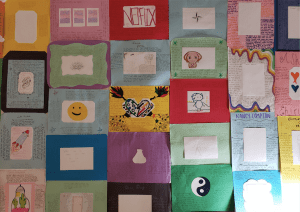
Mrs. Davenport’s class created picture frames that represent how they view the world.

emotional triggers, such as Mary Davenport’s frame activity, in which students decorate construction-paper “frames” and write brief, introspective pieces around the borders about the experiences that shape how they view the world. Davenport often gleans background information about her students that helps her recommend books to them, as social and emotional factors are every bit as important as reading (or dare I say it: Lexile) levels. Finding safe ways to learn about her students’ lives has allowed her to match readers with books they enjoy, and that is our mission: to expand our knowledge base about our students’ lives, without prying or making them feel vulnerable, so we can get the right books into their hands.

I would love to help teachers who are less experienced with conferring with students, and improve my own craft, so please share your strategies for getting to know your students’ emotional needs (as they relate to reading) in the comments.

Screen Shot 2019-09-04 at 9.20.51 PM

Amber Counts teaches AP English Literature & Composition, PSAT Team, English 4, and Academic Decathlon at Lewisville High School. She believes in the power of choice and promotes thinking at every opportunity. She wants her students to know that language is power – one that she hopes they will be able to wield for Good. Someday she will write her story. Follow Amber @mrscounts.

My Antiracist Reading List

Many years ago in my teaching career, I acknowledged a gaping hole in my pedagogical knowledge that’s rooted in an unchangeable part of my teacher identity: being a white woman.

The implications of this were both large and small. I realized that the students in my classroom who were most successful were the white females. I realized that the students I had the most trouble suggesting books for were the students who were not white females. I realized that my family phone call log was full of communication with male students and students of color.

I knew I needed to make a change. And I realized that the one and only variable of my classroom that I could ever control or change was myself.

It was then that I began to look critically at the systems and norms and institutions I had in place or held in place. I examined my curriculum critically and saw a slew of white authors. I found a canon of classics that were long and uninteresting and irrelevant to my students. I found a syllabus, a classroom contract, and a school handbook of rules that privileged a definition of behavior and compliance defined by white people.

So, I did what I considered an extension of my education program: I read theory, reflected, put it into practice, reflected some more; read more theory, reflected, practiced, repeat.

And I got better. My curriculum became more diverse (adios, dead white guys; hello, @diversebooks), my methods became more student-centered (goodbye, long tests; hello, conferring), my critical reflection became more astute (sayonara, mindless grading; hello, assessment for learning). And my students experienced more successes in reading and writing because I was addressing some of the inequities and inadequacies in my teaching.

Here we are, ten years after that realization, and I’m optimistically hoping antiracist teaching has become an educational aspiration that is normative. And, three states and four schools later, I’m still working to grow and improve.

So this summer, thanks to #cleartheair, #educolor, #disrupttexts, and #thebookchat friends on Twitter, my TBR list has been filled with books about antiracist, equity, and inclusive teaching. It’s been hard to find those books alone, and it’s been especially difficult to find voices of color in books specifically tailored to secondary English pedagogies and methods:

After that conversation, I was left with two things: an impressively wide to-read list filled with BIPOC authors discussing equity, and a distressingly narrow slice of books by BIPOC authors who were writing about literacy methods in high school classrooms. Here’s a short list of titles:

  • Not Light, But Fire by Matthew R. Kay
  • Fearless Voices by Alfred Tatum
  • Writing Instruction in the Culturally Relevant Classroom by Maisha T. Winn and Latrise Johnson
  • Total Literacy Techniques by Persida Himmele
  • The Write Thing by Kwame Alexander
  • Linking Literacy and Popular Culture by Ernest Morrell

I wondered why there weren’t more books like this out there, so I did some broader reading, too: Paolo Freire, bell hooks, Gloria Ladson-Billings, James Baldwin. At Cornelius Minor’s suggestion, I read Baldwin’s “A Talk to Teachers.” At my entire Twitter timeline’s suggestion, I read Robin DiAngelo’s White Fragility, and ordered Ibram X. Kendi’s How to Be An Antiracist.

These readings stirred my thinking in hundreds of ways, but it really boiled down to one change I wanted to make: elevating voices that have historically been silenced.

I specifically want to find and read texts by authors whose perspectives have been marginalized, to amplify those voices and others’ whose have been oppressed, and to help students tell stories they’ve not been able to tell before (but that’s another blog post). This cycle, to me, involves considerable struggle, but it is worth it to help change the narrative of who and what matters in classrooms. This is our tireless work, and my goal this year is to keep at it unflaggingly, with boundless energy, because it matters.

I hope you, too, have dug deep this summer into the changes you hope to make in your students, your teaching, and yourself. I wish you strength this school year as you internalize Baldwin’s words in his talk to teachers: “The obligation of anyone who thinks of himself as responsible is to examine society and try to change it and to fight it.”


Please share your thinking in the comments: who might you add to this reading list? What changes are you hoping to make this school year? Please also consider joining our writing team!

Shana Karnes lives, learns, and teaches in Madison, Wisconsin, with her husband and babies. This year she’s working with the Greater Madison Writing Project at the University of Wisconsin. Connect with Shana on Twitter at @litreader.

Hope Thrives in Courage

Today is the third Friday with my senior English students. Yep, I did it. I’m back in the classroom, learning alongside some amazing young people.

I have a billion goals for myself — enough to weigh me down, certainly — but one that keeps floating to the top is this:  Thrive in hope. (Yeah, I don’t really know if that’s a goal, but stay with me here.)

When I left the classroom two years ago, I’d lost a lot of it. Personal struggles. Professional struggles. The state of the world struggles. All of it. But lots of self-reflection, rest, writing, paint, dirt, good friends, family, and growing things –probably most of all growing things — changed me. My hope is back. It’s thriving, just like the plants that add energy and life to my home and my new classroom.

And while I teach literacy skills to seniors in high school, what I really want to teach is hope. Hope in humanity and our ability to thrive — together and as individuals.

So, like you, I’ve started with relationships. Every text we’ve read together, every task WritingBesideDwyaneWadeI’ve asked students to complete, every book I’ve matched to a reader’s interest has given me insight into who these young people are as individuals with backgrounds, cultures, fears, failures, dreams and desires. Just like me, they cling and pounce and clamor after hope.

A few years ago, after a sniper killed five police officers in downtown Dallas, I read this commentary by Chequan Lewis. The last line still resonates: “My sights are simply set on what is possible when we are courageously human.”

Courageously human. That’s what I want for myself and for my students — to practice courage as a means of becoming better than we were when we walked in the door. So moving forward into senior English plans, I’ll invite students to step into the vulnerable spaces that require courage: reading texts that challenge the status quo, writing honestly about ourselves, our learning, controversies, and convictions; and communicating in ways that validate, clarify, empathize, and challenge.

I’ll step there, too, because the more I think about it:  Hope thrives in courage.

Here’s a few of the texts we’ve used thus far to write beside and spark our thinking on this journey. Perhaps you’ll find them useful as you begin your own.

My Honest Poem by Rudy Francisco

Famous by Naomi Shihab Nye; the poem here

“This Bud’s for 3” — Dwyane Wade

If you have ideas for more resources that fit our theme, please share in the comments.


Amy Rasmussen teaches seniors at a large high school in North Texas. She’s a #houseplantcollector, writer, reader, gardener, watercolor-artist wannabe, bicyclist, and grandmother to eight courageous little people, the newest little man born today! Follow her @amyrass and @3TeachersTalk

Becoming a Writer — Guest Post by Austin Darrow

On a late summer night, as the new school year looms on the horizon, my wife and I re-watch Heath Ledger’s comedic masterpiece A Knight’s Tale for the umpteenth time. As Ledger’s character William makes the decision to bravely follow his true calling and stand as a knight, knowing he will be arrested, Roland proclaims the old adage, “Well boys, all good things must come to an end.”

As all teachers oft do, I took this as a metaphor. It’s time for summer to come to an end, to don my armor, pursue my calling, boldly face the new year. In response, my wife said to stop being so melodramatic and watch the movie.

With her reminder, I did put an end to these flairs. Sure, summer–with its days of sleeping in, its weeks to simply and blissfully read for hours, catch up with old friends, its endless possibilities–would have to make way for something more structured. But I also felt a change this time around. The nervousness, the butterflies, the back-to-school nightmares (mostly) gave way to a new feeling: excitement. This would be a great year.

You see, last year, my second year in this profession, was a furnace for me.

industry-647413_1280

The Image by zephylwer0 from Pixabay

Conditions were just right: the heat was cranked up by my peer Charles Moore, who constantly challenged me to grow through conversations, mentor text wars, an anchor chart “hall of fame”, and an endless pursuit of authenticity in our shared love of teaching literacy; a mold was given to me by my mentor, Helen Becker, who showed me concrete strategies to make these things work while always reminding me to read, write, and cut out all the extra “stuff” that could allow impurities to ruin my work; Megan Thompson was the hand that guided the hammer, refining the techniques I tried, inviting me into her classroom and her thoughts, and modeling an unconditional love for students that requires a strong will; lastly, the students were the anvil, always giving me a sturdy base on which I could hone my edges and continue growing and shaping.

Without “further gilding the lily” as Chaucer would say in A Knight’s Tale, I learned and grew so much in this forge through the strong students, mentors, peers, colleagues, and I daresay friends that were willing to walk the walk with me.

Our North star–our central focus–at the heart of this growth was always learning how to make the literacy experiences for our students more authentic.

As I continue to reflect on these experiences, I realize that our greatest growth was in writing instruction. As our students walked in the door for the first time last year, we quickly realized many had gaps in their writing instruction. But perhaps a more alarming assessment was that most students, even those “proficient” by any state standards, had no love or purpose for writing.

And so our work began.

We tried many things–increasing the amount of formative data we would look at in team meetings to help guide our planning; shifting what and how we assessed and graded with rubrics and scales that would be more authentic; changing the pacing and length of our mini-lessons to get out of the way of these young writers; and so much more. Each of our adjustments were tried, refined, and often ditched and replaced, and I believe that each warrants further reflection. But one adjustment stood above the rest: when we as teachers became writers too.

In Kelly Gallagher’s Write Like This, he proclaims: “Of all the strategies I have learned over the years, there is one that stands far above the rest when it comes to improving my students’ writing: the teacher should model by writing–and think out loud while writing–in front of the class” (15).

Nearly all teachers of writing have heard something along these lines at some point in their career. Many have been brave and vulnerable enough to try it.

But this past year, I learned that there is a difference between writing in front of your students and becoming a writer.

A writer is a person who keeps journals and notebooks and endless Word documents, filled with ideas and drafts and revisions in a smorgasbord of conditions. A writer is an artist who pursues and experiments with their craft to get it just right. A writer is a dreamer filled with goals and purpose that can only be met through careful, meticulous, arduous effort.

With this working definition, I quickly realized that I was not a writer. Are you? I also questioned myself:  How could I authentically ask my students to become the writers that I have qualified here if I hadn’t become a writer yet myself? How could I expect them to give what I was not willing to give myself?

So I set out to become a writer. At first, I wrote the same essays and assignments that I tasked my students with. Then I said yes to sponsoring our school’s Poetry Corner and shared my own work at our weekly meetings. I wrote letters to family and friends, and love notes to my (at the time) fiancé. I wrote reviews of products I had purchased and services I had received, application letters to conferences I wished to attend, thank-you cards to wedding guests, and much more.

As I climbed each of these mountains of literacy, I shared my writing experiences with students. I wrote many of these pieces with them, inviting their feedback and giving mine in return. I became a writer and watched as my students became writers, too.

In a recent conversation with the aforementioned colleagues and friends, we created an anchor chart of reasons why everybody–students and teachers alike–benefit when the teacher becomes a writer:

  • Foresight to specific struggles students might have
  • Better understanding of what skills to teach in mini-lessons
  • Concrete conferring questions to ask student writers
  • Empathy for students struggling with the writing process
  • Equity in creating assessment scales and rubrics
  • Modeling vulnerability, struggle, and craft for the students
  • Modeling authenticity and purpose as a writer

I’m certain there is more to unpack here, but with these benefits alone, I am convinced: the most essential “tool” of writing instruction is when the teacher becomes a writer, too.

So as I glimpse into the year ahead, the usual back-to-school nerves have been replaced with sheer excitement. I am excited to step into the classroom, share my writing territories with students, and coach them as they create their own. I am excited to write alongside them, receive their feedback, and watch as they grow. I am excited for our next Poetry Corner meeting, where old students and new are so electrified by their literacy that they have to come and share. I have so much to learn still about writing instruction, and I am excited to step back into the furnace.

Austin Darrow has now begun his third year as a teacher and self-proclaimed literacy advocate. He teaches English I, AP Lit, and coaches the Academic Decathlon at Clear Creek High School. He is trying to grow and refine his voice of advocacy, so follow him on Twitter @darrowatcreek.